AI Readiness Assessment: Is Your Business Ready for AI?
Posted On: May 13, 2026
Written by Rodi Taze, Co-Founder of AI Workforce · Reviewed by Luca Controlo, AI Adoption and Marketing Automation Lead at AI Workforce
Last updated: August 2026
Most businesses that struggle with AI do not have a technology problem. They have a readiness problem. This self-assessment guide helps you understand where your business stands today, what is missing, and what to fix before you spend anything on AI, so when you do invest, it works.
Quick Answer: What is AI readiness? AI readiness is a measure of how prepared a business is to successfully adopt artificial intelligence. It considers the quality of your data, leadership alignment, technology, business processes and governance before any investment is made. Businesses with strong AI readiness are more likely to achieve measurable results and avoid costly implementation mistakes.
What's Covered
The Full Framework and Checklist
Roadmap and Next Steps
What Does AI Readiness Actually Mean?
AI readiness is the degree to which your business has the foundations in place to successfully adopt and benefit from artificial intelligence. It is not about having the latest technology or the biggest budget. It is about having the right data, the right processes, the right people, and the right expectations before you start. A business that scores well on AI readiness will get far more from the same tool than one that rushes in without those foundations.
An AI readiness assessment is a structured review of whether a business has the data, processes, systems, governance, skills and operational maturity needed to adopt AI successfully. It should identify gaps before a company selects a platform, commissions a build or commits significant budget.
The reason a readiness assessment matters is simple: a common pattern shows up across many businesses that have struggled with AI implementation. They bought or built an AI solution before they understood what problem it was solving, whether their data could support it, or whether their team was prepared to use it. The result is wasted investment and a loss of confidence in artificial intelligence that makes the next attempt harder. A self-assessment done honestly helps avoid that pattern.
This guide is designed for small business owners and operational leaders who want to understand where their business stands before committing to an AI journey. It is also useful for larger organisations evaluating specific departments or use cases. AI readiness is not a binary; it exists on a spectrum, and knowing where you sit on that spectrum is one of the most valuable things you can do before you spend a single pound on AI.
Why Do Most AI Projects Fail Before They Start?
A common pattern in struggling AI projects is that the business has not defined the problem clearly, the available data is weaker than expected, the team does not trust the output, or leadership is not prepared to support the workflow change. These are readiness gaps rather than evidence that AI technology itself is always unsuitable.
Successful AI adoption requires more than a good vendor and a signed contract. It requires the organisation to be genuinely prepared to change how it works. Integrating AI into business operations means changing workflows, training people, and accepting that the first version will not be perfect. Businesses that approach AI implementation expecting instant, frictionless results are often disappointed. Businesses that approach it as a structured change process with clear milestones are the ones that make it work.
AI Workforce Insight: In our experience, businesses rarely fail because they chose the wrong AI platform. They struggle because they automate inconsistent processes or poor-quality data. Spending time on readiness before implementation usually produces a better return than rushing into a larger AI project.
Using AI well is a skill that develops over time. The businesses with the best AI outcomes did not get everything right on the first attempt; they built the capacity to learn and iterate. That capacity starts with an honest AI readiness assessment that tells you what you actually have, not what you wish you had. The goal is not to feel good about where you are. It is to have an accurate picture so the roadmap forward is realistic.
Signs Your Business Is Ready
Before working through the full assessment, a quick gut check. You are likely in a reasonable position to start if most of the following are true:
Your CRM and core records are reasonably clean and up to date
Your main business systems can connect to each other, or could with modest setup
Leadership agrees on what problem you would use AI to solve first
At least one process you want to automate is documented and done consistently
Someone is willing to own the initiative and be accountable for it
Staff are broadly open to changing how a task is done, not just tolerating it
If most of these do not apply yet, that is useful information rather than a setback; the fuller assessment below will show you exactly what to prioritise.
The Four Pillars of AI Readiness
Everything in this assessment sits under four pillars: data, leadership, technology, and process. A business does not need to be perfect across all four, but weakness in any one of them tends to limit what AI can realistically deliver, no matter how good the tool is.
A major weakness in any one pillar can limit how much value a business gets from AI. What happens when a pillar is weak:
Data: poor-quality or inconsistent outputs, since the AI reflects whatever it is given
Leadership: the project stalls in the middle, approved in principle but never fully backed
Technology: integration failures and workarounds that quietly break over time
Process: the AI scales the inconsistency that was already there, faster and at greater volume
Pillar One: Is Your Data Ready?
Data readiness is a critical and often underestimated dimension of AI readiness. AI models learn from data. If your data is incomplete, inconsistent, or siloed across systems that cannot talk to each other, the AI system built on top of it will reflect those problems in its output. Garbage in, garbage out applies more directly to artificial intelligence than to almost any other technology.
Start by asking three questions about your data. Is it accessible, can you actually retrieve it when you need it, or is it locked in spreadsheets, legacy systems, or individual email inboxes? Is it consistent? Does the same field mean the same thing across all your systems? Is it sufficient? Do you have enough volume and variety to configure an AI solution meaningfully? If the answer to any of these is no, data work comes before AI development work.
For a small business, data readiness does not require a data warehouse or a team of analysts. It requires clean, structured records in the systems you already use: your CRM, your accounting software, your project management tool. Automation can help consolidate and clean data, but there is no shortcut around the fundamental need for quality inputs. Clean, accessible data is one of the most important foundations that separates an AI solution delivering measurable business value from one that frustrates everyone involved.
Pillar Two: Is Leadership Aligned?
Leadership alignment means that the people with decision-making authority in your business agree on what AI is for, what success looks like, and who is responsible for making it happen. Without this, AI initiatives stall in the middle, approved in principle, but lacking the consistent support needed to get through the hard parts of implementation. This is one of the most common reasons AI use cases never make it from pilot to production.
Alignment does not mean everyone needs to be an AI expert. It means the leadership team has a shared view that connects AI investment to real business outcomes. What business problems are you trying to solve? Which specific business processes would benefit most from automation or AI? Who owns the outcome? Connecting these questions to concrete goals is what keeps AI projects on track when they inevitably encounter friction.
For enterprise organisations, alignment often requires a formal steering group. For a small business, it might just mean a direct conversation between two or three people. The scale differs; the need for clarity does not. Leadership that understands what is being built, why, and what guardrails are in place is what allows good decisions to be made quickly when the unexpected happens.
Pillar Three: Can Your Technology Support AI?
Your technology infrastructure determines what kinds of AI you can practically deploy. A business running on modern cloud-based tools with well-documented APIs is in a very different position from one running on legacy on-premises software with no integration capabilities. Before evaluating any AI tools, audit what you already have: how systems connect, where data lives, and what your team actually uses day to day.
AI integration is only as smooth as the systems it is integrating with. Many AI vendors will tell you their product connects with everything. In practice, the quality of that connection varies enormously; a native integration is different from a workaround. AI workloads, especially those involving generative AI, can also place demands on infrastructure that lighter business tools were not designed to handle. Know your system's limits before you promise stakeholders a timeline.
The good news for smaller businesses is that the gap between enterprise and small business infrastructure has narrowed significantly. Cloud platforms, no-code connectors, and modern SaaS tools mean that a well-chosen stack of accessible software can support AI at a level that was unachievable without significant IT investment just a few years ago. Data infrastructure for AI does not have to be complex; it has to be connected and accessible. That is an achievable standard for most businesses.
Pillar Four: Are Your Processes Defined?
The pillars of AI readiness always include process, and it is the one that gets skipped most often. AI works best when it is automating or augmenting something that is already well-defined. If the process is inconsistent, undocumented, or varies depending on who is doing it, the AI will not fix that inconsistency. It will scale it. Before you adopt AI for a given task, document how that task is done, by whom, and what a good outcome looks like.
Process readiness also includes risk management. What happens when the AI system makes a mistake? Who reviews outputs before they affect the customer experience? What escalation path exists when the system encounters something it cannot handle? These are design requirements, not hypothetical questions. Building them into your approach to implementation from the start prevents bigger problems later, and is covered in more detail in the governance section below.
The Full AI Readiness Assessment Framework
The four pillars above give a solid foundation, but a genuine business AI readiness assessment covers more ground. The table below extends that foundation into ten areas worth reviewing before committing meaningful budget.
Area | What to assess | Ready looks like | Warning sign |
|---|---|---|---|
Use-case clarity | Whether the specific problem AI would solve is defined | One clear, prioritised problem with a measurable outcome | "We want to use AI somewhere" with no specific task named |
Process maturity | Whether the target process is documented and consistent | A written, repeatable workflow followed the same way by everyone | The process varies by who is doing it, or exists only in someone's head |
Data quality and accessibility | Whether the data AI needs is accurate, current and reachable | Clean, structured records in systems you can actually query | Data locked in spreadsheets, inboxes or inconsistent fields |
Systems and integrations | Whether core systems can exchange data with minimal manual work | Cloud-based tools with documented APIs or native connectors | Legacy or on-premise systems with no realistic integration route |
Governance and risk | Whether ownership, approval and escalation are defined | A named owner, an approval step and an escalation path exist | No one is accountable if the system gets something wrong |
Security and privacy | Whether access, data protection and compliance are addressed | Role-based access, a lawful basis for data use, and a DPIA where relevant | Anyone can access anything, with no privacy review carried out |
Team capability and ownership | Whether someone has the time and authority to run the initiative | A named owner with real authority and enough time allocated | The initiative is everyone's job and therefore no one's |
Change management | Whether staff have been prepared for how their work will change | Staff informed, involved and given a route to raise concerns | The system is launched with no communication to the people using it |
Budget and implementation capacity | Whether cost and internal resourcing are realistic | A budget that covers setup, training and ongoing review, not just the tool | Only the licence cost is budgeted, with no time set aside for rollout |
Measurement and ROI readiness | Whether success will actually be measured | Baseline metrics captured before launch, with a defined review point | No baseline exists, so improvement cannot be demonstrated later |
What Makes a Business Not Ready for AI?
The warning signs across the framework above tend to repeat. Consolidated, the clearest indicators that a business is not yet ready include:
No clearly defined use case
Poor or inaccessible data
Broken or undocumented processes
No accountable owner
No realistic integration route
Weak governance or security controls
No human-review process
Unrealistic ROI expectations
Insufficient implementation capacity
Attempting to automate work that should first be removed or simplified
Any single item on this list is a fixable gap, not a reason to abandon AI altogether. Several of them together are a signal to spend a quarter on groundwork before evaluating tools.
AI Readiness for SMEs
SMEs do not require enterprise-scale data infrastructure to be AI-ready. What actually matters at this scale is narrower and more achievable:
One clear business problem
Usable records
A documented workflow
A named owner
A modest but realistic budget
A measurable pilot
A human fallback
Time to review and improve the system
A small business that has these eight things in place for one process is usually in a stronger position to succeed with AI than a larger organisation attempting five use cases at once without them. Depth on a narrow use case beats breadth across an undefined one, at any company size.
How Should Enterprises Evaluate AI Maturity?
Larger organisations carry additional readiness requirements beyond the SME list above, mainly because more people, systems and regulatory exposure are involved. An enterprise AI maturity review should additionally cover:
Data ownership and lineage
Role-based permissions
Integration complexity
Information security
Model and vendor risk
Procurement and contractual review
Auditability
Cross-functional ownership
Legal and compliance involvement
Change management across departments
Business continuity and exit planning
None of this needs to slow an enterprise pilot to a crawl, but skipping it tends to surface as a blocker later, typically during procurement, a security review or a data protection impact assessment, rather than at the point it could have been addressed cheaply.
Governance Before Deployment
Governance rarely gets called by name in most AI advice for small businesses, but it sits behind almost every readiness question above. Before any AI system goes live, even a simple one, it is worth having clear answers to the following:
Named owner: someone accountable for how the system performs day-to-day
Approval process: a defined step before a new use case goes live
Access permissions: what data and systems the AI can actually reach
Review schedule: a regular check on performance, errors and edge cases
Audit logs: a record of what the system did, particularly for anything customer-facing
Escalation path: a clear route for handing off to a human when needed
Data retention: how long inputs and outputs are kept, and why
None of this needs to be elaborate for a small business. A shared document covering these seven points for each live AI use case is usually enough to start, and it is far easier to put in place before launch than to retrofit afterwards. For a more detailed UK framework, see the NCSC's Guidelines for Secure AI System Development.
What Should an AI Readiness Assessment Measure?
A readiness assessment is not only a checklist exercise. For each proposed use case, it should also record a commercial and operational baseline, so that a later decision to expand is based on evidence rather than impression. Capture, for each use case under consideration:
Current manual time and cost
Monthly transaction or task volume
Current error rate
Exception rate
Data availability
Integration requirements
Human-review requirements
Compliance risk
Expected business outcome
How success will be measured
What result would justify expansion
Recording these before a pilot starts is what makes the review at the end of the pilot meaningful, rather than a subjective impression of whether things felt like they went well.
Once the baseline is documented, the next step is deciding exactly which measures will determine whether the pilot is succeeding. Our guide to AI agent KPIs explains how to combine outcome, quality, cost, reliability and risk metrics into a practical measurement framework, with formulas, guardrails and stop thresholds.
The AI Readiness Checklist and Score
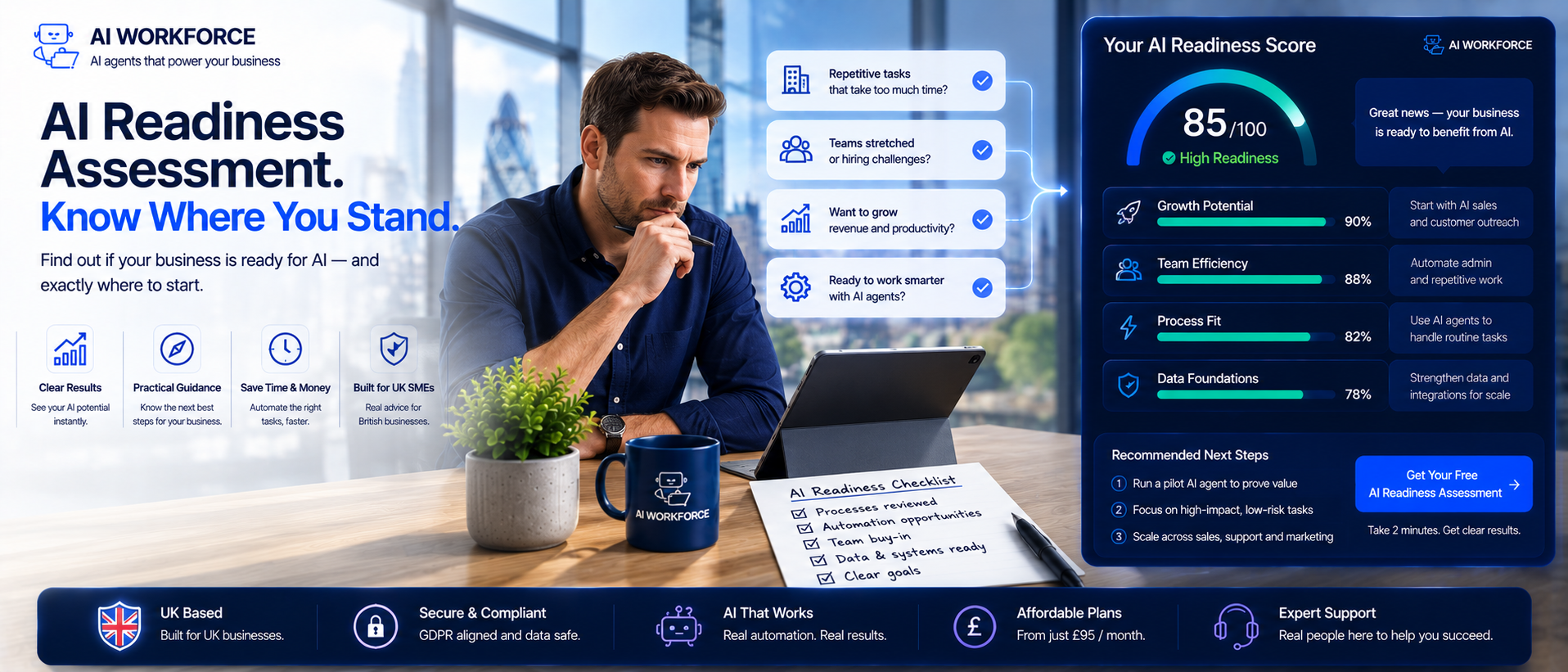
The checklist below is the practical output of the framework above. Work through it honestly, giving yourself one point for each statement that is true of your business today. The goal is not a perfect score; it is an accurate picture of where the gaps are so you can address them in the right order.
AI Readiness Checklist:
We have clean, structured data in the systems the AI will use
Leadership has agreed on what problem AI is solving and what success looks like
We have a named owner for the AI initiative with the authority to make decisions
Our core business systems are cloud-based and have integration capabilities
The process we want to automate is documented and consistent
We have a plan for what happens when the AI makes a mistake
Staff who will use the AI output have been informed and involved
We have a realistic timeline that accounts for iteration, not just launch
We know how we will measure whether the AI is delivering value
We have considered data privacy and communicated our approach internally
What your score means:
0 to 3: Not ready. Focus on data quality and process documentation before evaluating any AI tools.
4 to 6: Foundation stage. The basics are forming. Close the biggest gaps before committing budget.
7 to 8: Potentially ready for a pilot. You are in a reasonable position to trial one well-defined AI use case.
9 to 10: Strong foundations for a pilot. Consider wider deployment only after one use case has produced reliable, measured results.
Illustrative bands. Treat these as a starting filter, not a precise diagnostic. This is an AI Workforce self-assessment framework, not an industry standard, certification or substitute for technical, legal and security due diligence. A high total score should not override a critical weakness in data protection, security or process ownership.
A low score is not a failure; it tells you exactly what to work on before you invest in AI rather than discovering the gaps after you have already committed budget.
How to Measure Readiness
Most advice on AI focuses on measuring results after a system is live. It is just as useful to measure your starting point, so you know whether you are actually closing the gaps you identified. Track these alongside the checklist above:
Data completeness: how much of the data the AI would need is actually present and current
Integration coverage: what proportion of your core systems can exchange data without manual work
Process consistency: whether the task is done the same way regardless of who does it
Leadership agreement: whether decision-makers agree on the priority use case, in writing if possible
Staff confidence: whether the people closest to the task feel prepared for the change, not just informed of it
Documentation quality: whether someone new to the process could follow it from what is written down
Revisit these every few months. Readiness is not a one-off score; it moves as you fix the underlying gaps.
The AI Readiness Maturity Model
It helps to see readiness as a path rather than a single checkpoint. Most businesses move through recognisable stages as they build capability:
Illustrative model. Businesses can move through these stages at very different speeds.
A business at "Not Ready" is focused on fixing data and process gaps. "Foundation" means the basics are in place but nothing has been trialled yet. "Pilot" is one well-defined use case running with close oversight. "Operational" means that use case is proven and a second is underway. "AI-Driven Business" is a stage most SMEs will not reach for some time, and do not need to; steady progress through the earlier stages is a perfectly reasonable place to stay for a while.
Common Readiness Mistakes
Common mistakes to avoid: buying software before defining the problem it needs to solve, assuming AI will fix poor-quality data rather than expose it, launching without a named project owner, trying to automate every department at once instead of one process, measuring activity instead of business outcomes, and underestimating the staff training needed to actually get adoption. Most of these are avoidable with an honest readiness assessment before any budget is committed.
What If Your Business Is Not Ready?
If your self-assessment reveals that your business is not ready for a full AI implementation, that is a genuinely useful result. It means you have avoided an expensive mistake and have a clear picture of what to fix. The next steps are practical and achievable: clean your data, document your key processes, align your leadership team on goals, and audit your technology stack for integration gaps.
There are also lower-risk ways to build AI experience without a major commitment. AI chatbots for customer queries, similar to the approach covered in our guide to AI call centre agents, generative AI tools for content drafting, and AI-assisted features in the software you already pay for are all ways to develop familiarity and confidence without a high-stakes project. Good experience at a small scale builds the muscle memory that makes bigger AI projects more likely to succeed.
Specialist input can also help identify the gaps a self-assessment might miss, particularly around data quality and infrastructure. A short conversation with someone outside the business often surfaces issues that are not obvious from the inside. The goal is always the same: the business is genuinely prepared before meaningful money is spent. Getting there might take a few months of groundwork. That groundwork is not wasted time; it is the investment that makes everything after it work.
Worth Remembering: Being not ready is not a permanent state. Every gap identified in a readiness assessment is a fixable problem with a clear action attached to it.
When You Should Wait
Sometimes the right decision is to delay an AI project rather than force it through. It is usually worth waiting if:
A CRM migration or major systems change is already underway
Leadership has not actually agreed on the priority problem, even if everyone says they support "doing something with AI"
The process you want to automate does not have a defined, repeatable workflow yet
The business is going through a restructure or significant headcount change
A data quality or cleanup project is in progress but not finished
Starting an AI project on top of any of these usually means solving two hard problems at once instead of one. Waiting a quarter to let the groundwork settle is often the faster route to a working system, not a slower one.
How to Build Your AI Roadmap
An AI roadmap is a sequenced plan that connects your current state to where you want to be, with realistic milestones, clear ownership, and defined success criteria at each stage. It is not a wish list. It treats AI investment like any other capital allocation: with expected return, time horizon, and risk considered in advance.
Illustrative roadmap. Timelines vary by starting point and the size of the gaps identified.
Assess → prioritise one use case → fix critical data and process gaps → define governance → run a controlled pilot → measure outcomes → scale only after proving value.
Start your roadmap with the highest-value, lowest-complexity use case you identified in your self-assessment. If that use case is broad enough to be managed as an ongoing business role rather than a single isolated task, it may eventually be configured as what vendors call an AI employee. Our guide to what an AI employee is explains that role-based model, including how it differs from an AI agent, digital worker and traditional automation.
This is your proof of concept. It should solve a real business problem, be measurable clearly, and not require solving all your data or infrastructure gaps first. Automating a specific, well-defined task- invoice processing, meeting summaries, lead qualification- is a better starting point than a broad platform implementation. If you are still shaping what that first use case should look like, our guide to writing an AI agent brief is a useful next step.
Illustrative planning ranges only: actual timelines vary significantly by systems, data quality, governance requirements and organisation size.
Data cleanup: 2 to 6 weeks, depending on how many systems are involved
Leadership alignment: 1 to 2 weeks for a small business, longer for larger organisations
Pilot: 4 to 8 weeks, from setup through to a first honest read on results
Review: 30 to 60 days of real use before deciding whether to expand
Expansion: ongoing, one use case at a time rather than all at once
These are illustrative ranges, not guarantees; actual timelines depend on how large the gaps were at the start.
From there, build in review points. After 60 days, what has the AI actually delivered? Where has it surprised you, positively or negatively? What does the team think? Development is iterative by nature. A roadmap that builds in learning loops produces better outcomes than one that assumes everything will work as planned. Expect complexity, and plan for it rather than around it. If a pilot underperforms, it is worth understanding why before abandoning the approach; our guide to why AI agents fail covers the most common causes.
Next Steps After the Assessment
Once you have completed your AI readiness assessment, you are in one of three positions. If you scored well across the framework and have no critical security, governance or process gaps, you may be ready to begin one focused pilot with clear goals, human oversight and a named owner. If you have gaps in one or two areas, address those first while exploring the lower-risk applications covered above. If the gaps are significant, treat the next quarter as a foundation-building phase before you assess AI solutions properly.
In every case, the actionable output of this process is the same: a clear picture of where you are, a prioritised list of what to fix, and a realistic sense of when you will be ready to move. A business is ready for AI when the data, the leadership, the technology, and the processes are all pointing in the same direction. That alignment is what allows AI to improve efficiency, reduce costs, and genuinely change how the business runs, rather than just adding another tool to the stack.
Deciding whether to build your first AI workflow in-house or bring in a partner? Our guide to build vs buy for AI agents covers that decision, and our guide to AI automation pricing covers what a realistic budget looks like.
Investing in AI without readiness is expensive. Investing in readiness before AI is one of the highest-value things a business can do. Businesses that achieve the strongest results from AI are rarely the ones that move first. They are the ones that prepare properly, measure carefully, and expand only after proving value. Readiness is not a delay to implementation; it is what makes successful implementation possible.
Ready to Find Out Where You Stand?
If you would like a second opinion on your readiness score, or help prioritising which gap to close first, we are happy to talk it through.
Frequently Asked Questions
What is AI readiness?
AI readiness is how prepared a business is to adopt AI successfully, based on the quality of its data, leadership alignment, technology and processes. It is a spectrum, not a pass or fail state.
What is an AI readiness assessment?
An AI readiness assessment is a structured review of whether a business has the data, processes, systems, governance, skills and operational maturity needed to adopt AI successfully. It identifies gaps before a company selects a platform, commissions a build or commits significant budget.
What should an AI readiness checklist include?
A useful checklist covers data quality, a documented process, leadership alignment, a named owner, integration capability, a plan for errors, staff involvement, a realistic timeline, a way to measure value, and a data privacy approach, at minimum.
How do you assess business AI readiness?
Work through the ten-part framework in this guide, covering use-case clarity, process maturity, data, systems, governance, security, team capability, change management, budget and measurement, then score the checklist honestly against your own operation.
How do I know if my business is ready for AI?
Work through the checklist in this guide and score yourself honestly. A score of 7 or higher generally points to possible pilot readiness, though a critical weakness in data protection, security or process ownership should still be resolved first. Lower scores point to specific gaps to close.
How should SMEs prepare for AI?
SMEs do not need enterprise-scale data infrastructure. They need one clear business problem, usable records, a documented workflow, a named owner, a modest but realistic budget, a measurable pilot, a human fallback, and time to review and improve the system.
How should enterprises evaluate AI maturity?
Enterprises should additionally assess data ownership and lineage, role-based permissions, integration complexity, information security, model and vendor risk, procurement review, auditability, cross-functional ownership, legal and compliance involvement, and business continuity planning.
What data do you need before adopting AI?
Most businesses only need clean, structured records in the systems they already use, a CRM, accounting software, or a project management tool, rather than a dedicated data warehouse, provided the data is accessible, consistent and sufficient for the use case.
What is the biggest reason AI projects fail?
Readiness gaps, not technology failures, are a common cause. Frequent issues include poor-quality or inaccessible data, undocumented processes, and a lack of leadership alignment on what problem AI is meant to solve.
What are the biggest signs a business is not ready?
No clearly defined use case, poor or inaccessible data, undocumented processes, no accountable owner, no realistic integration route, weak governance or security controls, no human-review process, and unrealistic expectations of return are the clearest warning signs.
Do I need a data warehouse to be AI-ready?
No. Most small businesses only need clean, structured records in the systems they already use, a CRM, accounting software, or a project management tool, rather than dedicated data infrastructure.
How long does it take to become AI-ready?
It varies widely, but a few months of focused groundwork, cleaning data, documenting one process, and aligning leadership is enough for most small businesses to move from not ready to ready for a pilot.
How do you build an AI readiness roadmap?
Start with the highest-value, lowest-complexity use case from your self-assessment, sequence data cleanup, leadership alignment, a pilot and a review period, and expand one use case at a time rather than launching everything together.
Should processes be fixed before introducing AI?
Yes, wherever possible. AI automates or augments whatever process it is given, so an inconsistent or undocumented process gets scaled at greater speed and volume rather than corrected.
What should I do first if my score is low?
Focus on the single biggest gap rather than trying to fix everything at once. For most businesses, that is data quality or process documentation, since those two underpin almost everything else.
Can I start with AI even if I am not fully ready?
Yes, with care. Lower-risk applications like AI chatbots or AI-assisted features in tools you already use are a reasonable way to build experience while you close the bigger gaps in parallel.
How often should I reassess AI readiness?
Every few months, or whenever something material changes: a new system, a leadership change, or a completed data cleanup. Readiness moves as the underlying gaps close.
Where can a business get an AI readiness assessment?
Many businesses start with a self-assessment like this guide, then bring in specialist input to validate the result, particularly around data quality, security and infrastructure, before committing significant budget.
Key Takeaways
AI readiness is about foundations, data, leadership, technology and process, not just having the budget to buy a tool
An AI readiness assessment covers ten areas: use case, process, data, systems, governance, security, team capability, change management, budget and measurement
Readiness gaps, not technology failures, are a common cause of struggling AI projects. Assess first, invest second
Data quality is one of the most important foundations. Clean, accessible, structured data is non-negotiable
Leadership alignment means agreeing on the problem, the owner, and what success looks like before implementation begins
Basic governance, an owner, an approval step, and an escalation path should exist before any AI system goes live
SMEs need a narrower set of foundations than enterprises; both are covered separately in this guide
Score the checklist honestly. Your band tells you whether to fix foundations, pilot, or scale, but a critical governance or security gap outweighs the score
Measure your readiness itself, not just AI results after deployment
Not being ready is not a failure; it is a clear list of fixable problems with a logical order of priority
Sometimes the right call is to wait a quarter rather than force a project through unfinished groundwork
Start your roadmap with the highest-value, lowest-complexity use case. Prove value at a small scale first
Related Guides
Readiness by Sector
The four pillars in this guide apply across sectors, but what "ready" looks like in practice varies. A few sector-specific examples:
Best AI Tools for Mortgage Brokers in the UK
How AI Is Transforming the Logistics Industry
AI for Healthcare Is Set to Transform the NHS
Rodi Taze is Co-Founder of AI Workforce, working directly with UK businesses on AI implementation, readiness assessments and measurement.
Reviewed by Luca Controlo, AI Adoption and Marketing Automation Lead at AI Workforce. The checklist, four pillars and maturity model referenced in this guide are AI Workforce frameworks. Reviewed August 2026.