AI Receptionist: How It Works, What It Can Do and When Humans Take Over
Posted On: May 18, 2026
Last updated: September 2026 · Written by Rodi Taze, Co-Founder of AI Workforce
Some missed calls represent lost enquiries, delayed service or a frustrated customer. An AI receptionist can provide useful additional call coverage, particularly outside office hours and during busy periods, but its value depends on your call volume, caller intent and the workflows it can genuinely complete. This guide explains how the technology actually works, what it can realistically handle, what it costs, and what to check before it answers a real call.
Quick Answer: An AI receptionist is a software system that answers business calls, holds a spoken conversation with the caller, and can complete approved actions such as answering FAQs, routing calls and booking appointments through connected systems. It can complete some routine requests without a person actively participating in the call, but it depends on good setup, tested integrations, clear escalation rules and ongoing monitoring. It is not guaranteed to resolve every call, and it still needs defined permissions and a fallback for anything outside its approved scope.
At a Glance
What it is: software that answers business calls, understands spoken requests and completes approved actions
Cost drivers: call volume, telephony, integrations, support, concurrency and human escalation
Practical use cases: repetitive, bounded inbound enquiries such as FAQs, routing and appointment booking
AI Workforce deployment observation: a narrow number/basic configuration has taken roughly 48 hours in our own work, while refinement and testing have often taken around two weeks of elapsed iteration. These are internal observations, not market-wide implementation benchmarks
Potential benefit: additional call coverage outside office hours and during demand peaks
Key risk: a poorly configured system acting without a tested fallback or escalation path
What Is an AI Receptionist?
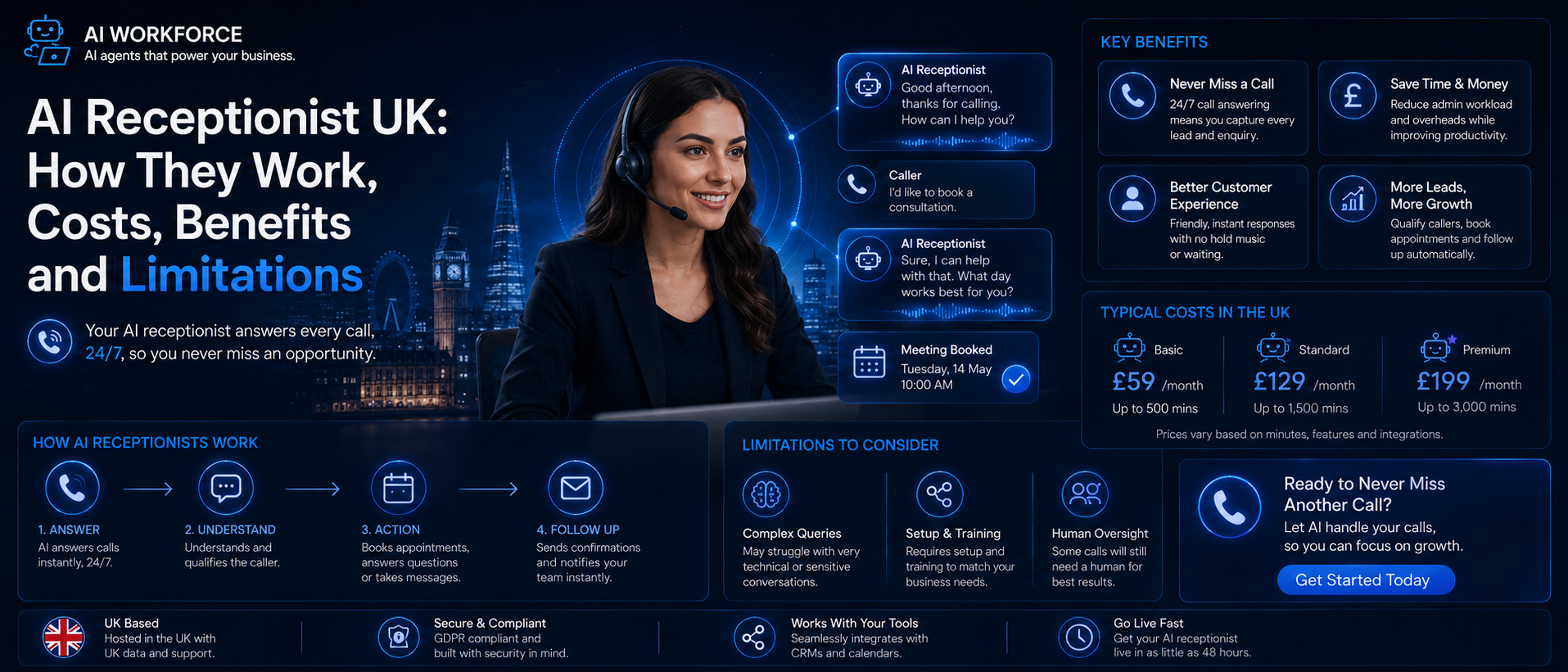
An AI receptionist is an AI-powered phone system that answers business calls, understands spoken requests, provides information, routes enquiries and books appointments through connected business systems. It is not a voicemail system, and it is not a basic phone tree. A modern AI receptionist can understand what the caller is saying, ask relevant follow-up questions, and take approved actions, such as booking an appointment, answering an FAQ, or transferring the call to the right person.
Unlike a fixed IVR or phone menu, an AI receptionist can interpret natural-language requests and select among permitted responses and actions. Conversation quality still varies by provider, configuration, latency, line quality and the caller's speech, so it should be tested against real call scenarios rather than assumed from a demo.
For a small business or a team without a dedicated front desk, an AI receptionist can fill a real gap. A call that goes unanswered is a potential enquiry lost to whoever else the caller tries next. An AI receptionist can provide an additional route for answering calls when staff are unavailable, with unsupported cases following a defined fallback such as transfer, callback or structured message capture.
How Do the Terms Compare? AI Receptionist, Answering Service, IVR and More
Providers use overlapping labels inconsistently, and this makes it harder to know exactly what a specific product does. It is worth comparing capability against the descriptions below rather than relying on the category label a vendor has chosen.
Term | What it normally means |
|---|---|
AI receptionist | AI software handling receptionist-style calls: answering, routing and completing approved actions such as bookings |
Virtual receptionist | Ambiguous term that may mean a remote person, an AI system, or a hybrid of both |
AI answering service | AI handling call answering and message-taking, which may or may not include the fuller booking and routing workflow an AI receptionist offers |
Human answering service | A person or team answering calls on a business's behalf; capability can range from message-taking to booking, dispatch and system access depending on the provider |
Automated receptionist | A broad term covering any automated front-desk or call-handling function, from a basic IVR to a full AI receptionist |
IVR | A fixed menu and routing system, typically keypad or basic voice commands, with no genuine conversational ability |
Voicemail | Records a message without conducting any workflow, understanding intent or taking any action |
Because these terms are used loosely, compare what a specific platform actually does, not the label on its pricing page.
How Does an AI Receptionist Work?
When a call reaches an AI receptionist, whether on your existing number or a dedicated business line, it passes through several stages: telephony, speech recognition, a language model that interprets the caller's intent and decides how to respond, and speech synthesis that speaks the response back. The response delay a caller experiences depends on the provider, the underlying architecture, any integrations the system calls mid-conversation, and network conditions, so latency should be measured end to end on real calls rather than assumed from a single marketing claim.
AI Workforce Insight: in our own voice-agent testing on a single deployment built around a customer-service booking workflow, reducing end-to-end response latency from roughly 2,360ms to around 1,160ms, measured across repeated test calls, made calls feel substantially less delayed to callers. This is a result from one implementation and test set, not a broad study across multiple deployments, so treat it as an illustration of what latency work can achieve rather than a universal benchmark. It also taught us that latency is not one number produced by one model; telephony, transcription, reasoning, any tool calls and speech generation each add their own share of the pause, and each has to be measured and improved separately.
The AI receptionist draws on a knowledge base you configure, covering your business hours, services, pricing, team members, FAQs, booking rules and escalation preferences. When a caller asks something the knowledge base covers, the system uses that source to formulate an answer; the underlying information should be kept current and tested regularly, since a knowledge base that is outdated, incomplete or conflicting will produce an inaccurate answer regardless of how well the AI reasons. When a caller asks something outside the approved knowledge, the system should be set up to say so and transfer or take a message rather than guess, though this behaviour still needs to be tested rather than assumed.
Depending on the platform and how you configure it, calls may be recorded, transcribed, summarised and logged to a dashboard. These are genuinely useful features, but they are not automatic defaults that come with no obligations attached; see the Recording, Disclosure and Caller Data section below before switching them on.
The AI Workforce Receptionist Workflow
The technical explanation above describes the underlying mechanics. At a business level, a well-configured AI receptionist follows a simpler, seven-stage workflow on every call. The AI Workforce Receptionist Workflow is an AI Workforce implementation framework rather than an industry standard.
Answer → Understand → Retrieve → Act → Confirm → Escalate → Record
Answer: the call is picked up promptly, on your existing number or a dedicated line
Understand: the system identifies what the caller wants from what they actually say
Retrieve: it pulls the relevant answer, availability or account detail from an approved source
Act: it completes a permitted action, such as booking a slot or logging a message
Confirm: it reads back the outcome to the caller, only once the connected system has actually returned a successful result
Escalate: at any point in the sequence, a call that falls outside approved scope is handed to a person rather than guessed at
Record: the call outcome and any action taken are logged under a defined retention policy
The deeper speech architecture, latency measurement and cascaded-versus-speech-to-speech technical detail behind this workflow are covered in our AI voice agents guide; this section focuses on what the workflow means for how your business actually uses it.
What Can an AI Receptionist Realistically Handle?
Routine FAQs such as opening hours, directions, service descriptions, pricing ranges and cancellation policies are practical candidates for bounded automation where the approved answers are maintained in a reliable knowledge base.
It can also route calls based on the caller's stated reason for calling rather than a static keypad menu, transfer callers to the right person, capture structured details for a callback, and complete a booking through a connected calendar or booking system once the integration has been checked. Where a transfer integration supports it, a summary or transcript can be passed to the receiving person, which can reduce the need for the caller to repeat themselves, though this depends on the integration actually working rather than being assumed. Our guide to AI call handling covers this broader pattern in more depth, and sectors with high call volumes, such as recruitment, have their own specific considerations, covered in our guide to AI receptionists for recruitment agencies.
What Does an AI Receptionist Still Struggle With?
A trustworthy guide is honest about the limits, not just the capability. Current AI receptionists can still struggle with:
Heavy background noise or poor line quality
Overlapping speech and interruptions
Unusual names, addresses and specialist terminology
Strong or unfamiliar accents, particularly where line quality or specialist terminology adds further ambiguity
Distressed or vulnerable callers
Long, unstructured complaints that do not follow a predictable shape
Ambiguous requests that fall outside the approved scope
Failed calendar, CRM or payment actions where the system cannot complete what it just told the caller it would
Fraud or identity-verification scenarios
Emergency or safety-critical calls, which need a predefined safe response, such as immediate human escalation or clear instructions to contact the appropriate emergency service
None of this makes an AI receptionist unsuitable for the use cases described above. These limitations are why fallback and escalation should be evaluated alongside conversation quality.
AI Workforce operational observation: in our voice-agent development work, substantial implementation effort has gone into conversation flows, edge cases and escalation rules rather than speech generation alone. This is an internal implementation observation rather than evidence about the market as a whole.
What Should an AI Receptionist Never Do?
An AI receptionist should not pretend to be human, provide regulated professional advice, make consequential decisions, invent prices or availability, disclose sensitive information without verification, issue unusual refunds, resolve every complaint autonomously, or act outside its configured authority.
Setting this boundary explicitly, rather than leaving it to be inferred from the rest of the configuration, is what keeps the automated part of the call trustworthy, because it means every call the system resolves on its own was one it was actually equipped to handle.
Human Handover: When Should a Person Take Over?
A governed AI receptionist workflow should define when a person takes over rather than leaving that decision entirely to the system in the moment. Handover should be triggered by a specific, written list of situations rather than left to the system's judgement in the moment. A call should transfer to a person when:
the caller requests a person
the same misunderstanding repeats
the system's confidence in what it heard is low
the caller sounds distressed or raises a complaint
the request is sensitive or unusual
a payment dispute is involved
the call represents a high-value opportunity
a connected system or integration fails
the request falls outside the receptionist's configured policy
anything resembling a safety or emergency concern arises
Where technically possible, the caller's details and conversation context should transfer with them, so they are not asked to repeat everything from the start.
AI Receptionist vs Human Receptionist
An AI receptionist can cover bounded phone workflows such as FAQs, message capture and straightforward booking. A human receptionist can additionally perform physical front-desk work and respond to situations requiring contextual judgement, such as welcoming visitors, handling a complex complaint, supporting a vulnerable caller, or coordinating with a wider team. Compare the actual duties and coverage requirements rather than treating the two as direct substitutes.
The cost comparison is often presented too simply. Receptionist salaries vary substantially by region, sector, experience and responsibilities. The employment cost also extends beyond gross salary to employer National Insurance, pension contributions, recruitment, training and paid leave. An AI call-handling service may cost materially less, but it is not functionally equivalent to a person performing the full receptionist role. A person can also manage physical premises, exercise judgement, handle complex complaints and support vulnerable callers in ways software cannot. Compare the cost of the specific call coverage you actually need rather than treating an AI receptionist as a like-for-like replacement for every receptionist duty. Our dedicated AI receptionist pricing guide includes a fuller cost comparison built from named UK salary and employer-cost assumptions.
At a glance, the two options tend to differ in these ways:
Availability: AI can remain available outside staffed hours subject to provider and system availability; human coverage requires staffing
Cost: a monthly software cost against a salary plus employer costs
Judgement and complex situations: sensitive and ambiguous calls should route to a person
Appointment booking: either can book where the process and system permit it
Emotional or sensitive conversations: route to a person
Scaling call volume: AI can handle multiple calls subject to telephony and concurrency limits
Physical, front-of-house tasks: only a person can do these
AI Receptionist vs Human Answering Service
A separate comparison is between an AI receptionist and a traditional human answering service, where a person, often shared across several clients, answers calls. The right choice depends on call volume, budget, and how much judgement a typical call requires.
Human empathy and flexibility: a person can read tone and context in ways an AI system cannot, particularly for a distressed or unusual caller
Script consistency: a well-configured AI receptionist can draw consistently from the same approved information, although its wording and interpretation still need monitoring, while a human service depends on the individual operator
Extended availability: AI can remain available outside staffed hours; round-the-clock human coverage requires staffing arrangements
Concurrency: software can generally handle more simultaneous calls than a small human team, subject to provider capacity
Calendar and CRM integrations: an AI receptionist can complete a booking or update a record directly within the call; a human answering service may take and relay messages, although some providers also offer booking, dispatch or system access depending on the service plan and integration
Message-taking vs task completion: many human answering services began with message-taking, although current capabilities vary by provider and can include booking, qualification and escalation; a well-configured AI receptionist can also complete the task itself, such as a booking, in the same call
Complex and sensitive calls: route to a person, whether a human answering service operator or your own staff member
Cost structure: a human answering service is usually priced per call or per minute of live handling; an AI receptionist mixes a platform fee with usage-based costs
Escalation and hybrid arrangements: a hybrid arrangement can use AI for bounded routine calls while routing defined exceptions to a human service or in-house team
When evaluating a provider, whether AI or human, check call quality with your actual callers, human-transfer reliability, calendar and CRM compatibility, data storage and retention, reporting, concurrency limits, support arrangements and whether you can test realistic failure cases before launch. For individual provider comparisons, see our Best AI Receptionist UK guide.
How Does Call Routing Work?
Call routing in an AI receptionist is driven by the caller's stated intent rather than a menu they have to navigate. The system listens to the reason for the call, matches it against routing rules you configure, and attempts to transfer accordingly; if confidence is low or the intended destination is unavailable, it should fall back to a tested alternative, such as another team member or a message, rather than leaving the caller stranded.
Routing and transfer are related but distinct steps, worth defining separately: routing determines where the call should go, while transfer connects the caller to that destination. A routing decision can be correct while the transfer itself still fails, for example, if the destination number is unreachable, which is why both steps need to be tested independently rather than assuming a correct routing decision guarantees a successful transfer.
The routing logic can be as simple or as sophisticated as your business needs, from a handful of destinations for a small business to more complex rules based on time of day, enquiry type or caller history for a larger operation. Where the receiving system supports it, passing a summary or transcript to the person taking the transfer can reduce repetition for the caller, provided the integration works correctly and the receiving system actually surfaces what was sent.
New Callers vs Existing Customers
Treating every caller identically misses an important distinction. A new caller and an existing customer typically need different handling:
New caller: identify the service or reason for calling, answer approved questions, capture contact details, create a lead record, and book or route as appropriate
Existing customer: verify identity where the request requires it, identify what they need, provide approved administrative information, and arrange a callback or route to the right person
Sensitive account details, such as anything that would let someone act on an existing customer's account, should require suitable verification before the system discloses or changes anything, rather than being provided on request alone.
Appointments and Bookings
Appointment booking is a practical use case where a compatible calendar or booking system is connected and the workflow has been tested. The system can offer available slots, capture the details it needs, and confirm a booking. It should never confirm a booking unless the connected system has actually returned a successful result; a spoken confirmation that is not backed by a real booking is a failure mode worth testing for specifically, not assuming away.
If qualification, calendar routing, round-robin assignment and booking logic are the main workflow you want to automate, our guide to AI appointment setter tools covers that category in more depth.
More complex bookings, for example those involving a deposit, an eligibility question, or a service that needs to be matched to a specific practitioner, may still need human review rather than being completed automatically end to end. For businesses where missed bookings are directly tied to lost revenue, clinics, salons, consultancies, trades and similar services, a well-tested booking flow is a practical priority, provided it has been checked against the edge cases that come up in real bookings, not just the straightforward ones. Our guide to automating appointment booking with AI covers this specific capability in more depth.
Calls, Transcripts and Analytics
Depending on the platform and your configuration, calls can be recorded, transcribed and summarised, giving you visibility into call volume, common questions and outcomes through a dashboard. This can provide operational data on call volume, common questions and outcomes, provided recording, transcription, retention and data quality are properly governed; not every call needs to be fully transcribed or retained indefinitely by default.
Where this visibility is in place, call summaries delivered after each call mean your team can follow up with context even if they were unavailable when the call came in, and analytics can show which times of day generate the most calls, which questions come up most often, and how many calls result in a booking rather than a message. That said, the quality of this insight is only as good as how well the system actually records and structures the data; treat it as a genuine capability to configure and check, not a feature that arrives fully formed by default.
Recording, Disclosure and Caller Data
Any AI receptionist that records, transcribes or logs calls involving personal data needs to address data protection from the outset, not as an afterthought once the system is live.
For UK operations, the relevant framework is UK GDPR and the Data Protection Act 2018. Recording and transcribing calls needs a defined purpose, a lawful basis, clear privacy information given to callers, a defined retention period, appropriate security, and a process for handling data-subject access or deletion requests. Vendor terms vary on whether the provider acts as your processor or has its own rights to use call data, so check the actual contract rather than assuming a standard arrangement applies. Where a vendor processes or stores data outside the UK, check that an appropriate transfer safeguard is in place. Our AI and GDPR compliance guide covers this underlying framework, including lawful basis, vendor due diligence and international transfers, in more depth.
Special category data can come up in calls in ways that are easy to miss, for example, a caller mentioning a health condition, a disability, or a vulnerability while explaining why they are calling. Your organisation should assess whether the call processing involves special category data and, where it does, identify both an Article 6 lawful basis and an applicable Article 9 condition, as set out in ICO guidance on special category data.
Under Article 50 of the EU AI Act, which took effect from 2 August 2026, transparency obligations apply to certain AI systems that interact directly with people. Businesses deploying an AI receptionist should review whether these requirements apply to their specific use case and ensure callers are appropriately informed. AI Workforce recommends proactive disclosure near the start of the call rather than relying on the caller to ask, for example: "Hello, I'm Emma, AI Workforce's automated voice assistant" (an illustrative example of the wording, not a mandatory script).
If your AI receptionist is also used for outbound calls, such as appointment reminders or follow-ups, that activity is regulated separately under PECR, with materially different rules for live calls compared with automated calls; treat this as a distinct compliance question rather than assuming your inbound setup already covers it.
Compliance note: this is general information, not legal advice. Take specific advice on your own recording, disclosure and retention practices, and check current ICO guidance, which continues to develop in this area.
When Does an AI Receptionist Make Sense for a Small Business?
An AI receptionist is worth evaluating where routine inbound calls create measurable missed-call or administrative workload, particularly when staff cannot answer consistently during busy or out-of-hours periods. Suitability depends on whether the common call types can be bounded, whether escalation can be defined and whether the required systems can be connected reliably, without requiring you to replace your existing phone system outright.
Call capacity can increase with software, but concurrency is not unlimited; it depends on provider capacity, telephony channels, usage costs and your own ability to manage the escalations and transfers that result. Plan for those limits rather than assuming the system scales without any constraint. Our guide to the best AI receptionist platforms in the UK compares specific options in more depth, and our guide to AI call centre agents covers the broader contact centre picture for higher call volumes.
Suitability increases where you receive a meaningful volume of inbound calls each week, a large share of them are repetitive (FAQs, routine bookings, simple routing), and you can define a clear rule for when a call needs a person instead. Closer human oversight is needed where calls commonly involve emergencies, complex complaints, highly emotional conversations, or heavy regulatory requirements that need case-by-case review.
This pattern shows up across several sectors, with the specific routine tasks and human boundaries varying by business type:
Business | Routine AI task | Human boundary |
|---|---|---|
Dental practice | Booking and opening-hours enquiries | Clinical or urgent questions |
Law firm | Administrative intake and routing | Legal advice and conflict-sensitive matters |
Recruitment agency | Candidate details and interview scheduling | Complex candidate or client discussions |
Estate agency | Viewing enquiries and booking | Negotiation and offer discussions |
Trades business | Enquiry capture while staff are on-site | Emergency or technically unusual requests |
Professional services | Enquiry capture and scheduling | Advice and commercially sensitive discussions |
Recruitment agencies often deal with high call volumes around candidate screening and interview scheduling, covered in our guide to AI receptionists for recruitment agencies. Law firms handling new enquiry and matter-intake calls face their own specific duties, covered in our guide to AI receptionists for law firms. Clinics, salons and trades often prioritise appointment-booking use cases specifically, discussed above.
What Does an AI Receptionist Cost?
Pricing varies widely by provider, call volume and configuration, and headline monthly figures rarely tell the full story. Rather than a single number, the real cost is built from several components:
Call volume or minutes
Telephony
AI usage
Integrations, such as calendar and CRM connections
Setup and customisation
Support and monitoring
Concurrency
Human escalation, where included
Ask any provider to itemise these components against your own expected call volume rather than relying on a marketing headline. Our dedicated AI receptionist pricing guide breaks down current, named UK provider pricing and a full cost-stack model in depth, and our broader AI automation pricing guide covers UK implementation costs more generally.
How Long Does Setup Take?
The phone number and a narrow initial configuration can be set up quickly; in our own deployment experience, this has typically taken around 48 hours. That is different from a production-ready deployment. A system intended for real callers still needs its knowledge, routing, integrations, disclosure, failure handling and escalation tested against realistic scenarios, and that stage hinges on your call types, integrations and requirements rather than a single fixed timeline. Ask any provider to separate prototype time from the time needed for a monitored, live deployment with real callers.
AI Workforce Insight: in our own experience across the projects our team has run, refining a call prompt and conversation flow against realistic scenarios typically takes around two weeks of elapsed, iterative testing, even for a fairly narrow use case. That figure reflects active implementation effort spread over roughly two weeks, not two weeks of constant work, and it can run longer for a wider call scope. That testing time is often the part a quick demo does not show. These observations come from AI Workforce projects rather than a controlled market-wide study, and timing varies with integrations, call scope and compliance requirements.
An Implementation Roadmap
Choose one bounded call type to start with
Define the information the system is approved to share
Define the actions it is permitted to complete
Establish the handover rules from the section above
Connect the minimum necessary systems, following the least-privilege principle
Test normal, unusual and failure cases before going live
Pilot on a limited call volume, such as overflow or after-hours calls
Measure and improve before expanding to further call types
AI Workforce AI Receptionist Production-Readiness Checklist
Before an AI receptionist goes live with real callers, confirm:
It identifies itself appropriately, and disclosure actually happens on every call, not just in testing
Supported and unsupported call types are documented, and unsupported cases escalate rather than guess
A caller can ask for a person and reach one
Routing destinations and out-of-hours fallbacks have been tested, not just configured
Calendar and CRM actions have been tested, including failure cases
Duplicate bookings or actions are prevented or caught
The system never confirms an action unless the connected system has actually returned a successful result
Call recording and transcription are governed by a clear lawful basis, retention period and access policy
Sensitive or vulnerable callers, and anything resembling an emergency, escalate to a person as standard practice
A kill switch exists to pause or stop the workflow quickly
Calls are sampled regularly for quality and accuracy
Callers have a clear route to make a complaint
Concurrent-call and usage limits are understood and planned for
How to Measure Whether It Is Working
Track a mix of completion, quality and risk indicators rather than call volume alone:
Answer rate and caller hang-up rate
Task-completion rate for the call types the system is meant to handle
Booking success rate, and incorrect-booking or CRM-write-error rate
Transfer rate and failed-transfer rate specifically
Average end-to-end response latency
Unsupported-request rate, and how often the system correctly escalates rather than guesses
Human correction rate after review
Complaint rate and caller feedback where available
Cost per successful outcome, calculated against your own telephony and platform costs
Disclosure completion rate, where this applies
Cost per successful outcome can complement cost per completed call because a completed call is not necessarily a correctly resolved one: cost per successful outcome = total monthly operating cost ÷ successfully completed outcomes. Depending on the workflow, a successful outcome might be a correctly captured enquiry, a completed booking, an appropriately routed call, a correctly resolved routine request, or a successful human handover.
Define an observation period appropriate to your call volume before deciding whether to expand an AI receptionist to a new use case.
See If AI Receptionist Automation Fits Your Business
Book a free AI receptionist assessment. We will review your call volume, common enquiries, integrations and escalation requirements to identify which call types are suitable for bounded automation.
Frequently Asked Questions
Will callers know they are speaking to an AI?
Modern speech synthesis can sound convincing, so callers may not always know automatically. AI Workforce recommends proactive disclosure near the start of the call rather than relying on the caller to ask. Article 50 of the EU AI Act, in effect from 2 August 2026, brings transparency obligations for certain direct-interaction AI systems, so it is worth checking whether it applies to your setup.
What happens when the AI cannot handle a call?
A well-configured AI receptionist has a defined fallback, such as transferring to a person with a summary where the integration supports this, or taking a detailed message. Fallback paths should be tested explicitly rather than assumed to work because they have been configured.
Does it work outside office hours?
Yes, an AI receptionist can operate outside standard hours, with different behaviour set up for out-of-hours calls, such as taking messages overnight but still attempting bookings where appropriate. This relies on the system and integrations being properly arranged for that scenario, not something that works automatically by default.
Can it integrate with my existing calendar and CRM?
Many platforms integrate with common calendar tools for availability and booking, and with CRM systems to log caller details automatically, but integration depth and reliability vary by provider. Check compatibility and test the actual integration before relying on it.
How much does an AI receptionist cost?
Pricing varies considerably by provider, features and call volume. See the pricing section above, and our dedicated AI receptionist pricing guide, for a fuller UK breakdown with named provider examples, and ask for a current, itemised quote rather than a generic monthly figure.
What's the difference between an AI receptionist and an AI answering service?
The terms overlap in how vendors use them. An AI answering service typically describes the narrower job of answering calls, taking messages and basic routing. An AI receptionist usually implies the fuller workflow, including booking and CRM logging. Compare capability rather than the label.
Key Takeaways
An AI receptionist can answer supported inbound calls, collect and qualify caller information, handle approved FAQs, book appointments through connected systems, and transfer cases that need a person, provided the setup has been properly tested
It can complete some routine requests without a person actively participating in the call, but it still depends on people for setup, knowledge maintenance, monitoring and escalation
The seven-stage workflow, Answer, Understand, Retrieve, Act, Confirm, Escalate, Record, describes what a well-configured receptionist does on every call
Test conversation quality, latency and booking reliability against realistic calls rather than relying only on a vendor demo
Compare an AI receptionist against both an employed receptionist and a human answering service by actual duties and coverage requirements rather than treating either as a universal winner
Define explicit human-handover and prohibited-action rules before launch
UK receptionist salaries and AI receptionist pricing both vary considerably; compare the cost of the specific coverage you need rather than a single headline figure on either side
EU AI Act Article 50, in effect from 2 August 2026, brings transparency duties for certain systems; AI Workforce recommends proactive AI disclosure near the start of the call
A production-ready deployment needs a tested fallback, defined escalation, a clear recording and retention policy, and ongoing monitoring, not just a working demo
About the Author
Rodi Taze is Co-Founder of AI Workforce, a British AI company building AI agents for UK businesses. He specialises in helping SMEs identify practical automation opportunities across sales, customer service and operations, including where an AI receptionist genuinely fits a business's call volume and risk tolerance.
About the Reviewer
Seth Ayush is Co-Founder and Head of Design and Product at AI Workforce. He reviewed this guide for technical accuracy on call architecture, latency and escalation design, drawing on his work building and testing AI Workforce's own voice agents.
Reviewed: September 2026
Sources and Further Reading
The AI Workforce Receptionist Workflow, latency example, deployment-time observations, Production-Readiness Checklist, implementation roadmap, measurement framework and cost-per-successful-outcome formula are AI Workforce frameworks, implementation observations and illustrations rather than industry standards or independently verified benchmarks.
Related Guides
Best AI Receptionist UK
AI Receptionist Pricing UK
AI Call Handling
AI Receptionist for Recruitment Agencies
AI Receptionist for Law Firms
AI and GDPR Compliance for UK Businesses
© 2026 AI Workforce Ltd. All rights reserved.