AI Sales Statistics 2026: UK and Global B2B Data
Posted On: August 15, 2026
Written by Clara Miller, Content Specialist at AI Workforce · Reviewed by Seth Ayush, Co-Founder of AI Workforce
Last updated: August 2026
Quick Answer: AI use in sales is now widespread in global industry surveys, although adoption rates vary according to what each study measures. Salesforce's 2026 survey found that 87% of sales organisations used AI, while 54% had used AI agents. UK-wide research shows lower adoption across businesses generally, demonstrating why sales-industry and economy-wide statistics should not be treated as directly comparable. The most commonly reported applications include prospecting, drafting, call summaries, quoting and sales administration.
At a Glance
Global sales-industry surveys report high AI adoption among sales organisations and professionals.
Economy-wide UK surveys, which include every sector and business size, report much lower adoption.
Both sets of figures can be accurate at the same time because they measure different populations.
AI agents, which take multi-step action rather than answering a single prompt, are a fast-growing but still-developing category.
Reported benefits include faster prospecting, shorter sales cycles and time saved on admin, though not all reported gains are independently measured.
UK data-protection rules continue to apply to AI-assisted prospecting and outreach.
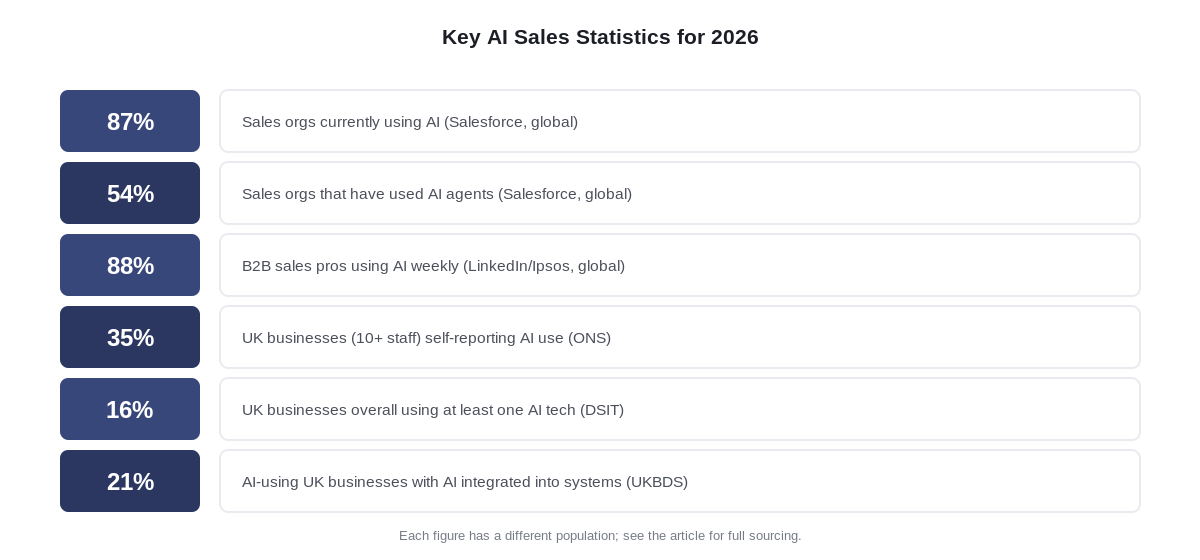
Key AI Sales Statistics for 2026
Statistic | What it measures | Geography | Source |
|---|---|---|---|
87% | Sales organisations currently using AI in some form | Global | Salesforce, State of Sales 2026 |
54% | Sales organisations that have used AI agents | Global | Salesforce, State of Sales 2026 |
88% | Sales organisations expecting to use AI agents by 2027 | Global | Salesforce, State of Sales 2026 |
94% | Sales leaders with agents who call them critical to meeting business demand | Global | Salesforce, State of Sales 2026 |
88% | B2B sales professionals using AI weekly | Global | LinkedIn and Ipsos, 2025 |
56% | B2B sales professionals using AI daily | Global | LinkedIn and Ipsos, 2025 |
28% | Average lift reported by sellers who said AI had improved their outreach response rates | Six-country B2B sample | LinkedIn and Ipsos, 2025 |
2.5x | Sellers exceeding quota were 2.5 times more likely to use AI daily than sellers falling short of quota | Six-country B2B sample | LinkedIn and Ipsos, 2025 |
35% | UK businesses with 10+ employees self-reporting AI use, June 2026 | UK | ONS, AI in UK Businesses 2023-2026 |
16% | UK businesses overall currently using at least one AI technology | UK | DSIT, AI Adoption Research |
21% | AI-using UK businesses reporting AI integrated into existing systems | UK | UK Business Data Survey 2026 |
What's Covered
This article gathers named, sourced statistics on AI use in sales, rather than a general narrative about AI adoption. It is worth reading because headline figures in this space vary enormously depending on what a survey measures, who was asked, and whether the population is sales professionals specifically or an entire national economy. Understanding those differences matters more than memorising any single percentage.
How Reliable Are AI Sales Statistics?
Statistics about AI in sales come from very different kinds of research, and treating them as interchangeable is one of the most common mistakes in this space. A figure describing sales organisations that have used an AI agent at least once is not the same as a figure describing all UK businesses that currently run an AI tool in production. Both can be entirely accurate, yet a reader skimming headlines could easily conclude they contradict each other.
Three factors explain most of the apparent disagreement between sources: the population being surveyed (sales professionals versus all businesses, or global versus UK-only), the definition of AI use (any experimentation versus regular production use versus full integration), and who commissioned the research. Vendor-sponsored surveys are not automatically unreliable, but a supplier of AI sales software has a commercial interest in reporting strong adoption figures, so its numbers deserve the same scrutiny as any other primary source.
This article labels every statistic with its geography, its population and its original source, and grades the underlying evidence using the framework set out later in this guide, so that global sales-industry figures and UK economy-wide figures are never presented as if they were measuring the same thing.
AI Adoption in Sales
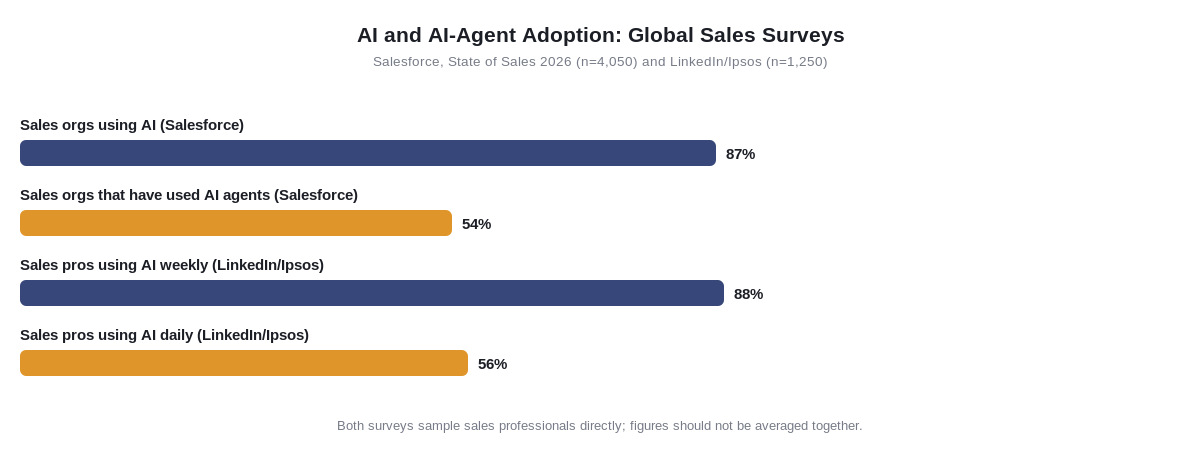
Salesforce's 2026 State of Sales survey, based on responses from 4,050 sales professionals across 22 countries including the UK, found that 87% of sales organisations were using AI in some form. That figure describes current adoption among a global panel of working sales professionals, not the general business population, and it should be read as such.
Separately, LinkedIn-commissioned primary research conducted by Ipsos among 1,250 customer-facing B2B revenue professionals found that 88% used AI weekly and 56% used it daily. That survey measures reported behaviour among individual sales professionals rather than organisation-level adoption, which is a different population again from the Salesforce figure above. Both surveys point in the same broad direction, frequent and growing use of AI in sales roles, but their precise percentages are not designed to be added together or averaged.
AI-Agent Adoption
AI agents differ from earlier generative AI tools because they can take a sequence of actions, such as researching a prospect and drafting an outreach message, rather than responding to a single prompt. Salesforce's 2026 research found that 54% of sales organisations had used AI agents, and that 88% expected to be using them by 2027. Among sales leaders who already had agents deployed, 94% described them as critical to meeting business demand, an expectation-heavy statistic that reflects sentiment among current adopters rather than a market-wide outcome.
These figures describe a fast-moving but still-maturing category. An 88% expectation of future use is a forecast of intent, not a confirmed adoption rate, and should be reported as such rather than folded into current-adoption statistics. Readers evaluating AI agents for their own sales process should treat the 2027 figure as directional guidance on momentum rather than a guarantee.
Not sure whether AI agents fit your sales process yet?
Prospecting and Productivity Statistics
The clearest reported productivity gains in the LinkedIn and Ipsos research relate to time, response rates and quota attainment. Among sellers who said AI had improved their outreach response rates, the reported average lift was 28%, a figure that describes sellers who noticed an improvement, not all AI-assisted outreach. Sellers exceeding quota were found to be 2.5 times more likely to use AI daily than sellers who fell short of quota, an association rather than a proven causal effect: better-resourced or more experienced sellers may also be more likely to adopt new tools, so this figure should not be read as proof that AI use caused higher quota attainment.
Two further findings are worth separating out because they apply to specific use cases rather than AI-assisted outreach in general. Among sellers using AI for lead and company research, 38% reported savings of more than 1.5 hours a week, a task-specific time-saving figure rather than a claim about AI use overall. Separately, 69% of sellers using AI-powered CRM integrations reported that their sales cycles had shortened, by an average of around one week, a result tied specifically to CRM integration rather than to outreach or prospecting AI more broadly. Salesforce's research adds a further, more explicitly forward-looking figure: sellers using AI agents expect a 34% reduction in prospect-research time, which is a reported expectation rather than a measured result and should not be quoted as an achieved productivity gain.
The LinkedIn and Ipsos research was commissioned by LinkedIn and conducted by Ipsos among 1,250 customer-facing B2B revenue professionals at organisations with 200 or more employees, across six countries: the United States (450), the United Kingdom (200), Germany (150), Australia (150), India (150) and Singapore (150). Because the survey only covered professionals at organisations with at least 200 employees, its findings should not be treated as representative of small-business sales teams. The report also states that its sample may or may not represent all sales professionals.
Common Sales Use Cases
Across the available research, the most frequently reported AI use cases in sales cluster around a small number of repeatable tasks: drafting outreach emails and follow-ups, summarising calls and meetings, researching accounts and prospects, and supporting quoting or proposal preparation. These are largely preparatory and administrative tasks rather than tasks that replace a salesperson's judgement in a negotiation or a final decision.
Marketing and sales teams increasingly apply AI jointly to lead qualification and handoff, since both functions often work from the same account and contact data. For a fuller breakdown of adoption trends and prospecting workflows specifically, see our related guide to AI sales agents and to AI for lead generation. Teams evaluating the cost of adding AI to prospecting should also see our guide to AI SDR pricing in the UK.
UK AI Adoption and What It Means for Sales
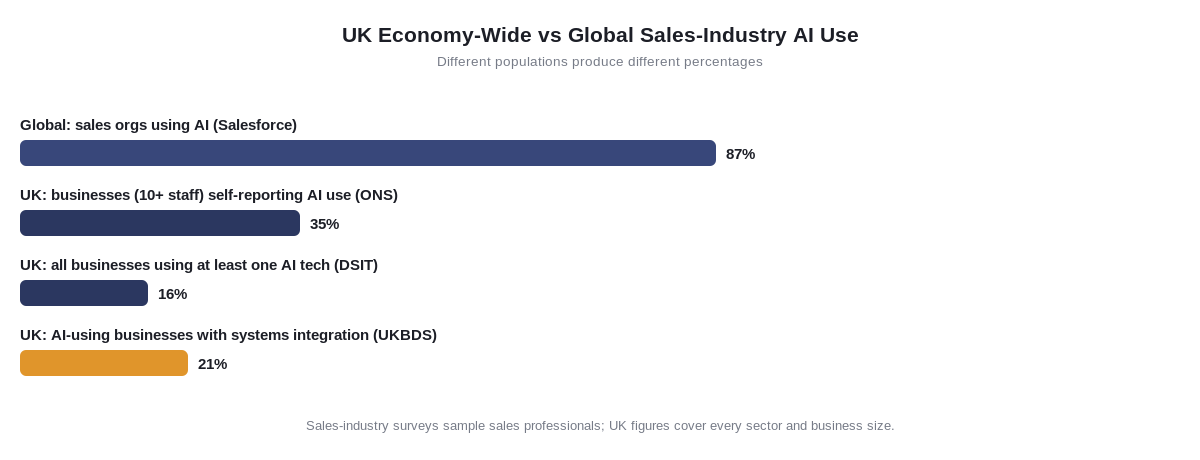
UK-wide statistics tell a more measured story than the global sales-industry surveys above, and the gap is informative rather than contradictory. The Office for National Statistics found that self-reported AI use among UK businesses with 10 or more employees rose from around 12% to around 35% between late 2023 and June 2026. DSIT's separate AI Adoption Research, using a different methodology, found that only 16% of UK businesses overall currently use at least one AI technology, with adoption strongly skewed by size: 36% of large businesses compared with just 14% of micro businesses.
Even among UK businesses that have adopted AI, integration remains shallow. The government's UK Business Data Survey 2026 found that only 21% of AI-using UK businesses reported their AI tools were integrated into existing systems such as a CRM or finance platform, rising to 57% among large businesses but falling to 18% among sole traders. Read together, these figures suggest that many UK sales teams are experimenting with standalone AI tools for research, summarisation and correspondence rather than running AI as a connected part of their sales technology stack.
This matters for UK sales teams specifically because outbound prospecting and AI-personalised outreach remain subject to UK GDPR and PECR regardless of how the message was drafted. Under PECR, marketing emails to corporate subscribers (limited companies and LLPs) generally do not require prior consent, but the sender must still be identifiable and provide a working opt-out. Marketing emails to individual subscribers, including sole traders and some partnerships, generally require consent unless the soft opt-in applies. The soft opt-in requires the contact details to have been obtained during a sale or negotiations for a sale, the marketing to concern the sender's similar products or services, and a clear opt-out both when the details were collected and in every subsequent message. UK GDPR applies whenever the message includes personal data, such as a named business contact, regardless of the PECR position. Live marketing calls must be screened against the TPS and CTPS registers, and automated marketing calls need specific consent. Using AI to write or personalise an email does not remove any of these requirements, and suppression lists still need to be checked before sending. See the ICO's guidance on business-to-business marketing and our guide to AI and GDPR for a fuller treatment of these obligations.
The AI Workforce Sales Statistics Evidence Scale
Not all statistics in this space carry the same evidential weight. AI Workforce grades each major source using the following scale, and applies a grade to every statistic in the table above.
Grade A, Official and public-sector evidence: national statistical bodies publishing official statistics, such as ONS and the UK Business Data Survey.
Grade B, Commissioned primary research: original research conducted by an established independent research organisation, with the commercial sponsor, sample and methodology disclosed, such as the LinkedIn and Ipsos study.
Grade C, Vendor primary research: original vendor surveys with a disclosed methodology but a possible commercial interest, such as Salesforce's own State of Sales report.
Grade D, Market forecasts: modelled estimates that depend heavily on assumptions about market definition and growth rate.
Grade E, Compilations: secondary articles that repeat statistics without publishing the original dataset or methodology.
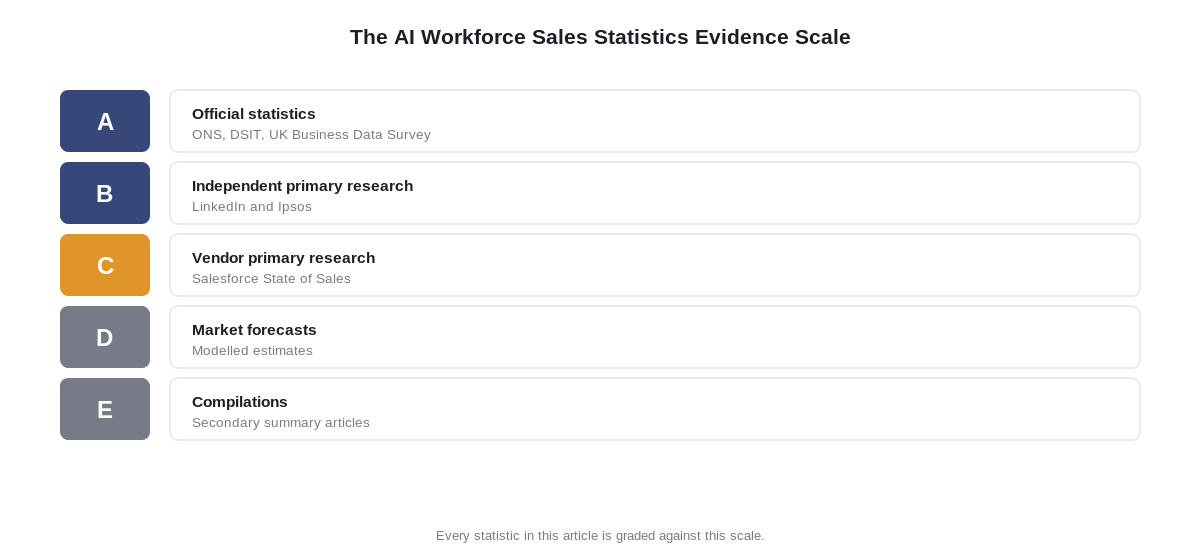
Applying this scale, the ONS and UK Business Data Survey figures used in this article are Grade A, as official statistical publications. DSIT's AI Adoption Research is government-commissioned research rather than an official statistical publication in the same sense, so it is treated as Grade A on the strength of its methodology and disclosure but noted separately from ONS and the UK Business Data Survey. The LinkedIn and Ipsos research is Grade B, commissioned by LinkedIn and conducted by Ipsos, and the Salesforce figures are Grade C. No Grade D or E statistics are used as primary evidence in this article; where a compilation source is referenced elsewhere, that limitation is stated explicitly.
Risks and Limitations
Every statistic in this article should be read alongside its limitations. The Salesforce data comes from a vendor with a commercial interest in AI adoption and is based on self-reported responses from 4,050 sales professionals surveyed in August and September 2025 across 22 countries; it measures current use and stated intent, not independently verified business outcomes. The LinkedIn and Ipsos research, commissioned by LinkedIn and conducted by Ipsos, is based on a smaller sample of 1,250 customer-facing B2B revenue professionals at organisations with 200 or more employees, and also relies on self-reported behaviour rather than system-level usage data. Because the sample only covered professionals at organisations with at least 200 employees, its findings should not be treated as representative of small-business sales teams; the report itself states that its sample may or may not represent all sales professionals.
ONS and the UK Business Data Survey are official statistical publications from UK government bodies, which gives them the strongest evidential grounding in this article. DSIT's AI Adoption Research is government-commissioned research using its own methodology rather than an official statistical publication in the same sense as ONS or the UK Business Data Survey, though it is still a primary, disclosed source. All three measure AI use across entire businesses and sectors rather than sales functions specifically, which is why their percentages are lower than the sales-industry figures above. None of the statistics in this article should be treated as a guarantee of results for any individual sales team, and expectation-based figures, such as forecasts of future adoption or expected time savings, are clearly distinguished from measured, current-state figures throughout.
How to Measure AI in Your Own Sales Team
Rather than relying on industry-wide averages, sales leaders evaluating AI can track a small number of internal measures before and after adopting a specific tool: time spent on manual research and data entry per rep, response rates on outbound outreach, and the proportion of pipeline that originates from AI-assisted prospecting versus manual effort. Comparing these figures over a defined pilot period, ideally against a control group of reps not yet using the tool, produces evidence specific to that organisation rather than a borrowed industry statistic.
For UK teams considering a wider rollout, our guide to AI automation pricing sets out typical cost ranges, and our AI readiness assessment provides a structured way to identify which sales tasks are worth automating first.
FAQs
Why do AI adoption statistics for sales vary so much between sources?
Because they measure different populations. A figure describing sales organisations or sales professionals globally is not the same as a figure describing all UK businesses, and adoption thresholds range from any past experimentation to full production use.
Is 87% of sales organisations really using AI?
That figure comes from Salesforce's 2026 State of Sales survey of 4,050 sales professionals across 22 countries. It is self-reported and vendor-sponsored, so it should be read as an indicator of current sales-industry sentiment rather than an independently audited adoption rate.
Why is UK AI adoption reported so much lower than global sales-industry figures?
UK government research from ONS and DSIT measures AI use across businesses and sectors rather than sales functions specifically, and uses different populations, definitions and sampling methods. Sales-industry surveys sample sales professionals directly, which helps explain their higher reported adoption figures.
Want help identifying the right AI sales workflow for your team?
Key Takeaways
Salesforce's 2026 survey found 87% of sales organisations use AI and 54% have used AI agents, based on 4,050 sales professionals across 22 countries.
LinkedIn and Ipsos found 88% of B2B sales professionals use AI weekly and 56% daily, based on a sample of 1,250 professionals.
UK economy-wide adoption is lower and more uneven: ONS reports around 35% of businesses with 10 or more employees self-report AI use, while DSIT reports 16% of UK businesses overall currently use at least one AI technology.
Only 21% of AI-using UK businesses report AI integrated into existing systems, according to the UK Business Data Survey 2026.
Reported benefits such as shorter sales cycles, higher response rates and time saved should be distinguished from forecasts and expected benefits, which are not the same as measured results.
Grading each statistic by its evidence type, official or public-sector, commissioned primary, vendor primary, forecast or compilation, is the clearest way to judge how much weight it deserves.
UK GDPR and PECR obligations apply to AI-assisted prospecting and outreach in the same way they apply to manually written communications.
Sources and Methodology
Salesforce: State of Sales Report 2026 — survey of 4,050 sales professionals across 22 countries, August to September 2025, vendor-sponsored (Grade C).
LinkedIn and Ipsos: Sales Leader Compass, The ROI of AI — commissioned primary research conducted by Ipsos among 1,250 customer-facing B2B revenue professionals on behalf of LinkedIn (Grade B).
DSIT: AI Adoption Research — government-commissioned research on AI adoption across UK businesses, methodology disclosed (Grade A).
UK Business Data Survey 2026 — official UK government statistics (Grade A).
ONS: Artificial intelligence in UK businesses, 2023 to 2026 — official UK government statistics (Grade A).
Related reading: AI Sales Agents · AI Lead Generation · AI Agent Cost · AI Automation Pricing UK · AI Productivity in the UK · AI and GDPR · AI Readiness Assessment · AI Workforce pricing
About the author: Clara Miller is a Content Specialist at AI Workforce. Clara researched the sales-adoption datasets, survey methodologies and practical B2B applications included in this article.
Reviewed by Seth Ayush, Co-Founder of AI Workforce. Seth reviewed the commercial interpretation, implementation boundaries and distinction between reported, observed and forecast results. Reviewed August 2026.
Frequently Asked Questions
Everything you need to know about this topic
Statistics about AI in sales come from very different kinds of research, and treating them as interchangeable is one of the most common mistakes in this space. A figure describing sales organisations that have used an AI agent at least once is not the same as a figure describing all UK businesses that currently run an AI tool in production. Both can be entirely accurate, yet a reader skimming headlines could easily conclude they contradict each other. Three factors explain most of the apparent disagreement between sources: the population being surveyed (sales professionals versus all businesses, or global versus UK-only), the definition of AI use (any experimentation versus regular production use versus full integration), and who commissioned the research. Vendor-sponsored surveys are not automatically unreliable, but a supplier of AI sales software has a commercial interest in reporting strong adoption figures, so its numbers deserve the same scrutiny as any other primary source. This article labels every statistic with its geography, its population and its original source, and grades the underlying evidence using the framework set out later in this guide, so that global sales-industry figures and UK economy-wide figures are never presented as if they were measuring the same thing.
Because they measure different populations. A figure describing sales organisations or sales professionals globally is not the same as a figure describing all UK businesses, and adoption thresholds range from any past experimentation to full production use.
That figure comes from Salesforce's 2026 State of Sales survey of 4,050 sales professionals across 22 countries. It is self-reported and vendor-sponsored, so it should be read as an indicator of current sales-industry sentiment rather than an independently audited adoption rate.
UK government research from ONS and DSIT measures AI use across businesses and sectors rather than sales functions specifically, and uses different populations, definitions and sampling methods. Sales-industry surveys sample sales professionals directly, which helps explain their higher reported adoption figures.