AI LinkedIn Message Generator: How to Personalise Outreach Without Sounding Automated
Posted On: September 29, 2026
Last updated: September 2026
Written by Clara Miller, Content Specialist at AI Workforce · Reviewed by Rodi Taze, Co-Founder of AI Workforce
Quick answer: An AI LinkedIn message generator should not simply take a name, job title and company and produce a superficially unique message. A governed system retrieves relevant context, preserves its source, distinguishes fact from inference, chooses only business-relevant details, drafts the message, verifies factual claims, checks tone and boundaries, and routes the draft to a person before any LinkedIn action happens. The goal is not to make every message different from the last one. The goal is to give this particular person a clear, truthful reason for receiving this particular message.
What Is an AI LinkedIn Message Generator?
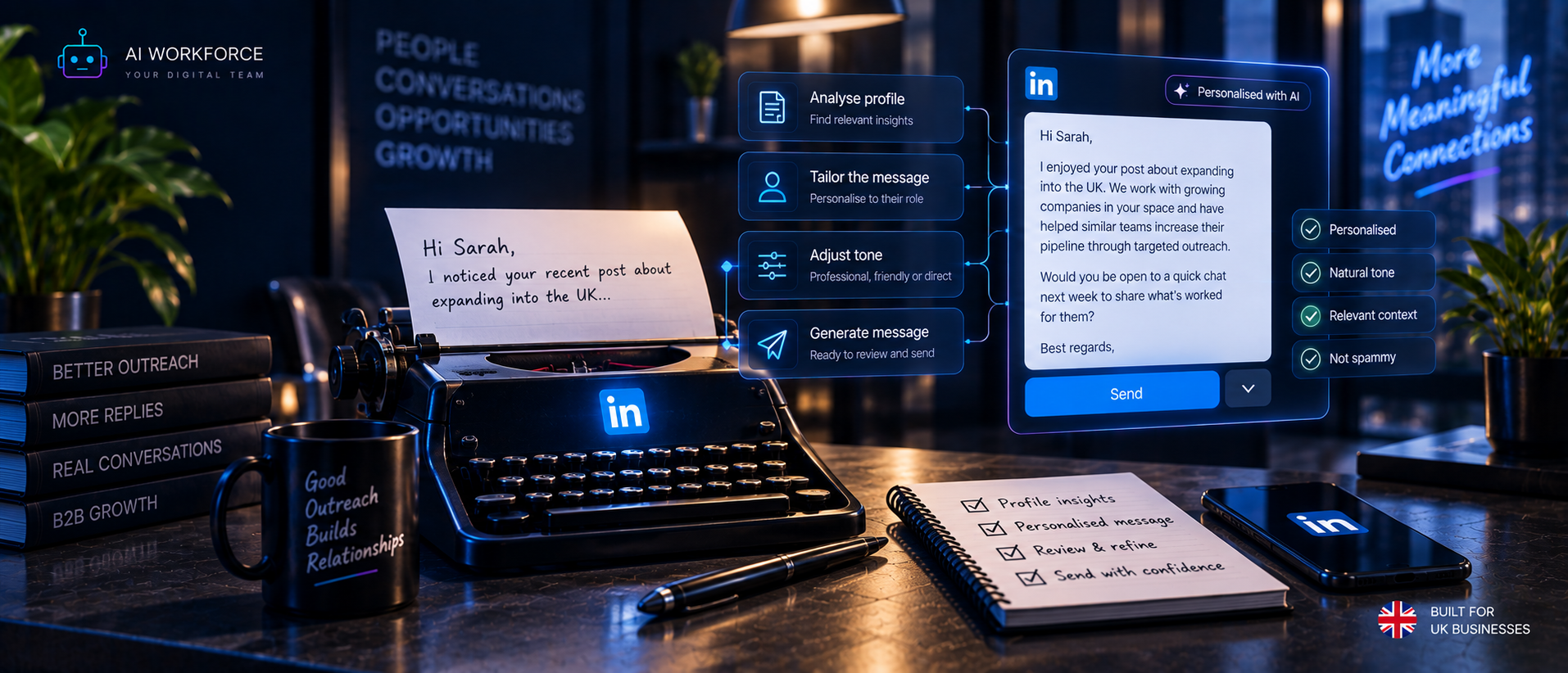
An AI LinkedIn message generator is software that drafts connection requests or messages, ranging from simple template variable insertion, "Hi {first_name}, I work with {industry} companies", through to generative drafting that writes freeform text, up to research-grounded generation that pulls verified context before writing anything. None of these is the same as LinkedIn account automation. Message generation produces a draft; it does not send it. AI can generate the draft without performing the LinkedIn action itself, and this guide treats that as a meaningful line, not a technicality.
AI Message Generation vs LinkedIn Outreach Automation
AI message generation covers research, personalisation and drafting, the specific work this article addresses.
LinkedIn outreach automation covers the wider process, targeting, the account action, replies, follow-up, qualification, handoff and CRM state, addressed in AI Workforce's LinkedIn Outreach Automation guide.
Direct LinkedIn automation covers software actually performing the LinkedIn account action itself, governed by LinkedIn's own platform rules and addressed in AI Workforce's LinkedIn Automation Limits guide.
This article focuses specifically on the first category.
The AI Workforce LinkedIn Message Generation Model
The following is an AI Workforce implementation framework rather than an official LinkedIn process or industry standard.
Research → Source → Select → Personalise → Draft → Verify → Review → Message-Ready
Research. Collect potentially relevant business context.
Source. Retain where every important factual claim came from.
Select. Choose only context relevant to the commercial reason for contact.
Personalise. Connect that evidence to the reason for the conversation.
Draft. Generate a concise first version.
Verify. Check factual claims against the source.
Review. A person checks tone, relevance, accuracy and appropriateness.
Message-Ready. The draft is suitable for a person to decide whether to send, edit or discard.
Why AI LinkedIn Messages Sound Automated
There is no single universal "AI writing style" to avoid, but certain patterns can make AI-assisted outreach read as generic or poorly grounded: generic compliments, repeated sentence structure across messages, excessive enthusiasm, personalisation that is technically true but irrelevant to the offer, a long setup before reaching the point, vague claims with no specifics, overexplaining, artificial familiarity with someone the sender has never interacted with, unnecessary jargon, fake observations presented as if personally noticed, generic calls to action, and cramming every research fact the system found into a single message.
A message can sound generic or inappropriate because the system worked from weak evidence, had poor constraints on what to include, or lacked meaningful human review before the message went out.
The AI Workforce LinkedIn Personalisation Evidence Ladder
The following is an AI Workforce implementation framework rather than an official LinkedIn process or industry standard. Evidence strength and relevance are separate questions; a verified fact can still be irrelevant to the reason for contact.
Level 1, Basic Identity. Name, company, current role.
Level 2, Role-Relevant Context. Verified responsibility or business function.
Level 3, Company-Relevant Context. A verified company characteristic relevant to the offer.
Level 4, Current Business Context. Verified hiring, expansion, a vacancy, an announcement, or another relevant change.
Level 5, First-Party Context. Something the prospect directly said or did in relation to the business.
Boundary, Intrusive or Unverified. Sensitive information, irrelevant personal details, fabricated facts, inferred pain points, or unverifiable assumptions. This boundary is not a higher personalisation level; it is the point at which personalisation stops being appropriate.
The Three Tests for LinkedIn Personalisation
An AI Workforce editorial and implementation test.
Is it true? Can the claim actually be verified?
Is it relevant? Does it genuinely explain why this person or company is being contacted?
Is it appropriate? Would the recipient reasonably understand why this information was used in a business message?
If any of the three tests fail, the detail should be removed from the draft.
What Should AI Personalise?
Signal | Potential use | Main risk | Verification needed? |
|---|---|---|---|
Current role | Confirms relevance of the message | Roles change often | Yes |
Company industry | Shapes framing of the offer | Stale or incorrect classification | Yes |
Company size | Confirms ICP fit | Stale or inaccurate headcount | Yes |
Relevant vacancy | Can provide current business context relevant to the reason for contact | Listings expire quickly | Yes |
Current hiring | Evidence of organisational change | Does not prove need for your product | Yes |
Public company announcement | Timely, verifiable context | Must be accurate and current | Yes |
Recent business post | Can provide relevant professional context when the post directly relates to the reason for contact | Not automatically relevant; read it first | Yes |
Current product or service | Helps frame relevance | Can go stale | Yes |
Known technology or process | Can support relevance if accurate | Should never be invented | Yes |
Mutual connection | Can provide shared context | Does not imply endorsement | Yes |
First-party interaction | Strong, direct relevance | Interaction recorded incorrectly or used out of context | Yes |
Personal interests | Rarely business-relevant | Intrusive, avoid | N/A |
Family or personal life | Not business-relevant | Intrusive, avoid | N/A |
Sensitive personal information | Not appropriate for sales use | Avoid entirely | N/A |
Inferred pain point | Not a fact until stated | Fabricated personalisation | N/A |
Source Provenance: No Source, No Factual Claim
Every material personalisation fact should retain its source, the date it was checked, its verification status, and a confidence indicator where appropriate. The working rule: no source, no factual personalisation claim. AI-generated research notes should never silently become stated facts in a message. Where the source is uncertain, remove the claim, frame it as a genuine question where appropriate, or route it for human review before it appears in a draft.
Fact vs Inference vs Hypothesis
Type | Example | Can AI state it as fact? |
|---|---|---|
Fact | "The company is recruiting three BDRs." | Yes, if verified and current |
Inference | "Your sales team must be struggling with ramp-up." | No |
Hypothesis | "Scaling outbound may create additional research workload." | Can be framed as a possibility, never as something known about the prospect |
Collapsing these categories can turn a hypothesis into an unsupported factual claim about the person being contacted.
A Practical LinkedIn Message Structure
Context, Relevance, Reason, Low-Friction Next Step. Context explains why the message exists. Relevance explains why this person or company specifically. Reason explains what conversation is being proposed. Low-Friction Next Step gives an easy response that does not require immediate commitment. This is a practical AI Workforce structure, not a claim about the single best-performing template, and this guide does not prescribe a universal character count.
Connection Request vs First Message
These serve different purposes. A connection request may simply establish relevant context, it does not need to carry the full reason for contact. A first message can explain that reason more clearly once the connection exists. Not every connection request needs a note, and not every accepted connection should immediately receive a pitch.
LinkedIn Connection Request Examples
No-pitch professional connection:
"Hi James, I work with sales leaders at growing UK software companies and wanted to connect. No pitch, just keen to follow your updates."
Evidence used: none beyond the recipient's professional field. Deliberately avoids: any claim about the recipient's specific situation.
Shared business context:
"Hi Priya, saw you've recently moved into the sales leadership role at [Company]. I work in a similar space and thought it'd be worth connecting."
Evidence used: a verified current role change. Deliberately avoids: any assumption about what that role change means for the business.
Relevant company event:
"Hi Tom, congratulations on the new office opening. I work with growing UK teams and thought it'd be good to connect."
Evidence used: a verified, current public announcement. Deliberately avoids: linking the event to an assumed need for the sender's product.
Existing first-party context:
"Hi Claire, we're both connected to [Name], and I saw your comment on their recent post about the outbound process; thought it'd be worth connecting."
Evidence used: a genuine first-party interaction the sender actually observed. Deliberately avoids: exaggerating the closeness of the connection.
First LinkedIn Message Examples
UK SaaS founder:
"Hi Claire, congrats on the recent product launch. We help SME founders manage inbound enquiries without hiring a full support team. Would it be useful to see how that's worked for a similar business?"
Evidence used: a verified, current product launch. Reason it is relevant: the offer relates to inbound-enquiry handling, so the launch provides current company context for testing whether that topic is relevant. Human check required: confirm the launch is genuinely recent and the claim about it is accurate.
Head of Sales:
"Hi Marcus, noticed [Company] is hiring for its first BDR. We help sales teams automate parts of prospecting research for new and existing reps. Worth a quick look?"
Evidence used: a verified, currently live vacancy. Reason it is relevant: the vacancy directly relates to the offer. Human check required: confirm the listing is still live before sending.
Recruitment agency:
"Hi Ellie, saw your team's grown this year. We help recruitment firms keep candidate pipelines warm between roles using automated but reviewed outreach. Happy to share how it works if useful."
Evidence used: verified headcount growth. Reason it is relevant: the offer concerns pipeline management, so the growth provides current business context for testing whether that topic is relevant. Human check required: confirm the growth figure is current, not a stale data point.
Accountant or professional services firm:
"Hi David, saw [Firm] recently opened a second office. We work with growing professional services firms on managing client enquiries as they scale. Worth a brief chat?"
Evidence used: a verified, current expansion announcement. Reason it is relevant: the offer concerns enquiry handling during organisational growth, so the expansion provides current business context without establishing that the firm has an enquiry-volume problem. Human check required: confirm the announcement is accurate and not outdated.
Estate agency or property business:
"Hi Sophie, noticed [Agency] is expanding into a new area. We help agencies handle enquiry volume during periods of growth without adding headcount. Would it be worth a quick look?"
Evidence used: a verified area expansion. Reason it is relevant: the expansion provides current business context related to the service being offered; it does not establish that enquiry volume has increased. Human check required: confirm the expansion is current and correctly described.
Bad AI LinkedIn Message Examples
Fake compliment:
"Hi Sarah, I noticed your incredibly impressive profile and wanted to reach out." This fails because it is generic, unverifiable, and applies to anyone.
Fabricated trigger:
"Hi Tom, congrats on your recent Series A!" sent to a company that has not raised funding. This fails the truth test outright, and sending it damages credibility immediately.
Intrusive personal detail:
"Hi Priya, I saw your recent post about your father's illness; hope things are improving. Anyway, wanted to introduce our product." This fails the appropriateness test; sensitive personal information has no place in a sales message, regardless of where it was found.
Generic "AI revolution" pitch:
"Hi James, AI is revolutionising every industry and your business can't afford to be left behind. Let's 10x your results together!" This fails the relevance test; it says nothing specific about the recipient and relies entirely on hype language.
The AI Workforce LinkedIn Message Quality Model
An AI Workforce internal evaluation heuristic, not a validated industry standard.
Six dimensions, each scored 1 to 5, maximum 30. Accuracy: are the factual claims correct and current? Relevance: does the message explain why this specific person is being contacted? Specificity: does it avoid vague, generic language? Restraint: does it avoid intrusive or excessive personalisation? Naturalness: does it read like something a person would actually write? Actionability: is the next step clear and low-friction?
As an internal planning heuristic only: 25 to 30 suggests the draft is ready for human consideration, 19 to 24 suggests revision is needed, below 19 suggests redrafting or further research. A high score does not mean a message should be sent automatically; human judgement still applies regardless of the score.
Human Review Before Sending
Before any message is sent, a person should check that it names the correct person, reflects their current company and role, relies on a source that is still current, contains no fabricated claim, makes no sensitive inference, has clear business relevance, uses an appropriate tone, makes no unsupported promise of outcomes, respects any prior objection or suppression flag, matches the correct conversation state, has an appropriate call to action, and is something the sender would be comfortable putting their own name to. Human approval needs to genuinely allow editing, rejecting or stopping the message, not function as a rubber stamp.
Can AI Write LinkedIn Follow-Ups?
AI can draft follow-up messages based on the current conversation state, but follow-up is inherently state-dependent. A reply changes what the next message should say. An objection should stop or change the sequence entirely. A booked meeting changes the state to something that no longer needs further outreach drafting. A do-not-contact request suppresses further outreach altogether. Ambiguous or sensitive replies need human review before anything is drafted. For the full follow-up framework, see AI Workforce's AI Follow-Up Automation and LinkedIn Outreach Automation guides, this section is intentionally brief.
Can AI Reply to LinkedIn Messages?
AI can classify an incoming reply and prepare a response for a person to review. Whether software can actually perform the LinkedIn send is a separate platform-permission question, governed by LinkedIn's own rules on unauthorised account automation rather than by anything in this guide. See AI Workforce's LinkedIn Automation Limits guide for that analysis.
What AI Should Never Infer From a LinkedIn Profile
Buying intent, budget, authority based on title alone, urgency, personal wealth, health, religion, political beliefs, ethnicity, family situation, emotional state, personal problems, and willingness to buy should never be inferred from a LinkedIn profile. If a claim is not supported by appropriate business evidence, it should not be used to personalise a message, however plausible it might seem.
UK GDPR and AI LinkedIn Personalisation
Profile information can be personal data, and its public availability does not remove UK GDPR obligations. A lawful basis is still required to process it for outreach purposes, and where legitimate interests are relied on, this requires a genuine assessment rather than an assumption. Transparency about how the data is used matters; the right to object must be respected; a suppression list should be actively maintained, and only the personal or sensitive information genuinely needed for the message should be collected or retained, with its source kept on record. For the fuller compliance picture, see AI Workforce's AI GDPR Compliance UK guide.
LinkedIn Platform Rules
Generating or drafting a message is different from software automatically sending it through LinkedIn. LinkedIn's restrictions on unauthorised third-party automation still apply at the account-action layer, regardless of how the message was drafted. The full policy analysis is covered in AI Workforce's LinkedIn Automation Limits guide.
How to Build an AI LinkedIn Message Generator
A workable architecture, conceptually: Prospect Record, Approved Sources, Retrieval, Evidence Selection, Prompt or Instructions, Draft, Fact Verification, Quality Evaluation, Human Review, Message-Ready. Each draft should be stored alongside its prospect ID, the source facts it drew on, the source URLs or references, the date those sources were checked, the generated draft itself, the model or version used where useful, any human edits made, the approval or rejection decision, and the reason for rejection where useful. This creates both an audit trail and a dataset for evaluating and improving the system over time.
How to Pilot AI LinkedIn Message Generation
The following is an AI Workforce implementation methodology, not an industry standard.
Stage 1, Historical Evaluation. Generate messages for past prospects where the real context is already known, to see how the system performs against known outcomes.
Stage 2, Shadow Drafting. AI drafts alongside the salesperson's current process without replacing it.
Stage 3, Human-Approved Live Use. Use AI drafts on a bounded segment with mandatory review before sending.
Stage 4, Measure and Refine. Analyse corrections, factual errors, replies and objections.
Stage 5, Expand or Hold. Expand only if the evidence from earlier stages supports it, there is no fixed rollout timeline.
How to Measure AI LinkedIn Messages
The number of messages generated or sent is an activity count, not a quality measure. Relevant measures include: factual correction rate, human edit rate, rejection rate, incorrect personalisation rate, inappropriate-message rate, acceptance rate where relevant, reply rate, qualified reply rate, objections, opt-outs, meetings generated, accepted opportunities, time spent reviewing per approved message, and cost per accepted opportunity. A message can receive a reply and still be a poor message if it is inaccurate, intrusive, or creates the wrong kind of conversation.
How to Evaluate an AI LinkedIn Message Generator
What research sources does it use? Does it preserve provenance? Can it distinguish fact from inference? Can it avoid sensitive data entirely? Does it invent pain points? Can users define tone? Can users provide approved examples for it to work from? Does every draft require human approval before sending? Can a user edit or reject drafts easily? Does it remember suppression status? Does it understand conversation state? Can it explain why a particular personalisation detail was selected? Can it show the source behind that detail? Does it directly control LinkedIn, and if so, is that access authorised? Can it export its evaluation and correction data? Can it be paused immediately? For a comparison of specific tools against these questions, see AI Workforce's Best AI LinkedIn Automation Tools guide.
Worked End-to-End Example
Target: Head of Sales at a UK SaaS company. Research surfaces that the company is currently recruiting two BDRs. Source: the company's current careers page. Selection: this is relevant because the offer relates to the prospecting research workload a new hire typically inherits. Draft: AI prepares a message referencing the vacancy and the ramp-up challenge it creates. Verification: the vacancy is confirmed to still be live. Human review: the person removes one overly promotional sentence and adjusts the tone slightly. Message-ready: the draft is approved for the person to decide whether to send.
At that point, this example stops. What happens after the message is sent belongs to AI Workforce's LinkedIn Outreach Automation guide.
Sources and Methodology
All sources above were checked directly in September 2026 and quoted or summarised from their current published wording. The AI Workforce LinkedIn Message Generation Model, Personalisation Evidence Ladder, Three Tests for LinkedIn Personalisation, message structure, Message Quality Model, review checklist, pilot methodology and measurement framework are AI Workforce implementation and editorial frameworks rather than official LinkedIn processes, industry standards or independently verified benchmarks.
Frequently Asked Questions
What is an AI LinkedIn message generator?
Software that drafts LinkedIn connection requests or messages, ranging from simple template tools to systems that research and verify context before writing. Generating a draft is separate from sending it.
Can AI write LinkedIn messages?
Yes, AI can draft connection requests and messages based on verified research, provided a person reviews the draft for accuracy, relevance and tone before it is sent.
How do I make AI LinkedIn messages sound natural?
Ground them in specific, verified, business-relevant evidence rather than generic templates, keep them concise, and have a person review and adjust the tone before sending.
How do I personalise LinkedIn messages with AI?
By selecting only context that passes three tests: is it true, is it relevant, and is it appropriate, rather than inserting every piece of research the system found.
What should I include in a LinkedIn connection request?
Enough context to explain why you're connecting; this can be minimal or none at all depending on the situation. There is no single required format.
Should I add a note to every LinkedIn connection request?
Not necessarily; a note is useful when it adds genuine context, it is not required for every request.
How long should a LinkedIn sales message be?
There is no universally correct length. Use enough space to establish context, relevance, reason and a clear next step without adding material that does not help the recipient understand the message.
Can AI automatically reply to LinkedIn messages?
AI can classify a reply and draft a response for review. Whether software can send that response automatically is a separate platform-permission question, covered in AI Workforce's LinkedIn Automation Limits guide.
Can AI send LinkedIn messages automatically?
Drafting and sending are separate. Automated sending through unauthorised third-party software sits within LinkedIn's platform restrictions, covered in AI Workforce's LinkedIn Automation Limits guide.
Is AI LinkedIn personalisation GDPR compliant?
It can be, provided there is an appropriate lawful basis for processing the personal data involved, data use is transparent, and objections and suppression are respected. This depends on how the specific workflow is run, not on using AI itself.
Can I use someone's LinkedIn post in a sales message?
It can be used if it is genuinely relevant and the reference is accurate; it should not be presented as something the sender personally noticed if it was actually surfaced by AI research.
Should AI mention personal interests from LinkedIn?
No, personal interests are rarely relevant to a business reason for contact and risk making the message feel intrusive.
How do I stop AI inventing personalisation?
Require a source for every factual claim, and remove or flag for review any claim that cannot be traced back to a verified source.
What makes a LinkedIn message relevant?
A message is relevant when it clearly explains why this specific person, at this specific company, is being contacted now, based on evidence the recipient could reasonably verify themselves.
Key Takeaways
AI-generated does not mean personalised, and unique does not mean relevant. Every factual personalisation claim needs a source; without one, it should not appear in a message. Fact, inference and hypothesis are three different things and should never be collapsed into one. Business relevance is what makes personalisation useful, not the mere existence of a verified detail. Intrusive personalisation is a boundary to avoid, not a higher level of sophistication to aim for. Verification should happen before a draft reaches a person, and human review should happen before any LinkedIn action. Measurement should track corrections and downstream outcomes, not just message volume. And message-ready is the intended endpoint of this process; sending the message is a separate action governed by a person and, where automation is involved, by LinkedIn's own platform rules.
Written by Clara Miller, Content Specialist at AI Workforce · Reviewed by Rodi Taze, Co-Founder of AI Workforce