LinkedIn Follow-Up Automation: How to Follow Up Without Losing Conversation Context
Posted On: September 29, 2026
Last updated: September 2026
Written by Rodi Taze, Co-Founder of AI Workforce · Reviewed by Luca Controlo, Co-Founder of AI Workforce
Quick answer: LinkedIn follow-up automation should not simply send another message because a timer expired. A governed workflow first determines the current conversation state, whether a reply exists, what that reply means, whether another message is appropriate, whether human review is required, and whether the prospect should be handed off to a salesperson or suppressed from further contact. AI can assist with classification and drafting. That is separate from software automatically performing the LinkedIn account action.
What Is LinkedIn Follow-Up Automation?
It can involve monitoring conversation state, detecting replies, classifying what a reply means, deciding whether another action is appropriate, preparing a follow-up draft, routing for human review, updating CRM records, handing a conversation to a salesperson, or suppressing further contact. These are distinct activities: the decision about whether to follow up, the drafting of the message itself, and the LinkedIn account action that actually sends it are three separate things, and this guide treats them separately throughout.
LinkedIn Follow-Up vs General AI Follow-Up Automation
LinkedIn follow-up deals with channel-specific state, conversation history and platform considerations that are particular to LinkedIn.
General AI follow-up may span email, WhatsApp, calls, CRM tasks and other channels. For that broader picture, see AI Workforce's AI Follow-Up Automation guide; this article focuses specifically on the LinkedIn channel.
The AI Workforce LinkedIn Follow-Up Model
The following is an AI Workforce implementation framework rather than an official LinkedIn process or industry standard.
Observe → Classify → Decide → Draft → Verify → Review → LinkedIn Action → Update State → Handoff / Suppress
Observe. Check the latest known conversation state.
Classify. Determine what actually happened.
Decide. Determine whether another LinkedIn action is appropriate at all.
Draft. Prepare the next message only if the state permits one.
Verify. Check facts and conversation context.
Review. Route for human review where required.
LinkedIn Action. A person performs the action, or specifically authorised functionality does so where LinkedIn permits it.
Update State. Record the actual outcome.
Handoff / Suppress. Transfer to a salesperson or stop further outreach where appropriate.
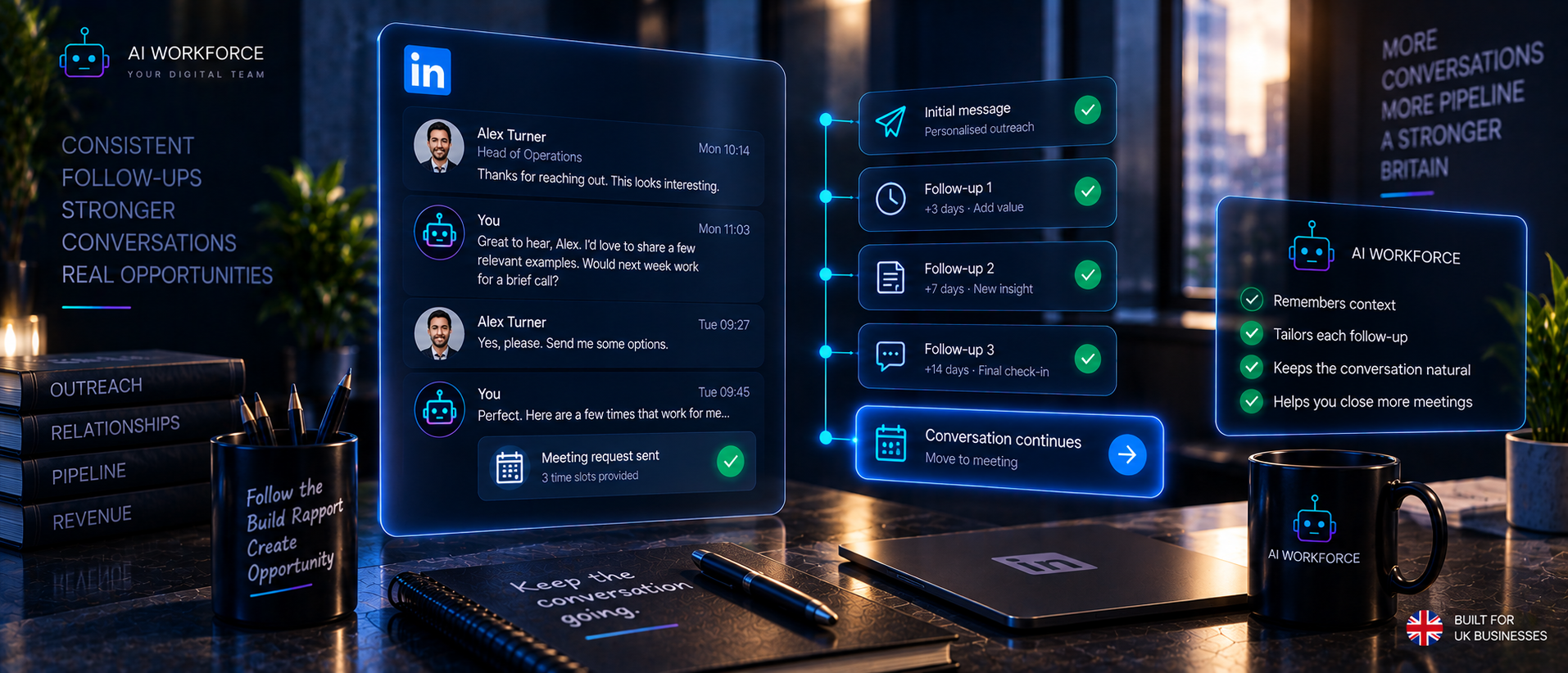
Follow-Up Is a State Machine, Not Just a Timer
The following states are an AI Workforce workflow-state model, not official LinkedIn platform statuses.
Awaiting Reply, Reply Received, Interested, Question, Objection, Not Now, Wrong Person, Not Relevant, Already Using Alternative, Human Review Required, Meeting Proposed, Meeting Booked, Do Not Contact, Handed Off, Closed or Suppressed.
A timer can tell the system that enough time has elapsed to reconsider a record. It cannot, by itself, determine that another message should be sent. The principle worth protecting: time can trigger a review; conversation state determines the action.
What Should Happen After a LinkedIn Connection Is Accepted?
Connection acceptance is not buying intent. The workflow should check whether existing context already exists, whether a first message has already been sent, whether there was any prior interaction, whether a message is appropriate at this point, whether the contact is suppressed, and whether another salesperson already owns the conversation. The full details of the connection stage itself is covered in AI Workforce's LinkedIn Connection Request Automation guide; this article picks up from where that one ends.
What Should Happen After No Reply?
No reply is an absence of information, not evidence of anything specific. It does not prove rejection, a lack of interest, a lack of need, that the message was even seen, or that another message is automatically appropriate. A decision model: no reply prompts a check of the current state, a check of prior messages, a check of suppression status, a check of whether the original relevance is still current, and a review of whether another follow-up is genuinely appropriate before drafting one, or stopping. A business may define its own cadence, but that cadence should operate inside stop conditions and conversation-state logic, not override them.
How Many Times Should You Follow Up on LinkedIn?
There is no universal number this guide can responsibly recommend for every prospect, business and context, and it does not provide one. The appropriate stopping point depends on prior engagement, the relationship or context involved, whether the message content is still relevant, any objection already raised, the specific sales process in use, applicable platform rules, business policy, and anything the prospect has explicitly requested. A finite sequence with explicit stop conditions is more governable than indefinite follow-up; that is the standard worth designing around rather than a specific count.
How Long Should You Wait Between LinkedIn Follow-Ups?
Again, there is no universal interval this guide presents as correct. Elapsed time can trigger a review, it should not automatically trigger a send. The business should define its own documented cadence, appropriate to its sales process, and test that cadence against objections, opt-outs, reply quality, qualified conversations and any account or platform warnings, rather than adopting a benchmark from elsewhere.
The AI Workforce LinkedIn Reply-State Taxonomy
An AI Workforce implementation taxonomy. A positive, negative or neutral classification does not distinguish several states that require different workflow actions.
Interested. The prospect expresses interest or asks to continue.
Question. The prospect asks for information.
Objection. The prospect raises a concern.
Not Now. The prospect indicates the timing is wrong.
Wrong Person. The prospect indicates someone else owns the issue.
Not Relevant. The prospect says the offer or topic does not apply to them.
Already Using Alternative. The prospect identifies an existing solution, provider or process.
Ambiguous. The meaning of the reply is unclear.
Sensitive. The conversation requires judgement or contains sensitive context.
Do Not Contact. The prospect asks for outreach to stop.
Meeting Booked. A commercial next step has already been agreed.
The AI Workforce LinkedIn Follow-Up Decision Matrix
State | AI May draft? | Human review? | Follow-up permitted? | Next state or action |
|---|---|---|---|---|
Awaiting Reply | Potentially | According to policy | Only if cadence and stop rules permit | Follow-up or close |
Interested | Yes | Depending on context | Respond according to context | Answer or handoff |
Question | Yes | Where accuracy or judgement requires it | Respond to the question | Await reply |
Objection | AI may summarise or draft | Human review | No generic sequence | Address or close |
Not Now | Record stated timing | Human review where needed | No immediate sequence | Future review if appropriate |
Wrong Person | Draft acknowledgement | Human review | Stop outreach to current contact | Research appropriate contact |
Do Not Contact | No | No sales drafting | No | Suppress |
Meeting Booked | No further prospecting follow-up | Handoff | No | Meeting workflow |
Human Review Required | Draft optional | Mandatory | Paused | Human decision |
How AI Should Classify LinkedIn Replies
AI can classify a reply based on its explicit wording, the conversation history, the current CRM state, and prior messages in the thread. It should not infer buying intent where none was stated, budget, authority, urgency, emotional state, or hidden meaning behind the words used. Where confidence is low, the appropriate classification is Human Review Required; sentiment analysis alone is not treated as sufficient for routing a decision in this guide.
Confidence and Human Review
Where a state is explicitly defined as eligible for automated routing, confidence is high, and the action remains within tested permissions, the workflow can route according to those rules. An ambiguous reply requires human review. An objection, a sensitive reply, or anything resembling a commercial negotiation requires human review. A do-not-contact request triggers a suppression action, not further drafting. A booked meeting triggers handoff, not more prospecting messages. Confidence should control whether the system is allowed to route a case automatically; it should never be treated as a license to invent an interpretation of an unclear reply.
Writing the Follow-Up Message
A practical structure: Context, Relevance, and a Low-Friction Next Step, adjusted for whatever new information the state provides. A follow-up that only says "just bumping this" adds no new context. Where additional relevant context exists, the draft can use it, where it does not, the business should decide whether another message is useful at all.
No reply:
State: Awaiting Reply; stop and cadence rules permit a follow-up. Assuming the original verified context concerned BDR hiring:
Draft: "Hi Marcus, following up on my note about BDR ramp-up, happy to share a short example if useful, no pressure either way."
Avoids: repeating the entire original pitch, implying the first message was ignored out of disinterest.
Human check: confirm the original relevance is still current before sending.
Prospect asked a question:
State: Question.
Draft: "Good question. We support CRM integration in defined setups; if you let me know which CRM you're using, I can confirm what's supported."
Avoids: ignoring the question and reverting to a scripted next step, or claiming compatibility that has not been confirmed.
Human check: confirm the actual integration capability before sending.
Not now:
State: Not Now, explicit timing given as Q1.
Draft: none sent immediately. A note is recorded for review in the stated timeframe, not an automatic message.
Avoids: continuing the sequence as if nothing was said.
Human check: confirm the stated timing was recorded accurately.
Wrong person:
State: Wrong Person.
Draft: "Thanks for letting me know. Would you mind pointing me to the right person, or happy to look into it myself if that's easier."
Avoids: continuing to pitch the current contact.
Human check: confirm no assumption is made about who the correct contact actually is.
Bad LinkedIn Follow-Up Examples
Repeated "just checking in": sending the same low-content nudge multiple times regardless of whether a reply exists. This is a state-management failure; the system is not checking whether anything has changed since the last message.
Continuing after do-not-contact: any further message after a stop request, regardless of tone. This is an outright governance failure, not a copy problem.
Ignoring a prospect's question and sending the scheduled pitch anyway: the reply was classified incorrectly, or classification was ignored in favour of a fixed sequence.
Treating "not now" as permission for immediate repeated messages: "Not now" is not "no", but it is also not an invitation to message the following week again; the stated timing should be respected.
LinkedIn Follow-Up Stop Conditions
Stop or pause if a do-not-contact request has been received, an objection requires a human decision, the prospect has said the offer is not relevant, the contact turns out to be the wrong person, a meeting has already been booked, the prospect has been handed to a salesperson, the conversation has become sensitive, the reply is ambiguous, information conflicts, the context is stale, another salesperson owns an active conversation with that contact, a duplicate sequence is detected, the account has received a LinkedIn warning or restriction, a suppression flag exists, or the contact no longer fits the current ICP. Stop conditions override timers; that is the key rule this section exists to establish.
What Does "Not Now" Mean?
Not Now does not mean No, but it also does not mean permission for immediate continued follow-up. What should be recorded: what the prospect actually said, any timing they explicitly provided, whether future contact was invited, who owns the record, and what the next review state should be. Do not invent a follow-up date if none was given; if future review is appropriate, business policy or a person should determine when.
What Does "Wrong Person" Mean?
Do not simply continue pitching the same contact. Possible next actions include acknowledging the response, asking for direction where appropriate, stopping the current sequence to that contact, researching the correct role or person, and preserving any referral or provenance information the prospect provided. Do not infer who the right person is without evidence; guessing and continuing outreach based on that guess compounds the original mistake.
What Should Happen After an Objection?
An objection changes the conversation state. AI can classify it, summarise it, retrieve approved information relevant to it, and prepare a draft response. In the workflow used in this guide, human review remains required for pricing negotiation, commercial concessions, contractual questions, sensitive complaints, unusual claims, and relationship-sensitive situations generally. An objection is not a reason to continue the original sequence unchanged; it requires the workflow to branch.
What Happens After a Meeting Is Booked?
Prospecting follow-up stops. The state moves from Meeting Booked to handoff, and from there into a meeting-preparation or reminder workflow rather than continued sales messaging. Generic prospecting messages should not continue to a contact who has already agreed a meeting; that is a state-management failure worth designing against explicitly.
CRM State for LinkedIn Follow-Up
Recommended fields: prospect ID, LinkedIn profile reference, conversation owner, current reply state, last inbound message, last outbound message, last action date, reply classification, classification confidence, human-review flag, objection type where applicable, any explicitly provided not-now context or date, suppression status, meeting status, next permitted action, next review state, source or provenance, and handoff status. A CRM record for follow-up should represent the current conversation state, not just store a history of messages sent.
LinkedIn Follow-Up and Platform Rules
AI drafting and classification is separate from software automatically sending LinkedIn messages. Unauthorised third-party account automation remains governed by LinkedIn's own rules regardless of how thoughtfully a follow-up was classified or drafted. The full policy analysis is covered in AI Workforce's LinkedIn Automation Limits guide.
UK GDPR and LinkedIn Follow-Up
Profile and message data can be personal data, and a lawful basis for processing it still matters at every stage of a follow-up sequence, not only at first contact. Objections must be respected, and a do-not-contact request should immediately update suppression status. Only the data genuinely needed should be retained, with its source kept on record. A LinkedIn connection or a previous reply does not create blanket consent for marketing through every other channel; moving contact to email, SMS or phone requires its own separate assessment. For the fuller compliance picture, see AI Workforce's AI GDPR Compliance UK guide.
How to Pilot LinkedIn Follow-Up Automation
The following is an AI Workforce implementation methodology, not an industry standard.
Stage 1, Map States. Define the reply states and stop conditions that matter for the business.
Stage 2, Historical Classification. Test the classification approach against past LinkedIn conversations.
Stage 3, Recommendation Mode. AI classifies and drafts; a person decides every action.
Stage 4, Controlled Live Use. Allow bounded routing and drafting on tested states while preserving human review.
Stage 5, Expand or Hold. Expand only where classification accuracy, correction burden, objection rates and governance evidence from earlier stages support it.
How to Measure LinkedIn Follow-Up
The number of follow-ups sent is an activity count, not a quality measure. Relevant measures include: reply-classification accuracy, human correction rate, incorrect-state rate, inappropriate-follow-up rate, stop-condition accuracy, suppression accuracy, duplicate-message rate, reply rate, qualified reply rate, objection rate, meetings generated, accepted opportunities, handoff accuracy, time spent reviewing, account warnings or restrictions, and cost per accepted opportunity. A high reply rate is not automatically a good sign if a meaningful share of those replies are objections or complaints.
Worked Example
A UK SaaS company is targeting a Head of Sales. An initial message has been sent; state: Awaiting Reply. No reply arrives; a timer triggers a review rather than an automatic send. Checks confirm the offer is still relevant, there is no suppression flag, no new conversation has started elsewhere, and there is no account issue. AI drafts a follow-up. A person reviews and approves it. The prospect replies, "Interesting, but we're not looking at this until Q1." AI classifies this as Not Now. The system records the explicit timing, Q1, sends no immediate follow-up, and sets the record for human review or future state change according to business policy.
At that point, this example stops; it does not continue into a full sales sequence.
How to Evaluate a LinkedIn Follow-Up Automation Tool
Can it detect a reply before sending another message? Can it classify replies beyond positive and negative? Can a person override its classification? Can it represent Not Now as its own state? Can it represent Wrong Person as its own state? Can it immediately suppress a Do Not Contact request? Can stop conditions override timers in practice, not just in the product description? Can it prevent duplicate messages to the same contact? Does it understand a meeting-booked state and stop prospecting accordingly? Can it hand off to a salesperson cleanly? Does it preserve full conversation history? Can it maintain accurate CRM state? Can it record classification confidence? Can it be paused immediately? Does it directly control LinkedIn, and if so, what permission authorises that? Can it export its correction and evaluation data? Does it retain personal data appropriately? For a comparison of specific tools against these questions, see AI Workforce's Best AI LinkedIn Automation Tools guide.
Common LinkedIn Follow-Up Automation Failure Modes
A timer overriding a reply that has already arrived. A scheduled message sending after the prospect has already responded. A do-not-contact request being ignored. Not Now being treated as permission for immediate further follow-up. Wrong Person being ignored and the same contact continuing to receive messages. An objection receiving a generic scheduled sequence instead of a considered response. A booked meeting still generating prospecting messages. Duplicate messages sent to the same contact. Stale personalisation carried over from the original message. No CRM state kept for the conversation. A crude positive or negative classification that misses genuinely different reply types. A low-confidence reply routed automatically instead of flagged for review. A salesperson handoff that never actually happens once a meeting is booked.
Sources and Methodology
All sources above were checked directly in September 2026 and quoted or summarised from their current published wording. The AI Workforce LinkedIn Follow-Up Model, workflow-state model, Reply-State Taxonomy, Follow-Up Decision Matrix, stop-condition model, pilot methodology and measurement framework are AI Workforce implementation frameworks and illustrations rather than official LinkedIn processes, industry standards or independently verified benchmarks.
Frequently Asked Questions
What is LinkedIn follow-up automation?
Automating parts of the process around following up on LinkedIn, detecting and classifying replies, deciding whether another message is appropriate, drafting it, and updating CRM state, while keeping human review and the LinkedIn action itself governed appropriately.
Can you automate LinkedIn follow-ups?
Classification, decision support and drafting can be assisted by automation with human review. Automating the LinkedIn account action itself is governed by LinkedIn's platform rules, covered in AI Workforce's LinkedIn Automation Limits guide.
What should happen after no response on LinkedIn?
The record should be reviewed against current relevance, suppression status and stop conditions before a follow-up is drafted, rather than sending automatically because time has passed.
How many times should I follow up on LinkedIn?
There is no universal number. Define a finite sequence with explicit stop conditions rather than allowing follow-up to continue indefinitely.
How long should I wait between LinkedIn follow-ups?
There is no universal interval. A business should define its own cadence and test it against objections, opt-outs and reply quality rather than adopting an external benchmark.
What does "not now" mean in a LinkedIn reply?
It indicates the timing is currently wrong, not a rejection and not an invitation to message again immediately. Any timing the prospect explicitly gave should be recorded and respected.
What should happen if I've contacted the wrong person on LinkedIn?
Stop the current sequence to that contact, acknowledge the response, and research the correct contact rather than guessing and continuing outreach based on an assumption.
What should happen after an objection on LinkedIn?
The conversation should branch into a considered response, generally with human review, rather than continuing an unchanged scheduled sequence.
Should follow-up continue after a meeting is booked?
No, prospecting follow-up should stop, and the record should move into a handoff or meeting-preparation workflow.
Can AI classify LinkedIn replies accurately?
AI can classify replies based on explicit wording and conversation history, but should route ambiguous, sensitive or low-confidence replies to human review rather than guessing at their meaning.
Does a LinkedIn reply count as marketing consent for other channels?
No, a reply or an accepted connection on LinkedIn does not create consent for marketing through email, SMS or other channels; each requires its own assessment.
Should LinkedIn follow-up be tracked in CRM?
For a team-based sales workflow, recording current conversation state, classification, and next action in CRM can make ownership, suppression and handoff visible beyond one person's LinkedIn inbox.
Key Takeaways
A LinkedIn follow-up should be driven by conversation state, not simply by elapsed time. A timer can trigger a review; it should never automatically trigger a send. No reply is an absence of information, not evidence of rejection. There is no universal number of follow-ups or universal interval between them that this guide can responsibly recommend. Reply classification needs more categories than positive and negative, and low-confidence replies belong in human review, not automatic routing. Stop conditions override timers. Not Now and Wrong Person each require a specific, considered response, not a default continuation of the existing sequence. A booked meeting ends prospecting follow-up. And a LinkedIn reply or connection does not create consent for contact through any other channel.
Written by Rodi Taze, Co-Founder of AI Workforce · Reviewed by Luca Controlo, Co-Founder of AI Workforce