AI Voice Agents: How They Work, Use Cases & Risks 2026
Posted On: May 15, 2026
Last updated: September 2026 · Written by Seth Ayush, Co-Founder and Head of Design and Product at AI Workforce · Reviewed by Rodi Taze, Co-Founder of AI Workforce
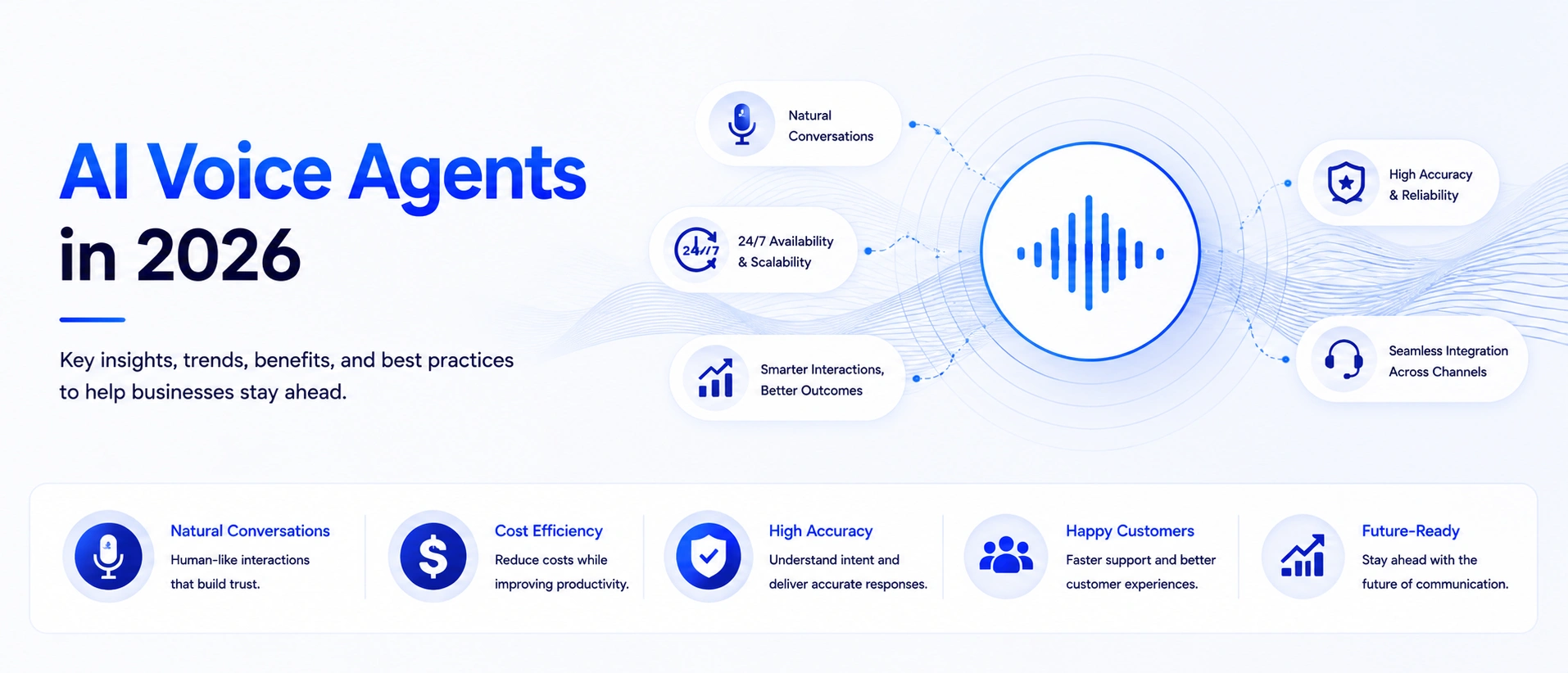
AI voice agents can now support practical customer-service and sales workflows, including routine call handling, booking, qualification and routing within defined permissions. They can complete some routine calls without a person actively participating, while escalating uncertain or consequential cases to a human agent. This guide explains how the technology actually works, what it can realistically handle, and what to check technically, operationally and legally before putting one in front of real callers.
Quick Answer
An AI voice agent is a software system that can receive or place calls, interpret speech, generate spoken responses and complete approved actions through connected business tools. It can handle narrow, repetitive conversations without a person actively participating, but it still needs defined permissions, disclosure, monitoring, escalation and a fallback for when it misunderstands the caller or a connected system fails.
What Can AI Voice Agents Actually Do?
Use case | What the agent can do | Human boundary |
|---|---|---|
Inbound enquiries | Answer routine questions and retrieve approved information | Escalate unusual, sensitive or unverified requests |
Appointment booking | Check live availability, book or reschedule approved appointments | Handle exceptions or failed integrations |
Lead qualification | Collect predefined factual qualification information | Human reviews consequential or judgement-heavy decisions |
Outbound reminders | Place bounded reminder or follow-up calls | Escalate objections, complaints or requests outside scope |
Call routing | Identify intent and route to the correct team | Human handles complex or sensitive cases |
Out-of-hours cover | Answer calls, capture enquiries and complete approved routine actions | Urgent or consequential matters follow the defined on-call escalation path |
What Is an AI Voice Agent?
An AI voice agent is a software system that can hold a spoken conversation with a caller: understanding what is said, deciding how to respond, and taking action based on the exchange. Unlike a traditional phone menu, it does not just play pre-recorded options. It processes natural speech and responds in a way that can feel more conversational than navigating a fixed set of prompts when the system is well configured and tested for the callers it actually handles.
The technology behind a voice agent combines several components: speech recognition to convert spoken words into text, a language model to interpret intent and generate a response, and speech synthesis to speak that response back to the caller. Some newer systems process and generate audio through a single real-time model rather than three separate services, but the recognise-reason-respond structure remains a useful way to understand what is happening, whichever architecture sits underneath it.
Practical use cases include customer service, sales, recruitment, professional services and hospitality, particularly where calls involve repeatable requests and a clear rule for when a person should take over.
How Do AI Voice Agents Work? The AI Workforce Eight-Stage Voice Agent Model
Two architectures are common in production systems today. A cascaded architecture passes audio through separate stages: automatic speech recognition converts the caller's audio to text, a language model interprets that text and decides what to say or do, and a text-to-speech engine converts the response back into audio. A speech-to-speech architecture uses a single real-time multimodal model to process incoming audio and generate an audio response more directly, which can reduce some of the handoff delay between stages. Either way, a production voice agent also needs telephony infrastructure, voice-activity detection to manage turn-taking, tool integrations to actually complete actions, state management across the call, logging, and an escalation path.
To make that concrete, we use a simple eight-stage sequence that describes what a well-built voice agent actually does on a single call, regardless of which underlying architecture powers it:
Listen → Understand → Reason → Retrieve → Act → Speak → Record → Escalate
Listen: capture the caller's audio as it arrives, managing turn-taking and interruptions
Understand: interpret the caller's speech and identify what they want; in cascaded architectures this commonly includes speech-to-text, while integrated real-time models may process audio more directly
Reason: decide what should happen next against the agent's configured rules and permissions
Retrieve: pull approved information from a knowledge base, calendar or connected system
Act: complete a permitted action, such as booking a slot or updating a record
Speak: generate and deliver a spoken response
Record: retain the minimum necessary call outcome, action history and audit information under the organisation's recording and retention policy
Escalate: hand over to a person whenever confidence, risk or complexity exceeds a defined limit, at any point in the sequence rather than only at the end
The prompt or configuration given to the underlying model is what defines the agent's role, tone and rules: what it can and cannot do, how it should handle specific situations, and when to hand off to a human agent. The prompt or configuration is one control layer defining role, tone, permissions and handoff behaviour, alongside the model, knowledge sources, tools, application-level permissions and evaluation. A well-designed configuration is more likely to produce an on-brand, appropriately bounded conversation; a poorly defined one is more likely to drift off-topic or mishandle edge cases.
Latency, the pause between a caller finishing a sentence and the agent responding, is an important operational measure, but it should be judged end-to-end on real calls rather than inferred from a single model benchmark. Telephony, speech recognition, reasoning, any tool calls the agent makes mid-conversation, and speech generation all contribute to the pause a caller experiences. There is no single industry-wide number that qualifies as "fast enough"; the right target is a response time and interruption pattern that your own callers find natural across your actual call scenarios, not a number taken from a vendor's best-case demo.
AI Workforce Insight: In one of our own voice-agent test environments, built around a customer-service booking use case, we measured a reduction in end-to-end response latency from roughly 2,360ms to around 1,160ms across repeated test calls, and this made calls feel substantially less delayed to the test callers involved. This figure comes from a single implementation and test set rather than a broad study across multiple deployments, so treat it as an illustration of what latency work can achieve, not a universal benchmark for every voice agent. It also taught us that latency is not one number produced by one model: telephony, transcription, reasoning, tool calls and speech generation each add their own share of the pause, and each has to be measured and improved separately.
The AI Workforce Eight-Stage Voice Agent Model is an AI Workforce implementation framework rather than an industry standard. A production system also needs monitoring, logging and a tested escalation path around these steps.
Worked Example: Booking an Appointment by Phone
To make the eight-stage model concrete, here is what a well-configured booking call looks like end to end.
A caller rings to book a service appointment. Listen and Understand: the system identifies that the caller wants to book, and captures the service type they mentioned. Reason: it checks whether this is a routine booking request within its configured scope, rather than something requiring escalation. Retrieve: it checks the calendar for availability matching the requested service. Act and Speak: it offers two or three suitable times and confirms once the caller picks one, creating the booking. Record: the CRM is updated with the new appointment and a short call summary, and a confirmation message is sent to the caller. Escalate: if at any point the caller describes an unusual situation, such as a safety issue or a request outside the agent's approved scope, the workflow stops the routine booking path and transfers to a person instead.
If voice-based qualification, calendar routing and booking are the main workflow you want to automate, see our guide to AI appointment setter tools for the dedicated booking and qualification layer.
This sequence is deliberately narrow. The value of the eight-stage model is that it shows exactly where a call could go wrong: a missed intent at Understand, a stale calendar at Retrieve, a failed write at Act, so each stage can be tested and monitored separately rather than treating the whole call as one opaque process.
How Does an AI Voice Agent Compare to IVR and Other Technologies?
Several distinct technologies get grouped under "AI voice," and separating them out makes it much easier to compare what a specific product actually does.
Technology | Interaction model | Workflow structure | Actions |
|---|---|---|---|
IVR | Keypad/fixed voice menu | Predefined branches | Mainly routing |
Voicebot | Spoken | Varies by implementation | May support simple tasks |
AI chatbot | Text | Conversational within configured boundaries | Depends on integrations |
AI voice agent | Spoken | Conversational within configured boundaries | Can use connected tools |
Human call handler | Spoken | Human judgement | Can perform authorised business actions |
It is worth being aware that vendors use these labels inconsistently. A product marketed as a "voicebot" from one vendor may be more capable than a product marketed as an "AI voice agent" from another. Compare what a specific platform actually does against the eight-stage model above, rather than relying on the category label alone.
Interactive voice response, IVR, is the traditional phone-menu technology built around keypad input or very basic voice commands: press 1 for billing, press 2 for support. Traditional keypad-based IVR presents a fixed menu and routes callers through predefined options; it cannot hold a conversation or handle anything outside its menu structure, and it typically repeats itself or fails when a caller says something unexpected. More modern "conversational IVR" systems use speech recognition and natural-language routing, which narrows the gap somewhat. An AI voice agent may additionally interpret free-form requests and complete connected actions rather than only selecting a routing branch.
An AI voice agent can support a freer spoken interaction and may complete some requests directly rather than only routing them: a caller saying "I want to reschedule my appointment for next Tuesday" can be handled without navigating a menu or repeating themselves. A well-designed conversational system may reduce menu navigation and complete more routine requests than a fixed IVR tree, but the actual improvement in containment, transfer rate and caller satisfaction should be measured against your own call data rather than assumed; a poorly configured voice agent can be more frustrating for callers than a clear, well-labelled IVR menu.
What Are the Key Use Cases?
Practical voice-agent use cases include inbound FAQs, appointment booking, order-status enquiries, reminders, qualification and routing where the permitted actions and escalation rules can be defined clearly. Appointment booking, order status enquiries, FAQ resolution and payment reminders are well suited to voice automation. The agent can complete approved actions and write structured call outcomes to a CRM when the required integrations and permissions are in place. This depends on the integration work being completed and tested; it is not automatic by default. Our guide to automating appointment booking with AI covers the booking-specific mechanics, including calendar permissions and failure handling, in more depth.
Outbound use cases include appointment reminders, qualification and follow-up calls that a business initiates itself. Concurrent capacity depends on provider limits, telephony channels, dialler policy, cost controls and the organisation's ability to manage transfers, complaints and compliance, not simply on how many calls the software can technically start. Our guide to AI outbound sales automation covers the wider outbound stack that voice calling often sits within. See the UK outbound-call compliance section below before running any outbound campaign.
For higher-volume customer-service environments, our AI Call Centre Agents guide covers how voice agents fit into a wider contact-centre operation, including agent assist, autonomous handling, CRM integration, human escalation and measuring successful resolution alongside containment.
Voice agents are also used for out-of-hours coverage, multilingual support, and account or booking enquiries in sectors including recruitment, professional services and hospitality. Hospitality use cases can include reservations and routine information calls during periods when staff are occupied elsewhere. Our guide to AI for restaurants in the UK covers how voice reservations fit alongside demand forecasting, staff scheduling, inventory and other restaurant AI workflows. Our guide to AI call handling covers the broader contact-centre picture, our guide to AI receptionists for recruitment agencies covers a specific high-volume use case, and our guide to AI receptionists for law firms covers a sector where the escalation boundary carries particular professional weight. Across these use cases, the common requirement is a reasonably predictable set of queries and a clear rule for when a case needs a person instead.
What Does Production-Ready Conversation Actually Require?
A clean, scripted demo tells you very little about how a voice agent will behave on a real caller's actual phone call. Several distinct issues need to be tested and handled deliberately, not assumed away because a demo sounded smooth:
Interruptions and barge-in: can the system handle a caller talking over it, and recover gracefully rather than losing the thread
Hesitation, pauses and filler words: does normal, unscripted speech, "um, so, I was wondering if...", confuse the system's turn-taking
Background noise: a caller in a car, a shop floor or a windy street is a different test case to a quiet office
Regional UK and non-native accents: performance still varies meaningfully by provider and by the specific caller population, and this has to be tested against your own callers, not assumed from a vendor's general claim
Names, postcodes, addresses and email addresses: these are disproportionately likely to be misheard, and a system needs a defined way to confirm them rather than guess
Callers correcting themselves: "actually, make that Thursday, not Wednesday," mid-sentence
Repeated misunderstandings: what happens on the second or third time the system gets something wrong in the same call
Topic changes during a call: a caller who starts with a booking question and moves to a complaint partway through
None of this makes voice agents unsuitable for the use cases described above, but a system that performs well on a small set of clean demo prompts has not yet demonstrated that it will perform well on a real caller with a cold, a bad line, and a habit of talking over the system. These are why fallback, escalation and conversation quality should all be evaluated during production testing, covered in more depth in the testing methodology section below.
The AI Workforce Bounded Autonomy Ladder for Voice Agents
Not every voice agent should operate with the same level of independence. It helps to think in stages:
Answer and route: the agent greets the caller and directs the call, without taking any other action
Collect information: the agent gathers structured details for a person to act on afterwards
Draft or recommend: the agent proposes a response or action that a person reviews before it goes ahead
Complete low-risk actions: the agent completes defined, reversible actions automatically, within agreed permissions
Transfer consequential cases: routine calls are handled directly; anything uncertain, sensitive or high-value is transferred to a person
For a new use case, AI Workforce uses the lower rungs as an evaluation starting point and extends permissions only where testing supports broader autonomy.
The AI Workforce Bounded Autonomy Ladder is an implementation framework rather than an industry standard.
How Do You Control Hallucination and Incorrect Actions?
A voice agent, like any language-model-based system, can produce a confident, well-formed answer that is simply wrong, or take an action based on a misunderstanding it never surfaced. The following controls reduce this risk; none of them eliminates it entirely.
Approved knowledge sources: the agent should answer from a defined, business-approved knowledge base rather than generating an answer from general model knowledge
Retrieval from current information: pricing, availability and policy information should be retrieved live from the source system, not baked into a static prompt that goes stale
Structured price and availability data: wherever possible, the agent should read exact figures from a database or API rather than paraphrasing them from unstructured text, which reduces the chance of a subtly wrong number
Confirmation of names, dates and important details: the agent should read back details that are particularly likely to be misheard, such as a name, date, email address or postcode, before acting on them
Restricted tool permissions: the agent should only have access to the specific systems and actions a given call type actually needs
Read-back before consequential actions: before completing a booking, a payment-related action or anything hard to reverse, the agent should confirm the details with the caller first
Escalation rules: a defined, specific list of situations that always hand off to a person, rather than leaving the boundary to the model's judgement
Human handover: a working, tested route to a person, not just a documented one
Monitoring and correction: transcripts sampled regularly, with corrections fed back into the configuration
State clearly to anyone evaluating this technology, including your own team, that retrieval and these controls reduce the risk of an incorrect answer but do not eliminate it. A voice agent, like a person, can still misunderstand a caller or make a mistake; the goal of these controls is to catch that before it causes real harm, not to claim the system is infallible.
What should a voice agent never do? An AI voice agent should not pretend to be human, provide unreviewed legal, medical or financial advice, disclose sensitive information without appropriate verification, make consequential eligibility or pricing decisions, promise outcomes outside its authority, or continue autonomously when a caller is distressed or repeatedly asks for a person.
Human-handover triggers should be written down rather than left to the model's judgement. A voice agent should transfer to a person when:
the caller asks for a person
the same misunderstanding repeats
the agent's confidence in what it heard is low
the caller sounds distressed or raises a complaint
sensitive information is involved
the call meets a business-defined high-value opportunity threshold
the request falls outside approved policy
a connected tool or integration fails
the system experiences an outage
the next step is a consequential or irreversible action
Where technically possible, the caller's context should transfer with them, so they are not asked to repeat everything from the start.
What Operational Benefits Can Voice Agents Provide?
Voice agents can provide additional call coverage outside staffed hours and during demand peaks, subject to provider capacity, telephony limits and the organisation's ability to handle resulting escalations. It can handle multiple concurrent calls, subject to provider capacity, telephony limits, cost controls and your own ability to manage the escalations that result, rather than an unlimited number regardless of circumstances.
Cost should be evaluated against successful outcomes rather than call volume alone. A completed call is not necessarily a successful outcome, so the AI Workforce Voice Agent Cost-per-Outcome Model is: cost per successful outcome = total monthly voice-agent cost ÷ successfully completed outcomes. This is a planning formula, not an accounting standard or industry benchmark. What counts as a successful outcome depends on the use case: a completed appointment, a correctly captured enquiry, a resolved routine request, a qualified conversation, or a successful human handover. The numerator should include telephony charges, model usage, platform fees, a share of implementation cost, and ongoing monitoring and human-escalation time. Run that calculation against your own call volume and provider pricing rather than assuming a fixed saving. For a detailed breakdown of setup fees, per-minute voice costs, telephony, concurrency and ongoing support, see our guide to AI voice agent pricing in the UK. Our AI automation pricing guide breaks down what drives these costs, and our dedicated AI receptionist pricing guide covers named UK provider pricing specifically, for anyone comparing a receptionist-style deployment.
A voice agent does not experience fatigue in the way a person does, but it still requires testing, monitoring and a fallback for technical or conversational failure: it can mishear a caller, select the wrong action, lose context partway through a call, fail a booking, call a connected tool incorrectly, or transfer to the wrong queue. A well-integrated transfer can give the receiving human agent a transcript or summary, reducing the need for the caller to repeat themselves, but only when the integration succeeds and the receiving system can actually surface that information.
Voice data generated by calls can provide useful operational insight into what customers ask about, which problems recur and what language they use, provided it is captured, retained and used under proper governance rather than treated as an unrestricted resource. Not every call should be fully transcribed, retained indefinitely, or used for personalisation and training by default; purpose limitation and a defined retention period matter here as much as the technology itself.
Inbound vs Outbound: How They Differ
Inbound and outbound voice agents share the same technical stack but serve different purposes. An inbound agent waits for a caller to initiate contact and attempts to identify and handle the caller's request, answering questions, booking appointments, resolving simple issues, or routing to a person when the complexity warrants it. It needs to identify a broad range of possible intents early in the call.
An outbound agent initiates the call with a specific purpose: a reminder, a follow-up, a qualification question or a survey. The conversational scope is narrower, which can make the workflow more tightly bounded, although consent, screening and escalation may still make the overall deployment complex. Outbound use cases can include appointment reminders, lead re-engagement and post-purchase check-ins, with the agent delivering the core message, handling simple responses, and escalating to a person when the conversation needs it.
The compliance considerations differ sharply between the two, and outbound calling in particular carries specific UK legal obligations covered in full below. Any business running outbound voice campaigns needs to check call classification, consent and screening requirements before launch, not assume a general marketing consent already covers it.
What About Enterprise Deployments?
Enterprise deployments involve more complexity: more call types, more systems to integrate, more languages, and more compliance requirements than a single-use-case pilot. An enterprise voice agent typically needs to connect with existing CRM platforms, ticketing systems, knowledge bases and workforce management tools, with robust fallback and escalation paths, because the operational and reputational impact of a failed interaction can rise with call volume and the sensitivity of the use case.
Generative AI has changed what enterprise voice agents can handle: rather than needing exhaustive scripting for every possible conversation path, a generative AI-powered agent may respond more flexibly to inputs that were not explicitly scripted. That flexibility also introduces variable output rather than a fixed, predictable script, so it requires ongoing evaluation, proper knowledge grounding and clear escalation rules, following the same principles set out in the eight-stage model and hallucination-control section above, just applied across more call types and systems. Custom or cloned voice synthesis is one option enterprise deployments consider for a distinctive brand voice, but it raises its own issues worth a deliberate decision: consent from any real voice used as a basis, impersonation risk, accessibility, and caller trust.
Privacy, Compliance and Voice Data
Any voice agent deployment that records calls or processes personal data needs to address data protection from the start, and the framework depends on where your organisation and your callers are based.
For UK operations, the relevant framework is UK GDPR and the Data Protection Act 2018, not "GDPR" in general terms; EU GDPR may separately apply where processing falls within its territorial scope, for example, calls involving people in the EU. Voice data is personal data when it relates to an identifiable person, but it is not automatically special-category biometric data simply because it is audio; biometric rules become particularly relevant where voice is technically processed for unique identification rather than simply transcribed and understood as speech.
Recording requires more than a single disclosure line. In practice, a business needs a defined purpose, a lawful basis, clear privacy information given to the caller, data minimisation, a defined retention period, appropriate security, a process for handling data-subject access requests, and a separate assessment if voice data is being used for biometric identification or involves sensitive content.
From 2 August 2026, Article 50 of the EU AI Act requires providers of AI systems designed to interact directly with people to ensure that individuals are informed they are interacting with AI, unless this is already obvious from the circumstances. Depending on the deployment and each party's role, providers and deployers may have additional transparency responsibilities. AI Workforce recommends proactive disclosure near the start of a customer-facing call rather than relying on the caller to ask, for example: "Hello, I'm Emma, AI Workforce's automated voice assistant" (an illustrative example of the wording, not a mandatory script). Some providers offer configurable disclosure scripts, but the deploying business remains responsible for deciding what must be said and for verifying that the disclosure is actually delivered on every call, not just built into a demo.
Businesses running voice agents in a US healthcare context should note that HIPAA involves its own organisational requirements that go beyond a single product feature and do not apply to UK deployments, where UK GDPR, the Data Protection Act 2018 and the sector's own regulator apply instead.
Alongside the legal framework, a short operational-security checklist is worth working through with any vendor before signing:
Which subprocessors receive audio, transcripts or caller data?
Where is information stored and processed?
Are international transfers involved, and what safeguard covers them?
Is data used to train the vendor's own models?
How are recordings and transcripts deleted, and on what schedule?
Is data encrypted in transit and at rest?
Which staff can access calls and transcripts, and how is that access controlled?
How are CRM and other connected-system credentials managed?
Does the system maintain an audit log of actions taken?
What happens to data when the contract ends?
The same least-privilege principle set out in the hallucination-controls section above applies here too: the agent, and the people who can review its calls, should only have access to the systems and data that a given call type actually needs.
UK Outbound-Call Compliance
UK businesses running outbound voice campaigns need to distinguish live-call rules from automated-call rules before launch. Do not assume an interactive AI call is regulated the same way as a conventional call made by a person, and do not assume general marketing consent, or consent for live calls, is enough to cover an automated one.
Live calls are governed by PECR regulations 21, 21A and 21B. You must screen against the Telephone Preference Service (TPS) for individuals and the Corporate TPS (CTPS) for businesses, and you must not call anyone who has told you they do not want your calls, unless they have specifically consented. You must always identify the caller, display a genuine contact number, and provide a contact address if asked.
Automated marketing calls are traditionally defined as calls made by an automated system that plays a recorded message, and fall under the stricter regulation 19. These require the recipient's prior, specific consent to that type of call; general marketing consent, or consent only for live calls, is not sufficient. In September 2025, the ICO fined two energy-related firms a combined £550,000 (Home Improvement Marketing Ltd £300,000 and Green Spark Energy Ltd £250,000) for using avatar software that made automated marketing calls sound like a live UK-based agent, an enforcement action worth reading in full before assuming a voice agent's calls are exempt.
Interactive AI-generated calls create an additional classification question that should be resolved before launch. An AI voice agent conducting a live, adaptive conversation is not obviously the same thing as a recorded-message robocall, but it is also not obviously a live human call either. Take specific advice on how your proposed call format is classified before launching an outbound campaign, rather than assuming the more permissive live-call rules apply by default.
The ICO enforces PECR; Ofcom separately regulates telephony matters including number presentation and persistent misuse of a network. Both can be relevant depending on the issue.
See the ICO's own guidance on telephone marketing for the full rules, checklists and current status of this guidance, which was under review at the time of writing following changes introduced by the Data (Use and Access) Act, and see the ICO's enforcement notice on unlawful automated marketing calls for the case referenced above.
Compliance note: this is general information, not legal advice. Take specialist advice on how your specific call format and campaign are classified before launch, and check current ICO and Ofcom guidance, which continues to develop in this area.
When Does a Voice Agent Make Sense for an SMB?
A voice agent is worth evaluating where repetitive inbound calls create measurable missed-call or administrative workload and where the permitted actions and escalation boundary can be defined clearly. Out-of-hours coverage can be one starting use case because the scope can be bounded around enquiry capture, routine information or approved bookings. You do not need to replace your entire phone system to benefit; many voice agents work alongside an existing number, handling specific call types while passing others to the existing team.
A narrow demonstration can be configured quickly, but a production deployment depends on your integrations, call types, testing, compliance requirements and escalation design, not a single fixed timeline. Ask any provider to separate prototype time from the time required for a monitored, live deployment with real callers.
AI Workforce Insight: In our own implementation work, getting a call prompt and conversation flow properly tested against real call scenarios has typically taken around two weeks of iterative trial and error for a fairly narrow use case, based on the projects our team has run rather than a formal study across the market. That testing time is often the part a quick demo does not show, and it can run longer for a wider call scope or a higher-risk use case.
Pricing varies by provider and changes over time, and headline monthly figures rarely include setup, phone numbers, usage-based model and telephony costs, integration work, monitoring or support. Rather than quoting a fixed figure here, our dedicated AI automation pricing guide breaks down current UK costs in more depth, and our AI receptionist pricing guide covers named provider pricing for the receptionist use case specifically; ask any provider for a dated, itemised quote rather than relying on a marketing headline. Our guides to AI call handling and AI receptionists cover closely related use cases in more detail, and our guide to AI agents for small businesses covers the broader context this fits into.
Not Sure Where a Voice Agent Would Fit?
Book a free AI readiness review, and we will help you identify the right first use case for your call handling.
The AI Workforce Voice Agent Testing Methodology
Confirming that "calls are sampled" is not a sufficient testing standard on its own. Before a voice agent goes live, it should be tested deliberately against each of the following scenario types, not just a handful of clean example calls:
Normal, everyday conversations, covering the most common call types the agent will actually handle
Edge cases: unusual but plausible requests that sit at the boundary of the agent's scope
Deliberate attempts to push the agent outside its policy, testing whether it holds the line
Accents, background noise, interruptions and fast speech, covering the range described in the production-conversation section above
Incorrect or missing CRM information, testing how the agent behaves when its data is wrong or absent
Calendar, API and telephony failures, testing whether the agent fails safely rather than confirming something that did not happen
Human-transfer failures, testing what happens when the escalation path itself does not work
Long conversations and context retention, testing whether the agent loses track of earlier parts of the call
Repeated or changed caller information, testing self-correction and confirmation handling
Duplicate-action prevention, testing that the same booking or action is not created twice
Use these scenarios before launch and repeat them as the knowledge base, models or integrations change. Our guide to why AI agents fail covers the common failure patterns this testing is designed to catch.
An Implementation Roadmap
Choose one call type to start with, ideally high-volume, low-risk and well-defined
Define the permitted answers and actions in writing, rather than leaving them implicit
Establish mandatory handover conditions: the specific list of situations that always reach a person
Connect only the minimum required systems, following the least-privilege principle set out in the hallucination-controls section above
Test normal, edge and failure cases, using the ten-point testing methodology above
Pilot on a limited call volume, such as overflow or after-hours calls, before expanding
Review transcripts, actions and handovers regularly, not just once at launch
Expand only when the evidence from that review actually supports it
How to Measure Whether a Voice Agent Is Working
Track a mix of completion, quality and risk indicators rather than call volume alone:
Answer rate and caller hang-up rate
Task-completion rate for the call types the agent is meant to handle
Transfer rate and failed-transfer rate specifically
Average end-to-end response latency and how often the agent is interrupted
Incorrect-action rate and CRM or booking write-error rate
Complaint rate and caller feedback where available
Cost per successful outcome, calculated against your own telephony and platform costs
Human correction rate after review
Disclosure completion rate, where this applies
A useful way to think about overall reliability is as a chain: understanding the caller correctly, retrieving accurate information, taking the right action successfully, recovering cleanly from an error, and transferring correctly when needed. A reliability review should therefore consider the full chain rather than treating strong performance at one stage as evidence that the complete call was handled correctly. Define an observation period appropriate to your call volume before deciding whether to expand a voice agent to a new use case, and see our guide to AI agent KPIs for a fuller framework for choosing what to track.
Ready to Build a Voice Agent That Callers Can Actually Trust?
Book a free AI readiness review to identify the right first use case for a voice agent, agree on the disclosure, permissions and escalation it needs, and build something properly tested before it ever answers a real call.
Sources and Further Reading
The AI Workforce Eight-Stage Voice Agent Model, Bounded Autonomy Ladder, latency example, implementation observations, Voice Agent Testing Methodology, implementation roadmap, measurement framework and cost-per-successful-outcome formula are AI Workforce frameworks, implementation observations and illustrations rather than industry standards or independently verified benchmarks.
Frequently Asked Questions
Will callers know they are speaking to an AI?
They should be told. For customer-facing deployments, AI Workforce recommends proactive disclosure near the start of the call, and it may be legally required depending on the deployment and jurisdiction. Modern voice systems can sound convincing, so businesses should not rely on callers recognising that they are speaking to AI themselves.
What happens when the agent cannot handle a call?
A well-designed voice agent has a clear escalation path: it transfers the caller to a person with a transcript or summary where the integration supports this, reducing the need for the caller to repeat themselves. Transfer paths should be tested explicitly rather than assumed to work because they have been configured.
How long does it take to deploy a voice agent?
A narrow demonstration can be configured quickly, but a production deployment depends on integrations, call types, testing, compliance review and escalation design. Ask providers to separate prototype time from the time needed for a monitored, live deployment, rather than relying on a single quoted figure.
Can a voice agent handle accents and background noise?
Performance varies by provider, caller population, line quality and background noise, so test with representative call scenarios before go-live.
What does a voice agent cost?
Pricing varies by provider and by call volume, and headline figures often exclude setup, telephony, usage-based model costs and integration work. Ask for a current, itemised quote rather than a generic monthly figure, and see our AI automation pricing and AI receptionist pricing guides for a fuller UK breakdown.
Are AI outbound calls legal in the UK?
They can be, but the rules differ for live and automated calls, and an interactive AI-generated call should not be assumed to count as a live call by default. See the UK outbound-call compliance section above, and take specific advice before launching a campaign.
How does a voice agent prevent hallucinated or incorrect answers?
Through a combination of controls, not a single fix: approved knowledge sources, live retrieval of current information, structured data lookups rather than paraphrasing, confirmation of important details before acting, restricted tool permissions, read-back before consequential actions, defined escalation rules and ongoing monitoring. These reduce the risk of an incorrect answer but do not eliminate it.
Key Takeaways
A voice agent holds real spoken conversations rather than operating a fixed phone menu, though performance still varies by accent, noise and call complexity
The eight-stage model, Listen, Understand, Reason, Retrieve, Act, Speak, Record, Escalate, describes what a well-built voice agent does on every call, whichever underlying architecture powers it
Vendors use terms such as IVR, voicebot and AI voice agent inconsistently; compare actual capability against the eight-stage model rather than the category label
A clean scripted demo does not prove production quality; interruptions, hesitation, background noise, accents and topic changes all need deliberate testing
Hallucination and incorrect actions cannot be eliminated entirely, but approved knowledge sources, structured data, confirmation and restricted permissions reduce but do not eliminate the risk
Outbound campaigns carry specific UK obligations under PECR, including a materially stricter consent requirement for automated calls than for live ones
From 2 August 2026, EU AI Act Article 50 requires clear disclosure that a caller is interacting with AI in many contexts; AI Workforce recommends proactive disclosure rather than only when asked
Test against a defined methodology covering normal use, edge cases, deliberate policy tests, noisy conditions, data failures and duplicate-action prevention, not just a handful of clean demo calls
Deployment time and cost depend on your integrations, testing and compliance requirements; treat any fixed timeline or price as a starting estimate, not a guarantee
Related Guides
About the Author
Seth Ayush is Co-Founder and Head of Design and Product at AI Workforce. He works on how AI Workforce's voice and automation products are designed, tested and deployed for UK businesses, with a focus on latency, escalation and getting the details of a call flow right before it reaches a real caller.
About the Reviewer
Rodi Taze is Co-Founder of AI Workforce. He works with UK businesses to map AI voice and call-handling workflows, agree escalation boundaries and put UK GDPR, PECR and disclosure safeguards in place before a system is trusted with real callers.
Reviewed: September 2026
© 2026 AI Workforce Ltd. All rights reserved.