AI Customer Service Statistics 2026
Posted On: August 14, 2026
Quick answer: Customer-service research in 2026 shows that customers increasingly expect faster, round-the-clock support, but not unrestricted automation. Zendesk's CX Trends 2026 research (11,000+ respondents, 22 countries) found that 88% of consumers expect quicker responses than a year earlier, 74% expect 24/7 availability, and 95% want to understand why AI makes decisions, though only 37% of CX leaders currently explain that reasoning. Gartner forecasts that agentic AI could autonomously resolve 80% of common service issues by 2029, but that remains a forecast, not current performance, and vendor-commissioned tracking research suggests that most consumers still prefer a human agent for anything beyond a simple task.
This article separates what customers currently expect, what businesses currently do, what people say they prefer, and what analysts forecast for the future, because treating all four as equivalent is the most common mistake in AI customer service coverage.
At a Glance
Current customer expectations: faster responses (88%), round-the-clock availability (74%) and an explanation when AI makes a decision (95%), per Zendesk, CX Trends 2026
Current organisational practice: only 37% of CX leaders currently explain AI decisions to customers, per Zendesk, CX Trends 2026, and 56% are exploring new generative AI vendors, per Zendesk's 2026 statistics roundup
Customer preference: OnePoll research commissioned by AnswerConnect found that 85% of surveyed consumers across the US, UK and Canada preferred speaking to a real person in April 2026
Forecast, not current result: agentic AI autonomously resolving 80% of common issues by 2029, per Gartner, March 2025
Evidence limitation: most figures come from vendor-sponsored, vendor-commissioned or multinational surveys, and differences in geography, sample and question wording mean the results are not directly comparable
What's Covered
Why Vendor, Survey and Forecast Evidence Need to Be Kept Separate
Is There a Trust Gap Between What Customers Want and What Businesses Provide?
AI Agent or Human Agent: Which Do Customers Actually Prefer?
Where Does the AI Agent Fit Into Customer Interactions Today?

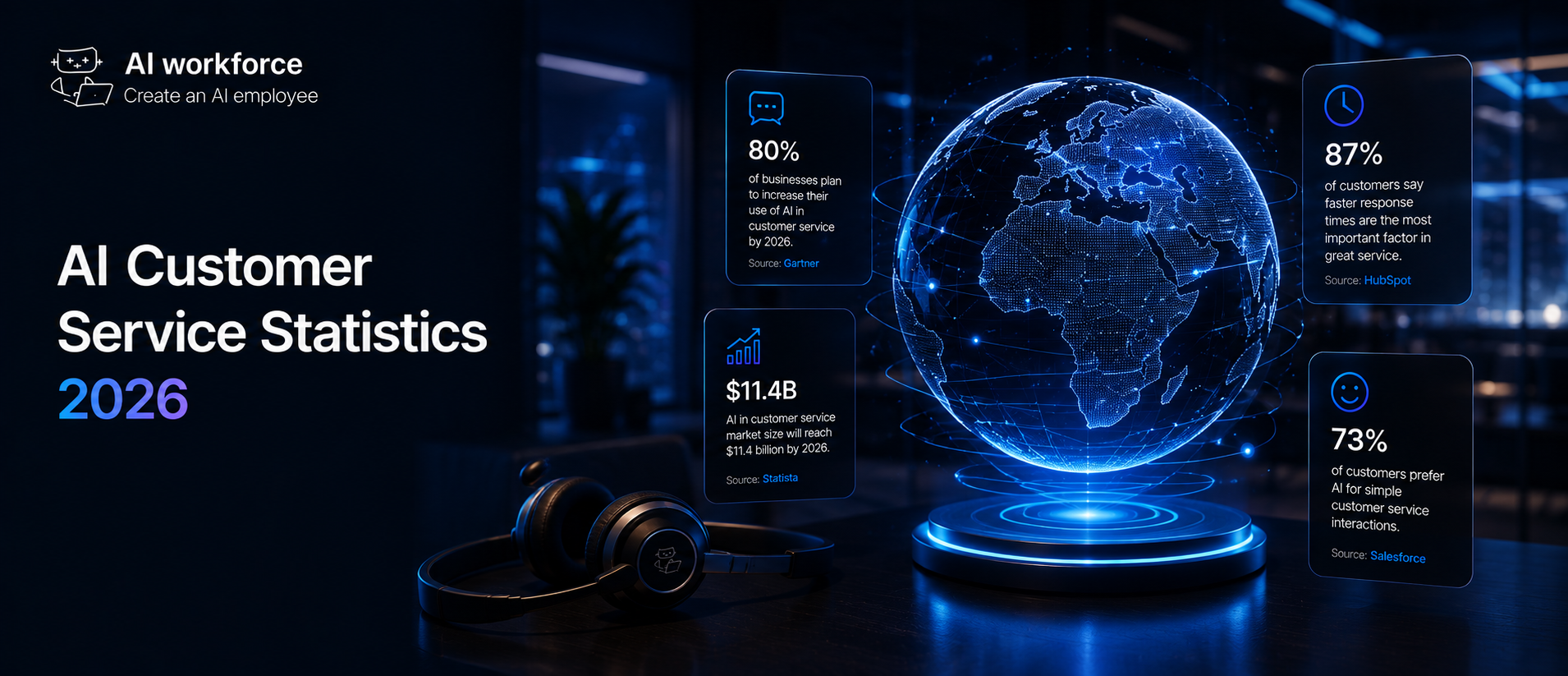
Four headline figures from Zendesk's CX Trends 2026 research. The gap between the third and fourth card is the single most important fact in this article.
Evidence at a Glance
Nine current, named figures set the scene before the detail below. The gap between the fourth and fifth row is the single most important fact in this article.
Statistic | What it measures | Source and year | Sample | Evidence type |
|---|---|---|---|---|
88% expect faster responses than a year ago | Customer expectation | Zendesk CX Trends, 2026 | 6,182 consumers, 22 countries | Survey |
74% expect 24/7 service | Customer expectation | Zendesk CX Trends, 2026 | 6,182 consumers, 22 countries | Survey |
81% want an agent to continue a conversation without backtracking | Customer expectation | Zendesk CX Trends, 2026 | 6,182 consumers, 22 countries | Survey |
95% want AI decisions explained | Customer trust | Zendesk CX Trends, 2026 | 6,182 consumers, 22 countries | Survey |
37% of CX leaders currently explain AI decisions | Organisational practice | Zendesk CX Trends, 2026 | 5,115 business respondents, 22 countries | Survey |
Preference for a human agent rose from 83% to 85% | Customer preference | AnswerConnect (commissioned OnePoll survey), Apr 2026 | 6,000 consumers, US/UK/Canada, vs Oct 2025 | Vendor-commissioned survey |
55% highly concerned about bias in AI decisions | Consumer sentiment | Pew Research Center, Apr 2025 | 5,410 US adults | Independent survey |
$12.06bn (2024) to $47.82bn (2030), 25.8% CAGR | Market forecast | MarketsandMarkets, AI for Customer Service Market | Global market model | Forecast |
80% of common issues resolved autonomously by 2029 | Future forecast | Gartner, Mar 2025 | Analyst forecast | Forecast |
Table 1: nine customer-service statistics referenced in this article, with source, sample and evidence type shown separately.
Why Vendor, Survey and Forecast Evidence Need to Be Kept Separate
Most "AI customer service statistics" articles blend five different kinds of evidence into one narrative: what technology is actually deployed, what customers say they expect, what a company has measured about its own results, what executives intend or predict, and what an analyst firm models for a future date. These are not interchangeable, and conflating them is why AI statistics coverage is often unreliable.
AI Workforce uses a simple framework, the AI Workforce Customer Service Evidence Matrix, to keep these separate when interpreting any customer-service statistic.
Evidence category | Meaning | Appropriate use |
|---|---|---|
Observed adoption | Technology currently in operation, reported by vendors or analysts | Assess market maturity |
Customer expectation | What survey respondents say they expect or want | Inform experience design |
Operational result | Measured resolution rate, cost or satisfaction from a named deployment | Build a business case |
Executive intention | What business leaders plan, explore or expect | Directional evidence only |
Forecast | An analyst's model of possible future adoption | Scenario planning, not a current claim |
Zendesk is a useful primary source for its own research, but it is also a customer-service technology vendor, so its findings sit alongside independent research and analyst forecasts in the table above rather than standing in for all of them.
What Do Customers Currently Expect From AI-Powered Support?
Zendesk's CX Trends 2026 research, based on 6,182 consumers and 5,115 business respondents across 22 countries surveyed in June 2025, found that 88% of consumers expect faster responses than they did a year earlier, and 74% expect customer service to be available around the clock. A further 81% said they want a service agent to continue a conversation without making them repeat information they had already given, and 74% said they get frustrated when they do have to repeat themselves.
These are customer expectation statistics, not adoption statistics: they describe what people say they want, not what businesses have actually built. A Zendesk statistics roundup reports that 56% of CX leaders are exploring new generative AI vendors for customer service, which is a statement of executive intention rather than a measured outcome; this figure appears in Zendesk's 2026 statistics roundup but is not confirmed as part of the CX Trends 2026 fieldwork itself, so it should be read as Zendesk-sourced rather than attributed to that specific study.
How Widespread Is Actual AI Adoption in Customer Service?
Reliable, precisely sourced figures on what proportion of contact centres currently use AI are harder to find than the marketing language around "AI adoption" suggests, and several widely repeated adoption percentages could not be traced back to an identifiable, named survey with a clear methodology. Rather than repeat an unverifiable adoption figure, the more defensible statement is that AI-assisted triage, drafting and self-service are now common in customer service software, evidenced by the pace at which established vendors including Zendesk, Salesforce and HubSpot have moved core products toward AI-agent and outcome-based pricing over the past two years, a shift covered in more depth in our AI Call Centre guide.
The AI for Customer Service Market, tracked by MarketsandMarkets, was valued at $12.06 billion in 2024 and is forecast to reach $47.82 billion by 2030, a compound annual growth rate of about 25.8%. This is a market-size forecast, not a measure of what share of customer service interactions are currently AI-handled, and market definitions vary between research firms, so it should not be read alongside adoption percentages from a different source as if they measured the same thing.
What Do Customers Say About Chatbots and Human-Assisted AI?
Zendesk's 2026 statistics roundup reports that 51% of consumers prefer interacting with a bot when they need an immediate response, a meaningful figure given how often chatbots were dismissed as poor customer experience only a few years ago. Separately, Zendesk reports that 75% of CX leaders see AI as a way to amplify human intelligence rather than replace it. That is an executive view, not evidence that customers prefer AI-drafted replies or that those replies produce better outcomes, and the two figures should not be read as measuring the same thing.
Neither statistic says how often a chatbot actually resolves an issue correctly, and businesses should treat "consumers prefer bots for immediate service" and "chatbots resolve issues well" as two separate claims that each need their own evidence.
Not sure which customer-service workflows are ready for automation? Use the AI Readiness Assessment to separate the tasks suited to autonomous handling from the ones that still need a person.
Is There a Trust Gap Between What Customers Want and What Businesses Provide?
Yes, and it is one of the more consistent findings across 2026 research. Zendesk found that 95% of consumers want to know why AI makes the decisions it does, yet only 37% of CX leaders currently offer any reasoning behind those decisions, even though 80% of CX leaders agree that AI transparency will be required for customer-facing AI within two years. That is a 58-percentage-point gap between what customers say they want and what organisations report actually doing, one of the most consequential figures in this article and a consideration relevant to any business also working through UK GDPR compliance for AI systems.
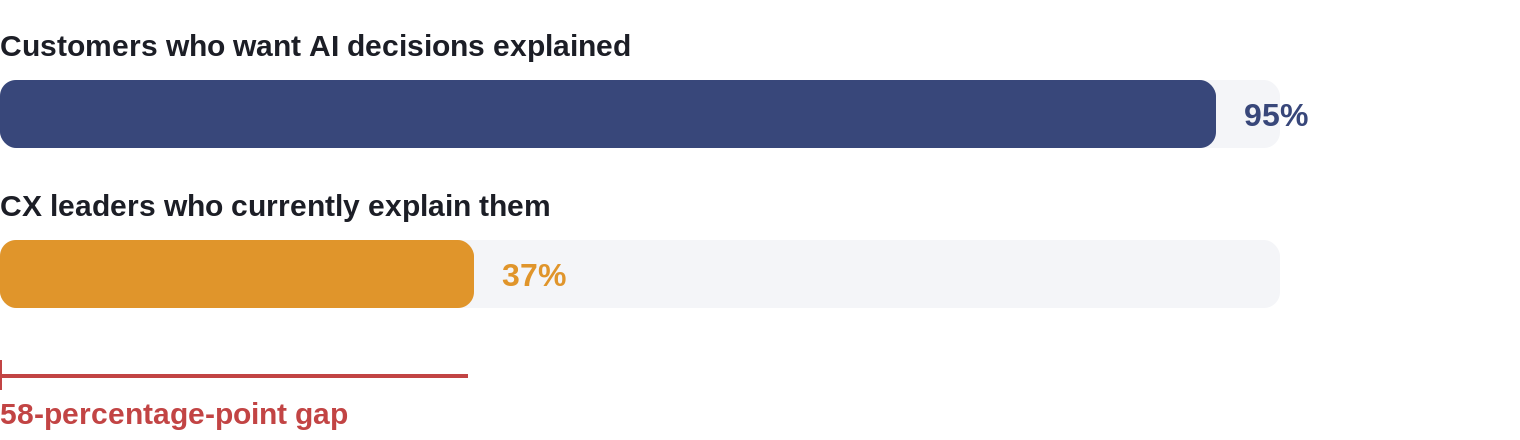
Measure | Share |
|---|---|
Customers who want AI decisions explained | 95% |
CX leaders who currently explain them | 37% |
Gap | 58 percentage points |
Table 2: the transparency gap between what customers want explained and what CX leaders currently explain. Source: Zendesk, CX Trends 2026.
Separately, Pew Research Center's April 2025 survey of 5,410 US adults found that 55% were highly concerned about bias in decisions made by AI, a finding about general attitudes to algorithmic decision-making rather than customer service specifically, but relevant context for why transparency matters. Businesses that use AI without addressing this gap risk building an efficient system that does not earn customer trust, regardless of how accurate it actually is.
AI Agent or Human Agent: Which Do Customers Actually Prefer?
Vendor-commissioned tracking research conducted by OnePoll for AnswerConnect, an answering-service provider, surveyed 6,000 consumers across the US, UK and Canada and found that preference for speaking to a real person rose from 83% in October 2025 to 85% in April 2026, while preference for AI fell from 7% to 5% over the same period. AnswerConnect sells human-staffed answering services and campaigns publicly for "people, not bots," so this figure should be read as commissioned research with a clear commercial position, not as independent academic data.
That does not mean AI and human support are competing for the same interactions. Customers say they find AI genuinely useful for narrow, low-stakes jobs: directing them to the right person, confirming an order, or scheduling an appointment. Support teams that use AI for that narrower set of tasks, while keeping a person available for anything more complex, are closer to what the preference data actually shows than teams pursuing full automation.
Where Does the AI Agent Fit Into Customer Interactions Today?
An AI agent, in the agentic sense, does not only answer a question; it can take action, such as starting a refund, updating a record or completing a booking change inside a single conversation. Zendesk's CX Trends 2025 report (its seventh annual report, based on more than 10,000 consumers and business leaders) found that 75% of CX leaders expected AI agents to resolve around 80% of customer interactions without a person involved within a few years, an executive-intention figure that should be read alongside Gartner's separate forecast below rather than as a confirmed outcome.
Gartner's March 2025 forecast is more specific: agentic AI is expected to autonomously resolve 80% of common customer service issues without human intervention by 2029, up from a negligible share at the time of the forecast, with an associated 30% reduction in operational costs. This is Gartner's separate and more specifically defined forecast: it measures "common customer service issues," not the broader "customer interactions" Zendesk's 2025 CX leaders were asked about, so one figure should not be read as a more conservative version of the other. This is explicitly a 2029 forecast, not a 2026 measurement. Our AI Voice Agents guide covers the related shift toward voice-based automation in more depth, and Zendesk separately reports that 83% of CX leaders consider AI agents that retain context across channels important to building a genuinely personalised customer journey.
Published as CX Trends 2026: survey findings | Gartner 2029 forecast |
|---|---|
88% expect faster responses; 74% expect 24/7 availability; 95% want AI decisions explained; 37% of CX leaders currently explain them (Zendesk, CX Trends 2026) | Agentic AI autonomously resolves 80% of common customer service issues without human intervention, with an associated 30% reduction in operational costs (Gartner, March 2025 forecast) |
Table 3: Zendesk's CX Trends 2026 survey findings shown alongside Gartner's separate 2029 forecast, kept in different columns so the two are not read as the same kind of evidence.
How Does This Play Out Beyond the Support Desk?
Phocuswright's 2025 research report, "Chat, Plan, Book: GenAI Goes Mainstream," found that 78% of travellers rated generative AI results as somewhat or very helpful for trip planning, though the same report found only around a third of travellers said they fully trust generative AI's responses, illustrating that usefulness and trust are measured separately and do not move together.
EY's Global Consumer Health Survey 2026 (7,697 respondents across seven market groupings) found that 56% of respondents had requested, or would consider requesting, a test, treatment or prescription based on information they learned from AI. Clinicians remained the more trusted source overall: 89% of respondents considered clinicians reliable, compared with 68% for AI tools. This concerns health information rather than customer service specifically, but it illustrates the same wider pattern as the customer-service data above: people are willing to use AI for a well-defined task while still wanting a person, or a professional, accountable for anything that matters to them.
What Would Make This Evidence More Useful Going Forward?
Most publicly available customer-service statistics come from vendors marketing their own AI products, from single-country consumer polls, or from analyst forecasts with a multi-year horizon. Few are independently replicated, and percentages from different studies, countries and years are not directly comparable even when they look similar. AI Workforce's second framework, the AI Workforce Customer Service Boundary Matrix, is a simpler tool for turning this evidence into a decision rather than a headline:
Suitable for autonomous resolution: high-volume, low-ambiguity tasks with a clear correct answer, such as order status, appointment scheduling or password resets
Suitable with human review: tasks where AI can draft or recommend, but a person checks the output before it reaches the customer, such as complex replies or refund decisions above a set value
Requires human ownership: tasks involving distress, complaints, safeguarding, or decisions with a material financial or legal consequence for the customer
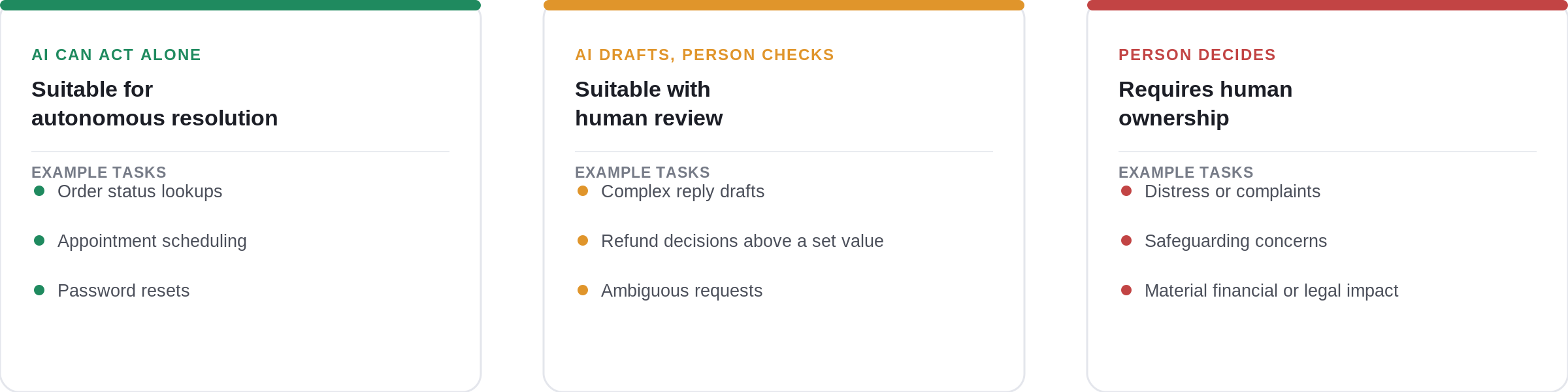
The AI Workforce Customer Service Boundary Matrix: three categories for deciding when AI can act alone, when it should draft for human review, and when a person must retain ownership.
Methodology Note
This article draws on named, dated, publicly available sources rather than aggregating unattributed statistics from secondary listicles. Figures are drawn from global or US-based surveys unless a source specifically covers other markets; readers should not assume any single figure applies uniformly across markets. Vendor-sponsored or vendor-commissioned research (Zendesk, AnswerConnect) is presented alongside independent survey data (Pew Research Center) and analyst forecasts (Gartner, MarketsandMarkets), plus travel- and health-sector research (Phocuswright, EY) used only for wider context, rather than blended into one figure. Forecasts are explicitly labelled with their target year and are not presented as 2026 measurements. All figures are reported in the currency used by the original source, with no currency conversion applied. Sources were checked in August 2026; percentages from different studies should not be treated as directly comparable, since sample, geography, question wording and year all vary.
Key Things to Remember
Zendesk's CX Trends 2026 research (11,000+ respondents, 22 countries) is the best-sourced dataset in this article: 88% expect faster responses, 74% expect 24/7 availability, 95% want AI decisions explained, and only 37% of CX leaders currently explain that reasoning
Gartner's forecast that agentic AI will autonomously resolve 80% of common issues by 2029 is a forecast for 2029, not a description of 2026 performance
Vendor-commissioned tracking data (AnswerConnect) shows a majority of customers still prefer a human agent once a task is more than simple, and that preference has not weakened through 2026
The AI for Customer Service Market was valued at $12.06 billion in 2024 and is forecast to reach $47.82 billion by 2030 (MarketsandMarkets), a market-size forecast rather than an adoption or performance figure
A 58-percentage-point gap exists between the 95% of consumers who want AI decisions explained and the 37% of CX leaders who currently do so
Vendor research, independent surveys and analyst forecasts measure different things and should not be blended into a single narrative
The most useful role for AI in customer service today is handling narrow, verifiable tasks well, while keeping a person accountable for anything complex, sensitive or high-stakes
Related Guides
Sources and Further Reading
Zendesk, CX Trends 2026: survey of 6,182 consumers and 5,115 business respondents across 22 countries, fieldwork June 2025, published November 2025.
Zendesk, "Contextual Intelligence Becomes the New Standard for Exceptional Customer Experience in 2026," press release, November 2025.
Zendesk, "59 AI Customer Service Statistics for 2026," checked August 2026.
Gartner, "Gartner Predicts Agentic AI Will Autonomously Resolve 80% of Common Customer Service Issues Without Human Intervention by 2029," March 2025.
MarketsandMarkets, "AI for Customer Service Market," 2024 to 2030 size and growth forecast.
Pew Research Center, "How the U.S. Public and AI Experts View Artificial Intelligence," April 2025, 5,410 US adults.
AnswerConnect, "2026 AI Customer Service Statistics: Customers Prefer Humans Over Bots," OnePoll-commissioned tracking survey, October 2025 to April 2026.
Zendesk, CX Trends 2025 report: seventh annual report, more than 10,000 consumers and business leaders.
Phocuswright, "Chat, Plan, Book: GenAI Goes Mainstream," 2025.
EY, Global Consumer Health Survey 2026, 7,697 respondents across seven market groupings.
Not Sure Where Customer-Service Automation Should Begin?
AI Workforce can assess your current support journey, identify a suitable first workflow, and define where human review should remain mandatory.
About the Author
Clara Miller is a Content Specialist at AI Workforce, a British AI company building AI agents for UK businesses. She researches and reports on AI adoption evidence for UK business audiences.
Reviewed by Seth Ayush, Co-Founder of AI Workforce, for the interpretation of AI systems, customer-service workflows and implementation boundaries.