AI Call Centre Agents: Automation, Software and UK Guide
Posted On: August 1, 2026
Written by Luca Controlo, AI Adoption and Marketing Automation Lead at AI Workforce · Reviewed by Rodi Taze, Co-Founder of AI Workforce
Last updated: August 2026
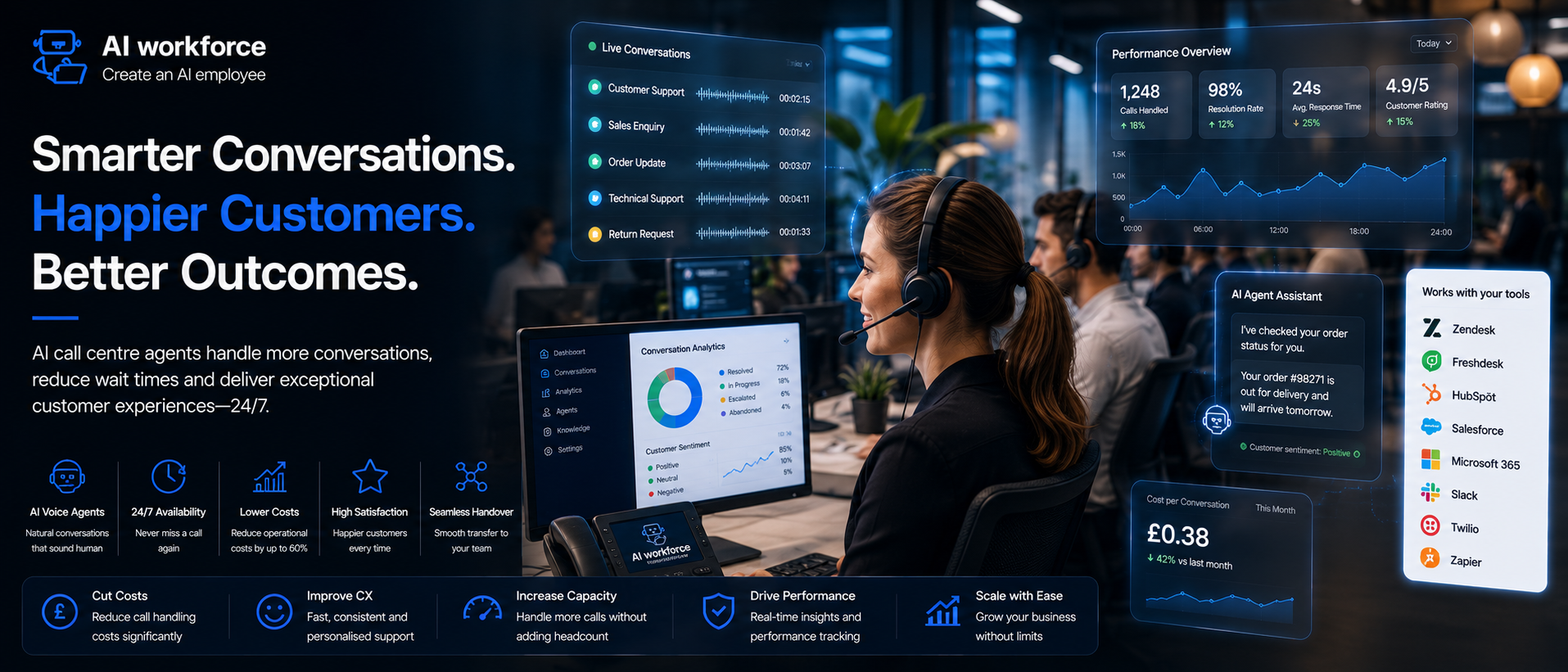
Quick Answer: An AI call centre uses artificial intelligence to automate or assist customer conversations: routing, transcription, summarising, quality monitoring and routine follow-up. AI can be configured to handle high-volume, predictable enquiries within an approved scope, while complaints, vulnerable customers, complex decisions and anything carrying significant financial or regulatory consequences should have a clear route to a human agent.
At a Glance
What it is: AI layered onto call routing, voice interaction, transcription and response drafting inside an existing call or contact centre
What AI can automate: routine FAQs, order and status checks, call routing, basic data capture, transcription and appointment booking
What needs a human: complaints, vulnerable customers, complex financial decisions, retention disputes and anything outside approved policy
Biggest implementation risk: rolling automation out broadly before proving one narrow workflow, and mistaking a high containment rate for genuine resolution
What to measure: successful resolution alongside containment, not containment alone, plus escalation rate, handling time and cost per resolved contact
What's Covered
What Is an AI Call Centre?
AI Call Centre vs AI Contact Centre: What Is the Difference?
How Does an AI Call Centre Work?
What Can AI Automate in a Call Centre?
Agent Assist vs Autonomous AI Agents
The AI Workforce Call Centre AI Model
The AI Workforce Call Centre AI Boundary Matrix
Worked Example: Rescheduling an Appointment by Phone
AI Voice Agents vs Traditional IVR
Can AI Call Centre Agents Replace Human Agents?
What Are the Benefits of AI in Call Centres?
Can AI Reduce Average Handle Time?
How Do You Integrate AI With an Existing Contact Centre?
Outbound Call-Centre Use Cases
What Should Businesses Look for in AI Call-Centre Software?
Comparing Call-Centre Operating Models
Is AI Call-Centre Software Right for UK Businesses?
What Are the Risks of AI Call Centres?
How Much Does an AI Call Centre Cost?
How Do AI Voice Agents Hand Calls to Humans?
How Do You Measure AI Call Centre Performance?
How Should a Business Implement AI in a Call Centre?
Common Mistakes
Frequently Asked Questions
Key Takeaways
What Is an AI Call Centre?
What is an AI call centre? An AI call centre is a customer contact operation that uses artificial intelligence to automate or assist parts of a call: routing a caller to the right place, transcribing and summarising a conversation, drafting or delivering a response, and flagging what needs a person. It is not a single product. It is a layer of capability added to the routing, telephony and CRM systems a call centre already runs.
Most AI call centres do not replace their existing telephony and CRM systems. AI is layered on top: routing decisions, transcription, response drafting and quality monitoring all happen with far less manual effort, while the underlying systems of record stay the same. Platforms built for this environment increasingly bundle several of these functions together, and a model configured against a business's own call history and approved information tends to perform more reliably on that business's specific enquiries than a generic, ungrounded tool.
Centres that adopt this successfully usually start with one narrow task, a routing decision or a first-line answer, before expanding further. That narrow starting point matters more than the headline capability of any one platform, and it is the theme this guide returns to throughout.
AI Call Centre vs AI Contact Centre: What Is the Difference?
An AI call centre primarily manages voice calls. An AI contact centre applies similar routing, assistance and automation across calls, email, live chat, messaging and social channels. In practice, many modern platforms support both, but businesses should check whether a proposed solution is genuinely omnichannel or primarily a voice product before assuming it covers every channel a customer might use.
The distinction matters most when a business already runs live chat or email support alongside phone calls. A platform bought as a voice-only AI call centre may need a separate tool, or a separate configuration, to cover those other channels, which changes both the cost and the integration work involved.
How Does an AI Call Centre Work?
How does an AI call centre work? An AI call centre typically combines speech recognition, a language model and integrations with a CRM or knowledge base. The system listens to or reads a customer's request, works out the intent, retrieves approved information, responds or takes a pre-approved action, and hands the call to a person whenever confidence, risk or complexity exceeds a defined limit.
Several distinct technologies get bundled under the single label "AI call centre," and separating them out actually improves both clarity and search relevance. Traditional IVR is a fixed phone menu built around keypad or basic voice input. A conversational AI system interprets natural language rather than matching against a script. An AI voice agent extends conversational AI to full spoken interaction, understanding context across a call rather than one exchange at a time. Agent-assist AI sits alongside a human agent, prompting a next-best action or drafting a response for them to send, rather than handling the call independently. Speech analytics reviews recorded or live calls for sentiment, compliance or quality signals, typically after the fact rather than acting in the moment. A single deployment often uses several of these together, which is exactly why it is worth knowing which one is actually doing the work in any given part of a call.
AI agents now handle a growing share of the repetitive load that used to sit entirely with a person: pulling up an account, drafting a first response, summarising what happened on a previous call. This does not remove a human agent from the loop. It changes what they spend their time on, shifting attention toward the calls that need real judgement rather than the ones that follow a predictable pattern.
What Can AI Automate in a Call Centre?
Not every part of a call carries the same risk, and treating them all the same is one of the more common reasons an AI call centre rollout goes wrong. Deciding what to automate first matters more than most teams expect. A narrow, high-volume, low-complexity task is almost always the right place to start, rather than trying to automate an entire operation at once.
What can AI call centre agents automate? AI can reliably automate call routing, opening-hours and order-status enquiries, routine FAQs, basic data capture, appointment booking and transcription. It should not independently resolve complaints, handle vulnerable callers, make complex financial decisions or act outside a business's approved policy without a defined path to a person.
Call volume spikes are where the return on this kind of automation shows up fastest, since a well-configured system can absorb a surge that would otherwise mean a long wait or a dropped call. Call routing improved this way gets a caller to the right place faster and with less back-and-forth than a traditional menu system, and call handling overall becomes noticeably smoother once these smaller pieces work well together rather than being bolted on separately. Our guide to AI call handling covers the underlying mechanics of this in more depth, including how a system should behave when it does not have a confident answer.
Agent Assist vs Autonomous AI Agents
Agent assist and a fully autonomous AI agent are often described interchangeably, but they carry different risk profiles and suit different teams. Agent assist is often the lower-risk starting point for an established support team, since a person remains in control of the call throughout.
Swipe to see all columns →
Capability | Agent assist | Autonomous AI agent |
|---|---|---|
Who leads the call? | Human agent | AI system |
Live prompts | Yes | Not applicable |
Knowledge retrieval | Supports the person | Retrieves for its own response |
Call summaries | Drafts after or during the call | Creates its own interaction record |
Independent actions | Usually limited | Pre-approved actions only |
Human escalation | Human is already present | Requires an explicit handoff |
A team new to AI in the call centre often gets more reliable early results from agent assist, since the human agent can catch a wrong suggestion before it reaches the customer. Autonomous agents earn a wider role over time, as the Boundary Matrix below sets out, once a narrow task has been proven with real call data.
The AI Workforce Call Centre AI Model
Across every deployment we have looked at, a consistent underlying pattern shows up, whether the tool is a simple routing assistant or a full conversational voice agent. We call this the AI Workforce Call Centre AI Model, a framework for separating what AI can safely prepare from what requires a person's decision.
AI Workforce developed the Call Centre AI Model as a practical framework for checking whether a specific workflow is actually a good fit for automation.
Listen: capture the customer's speech or message as it comes in
Understand: identify intent, context and the relevant details of the request
Retrieve: pull approved information from the knowledge base, CRM or other connected systems
Respond: provide an answer or ask the next appropriate question
Act: complete pre-approved actions, such as booking an appointment or updating a record
Escalate: hand over to a person whenever confidence, risk or complexity exceeds defined limits
Record: save the interaction, the outcome and any actions taken
Learn: review errors, escalations and outcomes to improve the workflow over time
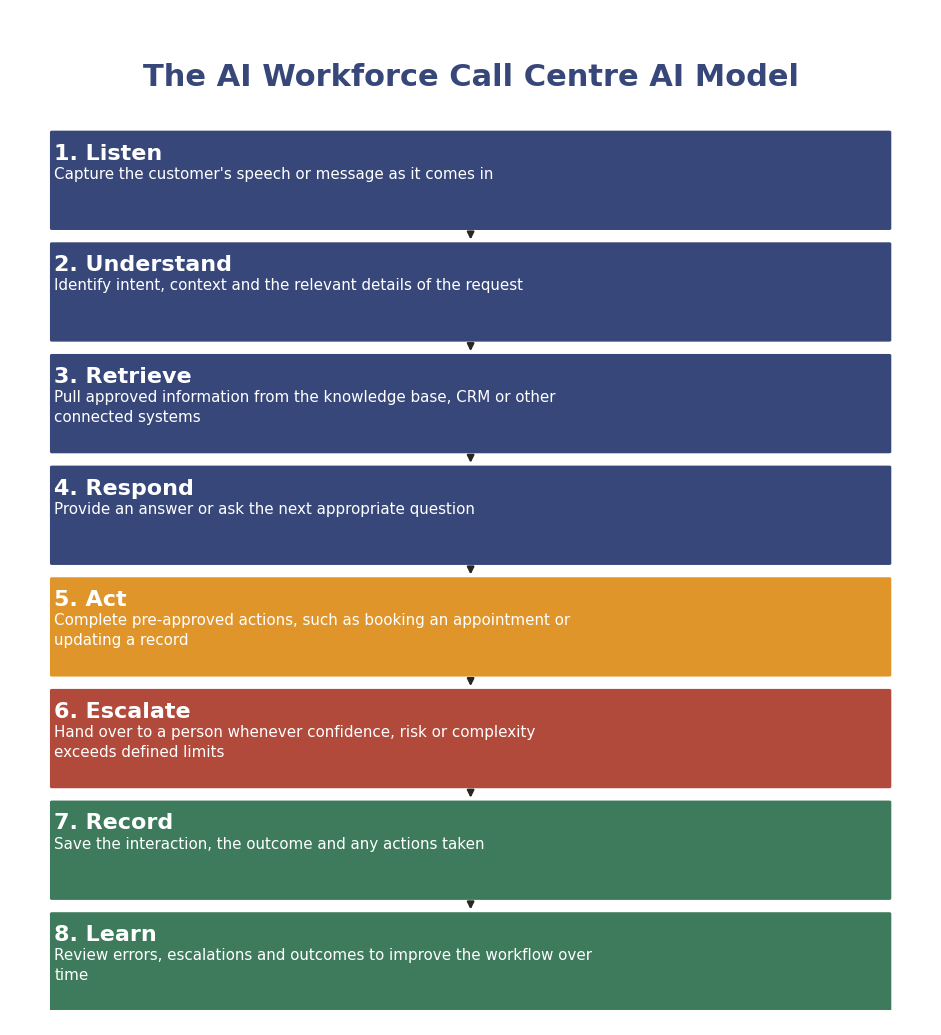
A call-centre workflow that moves from Understand directly to Act, without checking approved information or having an escalation path, carries substantially more risk than one built around Retrieve and Escalate. The difference is not visible in a demo. It shows up the first time a caller asks something the system was never actually equipped to handle.
The AI Workforce Call Centre AI Boundary Matrix
Not every call carries the same risk, and grouping tasks by how much autonomy is appropriate makes the rest of this guide, and any real deployment, considerably more useful. This is how we group call-centre work into three tiers.
Illustrative starting point. Your own risk tolerance and call volume should adjust where a task sits.
Higher Automation
Opening hours and location enquiries
Order and status checks
Routine FAQs answered from approved information
Call routing
Basic data capture
Transcription
AI Handles, Human Available
Appointment booking and rescheduling
Lead qualification
Account updates
Follow-up drafting
Standard troubleshooting
Human-Led
Complaints
Vulnerable customers
Complex financial decisions
Retention disputes
Regulatory or safety issues
Anything outside approved policy
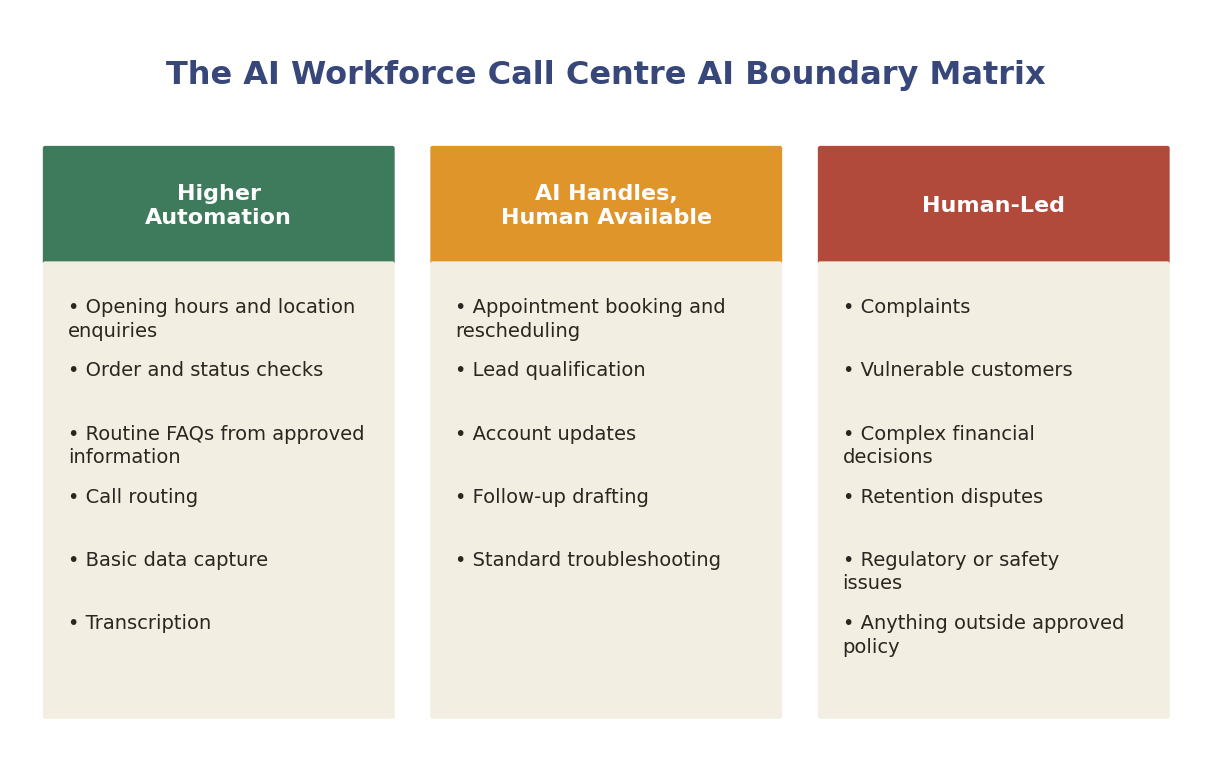
A task sitting in the top tier today does not have to stay there forever, and a task that starts in the bottom tier is not necessarily permanent either. The point of the matrix is to make the current boundary explicit, so that moving a task up a tier is a deliberate decision based on evidence, not something that happens by default because a platform technically could handle it.
Worked Example: Rescheduling an Appointment by Phone
To make the Call Centre AI Model concrete, here is what a well-configured call looks like end to end, following the same pattern described above.
Illustrative example. A production deployment also needs a defined audit trail, not just the steps shown here.
00:00, Listen: the customer calls and asks to move tomorrow's appointment.
00:05, Understand: the system identifies the customer and the booking intent.
00:10, Retrieve: it checks the CRM and calendar for available slots.
00:15, Respond: it offers three available times that fit the customer's stated preference.
00:30, Act: the customer chooses Friday at 11:30, and the appointment is updated in the calendar and CRM.
00:35, Record: the CRM receives the new booking and a short call summary.
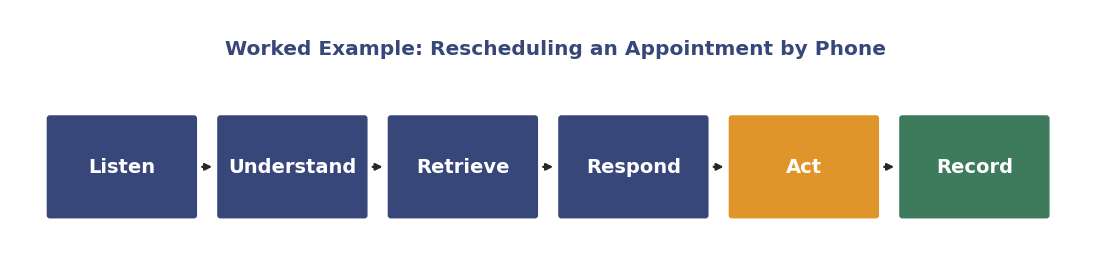
If the same customer instead says they want to complain about how a previous booking was handled, the conversation moves to Escalate rather than attempting an autonomous resolution. That branch point, not the booking flow itself, is where most of the real risk in a call-centre deployment actually sits.
AI Voice Agents vs Traditional IVR
What is the difference between AI call centres and traditional IVR? Traditional IVR follows predefined menus and rules: press one for billing, press two for support. An AI voice agent can interpret natural language, maintain conversational context, retrieve information and take approved actions. Both can automate calls, but AI is more flexible while also requiring stronger controls around accuracy, escalation and data access.
The practical difference shows up the moment a caller says something that does not fit a fixed menu. A traditional IVR tree either forces the caller back to the start or routes them somewhere close enough, but not quite right. A well-configured conversational system can ask a clarifying question, retrieve relevant information and complete the request without the caller repeating themselves or navigating a menu at all.
This flexibility is also exactly why an AI voice agent needs more governance than a fixed IVR tree, not less. A menu can only take a caller down a small number of pre-built paths. A conversational system that can respond to open-ended input needs a defined escalation policy, an approved knowledge base and monitoring, because its flexibility is precisely what makes an unbounded or poorly configured deployment riskier than a rigid one. Our guide to AI voice agents covers this technology, and the governance it needs, in more depth.
Can AI Call Centre Agents Replace Human Agents?
Can AI call centre agents replace human agents? Not for anything requiring real judgement. AI agents handle a growing share of repetitive, well-defined enquiries well, but a human agent still needs to handle complaints, vulnerable customers, complex decisions and anything a caller finds genuinely frustrating or unresolved. The strongest deployments use AI to absorb predictable volume, freeing people for the calls that actually need them.
A human agent still handles anything that needs real judgement or a difficult conversation, and AI is best used for the narrow, well-defined questions that make up most of the call volume in a typical operation. In our experience, agent productivity tends to improve once the repetitive parts of the job are handled automatically, though the scale of that improvement depends heavily on how well the underlying workflow was designed and how much of the call volume genuinely fits the narrow, predictable pattern AI handles well.
In a 2022 forecast, Gartner projected that conversational AI could reduce contact centre agent labour costs by 80 billion US dollars in 2026 and automate roughly one in ten agent interactions, up from around 1.6% at the time the forecast was published. That remains a forecast rather than a measured 2026 outcome, so it is most useful as an indication of the scale of expected automation rather than proof of realised savings. Separately, respondents to Salesforce's 2025 State of Service survey estimated that AI handled 30% of service cases in 2025 and expected that share to reach 50% by 2027. Salesforce surveyed 6,500 service professionals and decision-makers across numerous countries, including the UK, so these are survey estimates rather than independently measured resolution data. Neither figure means AI is replacing agents wholesale. Both describe AI absorbing a growing share of the routine, high-volume end of the workload while judgement-heavy work stays with people.
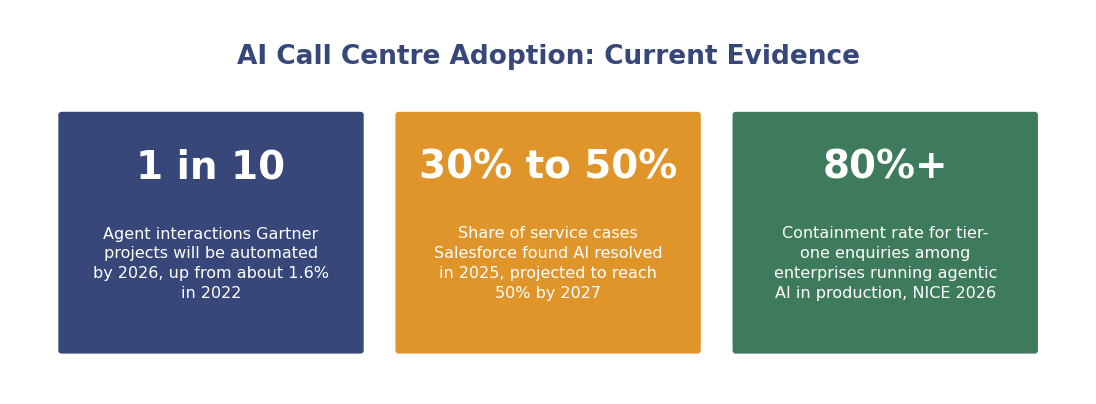
Sources: Gartner (2022 forecast for 2026), Salesforce 2025 State of Service Report, NICE Agentic AI CX Frontline Report (February 2026).
What Are the Benefits of AI in Call Centres?
Customer experience improves in ways that are easy to measure once the basics are handled well: shorter waits, fewer repeated explanations, a faster path to an actual answer. Customer interactions handled this way also tend to feel more consistent, since a well-configured system applies the same information and the same rules every time, without the variation that comes from different agents having different levels of experience.
Availability is one of the most immediate benefits. An AI system can answer calls outside standard hours and absorb peak-period volume that would otherwise mean a longer wait or a missed call entirely. NICE reported, across selected large early-adopter deployments in its 2026 CX Frontline Report, containment above 80% for tier-one enquiries, CSAT gains of up to 20% and double-digit cost-per-contact reductions. These are selected enterprise results published by a technology provider, not a universal benchmark, since they come from organisations far enough along in their deployment to have real production data behind them, not an assumed outcome for every rollout on day one.
Voice systems have improved, but performance still varies considerably by provider, accent, connection quality, background noise and interruption patterns. Test shortlisted systems using representative recordings and live scenarios rather than relying on a vendor demonstration. Generative AI adds a further layer, drafting a response or summary in language that reads naturally rather than a stiff, templated one. None of this means a caller can never tell they are speaking to a system. It means the gap has narrowed enough that disclosure and escalation design matter more than they used to, a point covered in the risks section below.
Can AI Reduce Average Handle Time?
Can AI reduce average handle time? Often, yes. AI can reduce average handle time through faster knowledge retrieval, real-time prompts during a live call, automatic identity and intent capture, transcription, call summaries, CRM updates and reduced after-call work, since much of the wrap-up that used to happen manually can be generated automatically.
Handle time can rise temporarily during rollout, while agents and the system adjust to a new workflow, and a shorter average handle time is not automatically a good outcome if resolution or customer satisfaction deteriorates alongside it. A call rushed to a short handle time but left unresolved simply reappears as a repeat contact later, which is why handle time should be read alongside Successful Resolution Rate rather than on its own, as covered in the measurement section below.
How Do You Integrate AI With an Existing Contact Centre?
How do you integrate AI with an existing contact centre? Most deployments connect AI to the telephony or CCaaS platform, the CRM, the helpdesk or ticketing system, the knowledge base, calendars and workflow tools, typically through APIs or webhooks, with role-based permissions and audit logs controlling what the system can see and do.
A properly scoped integration also needs defined escalation queues and a way to pass context during a human handoff, so a receiving agent is not starting from nothing. The CRM or helpdesk normally remains the system of record: AI reads from it and writes back to it, rather than becoming a separate, parallel database that someone then has to reconcile by hand. Getting this integration scope right before go-live is one of the more common gaps in a rushed deployment, since a system that cannot see the full customer history will make confident-sounding suggestions based on incomplete information.
Outbound Call-Centre Use Cases
Beyond the compliance considerations covered later in this guide, AI has a number of practical operational uses on the outbound side of a call centre: appointment reminders, following up on an existing enquiry, lead qualification, customer reactivation and routine service updates all fit the same repetitive, checkable pattern that makes automation safe elsewhere in this guide.
Objections, pricing discussions and anything resembling a complex sales conversation should still hand off to a person, in line with the Boundary Matrix above. This guide covers outbound calling as part of a call-centre operation rather than as a sales outreach strategy in its own right; for the broader outbound sales workflow, including cadence design and pipeline handling, see our guide to AI SDR tools.
What Should Businesses Look for in AI Call-Centre Software?
What should businesses look for in AI call-centre software? Voice quality and latency, natural interruption handling, routing controls, agent-assist capability, transcription accuracy, CRM and CCaaS integrations, analytics, human handoff, multilingual support, audit logs, recording controls, data residency and retention settings, and clear usage limits and pricing all belong on an evaluation checklist.
Voice quality and latency
Natural interruption handling
Routing controls
Agent-assist capability
Transcription accuracy
CRM and CCaaS integrations
Analytics
Human handoff
Multilingual support
Audit logs
Recording controls
Data residency and retention
Usage limits and pricing
Testing on real calls, real accents and real background noise, rather than a vendor's scripted demo, is the single most reliable way to judge whether a shortlisted platform will actually hold up in production.
Comparing Call-Centre Operating Models
Businesses generally choose between four broad operating models, and the right one depends on call volume, budget and how much judgement a typical call requires.
Swipe to see all columns →
Model | Availability | Human judgement | Setup burden | Scalability | Best fit |
|---|---|---|---|---|---|
Traditional outsourced call centre | Business hours or 24/7 by contract | High, throughout | Low for the business, high vendor management | Scales with contract renegotiation | Complex, judgement-heavy call volumes |
In-house human call-centre software | As staffed | High, throughout | Moderate, staffing-dependent | Scales with headcount | Teams needing full control over agents |
AI-assisted call centre (agent assist) | As staffed, with faster handling | High, AI supports the person | Moderate, integration-dependent | Scales without proportional headcount growth | Established teams adding efficiency |
Autonomous AI call agents | 24/7 within approved scope | Low for in-scope tasks, human for the rest | Higher upfront configuration | Scales well for narrow, high-volume tasks | High-volume, repetitive, low-complexity enquiries |
Most businesses end up running a mix rather than a single model: autonomous AI for the narrowest, highest-volume tasks, agent assist for the team handling everything else, and a clear human-led path for complaints and complex cases regardless of which model handles the rest of the call. For businesses weighing outsourcing against an AI-assisted approach specifically, our guide to the best AI answering services covers that comparison in more depth.
Is AI Call-Centre Software Right for UK Businesses?
The right starting point varies by business type. SMEs with missed or out-of-hours calls often see the fastest return from basic routing and FAQ automation, since a missed call is a missed opportunity that AI can capture without extra headcount. Appointment-led businesses, such as clinics, salons and trades, benefit from the booking and rescheduling flow covered in the worked example above. Customer-service teams tend to start with agent assist before moving toward more autonomous handling of routine enquiries. Sales and support operations that already run outbound calling should apply the same Boundary Matrix to that outbound work as they do to inbound calls. Larger contact centres introducing agent assist typically see the fastest, lowest-risk gains, since a human remains in control throughout while the AI reduces the manual load around each call.
What Are the Risks of AI Call Centres?
The most important context most guides in this space skip is UK-specific data protection and marketing law. Call centres frequently handle personal data, including names, contact details, account information, recordings and information disclosed during conversations, and several distinct legal frameworks apply depending on what the call involves.
Is AI call recording compliant with UK GDPR? It can be, but the business needs a lawful basis, a defined purpose and appropriate transparency. Callers should be told that recording is taking place and given relevant privacy information about how recordings will be used. Training, monitoring, quality assurance and evidential uses may rely on different lawful bases depending on the circumstances, so businesses should not assume either that consent is always required or that recording is automatically lawful simply because it is common practice.
Automated outbound marketing calls face a materially stricter standard than live calls made by a person. Live calls are governed by PECR regulations 21, 21A and 21B, which require screening against the Telephone Preference Service and Corporate TPS, and require the caller to always identify themselves and display a genuine number. PECR regulation 19 clearly applies where an automated dialling system plays a recorded marketing message. The ICO has also treated avatar systems using prerecorded responses as automated calls. Businesses should not assume a conversational AI system is treated the same as a live human call simply because it sounds human. The applicable PECR classification and consent requirements should be established before deployment. This distinction is not hypothetical: in September 2025, the ICO fined two energy-related firms a combined £550,000, Home Improvement Marketing Ltd £300,000 and Green Spark Energy Ltd £250,000, for using avatar software that made automated marketing calls sound like a live UK-based agent. For outbound AI voice campaigns, the classification and consent basis should be established before deployment rather than assumed after the fact.
Automated decision-making is another area worth checking before deploying AI more deeply into a call centre. Following the Data (Use and Access) Act 2025, the UK GDPR framework now sits across Articles 22A to 22D. A significant automated decision is one made without meaningful human involvement that has a legal or similarly significant effect on a person. Routine call routing or an FAQ answer is unlikely to meet that threshold on its own. A system that autonomously refuses a service, materially changes an account or makes another consequential decision about a customer is a different matter and should be assessed against the current automated-decision-making rules and safeguards. Our wider guide to AI and GDPR compliance covers lawful basis, DPIAs and vendor due diligence for AI generally, beyond the call-specific rules above.
Beyond regulation, the most common operational risk is treating a high containment rate as automatic proof of success. A call that never reaches a person is not necessarily a call that was actually resolved well. Measuring successful resolution alongside containment, not containment alone, is one of the clearest ways to catch a deployment that looks efficient on paper while quietly frustrating callers.
How Much Does an AI Call Centre Cost?
Cost depends heavily on scope rather than a single headline figure. A basic rule-based system handling routing and FAQs sits at the lower end of the market, while a fuller conversational voice deployment connected to a CRM, with proper escalation design and ongoing monitoring, costs considerably more. Our dedicated AI automation pricing guide breaks down current UK pricing models, typical project ranges and the hidden costs, such as ongoing API usage and maintenance, that a headline quote often leaves out.
The clearest way to judge whether a given price is reasonable is against your own call data rather than a vendor's demo script. A narrow, well-measured pilot on one call type reveals the real cost of getting a workflow right far more reliably than any published price range can.
How Do AI Voice Agents Hand Calls to Humans?
Getting a caller to the right agent quickly still depends on a person's expertise for anything outside the routine, and no amount of automation changes that. A well-designed escalation path is not an afterthought bolted onto a voice agent. It is one of the core design decisions in the AI Workforce Call Centre AI Model above, sitting between Respond and Record for a reason.
A properly configured handover passes context along with the call: what the caller has already said, what the system has already tried, and why it is escalating. This spares the caller from repeating themselves and gives the receiving agent a genuine head start, though only when the underlying integration actually supports passing that context through, which is worth testing directly rather than assuming. Our guide to AI voice agents covers escalation design, disclosure requirements and a full production-readiness checklist for voice-specific deployments in more depth.
How Do You Measure AI Call Centre Performance?
Modern call centres increasingly track a broader set of indicators than they did even two years ago, because volume-based metrics on their own can hide a deployment that is quietly underperforming. A useful measurement hierarchy tracks the following indicators together rather than relying on any single number.
Tracking these indicators together lets a business judge an AI deployment on genuine resolution and net effect, not activity volume alone.
Calls Assisted: how many calls are using AI in a defined, recorded way
Containment Rate: the share of calls that complete without reaching a human agent
Successful Resolution Rate: the share of calls that were genuinely resolved, whether contained or escalated
Human Escalation Rate: how often a call is handed to a person, and how that trend moves over time
Incorrect Resolution Rate: how often a call was marked resolved but the underlying issue was not actually fixed
Average Handling Time: how long a call takes from start to genuine resolution, not just to containment
Customer Satisfaction: how callers rate the experience, tracked separately for contained and escalated calls
Net Cost per Resolved Contact: the real cost once platform fees, escalations and corrections are accounted for, not the raw cost of a contained call
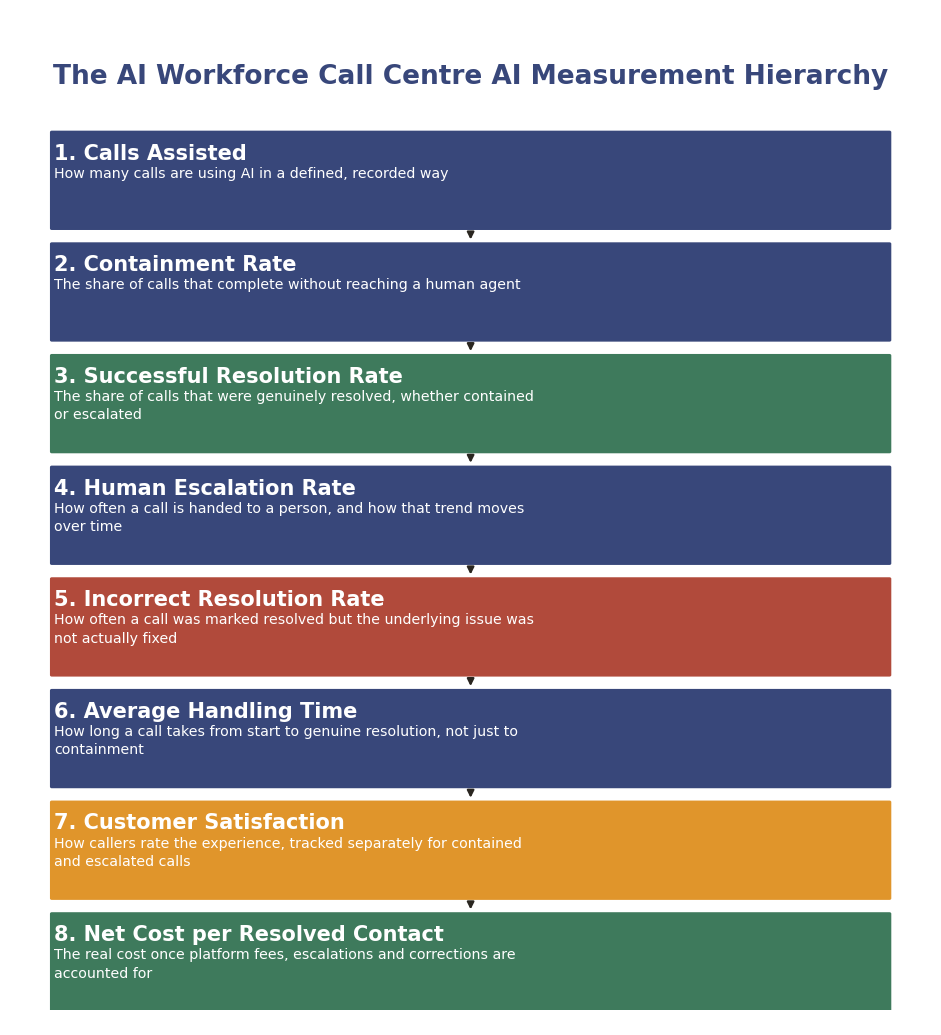
A high containment rate is not necessarily good if customers are being prevented from reaching a person when they genuinely need one. Measuring successful resolution alongside containment, rather than containment on its own, is what separates an honest read of a deployment from a vanity metric that looks impressive in a monthly report while callers quietly grow more frustrated.
How Should a Business Implement AI in a Call Centre?
Deploying AI this way means getting the rollout order right: start with a single, well-measured use case, prove the value, and only then expand further across the operation. The use case chosen for a first pilot should be genuinely repetitive and low-risk, not the hardest problem in the building. If you are still deciding where your operation stands before committing to a pilot, our AI readiness assessment is a useful starting point.
Not sure which call type is genuinely ready for automation? AI Workforce can review your call data and design a narrow, well-measured pilot before you commit to a full rollout. Get in touch.
Week one: pick one high-volume, low-complexity call type, most commonly routing or a routine FAQ, and confirm the approved knowledge base and escalation rules before any live calls are involved.
Week two: run the pilot with a person reviewing outcomes closely, and start tracking Containment Rate and Successful Resolution Rate from day one, not just call volume.
Week three: review escalations, incorrect resolutions and caller feedback, and confirm the handover to a human agent is actually working as designed, not just as documented.
Week four: compare Successful Resolution Rate against Net Cost per Resolved Contact, decide whether to extend the pilot to a second call type, and set a recurring review rather than treating go-live as the end of the process.
Initiatives that succeed tend to have a clear owner and a realistic timeline rather than an open-ended "figure it out as we go" approach, with regular review points built in from the start rather than added after something has gone wrong.
Common Mistakes
Common mistakes to avoid: treating containment as the same thing as resolution, rolling AI out across every call type at once instead of proving one workflow first, launching an automated outbound calling campaign without checking PECR consent requirements, letting a system answer outside its approved knowledge base rather than escalating, skipping regular quality review of contained calls, and measuring activity instead of genuine customer outcomes.
Frequently Asked Questions
What is an AI call centre?
An AI call centre uses artificial intelligence to automate or assist customer conversations: routing, transcription, summaries, quality monitoring and routine follow-up, layered onto the telephony and CRM systems a business already runs.
What is the difference between an AI call centre and an AI contact centre?
An AI call centre primarily manages voice calls. An AI contact centre applies similar routing, assistance and automation across calls, email, live chat, messaging and social channels. Many modern platforms support both, so it is worth checking whether a proposed solution is genuinely omnichannel or primarily a voice product.
How does an AI call centre work?
It typically combines speech recognition, a language model and integrations with a CRM or knowledge base to understand a caller's request, retrieve approved information, respond or act, and escalate to a person when needed.
What can AI call centre agents automate?
Routine FAQs, order and status checks, call routing, basic data capture, appointment booking and transcription are well suited to automation. Complaints, vulnerable customers and complex decisions should stay human-led.
When should an AI call centre transfer to a human?
Whenever confidence, risk or complexity exceeds a defined limit, including any complaint, any vulnerable caller, and anything falling outside the system's approved knowledge base or policy.
What is agent assist?
Agent assist is AI that supports a human agent during a live call, prompting a next-best action, retrieving relevant information or drafting a response for the person to review and send, rather than handling the call independently.
What is the difference between agent assist and an AI agent?
With agent assist, a human leads the call, and AI supports them in real time. With an autonomous AI agent, the AI system leads the conversation itself and only hands over to a person when it reaches a defined limit.
Can AI reduce average handle time?
It often can, through faster knowledge retrieval, real-time prompts, automatic identity and intent capture, transcription, call summaries and reduced after-call work. Handle time can rise temporarily during rollout, and a shorter handle time is not a good outcome on its own if resolution or satisfaction falls.
How do you integrate AI with an existing contact centre?
Through the telephony or CCaaS platform, the CRM, helpdesk or ticketing system, the knowledge base, calendars and workflow tools, usually connected by APIs or webhooks with role-based permissions and audit logs. The CRM or helpdesk normally remains the system of record.
What is the difference between AI voice agents and IVR?
Traditional IVR follows fixed menus. An AI voice agent interprets natural language and maintains context across a conversation, but this flexibility means it needs stronger escalation and governance controls than a rigid menu tree.
What metrics should an AI call centre track?
Containment Rate alongside Successful Resolution Rate, Human Escalation Rate, Incorrect Resolution Rate, Average Handling Time, Customer Satisfaction and Net Cost per Resolved Contact, not call volume or containment on its own.
What are the benefits of AI-powered call-centre software?
Shorter waits, availability outside standard hours, more consistent answers, faster resolution of routine enquiries and more time for human agents to focus on complaints and complex cases.
What should businesses look for in AI call-centre software?
Voice quality and latency, natural interruption handling, routing controls, agent-assist capability, transcription accuracy, CRM and CCaaS integrations, human handoff, multilingual support, audit logs, recording controls, data residency and pricing, tested on real calls rather than a demo script.
Can AI handle customer complaints?
Not on its own. A complaint should always have a defined route to a human agent. AI can capture and log the details of a complaint, but resolving it should stay human-led.
Can AI call centres operate 24/7?
Yes, for the tasks within their approved scope. Availability outside standard hours is one of the clearest benefits, though anything outside the approved scope should still be captured and handed to a person when the team is next available.
Is AI call recording compliant with UK GDPR?
It can be. The business needs an appropriate lawful basis, a defined purpose and appropriate transparency. Callers should be informed that recording is taking place and given relevant privacy information about how recordings will be used.
Is AI call-centre software suitable for UK businesses?
Yes, for SMEs handling missed or out-of-hours calls, appointment-led businesses, customer-service teams and larger contact centres introducing agent assist, provided UK GDPR, PECR and automated-decision-making requirements are addressed before deployment.
Will AI replace call centres, agents?
The evidence does not support that as a blanket claim. AI is absorbing a growing share of routine, high-volume enquiries, while complaints, vulnerable customers and complex decisions remain with human agents.
Key Takeaways
Start with one narrow, high-volume, low-complexity task before expanding automation further
An AI call centre manages voice; an AI contact centre extends the same approach across channels
Agent assist keeps a human in control and is often the lower-risk starting point
A human agent still handles anything that needs real judgement or a difficult conversation
The AI Workforce Call Centre AI Model separates safe preparation from decisions that need a person: Listen, Understand, Retrieve, Respond, Act, Escalate, Record, Learn
A high containment rate is not success on its own. Measure successful resolution alongside it
Automated outbound marketing calls face stricter UK consent requirements than live calls under PECR
AI voice agents are more flexible than traditional IVR, which is exactly why they need stronger escalation and governance controls
Track a full measurement hierarchy, not call volume or containment alone
Ready to Bring AI Into Your Call Centre?
AI Workforce helps UK businesses identify which call types are genuinely ready for automation, design an escalation path that keeps complaints and complex cases with a person, and introduce AI call handling with the right measurement in place from day one.
Related Guides
About the Author
Luca Controlo is AI Adoption and Marketing Automation Lead at AI Workforce. He works with UK businesses to design call-handling automation that separates what AI can safely handle from what should always reach a person.
This article was reviewed by Rodi Taze, Co-Founder of AI Workforce.
Reviewed: August 2026