AI Answering Service for Staffing Agencies: 24/7 Calls and Worker Enquiries
Posted On: July 28, 2026
Written by Clara Miller, Content Marketing Specialist at AI Workforce · Reviewed by Luca Controlo, AI Adoption and Marketing Automation Lead at AI Workforce · Last updated: September 2026
Quick answer: An AI answering service for a staffing agency can identify a worker or client caller, confirm shift and assignment details from live, verified data, capture call-offs and trigger an immediate escalation, take structured messages on payroll and timesheet queries, and capture urgent client staffing requests for fast follow-up, all outside normal office hours as well as during the working day. It should not decide whether an absence is acceptable, allocate or judge a worker's suitability for a shift, resolve a disputed payment, or handle a complaint or grievance. Those stay with a person. Used well, it closes the coverage gap created by early starts, night shifts, weekend assignments and a branch that closes while the operation it supplies keeps running, while routing anything judgement-heavy or sensitive straight to a human.
At a Glance
What it is: a voice AI system answering a staffing agency's phone lines around the clock, using verified worker, assignment and client data plus defined escalation rules
Best suited to: agencies running temporary or contract workers across multiple sites, shift patterns outside standard office hours, and on-call or overflow cover
Strongest use cases: shift and assignment queries, call-off capture and escalation, worker availability collection, urgent client cover requests, consultant and desk routing
Biggest benefit: reliable call coverage at 5am, overnight and at weekends, when workers and clients still need to reach someone but the branch is closed
Biggest risk: answering from stale rota or assignment data, for example telling a worker the wrong site, time or contact
Implementation approach: phased rollout starting with shift information and consultant routing, then call-offs and timesheet routing, then urgent client capture once accuracy is proven
Human-handoff rule: disputes, grievances, disciplinary matters, employment-law questions, safeguarding concerns and worker suitability decisions always go to a person
What's Covered
Fundamentals
How It Handles Calls
Worker Operations
Client and Payroll
24/7 and Risk
Compliance
Buying and Rollout
Reference
What Is an AI Answering Service for a Staffing Agency?
An AI answering service for a staffing agency is a voice AI system connected to the agency's phone lines that handles high-volume operational calls from workers already on assignment and from clients needing cover, using data the agency has approved in advance: live rota and assignment records, worker contact and identification details, and defined escalation rules for anything urgent or sensitive. It is not the same as a generic AI receptionist, and it is not the same as an AI receptionist built for recruitment calls about vacancies and interviews. A staffing agency's phone lines are dominated by a different pattern of calls: a worker ringing at 5am to say they can't make a shift, a night-shift worker asking where to report, a client ringing on a Sunday because two agency staff haven't turned up. These calls need to work at any hour, need a live connection to rota and assignment data rather than a static script, and need an escalation path that fires immediately, not at the next available consultant slot.
This article focuses on operational call handling for workers already engaged and clients already using the agency's staff, not on candidate registration, vacancy enquiries or interview booking. That side of recruitment call handling is covered in our sibling guide, AI receptionist for recruitment agencies, which this article deliberately does not repeat.
Why Staffing Agencies Need Different Call Handling
Temporary and contract workers operate outside the hours a branch is typically staffed. Early starts mean a worker confirming a shift, or calling off one, well before the office opens. Night shifts and weekend assignments mean questions and problems arise when no consultant is on the desk. Multiple sites mean a single agency can have workers reporting to a dozen different locations on any given day, each with its own site contact and instructions. Peak onboarding periods, when a large new contract goes live, generate a burst of shift and site questions in a short window, and payroll or timesheet deadlines create predictable spikes of queries about whether a timesheet has been received or when payment will land. Consultants, meanwhile, are frequently on calls, visiting sites or dealing with an urgent client shortage, which is exactly when other calls need answering. None of this requires an invented statistic to be true: it follows directly from how temporary staffing operates, with workers active at hours a branch is not, across more locations than a single desk can watch at once.
What Calls Can an AI Answering Service Handle?
Staffing agency calls split into worker calls and client calls, and they carry different urgency and risk profiles.
Worker calls. What shift am I on, where do I report, what time does the shift start, who is my site contact, I can't make my shift, can I pick up extra work, has my timesheet been received, when will I be paid, can I speak to my consultant. These are automatable where the answer exists in current, verified assignment data, and a call-off specifically needs to trigger escalation rather than simply be logged and left.
Client calls. Shift or cover queries, confirming who is on site today, and, most commercially significant, an urgent new staffing requirement when a client is short-handed. These need fast identification and routing to the desk or consultant covering that account.
Shift and availability queries. Confirming shift time, site, and reporting instructions from the live assignment record, and collecting a worker's availability for future shifts within predefined rules.
Timesheet and payroll routing. Confirming receipt where the system reliably shows it, and routing anything else to the payroll team rather than guessing.
General routing. Directing calls to the correct temp desk, branch, sector team or named consultant.
Complaints, disciplinary matters, grievances, employment-law questions, safeguarding concerns and worker suitability judgements sit outside all of these call types and should escalate to a person regardless of category. For call-handling design patterns beyond staffing specifics, see our AI call handling guide.
The AI Workforce Staffing Call Routing Model
This is an AI Workforce framework, not an industry standard.
Six Call Categories
1. Worker Availability: AI collects or confirms a worker's availability within predefined rules — it does not allocate shifts itself
2. Shift/Assignment Information: AI answers directly, but only from verified, live assignment data — site, time, reporting contact, reference
3. Absence/Call-Off: AI captures the issue accurately, then immediately triggers the predefined escalation and staffing workflow — it does not decide whether the absence is acceptable
4. Client Staffing Request: new or urgent headcount requirements are captured against a fixed set of questions and routed as high-priority commercial and operational enquiries
5. Payroll/Timesheet/Existing Assignment: AI identifies the caller, routes to the relevant team or takes a structured message, and must never invent a payment or assignment status it cannot verify
6. Sensitive/Disputed/Consequential: complaints, disciplinary matters, grievances, employment-law questions, safeguarding concerns, discrimination, worker suitability and disputed matters go straight to a person
This matters operationally because a staffing desk cannot afford ambiguity about what an AI system is allowed to decide on a call that might affect whether a client has cover tomorrow morning or whether a worker's absence is handled fairly. Assigning every call a category before the conversation goes further than a few exchanges keeps the AI inside data it can verify and hands off anything that needs judgement.
Which Staffing Calls Should You Automate First?
Start with calls that are high-volume, repetitive and verifiable against a fixed data source, not with everything at once.
Best first: shift information, consultant routing, worker availability capture, routine assignment FAQs
Next: call-offs, timesheet and payment-status routing, client staffing-request capture
Human-first: disputes, grievances, disciplinary matters, legal questions, suitability decisions, safeguarding
Sequencing matters because a call-off needs a reliable escalation workflow behind it before it's safe to automate the capture step, and because the most commercially valuable calls, an urgent client shortage, are not automatically the safest to hand entirely to AI without a person reviewing the detail quickly.
Worked Example: Worker Calling Off a Shift
A worker calls at 5:40am, before the branch opens, to say they can't make their 6am shift. The AI identifies the worker by name and phone number or a reference, then retrieves their current assignment record rather than asking them to describe it from memory. It confirms the shift, site and time back to the worker, records the non-attendance and, where the process asks for it, a brief factual reason, and confirms to the worker that the call-off has been logged. It then immediately notifies the correct desk or on-call contact for that site or client, and creates an urgent task flagged for cover, rather than leaving it in a queue for when the branch opens. Where the agency has a defined replacement workflow, for example alerting available workers who match the shift, the AI can trigger an approved replacement workflow automatically where that workflow has already been defined and governed. What it does not do is decide whether the absence is legitimate, apply any disciplinary consequence, or judge the worker's reliability. Those remain matters for a person to review, using the accurate record the AI has just created.
Worked Example: Client Needs Urgent Cover
A client calls on a Sunday morning because two workers haven't arrived. The AI identifies the client account from the caller's number or the company name given, then captures the site, the role needed, the headcount, the required start time, and how urgent the situation is. It identifies which temp desk or on-call consultant covers that account and, where routing rules allow, transfers the call live; where no one is reachable immediately, it creates an urgent CRM or task record flagged for immediate follow-up rather than a standard queue entry. This should be treated as high priority because an unfilled shift on a live contract is an immediate operational and commercial problem for the client, and a slow or generic response risks the relationship and the contract, not just a single call.
Not Sure What This Would Look Like for Your Agency?
We can help you map your worker and client call types, rota/assignment data and escalation rules before recommending an approach.
Can It Handle Worker Availability?
An AI answering service can collect a defined set of factual availability information from a worker: whether they're available for further shifts, the dates and times they're available, their preferred shift type, and a location or travel preference. This is straightforward data collection against a fixed set of questions, comparable to what a consultant would ask over the phone.
What it should not do, unless a separately governed workflow explicitly allows it, is decide which worker gets allocated to a shift, judge a worker's eligibility for a particular assignment, or make a suitability decision based on anything the worker says. Availability capture and shift allocation are different steps, and the AI's role should stop at the first one unless the agency has built and approved a specific allocation workflow with its own controls.
Can It Handle Shift and Assignment Questions?
Yes, where it has a live connection to the current assignment record: shift time, site, assignment reference, the approved on-site contact, start date, and any approved reporting instructions. The answer must come from verified, current data rather than the AI inferring or filling in a gap, because a wrong site or time sent to a worker can mean a no-show that the client experiences as a staffing failure. If a worker's question isn't covered by the assignment record, for example an unusual instruction that isn't logged, the AI should say so and offer to check with the desk rather than guessing based on similar assignments it has handled before.
Can It Handle Call-Offs and Absence?
This is an important area and needs careful design. The AI's job on a call-off is immediate, accurate capture, immediate escalation to the right desk or on-call contact, and creating a clear audit trail of when the call came in and what was recorded. Where the agency's process supports it, the AI can also trigger a replacement workflow to find cover quickly. Data minimisation matters here: the AI should record an absence reason only where the agency's process genuinely needs it, not capture every detail a worker volunteers about why they can't attend. What the AI must never do is make an autonomous disciplinary decision, apply a consequence, or decide whether the absence is acceptable under the agency's policy. Those judgements, and any action that follows from them, belong to a person reviewing the record the AI has created.
Can It Capture New Client Staffing Requests?
This is one of the most commercially significant things an AI answering service can do for a staffing agency, because a missed urgent-cover call can mean a client left without staff, not simply an information request going unanswered. The AI can capture the account or new company name, the urgent temporary cover needed, headcount, role, location, required start time, duration, and the caller's contact details, then route the request to the correct desk. New account enquiries and urgent cover requests should be treated with more urgency than a routine worker query and routed accordingly, ideally with a live transfer where a consultant is available.
Can It Handle Payroll and Timesheet Calls?
With careful boundaries, yes. The AI may confirm that a timesheet has been received where the underlying system data is reliable and current, and it can capture the details of a payroll issue and route it to the payroll team. What it should not do is invent a payment status it cannot verify, promise a specific payment timing unless that is confirmed in the system, or attempt to resolve a disputed pay query autonomously. A confidently wrong answer about pay is worse for trust in the agency than a message that gets a prompt callback from someone who can actually check the record.
24/7 Answering for Staffing Agencies
This is why 24/7 call handling can be especially important for staffing agencies compared with businesses whose operations stop when the office closes. Workers call off shifts at 5am, before any branch is open. Night-shift and weekend assignments generate questions at hours no desk is staffed, and a client's early-morning cover need doesn't wait for 9am. The branch may be closed, but the operation it supplies, a warehouse, a hospital ward, a distribution site, is often still running around the clock. An AI answering service can be available at these times in a way a small branch team realistically cannot staff continuously.
This should not be presented as unlimited availability without qualification. Any voice AI system depends on the telephony platform and its concurrency limits, meaning there is a practical ceiling on how many simultaneous calls it can handle at once, and on the reliability of its connection to rota, assignment and worker data at that moment. Out-of-hours capability is genuinely valuable for a staffing business, but it should be evaluated against those concrete limits rather than treated as a given.
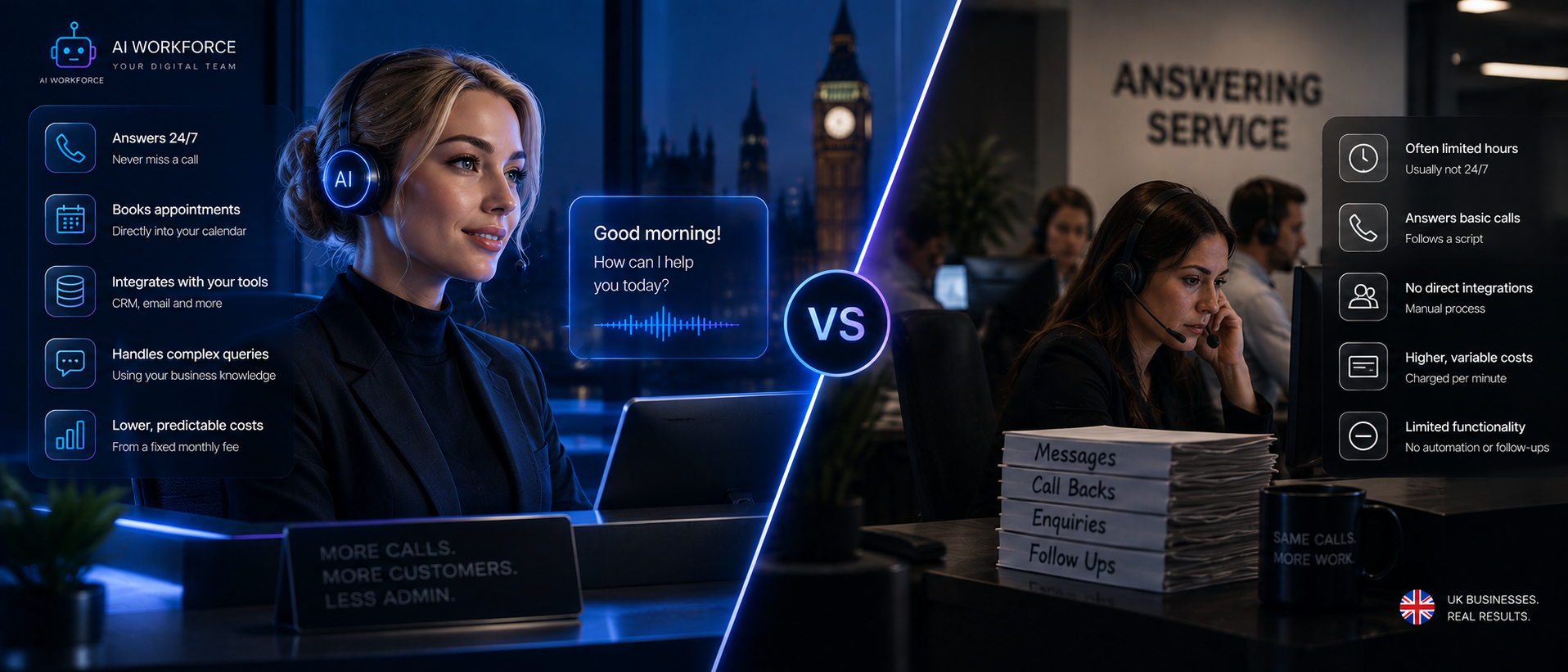
AI vs Human Answering Service for Staffing Agencies
For staffing agencies, the practical difference is about handling volume and hours a small team cannot cover alone. An individual human operator or on-call consultant can only handle one live call at a time, while a larger answering service scales through however many operators it has staffed; out-of-hours cover typically means someone on a rota carrying a phone, which has real limits during a bad night with several call-offs at once. An AI answering service can handle multiple simultaneous worker and client calls, subject to the provider's telephony and concurrency limits, and operates the same at 3am as at 3pm, but it should never be the one handling a dispute, a grievance, or a sensitive personal circumstance. A fuller comparison of AI, human and hybrid answering models, including cost structure and caller experience, is covered in our AI receptionist vs answering service guide, which this section does not repeat.
What Systems Should It Integrate With?
For an AI answering service to be useful rather than risky in a staffing agency, it needs a live connection to several systems rather than a static script: the staffing or recruitment CRM and ATS, for worker and client records; the worker database, holding contact and identification details; the assignment or rota system, which should be the single authoritative source of truth for shift status, site and timing; the timesheet system, for payroll routing; calendars, where consultant availability matters; the telephone platform, for routing and transfer; and email or SMS, for confirmations. We do not claim specific named integrations here; confirm what any given platform actually supports before assuming compatibility. What matters more than any specific list is that assignment and worker data has one authoritative source the AI reads from, not several that can drift out of sync.
What Happens When Shift or Assignment Data Changes?
Shift and assignment information changes frequently in a staffing operation: a shift time moves, a site changes, a worker is reallocated, a client updates on-site instructions, an assignment ends, or a rate changes where that data is exposed to the answering system. An AI answering from anything other than the current, approved record will eventually give a worker the wrong shift time or send them to the wrong site, which is a real operational failure, not a minor inconvenience: a worker turning up at the wrong location or the wrong time can mean the client is short-staffed and the worker loses paid hours. The system should retrieve assignment data live at the point of the call rather than caching it, and where records disagree, an internal update not yet reflected in the rota system, for example, the safer behaviour is to escalate rather than guess. Whoever updates rota or assignment data internally needs to understand that a delay in updating the source system is a delay in every caller getting an accurate answer in between.
Where Can a Staffing AI Answering Service Go Wrong?
Failure mode | Control |
|---|---|
Tells a worker the wrong shift time | Retrieve assignment data live at call time from the single authoritative rota source; never cache indefinitely |
Sends a worker to the wrong site | Same live retrieval requirement; read back site and time before ending the call |
Fails to escalate a call-off | Hard rule: every call-off triggers immediate notification to the correct desk or on-call contact, with confirmation logged |
Duplicates a worker's availability entry | Real-time write-back to the single record at the point of capture, not batched afterward |
Wrongly confirms timesheet or payment status | Only confirm receipt where system data is reliable; otherwise route to payroll rather than guessing |
Misroutes an urgent client request | Explicit high-priority routing rule for new or urgent cover calls, bypassing routine queues |
Records unnecessary sensitive absence information | Data-minimisation rule: capture an absence reason only where the process genuinely requires it |
Mishandles a complaint | Explicit complaint-detection trigger with direct escalation to a named contact or manager |
Gives employment-law advice | Explicit escalation trigger for legal, contractual and employment-law language |
CRM/rota integration failure mid-call | Fallback to message-and-callback rather than confirming anything the system can't verify |
Loses context in a transfer | Pass a structured call summary with every transfer, not just the live call |
None of these are reasons to avoid an AI answering service outright; they're reasons to treat rota and assignment data accuracy, escalation reliability and integration monitoring as the things worth getting right before expanding scope.
UK GDPR, Staffing Data and Worker Calls
This section is general information, not legal advice.
An AI answering service handling staffing agency calls processes personal data from the first call: worker and client names, contact details, assignment information, availability, and, where a worker volunteers it on a call-off, potentially sensitive information about the reason for absence. Where calls are recorded or transcribed, that recording is itself personal data and callers should generally be told a call may be recorded and why. A documented lawful basis, a defined retention period rather than indefinite storage, and clear information about how call data is used are ongoing requirements, not a one-off setup task. Any third-party platform or subprocessor handling call audio, transcripts or CRM/rota data should be checked for where that data is stored and processed. The workflow should avoid collecting or retaining unnecessary sensitive information a worker volunteers about an absence, consistent with data minimisation. Human oversight matters throughout: the AI should not be making worker allocation, suitability or disciplinary decisions, and any automated element of the workflow that could produce a significant effect on a worker should be assessed for appropriate safeguards. Our AI and GDPR compliance guide covers lawful basis, retention and processor due diligence in more depth.
How Much Does an AI Answering Service for a Staffing Agency Cost?
Cost depends on call volume and minutes used, the proportion of calls arriving out-of-hours, one-off setup, the number and complexity of integrations (ATS, CRM, rota or assignment system), telephony and concurrency requirements, whether human escalation cover is arranged separately, and the level of ongoing monitoring and support. An agency running multiple sites, shift patterns across all hours and both CRM and rota integrations will generally see higher setup complexity than a single branch handling day-shift assignments only. For detailed, dated figures from named UK providers, see our AI receptionist pricing guide, which this section does not attempt to duplicate.
Is an AI Answering Service Worth It for a Staffing Agency?
Whether it's worth it depends on your own call volume, missed-call rate and conversion, not a generic industry claim. The KPIs worth tracking are the inbound answer rate, the worker-call capture rate, the call-off escalation success rate, the urgent client-request capture rate, the successful consultant-transfer rate, the incorrect-answer rate found on transcript review, the abandoned-call rate, the cost per successfully handled call, and the cost per client staffing enquiry captured.
Illustrative ROI Formula
This is an illustrative formula, not a benchmark. Insert your own numbers.
Commercial value =
additional qualified staffing enquiries captured
× conversion rate
× average gross profit attributable to conversion
An agency should build this out with its own real figures, its own historical missed-call volume, its own enquiry-to-instruction conversion rate, and its own average margin, rather than relying on any generic percentage claimed elsewhere.
Four-Week Rollout Plan
Week 1: analyse existing call types and out-of-hours calling patterns from real phone data, not assumptions
Week 2: connect current worker and assignment data, and define escalation rules for call-offs and urgent client requests
Week 3: pilot on after-hours, overflow and routine shift-query calls, while the desk continues handling live-hours calls
Week 4: review call transcripts, call-offs and any misroutes, correct inaccuracies, and expand scope only if accuracy supports it
Before You Buy: Staffing Agency Checklist
Can the system reliably identify a worker or their assignment before answering questions?
Can it retrieve live, current shift and assignment information rather than a cached copy?
Does a call-off trigger immediate escalation to the correct desk or on-call contact?
Can urgent client staffing requests bypass routine queues and reach someone quickly?
Does it correctly distinguish worker calls from client calls in how it handles them?
Can it route calls by temp desk, sector, branch or named consultant?
What happens if the rota, ATS or CRM integration is unavailable mid-call?
Does it pass a structured call summary through on every transfer, not just the live call?
Does it avoid storing unnecessary absence detail a worker volunteers on a call-off?
What triggers an immediate human takeover, and can you review and adjust those triggers?
Can you review call transcripts to check for inaccurate answers?
How is stale or conflicting rota data handled?
How is concurrency handled during peak call periods, such as a bad-weather morning with multiple call-offs at once?
What personal data is captured, where is it stored, and for how long?
Does the provider disclose subprocessors handling call audio or transcripts?
Frequently Asked Questions
Can an AI answering service handle worker call-offs?
Yes. It can identify the worker, record the call-off accurately, confirm it back, and immediately escalate to the correct desk or on-call contact. It should not decide whether the absence is acceptable or apply any disciplinary consequence; that stays with a person.
Can it answer shift questions?
Yes, from the current, verified assignment record: shift time, site, reference and reporting contact. It should not answer anything the record doesn't cover, and should say so rather than guessing.
Can it work 24/7?
Yes. It can answer worker and client calls during early starts, evenings, nights, weekends and other periods when the branch is closed. Availability is still subject to the telephony platform's concurrency limits.
Can it handle urgent client staffing requests?
Yes. It can capture site, role, headcount, timing and contact details, identify the right desk, and route the request as high priority, live where possible or as an urgent flagged task.
Can it route calls to the right temp desk?
Yes, based on branch, sector, client account or a named consultant, passing a call summary along with the transfer.
Can it handle payroll or timesheet queries?
It can confirm receipt where system data is reliable and route issues to payroll. It should not invent a payment status or resolve a disputed pay query itself.
Does it integrate with a staffing CRM or ATS?
Capable platforms can connect to a CRM, ATS or rota/assignment system for record lookup and lead capture, though exact supported integrations vary by provider and should be confirmed directly.
Can it collect worker availability?
Yes, factual availability details against a fixed set of questions. It should not decide shift allocation or suitability unless a separately governed workflow exists for that.
Is an AI answering service GDPR compliant for staffing agencies?
It can be operated compliantly, but compliance depends on configuration, lawful basis, retention and processor arrangements, not the product alone. This is general information, not legal advice; see our AI GDPR compliance guide.
How much does a staffing agency answering service cost?
It depends on call volume, out-of-hours proportion, integration complexity and support level. See our AI receptionist pricing guide for dated figures from named UK providers.
Can AI replace a staffing-agency receptionist?
No, not entirely. It can handle a meaningful share of routine worker, shift and client-capture calls, especially out-of-hours, but disputes, grievances, disciplinary matters and suitability decisions still need a person.
Key Takeaways
An AI answering service should answer from live, verified assignment data, never from memory or inference, to avoid sending a worker to the wrong site or shift
Call-offs need immediate capture and immediate escalation, not just logging for later review
24/7 coverage is a genuine strength for staffing, given early starts, night shifts and weekend cover, but is still bounded by telephony concurrency limits
Urgent client staffing requests are commercially significant and deserve fast, high-priority routing, distinct from routine worker queries
Disciplinary matters, grievances, disputes and worker suitability decisions must stay human-led throughout, not confined to a single category
Payroll and timesheet answers should come from verified data or be routed, never invented
Track answer rate, call-off escalation success, urgent client-capture rate and incorrect-answer rate to judge whether it's working
Candidate calls, vacancy questions and interview booking are covered separately in our recruitment-receptionist guide; this article focuses on worker and client operational calls
See How This Would Work for Your Agency
We'll map your worker and client call types, rota/assignment data and escalation rules before recommending an approach.
About the author: Clara Miller is Content Marketing Specialist at AI Workforce, covering how UK staffing agencies apply AI to worker calls, shift queries and out-of-hours cover.
Reviewed by: Luca Controlo, AI Adoption and Marketing Automation Lead at AI Workforce, for accuracy of the call routing model, escalation design and UK compliance framing.
Reviewed: September 2026.
© 2026 AI Workforce Ltd. All rights reserved.