AI Call Handling: How Automated Call Answering Works for Businesses
Posted On: July 27, 2026
Last updated: August 2026 · Written by Clara Miller, Content Marketing Specialist · Reviewed by Rodi Taze, Co-Founder of AI Workforce
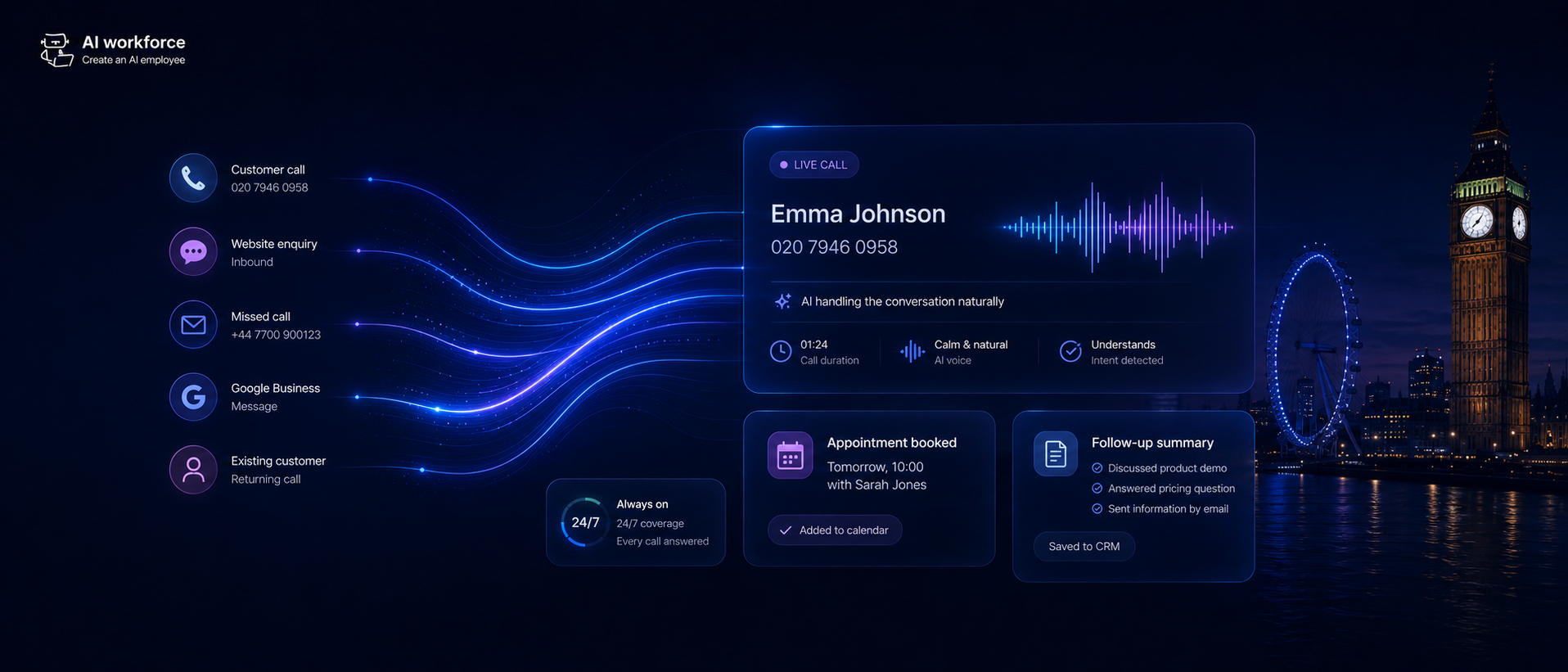
AI call handling lets a business answer, route and act on incoming calls automatically, including answering routine questions, capturing enquiries, booking appointments and transferring calls that need a person. For businesses dealing with missed calls, after-hours enquiries or unpredictable call volumes, it can provide wider coverage without requiring someone to answer every call manually. This guide explains how automated call handling works, where it performs well, what it should never handle alone and how to roll it out safely.
Quick Answer: AI call handling, sometimes described as automated call handling, uses voice AI to answer a business phone number, understand why someone is calling and take an approved next step. That can include answering from verified business information, capturing a message, routing the caller, booking an appointment or transferring to a person. It is particularly suited to repetitive inbound calls with clear rules; complaints, emergencies, sensitive issues and anything outside the approved information should still reach a human.
What Can Automated Call Handling Do?
In practice, automated call handling can: answer common questions from a business's approved information, capture caller details and the reason for the call, route the caller to the right department or person, book an appointment directly against live availability, cover overflow and after-hours calls that would otherwise go unanswered, log the outcome automatically in a connected CRM or workflow, and transfer to a person for anything sensitive, high-value or outside its approved scope. The sections below cover each of these in more detail, including exactly where a person still needs to stay involved.
At a Glance
What it is: software that answers, interprets, routes and acts on business phone calls
Best suited to: businesses with repetitive inbound call volume or a persistent missed-call problem
Potential benefit: wider, more consistent call coverage without matching staffing to every peak
Key risk: an incorrect answer, a bad transfer, or an action taken from a misunderstood request
Sensible rollout: start on overflow or after-hours calls before expanding to full coverage
What's Covered
How It Works
Where It Fits
Implementation
How Does Automated AI Call Handling Work?
AI call handling is a system built to answer, understand and act on a phone call without a person picking up first. Speech recognition converts the caller's speech into text or another machine-readable representation, while the language model or conversational system interprets the request and determines the next permitted action, in a way built to sound like a normal conversation rather than a menu of numbered options. Some systems use separate speech-to-text, language and text-to-speech components; others use more integrated real-time voice architectures.
Not every platform works the same way technically. Deployments may use prompts, retrieval against an approved knowledge base, tool integrations, fine-tuning or a combination of these approaches, grounded in a business's own knowledge base, booking rules and escalation policies. Built this way, a system can transfer a call, take a message, or book an appointment directly, with a person only stepping in where something genuinely needs one.
How Does an AI-Handled Call Actually Flow?
At a high level, most AI-handled calls move through the same broad stages: the system answers and establishes the interaction, works out what the caller actually wants, checks that against approved business information, takes an action such as answering, booking or routing, escalates to a person where the call falls outside its approved scope, and logs the outcome for review.
Illustrative flow. Exact steps vary by provider and how a system is configured.
This is a simplified, general picture rather than a fixed standard. For the detailed, stage-by-stage mechanics of how a call should be built to handle this safely, including how a system should behave when information is missing or conflicting, see our AI Answering Service guide.
Here's what that looks like in practice. A plumber receives a call at 8.10 pm about a leaking radiator. The system confirms the postcode, checks it against the approved service area, retrieves the next available booking slot and schedules the visit. If the caller instead reports water reaching live electrics, the routine booking workflow stops and the emergency escalation rule takes over immediately.
What Should AI Call Handling Never Do Alone?
A fair account of this technology has to be explicit about where a person needs to stay involved. The workflow should normally escalate to a person, or follow a predefined emergency/safety procedure, where a call involves:
an emergency or a safety-sensitive issue
a safeguarding concern
a complaint or a dispute
a payment dispute
an unusual pricing or discount request
a request for legal or clinical advice
a situation where the caller's identity genuinely needs verifying and can't be
a question with no answer in the system's approved information
repeated misunderstanding within the same call
an explicit request from the caller to speak to a person
Illustrative split. Your own risk tolerance and call patterns should determine exactly where a task lands.
None of this is a reason to avoid the technology. It's a reason to define the boundary in writing before a system goes live, so the automated portion stays trustworthy precisely because it was never asked to handle what it shouldn't.
Inbound AI Call Handling vs Outbound AI Calling
"AI call handling" can describe either side of a call, and the compliance position differs materially between them. Inbound handling, answering calls a customer initiates, is mainly a question of accuracy, data handling and knowing when to escalate. Outbound calling, where a system initiates the call, brings in stricter UK marketing rules.
Automated marketing calls covered by Regulation 19, calls made by an automated dialling system that plays a recorded message, are subject to stricter consent requirements than live marketing calls. The ICO enforces the Privacy and Electronic Communications Regulations (PECR), and its guidance on telephone marketing confirms that Regulation 19 requires the called person's prior, specific consent to these automated calls before they're made; general marketing consent, or consent to a live call from a person, doesn't satisfy this stricter rule. Ofcom separately regulates telecoms network issues such as number presentation and persistent misuse of a network, rather than the marketing-consent rule itself. The ICO has enforced this actively: in September 2025 it fined two energy companies a combined £550,000 for making automated marketing calls using "avatar" software without proper consent. If outbound automated calling is part of what you're considering, treat it as a materially different compliance conversation from inbound call answering, not an extension of the same project.
Best Use Cases for AI Call Handling
Practical use cases tend to share a common shape: high call volume, mostly routine questions, and a real cost to a missed call. A retailer might use AI to confirm an order over the phone. A trades business uses it to capture every enquiry that comes in while someone's on a job, something our AI Receptionist UK guide covers from a buyer's perspective. A dental practice's system can check appointment history before booking, reducing the double-bookings a busy front desk can miss under pressure; our guide to AI receptionists for dentists covers dental-specific booking, urgent-call escalation and patient-data considerations in more detail. Estate agencies are a further example because negotiators are often out on viewings or valuations while property enquiries continue coming in. An AI receptionist can answer verified listing questions, book viewings against live availability and route valuation or landlord enquiries to the right person. Our guide to AI receptionists for estate agents covers that workflow in detail, including listing-data accuracy and human escalation.
Recruitment agencies often have a different call-handling problem: the phone mixes candidate enquiries, interview scheduling, vacancy questions and new client opportunities into the same queue. AI can deal with the routine first layer by answering approved vacancy questions, capturing candidate details, booking interviews against consultant availability and routing existing candidate or client matters to the right person. Our guide to AI receptionists for recruitment agencies explains that workflow in more detail, including ATS/CRM integration and where human judgement should take over.
Restaurants are a further example because calls often arrive during busy service periods, when staff are least able to answer. AI can handle routine reservation requests, opening-hours questions and simple guest enquiries, while unusual requests or complaints still route to staff. Our guide to AI for restaurants in the UK covers how call handling fits alongside demand forecasting, staff scheduling, inventory and other restaurant AI workflows.
Across industries, the same pattern holds: automate the repetitive first layer of a call, and free people to focus on the conversations that need real judgement. If you're weighing call handling against other early automation priorities, our guide to AI agents for small businesses covers that broader context.
How Does AI Compare to a Traditional Call Centre?
A traditional human-staffed operation ultimately depends on enough agents being available at once. Modern contact centres can prioritise and route calls intelligently, but once every suitable agent is occupied, callers still queue or overflow elsewhere. An AI phone agent can handle multiple calls concurrently, subject to the provider's own telephony and concurrency limits, which reduces the queues and missed calls that build up once every person is already occupied.
For higher-volume customer-service operations, our AI Call Centre Agents guide covers how AI fits into existing contact centres, including agent assist, autonomous voice agents, CRM integration, human escalation and the metrics needed to distinguish containment from genuine resolution.
The cost structure differs materially: human operations depend on staffing levels, shifts and occupancy, while AI voice systems typically combine setup, telephony, usage and concurrency costs. Which model has the lower cost per successfully handled call depends on volume, complexity, escalation rate and the amount of human backup required. For a detailed breakdown of the costs behind that comparison, including setup, per-minute AI usage, telephony, concurrency and ongoing support, see our guide to AI voice agent pricing in the UK. This doesn't remove people from the picture entirely; it removes the repetitive first layer of a conversation, freeing up time elsewhere for the calls that are genuinely complex or sensitive.
Illustrative comparison. The right setup still depends on call volume, budget and how much judgement a typical call requires.
Can AI Voice Technology Really Sound Natural on the Phone?
Current voice systems can support conversational pacing, contextual follow-up and interruption handling, but performance varies with latency, accents, line quality, background noise, model choice and configuration. How natural a system sounds in practice depends heavily on the specific provider and how well it's been configured, not on the technology category as a whole, and that's a meaningfully different claim from performing indistinguishably from a person on every call. For a deeper look at the underlying technology, including speech recognition, latency, turn-taking, tool integrations, hallucination controls and human escalation, see our AI voice agents guide.
How Does AI Handle Missed Calls and Demand Spikes?
Missed calls can represent lost enquiries or delayed service. AI call handling can increase the proportion of calls answered during demand spikes, a promotion, bad weather, a seasonal rush, or outside business hours, since capacity can flex without anyone needing to be added to the rota, subject to the provider's own concurrency and telephony limits. Whether that creates commercial value should be measured using actual enquiry capture, conversion and cost per successfully handled call.
The same consistency applies outside business hours: a call after 6 pm can still be answered rather than going straight to voicemail. Handling high call volumes used to mean either understaffing or overstaffing depending on the day; a well-configured AI system reduces that trade-off, without eliminating the need for a fail-safe path if a telephony outage or integration failure affects coverage.
Staffing agencies are a particularly clear example because their urgent calls often happen outside normal office hours. A temporary worker may need to report a shift call-off, a client may need emergency cover, or someone may be chasing a timesheet or payroll issue after the main office has closed. Automated call handling can classify those enquiries, route urgent worker or client calls to the on-call team and record lower-priority matters for the appropriate desk to handle later. Our guide to AI answering services for staffing agencies covers 24/7 worker enquiries, shift call-offs, urgent client cover and out-of-hours routing in more detail.
How Do You Integrate This With CRM and Workflow?
Connecting a system to a calendar and CRM means a booking made over the phone can sync automatically, without someone re-typing details by hand afterwards. A connected workflow can reduce manual re-entry because booking and caller information can be written directly to the system the team already uses; our AI CRM guide covers what good integration should look like in more depth.
If the main goal is to qualify callers and move suitable enquiries directly into a booked slot, our guide to AI appointment setter tools covers calendar routing, qualification and booking logic in more depth.
A connected workflow should define what happens between the call ending and the next action, so nothing falls through the cracks. Platforms vary in integration depth, routing controls and reporting, so these capabilities should be verified against the workflow you actually need.
A connected workflow also needs a defined fallback. If the calendar, CRM or knowledge source is temporarily unavailable, the safest response may be to take a message or transfer the call rather than continue as though the missing system were still available. A reliable AI call workflow is defined as much by how it fails as by how it performs when every integration is working.
The AI Workforce Call Automation Scale-Up Path
Rather than switching on full call coverage from day one, AI Workforce uses a staged implementation path so performance can be evaluated before scope expands.
This is an AI Workforce implementation framework rather than an industry standard. Expand coverage only once the earlier stages have proven themselves.
Stage 1, Overflow and After-Hours: the system picks up calls the team can't get to, out-of-hours calls and overflow during busy periods, while people continue handling calls during normal hours
Stage 2, Full Inbound Coverage: once transcripts and outcomes from Stage 1 hold up, AI becomes the primary answerer during business hours too, with defined escalation rules doing the rest
Stage 3, Connected Workflow: calendar, CRM and ticketing integrations go live, so bookings, updates and follow-ups happen automatically rather than being re-entered by hand
Stage 4, Multichannel Extension: coverage extends to webchat and SMS on the same underlying knowledge base, with outbound calling treated as a separate project with its own consent requirements, not an automatic extension of inbound coverage
Moving to multichannel automation before validating inbound call handling adds additional integration and failure points before the underlying workflow has been proven.
How Should You Measure AI Call Handling Performance?
Call volume answered isn't a sufficient measure on its own, since a system can process a large number of calls while quietly giving wrong answers or mishandling bookings. Track a broader set of indicators:
Answer rate, the share of inbound calls actually picked up
Incorrect-answer rate, how often the system gave information that was wrong or ungrounded
Escalation accuracy: how often calls that genuinely required a person were correctly identified and handed over, distinct from whether the handover itself worked technically
Successful transfer rate: how often an escalated call actually reaches a person cleanly
Booking completion rate: for calls where booking was the goal
Abandoned-call rate: how often a caller hangs up mid-conversation
Repeat-call rate: callers who call back because the first call didn't resolve their need
Human takeover rate: how often a person has to step in mid-call
Average response latency: how quickly the system replies during a live call
Cost per successfully handled call, measured against your real call volume
Incorrect-answer rate and escalation accuracy are particularly useful when assessing whether the system stays grounded in approved information and recognises calls that require a person.
AI Workforce Insight: Natural voice quality matters, but it should be evaluated alongside correctness, escalation performance and successful resolution rather than treated as the primary quality measure.
Related Guides
AI Answering Service: A Practical Guide for UK Small Businesses
AI Voice Agents: How They Work, What They Can Handle and Where Humans Stay Involved
AI Appointment Setter: A Practical Guide to Automated Booking
AI CRM: A Practical Guide to AI-Powered Customer Relationship Management
Sources and Methodology
The call-flow example, AI Workforce Call Automation Scale-Up Path, worked plumbing example and measurement framework are AI Workforce illustrations and frameworks rather than industry standards or independent benchmarks.
Frequently Asked Questions
Does AI call handling work with an existing phone system?
Many providers can connect to existing numbers or telephony setups, but compatibility varies. Confirm the specific routing and carrier requirements before committing.
What happens if the AI can't answer a question?
A properly configured system should hand off to a person rather than guess, passing along context so the caller doesn't have to repeat themselves from the start.
Does AI call handling work across channels other than phone calls?
Many modern platforms extend the same underlying knowledge base to webchat and SMS, so a phone call is one part of a wider, connected system rather than a separate silo.
Is AI call handling the same as an AI receptionist?
They overlap heavily. AI call handling describes the underlying capability of answering, understanding and acting on calls; an AI receptionist is usually the commercial, front-desk product built on top of that capability. Our AI Receptionist UK guide covers the buyer side of that in more depth.
Do automated marketing calls need specific consent?
Yes, for calls covered by Regulation 19 of PECR, automated calls made by a dialling system that plays a recorded message, the recipient's prior, specific consent is required before the call is made. Live marketing calls made by a person operate under a different set of rules, including screening against the Telephone Preference Service and any previous objection from the recipient, rather than a blanket consent requirement. Don't assume every form of outbound AI calling falls under one identical compliance regime; treat it as its own project and confirm which rules apply to your specific setup.
Which call-centre tasks can AI call handling cover?
AI can handle or assist with routine call types that have clear information, actions and escalation rules. Complaints, disputes, emergencies and calls outside the approved knowledge base still require human involvement or a predefined escalation pathway. The appropriate mix depends on the organisation's call types and risk profile.
Key Takeaways
AI call handling can answer, interpret, route and act on business calls, but it isn't infallible; a defined escalation boundary still matters
Concurrent call capacity and instant scaling are real advantages, subject to the provider's own telephony and concurrency limits, not unlimited capacity
Voice quality has improved substantially, but performance still varies by provider, accent, line quality and configuration
Inbound call handling and outbound calling are different compliance conversations; automated recorded-message marketing calls covered by Regulation 19 require specific prior consent, while live marketing calls operate under a different PECR framework
A defined list of call types, emergencies, complaints, payment disputes, and legal questions should always reach a person
The Call Automation Scale-Up Path, overflow first, then full coverage, then connected workflow, then multichannel, reduces rollout risk
Track incorrect-answer rate and escalation accuracy alongside answer rate and booking completion, not call volume alone, to judge whether a rollout can actually be trusted
This article is general information rather than legal advice. Confirm current regulatory guidance and provider capabilities directly before rolling out automated calling.
Ready to Automate Your Calls?
If unanswered or repetitive calls are creating measurable workload or missed-enquiry problems, we can help map which call types are suitable for automation and where human escalation should remain in place.
About the Author
Clara Miller is a Content Marketing Specialist at AI Workforce. She covers how UK businesses evaluate and roll out AI call-handling and automation tools, with a focus on separating genuine capability from vendor marketing claims.
This guide was reviewed by Rodi Taze, Co-Founder of AI Workforce, for clarity, structure and alignment with how UK businesses actually evaluate and adopt AI call handling.
Reviewed: August 2026