AI Recruitment for SMEs: A Practical UK Guide
Posted On: May 13, 2026
Last updated: August 2026 · Written by Clara Miller, Content Marketing Specialist · Reviewed by Rodi Taze, Co-Founder of AI Workforce
Hiring is often one of the first business processes to come under pressure as a small business grows. A founder or generalist HR lead ends up screening CVs between other jobs, interviews get scheduled by email chains, and good candidates drift away simply because nobody replied fast enough. AI is increasingly part of the answer, but not every AI recruitment tool carries the same benefit or the same risk. This guide explains where AI can genuinely help SME recruitment in 2026, where human judgement needs to stay in control, and what to check before using AI in a live hiring process.
Quick Answer: AI recruitment for SMEs means using artificial intelligence to support parts of hiring such as drafting job adverts, sourcing candidates, summarising applications, scheduling interviews and communicating with applicants. These lower-risk uses are generally more suitable as starting points, provided outputs, accessibility, data handling and exception routes are still checked. Higher-impact uses, particularly candidate ranking, scoring and automated rejection, need stronger testing, transparency and human oversight because a consistently applied system can still produce unfair or inaccurate outcomes. How much autonomy you give an AI recruitment tool should be a deliberate decision, not a default setting.
At a Glance
Lower-risk starting points: job advert drafting, interview scheduling, candidate status updates, CV summarisation for a human reviewer
Higher-risk uses needing stronger oversight: CV scoring, candidate ranking, automated shortlisting or rejection
Typical cost: simple recruitment automation from around £500, mid-range AI workflows commonly £3,000 to £10,000, with £200 to £800 a month in ongoing support
Key legal considerations: UK GDPR, the Data (Use and Access) Act 2025, DPIA screening, and the Equality Act 2010
Safest first step: automate scheduling or candidate communication before automating any part of the shortlisting decision
What Is the Safest Way for an SME to Start Using AI in Recruitment?
The safest way for most SMEs to start using AI in recruitment is with administrative tasks such as interview scheduling, candidate updates and drafting job adverts. These tasks are easier to monitor and reverse than candidate scoring or automated rejection, which lets a business build genuine experience and confidence before introducing higher-risk AI workflows.
What's Covered
What Is AI Recruitment for SMEs?
The Different Types of AI Recruitment Tools, and Why the Difference Matters
Where AI Can Genuinely Save SMEs Time
Where Human Judgement Should Stay in Control
Accessibility and Reasonable Adjustments
AI Recruitment and UK Law: GDPR, the DUAA 2025, DPIAs and the Equality Act
Training AI on Your Past Hiring Data: Why This Needs Care
How Much Does AI Recruitment Cost for SMEs?
How to Evaluate an AI Recruitment Vendor
A Practical Pilot Plan for Introducing AI Recruitment
Metrics to Track
Talent Intelligence and Workforce Planning: What AI Can and Cannot Tell You
Where This Is Heading
Frequently Asked Questions
Key Takeaways
What Is AI Recruitment for SMEs?
AI recruitment covers a wide range of tools, from a simple AI writing assistant that drafts a job advert through to a system that scores and ranks every CV that comes in. For an SME without a dedicated talent-acquisition team, the appeal is obvious: hiring often falls to a founder, an operations manager or a generalist HR person who is already stretched, and AI tools promise to give some of that time back.
The important thing to understand before adopting any of these tools is that "AI recruitment" is not one uniform category. A tool that helps you write a better job description carries a very different level of risk to a tool that automatically decides which candidates get an interview and which get rejected. One of the most common mistakes SMEs make is treating every AI recruitment feature as if it carries the same level of risk. Our broader guide to AI agents for small businesses covers the same lower-risk-to-higher-risk pattern across other business functions, and our AI agent vs chatbot guide covers the underlying distinction between a system that answers and one that acts, which applies just as much to recruitment as to any other AI use case.
The Different Types of AI Recruitment Tools, and Why the Difference Matters
It helps to think about AI recruitment tools by what they actually do, not by the marketing label attached to them.
Drafting support: writing or improving job adverts, interview questions and offer letters. Lower risk, since a person reviews the output before it is used.
Administrative automation: scheduling interviews, sending status updates, chasing missing documents. Lower risk, since it does not affect who gets hired.
Candidate sourcing: matching profiles against role criteria to build a longlist. Medium risk, since sourcing criteria and data quality can still narrow the pool in ways worth checking.
Screening and ranking: scoring or shortlisting CVs based on defined or learned criteria. Higher risk, because the criteria directly affect who is considered.
Automated rejection: removing a candidate from the process without a person reviewing that specific decision. Highest risk, because the consequence for the individual is significant and immediate.
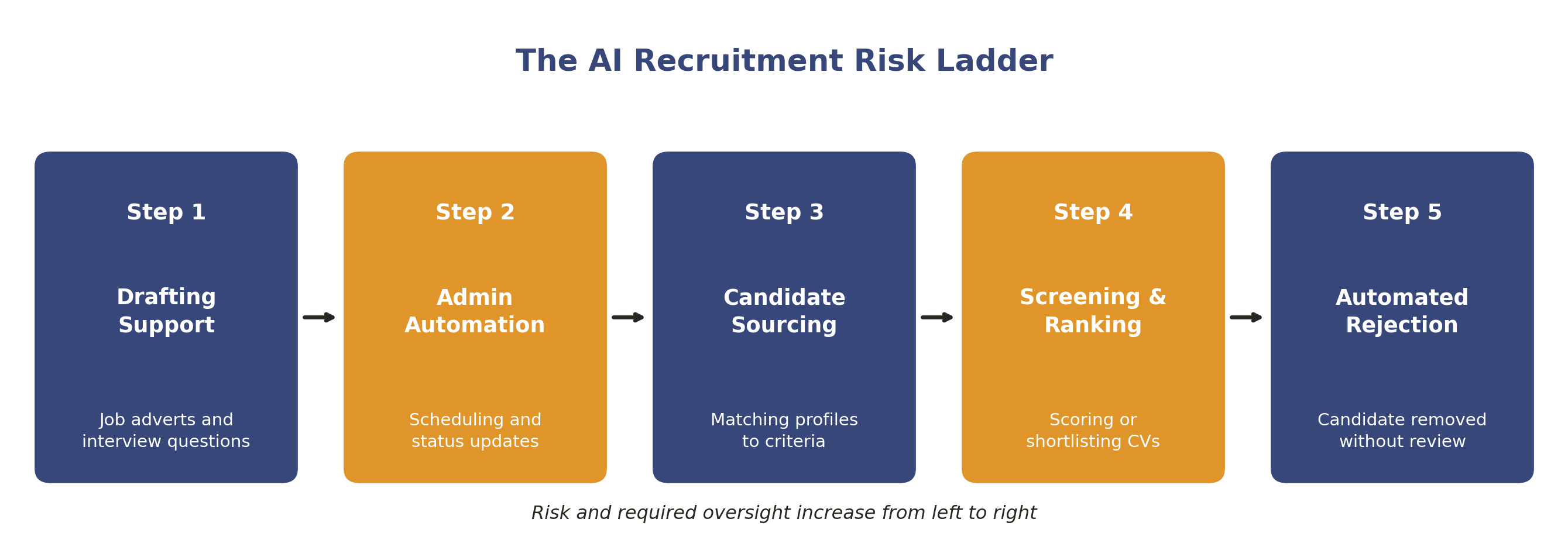
Illustrative ladder. Risk and required oversight increase from left to right.
The UK government's Responsible AI in Recruitment guidance, published by the Department for Science, Innovation and Technology's Responsible Technology Adoption Unit, sets out principles for exactly this reason: safety, security and robustness; appropriate transparency and explainability; fairness; accountability and governance; and contestability and redress. Those principles apply with different weight depending on where a tool sits on the list above. A drafting tool needs light-touch review. An automated rejection system needs all five principles taken seriously before it goes anywhere near a live hiring decision.
A practical rule for an SME with limited resources: spend your governance effort where the risk actually is. Do not apply the same casual approach to a CV-scoring tool that you would to a scheduling assistant, and do not spend weeks assessing a job-advert drafting tool that a person reviews line by line anyway.
Where AI Can Genuinely Save SMEs Time
The uses of AI recruitment that tend to deliver the clearest, least risky value for an SME are the administrative ones:
Drafting a first version of a job advert or interview question set, which a person then edits
Scheduling and rescheduling interviews across candidate and interviewer availability
Sending status updates so candidates are not left wondering what happened to their application
Summarising a long CV or application into a shorter format for a person to review, provided the summary is a starting point rather than a replacement for reading the original
Drafting rejection or offer communications for a person to personalise and send
None of these requires a system to decide who gets hired. They remove repetitive work while leaving the actual judgement with a person. This is also usually the fastest way for an SME to build genuine confidence in a vendor's tool before considering anything higher-risk.
Where Human Judgement Should Stay in Control
The riskiest part of AI recruitment is candidate screening, scoring and rejection, and it deserves more caution than it often gets in general AI recruitment content.
A common claim about AI screening is that it applies the same criteria to every application with the same rigour, which sounds reassuring. It is only partly useful. A system can apply its criteria completely consistently while those criteria, the data it was built on, or a variable acting as a proxy for a protected characteristic still disadvantage a particular group. Consistency is not the same thing as fairness. The criteria, the data and the outcomes all need to be tested for unfair exclusions and disproportionate effects, not simply assumed to be fair because the process is automated.
This matters under UK equality law as well as data protection law. Under the Equality Act 2010, indirect discrimination can occur where an apparently neutral provision, criterion or practice, including an AI scoring rule, places people who share a protected characteristic at a particular disadvantage compared with others, and where that cannot be objectively justified. Liability generally turns on the effect of a decision rather than on whether any bias was intended. Using an AI supplier does not remove the employer's responsibility to run a non-discriminatory recruitment process, and an employer may remain legally exposed where an AI-assisted decision produces an unlawful discriminatory outcome, regardless of what a vendor's documentation claims about the tool's neutrality.
The ICO has made this an active area of regulatory attention. In March 2026, it published a report on automated decision-making in recruitment following engagement with more than thirty employers, alongside a consultation on updated guidance on automated decision-making and profiling. Its stated expectations for any organisation using automated decision-making in hiring are that they proactively monitor for bias, including testing regularly and considering monthly bias reviews when procuring or running these tools; that they are transparent with jobseekers about when and how automated decision-making is used; and that they clearly explain how a candidate can challenge a decision and request a human review.
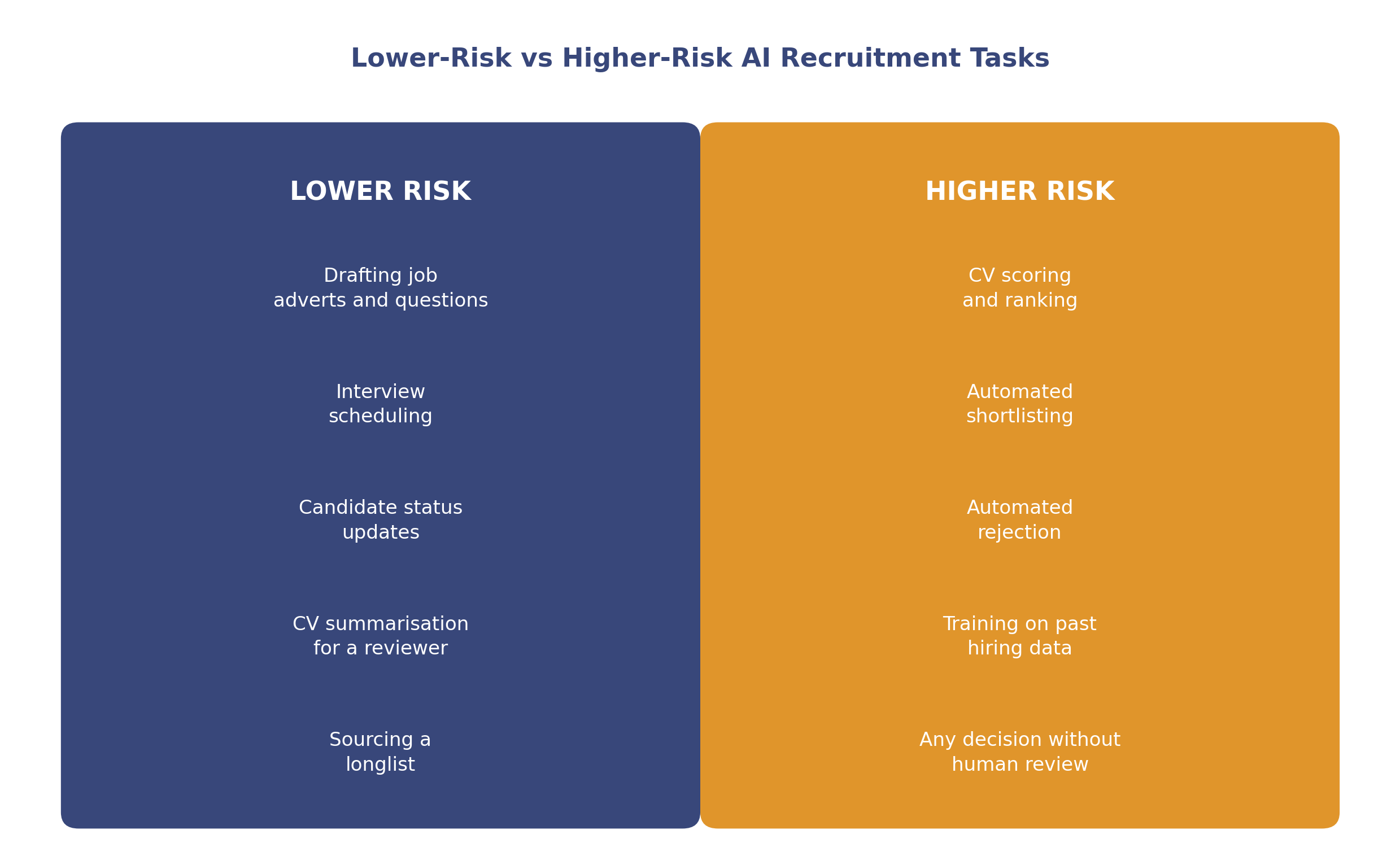
Illustrative comparison. Your own risk tolerance and regulatory context still apply.
Accessibility and Reasonable Adjustments
AI recruitment systems can unintentionally exclude candidates before formal screening even begins. A timed assessment, a video interview tool or an automated scheduling interface may disadvantage someone who uses assistive technology, needs additional time, or cannot use the standard channel for a reason unrelated to their suitability for the role.
Before deploying any AI recruitment tool, check:
Whether candidates can request a reasonable adjustment, and whether that request is easy to find and act on
Whether an alternative, non-AI route through the process exists for someone who needs one
Whether the tool has actually been tested with common assistive technologies, not just assumed to be compatible
Whether speech, video or behavioural analysis is genuinely necessary for the role, rather than added because the platform offers it
Whether a person reviews cases where technical performance, rather than candidate suitability, may have affected the result
AI Recruitment and UK Law: GDPR, the DUAA 2025, DPIAs and the Equality Act
This section is general information rather than legal advice, but it sets out the main obligations that apply once AI touches a real hiring decision.
UK GDPR applies to any AI recruitment tool that processes personal data, which covers all of them essentially, from a scheduling assistant handling a candidate's contact details through to a scoring tool assessing an entire CV. You need a lawful basis for the processing, and the seven UK GDPR principles, including data minimisation, accuracy and accountability, apply throughout. Our guide to AI and GDPR compliance for UK businesses covers the underlying framework in more depth, including how to map personal data across an AI system's lifecycle.
Special category data. Recruitment applications can reveal more than a standard CV suggests, including health or disability information given in connection with a reasonable adjustment, and sometimes data from biometric or behavioural assessments. Where a tool processes this kind of information, the employer needs both a UK GDPR Article 6 lawful basis and an applicable Article 9 condition, alongside appropriate safeguards. Solely automated significant decisions that use special category data are subject to tighter conditions still.
Automated decisions are specifically relevant to recruitment because a shortlisting or rejection decision can meet the definition of a decision with a legal or similarly significant effect on a person. The specific safeguards apply where a decision is both solely automated, meaning there is no meaningful human involvement, and significant in this sense. The Data (Use and Access) Act 2025 changed the rules here: rather than a general prohibition on solely automated significant decisions, the updated framework allows more of them to happen, provided those safeguards are genuinely in place, including information about the decision, a way to make representations, a way to contest the outcome and access to meaningful human intervention. A tool that produces a recommendation for a genuinely independent human reviewer may sit outside the solely automated definition, though the wider fairness, transparency, accuracy and accountability duties still apply regardless. Human review only counts here if it is real: a reviewer who simply approves whatever the tool recommends, without examining the candidate's actual evidence, is not providing meaningful human involvement. It is worth having enough authority, information and time to genuinely disagree with the tool, and monitoring how often that actually happens.
DPIA screening. A Data Protection Impact Assessment is not automatically required for every AI recruitment tool, but it is required where the processing is likely to result in a high risk to individuals. The ICO's screening criteria include systematic and extensive profiling with significant effects, and profiling used to decide access to an opportunity such as a job. An AI tool that profiles or scores candidates at scale to shortlist for a role is a strong candidate for needing a DPIA. Where you conclude a DPIA is not required, document that reasoning rather than skipping the question entirely.
The Equality Act 2010 applies regardless of whether a hiring decision is made by a person or a system. As set out above, an AI tool that produces a disproportionate effect on candidates sharing a protected characteristic can expose the employer to an indirect discrimination claim, even where the tool was never intended to discriminate and the criteria look neutral on their face.
Governance basics worth having in place before any AI recruitment tool touches a real decision:
A documented lawful basis for the personal data each tool processes
DPIA screening completed and recorded for any scoring, ranking or profiling tool
A named owner accountable for how the tool is configured and performs
A genuine, working route for a candidate to ask for human review of an automated outcome
Privacy information that explains, in plain terms, where AI is used in the recruitment process
A record of what data a vendor's tool was trained or configured on, and whether it uses your data to improve its own model
A periodic bias and accuracy review, not just a one-off check at launch
Training AI on Your Past Hiring Data: Why This Needs Care
A recommendation that shows up often in AI recruitment content is that a business should train a screening tool on its own historical hiring and performance data, on the logic that this teaches the system what a good hire looks like. This deserves more caution than it usually gets.
Historical hiring and performance data can encode a lot more than genuine performance. It can carry forward previous recruitment bias, uneven access to promotion, disability-related absence, maternity or caring-related patterns, subjective manager ratings, and variables that act as proxies for age, ethnicity, sex or socioeconomic background, even where none of those characteristics were recorded directly. A model trained on that data does not know the difference between a genuine performance signal and a historic pattern of unfair treatment. It simply learns the pattern.
There is also a narrower assumption worth questioning on its own: that an employee who stayed longer, or was rated more highly by a manager, was necessarily a better hire. Retention and manager ratings are each affected by many factors beyond the quality of the original hiring decision, including team dynamics, management quality and personal circumstances that have nothing to do with candidate suitability.
None of this means historical data is useless. It means it should not be treated as automatically suitable training data. Before using it, an SME should assess its quality and representativeness, confirm it has a lawful basis for that specific use, which is often a different purpose from the one the data was originally collected for, and actively test whether the resulting model reproduces historic bias rather than assuming it does not. Past retention or a manager's rating alone is not a reliable, ready-made definition of candidate quality.
How Much Does AI Recruitment Cost for SMEs?
Recruitment-specific AI pricing follows the same general pattern as AI automation pricing across other business functions, and it is worth budgeting for the whole picture rather than just the headline build cost. Based on the types of UK small business automation projects AI Workforce encounters, as covered in our AI automation pricing guide, indicative ranges as of August 2026 are:
Simple automation (roughly £500 to £2,000): for example, routing applications from a contact form into an applicant tracker with an automatic acknowledgement email, usually delivered on a no-code platform
Mid-range build (roughly £3,000 to £10,000): for example, an AI agent that summarises applications for a reviewer, schedules interviews across multiple calendars and sends candidate updates automatically
Custom AI (£10,000 and up): for example, a bespoke scoring or ranking system built and tuned for a specific role type, which is also the category that carries the most legal and governance work alongside the build cost
Ongoing monthly cost (roughly £200 to £800): maintenance, monitoring and support, scaling with usage and complexity
DIY option: platforms such as Zapier, Make or n8n can bring a simple recruitment workflow, such as routing applications or sending automatic status updates, down to a monthly subscription of roughly £20 to £50, if someone in-house is comfortable configuring it. Our guide on how to build AI agents without coding walks through this route in more detail
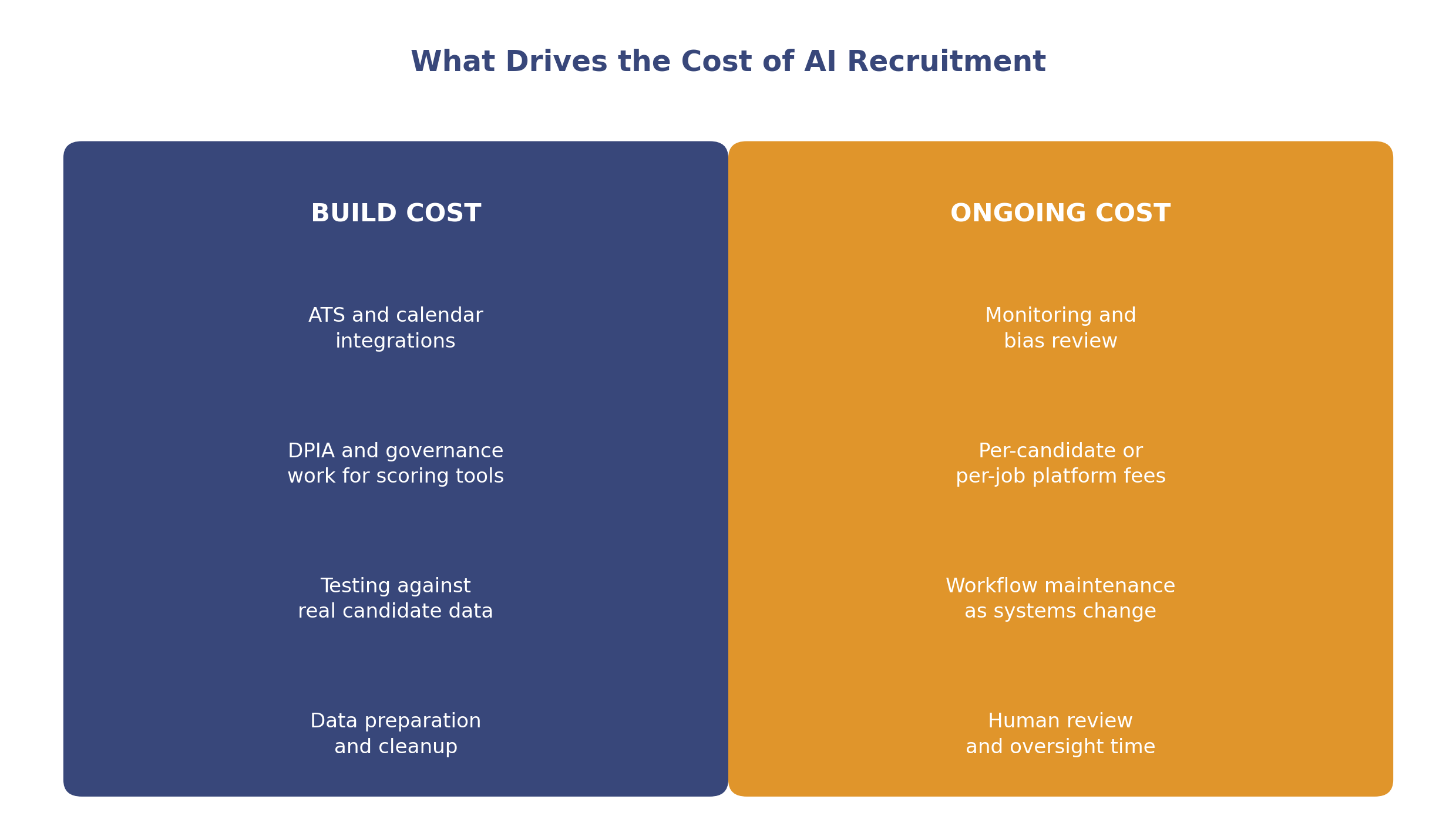
Illustrative cost drivers. Actual pricing depends on scope, data quality and how many systems are involved.
Beyond the build, factor in costs that are easy to miss when comparing quotes: per-candidate or per-job fees on some sourcing and screening platforms, data-cleanup work before a tool can be usefully configured, the DPIA and governance work described above, and the ongoing human review time that a responsible screening or ranking tool actually requires. A tool that looks cheaper on a monthly licence basis is not necessarily cheaper once proper human oversight is factored in.
A simple way to sanity-check the business case: multiply the vacancies you fill per month by the administrative hours each one currently takes and by the fully loaded hourly cost of the person doing that work, then compare the result with the automation's build cost spread over its expected life plus its monthly running, monitoring and review costs. If the sums are close, the case rests more on quality and risk reduction than on hard savings, which is worth being honest about internally.
AI Workforce Insight: the easiest recruitment tasks to automate are usually not the hiring decisions themselves. Scheduling, candidate updates and structured information capture are straightforward to test and simple to reverse if something goes wrong. Candidate ranking and rejection need considerably more evidence, governance and human review, because the consequences of an error are far more significant for the person affected.
How to Evaluate an AI Recruitment Vendor
Before adopting any AI recruitment tool that goes beyond drafting or scheduling, it is worth putting these questions to the vendor directly:
What data was the tool trained or configured on, and can that be explained in plain terms?
Can the vendor explain, in a way a non-technical hiring manager can understand, the main factors that affect a candidate's score or ranking?
Has the tool been tested for adverse impact on candidates sharing a protected characteristic, and can the vendor share the results?
Does the tool support reasonable adjustments for candidates with a disability?
Can a candidate challenge or ask for a human review of a result the tool produced?
Where is candidate data stored and processed, and does that involve a transfer outside the UK?
Is your data used to improve the vendor's own model, and can that be turned off?
How long are CVs, recordings, scores and other candidate data retained?
Can automated rejection be disabled, so a person reviews every negative outcome?
Can you export a full audit log of what the tool did and why?
What does the tool do when it is genuinely uncertain, rather than forcing a confident-looking output regardless?
A vendor that cannot answer most of these clearly is a signal to slow down, regardless of how polished the sales demonstration looks. If you are commissioning a custom AI recruitment agent rather than buying an off-the-shelf tool, our guide on how to write an AI agent brief covers how to specify its permissions, escalation rules and testing requirements before development starts.
A Practical Pilot Plan for Introducing AI Recruitment
Rolling out AI recruitment across an entire hiring process at once is a common way this goes wrong. If you are not sure your data, systems and ownership are in a fit state to start at all, our AI readiness assessment is a useful self-check to run before committing to a pilot. A simple decision rule helps: start with a task where an error is easy to detect, easy to reverse, and unlikely to remove a candidate from consideration. A more controlled approach, run over roughly four weeks, works better for most SMEs:
Week one: map your current recruitment workflow end to end, and record a baseline for time spent, cost and candidate drop-off at each stage
Week two: choose a single, lower-risk use case to pilot, such as interview scheduling or candidate status communication, rather than starting with screening or ranking
Week three: test the tool against historic or synthetic cases, deliberately including edge cases and reasonable-adjustment scenarios, before it touches a live candidate
Week four: run a monitored pilot with a person reviewing outcomes, and compare the results honestly against your baseline from week one
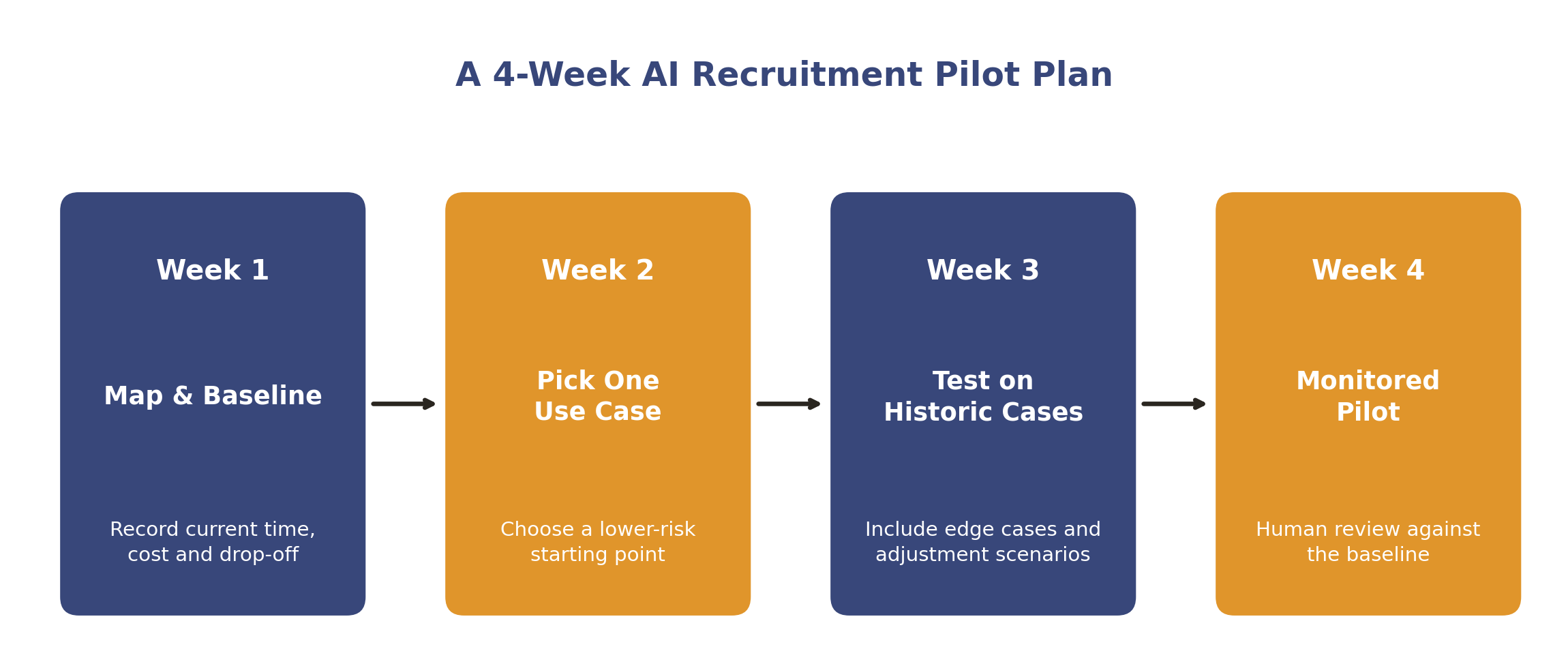
Illustrative roadmap. Pace depends on the risk level of the use case you start with.
Avoid starting with automated candidate rejection. It is the use case with the least room for error and the most legal exposure, and it is a poor choice for a first pilot regardless of how confident a vendor is in the tool's accuracy.
Metrics to Track
Once a pilot is running, track a mix of efficiency and fairness indicators rather than efficiency alone:
Time to first candidate response
Time spent screening per vacancy
Application completion rate
Candidate withdrawal rate
Interview scheduling time
Shortlist-to-interview conversion rate
Human correction rate, how often a person overrides or adjusts the tool's output
Reinstatement rate, how often a candidate initially excluded is reinstated on review
Candidate complaints related to the recruitment process
Hiring-manager satisfaction with shortlisted candidates
Cost per accepted hire
Retention at six and twelve months, interpreted as one signal among several rather than a complete measure of hiring quality
Reviewing these after a genuine pilot period, not just the first week, gives a far more honest picture of whether a tool is actually helping.
Talent Intelligence and Workforce Planning: What AI Can and Cannot Tell You
AI-powered talent intelligence tools, which analyse labour market data to inform hiring and workforce planning, can add genuinely useful evidence to decisions that were previously based mostly on instinct: where to source candidates, what a competitive salary looks like for a role, or which skills are becoming harder to find. It is worth being realistic about the limits of that evidence rather than treating it as a substitute for judgement.
The usefulness of a talent intelligence tool depends on the quality and recency of the market data behind it, how well it covers your specific geography and occupation, and, for the workforce-planning side, whether your own business has enough internal data to support a meaningful analysis in the first place. A tool supplies additional evidence to weigh alongside everything else you know about your business and your market. It does not replace the judgement of the person making the final call, and it is worth treating any output with the same scepticism you would apply to a single market report.
CIPD's Resourcing and Talent Planning Report found that, among organisations using AI in resourcing, 66% said it improved hiring efficiency and 62% said it increased the availability of useful information for workforce planning. That supports a case for potential efficiency and better information, but it does not mean every implementation reduces total cost. Software, integration, monitoring and human review time still need to be included in the business case before assuming AI recruitment pays for itself.
Where This Is Heading
Rather than speculating broadly about the future of AI recruitment, it is more useful to note a few specific, practical shifts that are already visible. AI features are increasingly built directly into mainstream applicant tracking platforms rather than sold as separate tools, which lowers the barrier to adoption but also makes it easier for an SME to end up using a screening feature without a deliberate decision to do so. Regulatory scrutiny and demand for auditability, meaning a genuine ability to explain and review what a tool decided and why, are both increasing, as reflected in the ICO's March 2026 recruitment report and its ongoing consultation. Candidate disclosure, being told clearly when AI is involved in a hiring decision, is becoming a baseline expectation rather than a differentiator, and structured, skills-based hiring data is becoming more valuable as a foundation for any AI tool. Employers also increasingly need a clear policy for candidates using generative AI themselves, for example, to draft applications or prepare for interviews, which is a live practical question with no single settled answer yet.
The honest summary is that AI recruitment is moving from an early-adopter advantage toward baseline infrastructure, in the same way that applicant tracking systems did a decade earlier. The businesses getting genuine value from it are the ones treating governance as part of the rollout, not as an afterthought once something has already gone wrong. Recruitment is one part of a wider shift; our digital workforce guide covers how automation, AI agents and people fit together across a business more broadly, with the same principle of matching autonomy to risk running throughout.
Frequently Asked Questions
What is AI recruitment for SMEs?
AI recruitment for SMEs means using artificial intelligence to support parts of hiring such as writing job adverts, sourcing candidates, summarising applications, scheduling interviews and communicating with applicants. Higher-impact uses such as candidate ranking or automated rejection require stronger testing, transparency and human oversight than lower-risk administrative uses.
Can SMEs use AI to screen CVs?
Yes, but AI screening should support rather than silently replace human judgement. Employers should validate the criteria a tool uses, test for unfair outcomes, explain the relevant processing to candidates, and give people a genuine, working route to challenge a result they believe is wrong.
What is the safest first AI recruitment use case for an SME?
Interview scheduling, candidate status updates and other structured administrative support are usually safer starting points than automated ranking or rejection, because mistakes in these areas are easier to spot and easier to reverse.
Does using an AI recruitment tool remove legal responsibility for a hiring decision?
No. Under the Equality Act 2010, liability for a discriminatory outcome generally turns on the effect of a decision, not on whether a person or a system made it. Using an AI tool does not transfer that responsibility away from the employer.
Do we need a DPIA before using an AI screening tool?
Not automatically for every tool, but very likely if the tool profiles or scores candidates at scale to decide who is shortlisted. Screen every AI recruitment tool against the ICO's DPIA criteria and document the outcome, even where you conclude one is not required.
Can AI recruitment software discriminate?
Yes. AI recruitment software can reproduce bias present in its training data, apply criteria that disadvantage a protected group, or introduce new forms of exclusion that were not present in a manual process. Employers should test criteria and outcomes, provide reasonable adjustments, and retain meaningful human oversight rather than assuming automation is neutral by default.
Must candidates be told that AI is being used in recruitment?
Candidates should receive clear privacy information explaining how their personal data is processed and whether automated decision-making is involved. Where a solely automated significant decision is made, the additional DUAA 2025 transparency and challenge safeguards apply on top of normal privacy information.
How much does AI recruitment cost for a UK SME?
Simple recruitment automation, such as routing applications, typically starts from around £500. Mid-range AI workflows, such as scheduling and candidate communication agents, commonly run £3,000 to £10,000 to build, with £200 to £800 a month in ongoing support. DIY options on platforms such as Zapier or Make can start from roughly £20 to £50 a month.
Will AI replace HR and recruitment professionals at an SME?
Most current use cases support existing HR and hiring staff by handling repetitive administrative work, rather than replacing the judgement-heavy parts of the role. CIPD research has found stronger trust among people in AI informing workplace decisions than in AI making those decisions independently, which is consistent with keeping people responsible for the final call.
Key Takeaways
AI recruitment is not one uniform category; drafting and scheduling tools carry far less risk than candidate scoring, ranking or automated rejection
A consistently applied AI screening process is not automatically a fair one; criteria, data and outcomes still need to be tested against the Equality Act 2010
The ICO has made automated decision-making in recruitment an active area of regulatory attention, expecting proactive bias monitoring, transparency with candidates and a genuine route to human review
Training a screening tool on past hiring and performance data carries real risk of reproducing historic bias, and needs its own lawful basis and testing, not an assumption of suitability
Realistic AI recruitment costs for an SME run from roughly £500 for simple automation to £3,000 to £10,000 for a mid-range build, plus £200 to £800 a month in ongoing support
Start with lower-risk administrative automation, such as scheduling or candidate communication, and treat automated rejection as a use case requiring the most caution, not the first pilot
Track fairness and correction metrics alongside efficiency metrics; efficiency gains do not automatically mean fairness or lower total cost
This article is general information rather than legal advice. Recruitment law and data protection guidance affecting AI are actively developing, including the ICO's guidance on automated decision-making, which was still being finalised at the time of writing. Take independent legal advice for any AI recruitment tool involved in scoring, ranking or rejecting candidates.
Ready to Introduce AI Recruitment Safely?
We'll help you identify which parts of your hiring process are genuinely safe to automate now, assess the risks in the parts that are not, and build a properly governed pilot before you rely on AI for a real hiring decision.
About the Author
Clara Miller is a Content Marketing Specialist at AI Workforce, a British AI company building AI agents for UK businesses. She writes blogs, whitepapers and guides that explain technical AI concepts and compliance considerations to everyday business buyers, working closely with AI Workforce's product and operations teams to keep the explanations accurate.
This article was reviewed by Rodi Taze, Co-Founder of AI Workforce, who works with UK businesses to identify where AI can genuinely support recruitment and operations, and to put practical governance in place before a tool is relied on for a real decision.
Reviewed: August 2026