AI Receptionist Pricing UK: Costs in 2026
Posted On: August 15, 2026
Written by Clara Miller, Content Specialist at AI Workforce · Reviewed by Seth Ayush, Co-Founder of AI Workforce · Last updated: August 2026
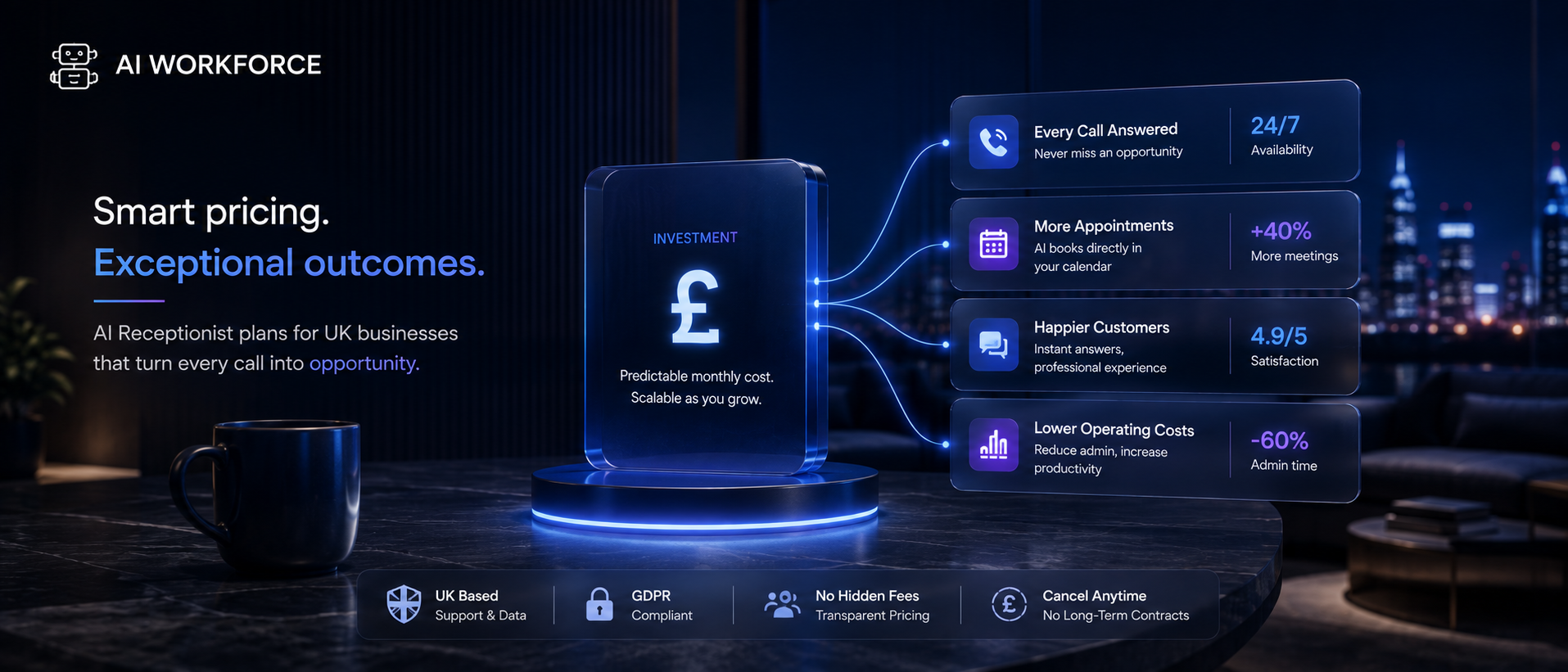
Quick answer: Public AI receptionist plans checked in August 2026 start from £25 a month, with self-service packages from named UK providers reaching £99 a month before VAT. Other providers, and hybrid AI-plus-human services, use custom quotations, particularly where managed setup, integrations or human call handling are involved. Compare the total monthly cost at your actual call volume, including overages, forwarding, setup and escalation, rather than the advertised starting price alone.
At a Glance
Lowest published starting price checked: £25 a month (Moneypenny, quoted individually from that point)
IONOS public tiers: £39, £69 and £99 a month excluding VAT, all three including website chat, call forwarding and SMS notifications
RingCentral AIR: officially announced UK starting price of £32 for 100 minutes; its current pricing page directs buyers to sales, so confirm live terms
Main pricing units: calls, minutes, or hybrid AI-plus-human usage
Biggest hidden cost: exceeding your included call or minute allowance
Best comparison metric: total cost per successfully resolved or correctly handed-off call, not the headline monthly fee
If you've started shopping for an AI receptionist, the first thing you'll notice is that the pricing is all over the place: one provider quotes £39 a month, another quotes £25, and a third won't give you a number until you've booked a demo. This 2026 pricing guide pulls that apart. It walks through the pricing models providers actually use, what verified public pricing looks like from named UK providers, the hidden costs to watch for, and a transparent way to compare an AI receptionist's cost against employing a person. It's worth reading before you sign anything, because the headline price on a provider's pricing page may not reflect the amount you pay once usage, overages, setup and optional services are included.
What Is an AI Receptionist, and Why Does Pricing Vary So Much?
An AI receptionist is software that answers calls to a business phone number, understands what the caller wants using natural speech technology, and completes approved actions such as answering an enquiry, taking a message or booking an appointment. Unlike a fixed-menu phone tree, it can handle approved, repeatable call types without forcing callers through a fixed button menu.
Pricing varies so much because "AI receptionist" is not one standardised product. Some providers sell a lightweight AI answering service that only takes messages and forwards calls. Others sell a fuller virtual receptionist that books appointments, updates a CRM and offers human answering service backup for anything it can't handle. A £39 a month plan and a custom-quoted hybrid plan may both be called an AI receptionist, but they are doing very different jobs, so comparing the headline price alone tells you almost nothing.
Call volume is the other major driver. A clinic answering 800 calls a month has fundamentally different pricing needs than a sole trader answering 40, and most providers price around that difference rather than charging every customer the same flat fee.
How Do Providers Actually Charge for an AI Receptionist?
The providers reviewed for this guide generally use one, or a combination, of three pricing models.
Flat monthly fee with a call cap. You pay a set monthly cost for a fixed number of calls, and anything over that cap is billed as overage at a stated per-call or per-minute rate, or triggers an automatic upgrade to the next tier. A flat monthly plan may be easier to budget for when call volume is reasonably predictable, since you know the base cost before overage applies.
Per-minute or per-call usage pricing. Instead of, or alongside, a flat allowance, some providers charge a per-minute or per-call rate directly, particularly once an included bundle is used up. This suits businesses with unpredictable or seasonal call volume, but it makes monthly cost harder to forecast, since a busy month can push the bill up sharply.
Hybrid AI-plus-human pricing. Some providers, such as Moneypenny, price the AI layer as a headline starting figure and then quote the full package, including human escalation, individually based on your call volume and configuration. This is typically the closest model to a traditional human answering service in terms of what it can actually handle, but it also means the public starting price tells you very little about your likely total cost.
How Much Does an AI Receptionist Cost in the UK? Verified Provider Pricing
There's no single answer to how much an AI receptionist typically costs, because pricing spans a wide range depending on provider, features and call volume. The examples below were checked directly against each provider's own pricing page or official announcement on 15 August 2026.
Provider | Published starting price | Usage unit | What's included | Source status |
|---|---|---|---|---|
IONOS AI Receptionist | £39/mo excl. VAT (30 calls, then £0.49/call) | Calls, with per-call overage | Website chat agent, call forwarding and SMS notifications on every tier; £69 and £99 tiers add outbound calling and appointment scheduling | Official published pricing, checked 15 August 2026 |
IONOS AI Receptionist (mid tier) | £69/mo excl. VAT (100 calls, then £0.39/call) | Calls, with per-call overage | As above | Official published pricing |
IONOS AI Receptionist (top tier) | £99/mo excl. VAT (unlimited calls) | Unlimited calls | As above, no per-call overage | Official published pricing |
Moneypenny AI Receptionist | From £25/mo | Quoted individually | Hybrid AI-plus-human answering, trained on Moneypenny's own call data; live escalation to human receptionists available | Official starting price; full configuration and cost require a quotation |
RingCentral AIR | From £32/mo for 100 minutes, plus additional minute bundles | Minutes | AI call answering, FAQs, routing and, per RingCentral's product announcement, appointment scheduling and multi-language support | Officially announced UK starting price; current pricing page directs buyers to sales, so confirm live terms |
AI Workforce | Pro tier: custom quote | Plan allowances and configuration | Personal Assistant Agent (AI inbound call answering) as part of a wider multi-agent Pro package, alongside outbound calling, CRM sync and other agents | First-party commercial inclusion; see disclosure below |
IONOS's April 2026 launch announcement listed lower £9, £19 and £29 introductory prices for the same three tiers, a useful reminder of how quickly public pricing in this market can move. IONOS launch announcement
About AI Workforce's inclusion: AI Workforce publishes this guide and is included for pricing transparency, not as an independent recommendation. Its inbound call-answering agent, the Personal Assistant Agent, forms part of its custom-priced Pro package rather than a fixed monthly tier, so prospective buyers should request a written quotation covering call minutes, setup, integrations and support before comparing it against a fixed-price competitor.
Public prices among the providers checked for this guide begin at £25 a month, while fixed self-service packages from named UK providers reach at least £99 a month before VAT. Other providers, and hybrid or managed services, use custom quotations, particularly where human backup, multiple locations, integrations or managed setup are involved. Those custom services can cost considerably more, but there is not currently enough consistent public pricing data across the market to define a reliable "typical" small-business price band, so treat any figure outside the named examples above with caution until you have a written quotation.
The AI Workforce Receptionist Total Cost Stack
Rather than comparing headline monthly fees alone, it helps to break an AI receptionist's real monthly cost into its component parts. We call this the AI Workforce Receptionist Total Cost Stack.
Subscription: the base platform fee for the plan tier you're on
Usage: calls, minutes and any overage charges beyond your included allowance
Telephony: phone numbers, call forwarding and transfer costs
Actions: bookings, SMS confirmations and outbound calls, where these aren't already bundled
Integration: calendar, CRM and sector-specific system connections
Human cover: escalation and overflow handling by a person, where included
Oversight: setup, testing and ongoing maintenance of the knowledge base and call flows
AI receptionist total monthly cost =
subscription + usage + telephony + actions
+ integration + human cover + oversight
For the broader voice-agent cost model behind those components, including speech-to-text, LLM usage, text-to-speech, telephony, concurrency and support, see our guide to AI voice agent pricing in the UK.
A plan that looks cheap on the subscription line alone can cost considerably more once usage, integration and human cover are added in, particularly for a business with high call volume or complex escalation needs. Ask any provider to itemise each of these seven components before comparing quotes.
Buyers should also confirm whether call recording, transcription, data storage, a data-processing agreement and configurable retention controls are included or separately priced, particularly where calls may contain personal or sensitive information.
Estimate your AI receptionist Cost
Want help mapping your own call volume against the Total Cost Stack? We'll help you work out a realistic monthly figure before you commit to a provider.
Hidden Costs to Watch: What's Often Left Off the Headline Price?
A handful of charges are easy to miss when comparing an AI receptionist pricing page against a competitor's.
Call forwarding, SMS confirmations and outbound calling may be bundled into the headline price or charged as add-ons, so check the fine print rather than assuming parity between two similarly priced plans; IONOS, for example, currently bundles website chat, call forwarding and SMS notifications into all three of its tiers. A setup fee for onboarding, custom scripts or number porting can also apply on top of the advertised monthly cost, particularly for more complex integrations.
Overage pricing deserves particular attention. If a provider caps included calls per month and charges a per-call or per-minute rate above that cap, a single busy month, a marketing push, a seasonal spike, or an enquiry surge can produce a bill several times the advertised monthly cost. IONOS, for instance, currently charges £0.49 per call above the 30-call allowance on its lowest tier and £0.39 per call above the 100-call allowance on its mid tier. Ask a provider directly what happens the moment you exceed your calls per month allowance, and get that answer in writing before signing.
Finally, a free trial is not the same as a free AI receptionist. IONOS currently offers a one-month free trial with cancellation available at any time, which is genuinely useful for testing real call scenarios against your own business details, but production use almost always moves onto a paid allowance once the trial period ends, so budget for the paid tier from the outset rather than assuming trial terms continue indefinitely.
AI Receptionist vs Human Receptionist: A Transparent Cost Comparison
Comparing an AI receptionist subscription with the cost of employing a person is not a straightforward like-for-like exercise, and a single "£24,000 to £32,000 a year" figure for a human receptionist is not reliable without showing how it's built. The table below sets out an illustrative model, built from salary assumptions plus the UK employer costs that actually apply, so you can see exactly what's included.
Cost component | Lean | Typical | Higher-support |
|---|---|---|---|
Base salary (assumption) | £22,000 | £26,000 | £30,000 |
Employer National Insurance (15% above the ~£5,000 secondary threshold) | £2,550 | £3,150 | £3,750 |
Minimum employer pension contribution (3% of qualifying earnings, £6,240 to £50,270) | £473 | £593 | £713 |
Recruitment and onboarding (assumption) | £800 | £1,200 | £1,800 |
Equipment and phone systems (assumption) | £300 | £500 | £700 |
Holiday or absence cover (assumption) | £600 | £1,000 | £1,500 |
Estimated annual total | £26,723 | £32,443 | £38,463 |
This model uses illustrative salary assumptions rather than a verified market average, so treat it as a worked example to adapt with your own local salary data, not a definitive UK figure.
Even in the Lean scenario, the illustrative annual employment cost is substantially higher than the fixed public AI receptionist subscriptions compared in this guide (£99 a month, or £1,188 a year, before VAT, at the top end). Custom and managed services may narrow that gap, but their costs should be assessed through a written quotation rather than an assumed market range. An AI receptionist subscription may cost materially less than employing a receptionist, but the services are not identical. Compare the AI's total operating cost with the portion of receptionist work it can safely and reliably perform, not with the entire human role.
That said, a human receptionist brings judgement an AI system shouldn't be given on its own: reading a distressed caller, handling a genuinely complex or sensitive enquiry, or making a call on something outside written policy. Many UK businesses land on a hybrid setup rather than picking one exclusively, using AI for routine call handling and volume, with a human answering service or in-house team stepping in for anything that needs real judgement. The honest comparison is not simply cost per month; it's what proportion of your calls genuinely need a person, which is worth mapping out from your own call history before deciding.
If you are deciding specifically between an AI receptionist, a human answering service or a hybrid of the two, see our full guide to AI receptionist vs answering service in the UK, which compares cost structure, call handling, booking, integrations, scalability and human judgement side by side.
Is an AI Receptionist Worth the Cost? Calculating ROI
Whether an AI receptionist is worth the monthly cost usually comes down to one number: how many calls, bookings or enquiries were you missing before. A trades business that was missing five enquiries a week because staff were on a job, and now captures most of them through an AI receptionist, can offset the monthly cost with a single converted job. A clinic that reduces missed bookings and no-shows through automated confirmation calls sees a similar payoff, since a missed booking slot has a direct, calculable cost.
Illustrative monthly value =
additional qualified calls captured × conversion rate × average gross profit per conversion
Estimated ROI =
(monthly value attributable to the receptionist − total monthly receptionist cost)
÷ total monthly receptionist cost × 100
Use gross profit rather than revenue where you can, since revenue alone overstates the value of an additional booking or enquiry. Alongside the ROI calculation, track a broader set of indicators: answered-call rate, successful resolution rate, correct transfer rate, booking completion rate, caller abandonment rate, escalation rate and incorrect-answer rate. A system that answers a large volume of calls while quietly mishandling bookings or giving wrong answers is not delivering the ROI the raw call count suggests.
This exercise is rougher for service businesses with lower call volume, where the fixed monthly cost may outweigh the marginal value of a small number of additional bookings, which is exactly why matching plan size to real call volume, not the provider's headline tier, matters so much.
For a broader look at how an AI receptionist actually works, what it should never handle alone, and how to compare providers on capability rather than price, our companion guide to the best AI receptionist providers in the UK covers that ground in full; this guide focuses specifically on the numbers. If you're comparing wider call-handling options, our guides to AI answering services and AI call handling cover adjacent categories, and our guide to AI agents explains the underlying technology in plain English.
How Do You Choose the Right AI Receptionist Pricing Plan?
Start with your real call volume, not the provider's example scenario. Pull three months of call data from your existing phone system, so you know roughly how many calls a month you're actually answering, and how many are going to voicemail today.
Match that volume against each provider's calls per month allowance rather than the base fee alone, and model what a busy month would cost once overage applies. A plan that looks like the cheapest option on a pricing page can end up the most expensive once your real call volume is priced in, particularly on usage-based tiers with a per-call or per-minute overage rate.
Finally, weigh the plan against what you actually need it to do. A sole trader who mostly needs missed calls answered and messages taken doesn't need a plan built around multi-location CRM integration and outbound calling; a growing clinic booking dozens of appointments a week probably does. Calendar or CRM integration may be included, restricted to certain tiers, or priced separately, so confirm this directly rather than assuming. Choosing a plan that matches your actual workflow, rather than the most feature-rich tier available, is usually the difference between a good deal and an overpriced one. If you're weighing this decision more broadly, our AI Readiness Assessment is a useful starting point, and our guide to AI and GDPR compliance covers what to check before any provider starts recording and storing caller data.
Estate agencies are another example where the workflow can materially affect total cost: answering basic property enquiries is relatively simple, while live listing-data access, viewing bookings across negotiator calendars and valuation-lead routing require deeper integration. Our guide to AI receptionists for estate agents explains that property-specific workflow in detail, including viewing bookings, listing-data accuracy and human escalation.
Recruitment agencies can face a similar pricing difference because a basic call-answering setup is much simpler than a receptionist connected to consultant calendars, vacancy data and an ATS or CRM. A fuller workflow may need to distinguish candidate enquiries from client calls, book interviews against the correct consultant's availability and route existing candidate or vacancy matters to the right desk. Our guide to AI receptionists for recruitment agencies explains that recruitment-specific workflow in more detail, including candidate calls, interview booking, ATS/CRM integration and human escalation.
Staffing agencies can face a different pricing profile because 24/7 worker coverage, urgent call routing and on-call escalation may matter more than appointment booking. A basic answering setup may only capture messages, while a fuller workflow may need to recognise shift call-offs, route urgent client cover requests, record timesheet or payroll enquiries and connect to the agency's on-call process. Those requirements can change telephony usage, integration needs and human-escalation costs. Our guide to AI answering services for staffing agencies covers 24/7 worker enquiries, shift call-offs, urgent client cover, payroll and timesheet routing, and human escalation in more detail.
Frequently Asked Questions
How much does an AI receptionist cost per month in the UK?
Verified public pricing from the providers checked for this guide starts from £25 a month (quoted individually), with fixed self-service tiers reaching £39, £69 and £99 a month excluding VAT. Other providers and hybrid or managed services use custom quotations, so always confirm the total monthly cost at your own call volume before budgeting.
Is there a free AI receptionist?
We did not verify an ongoing free production plan among the providers reviewed for this guide. IONOS currently offers a one-month free trial, but continued production use requires a paid package once the trial ends.
Does AI receptionist pricing include VAT?
Not always. IONOS publishes its prices excluding VAT, so confirm whether a quoted monthly cost is inclusive or exclusive of VAT before comparing plans.
Is an AI receptionist cheaper than a human receptionist?
Usually a lower subscription cost, but not a like-for-like service. Our illustrative model puts a fully loaded human receptionist at roughly £26,700 to £38,500 a year in the UK once employer National Insurance, minimum pension contributions, recruitment and cover are included, well above the named AI receptionist subscriptions in this guide, though the two aren't interchangeable in terms of judgement-based work.
Key Things to Remember
Verified UK provider pricing starts at £25 a month (Moneypenny, quoted individually) and £39 a month before VAT for a fixed self-service tier (IONOS); beyond these named examples, several providers use custom quotations, particularly for managed, integrated or hybrid AI-plus-human services
Providers use one or a combination of three pricing models: flat fee with a call cap, per-minute or per-call usage, and hybrid AI-plus-human pricing
Use the AI Workforce Receptionist Total Cost Stack — subscription, usage, telephony, actions, integration, human cover and oversight — to compare true monthly cost, not the headline subscription fee
Always check whether quoted prices include VAT, and confirm what happens once you exceed your calls per month allowance
Hidden costs to watch include setup fees, per-call or per-minute overage charges, and add-ons not bundled into every tier
An illustrative fully loaded human receptionist costs roughly £26,700 to £38,500 a year in the UK once employer costs are included, but a human receptionist and an AI receptionist are not a full substitute for each other
Calculate ROI from your own missed-call rate and gross profit per conversion, not a generic industry figure, and track resolution and escalation accuracy alongside call volume
Match your plan to your real call volume, pulled from your own phone system, rather than a provider's headline tier
Discuss an AI receptionist setup with AI Workforce
If your team is still juggling the phone between everything else, it's worth seeing how much an AI receptionist can take off their plate.
Sources and Further Reading
IONOS AI Receptionist pricing, checked 15 August 2026
IONOS AI Receptionist launch announcement, April 2026
Moneypenny AI Receptionist pricing
RingCentral AIR Everywhere announcement
AI Workforce pricing
AI Receptionist UK: Costs & Best Options for 2026, AI Workforce
AI Answering Service: A Practical Guide for UK Small Businesses, AI Workforce
GOV.UK: Employer National Insurance rates
GOV.UK: Workplace pensions, contribution rates
About the author: Clara Miller is a Content Specialist at AI Workforce, covering how UK small businesses evaluate the cost and value of AI call-handling tools.
Reviewed by: Seth Ayush, Co-Founder of AI Workforce, for provider-pricing accuracy, call-volume assumptions and implementation considerations.
Reviewed: August 2026.