AI Receptionist vs Answering Service UK: Cost, Features and Which Is Better?
Posted On: September 5, 2026
Written by Clara Miller, Content Specialist at AI Workforce · Reviewed by Rodi Taze, Co-Founder of AI Workforce · Last updated: September 2026
Direct Answer
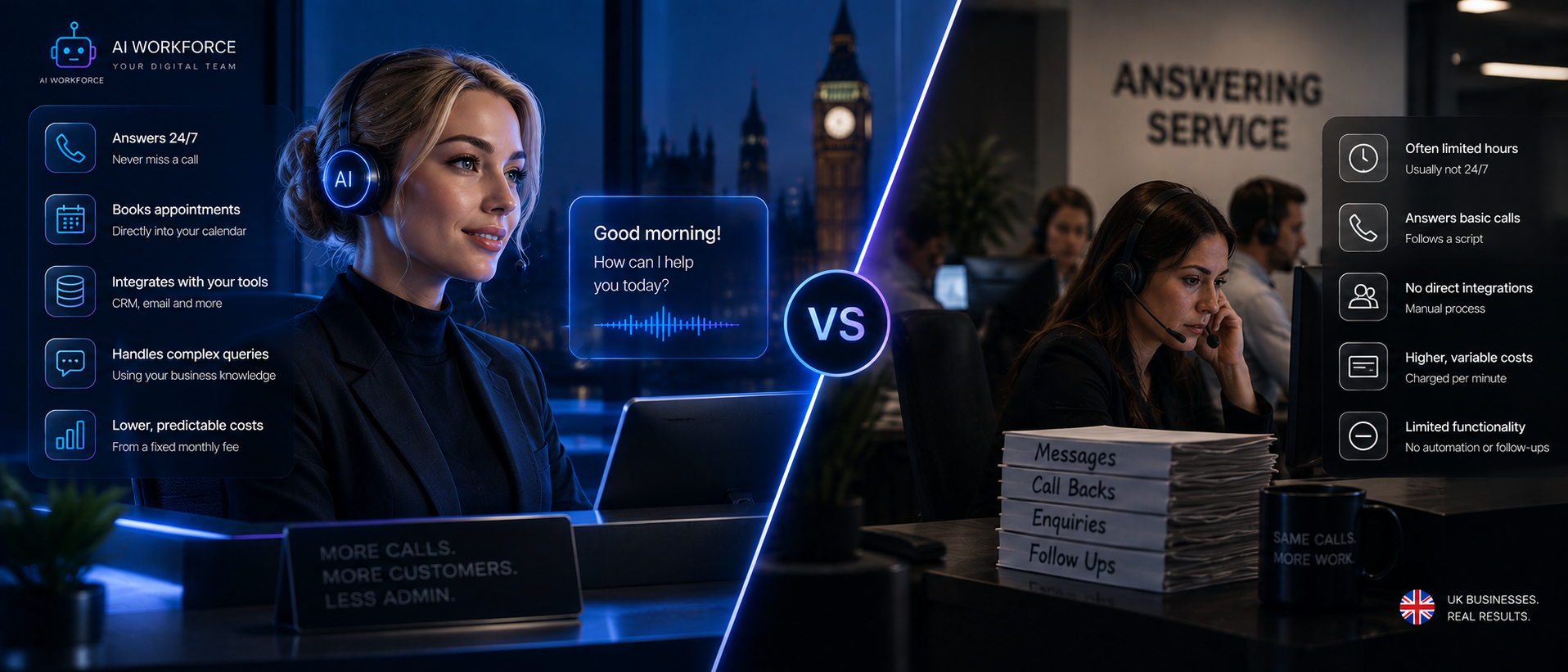
An AI receptionist and a human answering service solve the same problem, missed and unanswered calls, in fundamentally different ways, and neither is a universal replacement for the other. An AI receptionist suits repeatable calls: FAQs, appointment booking, structured qualification, and CRM updates, at consistent quality and often a lower marginal handling cost at higher call volumes, depending on platform, telephony and support pricing. A human answering service suits calls that need judgement: complaints, distressed callers, ambiguous requests, or bespoke pricing conversations, where flexibility and empathy matter more than speed. For businesses handling a genuine mix of both, a hybrid model — AI for routine volume with a defined handoff to a person — can provide a practical balance between automation and human judgement.
Quick answer: Choose AI for repeatable, booking-heavy, high-volume calls. Choose a human service for sensitive, ambiguous or high-value calls. Choose hybrid where routine calls dominate but meaningful exceptions still need a person.
AI Receptionist vs Answering Service at a Glance
Factor | AI receptionist | Human answering service |
|---|---|---|
Cost structure | Platform fee + usage + telephony + integrations, often lower marginal handling cost at volume | Retainer + included minutes + overage + add-ons, human time costs more per minute |
Availability | 24/7, subject to platform uptime and configuration | Depends on staffing; 24/7 available from some providers; pricing varies by package |
Call volume | Multiple simultaneous calls, subject to configured concurrency and telephony capacity | Limited by number of staffed operators at any given time |
Appointment booking | Direct calendar access, real-time availability | Varies by provider; some book from scripts, some just message |
Lead qualification | Consistent, rule-based, weaker on ambiguous intent | Flexible, judgement-based, varies by operator training |
CRM integration | Direct, structured updates and triggers | Varies; some integrate, others use portals or email |
Personalisation | Consistent, script-bound unless configured otherwise | Naturally adaptive, varies by operator |
Complex conversations | Should escalate rather than improvise | Generally stronger, real-time judgement |
Human judgement | None natively; depends on escalation design | Present by default |
After-hours | Native strength, no shift premiums | Possible; may be included or charged separately depending on provider |
Scalability | Usage-based, generally fast to scale | Bound by staffing pools and recruitment |
Setup | Knowledge base, integrations and testing; days to weeks | Scripts, escalation contacts, provider onboarding; often faster to start |
Compliance | UK GDPR/PECR apply to call data and recordings | Same obligations apply to recordings and personal data |
Best fit | High-volume, repeatable, booking-heavy call patterns | Low-volume, judgement-heavy, sensitive or bespoke calls |
This table compares operating models generally, not specific named products. Exact pricing figures for named UK providers are covered in our AI receptionist pricing guide and our AI answering service comparison.
What's Covered
The Core Comparison
Call Handling
Booking, Qualification and CRM
Judgement and Failure
Fit by Business Type
Cost, Scale and Consistency
Compliance
Deciding
Reference
What Is the Difference Between an AI Receptionist and an Answering Service?
An AI receptionist is software, a voice agent, that answers calls to a business number, understands the caller using natural speech technology, and executes predefined workflows: answering FAQs, booking appointments, qualifying enquiries and updating a CRM, within rules set by the business. A human answering service is a person, usually one of a pool of trained operators working from scripts and business information, answering calls on behalf of another business.
Two related terms are often used loosely alongside these. A "virtual receptionist" is an ambiguous term. Some providers use it for an AI receptionist, while others use it for a human receptionist working remotely or through an outsourced answering service. Check whether the service is AI, human or hybrid before comparing features or pricing. An "outsourced receptionist" is generally a human service, whether AI-branded automation sits behind it or not. A "hybrid model" combines both deliberately: AI handles the repeatable layer, and calls that need judgement route to a person, either at the same provider or at your own business. For a direct head-to-head on cost and coverage, see our guide to AI receptionist vs human receptionist.
The category-level distinctions between an AI answering service, an AI receptionist and a broader AI voice agent are covered in more depth in our AI answering service comparison; this article assumes you already understand roughly what each term means and focuses on which operating model fits your business.
Which Is Cheaper: AI Receptionist or Answering Service?
Neither is reliably cheaper in every case; the honest comparison is of cost structure, not one universal number. AI receptionist pricing typically combines a platform or subscription fee, setup, AI usage or minutes, telephony, integrations, concurrency allowances and, where used, human escalation coverage. Human answering service pricing typically combines a retainer, included or overage minutes, per-call charges, message-taking or booking add-ons, transfer charges, specialist-script fees and out-of-hours premiums.
Cost Formulas
AI receptionist total cost = platform + setup + voice usage + telephony + integrations + support + human escalation coverage Answering service total cost = retainer + included/overage minutes + call volume + booking or specialist add-ons + transfers + out-of-hours charges + setup
These are structural formulas, not price ranges. For exact, dated figures from named UK providers on both sides, see our AI receptionist pricing guide and our AI voice agent pricing guide, both of which cite official provider pricing pages with the date checked.
What tends to make AI receptionists cheaper at volume is that they often have a lower marginal handling cost per additional routine call, depending on platform, telephony and support pricing, since one platform can hold several simultaneous conversations at once. What tends to make human answering services cheaper at very low volume is that some providers charge close to nothing below a small included allowance, while an AI platform's fixed subscription applies regardless of how few calls come in. Anyone comparing a specific quote from each side should build out both formulas above against their own real monthly call volume before deciding, rather than comparing headline monthly fees alone.
AI Receptionist vs Answering Service: Feature Comparison
Split into two shorter tables so it stays readable on a phone.
Capability | AI receptionist | Human answering service | Usually fits better |
|---|---|---|---|
24/7 answering | Native, subject to uptime | Possible, often at a premium | AI, for routine coverage |
Simultaneous calls | Multiple at once | Bound by staffed operators | AI, at volume |
Message taking | Yes, structured | Yes, standard service | Either |
FAQs | Yes, from approved knowledge base | Yes, from a script or briefing | Either |
Appointment booking | Direct calendar access on capable platforms | Varies by provider and calendar access | AI, when integrated |
Calendar access | Real-time, where configured | Requires platform access, varies | AI, when configured well |
Qualification | Consistent, defined criteria | Flexible, judgement-based | Depends on call type |
CRM updates | Direct, structured | Portal, email or manual; varies | AI, when direct integration is configured |
Call routing | Rule-based | Judgement-based | Either |
Multilingual support | Varies by platform and configured languages | Varies by provider's staffing | Depends on provider |
Capability | AI receptionist | Human answering service | Usually fits better |
|---|---|---|---|
Scripts | Configured workflows and knowledge base | Written call scripts and briefings | Either |
Flexible judgement | Limited; should escalate rather than improvise | Natural strength | Human |
Emotional conversations | Weak; not designed for this | Natural strength | Human |
Complaint handling | Should escalate immediately | Natural strength | Human |
Custom pricing questions | Should escalate if outside approved rules | Can improvise within authority | Human |
After-hours | Native strength | Possible, often at extra cost | AI often has an operational advantage |
Auditability | Transcripts and structured logs may be available where configured | Call notes, recordings or portal records vary by provider | AI, when structured logging is included |
Reporting | Structured, dashboard-based | Varies by provider | AI, when structured reporting is included |
Scalability | Usage-based, generally fast | Bound by staffing pools | AI, at volume |
Consistency | Same rules every time | Varies by operator and training | AI, for repeatable calls |
Not Sure Which Call-Handling Model Fits Your Business?
We can help you scope call volume, operating hours, appointment booking, qualification, CRM integration, escalation, concurrency and voice usage before you commit to either model.
Which Handles More Calls?
An AI receptionist can generally hold more calls at once than a human answering service, because a platform's practical limit is its configured concurrency capacity, not the number of people available to answer the phone. A human answering service's capacity is set by however many trained operators are staffed at that moment; a busy period can still queue callers even at a well-run provider. This is a real structural advantage for AI during volume spikes, not a claim that any platform offers unlimited capacity: concurrency is a configured and priced limit, and should be confirmed with any provider rather than assumed. Our AI call handling guide covers concurrency, routing and overflow design in more depth.
Which Gives a Better Caller Experience?
Both have genuine strengths, and the honest answer depends on what the caller actually needs. An AI receptionist offers immediate response that can reduce or avoid hold time where sufficient concurrency is configured, consistent information every time, and 24/7 availability regardless of staffing. A human operator offers empathy, the ability to read tone and adjust mid-conversation, comfort handling interruptions, and the judgement to improvise on an unusual question a script never anticipated. A caller with a simple, repeatable request, checking opening hours, booking a routine appointment, generally experiences an AI receptionist as fast and frictionless. A caller who is upset, confused, or asking something genuinely unusual generally experiences a person as more reassuring, provided that person is actually trained and has the authority to help.
Can an AI Receptionist Book Appointments Better Than an Answering Service?
An AI receptionist with direct calendar integration can check real-time availability, qualify the caller before offering a slot, handle rescheduling, send confirmation, and write the booking straight back to a CRM, all within the same call. A human answering service can also book appointments, but this depends heavily on the specific provider: some have direct platform or calendar access and can book live, others work from a static schedule or simply take a message for someone to action later, and complex exceptions (double-booking, unusual availability rules, VIP scheduling) may genuinely suit a person's judgement better than a rigid workflow. Our AI appointment setter tools guide covers booking and qualification logic in more depth.
Which Is Better for Lead Qualification?
An AI receptionist applies defined qualification criteria consistently across every call, asking the same structured questions and routing based on rules, which produces cleaner CRM evidence for later analysis but performs less well when a caller's intent is genuinely ambiguous. A human operator can ask flexible follow-up questions and use judgement to interpret an unclear answer, but quality varies by individual training and experience, and consistency across a large operator pool is harder to guarantee than consistency across one configured workflow. Our AI lead qualification guide covers scoring, routing and criteria design in more depth.
Which Is Better for CRM and Workflow Integration?
An AI receptionist on a capable platform can update CRM fields directly, trigger follow-up tasks, classify call outcomes, create bookings and route records automatically, all as part of the same call. A human answering service's CRM integration varies significantly by provider: some genuinely integrate directly, others rely on a client portal or emailed messages for the business to action manually. It would be inaccurate to assume every human answering service lacks integration; confirm this directly with any provider rather than assuming either direction.
Which Is Better After Hours?
Both can offer extended coverage, evenings, weekends, bank holidays, and overnight, but the pricing and staffing models differ. AI receptionist usage is often priced independently of the time of day, although provider plans vary. Human answering services may include extended-hours coverage within a package or charge separately for evenings, weekends and overnight service. Compare the actual provider terms rather than assuming either structure. If after-hours and overflow capture is the main driver for adopting either model, model the actual cost difference at your own likely after-hours call volume rather than assuming AI is automatically cheaper for every business.
Staffing agencies are a good example of why after-hours coverage sometimes matters more than ordinary receptionist duties. Temporary workers may need to report a shift call-off before an early start, clients may request urgent replacement cover, and payroll or timesheet enquiries can arrive when the normal office team is unavailable. In that situation, the important question is not simply whether AI or a human answers the phone, but whether urgent calls are identified and routed to the on-call team while routine matters are captured for the correct desk to handle later. Our guide to AI answering services for staffing agencies covers 24/7 worker enquiries, shift call-offs, urgent client cover and out-of-hours routing in more detail.
Which Is Better for Complex or Sensitive Calls?
A human answering service is generally the stronger choice here: complaints, distressed callers, legal or medical questions involving a vulnerable person, negotiation, unusual requests, and genuine emergencies outside any script all benefit from real-time human judgement. An AI receptionist should be designed to recognise these situations and escalate rather than attempt to improvise a response beyond its approved scope. Treating this as a weakness to eliminate misses the point: a well-governed AI receptionist that reliably hands off sensitive calls to a person is doing its job correctly, not failing at it.
What Happens When an AI Receptionist Does Not Understand?
A well-designed AI receptionist should not guess. When it cannot classify what a caller needs, or the caller's request falls outside its approved knowledge base, the safe design is to ask a clarifying question, narrow the request with a simple menu of options, transfer to a person, take a detailed message, offer a scheduled callback, and log the outcome as uncertain rather than marking the call as successfully resolved. It should stop making automated decisions at that point rather than continue on script regardless of what it actually understood. This is not a rare edge case to design around once and forget; it should be treated as a standing part of the system's normal operation, reviewed against real call transcripts on an ongoing basis. Our AI voice agents guide covers failure handling and escalation design across voice-agent workflows more broadly.
Do Callers Need to Know They Are Speaking to AI?
As a matter of good practice, yes: telling a caller clearly and early that they are speaking with an automated assistant avoids ambiguity and supports transparent use of AI, and AI Workforce recommends this as a standard for any AI receptionist deployment regardless of what a specific jurisdiction strictly requires. Separately, UK data protection transparency requirements apply wherever personal data is processed, recorded or transcribed, regardless of whether a caller has been given this specific disclosure. Exact legal requirements can depend on context, sector and how the call is used, so this should be treated as general good practice rather than a single universal statutory phrase; confirm your specific obligations with your own advisor where the call content is sensitive.
AI Receptionist vs Human Answering Service for Small Businesses
For a small business with a genuine missed-call problem, an unpredictable volume of calls, no dedicated admin staff, or enquiries that spike unpredictably, an AI receptionist can capture calls that would otherwise go to voicemail without adding headcount, and can handle straightforward appointment booking and FAQs with a marginal cost structure that may become attractive as routine call volume increases. A human answering service suits a small business whose calls are lower in volume but tend to need real judgement, a small professional practice fielding varied and sometimes sensitive enquiries, for example, where the cost of a person's time is easier to justify against fewer, higher-stakes calls. Some small businesses find a hybrid arrangement fits better once they review their actual call history and see that routine and judgement-heavy calls coexist. Our AI answering service guide compares named providers by capability for small UK businesses specifically.
Which Is Better by Business Type?
Sector | AI receptionist usually suits | Human service usually suits | Main caveat |
|---|---|---|---|
Estate agents | Viewing requests, FAQs, valuation enquiries | Negotiation, complaint handling | High call volume rewards AI; vendor negotiations need a person |
Recruitment agencies | Screening questions, interview scheduling | Candidate concerns, client escalations | Sensitive candidate conversations need judgement |
Law firms | New enquiry intake, appointment booking | Case discussion, distressed clients | Regulated advice should never come from an unsupervised AI response |
Dental practices | Booking, rescheduling, reminders | Clinical concerns, anxious patients | Medical questions need clinical staff, not AI judgement |
Trades | Job booking, quote requests, missed-call capture | Emergency call-outs needing judgement | Genuine emergencies should route to a person immediately |
Accountants | Appointment booking, document requests | Complex financial queries, HMRC-related stress | Advice-adjacent questions should escalate, not be answered by AI |
Restaurants | Reservations, opening-hours questions | Complaints, large event enquiries | Busy service periods favour AI's concurrency |
Healthcare | Routine booking, reminders | Clinical triage, vulnerable patients | Never let AI make a clinical judgement |
Consultants | Diary booking, initial enquiry capture | Scoping calls, bespoke proposals | Early qualification can automate; scoping usually should not |
Property management | Maintenance requests, routine enquiries | Disputes, urgent habitability issues | Urgent repair reports need fast human judgement |
Ecommerce/customer service | Order status, FAQs, returns initiation | Complaints, high-value account issues | Escalate account and payment disputes to a person |
These are general tendencies, not guarantees for every business in a sector. Our best AI receptionist UK guide covers provider-level capability by use case in more depth.
AI Receptionist vs Answering Service for Professional Services
Law, accountancy, financial services and consulting sit in a particular middle ground. Appointment booking, initial enquiry intake and basic qualification- has the client already worked with the firm, what is the general nature of the enquiry- can often be automated safely, since these are structured, low-risk decisions. Anything touching actual advice, case specifics, financial detail or a client's emotional state should stay human-led, both because it is generally the right call for the client and because regulated professions carry specific obligations around who is permitted to give advice. A hybrid setup — AI for intake and scheduling, with a person handling substantive enquiries — can therefore be a practical model for professional-services firms.
What Are the Hidden Costs of Each Option?
Each model carries costs that rarely appear on a provider's headline pricing page.
AI receptionist hidden costs | Human answering service hidden costs |
|---|---|
Setup and integration work | Overage minutes or calls beyond the included allowance |
Voice usage and telephony charges | Transfer fees for routing calls onward |
Concurrency limits requiring a plan upgrade | Additional charges for custom scripts |
Knowledge-base maintenance over time | Appointment booking as a paid add-on |
Ongoing testing after workflow changes | Out-of-hours premiums |
Monitoring and quality review | Additional call-handling charges at volume |
Human escalation coverage, if not already staffed | Setup fees and dedicated-operator charges |
Prompt or workflow changes as the business evolves | Bilingual or multilingual service as a premium |
Neither list should be treated as a reason to avoid a category outright; both are simply reasons to ask for an itemised quote rather than comparing headline monthly prices alone.
Which Scales Better?
An AI receptionist can often scale capacity faster, because additional concurrency may be provisioned without recruiting and training additional staff. A human answering service scales through staffing pools and queue management, which is more flexible for unusual, one-off call types but slower to expand quickly, and provider capacity itself is not infinite. Scalability should not be equated with quality: a platform that scales cheaply while quietly mishandling calls has not actually solved the underlying problem.
Which Is More Consistent?
An AI receptionist applies the same rules to every call, which is a genuine strength for predictable information like opening hours or pricing bands, but carries a real risk: it will apply a badly configured rule just as consistently as a well-configured one, so an error in the knowledge base repeats at scale rather than varying by chance. A human answering service has natural flexibility that can adapt to circumstances a script never anticipated, but quality varies by individual operator's training, experience and, over time, staff turnover at the provider. Consistency is a strength for AI on repeatable calls and a genuine weakness if the underlying configuration is wrong.
Which Is Easier to Set Up?
This is not automatically won by either side. An AI receptionist needs a knowledge base built from real business information, call flows configured and tested, integrations connected, and escalation rules defined, which typically takes from a few days to several weeks depending on complexity. A human answering service needs scripts written, call-handling instructions documented, escalation contacts confirmed, and calendar or CRM access granted during provider onboarding, which can sometimes be faster to get live but depends heavily on the specific provider's onboarding process. Assuming AI is always the faster option to launch is a common mistake; a simple human answering service with a short script can sometimes be live sooner than a fully integrated AI workflow with CRM write-back.
AI Receptionist vs Answering Service: UK GDPR and PECR
Both models process personal data from the first call onward, so both carry real UK data protection obligations, and neither sits outside them because the call was answered by software rather than a person. This section is general information, not legal advice.
Call recordings, transcripts, names, phone numbers and appointment details are personal data whenever they relate to an identifiable person, so UK GDPR applies to that processing for both an AI receptionist and a human answering service in the same way. Data minimisation, a documented lawful basis, and a defined retention period rather than indefinite storage are standing requirements, not a one-off setup check. Callers should generally be told that a call may be recorded and why, and any AI-specific disclosure should be handled clearly and early in the call, as covered above.
PECR is a separate, related framework that governs marketing communications specifically, emails, texts and calls, rather than inbound call answering itself. Answering an inbound call from a customer or prospect is a different regulatory question from making an outbound marketing call, and the two should not be conflated: an AI receptionist answering inbound enquiries is not automatically subject to PECR's marketing-consent rules in the way an outbound AI calling campaign would be, though any outbound follow-up generated from that call, a marketing text sent after a booking, for example, brings PECR back into scope. Where a provider's infrastructure, subprocessors or live-agent staff sit outside the UK, international transfer obligations apply to both models equally, and should be checked directly with any vendor rather than assumed from branding alone. Our AI and GDPR compliance guide covers lawful basis, retention and vendor due diligence in more depth.
When Is an AI Receptionist the Better Choice?
An AI receptionist is usually the better choice when most calls are repeatable, when the business has a visible, recurring missed-call problem, when 24/7 coverage genuinely matters, when appointment booking is a large share of call volume, when FAQs are clear and stable enough to maintain in a knowledge base, when call volume is high enough that concurrency matters, when CRM integration is a priority, when qualification criteria are well defined, and when escalation paths for the exceptions are already clear before launch.
When Is a Human Answering Service the Better Choice?
A human answering service is usually the better choice when calls are frequently emotionally sensitive, when enquiries are complex or genuinely unusual rather than repeatable, when individual calls carry high value and warrant real judgement, when strong empathy is a core part of the caller experience the business wants to deliver, when call volume is low but each call is bespoke, when the work involves regulated professional judgement, and when improvisation beyond a script is a frequent, expected part of the job.
When Is a Hybrid AI + Human Model Better?
For businesses with a genuine mix of routine and judgement-heavy calls, a hybrid model can be particularly effective because each type of call can be routed to the handling model best suited to it. AI Workforce structures this decision using the following framework.
The AI Workforce Reception Routing Model
The AI Workforce Reception Routing Model is an AI Workforce framework, not an industry standard.
Routine: AI handles directly, FAQs, opening hours, straightforward information
Transactional: AI handles within defined rules, bookings, rescheduling, standard qualification
Uncertain: AI clarifies with the caller or pauses rather than guessing
High-value: hands off to a person, VIP callers, large accounts, strategic enquiries
Sensitive: hands off to a person, complaints, distress, safeguarding concerns
Outside scope: hands off to a person, anything not covered by the approved knowledge base
No human available: takes a detailed message or schedules a callback rather than leaving the caller with nothing
In practice, AI handles the greeting, FAQs, booking, initial qualification, routine routing and after-hours capture, while a person handles complaints, sensitive calls, unusual questions, high-value leads, complex pricing conversations and anything the AI escalates. This does not require two separate vendors; several providers configure both AI answering and human overflow within one service, and a business can equally run its own AI receptionist alongside its existing human team for exactly this purpose.
How Should You Choose Between an AI Receptionist and an Answering Service?
Work through this before speaking to a provider on either side:
What is your actual monthly call volume, pulled from real phone data, not an estimate?
How many calls are you currently missing, and when?
When do most calls actually arrive, business hours, evenings, weekends?
How repetitive are the questions you're asked, genuinely, based on real call history?
How many calls need an appointment booked rather than just information given?
Does the solution need direct calendar or CRM access, or is a message sufficient?
How often are calls emotionally sensitive or involve a distressed caller?
How often does a call need bespoke advice rather than a standard answer?
Do you need genuine 24/7 coverage, or just extended hours?
How many calls arrive at once during your busiest period?
Do you need multilingual support, and for which languages?
How often would a person realistically need to intervene mid-call?
What should happen when the system can't help, transfer, message, or callback?
What is your real monthly budget, not the headline price you'd like to pay?
Where will call data be stored, and for how long?
Do you need call recordings and transcripts kept for reference or compliance?
How much does consistency matter for the information given out?
How much does empathy matter for your typical caller?
How quickly do you need this live?
What should happen if the system behaves in a way you didn't expect?
A business whose answers to most of these point toward repeatable, high-volume, booking-heavy calls should lean toward an AI receptionist. A business whose answers point toward low-volume, judgement-heavy, sensitive calls should lean human. Most businesses land somewhere in between, which is exactly the case a hybrid model is built for.
AI Receptionist vs Answering Service: Final Verdict
There is no universal winner between an AI receptionist and a human answering service, and any comparison that declares one categorically better than the other is oversimplifying a decision that depends entirely on your own call mix. Choose an AI receptionist when your calls are repetitive, when volume is meaningful, when 24/7 coverage matters, and when booking and CRM integration are priorities with well-defined workflows behind them. Choose a human answering service when judgement, empathy, unusual requests or sensitive conversations are a regular part of your call volume, or when the value of each individual call is high enough to justify a person's time. Choose a hybrid model when most calls are routine but a meaningful minority require human judgement, a pattern common in businesses whose call history contains both straightforward enquiries and genuine exceptions.
Compare AI Receptionist and Answering Service Costs
We'll help you scope your call volume, operating hours, appointment booking, qualification needs, CRM integration, escalation rules, concurrency requirements, human handoff and voice usage before recommending a model, not after.
Frequently Asked Questions
What is the difference between an AI receptionist and an answering service?
An AI receptionist is software that answers calls and executes predefined workflows, such as booking and FAQs, using natural speech technology. An answering service is a human operator answering calls on behalf of another business, usually from a script and business briefing.
Is an AI receptionist cheaper than an answering service?
Often cheaper per call at volume, since AI's marginal cost per additional call is generally lower than a human operator's per-minute rate, but not universally cheaper: a very low-volume business can sometimes pay less on a human service's small included allowance than on an AI platform's fixed subscription. Compare the full cost formula for each against your own call volume rather than the headline price.
Can an AI receptionist answer 24/7?
Yes, this is a native strength of the model, subject to the platform's uptime and configuration. A human answering service can also offer 24/7 coverage, although whether evenings, weekends or overnight service costs extra depends on the provider and package.
Can an AI receptionist book appointments?
Yes, on a platform with direct calendar integration, it can check real-time availability, qualify the caller, book, reschedule, confirm and write the appointment back to a CRM within the same call. Booking capability on a human answering service varies significantly by provider.
Can an AI receptionist transfer calls to a person?
Yes, a properly configured AI receptionist should transfer to a person for anything outside its approved scope, sensitive calls, high-value accounts, or low-confidence understanding of what the caller needs, rather than attempting to handle everything itself.
What happens if an AI receptionist doesn't understand the caller?
A well-designed system should ask a clarifying question, offer a narrower menu of options, transfer to a person, take a detailed message, or offer a callback, and log the outcome as uncertain, rather than guessing or claiming a false resolution.
Is an AI receptionist better for small businesses?
Often, for businesses with a genuine missed-call problem and repeatable enquiries, since it captures calls without adding headcount. A small business with lower volume but frequently sensitive or bespoke calls may still be better served by a human service or a hybrid arrangement.
Is a human answering service better for complex calls?
Generally yes. Complaints, distressed callers, legal or medical sensitivity, negotiation and unusual requests benefit from real-time human judgement, which an AI receptionist should recognise and escalate rather than attempt to handle itself.
Can an AI receptionist update a CRM?
Yes, on a capable platform it can write structured updates, trigger tasks and log call outcomes directly. Human answering services vary here: some integrate directly, others rely on a portal or emailed message for the business to action manually.
Do callers need to know they're speaking to AI?
As good practice, yes, clear, early disclosure avoids ambiguity. Separate UK data protection transparency requirements apply to how personal data is processed regardless of that disclosure. Exact requirements can depend on context, so confirm your specific obligations where call content is sensitive.
Is an AI receptionist GDPR compliant?
It can be, but compliance depends on configuration and governance, not the product alone: lawful basis, retention, disclosure and processor arrangements all need to be addressed, the same as with a human answering service handling the same call data.
Can you use AI and a human answering service together?
Yes, this is the hybrid model covered in this guide: AI handles routine, transactional and after-hours calls, while a person handles sensitive, high-value or outside-scope calls the AI escalates, following a defined routing model rather than an ad hoc arrangement.
What is the difference between a virtual receptionist and an AI receptionist?
The terms are often used interchangeably when a provider is selling software, but "virtual receptionist" occasionally refers to an outsourced human receptionist working remotely rather than AI. Confirm which one a specific provider actually means before assuming.
Which scales better during busy periods?
An AI receptionist can often scale capacity faster, since concurrency is typically a configuration and pricing decision rather than a staffing one. A human answering service is bound by however many operators are available at that moment, which can mean queuing during a genuine spike.
Which is better for professional-services firms?
A hybrid approach can fit professional-services firms well: AI can handle intake, scheduling and basic qualification, while anything touching actual advice, case detail or a client's emotional state stays with a qualified person.
Key Takeaways
Neither an AI receptionist nor a human answering service is universally better; the right choice depends on your actual call mix, not a generic industry claim
AI receptionists suit repeatable, high-volume, booking-heavy calls with clear FAQs and defined qualification criteria
Human answering services suit judgement-heavy, sensitive, ambiguous or high-value calls that need real-time empathy and flexibility
Compare cost structures, not headline prices; use the formulas in this guide against your own real call volume
A well-governed AI receptionist should escalate to a person rather than improvise when it doesn't understand a caller
Both models carry real UK GDPR obligations for call recordings and personal data; PECR applies specifically to marketing communications, not inbound call answering itself
Where call volumes include both routine enquiries and meaningful exceptions, a hybrid model can combine AI handling for repeatable calls with human support for calls requiring judgement
Use the 20-question checklist in this guide to map your own call patterns before speaking to any provider on either side
Compare AI Receptionist and Answering Service Costs
AI Workforce can help scope call volume, operating hours, appointment booking, qualification, CRM integration, escalation, concurrency and voice usage, before recommending a model.
About the author: Clara Miller is a Content Specialist at AI Workforce, covering how UK small businesses compare AI and human call-handling models.
Reviewed by: Rodi Taze, Co-Founder of AI Workforce, for accuracy of the operating-model comparison, escalation design and UK compliance framing.
Reviewed: September 2026.
© 2026 AI Workforce Ltd. All rights reserved.