Best AI Marketing Agencies UK 2026: 6 Agencies Compared
Posted On: August 2, 2026
Written by Rodi Taze, Co-Founder of AI Workforce · Reviewed by Clara Miller, Content Marketing Specialist at AI Workforce · Last updated: August 2026
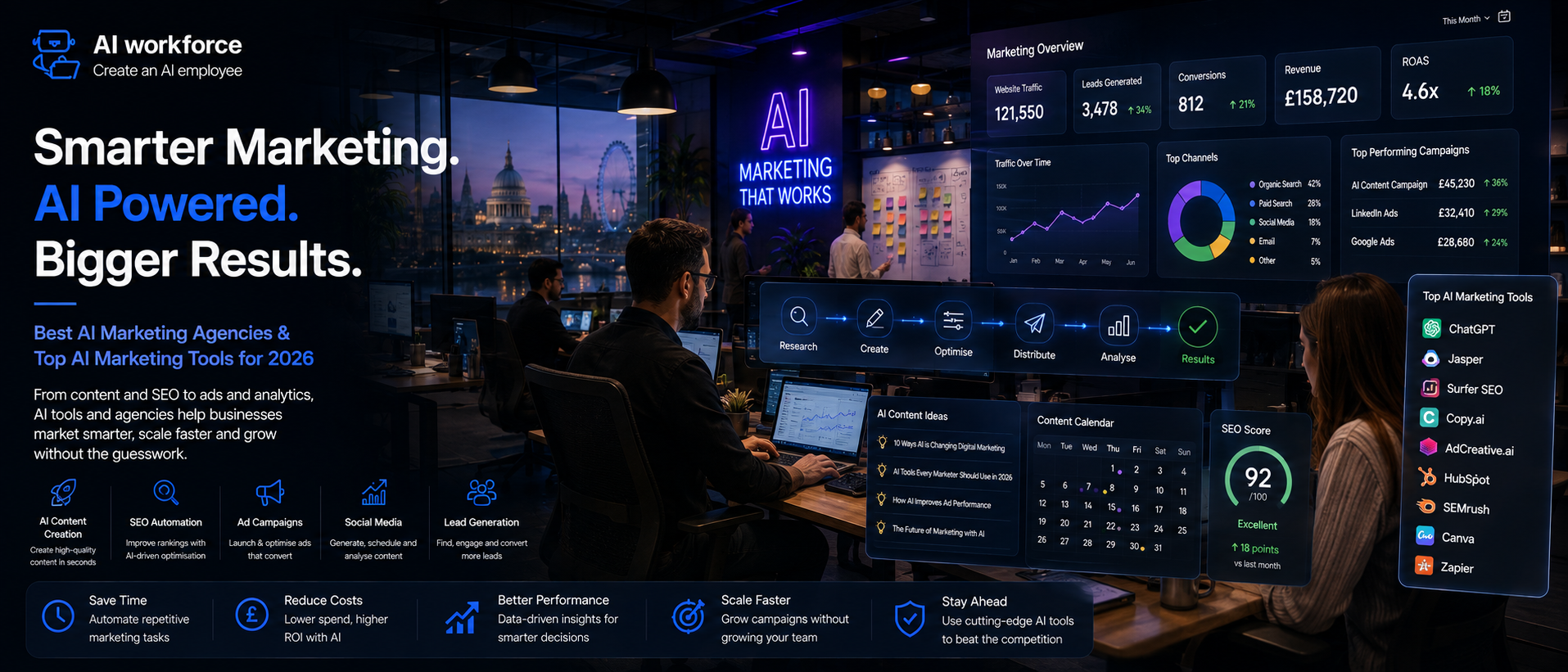
More agencies than ever now claim to use AI, but the depth varies enormously: some have rebuilt research, content, reporting and search-visibility work around it, others have added a chatbot on top of an unchanged process. This guide compares six UK agencies that have genuine, verifiable AI capability, looking at what each actually does, who it's best suited to, pricing transparency and where human oversight still sits. The shortlist is based on a stated methodology, not a paid placement, and AI Workforce's own inclusion is disclosed below rather than presented as an independent ranking.
Quick Answer: There is no single best AI marketing agency; the right choice depends on what you need. This guide compares six UK agencies with verifiable AI capability: ClickSlice and Koozai for AI search visibility (AEO/GEO) work, Found and Impression for broader AI-assisted performance marketing with predictive and generative capability, PUSH Group for AI-augmented performance marketing at enterprise scale, and AI Workforce (which publishes this guide) for AI-native marketing automation and agent workflows. Compare each agency's actual AI depth, service breadth, pricing transparency and how much human oversight remains over strategy and claims, rather than relying on "AI-powered" branding alone.
Best AI Marketing Agencies at a Glance
Agency | Best for | Core services | AI capability | Pricing transparency | Main limitation |
|---|---|---|---|---|---|
ClickSlice | AI search visibility (AEO/GEO) for ecommerce and SaaS | SEO, AEO/GEO, Google Ads, digital PR | AI-visibility tracking across ChatGPT, Claude, Gemini (Profound Certified Partner) | Custom quote | AI-specific capability is concentrated mainly in search visibility |
Koozai | Brands losing traffic to AI Overviews | AI search optimisation, digital PR, paid media, content strategy | Entity/schema optimisation, AI Visibility Triage diagnostic | Custom quote | AI capability is concentrated mainly in search visibility |
Found | Growth-stage ecommerce, travel, B2B, SaaS | AI & automation, AI search, paid media, SEO, data science, CRO | Everysearch™ unified search, Luminr competitor intelligence, LLM optimisation | Custom quote | Broad service offering means depth can vary by specialist team |
Impression | Data-driven B2B, ecommerce, fintech | SEO/GEO, paid media, PR, digital experience, data science | Generative AI (content/creative) and predictive AI (forecasting, segmentation) | Custom quote | AI proposition is less specific than agencies with named AI-search products or tools |
PUSH Group | Enterprises adopting AI across performance marketing | Media buying, paid search/social, SEO, CRO, AI training and consultancy | AI marketing audits, AI agents, GEO, in-house DIAL innovation lab | Custom quote | Training and consultancy proposition may be better suited to larger organisations |
AI Workforce* | Businesses wanting AI-native marketing automation and agent workflows | Marketing automation, AI agents, content and reporting workflows | Built around a defined AI workflow model with a mandatory human-verification step | Custom quote | Newer and narrower proposition than established full-service agencies |
*AI Workforce publishes this guide; see the disclosure below.
How We Chose the Best AI Marketing Agencies
We assessed each agency against eight criteria. AI Depth: how deeply AI is integrated into actual delivery, evidenced on the agency's own service pages, not just mentioned in marketing copy. Marketing Service Breadth: whether the agency provides meaningful execution across SEO, content, paid media, CRM, automation, creative or strategy, not a single narrow service. Evidence of Implementation: whether the agency documents real AI tools, named methodologies or processes rather than generic claims. Human Oversight: whether the agency's own material shows strategy, claims and budget decisions remaining accountable to people. Client Fit: how clearly the agency states who it's suited to. Pricing Transparency: whether pricing structure is published or, at minimum, clearly stated as custom-quoted rather than left ambiguous. UK Relevance: whether the agency is UK-based or serves UK businesses directly. Differentiation: whether the agency offers something distinct from generic AI-assisted digital marketing.
Every agency below was verified against its own website and, where available, independent listings. No agency, including AI Workforce, was scored on invented data, and we did not create a numerical scoring model since one was not applied consistently enough to publish.
What's Covered
The Shortlist
Deciding and Cost
Background
Choosing and Governance
1. ClickSlice — Best for AI Search Visibility (AEO/GEO)
What it does: A London-based digital marketing agency offering SEO, AEO/GEO, Google Ads and digital PR, with a specific focus on how brands appear inside AI-powered search platforms.
AI capability: A Profound Certified Partner, using AI-search intelligence to track how a brand is cited, or not, across ChatGPT, Claude and Gemini, and to benchmark that against competitors.
Best suited to: Ecommerce, SaaS and B2B brands whose growth depends heavily on organic and AI-assisted search visibility.
Strengths:
Named, verifiable AI-visibility tracking partnership
Published guide content on AI-visibility agencies
Broad sector coverage
Limitations:
Pricing isn't published
AI-specific capability is concentrated in search visibility rather than the full marketing stack
Pricing: Custom quote.
Why it made the list: Its Profound Certified Partner status provides a named, externally verifiable signal of AI-search visibility capability rather than relying only on a general "AI-powered" claim.
2. Koozai — Best for Brands Losing Traffic to AI Overviews
What it does: A long-established UK agency, more than 20 years old, offering AI search optimisation, digital PR, paid media and content strategy.
AI capability: Entity clarity, schema markup and content restructuring aimed specifically at machine interpretation, plus a named "AI Visibility Triage" diagnostic service.
Best suited to: Businesses seeing traffic decline despite stable rankings, or that are simply absent from AI-generated answers.
Strengths:
Long operating history
A named diagnostic product
Explicit sector expertise: travel, hospitality, healthcare, construction, SaaS
Limitations:
Pricing isn't published
AI capability is concentrated on search visibility rather than broader automation
Pricing: Custom quote.
Why it made the list: A clearly documented, named diagnostic offering gives concrete evidence of AI-specific capability rather than a general claim.
3. Found — Best for Growth-Stage Ecommerce, Travel and B2B
What it does: A London-based agency spanning AI & automation, AI search, paid media, SEO, data science and CRO.
AI capability: Two named proprietary tools, Everysearch™ (a unified search approach across Google, social and AI-driven search) and Luminr (AI-powered competitor intelligence), plus predictive modelling and attribution.
Best suited to: Growth-oriented businesses in ecommerce, hospitality, travel, B2B, SaaS and fintech wanting measurable, performance-driven results.
Strengths:
Among the agencies reviewed for this guide, Found showed the broadest documented combination of AI search, automation, data science and proprietary tooling
Two named, documented tools rather than generic claims
Genuine data science function
Limitations:
Pricing isn't published
Breadth of service means depth in any one area may vary by team
Pricing: Custom quote.
Why it made the list: The most extensively documented AI tooling and methodology among the agencies reviewed.
4. Impression — Best for Data-Driven B2B and Ecommerce
What it does: A performance marketing agency with a dedicated AI page splitting its capability into generative AI (content, creative, scaled copywriting) and predictive AI (forecasting, segmentation, recommendations).
AI capability: A named data science, engineering and analytics function underpinning both generative and predictive work.
Best suited to: B2B, ecommerce, SaaS and fintech businesses that need AI-assisted forecasting and personalisation alongside content production.
Strengths:
Clear, explicit split between generative and predictive AI use cases
Visible investment in a dedicated data science team
Limitations:
Pricing isn't published
The AI page is relatively general compared with Found's or ClickSlice's named tools
Pricing: Custom quote.
Why it made the list: A rare agency that clearly separates generative from predictive AI use cases rather than treating "AI" as one undifferentiated capability.
5. PUSH Group — Best for Enterprises Adopting AI at Scale
What it does: An 18-year-old UK performance marketing agency offering media buying, paid search/social, SEO, CRO and AI training/consultancy through its "Pulse" service.
AI capability: AI marketing audits, custom AI agents, GEO, and an internal "DIAL" (Digital Innovation Acceleration Lab) researching emerging AI capability.
Best suited to: Enterprises wanting an established performance-marketing partner that also trains internal teams on AI adoption, not just executes campaigns.
Strengths:
Combines delivery with training and consultancy
A named innovation lab
Google and Microsoft partner status
Limitations:
Pricing isn't published
Training/consultancy focus may suit larger organisations more than smaller buyers
Pricing: Custom quote.
Why it made the list: The only agency reviewed here that pairs AI marketing delivery with a formal internal training and innovation function.
6. AI Workforce — Best for AI-Native Marketing Automation
What it does: Builds and operates AI agent workflows for marketing operations, research, content drafting, reporting and campaign administration, structured around a defined Brief-Research-Generate-Personalise-Activate-Measure-Verify-Learn model rather than a traditional agency delivery model.
AI capability: An AI-native automation model with a mandatory human-verification step built into the workflow, rather than AI added to an existing service line.
Best suited to: UK businesses wanting AI to run inside a defined, governed workflow, with clear boundaries on what AI automates and what stays human-led.
Strengths:
Workflow-first rather than channel-first design
Explicit accountability structure (Boundary Matrix, Measurement Hierarchy) published openly
Limitations:
A newer, narrower proposition than the multi-decade full-service agencies compared above
Best suited to businesses specifically wanting an automation-led model rather than traditional creative or media-buying services
Pricing: Custom quote.
Why it made the list: Included as this guide's publisher, with disclosure below; genuinely differentiated by its workflow-governance model rather than included by default.
Disclosure: AI Workforce publishes this guide and is included where relevant. We have therefore separated factual information about our own services from the criteria used to assess other agencies and do not treat our inclusion as an independent endorsement.
Which AI Marketing Agency Is Best for Different Buyers?
UK SMEs wanting AI search visibility: ClickSlice or Koozai
Growth-stage ecommerce and travel brands: Found
Data-driven B2B and fintech: Impression
Enterprises wanting delivery plus internal AI training: PUSH Group
Businesses wanting AI-native automation and agent workflows rather than a traditional agency model: AI Workforce
Only the categories genuinely supported by the agencies compared above are listed here; a buyer whose need doesn't fit one of these should treat this as a starting shortlist rather than a complete market view.
How Much Does an AI Marketing Agency Cost?
None of the six agencies compared here publish a fixed price list; all quote custom pricing based on scope. That's typical for AI-assisted marketing services, since the actual cost depends on service breadth, campaign volume and how much AI automation is involved. Rather than inventing a "typical UK range" without evidence, it's more useful to understand the components a quote is likely to combine: a monthly retainer or project fee for strategy and delivery, implementation and integration costs where AI tools connect to your CRM or ad platforms, usage-based software or platform costs for the AI tools themselves, media spend where paid campaigns are involved, and ongoing optimisation or reporting time.
When comparing quotes, ask each agency to itemise these separately: agency fee, software/platform costs, media spend, implementation, data/integration work, ongoing optimisation and human strategy time. A quote that bundles everything into one number is harder to compare fairly against a competitor's itemised proposal. For a broader view of UK automation pricing structures, see our guide to AI automation pricing in the UK.
What Is an AI Marketing Agency?
An AI marketing agency has rebuilt its core processes around AI tools rather than bolting them onto an old way of working. The difference shows up in where time actually goes: research, first-draft content and reporting increasingly run through an AI-assisted workflow, while a strategist's time shifts toward positioning, judgement calls and the parts of a campaign that carry real commercial or reputational weight.
Machine learning, generative AI and increasingly agentic workflows underpin much of what makes this possible, spotting a pattern across a large volume of campaign data that a person would not have time to review manually. That is a genuine capability shift, but it is also why the distinction matters between an agency that has redesigned its workflow around this capability and one that has simply added a generative AI tool to an otherwise unchanged process. The same distinction applies to AI marketing agents used inside an agency's own stack, since a defined agent workflow behaves very differently from a single generative tool bolted onto an old process.
An AI marketing agency is a team that uses artificial intelligence throughout its core workflow, research, drafting, analysis, personalisation and reporting, rather than as an occasional add-on, while keeping a person accountable for strategy, brand claims and client decisions.
How Do AI Marketing Agencies Use AI?
Using AI well starts with picking the right task rather than the newest tool. Agencies that get this right tend to start with research and drafting, the highest-volume, lowest-risk parts of the job, before expanding into anything client-facing or budget-affecting. HubSpot's 2026 State of Marketing report found that 80% of marketers now use AI for content creation and 75% use it for media production, with 61% saying marketing is experiencing its biggest disruption in twenty years because of AI.
McKinsey's November 2025 State of AI survey, drawing on almost 2,000 respondents across 105 countries, found that revenue increases from AI use are most commonly reported in marketing and sales, alongside strategy, corporate finance, and product and service development. The same research found that organisations getting the most value from AI are disproportionately the ones that have redesigned workflows around it rather than layering AI onto an unchanged process.
Source: HubSpot 2026 State of Marketing Report; McKinsey State of AI 2025.
The AI Workforce Marketing AI Model
Most agencies that use AI well, even without naming it explicitly, follow a similar underlying pattern. We call this the AI Workforce Marketing AI Model, and it is a useful way to check whether a given task, or a given agency's process, is actually being run safely.
AI Workforce developed the Marketing AI Model as a practical framework, not an industry standard, for deciding where AI can speed up marketing work without removing accountability for what a client's brand actually says and spends.
Brief: define the audience, commercial objective, brand rules and permitted data
Research: AI structures market, competitor, search and customer information
Generate: AI creates draft copy, creative concepts, campaign variations or reports
Personalise: approved systems adapt messages and assets for defined audiences
Activate: campaigns are scheduled or launched within agreed limits
Measure: performance signals are gathered across channels
Verify: a marketer checks claims, brand alignment, spend, targeting and material decisions
Learn: results and corrections feed future campaigns
AI can accelerate Research, Generate, Personalise and Measure heavily. Brief and Verify stay marketer-led, and Activate should only run on pre-approved limits. A workflow that skips straight from Generate to Activate, with no genuine Verify step, is the one that turns an AI-drafted claim or a poorly targeted audience into a live campaign before anyone has checked it. For example, in a well-run campaign, a strategist defines the brief at 9am, AI structures the research and drafts creative directions through the morning, the strategist verifies claims and brand alignment before midday, and only then are approved ads activated, with AI monitoring performance afterwards and a person approving any meaningful budget or positioning change. Businesses looking to automate several connected marketing tasks can also see how AI agents for small businesses combine research, content, outreach and workflow automation within a defined set of permissions.
What Should an AI Marketing Agency Automate?
It helps to separate this by task type rather than treating "AI in marketing" as one single capability. An AI marketing agency should automate research, first-draft content, campaign reporting, asset resizing, CRM and campaign tagging updates, and first-pass keyword clustering. It should not automate brand strategy, major budget allocation, material advertising claims, regulatory claims, crisis communications or final positioning without a marketer's direct review.
Structuring competitor, search and customer research from a defined brief
Producing a first draft of blog content, ad copy, email sequences or social captions
Building campaign reporting summaries and flagging metrics outside an expected range
Resizing and reformatting creative assets across channels from one source brief
Updating CRM records, campaign tags and routine account admin
Producing a first-pass keyword cluster or SEO brief for a strategist to refine
None of this requires AI to exercise the judgement a client is actually paying an agency for. For a deeper look at how these tasks connect into a single system, see our guide to AI marketing automation.
The AI Workforce Marketing AI Boundary Matrix
Not every marketing task carries the same risk, and treating them all the same is where AI adoption in marketing tends to go wrong. This is how we group marketing tasks by how much AI autonomy is appropriate.
AI Workforce developed the Marketing AI Boundary Matrix as a framework, not an industry standard, for deciding which parts of a marketing operation are safe to automate and which require mandatory human judgement.
Higher Automation, Spot-Checked: reporting and performance summaries, meeting and call transcription, campaign tagging and CRM updates, resizing and reformatting creative assets, scheduling approved content, first-pass keyword clustering.
AI Prepares, Marketer Reviews: blog and long-form content drafts, email sequences, paid-ad variants and creative concepts, campaign analysis and insight summaries, customer segmentation suggestions, SEO briefs, social content and landing-page copy.
Human-Led, Mandatory Judgement: brand strategy, major budget allocation, material advertising claims, regulatory claims, crisis communications, final positioning, sensitive customer targeting, anything that could materially affect reputation or compliance.
A task sitting in the top tier today is not necessarily permanent, and a task in the bottom tier is not automatically off-limits forever. The point of the matrix is to make the current boundary explicit, so moving a task up a tier is a deliberate decision based on evidence rather than something that happens because a tool technically could.
How Do You Choose an AI Marketing Agency?
Choosing an agency built for this properly means asking specific questions rather than accepting "we use AI" as an answer.
What exactly do you automate?
What remains human-led?
What AI tools or workflows are actually used?
Who owns strategy?
How are claims verified?
How are outputs reviewed before publishing?
What does the agency measure, correction rate and outcome quality, or just activity volume?
How is pricing structured?
What systems does it integrate with?
What happens when AI gets something wrong?
Can you show real examples of the workflow?
An agency that can answer these clearly and specifically is a stronger sign than a pitch deck full of AI branding. It is also worth understanding AI automation pricing in the UK before comparing quotes, so you can tell whether a proposal is realistically scoped.
What Should Marketing AI Never Be Allowed to Decide Alone?
Marketing AI should never independently decide brand strategy, major budget allocation, material advertising claims, regulatory claims, crisis communications, final positioning or targeting that could disproportionately affect a sensitive group of customers. These decisions should be prepared or supported by AI and confirmed by a person, in line with the Boundary Matrix above.
The practical test is not whether AI is technically capable of generating a claim or a targeting rule, most systems are, but whether the consequence of an error is one a business is willing to accept without a person having checked it first. A wrong first-draft headline is a minor inconvenience caught at Verify. An unchecked, unsubstantiated product claim reaching a client's audience is not.
How Do You Measure ROI From AI Marketing?
Whether AI is actually helping a marketing operation is a different question from whether it is being used. We call this the AI Workforce Marketing AI Measurement Hierarchy, a set of indicators worth tracking together rather than relying on any single number.
AI Workforce developed the Marketing AI Measurement Hierarchy, a framework not an industry standard, so agencies judge an AI rollout on outcome quality and net effect, not just activity volume.
Campaigns Assisted: how many campaigns are using AI in a defined, recorded way
Human Correction Rate: how often a marketer has to correct an AI-prepared draft, claim or targeting suggestion during Verify
Brand Exception Rate: how often AI-generated output breaches brand guidelines or requires escalation
Qualified Outcome Rate: the share of AI-assisted leads or conversions that meet the agency's own quality bar, not just the raw count
Cost per Qualified Outcome: the actual cost of a genuinely qualified lead or conversion, not just cost per click or impression
Net Time Saved: the real time saved once Verify and any corrections are accounted for, not the raw time AI took to produce an output
Cost per Qualified Outcome can fall while lead quality quietly collapses, which is why Qualified Outcome Rate sits alongside it rather than being assumed. The strongest pair to track together day-to-day remains Human Correction Rate and Net Time Saved. A falling correction rate paired with a rising Net Time Saved is a sign the workflow is genuinely working. A low correction rate on its own is not necessarily good news; it can mean the Verify stage is not being done thoroughly, which is worth investigating rather than assuming it is a good sign.
What Are the Risks of AI in Marketing?
The main risks are publishing AI-generated claims or creative without verification, over-personalising in a way that feels intrusive or targets a sensitive audience inappropriately, losing brand consistency across AI-assisted output, treating activity volume as a success metric, and adopting AI across an entire operation before proving it on one narrow, well-measured pilot.
A model trained on past campaign data can confidently generate a plausible-sounding claim that has not actually been checked, and it will not necessarily flag its own uncertainty unless the workflow is built to force a Verify step. This is why the Verify stage in the model above matters as much as Generate and Personalise.
Common Mistakes
Common mistakes to avoid: treating an AI-generated draft or claim as finished marketing, publishing AI-assisted content without a defined verification step, chasing supposed GEO shortcuts such as special AI files, artificial content chunking or inauthentic mentions instead of investing in strong SEO and original content, naming individual tools without explaining what category they belong to or why they were chosen, measuring success by activity volume rather than correction rate and outcome quality, and rolling AI out across an entire account list before proving it on one narrow pilot.
How Is AI Changing SEO and Google Search?
Google's own guidance states that its generative AI features on Search remain rooted in its core Search ranking and quality systems, and that optimising for generative AI search is, in its words, still fundamentally SEO. No special files, markup or "AEO/GEO hacks" are required: unique, useful content with a genuine point of view and a clear technical structure is what matters, not llms.txt files or inauthentic mentions across the web. For an AI marketing agency, the practical implication is that the foundation of generative AI visibility remains strong SEO. Our guides to AI content creation and AI content marketing go deeper into building that kind of content at scale.
Frequently Asked Questions
What is the best AI marketing agency?
There is no single best agency; the right choice depends on your needs. This guide compares six UK agencies verified for genuine AI capability, each strongest in a different area: search visibility, broad performance marketing, or AI-native automation.
How do I know if an AI marketing agency's AI capability is genuine?
Look for named, documented tools or partnerships (such as a certified AI-tracking partnership or a proprietary diagnostic product), rather than a general "AI-powered" claim. Ask what it automates, what stays human-led, and for real examples of the workflow.
How much does an AI marketing agency cost?
All six agencies compared here quote custom pricing rather than publishing a fixed price list. Ask any agency to itemise agency fee, software/platform costs, media spend, implementation, integrations, ongoing optimisation and human strategy time separately.
What should an AI marketing agency automate?
Research, first-draft content, reporting, asset resizing, CRM updates and first-pass keyword clustering are strong candidates. Brand strategy, major budget decisions and material claims should stay human-led.
What should marketing AI never be allowed to decide alone?
Brand strategy, major budget allocation, material advertising claims, regulatory claims, crisis communications and final positioning should always be confirmed by a person, not decided by AI alone.
How is AI changing SEO and Google search?
Google's own guidance says its generative AI search features are rooted in its core Search ranking systems, and that unique, well-structured, expert-led content matters more than any AEO or GEO tactic. Google explicitly says no special files or markup are required.
Will AI replace marketing agencies?
The evidence does not support that as a blanket claim. AI is most effective at research, drafting and reporting, while strategy, judgement and client accountability remain with people, even as individual roles continue to shift.
Key Takeaways
The best AI marketing agency depends on what you need: search visibility, broad performance marketing, or AI-native automation are genuinely different specialisms
Look for named, documented AI tools or partnerships rather than general "AI-powered" branding
All agencies compared here quote custom pricing; ask for an itemised breakdown before comparing proposals
The Marketing AI Boundary Matrix separates work that can run with light spot-checking from work that needs mandatory marketer judgement
Google's own guidance confirms that generative AI search visibility is won through unique, well-structured, expert-led content, not special AEO or GEO tactics
Track Human Correction Rate and Net Time Saved together, not activity volume, to judge whether an AI marketing operation is actually working
AI Workforce's own inclusion in this guide is disclosed rather than presented as an independent ranking
Ready to Work With an Agency Built for This?
AI Workforce helps UK businesses identify which parts of their marketing operation are genuinely ready for AI, set the right verification steps before anything reaches a client's audience, and introduce AI without losing the judgement and accountability that actually matter.
Sources and Further Reading
Google Search Central, Optimizing your website for generative AI features on Google Search
Google Search Central, Google Search's guidance on generative AI content on your website
McKinsey, The state of AI in 2025: Agents, innovation, and transformation
About the author: Rodi Taze is Co-Founder of AI Workforce. He works with UK businesses to design AI-supported marketing workflows that keep brand voice, accuracy and accountability intact as automation increases.
Reviewed by: Clara Miller, Content Marketing Specialist at AI Workforce, for accuracy against current Google search guidance and published industry research.
Reviewed: August 2026.
© 2026 AI Workforce Ltd. All rights reserved.