AI Marketing Agents: How They Work, Use Cases & Best Tools 2026
Posted On: July 29, 2026
Last updated: August 2026 · Written by Seth Ayush, Co-Founder of AI Workforce · Reviewed by Rodi Taze
Quick Answer
An AI marketing agent is software that plans and carries out a marketing task, such as drafting content, building a campaign report or nurturing a lead, with limited human input at each step. It differs from a basic chatbot, which mainly responds to individual prompts, and from traditional automation, which follows predefined rules and branches. Many UK businesses remain at the experimentation stage with AI, with fewer embedding it into core business processes, according to DSIT's national adoption research. This guide covers how AI marketing agents work, where they help, where they still fail, how much autonomy to give them, and the UK GDPR and PECR considerations that come with using them.
What's Covered
What an AI marketing agent is and how it differs from a chatbot, tool and AI marketing agency; how these agents work; what they can and cannot do well; a practical deployment framework and autonomy ladder; where agents fail; UK GDPR, PECR and copyright considerations; how to run a pilot and measure results; and frequently asked questions.
What Is an AI Marketing Agent?
An AI marketing agent is software built on a large language model that can take a marketing goal, break it into steps, use tools or data sources to carry out those steps, and produce an output such as a blog draft, a campaign report or a sequence of nurture emails. The defining feature is that it plans and acts across multiple steps rather than simply generating a single response to a single prompt.
This distinguishes an agent from three related but different technologies.
A basic chatbot mainly responds to individual prompts. Some more advanced chatbots retain conversational context or call external tools, but an agent is specifically designed to pursue a broader goal across multiple steps, often without a person prompting each step along the way.
Traditional rules-based automation does not normally adapt beyond the conditions and branches configured in advance: if a form is submitted, send this specific email; if a lead score crosses a threshold, notify this person. An agent can adapt what it does next within a task based on what it finds, rather than following only a pre-set path.
An AI marketing agency is a company, made up of people, that uses AI tools (including AI marketing agents) as part of how it delivers marketing services to clients. An AI marketing agent is the software itself. AI Workforce's related guide, AI Marketing Agency: How AI-Powered Marketing Works in 2026, covers how to choose an agency that uses AI responsibly; this guide covers the underlying agent technology and how to use it directly, whether inside an agency or an in-house marketing team.
How Does an AI Marketing Agent Work?
A single output, like one blog draft, is only part of the picture. In production, most AI marketing agents operate as a continuing loop rather than a one-off task: Goal → Research → Plan → Create → Review → Execute → Monitor → Report → Recommend → Escalate.
Goal. A person defines the objective: draft a blog post on a given topic, summarise last month's campaign performance, or follow up with leads that have gone quiet. The clearer and narrower the goal, the more reliable the output.
Research. The agent gathers what it needs from a style guide, past content, a CRM record or an analytics platform before attempting the task.
Plan. The agent breaks the goal into steps and decides which tools or data sources to use for each one.
Create. The agent produces a draft, a report, a sequence or a recommendation, depending on what it was asked to do.
Review. A person checks the output for accuracy, tone and brand fit before it goes live. This step is where most of the risk in using AI marketing agents is managed, and it is the step most often skipped when teams move too fast.
Execute. Only approved outputs are published, sent or acted on.
Monitor. The agent, or a connected system, tracks what happened after execution, such as whether an email was opened or a post performed as expected.
Report. Results are summarised back to the responsible person on a regular cadence, not left buried in a dashboard no one checks.
Recommend. Based on what it observes, the agent can suggest a next action, such as a follow-up message or a change to a campaign.
Escalate. If the agent hits something outside its rules, an ambiguous request, a possible error or a higher-risk decision, it flags this to a person rather than guessing.
Not every task needs all ten stages in a formal sense; a simple content draft might move quickly from Goal to Review. But the full loop is the right mental model for any agent given ongoing responsibility for a workflow, since it makes clear that oversight does not stop once the first output looks good.
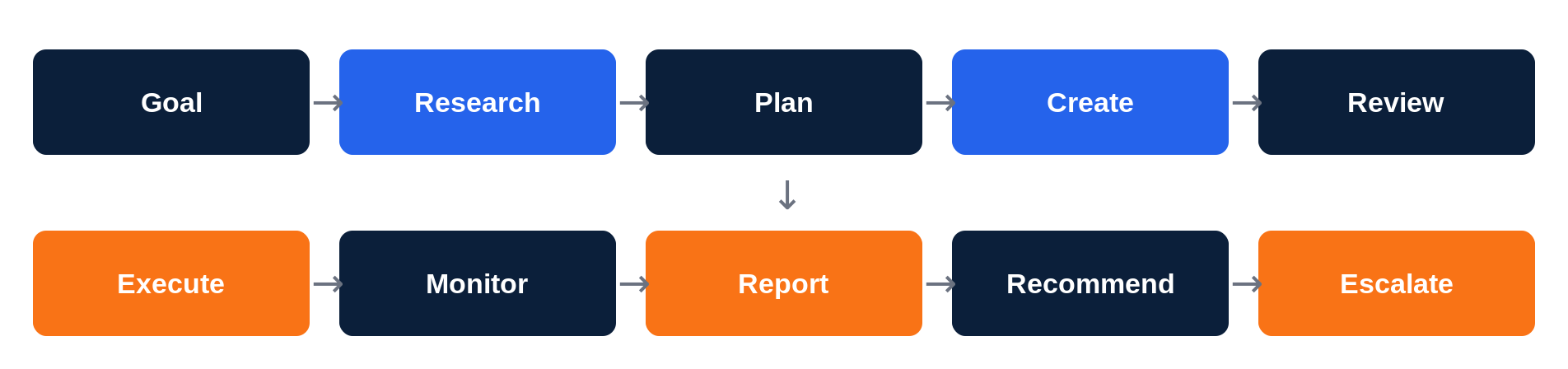
The AI marketing agent operating loop: Goal to Escalate, then back to Goal.
AI Marketing Agent vs Chatbot vs Automation vs Agency
Technology | What it does | Plans multiple steps | Typical example |
|---|---|---|---|
Basic chatbot | Responds to one prompt at a time | No | Answering a single customer question on a website |
Rules-based automation | Follows a fixed trigger-and-action sequence | No | Sending a welcome email when someone joins a mailing list |
AI marketing agent | Plans and executes a multi-step task toward a goal | Yes | Researching a topic, drafting a blog post and formatting it for publishing |
AI marketing agency | A team of people who use AI tools, including agents, to deliver marketing services | Not applicable (a service, not software) | Managing a client's paid search and content programme |
What Can an AI Marketing Agent Actually Do?
The realistic range of tasks in mid-2026 sits mostly in drafting, summarising and pattern-spotting, not in unsupervised decision-making.
Lower-risk tasks, where AI agents are already reliable with light review: drafting first versions of blog posts, social captions and ad copy; summarising campaign performance data into a readable report; tagging and categorising inbound leads; drafting (not sending) follow-up email sequences; researching competitor content and messaging; and generating variations of existing copy for testing.
Higher-risk tasks, where human review needs to stay tight: anything published under the brand's name without a check; email sends to real customer lists; claims about pricing, availability or product performance; anything referencing regulated activity (financial services, health, legal); and autonomous bidding or budget changes on live ad accounts.
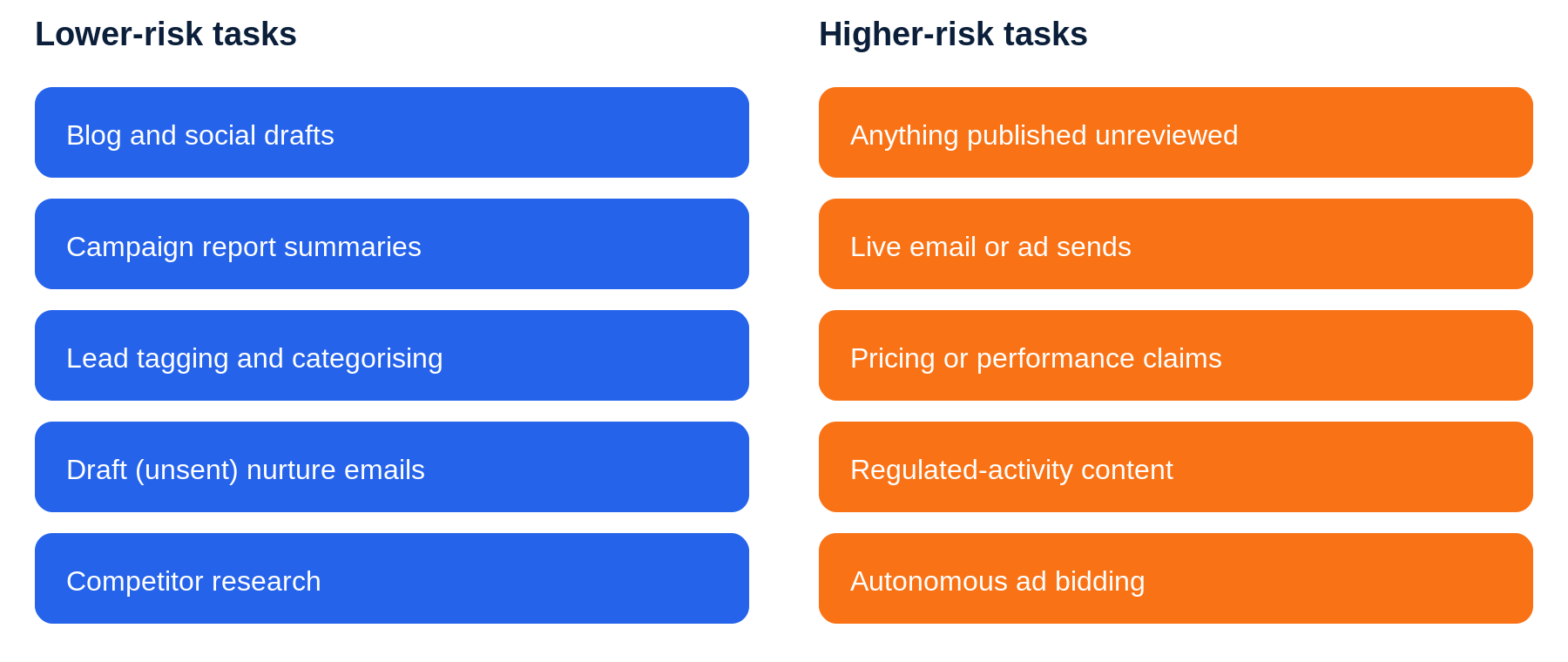
Lower-risk tasks suit light review; higher-risk tasks need tight human review.
A Week in an AI Marketing Agent Workflow
A useful way to see this in practice: a mid-size UK retailer's marketing team uses an AI content agent to draft its weekly blog post from a one-line brief, its reporting agent to summarise the past week's campaign data into a Monday-morning dashboard, and its lead-nurture agent to draft (not send) three follow-up emails for leads that have gone quiet. A marketer reviews all three outputs on Monday morning, adjusts tone and fact-checks any statistics, and only the reporting summary and one nurture email go out unedited that day. The blog post and two of the nurture emails are rewritten before publishing. This pattern, agents drafting at volume and a person deciding what actually ships, is closer to how most UK teams use these tools today than a fully autonomous system.
Not sure which marketing task to hand to an agent first?
Get a free AI Readiness Review →
Common Types of AI Marketing Agents
Content creation agents draft blog posts, social captions, ad copy and product descriptions from a brief. See AI Workforce's guides to AI content creation, AI content marketing, AI blog writing and AI copywriting for tool-level detail.
Campaign planning agents help structure a campaign brief, timeline and channel mix from a goal and a budget.
Reporting and analytics agents pull data from ad platforms, a CRM or web analytics and summarise it into a plain-language report.
Lead-nurture agents draft follow-up sequences based on where a lead is in the buying journey and how they have engaged so far.
Email marketing agents draft and sequence email content and adjust send timing based on engagement signals. See our AI email marketing tools comparison for platforms covering AI writing, segmentation, lifecycle automation, send-time optimisation and campaign analysis.
Social media agents draft and schedule posts across channels from a content calendar. See best social media automation tools.
SEO agents research keywords, audit on-page content and suggest structural changes. See best SEO automation tools.
Customer research agents synthesise reviews, survey responses and support tickets into themes.
Marketing operations agents handle the administrative layer: tagging assets, updating campaign trackers and flagging data-quality issues in a CRM.
Independent research on UK AI adoption gives a sense of scale here. DSIT's AI Adoption Research (reference DSIT 2026/003, published 28 January 2026, based on a survey of around 3,500 UK businesses run by IFF Research and Technopolis Group between February and May 2025) found a wide gap between businesses experimenting with AI tools and those running AI in core, revenue-generating processes such as marketing and sales. This gap is the reason most of this guide is about how to introduce agents carefully, not just what they can do.
The AI Workforce Marketing Agent Framework
Deploying an AI marketing agent well is less about the tool and more about the process around it. AI Workforce uses the following nine-step framework internally and with clients. It is our own framework, not an industry standard, but it reflects the pattern that shows up repeatedly in agent deployments that go well.
Objective. Define one specific outcome the agent is responsible for, such as "draft the weekly blog post" rather than "handle content marketing."
Knowledge. Give the agent the brand voice guide, past examples of approved content and any facts it needs, rather than relying on general training data.
Access. Decide exactly which systems and data the agent can read or write to, and connect only what the task requires.
Rules. Set explicit boundaries: what it must never publish or send without review, and what claims it must never make unverified.
Create. Let the agent produce a draft, report or recommendation.
Review. A named person checks the output against the rules before anything goes live.
Execute. Only approved outputs are published, sent or acted on.
Measure. Track what the agent actually saved or improved, not just what it produced.
Improve. Feed review corrections back into the brief or knowledge base so the same mistake is less likely next time.
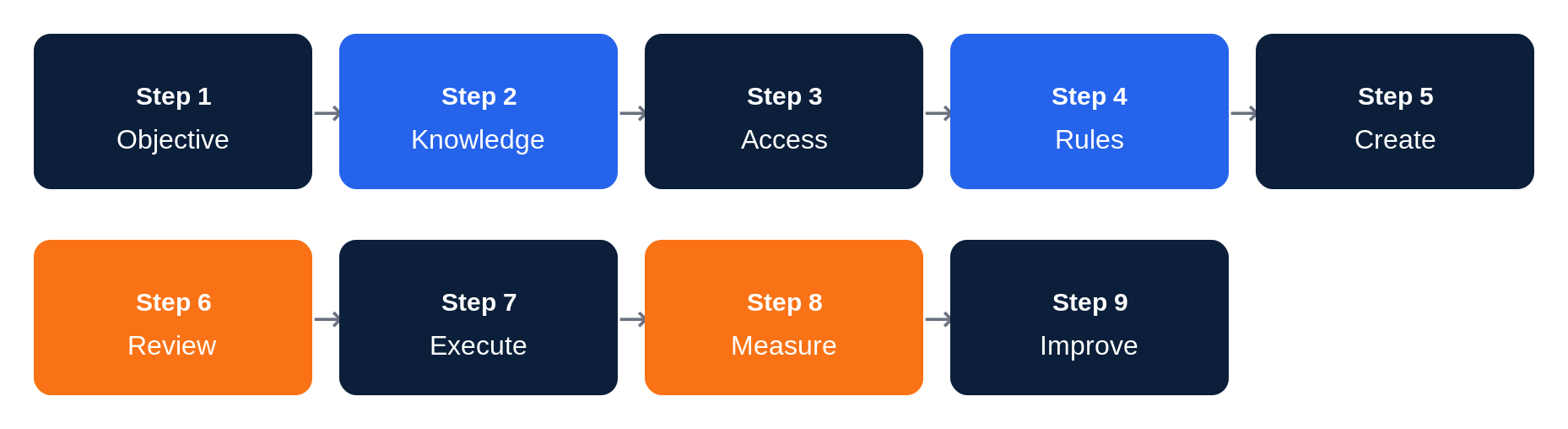
The AI Workforce Marketing Agent Framework is an AI Workforce model, not an industry standard.
How Much Autonomy Should an AI Marketing Agent Have?
Not every task needs the same level of human oversight, and giving an agent more autonomy than a task warrants is one of the most common sources of brand and compliance risk. AI Workforce uses a five-level autonomy ladder, again our own model rather than an industry standard, to help teams decide deliberately rather than by default.
Level 1: Assist. The agent suggests ideas or drafts; a person does the actual work.
Level 2: Recommend. The agent produces a full draft or recommendation; a person decides whether to use it.
Level 3: Prepare. The agent prepares an output ready to go, such as a formatted email or scheduled post, but nothing goes live until a person approves it.
Level 4: Execute approved actions. The agent carries out a specific, pre-approved action type, such as sending a follow-up email from an approved template, without a person reviewing each individual instance.
Level 5: Bounded workflow autonomy. The agent manages an entire narrow workflow within fixed limits, such as a defined budget or send-volume cap, with regular reporting back to a person and an easy override.
Most UK marketing teams in 2026 should expect to run the majority of tasks at Levels 1 to 3. Level 4 and 5 autonomy should be reserved for narrow, well-tested, low-risk workflows with clear guardrails and monitoring, not applied broadly across a marketing function.
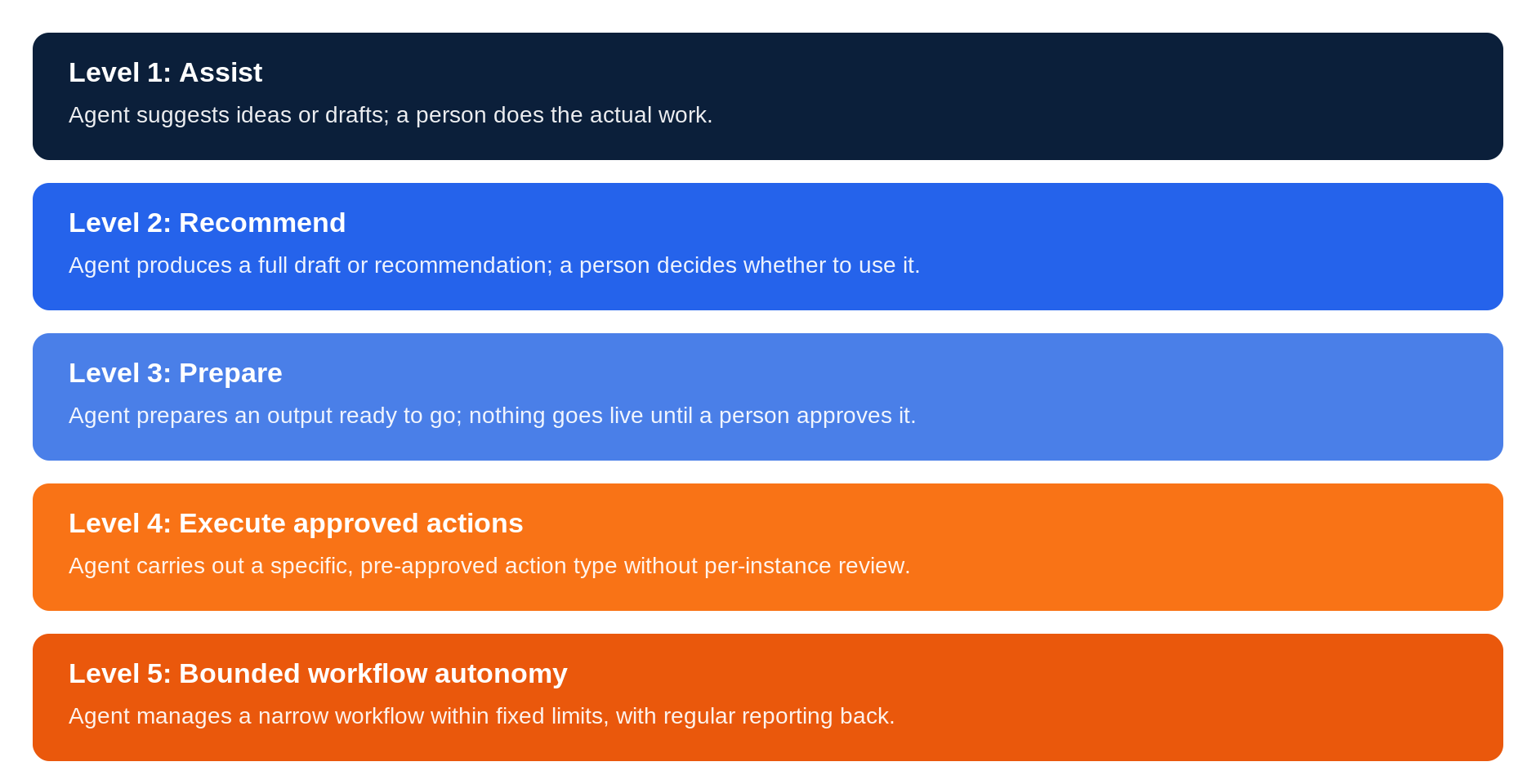
The five-level AI Workforce autonomy ladder, from Assist to Bounded workflow autonomy.
Where AI Workforce Fits
AI Workforce builds AI agents for UK small and medium-sized businesses, including a Blog and Content Engine that drafts and structures long-form content from a brief, an SEO Marketing Agent that researches keywords and suggests on-page improvements, an automatic content building and posting agent for scheduled publishing, a brochure and document creation agent, and social content creation and scheduling tools. We are not a neutral reviewer of every platform named in this guide, and we have not run side-by-side performance tests against HubSpot, Salesforce or the other vendors mentioned below; the platform notes are based on each vendor's own published documentation. Where AI Workforce's own tools are relevant to a task described in this guide, we say so directly rather than leaving that connection implicit.
Practical Workflows
Content workflow. A brief goes in; the agent researches the topic, drafts a structured post, and a person edits for accuracy, tone and any factual claims before it is published.
Campaign reporting workflow. The agent pulls performance data from connected platforms, summarises it into a plain-language weekly report, and a person checks the numbers against the source dashboard before it goes to stakeholders.
Lead-nurture workflow. The agent drafts a sequence of follow-up messages based on a lead's stage and engagement; a person reviews and approves the sequence before any message is sent, particularly for the first message in a new sequence type.
Best AI Marketing Agent Platforms in 2026
The following comparison is drawn from each vendor's own published documentation as of August 2026, not from hands-on testing by AI Workforce. Pricing and features change frequently; check the vendor's current pricing page before deciding.
Platform | Best for | Agent capability | Existing ecosystem required | Pricing visibility | Main limitation |
|---|---|---|---|---|---|
HubSpot Breeze | HubSpot-based SMEs | Content, social and prospecting agents | Strongly beneficial | Plan-dependent | Best value depends on HubSpot data |
Salesforce Agentforce | Salesforce-native enterprises | Multi-workflow agents using CRM data | Usually | Complex, often custom | Cost and implementation complexity |
Relevance AI | Custom no-code agent building | Configurable agents for specific workflows | No | Public plans available | Requires setup and configuration time |
Jasper | Content-led teams | Content planning and production agents | No | Public and enterprise plans | Narrower than full campaign orchestration |
Adobe Sensei GenAI | Large enterprise teams | Content and experience workflow agents | Strongly beneficial | Usually sales-led | Enterprise cost and complexity |
Before choosing a platform, ask each vendor directly: what data does the agent need access to, where is that data processed and stored, can outputs be reviewed before they go live or send, what audit trail does the platform keep of agent actions, and what happens if the agent produces an inaccurate or off-brand output.
How AI Marketing Agents Use Data and Tools
An agent's usefulness depends on what it can see and touch. A content agent connected only to a style guide and past blog posts is lower-risk than one connected to a live CRM with customer records and send permissions. Before connecting any tool or data source, confirm what the agent can read, what it can write to, and whether it can take an action (like sending an email) without a person approving it first. This connection map should be documented and reviewed, not left implicit in a vendor's default settings.
Where AI Marketing Agents Fail in Practice
Agents fail most often in predictable ways. They can produce confident-sounding but incorrect statistics or claims (a pattern often called hallucination) when asked to state a fact rather than draft persuasive copy. They can drift from brand voice over a long sequence of outputs if no one is checking consistency. They can be given access to more systems or send permissions than the task actually needs, widening the blast radius of a mistake. And a poorly worded brief, or a page containing hidden instructions the agent reads as part of a task, can lead an agent to follow instructions it should not, a risk generally described as prompt injection when it comes from external content the agent processes.
To manage accuracy specifically, it helps to distinguish between the type of information an agent is producing:
Observed data, such as a number pulled directly from a connected analytics platform, is usually reliable, but the connection and date range should still be spot-checked.
Official public source information, such as a statistic from a government body or regulator, should be checked against the original source before publishing, not taken on trust from the agent's summary.
Vendor claim information, such as a platform's own marketing statement about its capabilities, should be labelled as a vendor claim rather than presented as independently verified fact.
AI inference, where the agent is drawing a conclusion rather than reporting a fact, should be reviewed for whether the reasoning actually holds up.
AI-generated copy, the creative or persuasive text itself, needs a human edit for tone, accuracy of any claims it makes, and brand fit before it goes live.
Common mistakes to avoid: connecting an agent to send permissions before its drafts have been reliable for several weeks under review; skipping review on "routine" outputs because volume feels safe; and treating a vendor's stated capability as a guarantee of accuracy rather than a claim to verify.
Governance and Brand-Risk Controls
A working governance setup for marketing agents usually includes: a named person responsible for reviewing outputs before they go live or send; a written brief or style guide the agent works from, kept up to date; explicit rules on what the agent must never publish or claim without review; a log of what the agent did and what a person approved; a defined escalation path if an agent produces something wrong or off-brand; and a regular review of what autonomy level each workflow actually needs, since needs change as trust in a specific workflow builds or a mistake reveals a gap.
UK GDPR and PECR Considerations
Most AI marketing agents process personal data at some point, whether that is a lead's contact details, engagement history or behavioural data used to personalise a message. Under UK GDPR, this means having a lawful basis for the processing, being clear with people about how their data is used, and applying data minimisation, only giving the agent access to the personal data it actually needs for its task.
Under the Privacy and Electronic Communications Regulations (PECR), rules on electronic marketing, such as requiring consent for most marketing emails and texts to individuals, apply regardless of whether a human or an AI agent drafted or personalised the message. Using an AI agent to draft an email does not change the consent or opt-out requirements that already apply to that email.
Where an agent makes a solely automated decision that produces a legal or similarly significant effect on an individual, additional safeguards apply under the Data (Use and Access) Act 2025. These include informing the person about the decision, allowing them to challenge or make representations about it, and enabling meaningful human intervention. Ordinary campaign segmentation will not necessarily reach this threshold, but profiling and automated exclusion should still be assessed for fairness, transparency and data-protection risk. The ICO's guidance on AI and data protection sets out the regulator's expectations in more detail; see the Sources section below. For a fuller walkthrough of UK GDPR obligations across AI tools generally, see AI Workforce's guide to AI GDPR compliance for UK businesses.
Before connecting an agent to real customer or prospect data, check the following: who the data processor and any subprocessors are, and whether the platform's terms make this clear; whether personal data is transferred outside the UK and, if so, what safeguard applies; how long the platform retains data and whether that period is configurable; whether the agent's outputs involve profiling or behavioural targeting that needs its own assessment; whether a Data Protection Impact Assessment is needed for higher-risk processing; whether cookie or tracking consent is required for any personalisation the agent relies on; how suppression lists and opt-outs are honoured across the agent's outputs; and whether the vendor uses a business's data to train its own models, what controls or opt-out mechanisms are available, and whether those settings are enabled by default.
Copyright and Intellectual Property
AI-generated marketing content raises two separate copyright questions worth keeping distinct. First, whether the output itself is protected by copyright, and if so, who owns it; UK law in this area continues to develop, and specific advice should be sought for material a business is relying on commercially. Second, whether the underlying model was trained on copyrighted material without permission, a question currently the subject of ongoing legal and policy debate in the UK and elsewhere. Neither issue prevents a business from using AI marketing agents, but both are reasons to keep human review in the loop for anything published under the brand's name, and to avoid asking an agent to closely imitate a specific named competitor's copyrighted material or brand assets.
How to Run a Pilot
A repeatable pilot process, rather than an ad hoc trial, is what makes a first AI marketing agent deployment safe to expand later.
Choose one narrow workflow, such as drafting weekly campaign reports, rather than rolling an agent out across the whole marketing function at once.
Record the current baseline: how long the task takes today and what the output typically looks like.
Define what a successful outcome looks like before starting, not after.
Classify the workflow's risk using the lower-risk and higher-risk categories above.
Select the appropriate autonomy level from the ladder, starting lower rather than higher.
Restrict the agent's data and system access to only what the task needs.
Create a knowledge pack (style guide, examples, rules) for the agent to work from.
Test using historical or sandbox data before it touches anything live.
Run with mandatory human approval on every output during the pilot period.
Measure rework needed, accuracy, time recovered and any outcome change.
Review any incidents or near-misses before expanding autonomy or adding a new workflow.
This mirrors the Objective through Improve framework above: define one objective, review consistently, measure what actually changed, and expand deliberately.
How to Measure Results
A simple way to think about return on an AI marketing agent: monthly value equals time recovered by the team plus any attributable incremental contribution to marketing outcomes, minus the cost of the software, implementation time, ongoing review time, time spent correcting outputs, and any other operating costs. The following is an illustrative scenario to show how the maths works, not measured data from a specific deployment.
A marketing assistant spending roughly six hours a week manually drafting campaign reports might see that fall to around ninety minutes a week once an agent drafts the report and the assistant reviews and adjusts it, a shift in where time goes rather than a promise of the exact same result for every team, since the actual time saved depends on the quality of the brief, the complexity of the reports, and how much rework is needed.
Task type | Illustrative effort before | Illustrative effort with agent and review |
|---|---|---|
Weekly campaign report | 4 to 6 hours | 1 to 2 hours |
Blog post first draft | 3 to 5 hours | 1 to 2 hours |
Lead-nurture sequence draft | 2 to 3 hours | 30 to 60 minutes |
Social caption batch (10 posts) | 2 hours | 30 to 45 minutes |
These ranges are illustrative planning assumptions, not universal benchmarks or measured AI Workforce client results; actual time saved depends on brief quality, task complexity and how much rework is needed.
Separately, McKinsey's State of AI report (November 2025, based on 1,993 respondents across 105 countries, fielded June to July 2025) found that 62% of organisations were experimenting with or scaling AI agents, but a smaller share of respondents reported that agent use had meaningfully changed how their organisation operates day to day, a pattern consistent with the gap between trying a tool and embedding it in a workflow.
Want help running a low-risk AI marketing agent pilot?
Talk to AI Workforce →
Can AI Marketing Agents Replace Marketers?
No, not in the sense of removing the need for marketing judgment. Agents are reliable at producing volume, drafting variations and summarising data quickly; they are not reliable at deciding what a brand should stand for, reading a specific audience's mood, or taking accountability when something goes wrong publicly. The realistic shift is in where a marketer's time goes: less time on first drafts and routine reporting, more time on strategy, judgment calls and the review step that keeps agent output safe to publish.
Frequently Asked Questions
What is an AI marketing agent? Software that plans and carries out a multi-step marketing task, such as drafting content or summarising campaign data, with defined human review points.
How is an AI marketing agent different from a chatbot? A chatbot responds to individual prompts; an agent plans and executes several steps toward a broader goal, often using connected tools or data.
How is an AI marketing agent different from marketing automation? Automation follows a fixed trigger-and-action sequence; an agent can adapt its steps within a task based on the situation. See AI Workforce's guide to AI marketing automation for more detail on that distinction.
Is an AI marketing agent the same as an AI marketing agency? No. An agent is software; an agency is a business made up of people that may use agents and other AI tools to deliver services to clients.
What can an AI marketing agent do well right now? Drafting content, summarising performance data, tagging leads, researching competitors and drafting (not sending) nurture sequences, all with human review.
What should stay under human control? Anything published without review, live email or ad sends, claims about pricing or performance, and anything touching regulated activity.
Do AI marketing agents make things up? They can produce confident but incorrect claims, particularly statistics, if asked to state a fact rather than draft persuasive copy. This is why fact-checking is a required review step, not optional polish.
Is using an AI marketing agent GDPR compliant? It can be, if the business has a lawful basis for the personal data it processes, applies data minimisation to what the agent can access, and honours automated-decision-making safeguards where relevant. Compliance depends on how the agent is configured, not on the technology itself. PECR consent and opt-out requirements apply to the message and the recipient regardless of who or what drafted the content.
How much does an AI marketing agent cost? Costs vary widely by platform and scope, from tools bundled into an existing CRM to dedicated agent-builder platforms with usage-based pricing. See AI Workforce's guide to AI automation pricing for UK small businesses for a general cost framework.
Can a small business use AI marketing agents without a big budget? Yes. Most SME teams start with a single narrow workflow, such as drafting a weekly blog post or campaign report, using existing platform features before investing in a dedicated agent-builder.
Should I build a custom agent or buy an existing platform? Buying an existing platform is usually faster and lower-risk for common tasks like content drafting or reporting; building custom makes sense when a workflow is specific enough that no existing platform fits well, and a team has the resources to maintain it.
How do I choose between platforms like HubSpot, Salesforce and Jasper? Start from where your marketing data already lives: HubSpot-native teams generally get the fastest value from Breeze, Salesforce-native teams from Agentforce, and teams whose main bottleneck is content volume often start with a content-focused platform like Jasper.
How do I measure whether an AI marketing agent is worth the cost? Track time genuinely recovered, the quality of outputs (how much rework is needed), and any attributable change in marketing outcomes, against the full cost of the platform, implementation and ongoing review.
What is prompt injection and does it matter for marketing agents? It is when hidden instructions in content an agent reads (such as a scraped web page) cause the agent to follow unintended instructions. It matters most for agents that browse the web or read external documents as part of their task, and is a reason to limit what an agent can access and act on.
Will AI marketing agents replace marketing teams? The evidence so far points to a shift in where time goes rather than wholesale replacement: agents handle more of the drafting and reporting volume, while people focus on strategy, brand judgment and review.
Key Takeaways
Many UK businesses remain at the experimentation stage with AI, with fewer embedding it into core business processes, according to DSIT's national adoption research.
An AI marketing agent plans and executes multi-step tasks, which is what separates it from a chatbot that only responds to single prompts and from rules-based automation that follows a fixed sequence.
An AI marketing agent is software; an AI marketing agency is a service business that may use agents as one of its tools.
The AI Workforce Marketing Agent Framework (Objective, Knowledge, Access, Rules, Create, Review, Execute, Measure, Improve) and the five-level autonomy ladder are useful starting points for introducing agents with appropriate oversight, not industry standards.
Agents are most reliable at drafting, summarising and pattern-spotting; human review remains essential for anything published, sent to real customers, or making a factual or regulated claim.
UK GDPR and PECR obligations apply to what an agent produces and sends in exactly the same way they apply to human-drafted marketing, regardless of who or what did the drafting.
Sources and Further Reading
Department for Science, Innovation and Technology, AI Adoption Research (DSIT 2026/003), published 28 January 2026, based on a survey of around 3,500 UK businesses conducted by IFF Research and Technopolis Group, February to May 2025.
McKinsey & Company, The State of AI, November 2025, based on 1,993 respondents across 105 countries, fielded June to July 2025.
Information Commissioner's Office, guidance on AI and data protection
Information Commissioner's Office, guidance on PECR and electronic marketing
GOV.UK, Data (Use and Access) Act 2025: data protection and privacy changes
Salesforce, Agentforce for Marketing
Adobe, Experience Cloud with Sensei GenAI
AI Workforce, AI Marketing Agency: How AI-Powered Marketing Works in 2026
AI Workforce, AI Marketing Automation Guide for UK Businesses
AI Workforce, AI GDPR Compliance for UK Businesses
AI Workforce, AI Automation Pricing for UK Small Businesses
About the Author and Reviewer
Written by Seth Ayush, Co-Founder of AI Workforce, who works directly with UK small and medium-sized businesses on deploying AI agents, including marketing agents, into day-to-day operations.
Reviewed by Rodi Taze, who checked this article's operational and compliance claims against current UK GDPR and PECR guidance, August 2026. This is an operational review, not legal advice; businesses with specific compliance questions should consult a qualified data protection professional.
Ready to explore AI marketing agents safely?
Book Your Free AI Readiness Review →