AI Campaign Automation: How to Automate a Marketing Campaign End to End
Posted On: October 3, 2026
Last updated: October 2026 · Written by Clara Miller, Head of Content at AI Workforce · Reviewed by Luca Controlo
Quick Answer
AI campaign automation connects the stages of one marketing campaign, from goal and audience through research, planning, asset creation, approval, execution, monitoring, optimisation and reporting, so that approved information, assets, decisions and performance data move between systems without repeated manual transfer. End-to-end does not mean human-free. In a well-designed campaign, AI assists with preparation and analysis, automation carries out approved actions, and people retain control over positioning, claims, audiences, budget and other consequential decisions. This guide explains the stages, a campaign state model, approval gates, cross-channel coordination, UK GDPR and PECR considerations, and how to introduce campaign automation with evidence rather than assumption.
What's Covered
What AI campaign automation is; how it differs from marketing automation and AI marketing agents; the eleven stages of an automated campaign; the AI Workforce Campaign State Model; approval gates; cross-channel coordination; an illustrative UK service business example; what should not be fully automated; measurement; UK GDPR and PECR; implementation; and frequently asked questions.
What Is AI Campaign Automation?
AI campaign automation is the use of AI and workflow automation to connect the stages of a single marketing campaign. The unit of design is the campaign: a defined goal, audience, set of assets and channels, and a start and end. This is different from automating individual tasks. Using AI to draft a subject line, schedule a social post or summarise a report each saves effort at one point, but the campaign still depends on a person carrying information, files and decisions from one tool and stage to the next.
Connecting the whole workflow means the campaign brief informs the assets, the approved assets feed the channels, the live results return to a single view, and a change at one stage updates what happens at the next. The value is in the connections and the record they create, not in any single generated output.
This guide uses "end-to-end" to mean connected across the campaign lifecycle, not unsupervised. Some stages remain human decisions by design.
AI Campaign Automation vs Marketing Automation
Marketing automation is the broader layer: the systems and repeatable workflows a business runs continuously, such as lead capture, nurture sequences and reporting. Campaign automation applies those capabilities to the lifecycle of a particular campaign with a defined goal and end point. Many of the same tools sit underneath both. For the workflow, system, implementation and governance questions, see our AI Marketing Automation guide, which covers that layer in depth; this article stays with the campaign.
AI Campaign Automation vs AI Marketing Agents
An AI marketing agent is a type of software that works towards an objective by choosing and sequencing permitted actions. Agents may operate at one campaign stage, such as drafting assets, or across several permitted stages. Campaign automation describes the architecture of the campaign, meaning the stages, states, approvals and data flows, rather than the type of AI operating within it. A campaign can be automated with fixed rules, with agents, or with a mix. Questions about agent roles, autonomy, permissions and platform selection are covered in our AI Marketing Agents guide.
How an End to End AI Campaign Works
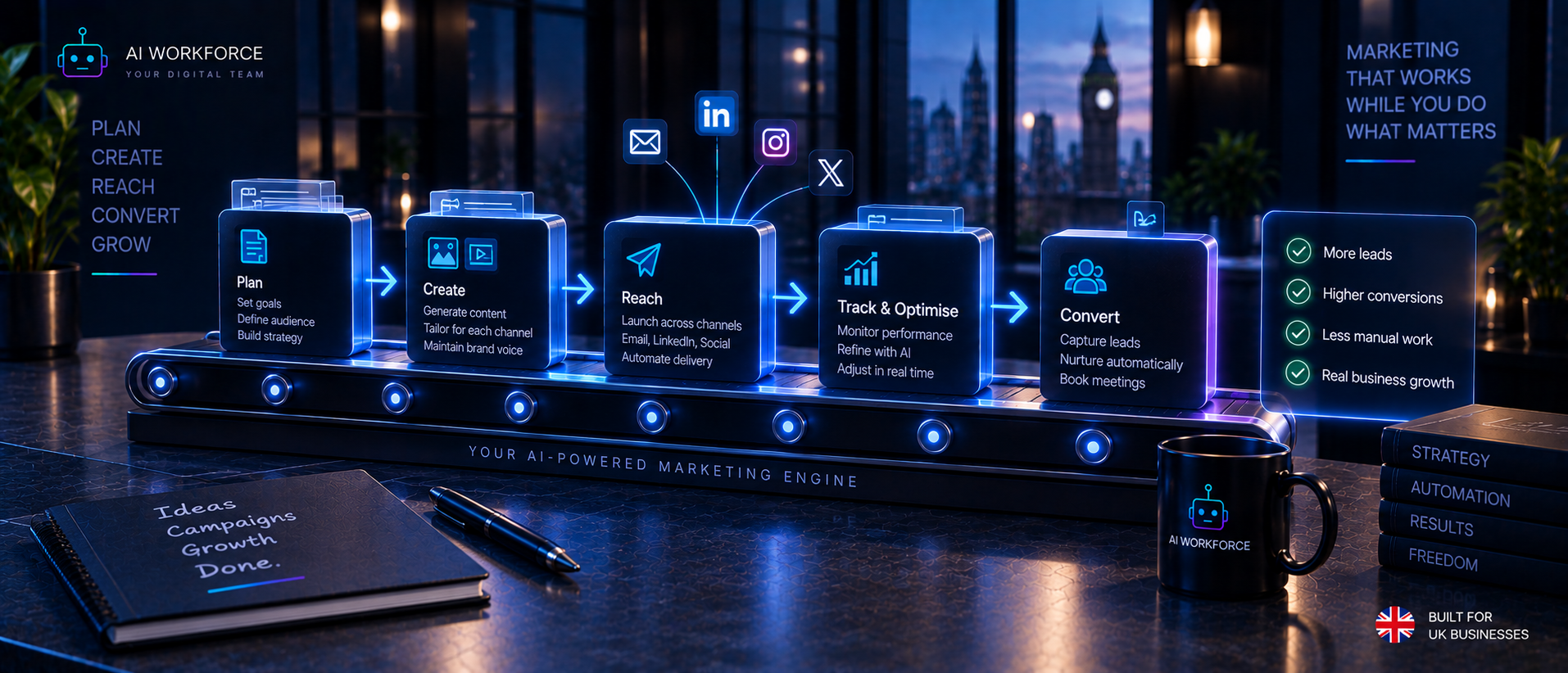
The AI Workforce campaign lifecycle has eleven stages: Goal, Audience, Research, Campaign Plan, Asset Creation, Approval, Execution, Monitoring, Optimisation, Reporting and Next Action. The table summarises what AI can assist with, what can be automated, and where people stay in control. It is an AI Workforce implementation framework, not an industry standard.
Campaign stage | AI can assist with | What can be automated | Human decision or control | Key risk |
|---|---|---|---|---|
Goal | Turning a business aim into measurable options | Recording the approved goal in the campaign record | Choosing the goal and success measure | Vague or unmeasurable objective |
Audience | Suggesting segments from permitted data | Building segments from agreed rules; applying suppression | Approving who is targeted and on what lawful basis | Unlawful or unfair targeting |
Research | Summarising sources, competitors and past results | Collecting permitted data on a schedule | Judging relevance and source quality | Inaccurate or outdated inputs |
Campaign plan | Drafting briefs, channel options and timelines | Creating tasks and calendar entries from an approved plan | Approving positioning, channels, budget | Plan built on weak research |
Asset creation | Drafting copy, variants and layouts | Routing briefs to drafts; storing versions | Editing for accuracy, tone and brand | Unsupported claims, off brand output |
Approval | Checking drafts against written rules | Routing items to named approvers; logging decisions | Approving or rejecting customer-facing material | Rubber stamping, unclear accountability |
Execution | Preparing send and publish schedules | Publishing or sending approved assets as scheduled | Authorising launch and any list or budget | Wrong audience, wrong version, wrong time |
Monitoring | Flagging anomalies and unusual results | Collecting results; raising alerts on set thresholds | Deciding whether an alert needs action | Misread or incomplete data |
Optimisation | Proposing tests and adjustments | Applying pre-approved changes within set limits | Approving meaningful changes and budget shifts | Over optimising a short term metric |
Reporting | Drafting summaries and commentary | Assembling data into a standard report | Interpreting results and checking claims | Selective or misleading reporting |
Next action | Recommending follow-up or closure | Creating follow-up tasks | Deciding whether to repeat, change or stop | Lessons not recorded |
Stage by Stage
For each stage, the useful questions are what goes in, what AI or automation does, what a person is responsible for, what comes out, and what changes in the campaign's state.
1. Goal
Input: An approved business aim.
AI and automation role: AI can help express it as measurable options. Automation records it in the campaign record.
Human responsibility: A person chooses the goal and how success will be measured.
Output: A written goal with a named owner.
State change: Draft.
2. Audience
Input: Permitted customer or prospect data and the goal.
AI and automation role: AI can propose segments; automation builds them from agreed rules and applies suppression.
Human responsibility: A person approves who is targeted and confirms the data may be used for this purpose.
Output: A defined audience with suppression applied.
State change: Researching.
3. Research
Input: Audience, market and past campaign information from permitted sources.
AI and automation role: AI summarises; automation gathers material on a schedule.
Human responsibility: A person judges relevance and checks sources for anything that will be relied on.
Output: A research summary with sources recorded.
State change: Researching, then Planning.
4. Campaign plan
Input: Goal, audience and research.
AI and automation role: AI drafts the brief, channel options and timeline; automation turns an approved plan into tasks.
Human responsibility: A person approves positioning, channels, budget and timing.
Output: An approved plan and brief.
State change: Planning, then Assets in Production.
5. Asset creation
Input: The approved brief and a knowledge pack of brand rules and examples.
AI and automation role: AI drafts assets and variants; automation routes briefs and stores versions. Specialist treatment sits in our AI content marketing and best AI tools for content creation guides.
Human responsibility: A person edits and fact-checks.
Output: Draft assets linked to the plan.
State change: Assets in Production, then Awaiting Approval.
6. Approval
Input: Draft assets and the rules they must meet.
AI and automation role: AI can check a draft against written rules; automation routes it to named approvers and logs decisions.
Human responsibility: A named person approves or rejects.
Output: A recorded approval for each asset.
State change: Awaiting Approval, then Approved.
7. Execution
Input: Approved assets, approved audience and schedule.
AI and automation role: Automation publishes or sends exactly what was approved, within permissions.
Human responsibility: A person authorises launch and any change to the approved audience or budget.
Output: Live activity across channels.
State change: Approved, then Live.
8. Monitoring
Input: Live results and delivery data.
AI and automation role: Automation collects results and raises alerts on set thresholds; AI can flag unusual patterns.
Human responsibility: A person decides whether an alert needs action and can pause the campaign.
Output: A current view of performance and incidents.
State change: Live, then Monitoring.
9. Optimisation
Input: Monitoring data and the plan.
AI and automation role: AI proposes adjustments; automation applies only pre-approved changes within set limits.
Human responsibility: A person approves meaningful changes.
Output: Logged changes with reasons.
State change: Monitoring, or Review Required.
10. Reporting
Input: Results, costs and the original goal.
AI and automation role: AI drafts commentary; automation assembles the report.
Human responsibility: A person checks figures and interprets results.
Output: A report tied to the original goal.
State change: Monitoring, then Completed.
11. Next action
Input: The report and recorded incidents.
AI and automation role: AI suggests follow-up; automation creates tasks.
Human responsibility: A person decides whether to repeat, change or stop.
Output: A recorded decision and lessons learned.
State change: Completed or Paused.
The AI Workforce Campaign State Model
A linear list of steps does not describe what a live campaign needs. Campaigns pause, return for approval and change after launch. The AI Workforce Campaign State Model assigns the campaign a defined workflow state so automation can act on what the campaign is currently permitted to do. More complex implementations may also track separate states for individual assets, audiences or channels. This is an AI Workforce implementation framework, not an industry standard.
State | Meaning | Typical permitted automation |
|---|---|---|
Draft | Goal recorded, nothing approved | Record keeping only |
Researching | Audience and research being gathered | Collect and summarise permitted sources |
Planning | Plan and brief being prepared | Draft plans; create planning tasks |
Assets in Production | Assets being drafted and edited | Generate drafts; store versions |
Awaiting Approval | Assets and audience submitted for sign-off | Route to approvers; send reminders |
Approved | Sign off recorded for all required items | Schedule approved items; no publishing yet |
Live | Approved activity is running | Publish or send exactly what was approved |
Monitoring | Results being tracked against thresholds | Collect data; alert; apply pre-approved limits |
Review Required | A threshold, error or complaint needs a person | Pause relevant actions; notify the owner |
Completed / Paused | Campaign ended, or stopped on purpose | Final report only; no new outbound activity |
State matters because automation should act on the campaign's current state, not merely on elapsed time. A rule that sends the second email "three days after the first" will send it even if the first was never approved, the audience changed or a complaint paused the campaign. A rule that sends it only when the campaign is Live, the asset is Approved and the recipient is not suppressed behaves correctly in all three cases. Recording who or what changed the state, and when, also creates the audit trail that review and compliance work depends on.
Human Approval Gates
Approval gates are the points where a person must decide before the campaign moves to the next state. Sensible places for a gate include positioning and messaging; factual claims about price, availability, results or comparison; audience selection and any use of personal data for a new purpose; all customer-facing content before first use; meaningful budget changes; regulated or sensitive material; and any other action that is hard to undo.
This does not mean every low risk action needs manual approval forever. A better approach is bounded permissions: define a narrow action, set limits on it, record what happened, and review the evidence. If the record shows the action is accurate and rarely corrected, the boundary can be widened deliberately. If it shows errors, the boundary tightens. Expansion should rest on representative evidence from the workflow, not on a calendar date. Our AI Marketing Agents guide sets out a related autonomy ladder for agents.
Cross-Channel Coordination
A campaign usually touches several channels, and the hard problem is coordination, not any one channel. At campaign level, the shared questions are: which audience each channel is allowed to reach and who is suppressed; which version of each asset is approved; when channels should fire relative to each other; and how results from every channel are measured against the same goal. Without a shared record, an email can go to someone who opted out on another channel, or a social post can promote an offer that has ended.
Email: sends depend on audience state, suppression and approval. Tools and details are in our AI email marketing tools guide.
Social media: posts follow the approved calendar and message. See our social media automation tools guide for the channel itself.
Content and blogs: long-form content anchors the message and gives other channels something to point to. The specialist treatment is in our AI content marketing guide.
CRM: holds the audience and consent record and receives responses, so suppression and status stay current.
Paid media, where relevant: budget changes and audience targeting can create material financial or targeting consequences, so permissions, spend limits and approval thresholds should be defined explicitly.
Reporting: one view across-channels, tied to the original goal.
Worked UK SME Example (Illustrative)
The following is an illustrative scenario, not a measured result. A small UK accountancy practice is launching a new fixed scope bookkeeping service for local sole traders.
Goal: The owner sets the aim of booking introductory calls for the new service and names the person accountable for the campaign. State: Draft.
Research: AI summarises permitted sources, such as the practice's own enquiry history and publicly available competitor service pages. A person reviews the summary and removes anything unreliable. State: Researching.
Audience: The practice builds a segment from contacts it is permitted to market to through the intended channel under its documented UK GDPR and PECR approach. Suppression and opt-out records are applied before the audience is approved. The owner reviews the segment before launch.
Plan and content brief: AI drafts a brief proposing one blog post, a short email sequence and a few social posts. The owner approves positioning and the channels. State: Planning.
Assets: AI drafts the blog, emails and posts. A team member edits them and checks every statement about pricing and scope. State: Assets in Production.
Approval: The owner approves each asset in the workflow, and the approval is logged. State: Awaiting Approval, then Approved.
Execution: automation publishes the blog, schedules the emails to the approved segment and queues the social posts. State: Live.
Monitoring: automation collects opens, clicks, enquiries, unsubscribes and complaints into one view. An unusual number of unsubscribes after the first email raises an alert. State: Review Required, with the later emails held.
State change: the owner reviews the first email, finds a confusing offer and corrects it. The campaign returns to Monitoring once the corrected email is approved.
Reporting and next action: AI drafts a summary against the original goal and records changes made. The owner reviews the figures, decides whether to repeat, adjust or stop, and records the reasons. State: Completed.
No figures are given because none are claimed. The example shows how state, approval and monitoring interact, not what results to expect.
What Should Not Be Fully Automated?
The useful distinction is between low-consequence workflow actions, such as creating tasks, formatting assets, collecting results or sending an internal reminder, and higher-consequence decisions, such as choosing a target audience, making a claim about a product, publishing to a live customer list, shifting spend or handling sensitive subject matter. The first group is a good candidate for automation within limits. The second group needs a person, or a tightly bounded permission that has earned its place through evidence.
Three controls should be designed in from the start:
Stop conditions: defined triggers that pause the campaign, such as a complaint threshold, a delivery failure, an unexpected spike in spend or a flagged factual error.
Escalation: a named person who is notified and has authority to decide, with a clear route when that person is unavailable.
Rollback: a way to unpublish, recall or pause what has gone out, and a record of what cannot be undone, such as an email already delivered. Irreversible actions deserve earlier approval gates.
When Is AI Campaign Automation a Poor Fit?
Campaign automation is a poor starting point when the campaign itself is not repeatable enough to map, the audience or offer changes materially every time, customer data is fragmented or unreliable, the systems involved cannot exchange state safely, approval ownership is unclear, or the likely consequence of an incorrect automated action is greater than the operational benefit of automating it.
It is also a poor fit when the main bottleneck is strategic rather than operational. Automation can move an approved brief, asset or decision through a workflow; it cannot resolve an unclear proposition, decide what a brand should stand for, or turn weak source material into a reliable campaign strategy without human judgement.
In those cases, the useful first step is to fix the campaign process, data or ownership before automating the handoffs between them.
How to Measure AI Campaign Automation
Measure against the business's own baseline rather than a universal benchmark. Useful measures fall into two groups.
Operational: campaign production time; human correction or rework rate; approval rate and time to approve; number of autonomous actions that had to be reversed; errors and incidents; and net time saved after review and maintenance are included.
Business: cost per lead or acquisition where applicable; conversion outcomes against the original goal; and unsubscribe and complaint rates where applicable.
Measure net improvement rather than gross automation time. For time specifically, compare the previous manual effort with the total effort after automation, including operation, human review, correction and maintenance. Track financial running costs separately rather than combining time and money into one figure. A faster first draft that creates more correction work may produce little or no net time saving. Compare like with like, record the baseline before launch, and avoid drawing conclusions from a single campaign.
UK GDPR and PECR
This section is general information, not legal advice. Campaign automation often processes personal data and sends electronic marketing, so several UK rules are relevant. For the full treatment, see our AI GDPR Compliance for UK Businesses guide; the points below are those most specific to a campaign.
Lawful basis and transparency: identify a lawful basis for each use of personal data in the campaign and make sure people have been told how their data is used. The ICO's guidance on direct marketing covers this.
Electronic marketing under PECR: rules on email and text marketing include consent requirements for individuals, with different treatment for some business-to-business contacts. Check the ICO's business-to-business marketing guidance linked in Sources.
Suppression and opt-outs: every channel must honour opt-outs, so suppression needs to be held in one place the whole campaign reads from.
Profiling and automated decisions: segmentation and targeting can involve profiling. The ICO sets out expectations on automated decision-making; see Sources.
Data minimisation: give each automated stage access only to the data it needs.
Tracking: cookies and similar technologies used for measurement or retargeting may need consent. See the ICO's guidance on storage and access technologies in Sources.
Processors: platforms that process personal data on a business's behalf need appropriate contracts and checks.
Human oversight: keeping people involved in consequential decisions supports accountability, and the Data (Use and Access) Act 2025 changes some UK data protection rules, so check current GOV.UK guidance.
Implementation
This sequence is an AI Workforce implementation model, not an industry standard. It is deliberately not tied to a time period. Move to the next step when the evidence from the current one supports it.
Campaign selection: choose one campaign with a clear goal and limited consequences if something goes wrong.
Baseline: record current production time, rework, approval steps and results.
Workflow map: map who does what at each of the eleven stages today.
Data and access: decide what data each stage needs and restrict access to that.
States: define the campaign states and what each permits.
Automation rules: write rules that act on state, not only on time.
Approval gates: place gates at the higher-consequence points and name approvers.
Sandbox and test: run the workflow with test data and internal recipients before anything reaches customers.
Launch: start with the narrowest permissions and active monitoring.
Measurement: compare results with the baseline, including errors, reversals and review effort.
Expansion or rollback: widen permissions only where representative evidence from the workflow supports it, and roll back where it does not.
Want help mapping one campaign into stages, states and approval gates? Talk to AI Workforce.
Frequently Asked Questions
What is AI campaign automation? It is the use of AI and workflow automation to connect the stages of a single marketing campaign, so that goals, audiences, assets, approvals, live activity and results move between systems without repeated manual transfer.
What is end-to-end campaign automation? It means the stages of a campaign are connected from goal through to reporting and next action. It does not mean a campaign runs without people; approval and decision points remain.
Can AI automate an entire marketing campaign? AI and automation can connect and carry out many stages, but decisions about positioning, claims, audiences, budget and consequential actions should stay with people unless a bounded permission has been justified by evidence.
What is the difference between campaign automation and marketing automation? Marketing automation is the broader layer of systems and repeatable workflows. Campaign automation applies them to one campaign's lifecycle. See our AI Marketing Automation guide for the broader topic.
Can AI create and publish campaign content automatically? AI can draft content, and automation can publish approved content on a schedule. Publishing under the brand's name or to a live customer list is a higher-consequence step that normally sits behind an approval gate.
Can AI optimise a live campaign? It can flag patterns and propose changes, and automation can apply pre-approved adjustments within set limits. Meaningful changes, especially to budget or audience, should be approved by a person and logged.
What should remain under human control? Goals, positioning, factual claims, audience selection, customer-facing content, meaningful budget changes, regulated or sensitive material and decisions to stop or continue.
How do you measure an automated campaign? Against the business's own baseline: production time, rework, approval rate, reversed actions, incidents, net time saved, and business outcomes such as cost per lead, conversions and unsubscribe or complaint rates where applicable.
Is AI campaign automation suitable for small businesses? It can be, where the campaign has a defined goal, suitable systems and data, clear approval points and a manageable scope. A small team still needs controls such as ownership, suppression, stop conditions and a baseline for measurement. For broader SME agent adoption and implementation considerations, see our AI Agents for Small Businesses guide.
See how AI Workforce can support your campaign workflows. Get in touch.