AI Marketing Automation: How It Works, Use Cases & Tools
Posted On: May 14, 2026
Last updated: August 2026 · Written by Luca Controlo, who writes on AI adoption and marketing automation for AI Workforce, drawing on the team's implementation work with UK small and medium-sized businesses
Marketing automation has been around for years. AI has expanded what those workflows can analyse, generate, recommend and execute. This guide focuses on AI marketing automation as a connected workflow system: what it is, how it differs from traditional automation, which marketing processes can be automated or AI-assisted, where human approval belongs, how the workflows connect, and how a UK business can introduce them safely. AI marketing agents and end-to-end campaign automation are related but distinct topics, linked to where relevant rather than treated as the primary intent of this guide.
Quick Answer
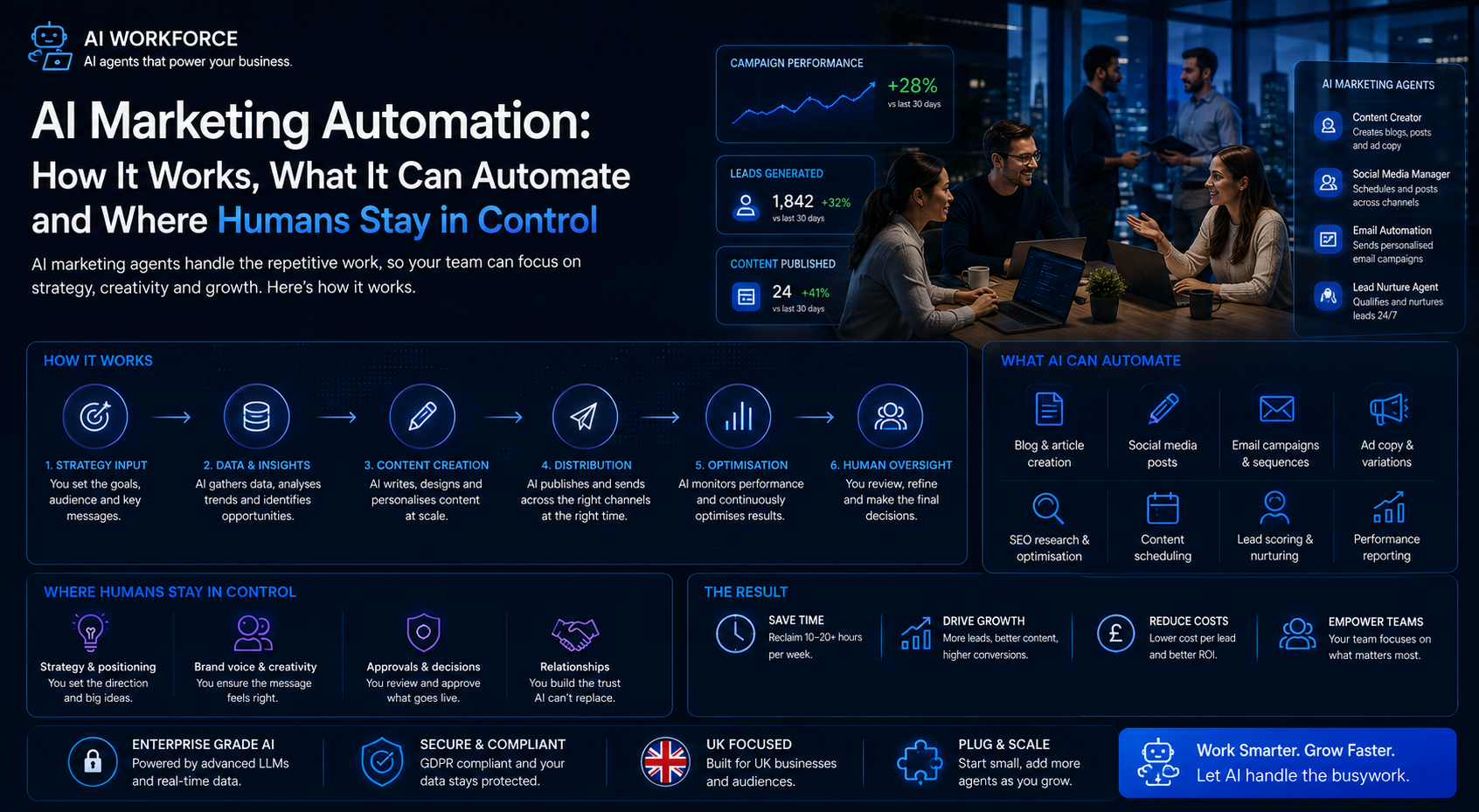
AI marketing automation combines machine learning, predictive analytics and generative AI with existing marketing workflows. Unlike traditional automation, which follows fixed rules, AI-supported systems can analyse behaviour, recommend or select actions, personalise content and optimise selected decisions within defined limits. For example, a system might segment approved contacts, draft campaign assets, route them for human approval, schedule the approved versions and prepare a performance report. They still require reliable data, clear goals, defined permissions and human oversight; they do not run marketing on their own.
What Can AI Marketing Automation Actually Do?
AI can assist, automate or recommend different parts of a marketing workflow, while higher-impact decisions should remain with a person.
Marketing activity | AI-assisted | Automated after approval | Human decision |
|---|---|---|---|
Audience research | Summarise questions and patterns | Monitor approved sources | Decide positioning |
Draft subject and body variants | Send through approved workflow | Approve audience and claims | |
Content | Research, brief and first draft | Schedule approved content | Editorial approval |
CRM | Classify and recommend routing | Update approved fields | Resolve ambiguous cases |
Paid media | Analyse and recommend changes | Apply changes inside tight limits | Major budget decisions |
Reporting | Summarise performance | Produce scheduled reports | Interpret strategy |
What's Covered
What AI marketing automation is and how it differs from traditional automation and AI marketing agents; how AI-assisted, automated and agentic workflows differ; how connected marketing workflows operate across email, content, CRM, social and reporting; practical use cases; current platform options; UK GDPR and PECR considerations; implementation, accuracy and security guidance; and how to measure whether an automated marketing workflow is actually working.
What Is AI Marketing Automation?
AI marketing automation is the use of artificial intelligence within repeatable marketing workflows to analyse information, generate or adapt approved content, recommend actions, route work and automate defined steps with less manual handling. It extends traditional marketing automation beyond fixed triggers by allowing AI models to contribute interpretation, prediction and generation within defined rules and permissions. It can operate across connected systems such as CRM, email, content, analytics and social tools rather than requiring every stage to be handled manually.
It is worth being clear early that this is not one tool. It is a layer of intelligence applied across many tools: your email platform, your CRM, your ad manager, your content tools. A marketer using a modern platform is likely already interacting with some form of this, even if the interface does not make it explicit.
What has changed recently is the quality of the underlying models. The arrival of capable generative AI has extended what these systems can do, from routing and scheduling toward drafting, personalising and recommending. Someone who understood marketing automation two years ago is working with a materially more capable set of tools today, tools that do not just follow instructions but can generate, adapt and suggest improvements.
How Does It Differ from Traditional Automation?
Traditional automation follows fixed rules. If a contact opens an email, send a follow-up in three days. If a lead reaches a certain score, notify the sales team. These rules are useful, but they are static: they do not change based on what is actually working. Traditional automation generally applies the same predefined rule to contacts who meet the same configured conditions, although sophisticated systems can contain many branches and segments. Someone still has to define every rule, update them when behaviour changes, and manually create the variations different audiences need.
AI-supported systems, by contrast, use machine learning to identify patterns and adapt. Rather than only reacting to what a contact does, they can estimate what a contact is likely to do next and adjust a workflow accordingly. A traditional setup might send the same email to everyone who abandoned a cart. An AI-supported one can recommend, or, within agreed limits, select, which message, channel and timing is most likely to convert a given contact.
AI Workforce Insight: the biggest mistake we see is trying to make a workflow autonomous before it has been made consistent. If a team cannot agree on how a lead should be scored, when a campaign should pause, or what requires approval, introducing an AI agent will not resolve that uncertainty. It will automate it, inconsistencies and all.
The realistic version of the practical difference is this: you define the goal, the data sources, the constraints and the approval rules. The system can then test and optimise selected decisions within those boundaries. That is a genuine shift from writing every rule by hand toward setting goals and guardrails, but it is not the same as handing over a goal and stepping away. AI-supported systems can also shift where maintenance happens rather than removing it: less time is spent writing rules, while more time is spent checking data quality, reviewing outputs and monitoring for drift.
AI Marketing Automation vs AI Marketing Agents
AI marketing automation improves or runs repeatable marketing processes. An AI marketing agent works towards an objective and may progress work across several steps or tools within defined permissions. An agent can use marketing automation infrastructure, but not every AI-powered automation is an agent.
In this guide, automation refers primarily to defined marketing processes and workflow stages; agentic marketing refers to systems that can choose and sequence actions toward an objective within defined permissions. An AI marketing agent may use automation infrastructure, but the two concepts should not be treated as interchangeable. For the dedicated role, capability, deployment and tool-comparison intent, see our AI Marketing Agents guide.
AI marketing automation improves a process; an AI marketing agent plans and acts toward a goal.
Assisted to Autonomous: Four Levels of AI Marketing Automation
Not everything described as "AI marketing automation" works the same way, and conflating the levels leads to unrealistic expectations. It helps to separate them:
AI-assisted. The system drafts or recommends; a person decides. Subject line suggestions, first-draft content, and segment recommendations sit here.
AI-automated. A predefined workflow runs automatically once configured, similar in spirit to traditional automation but with AI-generated content or scoring feeding into it.
Agentic. The system selects actions within defined permissions and goals, such as choosing which variant to send to which contact, and reports back on what it did.
High-autonomy. The system executes more consequential actions with limited approval, reallocating significant budget or publishing without review. This level needs the most caution and is rarely a sensible starting point.
Most marketing teams are better served starting at the assisted or automated level and only moving toward agentic workflows once a narrow use case has proven reliable.
Signs Your Marketing Team Is Ready
AI-supported marketing tends to work best when a few things are already true. You are in a reasonable position to start if:
Customer data is reasonably clean and accessible across the systems involved; campaign goals are specific and measurable, not just "grow engagement"; repetitive decisions already follow a recognisable pattern; the team knows, and agrees, what requires human approval before it goes out; your marketing platforms can exchange data with each other reliably; there is enough activity and history to actually learn from; and someone is named as owner of performance and governance for the workflow.
If several of these are missing, that is worth fixing before adding AI on top, since AI tends to amplify whatever is already true of a process, good or bad.
How Does AI Marketing Automation Work?
Understanding how this works starts with data. The system ingests signals from across marketing channels, website behaviour, email engagement, purchase history, and support interactions, and uses machine learning to find patterns. Those patterns inform predictions: which contacts are likely ready to buy, which are at risk of disengaging, and which content is likely to resonate with which segment. Depending on how the workflow is configured, the system then recommends an action or, within agreed limits, takes it.
Depending on the platform, the system can update scores, recommendations or optimisation decisions as new data arrives: a previously strong subject line that starts underperforming gets tested against alternatives; a segment that responds better to a shorter message at a different time has that pattern picked up. This does not necessarily mean the underlying model retrains itself continuously; more often it means the system is re-running existing logic against fresh data on a schedule. Either way, it still needs periodic human review to catch drift or errors.
The technical layer behind this typically includes natural language processing for understanding and generating text, machine learning for pattern recognition and prediction, and increasingly generative AI for producing personalised content at scale. In a well-built setup, these are woven together so a marketing team can direct the system through goals and guardrails rather than only rules and scripts, though someone still needs to define those guardrails clearly.
How Does AI Marketing Automation Connect an End-to-End Campaign?
AI marketing automation can connect individual workflow stages so approved information and assets move between research, audience selection, content creation, approval, execution, monitoring and reporting without repeated manual transfer. That does not make the campaign human-free: positioning, claims, audience decisions, budgets and other consequential actions can still require explicit approval.
A simplified campaign flow is:
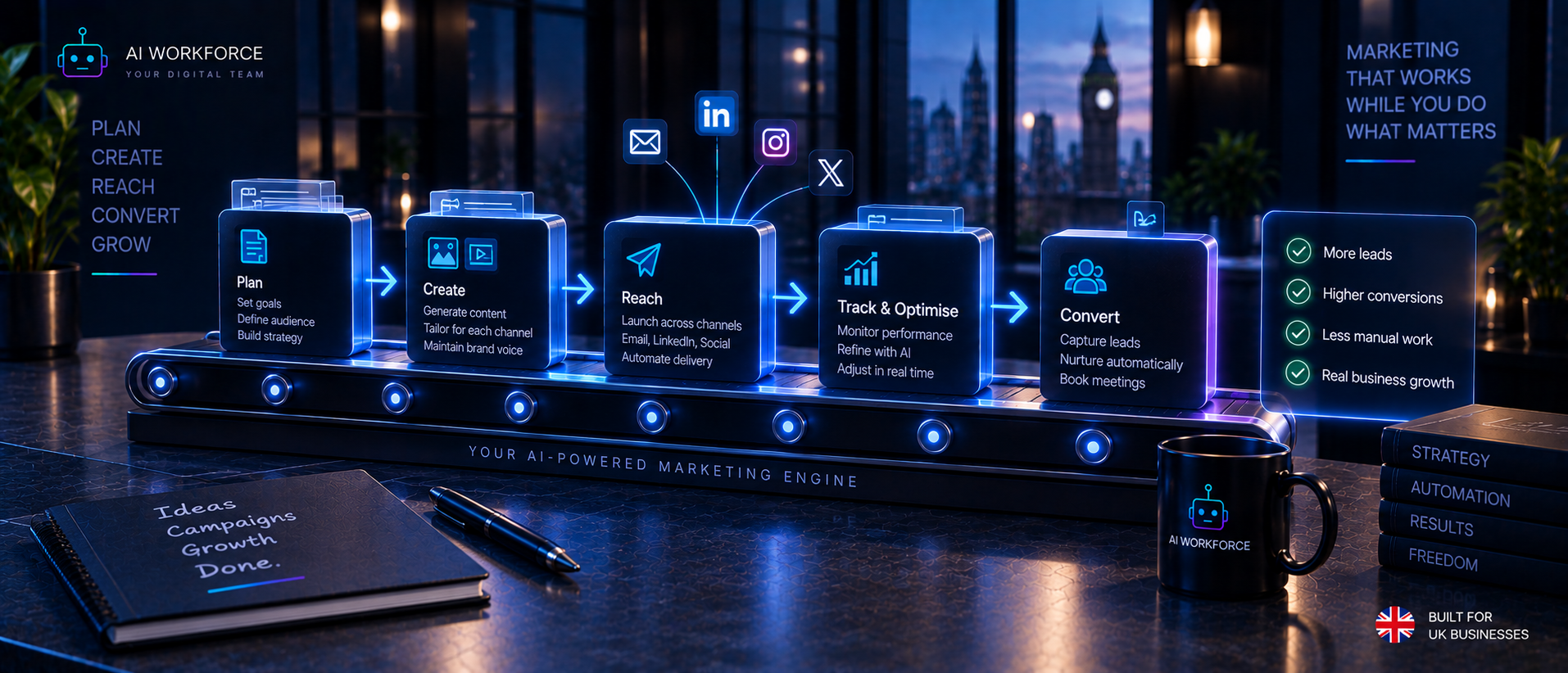
Goal → Audience → Research → Campaign Plan → Asset Creation → Approval → Execution → Monitoring → Reporting. This article treats that sequence as an example of how multiple marketing automations can connect. Our AI Campaign Automation guide covers the end-to-end campaign implementation itself, including workflow state, approvals, channel coordination, measurement and stop conditions.
Example: How Several Marketing Automations Can Work Together
A UK service business launching a new offering might use a connected setup roughly as follows: the system researches common customer questions about the new service and summarises recurring themes; a marketer sets the campaign positioning and goal based on that research; the system drafts a blog post, an email sequence and a set of social posts around the agreed theme; a marketer reviews and edits each asset for accuracy and brand voice; the system segments the CRM to identify contacts likely to be interested, based on criteria the marketer has approved; approved assets are scheduled through the connected email and social tools; the system monitors early engagement and flags any asset underperforming against a threshold; a marketer decides whether to pause, adjust or let an underperforming asset run its course; and the system prepares a performance summary and recommends a follow-up test for the marketer to approve.
Throughout this example, the business owner or marketer retains control over positioning and messaging, which contacts are targeted, what budget is committed, whether an underperforming asset is paused, and what the next test should be. The system's role is to remove repetitive research, drafting and reporting work, not to make these decisions unsupervised.
Not sure which workflow to automate first?
What Are the Key Use Cases?
The use cases that tend to deliver value fastest are the ones tied to volume and personalisation, where there is enough data and a clear, measurable target.
Email personalisation. Input: past engagement and purchase behaviour. Action: the system adjusts subject lines, content, and send time per recipient. Human role: approving the content pool and reviewing performance. Output: personalised email variants and timing decisions intended to improve relevant engagement. Primary KPI: engagement rate. Main risk: over-personalisation feeling intrusive without clear consent. For the dedicated platform layer, our AI Email Marketing Tools guide compares Klaviyo, HubSpot, ActiveCampaign, Mailchimp and Brevo across AI writing, segmentation, lifecycle automation, pricing and UK compliance.
Lead scoring. Input: CRM and engagement data. Action: the system scores leads dynamically as new signals arrive. Human role: setting the scoring criteria and reviewing edge cases. Output: a prioritised list for sales follow-up. Primary KPI: conversion rate from marketing-qualified to sales-qualified lead. Main risk: scoring drift if the underlying sales process changes without the model being updated.
Content drafting. Input: a brief covering topic, audience and goal. Action: generative AI drafts emails, social posts or ad copy variants. Human role: editing, fact-checking and brand review before publishing. Output: approved content assets ready for the relevant channel. Primary KPI: content approval rate and time to publish. Main risk: publishing unreviewed or inaccurate claims. For the broader system around planning, producing, distributing and measuring content, see our AI Content Marketing guide.
Customer journey management. Input: behavioural signals across channels. Action: the system recommends or selects a next-best action for a contact. Human role: setting the boundaries of what actions are available and approving higher-risk ones. Output: more consistent, timely follow-up. Primary KPI: retention or repeat purchase rate. Main risk: acting on stale or incomplete data.
Beyond these four, predictive lead scoring across an entire database and AI-supported ad spend reallocation across platforms are both maturing quickly. In both cases, someone sets the target and the constraints, and the system manages the ongoing allocation within them, rather than deciding the strategy unsupervised.
Which Marketing Tasks Should You Automate First?
The task map near the beginning of this guide shows which activities AI can assist with, which can run after approval and which should remain human decisions.
Lower-Risk vs Higher-Risk Marketing Tasks to Automate
Not every marketing task is a sensible first candidate for automation, and some need a human decision every time regardless of how mature your setup becomes.
Lower-risk, reasonable starting points: drafting content variations for review; summarising campaign performance reports; suggesting subject lines or headlines; segment recommendations; repurposing already-approved content across formats; and flagging underperforming campaigns for review.
Higher-risk, keep a human closely involved: automatically reallocating significant budget; publishing claims or offers without review; personalising sensitive or regulated offers; automated profiling of customers; suppressing or targeting customers without oversight; and sending regulated or legally sensitive communications.
Your own risk tolerance and regulatory context still apply on top of this starting filter.
What Are the Benefits?
The benefits tend to cluster around three things: efficiency, personalisation and insight.
On efficiency, these systems can handle the volume of work, scheduling, segmentation, testing variants, pulling together reporting, freeing marketing teams to spend more time on strategy, creative direction and the decisions that genuinely need human judgement. The time recovered compounds across a team once one workflow is running reliably.
On personalisation, AI can support more granular personalisation than manually maintained segments, where the business has suitable data, consent and platform capability. Without these tools, personalisation usually happens at the segment level, ten or twenty variations of a message. A well-configured platform can vary the message, timing, channel and offer per contact, though this depends on consent, identity resolution and data volume, not something every setup delivers by default.
On insight, analytics can surface patterns that would take a person considerably longer to find manually, not just what happened in a campaign, but which signals were associated with conversion, which content supported retention, which touchpoints mattered most. Those insights feed back into better decisions over time, provided someone is actually reviewing and acting on them.
Which Marketing Workflows Can AI Handle?
The workflows best suited to this kind of automation share common traits: repetitive decisions, meaningful data volume, and a defined goal. Lead nurture sequences are a clear example: monitoring behaviour, sending relevant content at a sensible time, and escalating to sales when readiness signals appear, while adjusting pace and content based on individual engagement rather than a single fixed schedule.
Content workflows can connect one approved theme across several formats: a team can brief the system on a topic, audience and goal and prepare a blog draft, social posts and an email newsletter adapted to the relevant channel. Human editorial review still determines what is accurate and suitable to publish. For content-production tools, see our Best AI Tools for Content Creation guide; for the wider content operating model, see our AI Content Marketing guide; and for scheduling, publishing and social-specific workflows, see our Best Social Media Automation Tools guide.
For teams looking to automate the SEO layer around those content workflows, our guide to SEO automation tools compares platforms for crawling, Search Console analysis, rank tracking, content optimisation and internal linking.
Customer re-engagement is another strong candidate. The system can monitor signs of disengagement, declining opens, reduced site visits, lengthening gaps between purchases, and trigger a personalised re-engagement sequence before a customer churns. This was theoretically possible with traditional automation, but the rules needed to do it well were often too complex to maintain by hand at scale.
What Tools Are Available?
The following comparison is drawn from each vendor's own published documentation as of August 2026, not from hands-on testing by AI Workforce. Pricing, packaging and features change frequently, so check the vendor's current pricing page before deciding.
Platform | Best for | AI capability | CRM/email/content coverage | Approval controls | Pricing transparency | Main limitation |
|---|---|---|---|---|---|---|
HubSpot | Teams wanting one connected CRM and marketing suite | Content, scoring and personalisation features | Strong across CRM, email and content | Draft review supported in workflow tools | Plan-dependent, published tiers | Best value depends on data already living in HubSpot |
Salesforce Marketing Cloud (Agentforce) | Salesforce-native enterprises and larger SMEs | Agentic scoring and campaign optimisation | Strong CRM and campaign coverage | Configurable approval steps | Complex, often custom quoted | Cost and implementation complexity |
Klaviyo | Ecommerce and DTC teams | Predictive segmentation, send-time and content personalisation | Strong for email and SMS, narrower for general content | Approval workflow features vary by plan | Usage-based, published tiers | Narrower fit for B2B or service businesses |
Adobe (Sensei GenAI, Experience Cloud) | Larger enterprise teams already on Adobe | Content and experience workflow features | Broad across content and experience tools | Enterprise-grade governance controls | Usually sales-led, less transparent | Cost and complexity for SME teams |
Custom agent workflows | Complex, multi-tool processes with no good off-the-shelf fit | Fully configurable to the specific workflow | Depends entirely on what is built | Depends entirely on what is built | Depends on implementation scope | Greatest implementation and maintenance burden |
CRM-centred suites are strongest when customer data already lives in the same ecosystem. Ecommerce platforms specialise in purchase-led journeys, while custom workflows suit processes that span several tools but require more implementation and maintenance.
A platform that does one thing well is often a better first choice than a broad suite used superficially. AI Workforce's guide to AI automation pricing covers what these projects typically cost in the UK if budget is the main open question. If you are considering external implementation support rather than software alone, see our Best AI Marketing Agencies 2026 comparison.
Where AI Workforce Fits
AI Workforce publishes this guide and also helps UK businesses design and implement AI-supported workflows. Unlike a standalone marketing tool focused on one channel, AI Workforce's role is to connect suitable tools around a defined business process, with permissions, approval stages and human oversight. We are not a neutral reviewer of our own services, and the platform comparison above is based on vendor documentation rather than independent hands-on testing.
Where Do AI Marketing Agents Fit?
AI marketing agents can sit on top of the automation workflows described in this guide when a system needs to choose and sequence permitted actions toward an objective rather than simply execute a predefined process. That is a separate agentic layer rather than a synonym for AI marketing automation. For the dedicated explanation of agent roles, capabilities, permissions, deployment and tools, see our AI Marketing Agents guide.
The AI Workforce Marketing Automation Framework below is an AI Workforce implementation model rather than an industry standard.
The AI Workforce Marketing Automation Framework
Introducing AI marketing automation depends on both the technology and the process around it. AI Workforce uses the following nine-step framework as an implementation model for defining scope, permissions, approvals and measurement. It is AI Workforce's own framework rather than an external industry standard or independently validated methodology.
Outcome. Define the specific business outcome the workflow is responsible for, not just "use AI in marketing."
Data. Identify what data the workflow needs, confirm it is accessible and reasonably clean, and note any gaps.
Workflow. Map the current process step by step before changing anything.
AI role. Decide exactly what the AI system will draft, recommend or execute at each step.
Rules. Set explicit brand, compliance and quality rules the system must follow.
Approval. Define who approves what, and at which stage, before anything goes live.
Execution. Run the workflow with approved outputs only, at first with full review.
Measurement. Track net time saved, correction rate and business outcome, not just output volume.
Improvement. Feed corrections back into the rules and briefs, and only expand scope once the workflow has proven reliable.
How to Implement AI Marketing Automation: A Ten-Step Plan
The pilot evaluation described under measurement below tells you whether a workflow is working. This plan is the broader process for getting there.
Choose one measurable workflow rather than attempting several at once.
Establish the baseline: how long the task takes today and what the current output looks like.
Map the current process step by step.
Identify specifically where AI adds value in that process, rather than assuming it helps everywhere.
Define the data and system access the workflow actually needs, no more.
Set brand and compliance rules the system must follow.
Establish clear approval points before anything customer-facing goes live.
Test in a sandbox or low-risk environment before touching live campaigns or contacts.
Measure corrections, reversals and outcomes, not just usage.
Expand only after the workflow has run reliably, and only one step at a time.
Accuracy, Brand and Security Guidance
AI-supported marketing systems can fail in specific, predictable ways, and a working setup should account for each of them directly.
Accuracy. Systems can produce incorrect statistics, misattributed quotations or invented competitor and product claims, particularly when asked to state a fact rather than draft persuasive copy. It helps to distinguish the type of information involved: observed data pulled directly from a connected platform is usually reliable but should still be spot-checked; an official source such as a regulator or government statistic should be verified against the original before publishing; a vendor's own claim about its product should be labelled as a vendor claim, not treated as independently verified fact; an AI inference, where the system is drawing a conclusion rather than reporting a fact, needs review for whether the reasoning holds; and AI-generated copy, the persuasive text itself, needs a human edit for tone, accuracy and brand fit before anything goes live.
Brand. Maintain a clear, current list of approved and prohibited claims, particularly around pricing, availability, guarantees and comparisons with named competitors, and review AI-generated copy against that list before publishing.
Security and access. Apply least-privilege access: connect a workflow only to the data and systems it actually needs, not broad access by default. Keep an audit log of what an AI system changed and what a person approved, with the ability to revoke access quickly if needed.
Prompt injection. Where a system reads external content, such as a scraped web page or an inbound email, as part of a task, hidden instructions in that content can cause it to follow unintended instructions. This is a reason to limit what a system can access and act on, particularly for workflows that browse the web or process untrusted inbound content.
Rollback. Define in advance how to pause a workflow and reverse an action if something goes wrong, and confirm this is technically possible before granting a system more autonomy, not after an incident.
UK GDPR and Compliance
This is the section a serious business guide cannot skip, and it is often missing from generic explainers. Before any AI-supported marketing system touches real customer data, it is worth working through the following.
UK GDPR. Identify a lawful basis for processing customer data, and be transparent with customers about how AI is used.
Profiling and automated decision-making. The Data (Use and Access) Act 2025 amended the UK GDPR's automated decision-making rules (articles 22A to 22D). It gives businesses more scope to make decisions based solely on automated processing that have a legal or similarly significant effect on a person, provided safeguards are in place: telling people about significant decisions made about them, letting them make representations or challenge the decision, and enabling human intervention. Most day-to-day marketing optimisation, such as which subject line a segment sees, sits below this threshold, but anything closer to pricing, eligibility or account-level decisions should be checked against the legislation, current GOV.UK guidance and the latest ICO material on automated decision-making, including any updated final guidance, since parts of this area were still being finalised through 2026.
Consent and electronic marketing rules. PECR treats corporate subscribers (limited companies, LLPs and similar) differently from individual subscribers (sole traders and most non-limited partnerships). Broadly, email or text marketing to corporate subscribers does not need PECR consent, provided you identify yourself and give an opt-out. Marketing to sole traders and individual subscribers by email or text needs either consent or a valid soft opt-in from an existing customer relationship. If you are unsure which category a contact falls into, the ICO recommends treating them as an individual subscriber. See the ICO's B2B marketing guidance for the details, including live and automated calls, which are treated differently again.
Data minimisation. Only feed the system the data actually needed for the task.
Special category data. Using health information, political opinions or other sensitive data requires both an Article 6 lawful basis and a separate Article 9 condition. For direct-marketing profiling, explicit consent is likely to be required in most ordinary commercial circumstances; see the ICO's special category data guidance.
Data protection impact assessment. Carry out a DPIA where the proposed processing is likely to result in a high risk to people. This may include large-scale profiling, significant automated decisions, extensive tracking, or large-scale use of special category data. When uncertain, completing a DPIA is a sensible accountability measure.
Email tracking. PECR's rules on cookies and similar technologies can apply to tracking pixels embedded in marketing emails, regardless of whether the recipient is an individual or corporate subscriber. Confirm the applicable consent requirement; do not assume permission to send an email also permits behavioural tracking; see the ICO's cookies and similar technologies guidance.
Suppression lists. Maintain and screen against opt-out and do-not-contact lists before every send, not only at the point someone unsubscribes.
Retention. Set how long customer data and generated content are kept, and why.
Vendor and processor due diligence. Check what a vendor does with your data, whether it is used to train external models, and where it is processed and stored, including any international transfer.
Human review for consequential decisions. Anything affecting pricing, eligibility, or a customer's treatment should have a person in the loop. For a fuller walkthrough of UK GDPR obligations across AI tools generally, see AI Workforce's guide to AI GDPR compliance for UK businesses.
Intellectual property risk. Check that generated content does not inadvertently reproduce copyrighted material, and clarify who owns the output under your vendor's terms.
None of this needs to block adoption, but it does need to be worked through deliberately rather than assumed, particularly before scaling beyond a single pilot workflow.
Compliance note: this section provides general information, not legal advice. Check the latest ICO and GOV.UK guidance and take independent advice where automated processing could materially affect individuals.
Common Mistakes When Adopting AI Marketing Automation
Common mistakes to avoid: choosing a tool before identifying the specific workflow it needs to solve; connecting the system to poor-quality or inconsistent data; allowing too many autonomous actions too early instead of proving one narrow use case first; measuring output volume, how much content was produced, rather than the business outcome it drove; generating a high volume of low-quality content because it is easy to do; treating AI recommendations as objective fact rather than a suggestion to be reviewed; skipping brand and compliance review to move faster; and failing to document what the system changed and why. Most of these are avoidable with a deliberate pilot and honest review before expanding.
When Is AI Marketing Automation a Poor Fit?
It is worth being honest that this will not suit every workflow. AI-supported marketing automation is a poor starting candidate when campaign volume is too low for the system to learn a reliable pattern; customer data is fragmented across systems that do not talk to each other; the process changes substantially every time it runs, with no repeatable structure; outputs would need extensive expert review regardless of how good the draft is, removing most of the time-saving; the team cannot agree on what success looks like for the workflow; the consequences of an error would outweigh the likely benefit; or no one is willing to be named as the accountable owner.
None of these rule out AI permanently. They usually point to groundwork worth doing first, cleaning the data, defining the process, or choosing a different, better-suited task to start with.
Standalone tool or a connected marketing workflow?
How to Measure Success
Benefits are only useful if you can tell whether they are actually showing up. Track a mix of efficiency, quality and risk indicators rather than usage alone: hours saved on the specific task, measured honestly against the manual baseline; cost per lead or per acquisition, before and after; conversion rate on the workflow in question; campaign production time, brief to publish; human correction rate, how often output needed meaningful editing; unsubscribe and complaint rates, which flag over-personalisation or poor targeting; content approval rate, how much generated content passes review unchanged; revenue plausibly influenced by the workflow; number of autonomous actions reversed by a human; and any data or compliance incidents logged.
It helps to measure net time saved rather than gross time saved:
Net time saved = previous task time − AI-assisted task time − review and correction time − ongoing maintenance time
Evaluate a pilot against a documented baseline rather than an arbitrary rollout period. Measure the existing process before introducing AI, then run the new workflow with appropriate human review while recording corrections, reversals, complaints, time spent and the intended business outcome. Continue the pilot long enough to collect enough representative cases for the workflow being tested, then compare the results with the baseline and decide whether to expand, adjust or stop.
What Is the Future of AI in Marketing?
AI is likely to extend from execution into strategy work and to become more embedded in marketing platforms, with interfaces shifting toward goals and natural-language instructions rather than menus. What these systems cannot replicate is empathy, cultural awareness and creative originality, the things that make a brand genuinely resonate. The marketer who learns to work well with these tools is not replaced by them; they become more effective when the tools are applied to suitable workflows and governed properly.
Frequently Asked Questions
Is AI marketing automation suitable for small businesses?
Yes, though most small teams get better results starting with one well-defined, high-volume task, such as email personalisation or content drafting, rather than adopting a broad platform all at once.
Does AI marketing automation replace marketers?
No. It tends to change the balance of work: less time on manual scheduling and reporting, more time on strategy, creative direction and reviewing what the system produces.
What data does it need?
Reasonably clean, accessible data from the systems involved, typically your CRM, email platform and website analytics. Incomplete or inconsistent data limits what the system can reliably do.
Can AI marketing automation connect an entire campaign?
It can connect defined workflow stages across research, content preparation, approvals, execution and reporting, but this does not mean every campaign decision should run autonomously. For the dedicated implementation workflow, see our AI Campaign Automation guide.
What is the difference between AI marketing automation and an AI marketing agent?
Automation improves or runs a repeatable process; an agent works toward a goal and can choose and sequence actions across several steps or tools within defined permissions. An agent can use automation infrastructure, but not every AI-powered automation is agentic. See our AI Marketing Agents guide for the full distinction.
Can AI send campaigns without approval?
It can be configured to, but this is a higher-risk setup best reserved for narrow, well-tested workflows. Most teams keep a human approval step for anything customer-facing, particularly early on.
How much does AI marketing automation cost?
It varies by platform and scope. AI Workforce's guide to AI automation pricing breaks down typical UK costs for automation projects of different sizes.
What are the best AI marketing automation platforms?
There is no single best platform; the right choice depends on where your data already lives. HubSpot suits teams centred on one CRM, Salesforce Marketing Cloud suits Salesforce-native enterprises, Klaviyo suits ecommerce and DTC teams, and Adobe suits larger enterprises already on its stack. See the comparison table above for detail.
How should ROI be measured?
Track a mix of efficiency (hours saved, production time), quality (correction rate, complaint rate) and outcome measures (conversion rate, cost per lead) rather than relying on a single headline number, and calculate net rather than gross time saved.
What are the UK GDPR risks?
The main areas are lawful basis for processing, transparency with customers about AI use, and vendor due diligence on how customer data is stored and used. The Data (Use and Access) Act 2025 also widened the scope for when businesses can rely solely on automated decisions with a significant effect on a person, provided safeguards such as information, challenge and human intervention are in place; check the legislation and the latest ICO guidance before relying on this for anything beyond routine campaign optimisation.
How can a UK SME implement AI marketing automation?
One implementation approach is to begin with a narrow, measurable workflow, such as email personalisation or campaign reporting, establish the existing baseline, introduce AI with appropriate human review, measure corrections and outcomes, and expand only where the evidence supports doing so. See the ten-step implementation plan above.
Key Takeaways
AI marketing automation adds prediction, personalisation and content generation on top of traditional rule-based workflows; it does not remove the need for clean data, clear goals and defined permissions
AI marketing automation and AI marketing agents are related but distinct: automation runs a repeatable process, while an agent plans and acts across steps toward a goal within defined permissions
Connected marketing workflows can pass approved information and assets between research, content, channels and reporting without making every campaign decision autonomous
Separate assisted, automated and agentic workflows clearly; most teams should start at the assisted or automated level
Practical use cases include email personalisation, lead scoring, content drafting and journey management; each should define what AI drafts or recommends, what can run after approval, and what remains a human decision
UK GDPR, PECR and vendor due diligence need to be worked through before scaling beyond a pilot, not treated as optional extras
Measure net time saved and track efficiency, quality and risk indicators together across a pilot measured against a documented baseline, not just how much the tool is being used
Sources and Further Reading
Information Commissioner's Office, guidance on automated decision-making
Information Commissioner's Office, special category data guidance
Information Commissioner's Office, cookies and similar technologies guidance
GOV.UK, Data (Use and Access) Act 2025: data protection and privacy changes
AI Workforce, AI Marketing Agents: How They Work, Use Cases & Best Tools 2026
AI Workforce, AI Marketing Agency: How AI-Powered Marketing Works in 2026
This article is general information rather than legal advice. Take independent advice where automated processing could materially affect individuals.
Ready to introduce AI into your marketing safely?
About the Author and Reviewer
Luca Controlo writes on AI adoption and marketing automation for AI Workforce, drawing on the team's implementation work with UK small and medium-sized businesses. AI Workforce helps UK organisations introduce AI safely through practical automation, AI agents and workflow design, identifying suitable use cases and implementing AI with appropriate governance and human oversight.
Reviewed by Rodi Taze, Co-Founder of AI Workforce, for operational accuracy and alignment with current UK GDPR and PECR guidance, August 2026. This review is not legal advice; businesses with specific compliance questions should consult a qualified data protection professional.
Reviewed: August 2026