Global AI Adoption in 2026
Posted On: August 14, 2026
Written by Clara Miller, Content Specialist at AI Workforce · Reviewed by Luca Controlo, AI Adoption and Marketing Automation Lead at AI Workforce
Last updated: August 2026
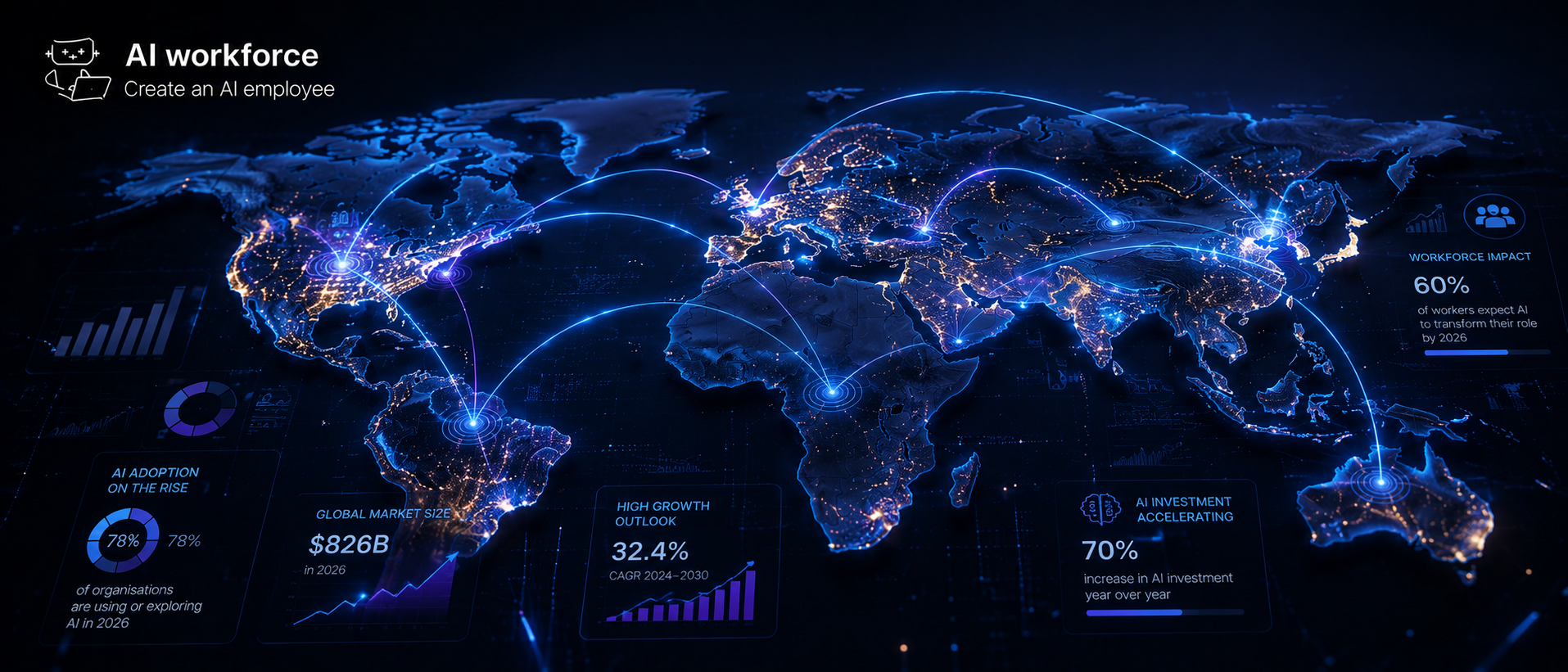
Quick answer: Global surveys show that organisational AI use became widespread during 2025, but scaled adoption remained much less common. McKinsey's 2025 global survey of 1,993 participants across 105 countries found that 88% of respondents said their organisation used AI in at least one business function, up from 78% a year earlier. However, only 23% reported scaling an agentic AI system in any function, while a further 39% were still experimenting with AI agents. The evidence suggests AI has moved well beyond isolated trials, but most organisations have not yet integrated it consistently across core workflows, and UK-specific figures remain considerably lower than these global enterprise numbers.
At a Glance
88% of respondents said their organisation regularly used AI in at least one business function (McKinsey, 2025)
23% reported scaling an agentic AI system in at least one function; 39% were experimenting
Only around one-third of respondents said their organisation had begun scaling AI across the enterprise as a whole
In the UK, ONS found AI use among businesses with 10 or more employees rose to around 35% by June 2026, up from around 12% in 2023, with 28% among businesses with fewer than 10 employees and 49% among businesses with 250 or more employees
DSIT fieldwork from early-to-mid 2025 found 16% of UK businesses (of all sizes) used at least one AI technology
Adoption is far ahead of deep integration: most adopters remain in experimentation or pilot stages
Global enterprise surveys should not be read as UK adoption rates because their samples, definitions and business-size profiles differ; 38% of McKinsey respondents worked for organisations with more than $1 billion in annual revenue
What's Covered
Artificial intelligence has moved out of the innovation lab and into the daily workflow of millions of organisations, but "adoption" covers a wide range of behaviour, from a single employee trying a chatbot once to a company that has rebuilt a core workflow around AI agents. This article separates those stages using named surveys, exact figures and clear methodology, so a reader can tell what a given adoption statistic actually measures, rather than repeating vague headline numbers out of context.
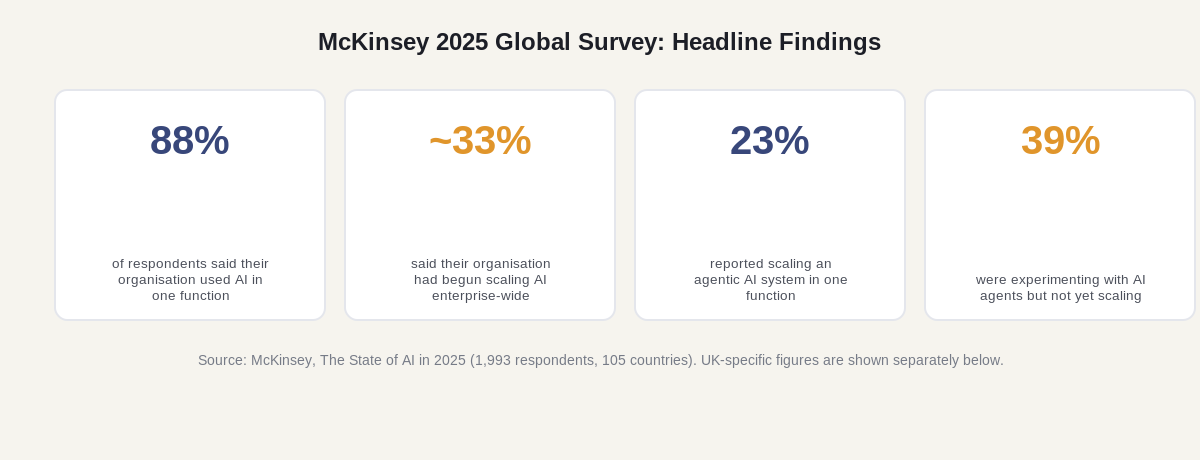
Source: McKinsey, The State of AI in 2025 (1,993 respondents, 105 countries). UK-specific figures are shown separately below.
What Do We Mean by AI Adoption?
AI adoption is not a single event. It typically progresses through five recognisable stages, and most published statistics only describe one or two of them at a time.
Stage | What it means | Evidence to look for |
|---|---|---|
Awareness | Staff know the tools exist | Training requests, internal interest |
Experimentation | Individuals use tools informally | Active user counts, common ad hoc tasks |
Pilot | One defined use case is tested | A baseline measurement and pilot results |
Integration | AI is connected to a real workflow | System access, human review steps |
Measured scale | Use expands after proving value | Cost, quality and outcome data tracked over time |
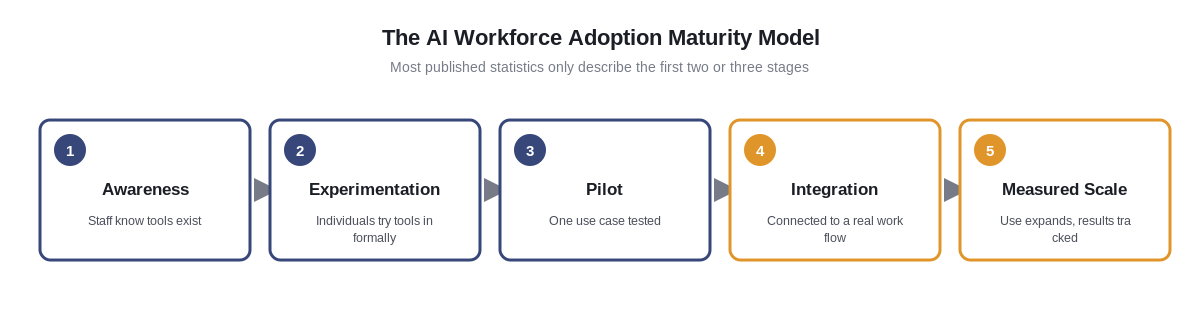
This distinction matters because most headline statistics describe organisations that have reached only the first two or three stages. McKinsey's 2025 global survey, for example, found that 88% of respondents said their organisation regularly used AI in at least one business function, yet the same survey found that only around one-third had begun scaling AI across the enterprise, and just 6% qualified as "high performers", attributing 5% or more of EBIT to AI use. A single statistic that blends these stages together can make adoption look far more mature than it is. McKinsey, The State of AI in 2025
How Many Organisations Were Using AI by 2026?
The most widely cited current figure comes from McKinsey's 2025 Global Survey on AI, fielded between 25 June and 29 July 2025 among 1,993 participants across 105 countries. It found that 88% of respondents said their organisation regularly used AI in at least one business function, up from 78% in the prior year's survey. That is a survey finding about self-reported organisational use, not a census of every business worldwide, and it should be read as such: the sample included a substantial share of large organisations, since 38% of respondents worked for organisations with more than $1 billion in annual revenue. McKinsey, The State of AI in 2025
The same survey found that roughly two-thirds of respondents said their organisation had not yet begun scaling AI across the enterprise, and that larger companies were far more likely to have reached that scaling stage than smaller ones: nearly half of respondents from companies with more than $5 billion in revenue reported scaling AI, compared with 29% of those with less than $100 million in revenue. That gap between broad exposure and deep integration is the central finding of the current evidence base, and it should anchor how any adoption statistic is interpreted. McKinsey, The State of AI in 2025
What Does Global Adoption Mean for UK Businesses?
AI Workforce is a UK company, and it is worth being explicit that the McKinsey figures above describe a global sample containing a substantial share of large organisations. UK-specific research, drawn from official statistics rather than an international enterprise panel, tells a more measured story. Our guide to UK AI statistics brings together the latest UK figures on adoption, productivity, jobs and investment with their original sources and data periods.
The Office for National Statistics reported that self-reported AI use among UK businesses with 10 or more employees rose from around 12% in late 2023 to around 35% by June 2026. Adoption varies sharply by business size within that same wave of data: 28% of businesses with fewer than 10 employees reported using at least one AI technology, compared with 49% of businesses with 250 or more employees. The ONS also found that while the share of adopters has grown substantially, the average number of AI technologies used per adopting firm moved only from around 1.4 to 1.6 over the same period, suggesting that adoption has widened faster than it has deepened. ONS, Artificial intelligence in UK businesses: 2023 to 2026
Separately, fieldwork commissioned by the Department for Science, Innovation and Technology and conducted by Technopolis UK and IFF Research between February and May 2025, based on a survey of 3,500 UK businesses and 100 in-depth interviews, found that only 16% of UK businesses currently used at least one AI technology, with a further 5% planning to adopt in the near future. That research also found sharp variation by size and sector: 36% of large businesses and 23% of medium-sized businesses reported AI use, compared with just 14% of micro businesses, and adoption was highest in information and communication (43%) and lowest in construction, retail and hospitality. DSIT, AI adoption research
These figures are not directly comparable with each other or with McKinsey's global numbers, because each survey defines "AI use" differently, samples a different population and was fielded at a different time. The practical takeaway for a UK business is that global enterprise statistics like McKinsey's 88% describe an international sample of larger organisations, not the UK economy as a whole, and that UK-specific adoption, while growing quickly, still sits well below that global enterprise figure.
What Types of AI Technologies Are Being Used?
Rather than treating "deep learning", "computer vision" and "natural language processing" as separate, mutually exclusive categories, it is more accurate to group current business AI use into overlapping functional categories:
Generative AI and large language models, used for drafting, summarising and conversational interfaces
Predictive machine learning, used for forecasting, fraud detection and recommendation systems
Natural language processing, which underpins chatbots and document analysis and often relies on the same underlying models as generative tools
Computer vision, used for quality control, retail analytics and document processing
Speech and voice AI, used in call centres and voice assistants
AI agents, which plan and execute multi-step tasks with limited supervision
Automation that combines AI with conventional rules-based systems or robotic process automation, which is not always AI on its own
McKinsey's 2025 survey found that respondents most often reported using AI to capture, process and deliver information through a conversational interface, in marketing content support such as drafting and generating ideas, and in contact-centre or customer service automation. IT, marketing and sales have consistently been the functions with the highest reported AI use across eight years of the survey, with knowledge management emerging as a newly prominent function in the latest results. McKinsey, The State of AI in 2025
Why Are So Many Organisations Adopting AI Right Now?
McKinsey's survey found that 64% of respondents said AI was enabling innovation at their organisation, and a majority reported that AI use had improved innovation more broadly, with nearly half reporting improvements in customer satisfaction and competitive differentiation. At the same time, only 39% of respondents attributed any measurable EBIT impact to AI, and most of those attributed less than 5% of EBIT to it, which is why the case for adoption is often built on qualitative and use-case-level benefits rather than confirmed enterprise-wide financial return. McKinsey, The State of AI in 2025
Cost benefits are most commonly reported in software engineering, manufacturing and IT, while revenue benefits are most commonly reported in marketing and sales, strategy and corporate finance, and product and service development. The organisations McKinsey classifies as "high performers", representing about 6% of respondents, are three times more likely than others to say their organisation intends to use AI for transformative change, and are nearly three times more likely to have fundamentally redesigned workflows around it, rather than simply layering AI onto existing processes. McKinsey, The State of AI in 2025
What Is Agentic AI and Why Does It Matter Now?
Agentic AI refers to systems built on foundation models that can plan and execute multiple steps in a workflow with limited human supervision, rather than simply responding to a single prompt. McKinsey's 2025 survey found that 23% of respondents said their organisation was scaling an agentic AI system in at least one business function, while a further 39% said they had begun experimenting with AI agents, meaning that roughly six in ten organisations surveyed had at least started exploring the technology in some form. McKinsey, The State of AI in 2025
That headline figure understates how narrow current agent deployments still are. Most organisations that report scaling agents are doing so in only one or two functions, and in any individual business function no more than 10% of respondents said their organisation was scaling agents there. Reported agent use is currently concentrated in IT and knowledge management, where use cases like service-desk automation and deep research have matured fastest, and in the technology, media and telecommunications, and healthcare sectors. McKinsey, The State of AI in 2025
That gap between broad experimentation and narrow scaling is also raising the stakes on governance, since a system that can take action rather than just generate a suggestion needs clearer human oversight than a passive assistant, and stronger models alone will not resolve that governance gap.
Wondering what agentic AI could look like inside your business?
AI Workforce helps UK businesses identify a suitable first use case, set clear guardrails and measure the results before scaling further.
What Are the Biggest Barriers to AI Adoption?
There is no single, universally agreed leading barrier to AI adoption, because different surveys ask about different populations and phrase the question differently. DSIT's 2025 UK research found that businesses most commonly cited a lack of identified business need (71%) and limited AI skills (60%) as reasons for not adopting, but when asked to rate the significance of specific barriers, businesses ranked ethical concerns highest (80%), followed by high cost (76%) and unclear regulation (72%). DSIT, AI adoption research
McKinsey's global research, focused on larger organisations already using AI, points to a different constraint: data readiness. Its 2025 Global Survey on AI found that around one-third of respondents said their organisation had begun scaling AI, but its separate analysis of AI data readiness found that more than two-thirds of high-performing companies identified their underlying data foundation, rather than the AI models themselves, as the primary obstacle to scaling further, citing incomplete data governance, inconsistent metadata and unclear data ownership as recurring blockers. Beginning to scale is not the same as achieving organisation-wide scale, and leadership commitment is a related factor: high performers are three times more likely than other organisations to say senior leaders demonstrate clear ownership of AI initiatives. McKinsey, AI data readiness: Foundation for scaling enterprise AI
Taken together, the evidence suggests that smaller and non-adopting businesses are more often held back by unclear use cases, cost and skills, while larger organisations already using AI are more often held back by data quality, governance and leadership follow-through once a pilot has proven itself. Any claim that a single factor is "the biggest barrier" should be read against the specific survey it comes from.
How Is AI Regulation Shaping Adoption Decisions?
Government policy has become a practical factor in AI procurement and adoption decisions, and DSIT's UK research found that businesses rated unclear regulation as one of the most significant barriers to adoption, behind only ethical concerns and cost. That finding cuts against any simple claim that clearer rules automatically increase confidence: regulatory uncertainty itself appears to be part of what slows some organisations down, while clearer requirements can also raise compliance costs and lengthen deployment timelines for others. DSIT, AI adoption research
Businesses that want to develop AI responsibly are increasingly building compliance and human-review steps directly into rollout plans rather than treating governance as an afterthought, particularly given that 51% of organisations already using AI report experiencing at least one negative consequence from that use, most commonly AI inaccuracy. McKinsey's research shows that organisations have broadened their risk mitigation efforts accordingly, acting to manage an average of four AI-related risks in the latest survey compared with two in 2022. McKinsey, The State of AI in 2025
Handling customer or employee data as part of your AI rollout?
See AI Workforce's guide to staying compliant with UK GDPR while deploying AI tools across your business.
How Are New Entrants Changing the Competitive Landscape?
The AI software market has become more crowded as established vendors and specialist start-ups both release new tools, which shapes how businesses evaluate and buy AI products. Pricing does not move uniformly across this market: model inference costs have fallen for many tasks as providers have introduced smaller, cheaper models, while business-software subscriptions and implementation costs vary considerably depending on vendor, functionality and deployment model. Stanford HAI, The 2026 AI Index Report: Economy
For buyers, the practical implication is to assess total implementation cost rather than assume that a more competitive market automatically makes every AI deployment cheaper.
What Does Adoption Look Like Across Different Industries?
Adoption varies sharply across industries. In McKinsey's 2025 survey, media and telecommunications and insurance respondents were as likely as technology respondents to report regular AI use, whereas a year earlier technology had led every other sector. Every industry except technology, which had already exceeded 90% reported use, saw a meaningful increase in reported AI use compared with the prior year's survey, and more than two-thirds of respondents now say their organisation uses AI in more than one business function. McKinsey, The State of AI in 2025
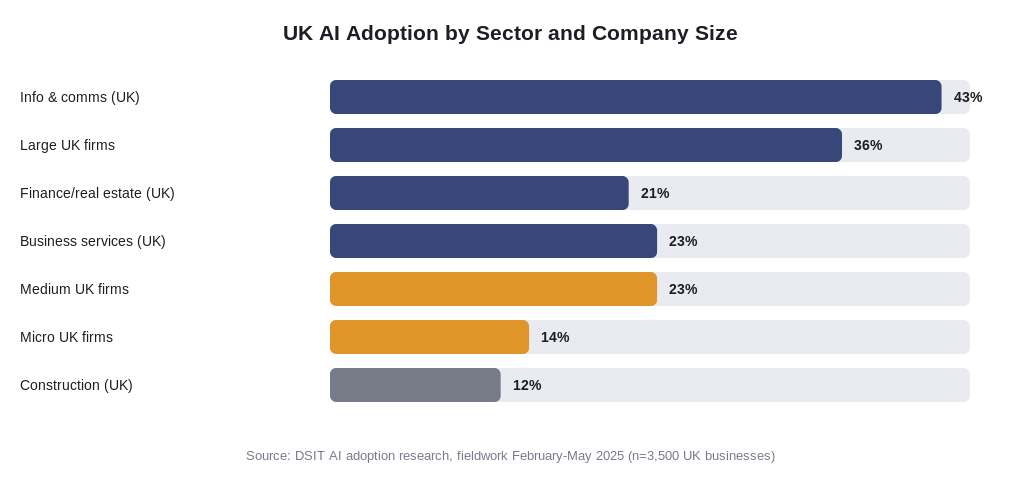
Source: DSIT, AI adoption research, fieldwork February to May 2025 (n=3,500 UK businesses)
In the UK, DSIT's research found the same pattern of uneven adoption by sector: information and communication (43%), finance and real estate (21%) and business services (23%) led adoption, while construction, retail and hospitality showed the highest rates of non-adoption, at 88%, 86% and 88%, respectively. DSIT, AI adoption research
Company size has a similar effect within every sector: DSIT found that 36% of large UK businesses used AI compared with just 14% of micro businesses, and McKinsey found that larger organisations were consistently more likely to have reached the scaling stage than smaller ones. Sector and size therefore both need to be adjusted for before comparing adoption figures between two different organisations.
What Should Businesses Do to Adopt AI Successfully?
Organisations that reach McKinsey's "high performer" category, representing around 6% of survey respondents, share a consistent set of practices rather than a single trick. They are more likely to redesign workflows around AI rather than bolting it onto existing processes, to set growth or innovation objectives alongside efficiency goals, to define clear processes for human validation of AI outputs, and to have senior leaders who visibly and consistently back AI initiatives. High performers also invest more, with more than a third committing over 20% of their digital budget to AI technologies. McKinsey, The State of AI in 2025
For most other organisations, particularly smaller UK businesses starting from a lower adoption base, the more realistic starting point is to pick one narrow, well-defined use case, establish a baseline before deploying, build in human review and basic monitoring from the outset, and measure the actual result before expanding further. That sequence maps directly onto the Awareness, Experimentation, Pilot, Integration and Measured Scale stages set out earlier in this article. These practices are more commonly reported by organisations that McKinsey classifies as AI high performers, although the survey evidence shows association rather than proving that any individual practice causes better results.
Ready to move from individual AI use to a properly managed rollout?
AI Workforce can help identify the right first use case, build in governance from day one, and measure whether AI adoption is actually delivering results for your business.
Methodology: This article draws primarily on two named survey sources: McKinsey's Global Survey on AI (fielded 25 June to 29 July 2025, 1,993 respondents across 105 countries, weighted by each respondent's country's contribution to global GDP) and DSIT's UK AI adoption research (fielded February to May 2025 by Technopolis UK and IFF Research, 3,500 UK businesses surveyed plus 100 in-depth interviews). UK adoption context also draws on the Office for National Statistics' Artificial Intelligence in UK Businesses release, published 20 July 2026. These three sources use different definitions of "AI use", different sample populations and different fieldwork dates, so their figures are presented separately rather than combined into a single number, and each is attributed to its named source throughout this article.
Key Things to Remember
McKinsey's 2025 global survey of 1,993 participants found 88% of respondents reported organisational AI use in at least one business function, up from 78% a year earlier, but only around a third had begun scaling AI enterprise-wide
23% of respondents reported their organisation was scaling an agentic AI system in at least one function; a further 39% were experimenting with agents, though deployment remains narrow within any single function
UK-specific figures are considerably lower than global enterprise data: ONS found around 35% of businesses with 10+ employees reporting AI use by mid-2026 (28% among businesses with fewer than 10 employees, 49% among those with 250 or more), while DSIT's 2025 fieldwork found 16% of all UK businesses using at least one AI technology
Adoption barriers differ by survey: DSIT found ethical concerns, cost and unclear regulation rated most significant in the UK, while McKinsey's research points to data readiness and leadership follow-through as the main constraints on larger organisations already using AI
Sector and company size both strongly affect adoption: larger firms and sectors like information and communication or technology consistently lead, while construction, retail and hospitality lag
Regulatory uncertainty is a significant barrier for some organisations, while clearer requirements can still increase compliance costs and implementation timelines; regulation should not be assumed to have one uniform effect on adoption
Businesses that succeed with AI typically redesign workflows around it, set growth or innovation goals alongside efficiency, build in human review, and measure results at each stage before scaling further
Sources and Further Reading
McKinsey & Company, "The state of AI in 2025: Agents, innovation, and transformation," November 2025
McKinsey & Company, "AI data readiness: Foundation for scaling enterprise AI"
Department for Science, Innovation and Technology, AI adoption research
About the author: Clara Miller is a Content Specialist at AI Workforce, a UK AI company. She researches AI adoption, implementation and business-use evidence for UK decision-makers.
Reviewed by Luca Controlo, AI Adoption and Marketing Automation Lead at AI Workforce, for the interpretation of adoption evidence, implementation stages and practical relevance to UK businesses.
Frequently Asked Questions
Everything you need to know about this topic
Output per hour of work is the standard measure economists use, and it sits at the centre of every debate about what AI means for output. When people talk about AI and productivity, they usually mean one of several different things, and mixing them up is one of the most common mistakes in AI coverage: the speed or quality of a single task, the time an individual worker saves across a working week, the output of a team or workflow, the productivity of an entire firm, or the productivity of the whole economy. Evidence at one level cannot automatically be treated as proof at the next, which is the central idea behind the AI Workforce Productivity Evidence Ladder below. LevelMeasureUK evidence Task efficiencySpeed and quality on one taskLimited controlled UK evidence Worker timeSavings across a working weekMostly international evidence Team performanceCases or tasks completedBusiness-specific measurement Firm productivityOutput relative to inputsDSIT self-reported evidence Economy-wide productivityUK output per hourNot yet clearly attributable to AI As the table shows, UK data is strongest on adoption and self-reported business impact, and weakest on precisely measured task-level and economy-wide effects. That gap shapes how the rest of this article uses evidence: UK sources lead, and international research fills in where UK measurement is not yet available.
The most current official picture comes from the Office for National Statistics. In May and June 2026, 55% of employed and self-employed respondents reported using AI for work or education. In June 2026, 35% of UK businesses with at least 10 employees reported using at least one AI technology. The two figures are not directly equivalent. The individual measure includes self-reported use for work or education and may capture informal use that has not been approved or recorded by an employer. The business measure asks whether the organisation reports using particular AI technologies. Even so, the difference points to an important pattern: AI can spread through individual experimentation before it becomes part of a documented business workflow. Other UK surveys produce different adoption rates because they use different definitions and samples, and these should be read as separate views of adoption rather than as a single continuous trend: ONS: 35% of businesses with at least 10 employees (June 2026) DSIT AI Adoption Research: 16% of UK businesses during February to May 2025 fieldwork DSIT departmental measure: 25% of UK businesses in January 2026 UK Business Data Survey: 41% of businesses handling digitised data These differences are valuable evidence about measurement, not a problem to hide. A business comparing itself to "UK AI adoption" should first check which of these definitions the figure it is reading actually describes.
The UK evidence points to perceived productivity improvements, but much weaker evidence of confirmed financial impact. DSIT research involving 3,500 businesses found that 56% of businesses already using AI reported an increase in employee productivity. Most estimated an improvement of no more than 20%. Those results are encouraging, but they are self-reported rather than independently measured. The same research found that 77% of adopters had not yet experienced a change in revenue, while 12% reported an increase. This suggests that making individual tasks faster does not automatically improve the commercial performance of the organisation. Integration appears to be part of the explanation. The UK Business Data Survey 2026 found that only 21% of businesses using AI had integrated it into existing systems such as Microsoft 365, CRM platforms, finance software or workflow tools. Integration was more common among large businesses than among sole traders and smaller firms. Taken together, the findings describe a progression: Employees gain access to an AI tool. Individuals use it for research, drafting or summarising. The business connects it to a defined process. The organisation measures output, quality, cost or revenue. Only then can it determine whether AI has produced a genuine productivity return. This is why reported time savings should be treated as evidence of potential value rather than proof of organisation-wide productivity. A structured AI Readiness Assessment is designed to establish exactly where a business sits on that progression before it invests further.
ONS research found that 55% of employed and self-employed respondents reported using AI for work or education, while 35% of businesses with at least 10 employees reported using an AI technology. A separate UK Business Data Survey found that, among AI-using businesses in its sample of organisations handling digitised data, 21% had integrated AI into existing business systems. These figures come from different samples and cannot be treated as a single adoption funnel, but together they suggest that individual access is more widespread than formal process integration. International worker research points in a similar direction without offering a directly comparable figure. A nationally representative US survey, finalised by Alexander Bick, Adam Blandin and David Deming and published in Management Science in January 2026, found that 27% of employed respondents had used generative AI for work at least once during the previous week. That US research also found substantial informal worker adoption, but it should not be directly compared with US business-adoption percentages, because the worker and business surveys measure different technologies, time periods and forms of use. For a UK business, closing the gap between individual use and integration is largely an implementation question rather than an access question, which is why AI Workforce's AI Agent Cost guide focuses on what integration actually involves once a workflow has been identified.
Adoption varies substantially by sector. Almost three-fifths of businesses in information and communications reported using AI, while uptake remained lower in sectors built around physical, in-person or location-dependent work. This broadly matches international evidence showing that writing, analysis, software and information-intensive work currently has greater exposure to generative AI than many manual and personal-service occupations. Professional and knowledge-based sectors, including the kind of work covered in AI Workforce's guide to AI tools for consultants, tend to sit toward the faster-adopting end of this range, while customer-facing operational functions such as contact centres, covered in AI Workforce's AI Call Centre research, show a more mixed picture: individual time savings appear quickly, but full integration into call handling and case management takes longer.
UK surveys currently provide better evidence on adoption and perceived business impact than on precisely measured time savings, so this section draws on international research to estimate what may happen within particular tasks, without presenting these figures as measurements of UK productivity. A widely cited MIT experiment, "Experimental Evidence on the Productivity Effects of Generative Artificial Intelligence" by Shakked Noy and Whitney Zhang, published in Science in 2023, assigned realistic writing tasks to 453 college-educated professionals and randomly gave half of them access to ChatGPT. Workers using the tool completed tasks 40% faster, and output quality scores rose 18%. At the level of a full working week rather than a single task, the finalised US survey by Bick, Blandin and Deming found that people who had used generative AI in the previous week reported saving an average of 5.4% of their working hours, roughly 2.2 hours for someone working 40 hours. Across the entire US workforce, including non-users, reported savings equalled 1.4% of total working hours. That figure indicates potential productivity value; it is not evidence that measured, economy-wide output has already increased by 1.4%, in the UK or the US, since self-reported time saved on a task can turn into extra output, better-quality work, or simply more leisure, and only some of those outcomes show up in official productivity statistics.
The occupational breakdown in the underlying US research covers everyone in an occupation, both users and non-users, not just the people actively using the technology. Across everyone working in computer and mathematical occupations, generative AI assisted approximately 9% to 12% of working hours and was associated with reported savings of roughly 2.1% to 2.5% of total working time, among the highest of any occupation studied. In personal-service occupations, AI assisted approximately 1.3% of hours, with reported savings of around 0.4%, the lowest of any group measured. Separately, the Penn Wharton Budget Model estimates that approximately 40% of current US GDP could be substantially affected by generative AI, with that exposure concentrated in particular tasks and occupations rather than spread evenly across the economy. That is a GDP-exposure estimate, not a measure of labour income, and it should not be read as saying 40% of workers' pay is at risk, in the UK or elsewhere.
The ONS found that most UK businesses using AI reported no change in workforce headcount. Among businesses using AI to improve operations, approximately 6% reported a reduction in headcount. This suggests that current adoption is more commonly associated with process change than wholesale workforce reduction, although the figures do not establish what will happen as systems become more capable, and the ONS result is self-reported and does not establish that AI caused the reductions that were reported. This fits alongside a June 2026 review by the International Labour Organization, which concluded that large-scale job displacement from generative AI has remained limited globally so far, while flagging emerging risks around entry-level opportunities, job quality and inequality. Together, the UK and multinational evidence supports a cautious reading, not a guarantee that broader displacement will not emerge as adoption deepens.
The gap between encouraging self-reported UK results, 56% of adopters reporting higher productivity, and modest official productivity statistics is not unique to Britain, and economists have a name for the general pattern: the productivity J-curve. Research by Erik Brynjolfsson, Daniel Rock and Chad Syverson describes how firms adopting general-purpose technologies, including AI, often see flat or even declining measured productivity in the early years, because the real investment goes into unmeasured intangible capital such as retraining staff, redesigning workflows and building new processes, well before the payoff shows up in official figures. Adjusting for these intangible investments in earlier waves of computer hardware and software pushed measured productivity meaningfully higher than the official numbers first suggested, and current evidence indicates a similar pattern may be developing with AI. The UK's own integration figures are consistent with this pattern: among AI-using businesses in the UK Business Data Survey sample, only 21% reported that their tools were integrated into existing systems, suggesting much of the investment described by the J-curve, workflow redesign and staff training, is still under way. That mismatch may reflect measurement and implementation lags, but it could also mean that some individual efficiencies do not translate into additional firm-level output. The current evidence is not yet sufficient to determine how much each explanation contributes.
Long-run forecasts are frequently compared as though they measure the same thing, when in fact they differ by geography, by whether they describe a level or an annual growth rate, and by whether they represent a central estimate or a specific scenario. The table below separates what is currently verifiable. SourceGeographyMeasurePeriodEstimateEvidence type Penn Wharton Budget ModelUnited StatesGDP and productivity levelBy 2035 / 2055 / 2075+1.5% / +3% / +3.7%Model Penn Wharton Budget ModelUnited StatesAnnual productivity growth contributionPeaks 2032+0.2 percentage pointsModel International Monetary FundGlobalAnnual GDP growth2025 to 2030Up to +0.5 points, stated scenarioScenario Penn Wharton's task-based framework, built on the work of MIT economist Daron Acemoglu, estimates that AI-related productivity and GDP could be 1.5% higher by 2035, nearly 3% higher by 2055 and 3.7% higher by 2075, with the annual growth contribution peaking at around 0.2 percentage points in 2032 before fading toward a smaller permanent effect. The IMF figure often cited alongside it comes from a specific 2025 scenario analysis of AI-related electricity demand and associated productivity effects, not a general IMF consensus forecast, and it describes global rather than UK or US growth. No comparably precise UK-specific long-run forecast is available yet; UK businesses should treat these figures as international context rather than a UK projection. Other institutions, including Goldman Sachs, the Dallas Fed and McKinsey, have published their own AI growth estimates, but their exact geography, measure, time period and central-versus-scenario status need to be confirmed against each firm's primary report before they can be compared meaningfully alongside the Penn Wharton and IMF figures above. Until that verification is complete, this article limits itself to the two forecasts it can attribute precisely.
Given the difference between widespread individual use and the relatively limited system integration reported in separate business research, the most useful step for most businesses is not adopting more AI, but measuring what is already happening: Begin with a defined workflow, not a general AI licence. Establish a baseline before implementation. Measure time, quality, rework, customer outcome and cost. Identify informal or shadow AI use already happening among staff. Define clear human-review boundaries for AI-assisted work. Assess UK GDPR, data protection and automated-decision implications; see AI Workforce's guide to AI and GDPR compliance. Consult affected employees and provide role-specific training. Avoid treating US or other international adoption and productivity results as UK benchmarks. Regulated sectors need an additional layer of care. Financial services, healthcare and advice-based businesses will typically require stronger governance and human oversight than low-risk internal drafting tasks, and should scope any rollout carefully rather than allow unmanaged tool use. Marketing teams weighing up the same questions may also find AI Workforce's AI marketing agency guide useful for sector-specific adoption patterns, and smaller organisations can find a lighter-weight starting point in the AI agents for small businesses guide.