
AI in Logistics: Uses, Benefits, Risks and a UK Guide
Posted On: August 2, 2026
Written by Clara Miller, Content Marketing Specialist at AI Workforce · Reviewed by Seth Ayush, Co-Founder of AI Workforce
Last updated: August 2026
AI in logistics is the use of machine learning, predictive analytics, generative AI, and AI agents to plan, monitor and improve the movement of goods. Logistics companies use it to forecast demand, optimise routes and loads, predict delivery times, monitor fleets and warehouses, identify delays, automate administration and keep customers informed. Important safety, workforce, contractual and commercial decisions still require human judgement.
Quick Answer: AI in logistics means software that learns from shipment, route, fleet and inventory data to forecast demand, plan routes and loads, predict delivery times, flag disruption early and speed up warehouse, freight and administrative decisions. It is not the same as robotics, which performs a physical task, or traditional rule-based automation, which follows a fixed script rather than learning from data. Decisions with real financial, safety or customer consequences should stay with a person, supported by AI rather than replaced by it.
At a Glance
What it is: software that learns from shipment, route, fleet, inventory and demand data to forecast, plan and flag exceptions faster than a manual process
Where it helps most: demand forecasting, route and load optimisation, warehouse slotting, fleet and driver-performance monitoring, shipment tracking, inventory planning, document automation and freight matching. AI can automate the collection and flagging of fleet or driver-performance indicators; it should not automatically impose disciplinary, employment or safety-critical decisions from those indicators
Where it should not decide alone: safety-critical routing changes, driver discipline decisions, contract and rate commitments, consequential employment decisions, and anything with a material customer or compliance consequence
Biggest risk: treating an AI-generated forecast, route or flag as a finished decision rather than an input a person still has to check
What matters most in year one: one well-measured pilot, a clear view of what AI does and does not decide, and a defined approach to driver, employee and customer data
What Is AI in Logistics and How Does It Work?
AI in logistics generally means one of two things: a system that makes a routine decision automatically within defined limits, or a system that gives a person better information to make a decision faster. Machine learning sits behind most of it, trained on years of shipment, route and inventory history to spot a pattern a person would take far longer to notice.
How is AI used in logistics? AI is used in logistics to forecast demand, plan and adjust delivery routes and loads, flag likely delays before they happen, optimise warehouse layout and picking, monitor fleets and drivers, track shipments, plan inventory, process routine documents, match freight to carriers, support recruitment and workforce planning, and draft routine shipment and customer communications. It works alongside existing systems rather than replacing them, and a person still checks anything with a high cost, safety or customer impact.
The short version of how this works end to end:
Transport, warehouse and customer data enter approved systems
→ AI analyses patterns
→ risks or opportunities are flagged
→ alerts or workflows trigger
→ people review important decisions
→ outcomes are recorded
Extractable summary. See the AI Workforce Logistics AI Model below for the detailed, staged version.
AI models built for logistics increasingly specialise by function: one tuned for demand forecasting, another for vehicle routing, another for warehouse slotting. Picking the right one for the specific problem matters more than picking whichever product has the most impressive demo, since a forecasting model and a routing model are solving genuinely different problems even when a vendor markets them under the same "AI platform" label.
AI vs Optimisation Software vs Robotics vs Traditional Automation
These four terms get used interchangeably in logistics marketing, and that loose grouping is one of the more common sources of confusion when a business is deciding what to actually buy.
Traditional automation follows a fixed, rule-based script: if a field matches this value, do that action. It does not learn from data and does not adapt when conditions change, but it is reliable, cheap and easy to audit for genuinely repetitive tasks such as sending a standard status email when a shipment reaches a checkpoint.
Optimisation software uses mathematical methods, often from operations research, to solve a well-defined problem such as vehicle routing or load building against a set of constraints. Much of the routing and network-planning software used in logistics today is optimisation software rather than AI in the strict sense, though many products now combine the two, using machine learning to predict inputs such as travel time or demand, then feeding those predictions into an optimisation engine that produces the actual plan.
AI, in the narrower sense used in this guide, refers to systems that learn patterns from data, including machine learning models used for forecasting, anomaly detection and increasingly generative AI used for drafting shipment updates or summarising documents. AI is often used inside an optimisation workflow rather than instead of it.
Robotics performs a physical task, moving a pallet, picking an item, sorting a parcel. Warehouse robotics increasingly uses AI for navigation and object recognition, but the robot itself is the physical automation layer, not the decision-making layer. A warehouse can use AI-driven demand forecasting with entirely manual picking, or use robotic picking guided by fairly simple rule-based logic. The two capabilities are related but genuinely separate purchasing decisions.
Understanding which of these four categories a specific tool actually falls into is one of the more useful questions to ask a vendor before buying anything, since "AI-powered" is applied loosely across all four in most sales material.
The AI Workforce Logistics AI Model
Most logistics workflows that use AI well, even without naming it explicitly, follow a similar underlying pattern. We call this the AI Workforce Logistics AI Model, and it is a useful way to check whether a given task, or a given tool, is actually being used safely.
AI Workforce developed the Logistics AI Model as a practical framework for deciding where AI can speed up logistics operations without removing human accountability for the outcome.
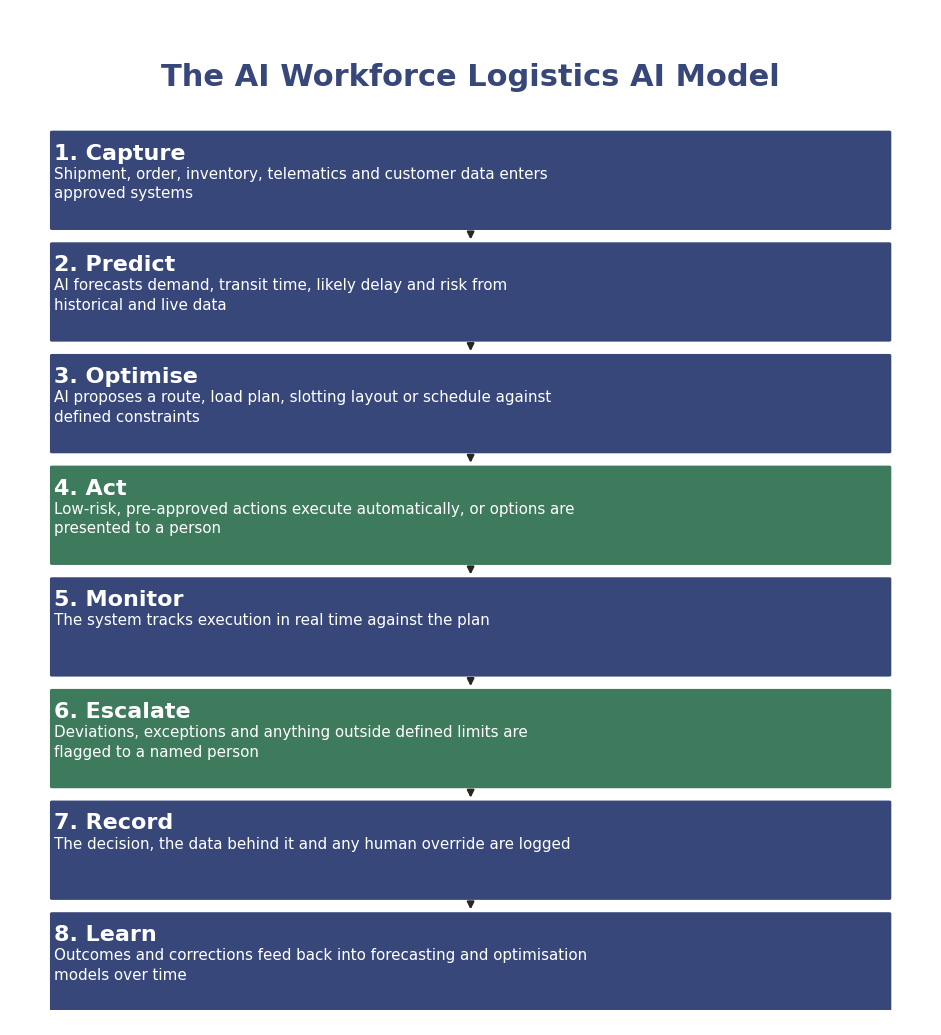
The AI Workforce Logistics AI Model is an AI Workforce framework, not an industry standard.
Capture: shipment, order, inventory, telematics and customer data enter approved systems
Predict: AI forecasts demand, transit time, likely delays, and risk from historical and live data
Optimise: AI proposes a route, load plan, slotting layout or schedule against defined constraints
Act: the system executes low-risk, pre-approved actions automatically, or presents options for a person to choose
Monitor: the system tracks execution in real time against the plan
Escalate: deviations, exceptions and anything outside defined limits are flagged to a named person
Record: the decision, the data behind it and any human override are logged
Learn: outcomes and corrections feed back into the forecasting and optimisation models over time
AI can accelerate Capture, Predict, Optimise and Monitor heavily. Act can be automated for low-risk, pre-approved cases and should stay human-led for anything consequential. A workflow that skips straight from Optimise to Act on a high-stakes decision, with no genuine Escalate step, is the one that turns an AI-generated plan into an unchecked commitment.
What Can AI Actually Automate in Logistics?
It helps to separate this by task type rather than treating "AI in logistics" as one single capability.
What logistics tasks can AI automate? AI can automate demand forecasting, first-pass route and load planning, warehouse slotting and pick-path suggestions, shipment status updates and ETA prediction, fleet and driver-performance monitoring, inventory reorder recommendations, document extraction and reconciliation, freight rate and carrier comparison, and drafting of routine customer and driver communications. It is not well suited to safety-critical decisions, contract commitments, or situations that fall genuinely outside its training data, which still need a person's judgement.
Producing a demand forecast from historical order, seasonal and promotional data
Proposing delivery routes and loads, and adjusting them in response to traffic, weather or a last-minute order change
Flagging a shipment likely to arrive late, before the delay is visible to the customer
Suggesting warehouse slotting and pick paths based on order frequency and item association
Monitoring fleet and driver performance indicators such as fuel use, idling and maintenance signals
Recommending inventory reorders and safety-stock levels from demand and lead-time data
Extracting and reconciling routine documents such as proof of delivery and delivery notes
Comparing carrier rates, capacity and reliability for a given lane or shipment
Drafting a shipment update, delay explanation or routine customer message for review
Reconciling data between systems that used to require someone manually checking each one
None of this requires AI to exercise the judgement a business is actually paying a logistics team for. It requires AI to handle the mechanical forecasting, comparison and drafting work well, and a person to make the calls that carry real consequences.
The AI Workforce Logistics AI Boundary Matrix
Not every logistics task carries the same risk, and treating them all the same is where AI adoption in logistics tends to go wrong. This is how we group logistics tasks by how much AI autonomy is appropriate.
AI Workforce developed the Logistics AI Boundary Matrix as a methodology for deciding which parts of a logistics operation are safe to automate and which require mandatory human judgement.
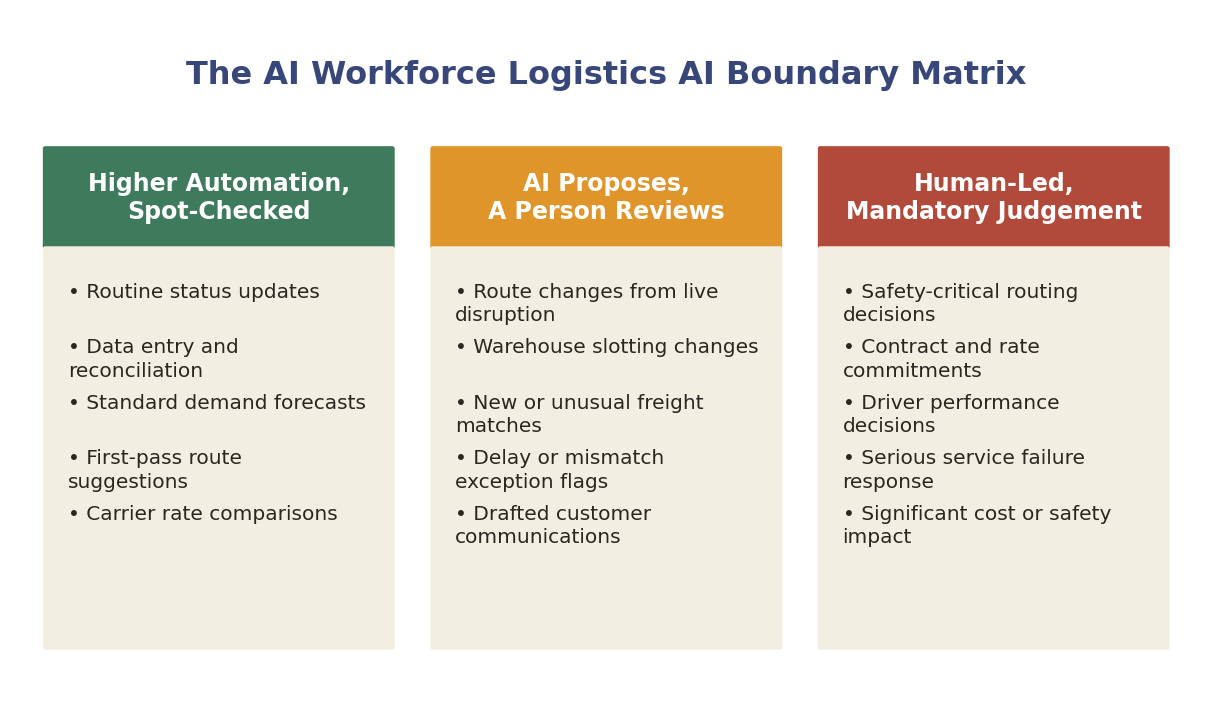
The AI Workforce Logistics AI Boundary Matrix is an AI Workforce framework, not an industry standard.
Higher Automation, Spot-Checked
Routine status updates and tracking notifications
Data entry and record reconciliation between systems
Standard demand forecasts for stable product lines
First-pass route suggestions for routine, low-complexity deliveries
Carrier rate comparisons for standard lanes
AI Proposes, A Person Reviews
Route and load changes in response to a live disruption
Warehouse slotting and layout changes
New or unusual freight and carrier matches
Exception flags for a likely delay or inventory mismatch
Drafted customer communications for anything beyond a routine update
Human-Led, Mandatory Judgement
Safety-critical routing or driver-hours decisions
Contract and rate commitments with a carrier or customer
Driver performance and disciplinary decisions
Consequential recruitment and employment decisions
Responses to a serious service failure or safety incident
Anything creating a significant cost, safety or compliance consequence
A task sitting in the top tier today is not necessarily permanent, and a task in the bottom tier is not automatically off-limits forever. The point of the matrix is to make the current boundary explicit, so moving a task up a tier is a deliberate decision based on evidence rather than something that happens because a tool technically could do it.
AI for Load Planning
Load planning sits alongside routing as one of the more mechanical, constraint-heavy problems in logistics, and it is well suited to a combination of AI prediction and optimisation.
AI and optimisation together can support:
Vehicle-capacity utilisation
Weight and volume constraints
Delivery order
Time windows
Product compatibility
Temperature requirements
Reducing partially empty journeys
Replanning after cancellations or late orders
Legal weight limits, dangerous-goods requirements and other safety constraints must be treated as hard rules the system cannot override, not as one factor among many to be optimised against. A load plan that is efficient but breaches a weight limit or a hazardous-materials separation rule is not a usable plan, whatever the optimisation score suggests.
AI for Demand Forecasting
Demand forecasting is one of the clearest early wins in logistics AI, because the underlying problem, predicting future order volumes from historical and contextual data, is exactly what machine learning is built for. A forecasting model trained on genuine order history, seasonality and promotional calendars can flag a likely demand spike or dip earlier than a manually updated spreadsheet, which can give a warehouse manager more lead time to plan capacity, depending on how far ahead the model can reliably forecast for that product line.
This works best with clean, consistent historical data behind it. A forecast is only as reliable as the data feeding it, and a new product line or a genuinely unprecedented event, a new competitor, a regulatory change, a supply shock, will always need a person's judgement layered on top of whatever the model predicts.
AI for Route Optimisation
How does AI improve route optimisation? AI improves route optimisation by predicting variables such as traffic, transit time and delay risk, then feeding those predictions into a routing or optimisation engine that plans and adjusts delivery routes in real time. This lets a dispatcher absorb a last-minute order change, a road closure or a weather event without manually replanning the whole route by hand.
Route optimisation increasingly combines AI-driven prediction with operations-research-based optimisation: the AI component forecasts what conditions will look like, and the optimisation component solves for the best route given those conditions and any constraints, vehicle capacity, delivery windows, and driver hours. Fuel consumption and mileage may fall when the proposed routes are feasible, adopted and measured against a reliable baseline, and a disruption to a planned route can often be absorbed more smoothly when the system proposes a revised route automatically rather than a dispatcher redoing the plan from scratch under time pressure.
AI for Fleet and Driver Performance
Beyond routing a single journey, AI is increasingly used to monitor how a fleet is performing over time, surfacing patterns a person reviewing individual trip reports would be slow to spot.
Vehicle utilisation across the fleet
Fuel-consumption patterns by vehicle, route or driver
Maintenance indicators and early fault signals
Idling time and route deviation from the planned journey
Driver-hours constraints and compliance tracking
Breakdown patterns and maintenance scheduling
Comparing planned versus actual journeys to explain variance
Telematics and performance scores should inform a conversation, not substitute for one. A driver's score should not be treated as an automatic basis for disciplinary action; it is an input a manager reviews alongside context the data cannot see, such as road conditions, a genuine emergency, or a fault with the vehicle itself. Our UK GDPR section below covers the legal framework for driver monitoring in more depth.
AI for Warehouse Operations
How is AI used in warehouses? AI is used in warehouses mainly for demand-driven slotting, pick-path optimisation, and predicting which items are likely to be picked together or need restocking soon. It is often paired with, but is a separate technology from, warehouse robotics, which handles the physical movement of goods and increasingly uses AI for navigation and object recognition rather than for the strategic slotting decision itself.
Warehouse visibility can improve considerably once a system can see inventory levels, incoming shipments, and warehouse capacity together rather than through separate reports, and better visibility can help reduce stockouts and unnecessary inventory by giving planners a clearer view of incoming demand, stock levels and capacity. Slotting and pick-path software built around this kind of data increasingly makes these recommendations automatically, though the underlying layout decision, especially any change involving significant capital cost or safety consideration, should still be reviewed by a person rather than accepted automatically.
AI for Shipment Tracking and ETA Prediction
Shipment tracking and predictive ETAs run through most of the sections above, but the question comes up often enough on its own to deserve a direct answer.
How does AI improve ETA prediction? AI can improve ETA prediction by combining planned routes with live location, traffic, weather, stop duration and historical journey data. The resulting ETA remains an estimate and should include confidence or exception information rather than being presented as certain. A predicted arrival window that quietly narrows as more live data arrives is more useful to a customer, and more honest, than a single fixed time presented from the moment of dispatch.
AI for Shipment and Customer Communications
Generative AI is increasingly used to draft a shipment summary, a delay explanation, or a routine customer update in plain language rather than a coded status alert. This does not remove a person from the loop; it changes what they spend their time on, since a drafted update still benefits from a quick review before it reaches a customer, particularly if the update explains a delay or a service issue rather than confirming a routine delivery.
Where a logistics operation runs a customer service or support function alongside deliveries, the same principles that apply to an AI call centre apply here: automate the repetitive, high-volume first-line queries, and route anything genuinely unusual or a customer complaint to a person. Where phone enquiries about a delayed delivery are a significant volume, our guide to AI voice agents covers how a voice-based system can handle a routine status call while escalating anything unusual.
AI for Freight and Carrier Management
A logistics business managing multiple carrier contracts benefits from a system that can compare rates, capacity and reliability automatically rather than requiring someone to check each option by hand. Automated comparison can shorten the time required to evaluate suitable carriers or lanes, but the improvement should be measured against the organisation's existing process rather than assumed. Every shipment moving through a network generates data that can improve the next comparison, provided the underlying data quality is good enough to trust.
This is also where the AI vs optimisation software distinction matters most in practice: a rate and capacity comparison across dozens of carriers is often solved well by a defined optimisation model, with AI used specifically to predict variables such as likely transit time or delay risk for a given carrier and lane, rather than one single "AI" doing everything end to end.
AI for Inventory Planning
Demand forecasting and warehouse slotting are inputs to inventory planning, but they are not the same thing. Inventory planning is the ongoing decision of how much stock to hold, where, and when to reorder it.
Reorder recommendations based on current stock and expected demand
Safety-stock levels calculated against demand variability
Expected lead times from supplier and route data
Stockout risk for a given product and location
Excess-stock risk, flagging inventory unlikely to sell within a normal cycle
Supplier variability and its effect on reliable lead times
Demand uncertainty, particularly for new or seasonal lines
AI can recommend a reorder quantity or flag a stockout risk well ahead of time, but a material purchasing commitment, particularly one involving a large capital outlay or a new supplier, should have human approval before it is placed.
AI for Document and Administrative Automation
Logistics generates a high volume of routine paperwork, and this is one of the more practical, lower-risk places to apply AI early.
Proof-of-delivery processing
Delivery-note extraction
Invoice and charge reconciliation
Customs-document preparation
Order entry
Exception summaries
Claims-document assembly
Updating transport, warehouse and CRM records
Document extraction is not equally reliable across every document type or quality of scan, and a workflow should include a review step for anything unusual, low-confidence or high-value, rather than assuming every document can be processed without a person checking it. Our guide to AI document automation covers this in more depth.
AI for Logistics Recruitment and Workforce Planning
Recruitment and workforce planning are a genuine, practical use case for AI in a logistics operation, separate from the driver-monitoring topic covered later in this guide.
Forecasting staffing requirements from expected shipment or order volume
Shift and capacity planning
Screening applications against defined, job-related requirements
Scheduling interviews
Drafting candidate communications
Identifying skills or coverage gaps across a workforce
A few boundaries matter here specifically. AI should not make consequential employment decisions, such as a final hiring or dismissal decision, without appropriate human review. Historic recruitment data may reproduce past bias if used to train or guide a screening tool, so any automated screening needs regular checking against that risk. Worker monitoring and recruitment should not be conflated: performance data collected for one purpose should not quietly become an input into hiring or promotion decisions without a clear, disclosed basis for doing so. Hiring criteria applied by or alongside an AI tool must be job-related and reviewable by a person, not a black-box score. Where this work is supported by a wider AI-driven operations layer, our guide to what a digital workforce is covers how AI agents fit alongside human staff more broadly.
AI Agents in Logistics
An AI agent differs from a single-purpose forecasting or routing model in that it can carry out a bounded sequence of actions across more than one system, within permissions a person has defined in advance.
In a logistics context, an AI agent can:
Monitor operational workflows across connected systems
Summarise exceptions for a person to review
Create follow-up tasks when something needs attention
Draft repetitive customer updates for review
Gather information from connected systems, such as a TMS, WMS or CRM
Escalate delays or unusual conditions to a named person
Record its own actions and any human override
An agent should not be given autonomy to make a safety-critical route, workforce or contractual decision on its own. Its role is to do the mechanical gathering, summarising and drafting work reliably, and to escalate anything that needs a person, in line with the Boundary Matrix above.
Worked Example: Order to Delivery
To make the model above concrete, here is what a well-run order looks like from placement to delivery, following each stage of the AI Workforce Logistics AI Model.
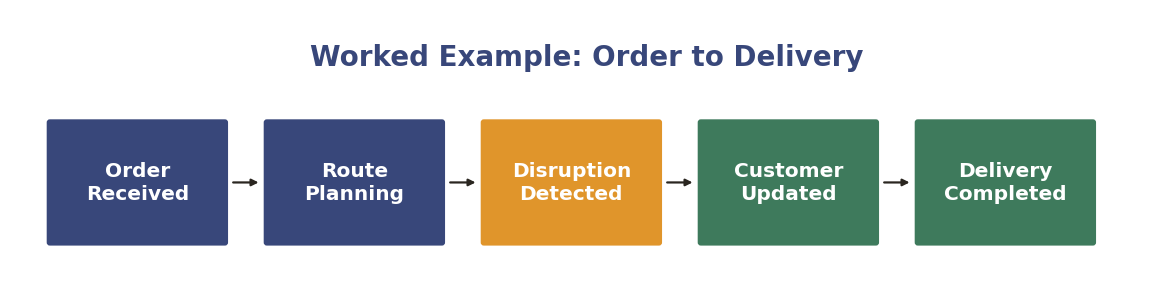
Illustrative timeline. A production workflow also needs a defined record of what was predicted, decided and overridden, not just the steps shown here.
Order received: the order enters the system and is matched against current inventory and warehouse capacity
Route planning: AI proposes a delivery route and estimated arrival window based on live traffic and historical transit data
Disruption detected: a road closure is flagged mid-route, and the system proposes an alternative route and revised arrival time
Customer updated: a drafted update explaining the revised arrival window is reviewed and sent
Delivery completed: the outcome, original plan, disruption, and revised plan are logged, and the data feeds back into future forecasting
AI prepared the route, flagged the disruption and drafted the update. It did not decide to accept the order, and a person remained available to step in if the revised route had raised a safety or service concern.
Can AI Make Logistics Decisions Automatically?
This is one of the most common questions logistics businesses ask before adopting AI, and it deserves a direct answer.
Can AI make logistics decisions automatically? Yes, for narrow, low-risk, pre-approved decisions, such as sending a routine status update, selecting between two pre-approved routes of similar cost and time, or reordering standard stock at a defined threshold. AI should not make decisions automatically where the outcome carries a significant safety, cost, contractual or customer consequence. Those decisions should be proposed by AI and confirmed by a person, in line with the Boundary Matrix above.
The practical test is not whether AI is technically capable of making a given decision; most routing and forecasting decisions are within its technical reach, but whether the consequence of an error is one your business is willing to accept without a person having checked it first. A wrong routine reorder is usually a minor inconvenience. A wrong safety-critical routing decision is not.
What Are the Risks of AI in Logistics?
What are the risks of AI in logistics? The main risks are treating an AI-generated forecast or route as a finished decision, deploying a model trained on data that does not reflect current conditions, losing visibility into why an automated system made a specific choice, over-relying on driver monitoring data collected without proper transparency, and rolling out automation across an entire operation before proving it on one narrow, well-measured pilot.
A model trained on historical data can be confidently wrong when conditions genuinely change- a new competitor, a regulatory shift, a disrupted supply route- and it will not necessarily flag its own uncertainty clearly unless the system has been built to do so. This is why the Escalate and Record stages of the model above matter as much as the Predict and Optimise stages: a system that cannot explain why it proposed a specific route or forecast is much harder to trust when something goes wrong.
Will AI replace logistics workers? The evidence does not support that as a blanket claim. AI is most effective at the repetitive, data-heavy parts of logistics work- forecasting, routing, status updates, freight comparison, document processing- while judgement on safety, customer relationships, exceptions and anything genuinely ambiguous still needs a person. Roles are shifting toward managing and checking AI-assisted workflows rather than disappearing outright, though the shape of specific jobs, particularly heavily administrative ones, is changing as automation absorbs more of the routine work.
UK GDPR, Driver Data and Employee Monitoring
Logistics operations handle some of the most sensitive employee and customer data in any sector: driver location, driving behaviour, vehicle telematics, delivery addresses and customer contact details. Where AI processes that personal data, UK GDPR applies in the same way it applies to any other processing. This section is general information rather than legal advice.
Vehicle telematics and driver monitoring. The ICO's guidance on monitoring workers confirms that telematics data, sometimes called "black box" data, which records a driver's activity, is personal information and is subject to data protection law. Where tachograph processing is required to meet statutory drivers' hours obligations, legal obligation may be an appropriate lawful basis, but monitoring driver behaviour and driving style more broadly is harder to justify and carries higher risk to a worker's privacy. Employers must inform workers and passengers of any vehicle monitoring, and if a vehicle can be used privately, monitoring during that private use is rarely justifiable.
AI-driven inference from driver data. Where a monitoring tool uses analytics to make inferences, predictions or decisions about drivers, the ICO says a Data Protection Impact Assessment must be carried out because the processing presents a high risk. This applies whether the inference is about driving style, fatigue risk, or route efficiency.
Dashcams. Dashcams and similar in-vehicle cameras are useful for safety and insurance purposes, but audio recording capability should be switched off by default and only triggered in exceptional circumstances, given the additional intrusiveness of continuous audio monitoring.
Customer data and delivery information. Delivery addresses, contact details and delivery preferences are personal data, and a logistics AI system drawing on this information should have a documented lawful basis and be scoped to use only what a specific workflow genuinely needs.
International transfers and vendor retention. Check where a logistics AI vendor actually processes and stores driver and customer data, whether that data is used to train the vendor's wider models, and what transfer mechanism applies if data leaves the UK.
Automated decisions affecting customers or drivers. The Data (Use and Access) Act 2025 reorganised the UK's automated decision-making framework into Articles 22A to 22D, defining a solely automated decision as one made without meaningful human involvement. Where an AI system would make a significant decision about a driver or customer, for example, an automated eligibility decision for a delivery service, without any real human review, that decision needs to be assessed against the Article 22C safeguards, including the ability to obtain human intervention and to contest the decision, rather than being assumed to be covered by general good practice. Our dedicated guide to AI and GDPR compliance for UK businesses covers this framework in more depth.
Compliance note: this is general information, not legal advice. Check current ICO guidance, and take independent advice for anything that could materially affect drivers, employees or customers.
Real-Time Logistics Analytics
What is real-time logistics analytics? AI can combine route, load, vehicle, equipment, driver and delivery data to identify delays, unusual performance or capacity problems faster. "Real-time" depends on how frequently each source updates; a dashboard cannot be more current than the systems feeding it.
A useful real-time view typically brings together:
Planned versus actual route
Vehicle position and utilisation
Load status
Equipment or maintenance alerts
Driver-hours constraints
Delivery exceptions
ETA confidence
Customer-impact priority
The value of this kind of dashboard is in surfacing a problem earlier, not in the dashboard itself; it still needs a defined escalation path so a flagged exception reaches a person who can act on it, rather than sitting unread in a report nobody checks between reviews.
How Can AI Reduce Logistics Costs?
AI does not reduce cost automatically; it reduces cost when a specific, measured change is made and adopted. The table below sets out where the opportunity typically sits and what to measure to know whether it is actually working.
Swipe to compare →
Cost pressure | How AI may help | What to measure |
|---|---|---|
Fuel and mileage | Propose more efficient feasible routes | Fuel per delivery and total mileage |
Empty miles | Improve load and backhaul matching | Empty-mile percentage |
Failed deliveries | Improve ETA communication and exception handling | First-attempt delivery rate |
Poor load utilisation | Improve load planning | Vehicle capacity utilisation |
Avoidable delays | Flag risks earlier | Delay frequency and duration |
Manual administration | Extract documents and update records | Human processing time and correction rate |
Reactive service | Trigger earlier customer updates | Enquiries per delayed shipment |
These are opportunities, not guarantees. Savings depend on data quality, whether proposed routes and loads are actually feasible and adopted, and whether the change is measured against a reliable baseline rather than assumed.
Not Sure Which Logistics Workflow Is Ready for AI?
Start with one operational process, its current baseline and the decisions that must remain human.
What Are the Main Benefits of AI in Logistics?
What are the main benefits of AI in logistics? The main benefits of AI in logistics are better forecasting, faster exception detection, more efficient route and load planning, improved fleet and inventory visibility, less manual administration, and more consistent customer communication. The value comes from improving thousands of repeated operational decisions rather than replacing human judgement on the small number of decisions where an error carries a serious safety, contractual or customer consequence.
What Types of AI Tools Are Available for Logistics?
Rather than naming specific products, which become outdated quickly and can read as an endorsement, it is more useful to understand the categories on the market and what each is actually built for.
Real-time visibility and predictive ETAs: multimodal shipment tracking and AI-driven arrival predictions across road, rail, ocean and air. Human review: moderate; spot-check predictions against known disruptions
Demand forecasting and network planning: demand forecasting, inventory optimisation and network planning across retail, manufacturing and third-party logistics operations. Human review: essential for major planning decisions, moderate for routine forecast updates
Warehouse management: warehouse management software combined with AI-assisted slotting and labour planning. Human review: essential for layout and capital decisions, moderate for routine picking suggestions
Route and load optimisation: optimisation engines combined with AI-driven prediction for routing, load building and dispatch. Human review: essential for anything safety-related, moderate for routine route suggestions
Freight and carrier matching: tools that match freight to carriers and compare digital freight options. Human review: essential for new or unusual matches, moderate for standard lanes
A tool that embeds into software a logistics team already uses, a transport management system, a warehouse management system, a CRM, tends to get used far more consistently than a standalone tool requiring its own login and a separate data feed. Picking the one that fits an existing workflow tends to matter more than picking the newest one. Confirm current capabilities directly with any vendor you shortlist rather than relying on marketing material alone.
What to Look for in AI Logistics Software
Use this checklist to compare platforms on capability rather than marketing language:
Swipe to compare →
Capability | What to verify |
|---|---|
Integrations | TMS, WMS, ERP, CRM, telematics and carrier systems |
Data quality | Missing, delayed and conflicting data handling |
Live tracking | Update frequency and coverage |
Forecasting | Inputs, confidence and error reporting |
Explainability | Why a route, forecast or alert was produced |
Workflow automation | Which alerts and actions can trigger automatically |
Reporting | Operational outcomes rather than activity alone |
Human controls | Approval, override, stop and escalation |
Security | Access, audit logs, processors and data location |
Implementation | Data preparation, training, testing and ongoing maintenance |
Before comparing specific products, it helps to be clear on the actual bottleneck: is forecasting too inaccurate, is routing too manual, is warehouse capacity planning reactive rather than proactive? A tool chosen to fix a specific, named problem tends to get adopted. A tool chosen because it looked impressive in a demo often does not. If you are still deciding whether now is the right moment, our AI readiness assessment is a useful starting point, and our guide to AI automation pricing in the UK covers what a project like this typically costs.
What Does Research Tell Us About AI in Logistics?
Investment in UK logistics technology is accelerating quickly. Research reported by Logistics UK and HSBC UK, based on more than 100 senior UK logistics executives, found that more than 77% of respondents reported greater technology spend in 2026 compared with the previous year, and 70% expect further increases next year. Cybersecurity, AI and software modernisation are now the sector's three biggest technology priorities, with AI cited by 20.5% of respondents as a current investment priority, close behind cybersecurity at 20.9%. These figures are drawn from reporting on the Logistics UK and HSBC UK research; see the source link below for the original report where accessible.
Academic research is following a similar trajectory. The MIT Centre for Transportation & Logistics launched its Intelligent Logistics Systems Lab in 2024, with seed funding from warehouse technology company Mecalux, to research how AI, machine learning and operations research together can solve high-impact logistics problems. Under the leadership of Dr Matthias Winkenbach, its research spans predictive and prescriptive decision-making, autonomous systems, coordination between multiple agents and human-AI collaboration. That last strand reflects the same principle running through this guide: the strongest logistics AI deployments combine what a system is good at with what a person is still needed for, rather than treating AI as a wholesale replacement for either judgement or existing optimisation methods.
How to Measure Whether It's Working
Whether an AI tool is actually helping is a different question to whether it is being used. We call this the AI Workforce Logistics AI Measurement Hierarchy, a set of indicators worth tracking together rather than relying on any single number.
How do you measure ROI from AI in logistics? Measure ROI from AI in logistics by tracking Forecast Error, Exception Capture Rate, Human Override Rate, On-Time Delivery and Net Cost or Time Saved together, rather than judging a rollout on adoption alone. A falling Forecast Error paired with a stable or falling Human Override Rate is a strong sign the system is genuinely improving decisions rather than just producing more output for a person to check.
Forecast Error: how far AI-generated demand or transit-time forecasts deviate from what actually happened
Exception Capture Rate: how often an AI-flagged disruption or anomaly turns out to be a genuine issue worth investigating
Human Override Rate: how often a person changes or rejects an AI-proposed route, forecast or match
On-Time Delivery: the share of deliveries completed within the promised window, tracked before and after AI adoption
Net Cost or Time Saved: the actual saving once review time, corrections and any override work are accounted for, not the raw time AI took to produce an output
The strongest pair to track together is Forecast Error and Human Override Rate. A falling Forecast Error paired with a falling Human Override Rate suggests the system is earning trust because it is genuinely getting better. A falling Human Override Rate on its own is not necessarily good news; it can mean people have stopped checking the output rather than that the output has improved, which is worth investigating rather than assuming it is a good sign.
Common Mistakes
Common mistakes to avoid: treating an AI-generated route or forecast as a finished decision, deploying a model without checking whether the training data still reflects current conditions, rolling out automation across an entire operation at once instead of piloting one process, monitoring drivers without the transparency the ICO's guidance requires, treating a telematics score as an automatic basis for disciplinary action, confusing AI with robotics or basic rule-based automation when scoping a project, and measuring success by how much AI is used rather than whether its output actually holds up under review.
A Four-Week Rollout
Week one: pick one workflow, most commonly demand forecasting or route planning, and test it on a real but contained part of the operation with a defined review step.
Week two: review what the tool produced against what a person would have planned manually. Note where it needed correction and why.
Week three: extend to a second, related workflow, keeping the same review discipline, and start tracking the Measurement Hierarchy indicators above.
Week four: review Forecast Error and Human Override Rate together, decide whether to extend the pilot further, and set a recurring review date rather than leaving the setup unreviewed indefinitely.
Frequently Asked Questions
How can AI help logistics companies in the UK?
AI can help UK logistics companies manage route and load efficiency, forecast warehouse demand, reduce repetitive administration, improve delivery updates and make better use of limited operational capacity. UK businesses should also account for worker-monitoring rules, driver-hours requirements, personal-data processing and the implementation burden on smaller teams. The best starting point is normally one high-volume workflow with reliable data and a measurable baseline.
How is AI used in logistics?
AI is used in logistics to forecast demand, plan and adjust delivery routes and loads, predict likely delays, optimise warehouse layout and picking, monitor fleets and drivers, plan inventory, process routine documents, match freight to carriers, and draft routine shipment and customer communications, generally alongside a person who checks anything consequential.
What are examples of AI in logistics?
Common examples include demand forecasting models, AI-assisted route and load optimisation, predictive ETA tools used by carriers and shippers, warehouse slotting recommendations, fleet and driver-performance monitoring, and generative AI used to draft shipment updates or extract information from documents.
What logistics tasks can AI automate?
AI can automate demand forecasting, first-pass route and load planning, warehouse slotting suggestions, shipment status updates, delay prediction, inventory reorder recommendations, document extraction and freight rate comparison. Safety-critical decisions, contract commitments and genuine exceptions should stay human-led.
Can AI predict logistics delays?
Yes, within limits. AI models trained on historical transit data, traffic patterns and live conditions can flag a likely delay before it becomes visible to a customer, though accuracy depends heavily on data quality and how unusual the disruption is compared with the model's training data.
How can AI reduce logistics costs?
AI can help reduce costs through more efficient routing and loads, better backhaul and empty-mile matching, earlier delay detection, faster document processing and more proactive customer communication, provided each change is measured against a reliable baseline. Savings are not guaranteed and depend on adoption and data quality.
What are the risks of AI in logistics?
The main risks are over-trusting an AI-generated forecast or route, using a model trained on data that no longer reflects current conditions, losing visibility into why an automated decision was made, and monitoring driver data without the transparency UK data protection law requires.
Will AI replace logistics workers?
Not as a blanket outcome. AI handles the repetitive, data-heavy parts of logistics work well, but judgement on safety, exceptions, customer relationships and anything genuinely ambiguous still needs a person, even as the shape of individual roles continues to shift.
How should a logistics company implement AI?
Start with one specific, well-measured problem rather than a company-wide rollout, integrate the new tool with systems that already work, and expand only once the first pilot has proven its value against a defined metric.
How do you measure ROI from AI in logistics?
Track Forecast Error, Exception Capture Rate, Human Override Rate, On-Time Delivery and Net Cost or Time Saved together. A single metric, such as adoption volume, does not tell you whether the system is actually improving decisions.
Can AI make logistics decisions automatically?
For narrow, low-risk, pre-approved cases, yes. For decisions with a significant safety, cost, contractual or customer consequence, AI should propose, and a person should confirm, in line with a defined boundary matrix.
Is AI the same as warehouse robotics?
No. AI is a decision-making and prediction technology; robotics performs a physical task. The two are often used together; a robot may use AI for navigation, but they are separate technologies and separate purchasing decisions.
Can AI help with logistics recruitment?
Yes, for the mechanical parts: forecasting staffing needs, screening applications against defined criteria, scheduling interviews and drafting candidate communications. Consequential hiring decisions should always have human review, and screening criteria must be job-related and reviewable.
Key Takeaways
AI in logistics means software that learns from data to forecast, plan and flag exceptions; it is distinct from robotics, optimisation software and traditional rule-based automation, even though marketing often blurs the four together
Coverage now spans forecasting, routing, load planning, fleet and driver performance, warehousing, shipment tracking, inventory planning, document automation, freight matching, recruitment and workforce planning, not just routing and warehousing
The Logistics AI Boundary Matrix separates routine, automatable tasks from decisions that need mandatory human judgement
Research from Logistics UK and HSBC UK found more than 77% of UK logistics executives surveyed said their organisations increased technology spend in 2026, with AI now among the sector's top three technology priorities
Vehicle telematics and driver monitoring fall within UK GDPR; the ICO requires transparency with workers and a DPIA before deploying any tool that makes inferences about driver behaviour
A telematics or performance score should inform a person's review, not stand alone as a basis for disciplinary action
Cost reductions from AI are an opportunity, not a guarantee; measure fuel, empty miles, delivery success, load utilisation, delays and administration time against a reliable baseline
Track Forecast Error and Human Override Rate together, not adoption volume, to judge whether an AI rollout is actually working
Starting with one narrow, well-measured pilot beats a company-wide rollout on day one
This article is general information rather than legal advice. Take independent advice on data protection obligations specific to your own fleet, warehouse and customer base.
Ready to Bring AI Into Your Logistics Operation?
AI Workforce helps UK logistics businesses identify which parts of their operation are genuinely ready for AI, set the right review steps before a decision reaches a customer or a driver, and introduce AI without losing the judgement that actually matters.
Related Guides
Sources and Further Reading
Fleet Transport, summary of the Logistics Investment Insight Report 2026
MIT Center for Transportation & Logistics, Intelligent Logistics Systems Lab
MIT Center for Transportation & Logistics, Deep Knowledge Lab for Supply Chain and Logistics
ICO, Specific data protection considerations for different ways or methods of monitoring workers
GOV.UK, The Data (Use and Access) Act 2025: what does it mean for organisations?
About the Author
Clara Miller is a Content Marketing Specialist at AI Workforce. She covers how UK businesses across logistics, professional services and regulated sectors are adopting AI in practice, and what to check before rolling it out.
About the Reviewer
This guide was reviewed by Seth Ayush, Co-Founder of AI Workforce, for accuracy and alignment with how AI Workforce's own logistics and operations automation agents are designed and governed.
Reviewed: August 2026.
© 2026 AI Workforce Ltd. All rights reserved.