What Is a Digital Worker? Definition, Examples and How It Works
Posted On: October 2, 2026
Last updated: October 2026
Written by Rodi Taze, Co-Founder of AI Workforce · Reviewed by Clara Miller, Content Specialist at AI Workforce
Quick answer: "Digital worker" is used in different ways across the automation and AI industry. In the AI Workforce model, a digital worker is an AI agent assigned a defined business role, such as answering calls, handling inbound email, qualifying leads or managing a repeatable workflow. Rather than requiring a person to operate it turn by turn, the agent works within defined permissions, systems, handoff rules and human-oversight boundaries. Multiple role-specific digital workers can then form a digital workforce.
What Is a Digital Worker?
In the AI Workforce model, a digital worker is an AI agent built around a defined business role rather than an open-ended general-purpose assistant. It has a specified scope, access to the tools or information required for that role, rules governing what it can do, and defined points where work should be handed to a person. The important distinction is therefore not simply whether AI is being used, but whether the system has been deployed to carry out a defined function with measurable outputs and operational boundaries.
In this model, a digital worker may be connected to systems the business already uses, such as a calendar, CRM, inbox or phone system, so it can perform permitted actions within its role. An AI receptionist, for example, might answer a call, check approved availability and book an appointment before handing exceptional cases to a person. By contrast, a general chat interface that only responds when a user prompts it is better described as an AI tool or assistant unless it has also been assigned an operational role and the ability to carry out that role.
Digital Worker vs Digital Employee vs AI Employee
There is no single industry-wide technical definition that cleanly separates "digital worker", "digital employee" and "AI employee", and providers may use the terms differently. Within AI Workforce's terminology, the distinction is mainly one of framing rather than underlying technology.
Digital worker emphasises the job being done, a defined role with a scope, inputs and outputs, similar to how a job description defines a human role.
Digital employee and AI employee emphasise the organisational framing, the idea that the AI occupies a position in the business the way a human employee would, with a name, a function, and a place in how work gets assigned and tracked.
None of these terms implies legal employment status, and none of them should be read that way; an AI agent is software, not a person, and it has no employment rights, no contract, and no independent legal standing. The terminology is a working metaphor for how the AI is deployed and managed, not a legal or regulatory category. For a closer look at the "AI employee" framing specifically, see AI Workforce's What Is an AI Employee? guide.
Digital Worker vs Digital Workforce
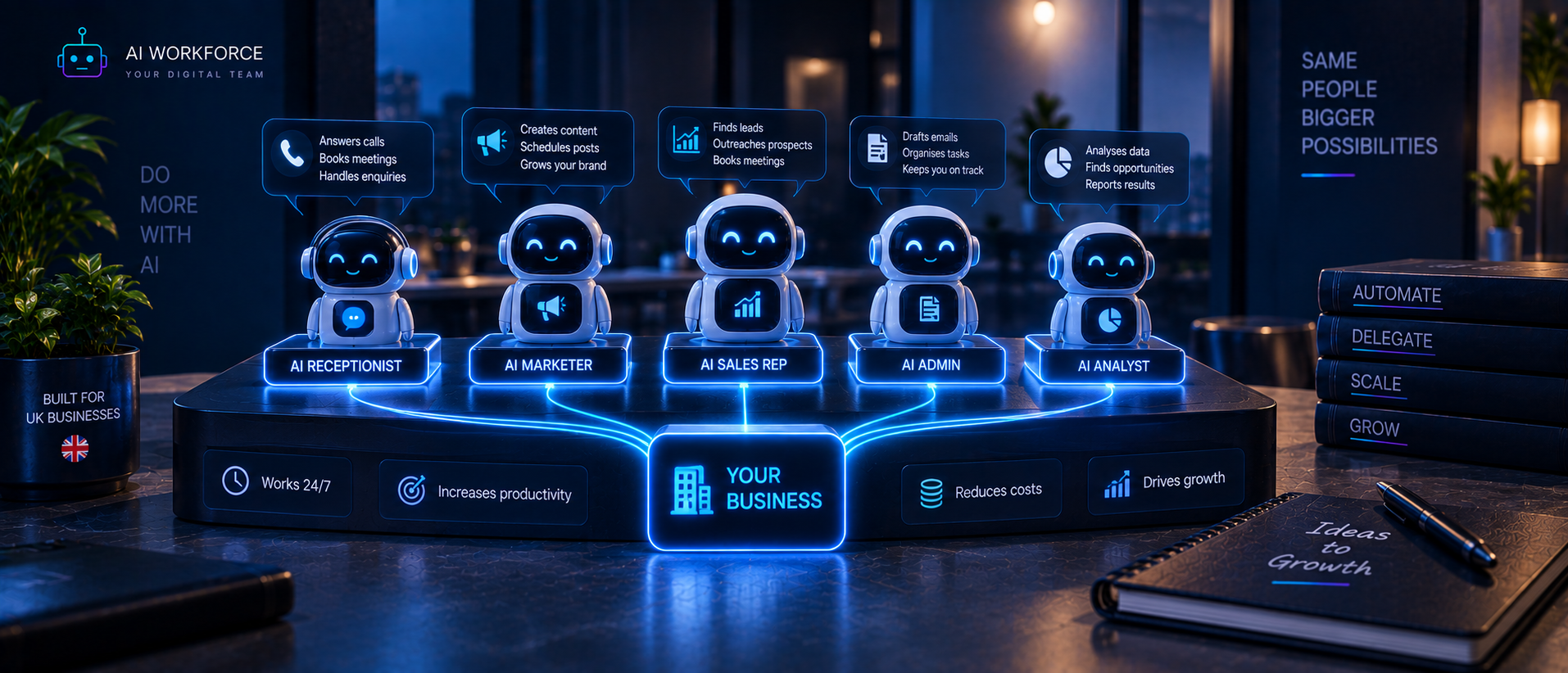
In the AI Workforce model, a digital worker represents one defined role, while a digital workforce is a collection of role-specific agents operating across different business functions. For example, one agent might handle inbound calls, another follow up with prospects, another triage email, and another prepare content. Where several agents operate together, shared state, ownership and handoff rules become important so that agents do not duplicate actions or work from conflicting information. For the fuller architecture, see AI Workforce's Digital Workforce Guide.
Digital Worker vs AI Agent vs Chatbot
These terms overlap, so it is more useful to distinguish them by role, action capability and operational scope than to treat them as universally agreed technical categories.
A chatbot typically answers questions within a conversation; it has limited or no ability to take action outside that conversation, book something, update a record, or follow up later without being asked again.
An AI agent can take multi-step action toward a goal, often using tools or integrations, but the term is used broadly enough to cover everything from a narrow single-task assistant to a more autonomous system.
A digital worker is a specific application of the AI agent concept, scoped to one job role inside a business, measured against that role's outcomes, and managed the way a task or function would be managed, rather than left open-ended. For the deeper comparison between agents and chatbots specifically, see AI Workforce's AI Agent vs Chatbot guide.
What Makes an AI Agent a Digital Worker?
AI Workforce uses five characteristics to distinguish a role-based digital worker from a general AI tool.
Characteristic | Question |
|---|---|
Defined role | What responsibility does the worker own? |
Systems and permissions | What can it access? |
Action capability | What is it permitted to do? |
Handoff rules | When must a person take over? |
Measurable outcomes | How is performance evaluated? |
The AI Workforce Digital Worker Role Model is an AI Workforce implementation framework rather than an industry standard.
What Can a Digital Worker Actually Do?
This depends on the role it is given; there is no fixed list of digital-worker capabilities because the term describes a deployment model rather than a specific feature set. Examples include answering and routing inbound calls, following up with leads, handling routine inbound email, qualifying prospects against defined criteria, and managing appointment booking or rescheduling. What links these examples is that the agent has a defined operational responsibility, permissions and handoff boundary rather than simply providing general-purpose AI assistance.
What a Digital Worker Is Not
Under the definition used in this guide, a digital worker is not an unrestricted substitute for human judgement, a general-purpose assistant with no defined scope, or a legal employee with employment rights or independent legal standing. Ambiguous, sensitive, high-consequence or out-of-scope cases should have defined escalation or handoff rules. The useful implementation question is therefore not simply "which person can this replace?" but "which responsibilities can this agent perform reliably, under what permissions, and when must a person take over?"
How Does a Digital Worker Fit Into a Team?
In the AI Workforce model, a digital worker should have an owner responsible for reviewing performance and deciding when its scope should change. It should also have defined handoff points so cases outside its permissions or capabilities move to a person rather than being guessed at, and measurable outputs so performance can be evaluated against the role it was assigned. Ownership, handoff and measurement therefore form part of the operating model rather than being left implicit after the agent is deployed.
Common Questions About Digital Workers
Is a digital worker the same as an AI employee?
There is no universal industry distinction. In the terminology used by AI Workforce, both describe role-based AI agents, while "AI employee" places more emphasis on the organisational metaphor. Neither term gives the software legal employment status.
Do digital workers replace human staff?
A digital worker can take responsibility for a defined task or function without replacing every responsibility held by a person. Whether it substitutes for existing work, adds capacity or changes how responsibilities are divided depends on the role, workflow and business deploying it.
What's the difference between a digital worker and automation software?
Rule-based automation executes predefined logic when specified conditions are met. In the model used in this guide, a digital worker can use an AI agent to interpret a wider range of inputs and choose between permitted actions within a defined role. The distinction is not that one uses automation and the other does not; it is the amount of contextual interpretation and bounded decision-making involved.
How much does a digital worker cost?
This varies by role, provider and scope, there is no single industry figure. For UK-specific pricing context, see AI Workforce's AI Employee Cost and AI Agent Cost guides.
Can a small business use a digital worker?
A small business can deploy a role-specific digital worker where there is a sufficiently defined workflow, appropriate system access and a clear human handoff. Starting with one bounded use case can also make performance and failure modes easier to evaluate before expanding the scope. See AI Workforce's AI Agents for Small Businesses guide for wider adoption context.
Key Takeaways
In the terminology used by AI Workforce, a digital worker is an AI agent deployed around a defined business role rather than an open-ended tool a person operates turn by turn. The term describes an operating model, not a legal employment category. A digital workforce is the broader system created when multiple role-specific digital workers operate across a business. "AI employee" is a related organisational framing, while "AI agent" describes the underlying agent concept more broadly. What makes a digital worker distinct in this model is the combination of a defined role, permitted systems and actions, measurable outputs, human ownership and explicit handoff boundaries.
Written by Rodi Taze, Co-Founder of AI Workforce · Reviewed by Clara Miller, Content Specialist at AI Workforce