AI Employee Cost: What Does It Really Cost to Operate One?
Posted On: August 20, 2026
Written by Clara Miller, Content Specialist at AI Workforce · Reviewed by Rodi Taze, Co-Founder of AI Workforce
Last updated: September 2026
Quick answer: The cost of operating an AI employee is rarely a single subscription fee. A realistic figure combines a one-off implementation cost (discovery, configuration, integration and testing) with recurring monthly costs (platform fee, usage, data, monitoring, maintenance and human oversight). First-year cost is typically higher than ongoing annual cost because setup work is largely one-off. Because pricing models vary widely across vendors, subscriptions, consumption-based charges, managed services and outcome-based fees, there is no single defensible market average, and any figure quoted here should be treated as illustrative rather than a quotation.
What's Covered
What Does an AI Employee Cost?
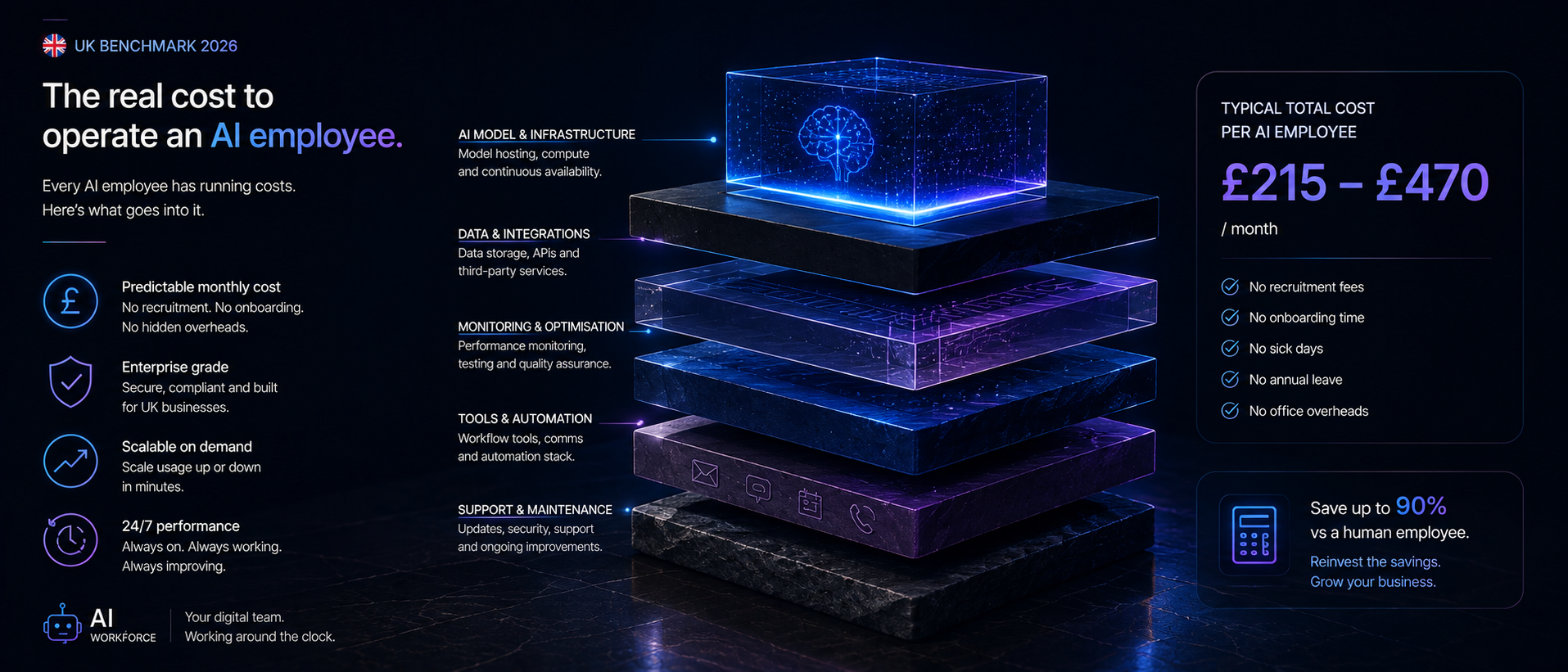
An AI employee's total operating cost has two parts: a one-off implementation cost to set it up, and a recurring monthly cost to keep it running. The one-off side covers process discovery, configuration, knowledge setup, integration with existing systems and testing. The recurring side covers the platform fee, usage-based charges, data, monitoring, maintenance and the human oversight the system still needs.
First-year cost is typically higher than ongoing annual cost, because implementation work does not repeat once the system is live. A subscription price on a vendor's pricing page is rarely the full picture: it typically excludes integration effort, usage overages, data costs and the review time a person still spends checking the system's output. This guide sets out what to include so a quoted price can be turned into a genuine annual budget figure.
What Does "AI Employee" Mean?
"AI employee" is a commercial description used by vendors for a software system, typically built on generative AI and workflow automation, that is designed to complete a defined job with limited day-to-day supervision. It is not an employee in the legal or employment-law sense: it has no contract of employment, no employment rights and no independent legal status. The label is useful shorthand for a category of product, not a statement about legal personhood.
Vendors use the term inconsistently. Some use "AI employee," others "AI worker," "digital worker" or "digital employee," for products with broadly similar underlying capability. Because there is no formal industry definition, the reliable way to assess any product is by what it actually does and what it costs to run, not by which of these labels a vendor has chosen to use. For a fuller definition of the concept itself, including how an AI employee differs from an AI agent, AI worker, chatbot and traditional automation, see our guide to what an AI employee is.
The AI Workforce Employee Total Cost Model
To make AI employee costs comparable across vendors, AI Workforce separates one-off cost from recurring cost, then combines them into a single total cost of ownership figure:
Setup + Initial Integrations + Recurring Operating Costs = Total Cost of Ownership
Recurring operating cost is itself a sum of several elements:
Platform + Usage + Data + Infrastructure + Oversight + Maintenance + Governance = Recurring Operating Cost
Each element is priced differently by different vendors, and some may be bundled into a single subscription while others are billed separately. The value of the model is not the specific numbers, which vary by vendor and workload, but the discipline of checking that every element has been priced somewhere before a total cost figure is accepted. A quote that only covers platform and setup, with usage, data, oversight, maintenance and governance left unstated, is not yet a total cost of ownership.
For the build, API and running costs of the underlying agent technology itself, rather than the packaged role built around it, see our guide to AI agent cost.
Which AI Employee Costs Are One-Off?
Implementation costs are paid once, at the start of a deployment, and typically include:
Process discovery: mapping the task the AI employee will take on
Configuration: setting rules, permissions and escalation paths
Knowledge setup: preparing the approved information the system can draw on
Prompt and instruction design: defining how the system should respond
Integration: connecting the system to CRM, email, telephony or other tools
Migration: moving relevant historical data where needed
Testing: checking accuracy and edge cases before go-live
Staff training: preparing the human team that will work alongside it
The scale of integration work has the largest effect on this figure. A narrowly scoped deployment touching one system can have a modest setup cost, while a multi-system deployment with several integrations and custom testing requirements costs substantially more. For a detailed breakdown of implementation-project pricing specifically, see our guide to AI automation pricing.
Which Costs Recur Every Month?
Recurring costs are billed on an ongoing basis, usually monthly, and typically include:
Platform fee: the core subscription or licence charge
Model or API consumption: usage-based charges for the underlying AI model
Calls and telephony: minutes or call volume for voice-based roles
Messages: volume-based charges for chat or email interactions
Data and enrichment: costs for external data the system relies on
Storage: hosting transcripts, records or logs
Infrastructure or hosting: where a system is not fully managed by the vendor
Monitoring: ongoing performance and accuracy tracking
Support: vendor support and account management
Human supervision: the person-hours still spent reviewing output and handling exceptions
Human supervision is the recurring cost most often left out of vendor comparisons, and it rarely falls to zero. Even a well-performing AI employee typically needs someone to review a sample of its work, handle escalations and update its instructions as the business changes.
How Do AI Employee Pricing Models Work?
Model | How it works | Main risk |
|---|---|---|
Per seat | Fixed licence per user | Paying for unused access |
Flat monthly | Defined service allowance | Usage exclusions |
Consumption-based | Calls, tokens, minutes or tasks | Volatile bills |
Per outcome | Charge for resolved task or result | Disputes about success |
Managed service | Platform plus implementation and support | Contract dependency |
Custom enterprise | Negotiated package | Low transparency |
Large consultancies including Deloitte market their own "digital worker" products commercially rather than publishing fixed price lists, which is typical of this market: pricing is usually confirmed directly with the vendor rather than published in full. UK vendors selling AI employee products directly to small and medium businesses commonly advertise tiered monthly plans, while enterprise deployments are more often negotiated individually. Before comparing two quotes, confirm which of these models each one uses, since a per-seat price and a per-outcome price are not directly comparable without converting both to an expected monthly cost.
What Makes an AI Employee More Expensive?
Several factors consistently push cost higher, regardless of which pricing model a vendor uses:
Workload volume: more conversations, calls or tasks processed each month
System complexity: the number of connected tools and data sources
Permissions: what actions the system is allowed to take without approval
Model choice: more capable underlying models typically cost more per use
Languages: multilingual support adds testing and, sometimes, licensing cost
Telephony: voice-based roles carry call-minute charges that text-based roles do not
Data volume: larger knowledge bases and higher-frequency data updates
Compliance requirements: additional security, audit and data-handling controls
Exception rates: how often the system escalates, which drives human oversight cost
A deployment scoring high on several of these factors at once, for example, a multilingual, high-volume, telephony-based role handling regulated data, should be budgeted well above a narrow, single-channel, text-only deployment.
How Do Costs Differ by Role?
Cost drivers differ meaningfully by the job an AI employee is doing:
AI receptionist: cost is driven mainly by call minutes and telephony charges. See AI receptionist pricing.
AI SDR: cost is driven by prospect data, enrichment, and email or calling volume. See AI SDR pricing.
AI administrator: cost is driven by the number of integrations and the rate of exceptions requiring human review.
AI marketing agent: cost is driven by content volume and the number of connected publishing platforms.
Customer-service agent: cost is driven by conversation volume, knowledge-base maintenance and escalation handling.
Because these drivers differ so much by role, a single blended "AI employee cost" figure is less useful than pricing each role against its own primary cost driver.
Worked Example: First-Year AI Employee Cost
The figures below are an illustrative scenario for a single, moderately scoped AI employee role bought as a configured managed product, not a bespoke, multi-system agent built from scratch. Bespoke deployments carry a materially higher implementation cost, closer to the higher planning bands set out in our AI agent cost guide. These figures are not a market average or a quotation, and actual costs will vary by vendor, workload and region.
Cost component | Example |
|---|---|
Initial configuration | £2,500 |
Integrations and testing | £1,500 |
Platform | £600/month |
Usage and data | £250/month |
Monitoring and maintenance | £200/month |
Human oversight | £300/month |
Infrastructure and basic governance are assumed to be included in the platform and maintenance figures in this example. A real quotation should show them as separate line items whenever they create additional charges, such as dedicated hosting, enhanced security controls or a formal audit trail.
Using the total cost model above:
Initial implementation: £2,500 + £1,500 = £4,000
Monthly operating cost: £600 + £250 + £200 + £300 = £1,350
First-year cost: £4,000 + (£1,350 × 12) = £20,200
Ongoing annual cost (year two onwards): £1,350 × 12 = £16,200
A lower-usage deployment with fewer integrations could land well below this figure, while a high-volume, multi-system deployment with regulatory requirements could run considerably higher. Treat this worked example as a template for your own calculation, not as a benchmark to match.
How Should You Calculate Your Own Cost?
Use the following formulas with figures specific to your own deployment:
Monthly operating cost = platform + usage + data + infrastructure + oversight + maintenance + governance
First-year cost = one-off implementation cost + (monthly operating cost × 12)
Ongoing annual cost = (monthly operating cost × 12) + scheduled annual costs
Where a vendor bundles some of these components into a single fee, still identify each one individually, even if its separate monetary value is £0, so that nothing is silently missing from the total. Because usage-based charges are the least predictable part of this calculation, model at least three scenarios, low, expected and high usage, rather than relying on a single point estimate. A vendor's quoted "starting price" typically reflects the low-usage scenario, not the expected one.
What Should You Ask an AI Employee Vendor?
Before signing, ask each vendor directly:
What is included in the platform fee, and what is billed separately?
What triggers a usage overage, and what does it cost?
What integration work is included, and what is chargeable as a separate project?
How much human oversight time does a typical deployment of this kind require?
What happens to cost if call, message or task volume doubles?
Is pricing per seat, per outcome, consumption-based, or a mix?
What is included in ongoing maintenance, and how often are instructions updated?
What data, security and compliance costs, if any, sit outside the headline price?
Is initial setup included in the headline price, or billed as a separate project?
Are calling minutes included, or charged separately once a threshold is reached?
Are API or underlying model charges included, or passed through at cost?
Is data or enrichment included, or billed as an add-on?
Are software upgrades and new features included, or charged as a paid tier change?
Is there a minimum contract term, and what is the exit or cancellation process?
Do unused credits or allowances expire at the end of each billing period?
What happens when an included usage allowance is exceeded mid-month?
Which specific costs increase automatically as usage grows, and by how much?
What happens to your data and integrations if you end the contract?
A vendor that can answer these questions clearly and in writing is easier to budget for accurately than one that only quotes a single monthly figure.
Real-World Cost Range by Business Size
Because pricing models and deployment scope vary so widely, it helps to see how the total cost model plays out at different business sizes rather than relying on one blended figure. The ranges below are illustrative, not quotations, and assume a single AI employee role rather than a multi-role deployment.
Business size | Typical setup | Typical monthly | Illustrative first-year total |
|---|---|---|---|
Micro business (1 to 9 staff) | £500 to £2,000 | £150 to £500 | £2,300 to £8,000 |
Small business (10 to 49 staff) | £2,000 to £6,000 | £500 to £1,500 | £8,000 to £24,000 |
Mid-sized business (50 to 249 staff) | £6,000 to £20,000 | £1,500 to £4,000 | £24,000 to £68,000 |
Larger business (250+ staff) | £20,000+ | £4,000+ | £68,000+ |
The jump between bands is rarely just headcount. It usually reflects a genuine increase in complexity: more integrations, more languages, higher compliance requirements and a lower tolerance for error once the system is handling higher volumes or more regulated interactions. A micro business piloting a single, narrowly scoped role should expect to sit at the low end of its band, while a business adding compliance, multilingual support or multiple integrations at the same headcount should budget toward the top of it, or into the band above.
Two practical implications follow from this. First, a smaller business is not automatically better off with the cheapest available plan: an under-specified deployment that cannot handle real call or message volume often costs more in lost leads and rework than a properly scoped one would have cost upfront. Second, a larger business should be wary of a single AI employee vendor quote that looks flat regardless of scale, since genuine enterprise deployments almost always carry materially higher integration and compliance costs than a small-business package with the same headline features.
How Does This Compare With Employing a Person?
This page calculates the AI system's own operating cost: implementation, platform, usage, data, oversight and maintenance. Comparing that figure with the cost of employing a person- salary, employer National Insurance, pension contributions, recruitment and management time- is a separate calculation with its own assumptions.
For a full worked comparison between AI-assisted and human-only task costs, including a step-by-step model and UK examples, see our guide to AI vs employee cost. If you are budgeting for several AI tools or projects across the company rather than a single role, see our Cost of AI for UK Small Businesses guide.
Frequently Asked Questions
Is there a single average cost for an AI employee?
No. Pricing models vary too widely- subscription, consumption-based, managed service and outcome-based- for one average figure to be meaningful. Build a cost using the total cost model instead.
Is a subscription price the full cost of an AI employee?
Rarely. Subscription price usually excludes implementation, integration, usage overages, data costs and the human oversight the system still needs.
Why is first-year cost higher than ongoing cost?
Implementation work, discovery, configuration, integration and testing is largely one-off, so it inflates year one but does not repeat in later years.
Does an AI employee remove the need for human oversight entirely?
No. Most deployments retain some level of human review and escalation handling, and that time should be included as a recurring operating cost.
Is an AI employee an employee in a legal sense?
No. It has no employment contract or legal personhood. "AI employee" is commercial terminology for a software system performing a defined job.
Can you negotiate AI employee pricing?
Often, yes, particularly on annual contracts, implementation fees and usage thresholds. Vendors are usually more willing to adjust setup fees and included usage allowances than the core per-seat or per-outcome rate, so it is worth asking for both before accepting a first quote.
Does a cheaper AI employee plan mean lower quality?
Not necessarily, but a lower price often means a narrower scope: less usage included, fewer integrations, or a smaller knowledge base. Check what is excluded from a cheap plan as carefully as what is included, rather than assuming price alone reflects capability.
How quickly do AI employee costs typically pay back?
Payback depends entirely on what the role replaces or augments and how much of that value is realised, so there is no reliable universal figure. A role replacing clearly measurable manual work, such as routine call handling or lead follow-up, is usually easier to model a payback period for than one aimed at more diffuse productivity gains.
Key Things to Remember
AI employee cost is a combination of one-off implementation cost and recurring monthly operating cost, not a single subscription figure.
The AI Workforce Employee Total Cost Model (platform, setup, integrations, usage, data, infrastructure, oversight, maintenance, governance) helps ensure nothing has been left out of a quote.
First-year cost is typically higher than ongoing annual cost because setup work does not repeat.
Pricing models vary widely (per seat, flat monthly, consumption-based, per outcome, managed service, custom enterprise), so confirm which model a vendor is quoting before comparing prices.
Cost drivers differ by role: telephony for receptionists, data and enrichment for SDRs, integrations for administrators.
Real-world cost typically scales with deployment complexity as much as with headcount, so a smaller business adding integrations or compliance requirements should budget above the low end of its size band.
Model low, expected and high usage scenarios rather than relying on a single estimate.
Comparing AI operating cost with employee cost is a separate calculation, covered in our dedicated AI vs employee cost guide.
Need a Complete First-Year Cost Estimate?
AI Workforce can help you itemise setup, integrations, expected usage, data, maintenance, governance and human oversight before you commit to an AI employee platform.
Related Guides
Sources and Further Reading
Deloitte, Digital Worker
Imperius AI, Pricing
NovekAI, How Much Does an AI Employee Cost?
Sources reviewed and current as of September 2026.
Clara Miller is a Content Specialist at AI Workforce, researching AI adoption trends and pricing structures across UK small and medium businesses to help buyers compare vendor claims against verifiable evidence.
Rodi Taze is Co-Founder of AI Workforce, with hands-on experience scoping, implementing and supporting AI workflows for UK businesses. This article was reviewed for pricing methodology, implementation practicality and commercial accuracy before publication.