
AI in Content Marketing: A Practical Guide for UK Teams
Posted On: July 29, 2026

Last updated: August 2026 · Written by Rodi Taze, Co-Founder of AI Workforce · Reviewed by Clara Miller, Content Marketing Specialist
Content marketing used to mean a person staring at a blank calendar, filling it one piece at a time. AI now handles a growing share of that work, from research to distribution, but content marketing itself is bigger than any single piece of content. It is the whole system: deciding what to say, producing it, getting it in front of the right people, and learning from what happens next. This guide covers where AI genuinely helps across that system, what stays firmly human, and how to build a workflow that scales output without losing judgement.
Quick Answer: AI in content marketing means using generative AI and automation across the full content operating system- research, planning, creation, optimisation, distribution and measurement- rather than in any single stage alone. It works best as a governed workflow: discover what your audience actually needs, plan what deserves to exist, let AI create a first pass, verify it before anything is published, distribute it across the right channels, measure what happened, and feed that back into the next cycle. AI accelerates most of that system; it should not be the thing deciding, unsupervised, what a business claims or publishes.
At a Glance
What it is: using AI across the full content marketing system, research, planning, creation, optimisation, distribution and measurement, within a workflow a person reviews and approves
Best suited to: marketing teams running content across multiple channels where manual research, drafting, repurposing and reporting are visibly limiting what actually gets done
Biggest benefit: a small team can handle substantially more research, drafting, repurposing and reporting without increasing manual workload at the same rate
Biggest risk: letting AI decide unsupervised what a business claims, publishes or sends, rather than treating it as a drafting and analysis layer under human review
Key consideration: AI content creation is one stage inside content marketing. Content marketing is the wider system that decides what gets made, why, and what happens to it afterwards
What's Covered
What Is AI in Content Marketing?
AI Content Creation vs AI Content Marketing
The AI Workforce Content Marketing Model
Where Does AI Fit Across the Content Lifecycle?
What Can AI Actually Automate?
The Content Marketing Automation Boundary Matrix
How Does AI Help With Research and Content Planning?
How Does AI Help With Content Creation?
How Do You Repurpose One Idea Across Multiple Channels?
AI for SEO and Content Optimisation
AI for Content Distribution
What Should AI Never Publish Without Review?
What Data Should You Put Into AI Content Marketing Tools?
How Do AI Marketing Agents Fit In?
Worked Example: One Interview to a Multi-Channel Campaign
How Should You Measure AI in Content Marketing?
A Four-Week Rollout Plan
Is AI in Content Marketing Worth It?
Related Guides
Frequently Asked Questions
Key Takeaways
What Is AI in Content Marketing?
AI in content marketing covers everything from research and planning through to drafting, optimisation, distribution and analysis, using models trained on large amounts of text and data. Generative AI handles the creative middle: drafts, outlines and variations that used to take a person hours. Used well, it is assistance, not autopilot: a person still decides what the business has to say, and AI helps produce, adapt and distribute that message faster.
Consistency is one of the clearest wins. A brand voice is far easier to keep steady across dozens of pieces when AI is working from the same brief, examples and style guide every time, rather than drifting depending on who wrote a given piece that week. That only holds if the workflow genuinely enforces it, which is why the model in this guide treats verification and review as a defined stage, not an assumption.
AI Content Creation vs AI Content Marketing
These two get used almost interchangeably, and that overlap is exactly what causes two pages on the same site to start competing for the same reader.
AI content creation is about producing and repurposing individual content assets: a blog post, a social caption, an email, a set of ad variations, all drafted from a brief and refined by a person. Our guide to AI content creation covers that stage in depth, including the verification checklist that should sit behind any AI-assisted draft.
AI in content marketing is the wider system that content creation sits inside: deciding what deserves to be made in the first place, based on real audience demand and business goals, then getting the finished asset in front of the right people and learning from what happens afterwards. Content creation answers "how do we produce this?" Content marketing answers "what should exist, for whom, and what do we do with it once it is live."
Treating these as the same thing is where a lot of AI content strategies go wrong: a team gets faster at producing pieces without getting any better at deciding which pieces are worth producing, or what happens to them after publication.
The AI Workforce Content Marketing Model
Most AI content marketing efforts stall for a familiar reason: there is no consistent process connecting research to a distributed, measured outcome. We use a seven-stage model with every content marketing workflow we help set up.
The AI Workforce Content Marketing Model
Discover: understand audience questions, search demand, customer conversations, competitor content and existing performance
Plan: decide which content deserves to exist, for whom, on which channel and for what commercial purpose
Create: AI assists with research, outlines, first drafts, variations and repurposing
Verify: a named person checks claims, sources, brand voice, product information and anything sensitive
Distribute: approved content is adapted and published for search, social, email and other relevant channels
Measure: track whether people actually found, read, engaged with and converted from the content
Learn: real performance feeds back into the next Discover and Plan cycle
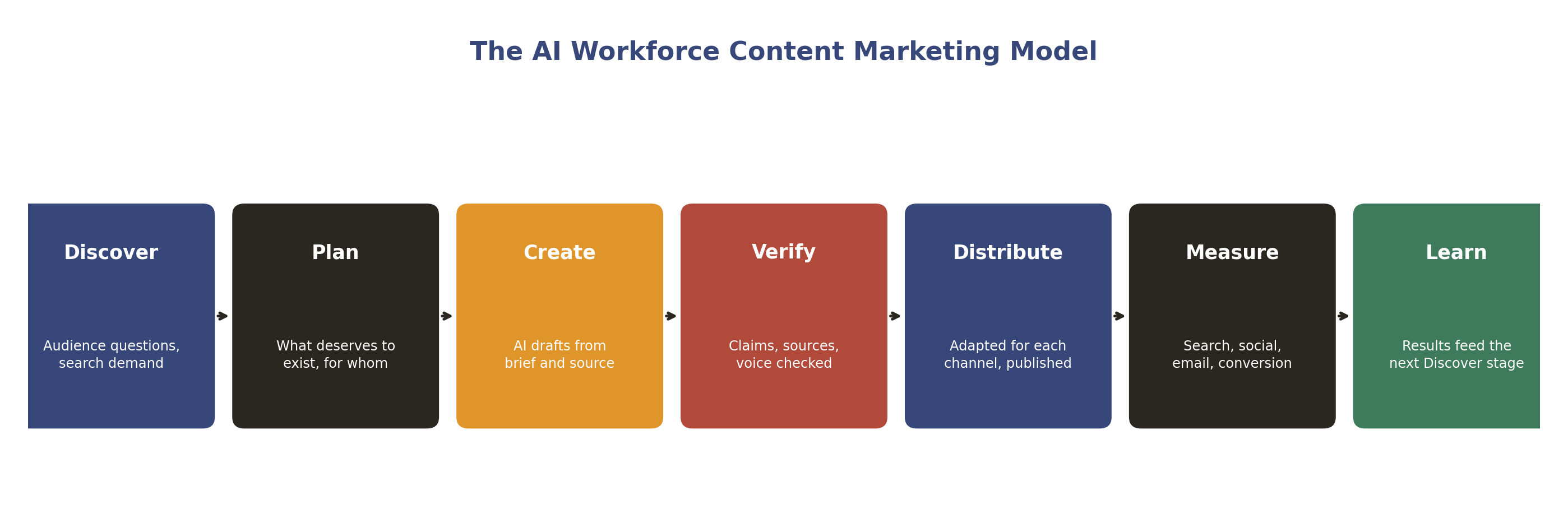
AI Workforce Insight: AI can accelerate almost every stage of content marketing. It should not be the system deciding, without oversight, what your business believes, claims or publishes.
Where Does AI Fit Across the Content Lifecycle?
The Content Marketing Model above sets out the governance stages. Day to day, a content team experiences that model as a lifecycle with more granular steps, and AI shows up differently at each one.
Research: summarise customer interviews, cluster Search Console queries, identify recurring questions across support tickets and reviews
Strategy: surface opportunities and content gaps, though a person still decides priorities based on business goals
Brief: turn research into a structured brief: audience, intent, format, channel and word count
Create: AI drafts the piece from that brief and the source material behind it
Optimise: AI suggests headings, internal links, meta titles and descriptions based on search intent
Repurpose: one approved asset becomes a newsletter section, a set of social posts, a short video script
Distribute: approved formats are scheduled and published across the right channels
Measure: search, social, email and conversion data are pulled into a single, plain-language view
Refresh: content that has decayed or gone stale is identified and queued for an update rather than left live and wrong
Stages that were often handled across separate tools and manual handoffs can increasingly be connected into one workflow, with people reviewing the points where judgement matters most. Keeping content consistent across formats, blog, social and email, matters as much as any single piece performing well on its own.
What Can AI Actually Automate?
Not every content marketing task is an equally safe candidate for automation, and the honest answer is "it depends on the task," not a blanket yes or no.
Research and pattern-detection tasks are the strongest starting point: clustering search queries, summarising customer interviews, flagging a content gap a competitor already covers. These are detection tasks, and AI can run them continuously and consistently across far more material than a person reviewing manually. First-draft production is a similarly strong candidate, since a structured brief going in produces a full draft coming back in a fraction of the time a blank page would take. Reporting is the same story again: pulling performance data from search, social and email into one summary removes a manual export step every week.
Where this gets more nuanced is anything that becomes a public claim, a compliance-sensitive statement, or a message sent to a specific person. That distinction is exactly what the Boundary Matrix below is built to capture.
The Content Marketing Automation Boundary Matrix
High automation: topic clustering, search and query research, content-gap detection, first-draft outlines, repurposing already-approved content once the workflow has been proven, scheduling approved content, performance summaries
AI drafts, a person approves: first-draft copy, meta descriptions, social adaptations, email subject line variations, content briefs
Human-led: product claims, statistics and research claims, legal or regulatory claims, original brand positioning, crisis or current-event content
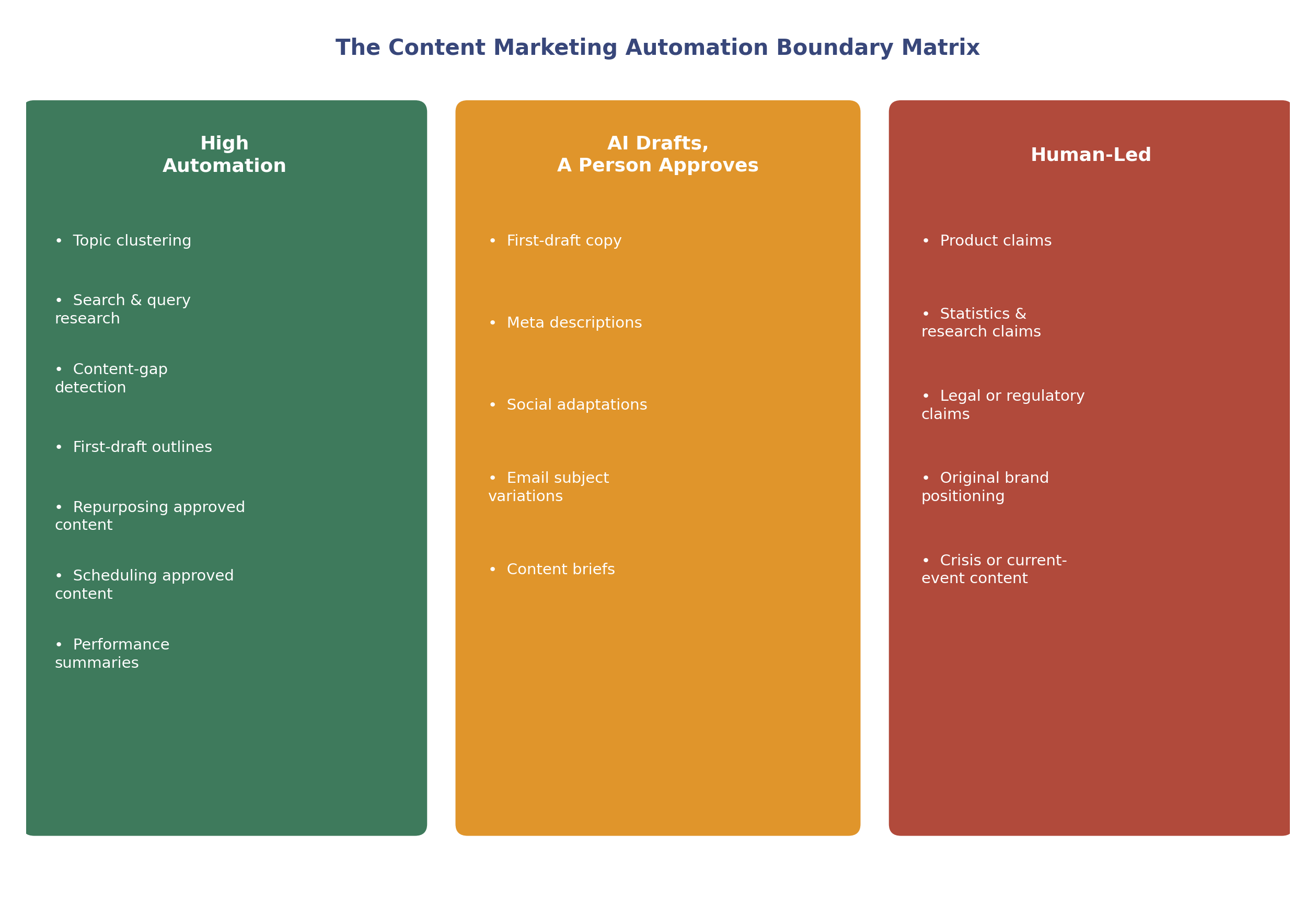
The pattern holds across all three tiers: the further a task sits from "detect and draft" and the closer it gets to "state a fact publicly or contact a specific person," the more it belongs in human hands.
How Does AI Help With Research and Content Planning?
Research used to be the quiet, time-consuming part of content marketing: reading through support tickets, scanning competitor content, manually clustering keyword lists. AI can now do a first pass of all of this in a fraction of the time, summarising recurring customer questions, grouping search queries by underlying intent, and flagging a subtopic competitors already rank for that your own content has not addressed.
None of this replaces the planning decision itself. A tool can surface twenty content opportunities; a person still has to decide which two or three are worth producing this month, based on business priority, resourcing and what genuinely serves the audience, not just what the data technically supports.
How Does AI Help With Content Creation?
Once a brief exists, AI can produce a structured first draft of nearly any format: a blog post, an email, a set of ad variations, a social caption. Our guide to AI content creation covers this stage in detail, including what should never be published from an AI draft without a human check, and our guide to the AI blog writer covers the same discipline applied specifically to long-form blog content.
The time saving is real but depends heavily on inputs. AI can materially reduce drafting and repurposing time, though the actual saving depends on the quality of the brief, the source material behind it, and how much the review process still needs to change before publication. A vague brief tends to produce a draft that needs a substantial rewrite; a specific one, with real examples and source material attached, tends to produce a draft that needs a lighter edit.
How Do You Repurpose One Idea Across Multiple Channels?
A single piece of real expertise- an interview, a webinar, a detailed internal document- can become several pieces of content without a person retyping the same ideas repeatedly. AI can turn a transcript into a blog post, a handful of social captions, a newsletter section and a short video script from the same source material.
The judgement that still matters here is quality control, not volume. Producing six assets from one source is only useful if each one is actually good enough to publish under the brand's name; six mediocre assets is not a better outcome than two strong ones. The Worked Example later in this guide walks through exactly this kind of repurposing end to end.
AI for SEO and Content Optimisation
Content marketing and SEO overlap heavily, and one of the most common questions a marketing team asks before scaling AI-assisted content is whether it will damage search performance.
Google's own guidance on generative AI content is clear that AI can be useful for researching a topic and adding structure to original content. Google's spam policies do not single out AI-generated content as a category to penalise. What they target is scaled content abuse: producing large volumes of content primarily to manipulate rankings rather than to help the person searching, regardless of whether AI, a person, or both produced it. Google's more recent guidance on AI-driven search features continues to emphasise satisfying the person searching over producing many pages to cover keyword variations.
AI can meaningfully speed up several optimisation tasks: suggesting headings and structure based on what already ranks, drafting meta titles and descriptions, and flagging internal linking opportunities. What should not be automated blindly is publishing at scale with no review. Our guide to AI SEO Automation covers this in far more depth, including a boundary matrix for exactly which SEO tasks are safe to automate heavily and which need a person in the loop.
AI for Content Distribution
Distribution used to mean manually posting the same piece across five channels, copying and pasting a slightly different version into each one. AI can now adapt one approved asset for each destination automatically, resizing and adjusting tone for social, drafting a newsletter section from the same source, and recommending the best time to publish based on channel-specific engagement patterns.
Distribution automation works best when it starts from something already approved, not as a shortcut around the Verify stage. Our guide to social media automation covers the distribution and scheduling layer specifically, including where automation is genuinely low-risk and where a person needs to stay in control of a live conversation. For the email-specific workflow around drafting, segmentation, review and measurement, see our AI Email Marketing Tools guide.
What Should AI Never Publish Without Review?
Some categories of content carry enough risk that they deserve an explicit rule, not an assumed "someone will catch it" review.
AI-assisted content should never be published or sent without human review where it includes a statistic or research finding, a quotation attributed to a real person, a legal, medical or financial claim, a comparison with a named competitor or product, a specific price or availability claim, original brand positioning, or anything tied to a live current event or a developing situation involving the business. It should also never be the sole check on whether an internal link actually resolves to the page the anchor text describes.
What Data Should You Put Into AI Content Marketing Tools?
This is particularly relevant given how much source material a content marketing workflow touches: customer interviews, sales call transcripts, CRM notes, survey responses, customer reviews, support tickets and audience or analytics profiles. This section is general information rather than legal advice.
Identifiable customer or prospect information remains personal data regardless of the tool processing it. Where AI is used to profile individuals, for example building an audience segment from engagement data for targeted marketing, the ICO's guidance is that organisations need to identify an appropriate lawful basis and be transparent about that processing, alongside the core UK GDPR principles of fairness, purpose limitation, data minimisation, accuracy, storage limitation, security and accountability. Where personal data is used for direct marketing, individuals have an absolute right to object to that processing. If they object, their personal data must no longer be processed for direct-marketing purposes.
Before pasting customer or prospect material into a content marketing tool, it is worth knowing what data you are sending, why you are processing it for this purpose, what the vendor does with it once submitted, and whether the personal information is genuinely necessary for the task, or could be anonymised first. Our guide to AI and GDPR compliance for UK businesses covers the wider framework, including lawful basis and vendor due diligence, in more depth.
How Do AI Marketing Agents Fit In?
AI agents increasingly handle a defined slice of the content marketing workflow with limited human input at each step: monitoring performance signals, drafting a response, tagging content, and flagging anything that needs a human decision before it moves forward. This is a meaningful step beyond a single-prompt tool, since an agent can hold a goal across multiple steps and decide which data source or action to use next.
This is the same shift covered in our guide to AI marketing agents, and the same caution applies here: the word "agent" is used loosely across the industry, so it is worth asking exactly what decisions a given tool makes on its own, and what it always hands back to a person before anything changes. Teams piloting agentic workflows tend to see the clearest early wins in reporting and first-draft production specifically, the same lower-risk tier identified in the Boundary Matrix above.
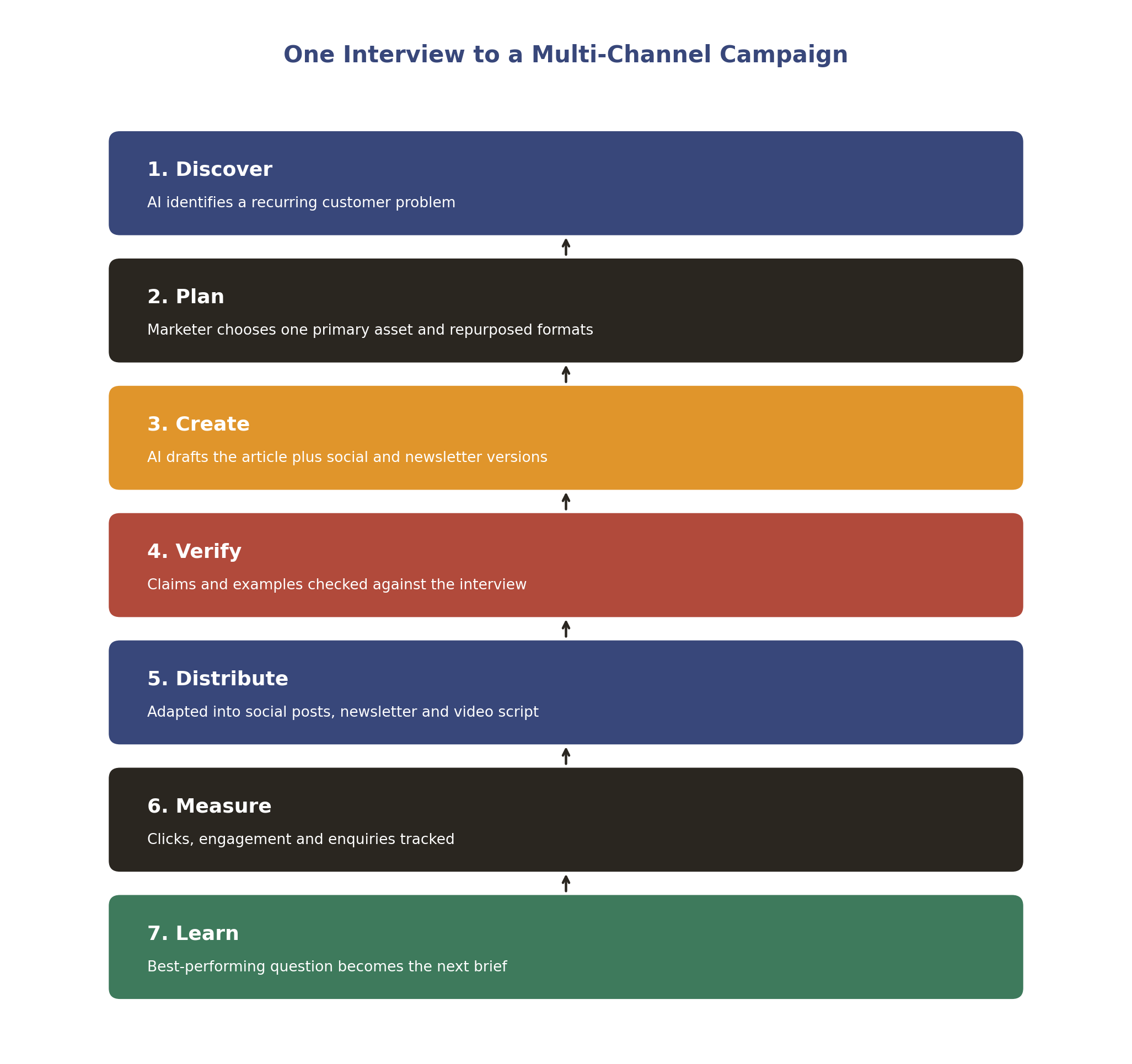
Worked Example: One Interview to a Multi-Channel Campaign
Illustrative example: turning one internal conversation into an approved, multi-channel campaign.
A UK business interviews its Head of Product for thirty minutes about a problem customers regularly raise.
Discover: AI analyses recent customer questions and support tickets and identifies the same problem recurring.
Plan: the marketer chooses one search-led guide as the primary asset, with a newsletter section and social posts planned as repurposed formats.
Create: AI turns the interview transcript and existing product documentation into a first article draft, plus draft social and newsletter versions.
Verify: product claims, examples and any statistics are checked against the interview and documentation before anything moves forward.
Distribute: the approved article is adapted into three social posts, one newsletter section and a short video script, and scheduled across the relevant channels.
Measure: search clicks, social engagement, email clicks and enquiry data are tracked against the campaign.
Learn: the best-performing customer question becomes the brief for the next Discover and Plan cycle.
How Should You Measure AI in Content Marketing?
Content published per month is easy to track and close to the wrong measure entirely. A team publishing twice as much content that nobody reads, or that needs constant correction, has not actually gained anything.
Production time per approved asset, measured against a real manual baseline
Correction rate, how often a published piece needed a factual fix after going live
Organic clicks and non-brand keyword visibility
Engaged reading time, as a proxy for whether people actually read what was published
Email and social distribution clicks
CTA conversion rate and qualified leads generated
Assisted pipeline or revenue, where that data is available
Content refresh rate, how often a piece needs updating to stay accurate
Content Multiplication Rate: the number of useful, approved channel assets produced from one original source asset
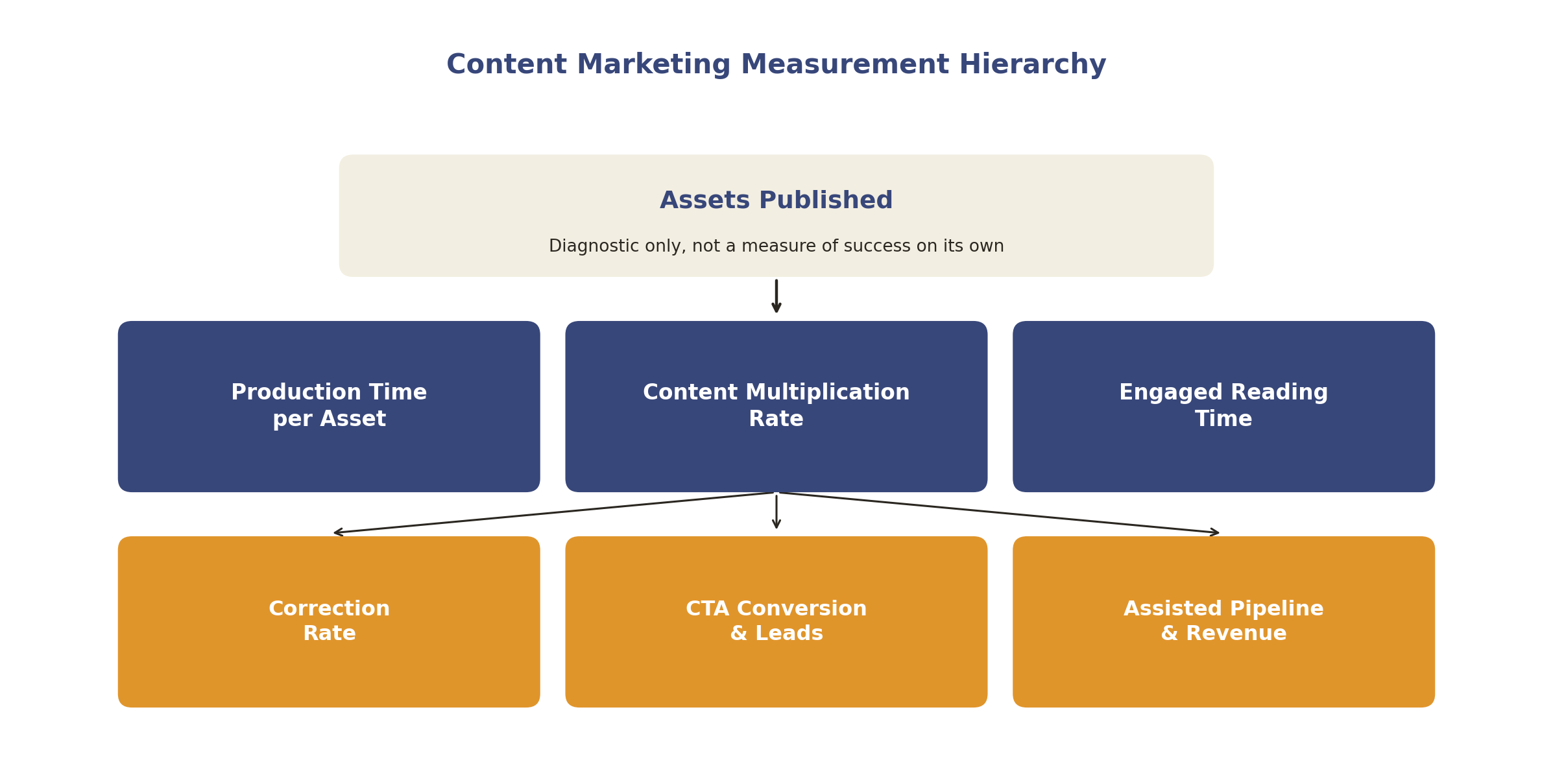
Content Multiplication Rate is worth explaining in full. If one expert interview becomes one article, three social posts, one newsletter section and one video script, that is five approved assets from a single source, a real productivity gain. But this metric only means something paired with correction rate and engagement: five assets nobody reads or that need constant fixing is not a better outcome than two that actually work. Reward genuinely useful multiplication, not raw volume.
A Four-Week Rollout Plan
Week one: benchmark current production honestly: time per asset, organic and distribution performance, and correction rate on recent content, before adding automation on top of an unmeasured baseline.
Week two: introduce AI for research and first-draft production on one content type, with a named person verifying every piece against the checklist above before it moves forward.
Week three: add repurposing and distribution automation for already-approved content, tracking Content Multiplication Rate and correction rate together.
Week four: expand to a second content type or channel, while keeping verification and a named editor in place for anything published under the brand.
If you are not sure whether your data, tooling and review capacity are ready for this level of automation, our AI Readiness Assessment is a useful self-check to run before starting week one.
Is AI in Content Marketing Worth It?
For most UK marketing teams running content across more than one or two channels, yes, provided the workflow includes a genuine Verify stage and the boundaries in this guide are respected. The clearest wins come from research, first-draft production, repurposing and reporting, tasks that are repetitive and where a person checking the output takes minutes rather than hours.
The weaker case is for a team expecting AI to replace strategic judgement entirely. Deciding what deserves to be made, what a brand genuinely believes, and how to respond to a sensitive moment all stay with a person. AI in content marketing is strongest as a way to free that person's time for exactly those decisions, not as a substitute for making them. For businesses that would rather bring in external expertise than build the workflow entirely in-house, our Best AI Marketing Agencies 2026 comparison looks at UK agencies across AI capability, service breadth, pricing transparency and human oversight.
Related Guides
Frequently Asked Questions
How is AI content marketing different from AI content creation?
AI content creation is about producing and repurposing individual assets. AI in content marketing is the wider system that decides what content should exist, gets it in front of the right audience, and measures what happened afterwards. Content creation is one stage inside content marketing, not a synonym for it.
Does using AI for content marketing hurt SEO?
Not because AI was involved. Google's spam policies target content produced at scale primarily to manipulate rankings rather than help users, regardless of whether AI, a person, or both produced it. The risk is publishing unreviewed volume, not using AI as part of the process. See our guide to AI SEO Automation for more detail.
What should never be automated in content marketing?
Product claims, statistics and research claims, legal or regulatory claims, original brand positioning and anything tied to a live current event should always have a named person review them before anything publishes or is sent.
What data is safe to use for AI-assisted content marketing?
It depends on what the data contains and the tool's handling of it. Identifiable customer or prospect information remains personal data, and using it to profile people for marketing requires transparency and a lawful basis under UK GDPR, along with the usual principles of fairness and data minimisation.
How do AI marketing agents differ from a simple AI writing tool?
An agent can hold a goal across several steps and decide which data source or action to use next, for example monitoring performance and flagging what needs review without being prompted at every stage. A single-prompt tool produces one output from one instruction with no ongoing decision-making of its own.
What is Content Multiplication Rate?
It is the number of useful, approved channel assets produced from one original source, such as an interview becoming an article, several social posts and a newsletter section. It should always be read alongside correction rate and engagement, since volume alone is not the goal.
Key Takeaways
AI content creation is one stage inside the wider content marketing system, not the whole of it
The Discover, Plan, Create, Verify, Distribute, Measure, Learn model keeps a person accountable at every stage that carries real risk
Research and reporting are the safest tasks to automate heavily; product claims, legal claims and brand positioning should stay human-led
Google does not penalise AI-assisted content specifically; its spam policies target content produced at scale to manipulate rankings
Personal data used for audience profiling or targeted marketing still needs a lawful basis and genuine transparency under UK GDPR
AI marketing agents can hold a goal across multiple steps, but the word "agent" is used loosely, so ask exactly what a tool decides unsupervised
Content Multiplication Rate is only a meaningful metric when paired with correction rate and genuine engagement, not read alone
Start narrow with one content type and a genuine verification step before expanding across the wider content operation
This article is general information rather than legal advice. Take independent advice on data protection obligations specific to your own content operation and customer data.
Ready to Bring AI Into Your Content Marketing?
If your team is still producing content by hand one piece at a time, it's worth seeing how much of the process can be sped up without losing your voice. Get in touch, and we'll help you find the right starting point.
About the Author
Rodi Taze is Co-Founder of AI Workforce. He works with UK businesses to design AI-assisted marketing workflows that stay on-brand, properly governed and genuinely useful day to day.
This guide was reviewed by Clara Miller, Content Marketing Specialist at AI Workforce, for accuracy against current Google search guidance and UK data protection practice.
Reviewed: August 2026