AI vs Employee Cost: What Can AI Actually Save a UK Business in 2026?
Posted On: August 15, 2026
Written by Clara Miller, Content Specialist at AI Workforce · Reviewed by Seth Ayush, Co-Founder of AI Workforce
Last updated: August 2026
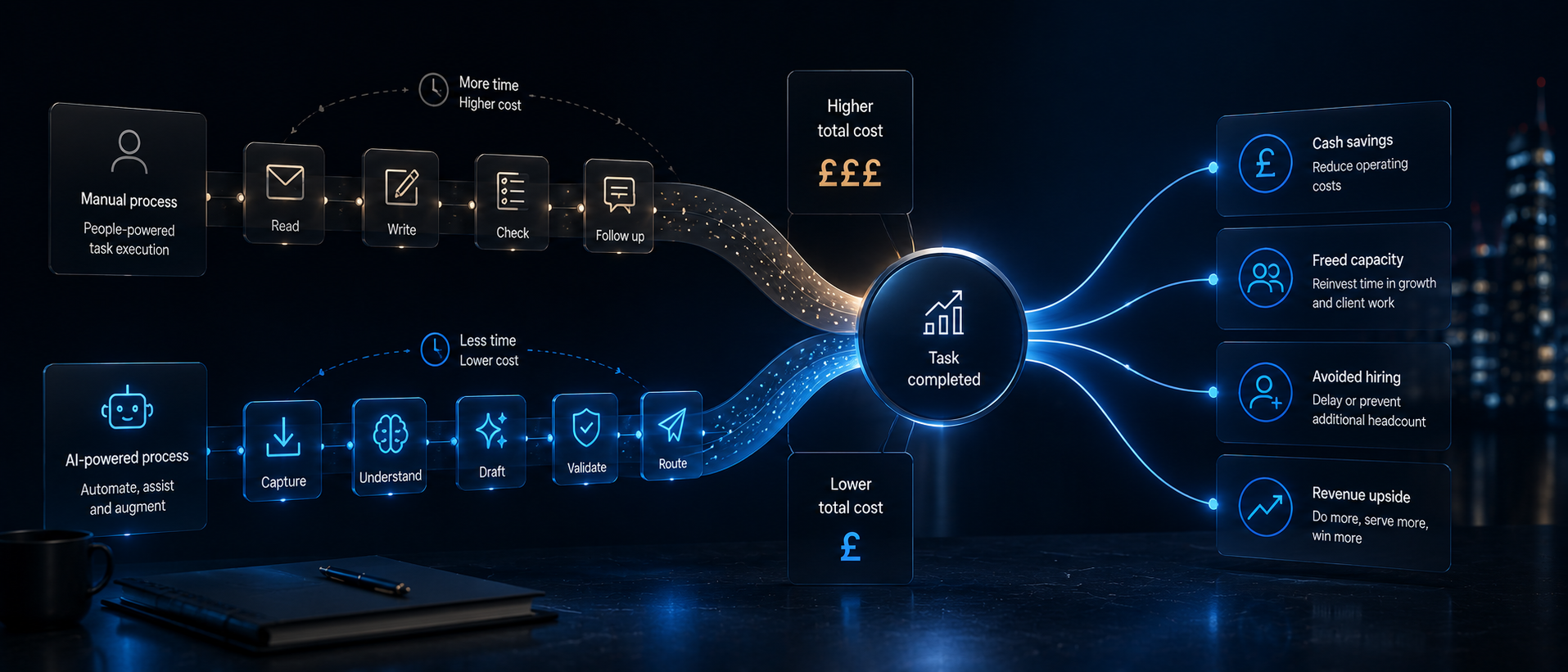
Quick answer: AI can cost materially less than employee time for repetitive, high-volume tasks, but hours saved do not automatically become cash savings. A fair comparison calculates the current cost of completing a defined task, the complete cost of the AI system, and the employee time still required for review or escalation. The difference may create cash savings, additional capacity, avoided hiring or extra revenue. It should not automatically be described as replacing the cost of an employee.
At a Glance
AI and employee cost should be compared at task level, not role level.
Salary is not the complete cost of employing someone.
An AI subscription price is not the complete cost of automation.
Human review and escalation remain part of the AI-assisted cost.
Hours saved are capacity gains unless payroll or external spending actually changes.
Avoided recruitment is different from reducing existing expenditure.
Cost per successfully completed task is usually the fairest metric.
Complex decisions and relationship-led work retain higher human value.
AI does not typically replace an employee. In most UK businesses, it replaces or assists specific tasks inside a role: drafting a reply, logging a booking, sorting an inbox, chasing an invoice. That distinction matters, because it changes the entire comparison. Placing a £30-a-month software subscription next to a £30,000 salary produces a headline number, not a useful answer. This guide sets out a fairer way to compare AI and employee cost, using a repeatable model, three worked UK examples, and a clear separation between cash savings, freed-up capacity, avoided hiring and revenue gains. For a closer look at what an AI employee actually costs to run, see our guide to AI employee cost.
What Does "AI vs Employee Cost" Actually Mean?
Comparing AI and employee cost means comparing the cost of completing the same defined piece of work with and without AI, not comparing a subscription fee with a person's total pay. A task such as "respond to routine customer emails" or "log new enquiries into the CRM" has a measurable cost when a human does it: hours spent multiplied by what that time truly costs the business. It also has a measurable cost when AI does some or all of it: licence fees, setup, and the human oversight still required.
This framing matters because AI in business rarely removes a role outright. Far more often, it takes over a portion of the repetitive tasks inside that role, while a person continues to handle judgement calls, exceptions and relationship management. Where software is configured around an ongoing business role, vendors may describe it as an AI employee. Our guide to what an AI employee is explains that concept in more detail, including how it differs from an AI agent, digital worker and traditional automation.
A meaningful AI vs employee cost comparison has to reflect that split, not treat automation as a full one-for-one swap.
Why Comparing an AI Subscription with a Salary Is Misleading
A common but flawed shortcut is to place an AI tool's monthly price next to an employee's salary and declare a saving. This ignores two things. First, salary is only part of what an employee actually costs a business. Second, an AI subscription is only part of what implementing AI actually costs once setup, integration, training and ongoing oversight are included.
The result of skipping both sides of this equation is a comparison that flatters AI and understates the residual human labour still required. A tool that costs £250 a month looks dramatically cheaper than a £28,000 salary, but if the AI only handles part of one task within that role, and a person still has to review its output, correct errors and handle exceptions, the real saving is far smaller, and sometimes it is not a cash saving at all.
What Does an Employee Really Cost a UK Business?
The fully loaded cost of a UK employee is significantly higher than their gross salary. It typically includes employer National Insurance, pension contributions, benefits, equipment and software, recruitment and onboarding costs, training, a share of management time, and cover during absence. Employer National Insurance is charged at 15% above the relevant secondary threshold for the 2026/27 tax year, according to HMRC's published rates and allowances.
Businesses that only look at gross salary when comparing AI and employee cost consistently underestimate the human side of the equation. In an illustrative calculation, a £28,000 salary could produce a fully loaded annual cost of approximately £34,000 to £38,000 once employer National Insurance, pension contributions, and stated allowances for equipment, recruitment and management are included. The actual total depends on the employer's own circumstances. Employer National Insurance is charged at 15% above the relevant secondary threshold for 2026/27, and minimum employer pension contributions under automatic enrolment are typically 3% of qualifying earnings between £6,240 and £50,270. Using an hourly fully loaded cost, rather than an annual salary figure, makes it much easier to compare against a specific task rather than an entire job.
What Does AI Really Cost?
AI costs are also rarely a single number. A realistic figure includes the licence or subscription fee, any usage-based charges, setup and integration work to connect the tool to existing systems, data preparation, staff training, ongoing oversight, and maintenance or compliance work as the system or the business changes. First-year AI costs are usually higher than ongoing annual costs because setup and integration are largely one-off.
Token pricing matters mainly where a business uses an AI model through an API or a usage-based platform. Subscription products may not expose token costs at all. Input, output, cached and specialist-model tokens can have different prices, so a reliable forecast should use the vendor's current pricing and the business's own measured production usage, not a rough guess based on how short a single conversation looks.
The AI Workforce AI-versus-Employee Cost Model
Step 1: Calculate the current human task cost.
Annual human task cost = task hours per week × 52 × fully loaded hourly cost
Step 2: Calculate the AI-assisted cost.
Annual AI-assisted cost = AI total cost (licence, usage, setup, integration, data, training, oversight, maintenance, compliance) + remaining human review and escalation cost
Step 3: Calculate the genuine saving.
Annual task saving = current human task cost minus AI-assisted task cost
Saving rate = annual task saving ÷ current human task cost × 100
Step 4: Classify the result.
State whether the result is a cashable saving, additional capacity, an avoided future cost, or a revenue gain. This last step is what most cost comparisons skip, and it is usually the difference between a defensible figure and a marketing claim.
The examples below use simplified assumptions to demonstrate the calculation. Their stated AI system costs include only the items shown. Where a real deployment also incurs usage, integration, training, maintenance, data, compliance or additional oversight costs, those amounts must be added before calculating the final saving.
Worked Example: AI-Assisted Administration
Three employees spend a combined 30 hours a week on a repetitive administrative task, at a fully loaded cost of £20 an hour. The current human task cost is 30 × 52 × £20 = £31,200 a year.
An AI tool automates 60% of the work, leaving 12 hours a week of human review and exception handling, costing 12 × 52 × £20 = £12,480 a year. The AI system costs £250 a month (£3,000 a year) plus a one-off setup cost of £1,500. This example assumes training and maintenance are included in the subscription; a deployment with separate training or maintenance fees should add those amounts before comparing.
AI cost component | Year 1 | Ongoing |
|---|---|---|
Subscription and usage | £3,000 | £3,000 |
Setup and integration | £1,500 | £0 |
Training | Included in subscription | Included in subscription |
Maintenance and support | Included in subscription | Included in subscription |
Human review | £12,480 | £12,480 |
Total AI-assisted cost | £16,980 | £15,480 |
Year one saving: £31,200 − £16,980 = £14,220, a saving rate of 45.6%. Ongoing saving: £31,200 − £15,480 = £15,720, or 50.4%.
Classification: most of this is capacity, since the 12 hours a week freed up will only become a cash saving if payroll or contractor spending actually falls. If the business previously paid an agency around £6,000 a year to cover overflow work and no longer needs to, that portion becomes a genuine cashable saving; the rest remains capacity redeployed to other work.
Worked Example: Customer Calls and Bookings
A receptionist role costs £14 an hour fully loaded and spends the full working week, 40 hours, handling around 24,000 calls a year. The current human task cost is 40 × 52 × £14 = £29,120.
An AI answering system handles 70% of routine calls, leaving 12 hours a week of human handling for complex or sensitive calls, costing 12 × 52 × £14 = £8,736 a year. The AI system costs £300 a month (£3,600 a year) plus an £800 one-off setup fee. This example assumes the £300 monthly AI cost includes the required call or minute allowance for approximately 1,400 AI-handled calls a month. If the provider charges usage or overages separately, those charges must be added before calculating the saving.
AI cost component | Year 1 | Ongoing |
|---|---|---|
Subscription and call allowance | £3,600 | £3,600 |
Setup and integration | £800 | £0 |
Human review | £8,736 | £8,736 |
Total AI-assisted cost | £13,136 | £12,336 |
Year one saving: £29,120 − £13,136 = £15,984, a 54.9% saving rate. Ongoing saving: £29,120 − £12,336 = £16,784, or 57.6%.
Classification: This example is more likely to create an avoided future cost if the business no longer needs to recruit a second receptionist. It becomes a cashable saving only where the AI reduces current expenditure such as overtime, temporary staffing or outsourced answering fees. Additional bookings from fewer missed calls should be reported separately as a potential revenue gain.
Worked Example: Sales or Marketing Support
An employee on a fully loaded cost of £25 an hour spends 15 hours of a 37.5-hour week on prospect research and drafting outreach messages, costing 15 × 52 × £25 = £19,500 a year.
An AI tool automates roughly half of this work, leaving 7.5 hours a week for review and personalisation, costing 7.5 × 52 × £25 = £9,750 a year. The tool costs £200 a month (£2,400 a year) plus a £1,000 one-off setup cost.
AI cost component | Year 1 | Ongoing |
|---|---|---|
Subscription and usage | £2,400 | £2,400 |
Setup and integration | £1,000 | £0 |
Human review | £9,750 | £9,750 |
Total AI-assisted cost | £13,150 | £12,150 |
Year one saving: £19,500 − £13,150 = £6,350, a saving rate of 32.6%. Ongoing saving: £19,500 − £12,150 = £7,350, or 37.7%.
Classification: This is almost entirely a capacity gain. The 7.5 hours a week freed up is typically redirected toward closing deals or handling higher-value conversations, which may eventually show up as a revenue gain, but it is not a direct cash saving unless it removes the need for an additional hire.
Not sure how your own tasks stack up?
Cash Savings vs Capacity Savings vs Avoided Hiring
These three outcomes are easy to blur together, and doing so is the single biggest source of inflated AI savings claims.
Cash savings are money that genuinely stops leaving the business: reduced overtime, lower spending on temporary staff, fewer outsourced service fees, or a role not replaced after natural attrition. Capacity savings are paid employee hours released for other work; if headcount and payroll stay the same, the business has gained capacity, not cash. Avoided hiring sits between the two: a planned recruitment that no longer needs to happen, which prevents a future cost increase rather than reducing a current one. Revenue or service gains are a fourth, separate category: value created through faster lead response, more enquiries handled, fewer missed calls, shorter turnaround, better conversion, or fewer preventable errors. None of these four should be merged into a single vague "AI saved us money" figure.
When Is AI Cheaper Than Employee Time?
AI tends to be cheaper than employee time for tasks that are high in volume, repetitive, and well-defined, where the rules for a correct outcome do not change often. Data entry, scheduling, first-line responses to common questions, and document sorting are typical examples. In these cases, the fixed cost of setting up the AI system is spread across a large number of repetitions, so the cost per completed task falls quickly.
AI is a weaker economic choice for low-volume, highly variable work, where the setup and oversight cost is spread across too few repetitions to bring the cost per task down meaningfully. A business considering AI for a task that happens a handful of times a week should check whether the ongoing oversight cost alone might exceed what a human would have cost to do the whole thing.
When Is a Human Still Better Value?
AI remains weaker, and a human retains higher value where the work requires empathy, negotiation, accountability, novel judgement, safeguarding, handling complex complaints, high-stakes financial or legal decisions, relationship development, or physical presence. Improvements in AI capability do not remove the need for meaningful human responsibility in these areas. High-stakes, sensitive or relationship-led work should retain clear human review, escalation and accountability.
This is not an article about replacing an employee with a subscription. It is a guide to calculating whether AI can perform part of a workflow at a lower cost while preserving the human judgement the process still needs. Businesses that treat AI as a like-for-like headcount replacement tend to under-resource the review and escalation work that remains, which shows up later as quality problems, complaints, or costly corrections.
How Should a Business Measure AI Savings?
Measuring AI savings properly means applying the four-step cost model to a specific, defined task, not to a whole department, and doing it before and after implementation using the same method. Set a baseline for the current human task cost, track the actual AI-assisted cost including oversight, and calculate cost per successfully completed task as the fairest single metric, since it accounts for both changes in cost and changes in error rates.
A successfully completed task is one that meets an agreed quality threshold without requiring unplanned correction, rework or escalation.
Cost per successfully completed task = total task operating cost ÷ tasks meeting the agreed quality threshold
Defining success this way prevents low-quality automated output from appearing artificially cheap simply because it was fast to produce.
It is also worth tracking the classification alongside the number. A business that reports "AI saved us £15,000" without saying whether that is cash, capacity, avoided hiring or revenue is not giving leadership enough information to make the next investment decision. Reporting all four categories separately, even briefly, produces a far more credible and useful figure.
Common Calculation Mistakes
The most frequent mistake is comparing an AI subscription price directly with a salary, ignoring both the fully loaded cost of the employee and the true, all-in cost of the AI system. A close second is assuming every hour freed by AI becomes a cash saving, when in most cases headcount and payroll are unchanged, and the business has simply gained capacity. Businesses also commonly ignore the residual human cost of review and escalation, treating an 80% automation rate as if it meant 80% of the task's original cost simply disappeared.
Another common error is quoting only the ongoing annual AI cost while excluding first-year setup and integration, which inflates the apparent saving in year one. Finally, many comparisons fail to separate revenue gains, such as faster response times leading to more bookings, from cost savings, even though the two are measured and reported differently.
FAQs
Does AI replace an employee's full salary in savings?
No. AI typically automates part of a role's tasks, not the whole role, so the fair comparison is at task level using the AI Workforce AI-versus-Employee Cost Model, not a direct swap of a subscription for a salary.
Are hours saved by AI the same as money saved?
Not automatically. Hours saved are a capacity gain unless the business reduces payroll, contractor spending, or planned recruitment as a direct result, in which case they become a cash saving or an avoided future cost.
How do I know if AI is worth it for a specific task?
Apply the four-step cost model to that task: calculate the current human task cost, the AI-assisted cost including residual human review, the saving, and then classify the result as cash, capacity, avoided cost, or revenue gain.
Ready to find out where the numbers work in your favour?
Key Things to Remember
Compare AI and employee cost at task level, using the current human task cost against the full AI-assisted cost, including remaining human review time.
An employee's fully loaded cost includes salary, employer National Insurance at 15% above the 2026/27 secondary threshold, pension, benefits, equipment, recruitment, training and management time.
An AI system's true cost includes licence or subscription fees, usage charges, setup, integration, training, ongoing oversight, and maintenance, not just the advertised subscription price.
Classify every result as a cashable saving, additional capacity, an avoided future cost, or a revenue gain, rather than reporting one blended number.
AI tends to offer the strongest savings on high-volume, repetitive, well-defined tasks, where the fixed setup cost is spread across many repetitions.
Work involving empathy, negotiation, accountability, novel judgement, safeguarding or high-stakes decisions still needs a human.
Cost per successfully completed task, tracked before and after AI adoption, is usually the fairest single measure of genuine savings.
Sources and Further Reading
Clara Miller is a Content Specialist at AI Workforce. Clara researched the cost-comparison methodology, UK employment-cost components and practical AI use cases in this guide.
Reviewed by Seth Ayush, Co-Founder of AI Workforce. Seth reviewed the operating assumptions, AI implementation boundaries and savings methodology. Reviewed August 2026.