AI SDR Pricing UK: Costs, Plans and ROI in 2026
Posted On: August 15, 2026
Written by Clara Miller, Content Specialist at AI Workforce · Reviewed by Rodi Taze, Co-Founder of AI Workforce · Last updated: August 2026
Sterling conversions use an illustrative exchange rate of £1 = $1.27, checked in August 2026. They are rounded for comparison, are not live exchange-rate quotations and should be treated as indicative. Always check current vendor pricing and exchange rates before budgeting.
Quick answer: AI SDR pricing ranges from low-cost prospecting software add-ons to multi-thousand-pound monthly platforms with annual commitments. Published prices do not always include data, sending infrastructure, implementation, overages or human oversight. Compare total annual cost against held qualified meetings and pipeline created, not emails sent or meetings booked alone.
At a Glance
Published prices vary widely: from per-user software subscriptions to custom enterprise quotes with no public price at all
Some leading platforms, including Regie.ai and 11x, require annual contracts and publish minimum seat or volume commitments
Data, mailboxes, sending domains and integrations can add substantially to the advertised platform fee
Autonomous AI SDR products and AI-assisted human SDR tools are not directly comparable and should be evaluated separately
Cost per held qualified meeting is a far more useful metric than emails sent or meetings booked
UK PECR and UK GDPR rules must be part of any AI SDR vendor evaluation, not an afterthought
What Is an AI SDR, and Why Does UK Pricing Vary So Much?
An AI SDR is software that performs the work of a sales development rep: researching prospects, writing personalised outreach, running multi-step sequences across email, phone and LinkedIn, and booking meetings without a person handling each step. Some platforms position themselves as a fully autonomous AI SDR that replaces a human SDR entirely, while others sell an AI-assisted tool that sits alongside a human SDR and speeds up the repetitive parts of the job. That distinction is the single biggest reason AI SDR pricing looks so inconsistent: a platform charging $180 per seat per month and one charging $3,750 per month may both be marketed as "an AI SDR," but they are selling fundamentally different products to fundamentally different buyers.
Pricing also varies because the AI SDR market itself is still young, and vendors have not converged on a shared pricing structure. Some platforms charge per seat, some charge per prospect contacted, some charge per credit consumed, and at least one major vendor does not publish a monetary price at all, scoping every quote to the buyer's outreach volume instead. A UK business comparing several vendors' pricing pages can easily end up comparing different units of measurement rather than genuinely comparable prices for the same thing, which is why the platform-by-platform pricing comparison below sets out pricing basis and source status alongside each published figure, not just a headline number.
For UK buyers specifically, there is an added layer: nearly every AI SDR platform reviewed in this guide is a US-headquartered vendor pricing in dollars, so a UK business also needs to budget for currency movement on top of the underlying pricing structure. Getting the pricing model, the seat or volume requirement, and the currency exposure clear before a demo call puts a UK sales team in a far stronger negotiating position than asking "what does it cost" and accepting the first number a sales rep offers.
What Pricing Models Do AI SDR Platforms Use?
Four pricing models dominate the AI SDR platform market in 2026. Per-seat pricing charges a flat monthly fee for each user or digital worker licence, similar to traditional SaaS, and is the easiest model to forecast but can be poor value if a seat sits partly idle. Usage-based pricing charges according to prospect volume, credits consumed or emails sent, and scales precisely with activity but is harder to budget for in advance. Credit-based pricing sits between the two: a business buys a pool of AI and enrichment credits that each outreach action consumes. Outcome or per-meeting pricing charges only when the AI SDR actually books a qualified meeting, shifting more risk onto the vendor, though this model remains less common among the platforms reviewed here than the other three.
Most platforms in 2026 do not use just one of these models in isolation. Regie.ai, for example, combines per-seat pricing with a separate credit-based data package; 11x prices per prospect contacted rather than per email sent; and Artisan scopes every plan individually around a buyer's expected outreach volume rather than publishing a fixed price at all. Pricing tiers are common too: a lower tier aimed at teams running their first outbound motion, a mid tier with more volume and integrations, and a custom Enterprise tier priced through a sales conversation.
Understanding which pricing model a platform uses matters more than comparing headline numbers directly, because usage-based and credit-based pricing can produce a bill several times the advertised starting price once a sales team scales outreach volume, while a flat per-seat platform stays predictable but may charge for capacity the team never fully uses.
AI SDR Pricing Compared: What Do the Leading Platforms Actually Cost?
Prices checked directly against each vendor's published pricing page on 15 August 2026 and shown in the vendor's published currency. Taxes, implementation services, overages and optional add-ons may be excluded. Custom quotations may differ by volume, features, region and contract length.
This guide focuses on prices, contract terms and total operating cost. For a broader comparison of features and use cases, see AI Workforce's guide to AI SDR Tools for 2026.
Platform | Product type | Public price | Pricing basis | Minimum term | Included volume | Source status |
|---|---|---|---|---|---|---|
AI-assisted and orchestrated prospecting | $180/user/mo (AI SEP) or $499/user/mo (Force Multiplier Rep) | Seats + credits | Annual | Varies by plan; Force Multiplier includes 120,000 AI/enrichment credits | Official published price | |
11x Alice | Autonomous outbound agent | From $3,750/mo (Growth) | Prospect volume + end users | Annual (multi-year on Pro/Enterprise) | 2,000 new prospects/month on Growth | Official price, but see annual-total note below |
Artisan Ava | Autonomous AI BDR | Custom quote, no public price | Outreach volume | Confirm with vendor | ~2,500 leads/mo (Team) or ~6,000/mo (Scale) | Official package details; no public price |
Reply.io Jason | AI sales agent in a sales engagement platform | "Starts from $500/mo" | Platform + usage | Confirm with vendor | Depends on configuration | Official starting figure; full quote needs a sales call |
AI Workforce | UK multi-agent platform including a Cold Outbound Agent | Basic £250/mo + VAT; Standard £480/mo + VAT; Pro custom | Monthly platform package | Monthly price displayed; confirm commitment and cancellation terms | Varies by plan | Official AI Workforce price; commercial disclosure below |
About AI Workforce's inclusion: AI Workforce publishes this guide and is included for pricing transparency, not as an independent recommendation. Its Basic and Standard plans cost £250 and £480 per month plus VAT respectively and include a Cold Outbound Agent as part of a wider suite of AI agents. Because these are bundled platform plans rather than standalone autonomous AI SDR licences, they are not directly comparable with products such as 11x Alice or Artisan Ava. Prices checked 15 August 2026.
AI Workforce's published prices apply to its standard Basic and Standard platform packages. The Pro tier is quoted individually, and bespoke workflow design or custom integrations outside a standard package may be priced separately where required.
On 11x's two published figures: 11x's pricing page lists the Growth plan at $3,750 per month billed annually, which implies an annual total of $45,000. The same page's FAQ separately states that "11x starts at $36,000 per year." These two figures do not reconcile arithmetically. Prospective buyers should therefore confirm the applicable monthly price, annual commitment and total contract value directly with 11x in a written quotation, rather than relying on either published figure alone.
On Artisan's pricing: Artisan does not publish a monetary starting price on its pricing page. Its Team, Scale and Enterprise packages are scoped around monthly outreach volume, with every quote generated through a sales conversation. Any monthly figure quoted for Artisan elsewhere should be treated as a third-party estimate, not a confirmed price, unless it comes with a dated quotation.
Annual commitments are common among the platforms with published contract information in this table, although terms vary by vendor, package and negotiation. Confirm the minimum term, renewal rules and early-exit provisions in writing before comparing annual costs across vendors.
What Does an AI SDR Platform Cost Per Month in the UK?
Converting the published figures above at the illustrative rate used throughout this guide, Regie.ai's AI SEP works out to roughly £142 per user per month, and its Force Multiplier Rep to roughly £393 per user per month, both before the seat minimums that push the effective monthly floor higher. 11x's Growth plan converts to roughly £2,953 per month. Reply.io's Jason starts from roughly £394 per month on the published floor, though a working quote will depend on configuration. Artisan has no public monetary price to convert.
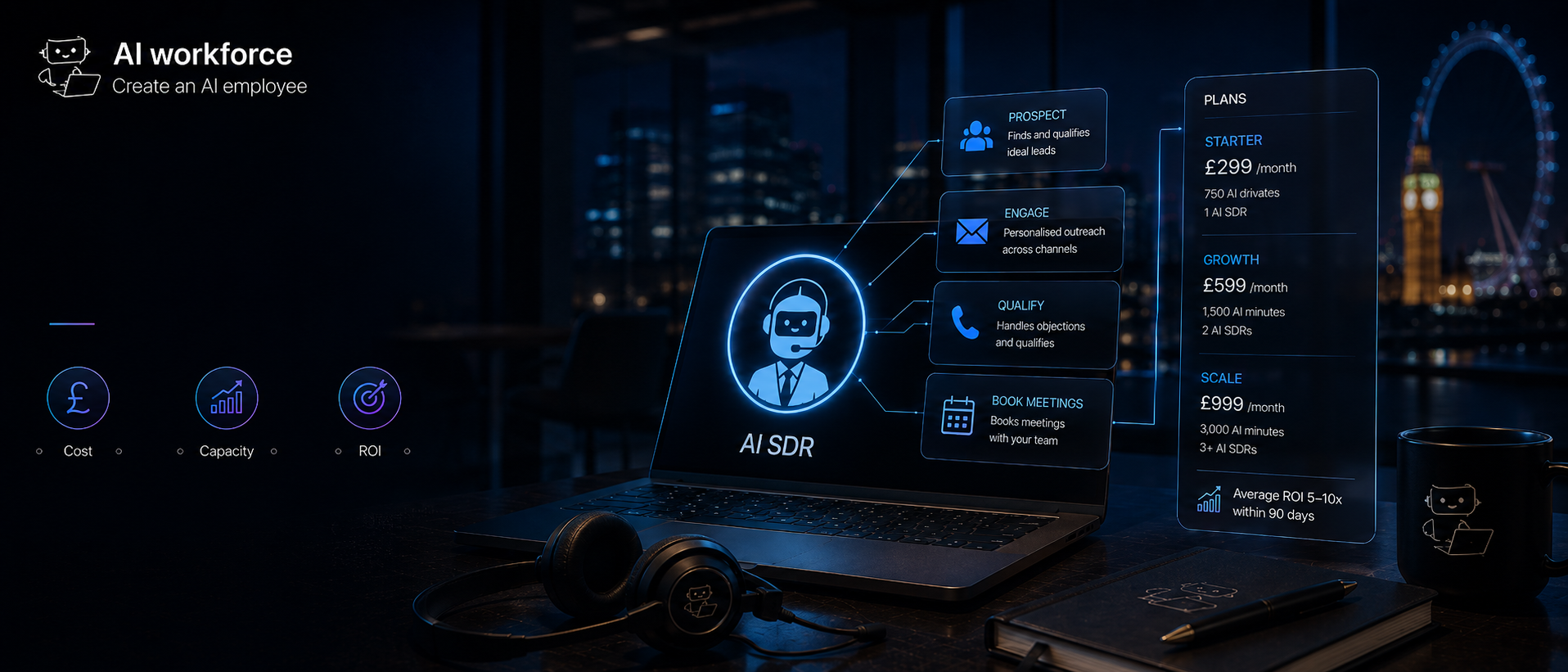
AI Workforce provides a UK-priced option starting at £250 per month plus VAT, with its Standard plan priced at £480 per month plus VAT. Both are broader multi-agent packages that include a Cold Outbound Agent rather than standalone autonomous AI SDR licences. Buyers should therefore compare the included agents, usage allowances and level of autonomy, not price alone.
Once seat minimums, contract terms and volume are factored in, a UK sales team should expect three broad monthly bands rather than a single figure. Lower-cost, seat-based tools sit in roughly the £150 to £400 per user per month range before minimums. Mid-market autonomous AI SDR platforms with published prices, such as 11x's Growth tier, sit in the roughly £2,500 to £3,500 per month range for a single digital worker. Custom-quoted platforms, including Artisan's higher-volume packages and most vendors' Enterprise tiers, can run considerably higher once volume, mailboxes and dedicated support are included, and should always be confirmed with a dated quotation rather than estimated.
Monthly cost is not the same as monthly value. A platform priced per prospect contacted, like 11x, will scale directly with the volume a UK sales team sends, while a platform priced per seat, like Regie.ai's AI SEP tier, will not move regardless of how hard that seat is worked. Before signing, ask a vendor to model at least two volume scenarios in writing: current activity, and a realistic six-month growth scenario, rather than accepting the quoted monthly cost as a ceiling.
How much does an AI SDR cost per month?
Most AI SDR platforms fall between roughly £70 and £400 a month per seat or workflow for the core subscription, before setup fees, lead data credits, voice minutes and email infrastructure are added. A realistic all-in monthly budget for a small UK business typically lands between £300 and £900 once those extras are included. See the AI SDR Total Cost Stack below for what each layer adds.
What is the cheapest AI SDR tool available in the UK?
Entry-level bundled outreach plans start from around £67 to £100 a month, but the lowest published price rarely reflects the real cost once data enrichment, voice calling and setup are added. Compare total monthly cost against your actual workflow rather than the headline subscription price alone.
Is there a free AI SDR tool?
Most platforms offer a free trial or a limited free tier rather than a genuinely free ongoing plan. A free tier is normally capped on lead volume, email sends or seats, and lacks the data enrichment and voice features most outbound workflows need at scale.
How much should a small business budget per month for an AI SDR?
For a single-seat outbound workflow covering email sequencing, basic enrichment and CRM sync, £300 to £600 a month is a reasonable starting budget for most UK small businesses. Adding voice calling or higher-volume data enrichment typically pushes that toward £600 to £900 a month. See the example cost scenarios below for a fuller breakdown by use case.
Not sure what a real deployment would cost your business? Work through the full AI SDR Total Cost Stack against your own volumes with AI Workforce. Get help estimating your AI SDR operating cost
The AI Workforce SDR Total Cost Stack
Comparing AI SDR platforms on subscription price alone consistently understates what a working deployment actually costs. AI Workforce uses the SDR Total Cost Stack to make sure every relevant cost category is considered before a UK business commits to a vendor.
Licence: the platform and seat charges shown on the pricing page.
Volume: contacts, credits, prospects and any overage charges once included volume is exceeded.
Data: enrichment, verification and intent data, whether bundled or billed separately.
Infrastructure: sending domains, mailboxes, warming and dialling capacity.
Implementation: integration work, campaign building, CRM sync and staff training.
Oversight: the time a sales manager or SDR spends reviewing AI-generated replies and messaging before it reaches a prospect.
Compliance: UK GDPR and PECR groundwork: privacy information, suppression list management and channel-specific governance.
AI SDR total cost of ownership = licence + volume + data + infrastructure + implementation + oversight + compliance
Where voice calling is part of the SDR stack, there is an additional usage layer covering speech-to-text, language-model processing, text-to-speech, telephony, phone numbers and concurrency. Our guide to AI voice agent pricing in the UK breaks down those voice-specific costs in detail.
Each category can contribute to the real operating cost, even when a vendor describes its platform as fully autonomous. Some costs may be bundled into the subscription, while others arise through internal staff time, additional services or compliance work. Compliance work is frequently absent from vendor cost estimates, even though UK businesses remain responsible for meeting the applicable UK GDPR and PECR requirements.
Human SDR Cost in the UK: Three Illustrative Scenarios
An SDR's on-target earnings are not the same as an employer's total cost, and quoting one figure as a national benchmark overstates the precision the underlying data actually supports. The table below sets out three illustrative scenarios built from named assumptions, not a single verified industry average, so a UK business can substitute its own figures.
Employer National Insurance for the 2026/27 tax year is charged at 15% on earnings above the secondary threshold of £96 a week (roughly £5,000 a year), and workplace pension contributions are calculated separately from salary.
Cost component | Lean | Typical | Higher-support |
|---|---|---|---|
Base salary | £30,000 | £40,000 | £55,000 |
Expected commission (on-target) | £8,000 | £15,000 | £15,000 |
Employer National Insurance (15% above threshold) | £4,950 | £7,500 | £9,750 |
Minimum employer pension contribution | £953 | £1,321 | £1,321 |
Sales tools and data subscriptions | £2,000 | £3,500 | £5,000 |
Recruitment, onboarding and ramp allowance | £3,000 | £5,000 | £6,000 |
Allocated management time | £2,000 | £4,000 | £6,000 |
Estimated annual total | £50,903 | £76,321 | £98,071 |
Pension contributions vary by scheme. This illustration uses the minimum 3% employer contribution applied to qualifying earnings between £6,240 and £50,270, which is why the pension figure for the Higher-support scenario is capped rather than continuing to rise with salary.
This is an AI Workforce illustrative model, not a national industry benchmark, and the assumptions behind each figure should be adjusted to reflect a specific business, region and role before being used for budgeting. London weighting, more senior hires, higher commission structures or a longer ramp period would all push the higher-support scenario further upward.
Cost Per Held Qualified Meeting: AI vs Human SDR
Monthly platform cost, and even total cost of ownership, only tell part of the story; the metric that actually determines value is cost per meeting that a sales team can genuinely work. A meeting simply being booked is a weak measure on its own, because a system can improve a booked-meetings count while producing meetings that never show up, are wrongly qualified, or go nowhere. The more useful formula is:
Cost per held qualified meeting = total monthly operating cost ÷ held meetings that satisfy the agreed qualification criteria
Applying that formula against the AI SDR Total Cost Stack and the illustrative human SDR scenarios above, a UK business should track, at minimum: meetings booked, meetings actually held, qualification acceptance rate, sales opportunities created, pipeline value generated, revenue won, and opt-out, complaint and bounce rates for the outreach itself. An AI SDR platform that produces cheap booked meetings that rarely convert once qualification and hold rate are applied is not delivering genuine value, regardless of how favourable its headline cost-per-meeting figure looks in isolation. The same discipline applies to a human SDR: on-target earnings divided by a headline meeting count tells a UK business far less than fully loaded cost divided by held, qualified meetings that actually progress into pipeline.
This is the same lesson established across AI Workforce's guide to AI Call Centre automation: a convenient activity metric should never be mistaken for a genuine business outcome, and cost per meeting is only meaningful once "meeting" is defined precisely and consistently across every platform being compared.
UK Compliance: PECR, UK GDPR and Cold Outbound
Automated outbound is not purely a software-price decision for a UK business; it is also a compliance decision, and the rules depend on the recipient type, the channel used and where the contact data came from. Under the Privacy and Electronic Communications Regulations (PECR), the ICO draws a distinction between "corporate subscribers," meaning companies, limited liability partnerships and similar incorporated bodies, and "individual subscribers," which includes sole traders and certain types of partnership. Electronic mail, including email, text messages and direct messages on social platforms, sent to a corporate subscriber generally does not require PECR consent, but the same message sent to a sole trader or an unincorporated partnership is treated the same as marketing to an individual and normally does require consent or a valid soft opt-in.
Publicly available business information, such as a contact found on a company website, Companies House or LinkedIn, is not automatically unrestricted marketing data. If that information identifies an individual, the UK GDPR still applies, and a UK business needs a lawful basis for processing it, must provide appropriate privacy information, and must respect any objection to being contacted. This applies whether the AI SDR platform sourced the data itself through built-in enrichment or the business supplied its own prospect list. Direct messages sent through LinkedIn or similar platforms fall within PECR's definition of electronic mail, and automated LinkedIn activity should also be checked against that platform's own terms of use, which is a separate risk from data protection compliance.
In practice, this means a UK business evaluating any AI SDR platform should confirm: whether the platform screens contacts against corporate versus individual subscriber status before sending, whether it maintains and screens against a suppression list, whether privacy information is provided to prospects in line with UK GDPR, and whether the vendor's own data sourcing practices are documented and auditable. AI Workforce's guide to AI and GDPR compliance covers the underlying data protection obligations in more depth, and is worth reviewing before any outbound AI SDR platform goes live.
Not sure whether your outbound process is ready for AI? Check your data, process and compliance foundations before you commit to a platform. Assess whether your outbound process is AI-ready
When Should You Use AI vs Human SDRs, and What ROI Should You Expect?
The choice of when to use AI vs human SDRs generally comes down to task type rather than a blanket replacement decision. High-volume, well-defined outbound prospecting, where the same qualification questions apply to every prospect, is where AI SDRs currently deliver the strongest return, because the task benefits from consistency and speed more than judgement. Complex, high-value or long sales-cycle deals, where a prospect's objections vary widely and relationship-building matters, remain better suited to a human SDR, at least with current AI SDR capability, and this is where an AI agent works best as a support layer for a person rather than a replacement.
ROI depends heavily on what a business measures, and vendor-reported ROI figures should be treated with appropriate caution, since they are rarely independently verified. A more defensible way to evaluate ROI is to track cost per held qualified meeting, meeting-to-opportunity conversion rate, and opportunity-to-close rate separately, alongside the AI SDR Total Cost Stack set out above, since an AI SDR platform that produces cheap meetings that rarely convert is not delivering real ROI, regardless of how favourable the headline cost-per-meeting number looks.
Some UK sales teams reduce SDR headcount growth and redirect the AI SDR budget there, while others keep their human SDR team stable and use an AI SDR platform purely to expand outreach volume beyond what the human team could otherwise cover. Both are valid uses of an AI SDR platform, but they produce very different ROI calculations and should not be measured against the same benchmark. A structured AI Readiness Assessment is a useful starting point for a UK business trying to work out which of these two paths actually fits its sales operation.
Full AI SDR or AI-Assisted Human SDR: Which Pricing Model Fits Your Team?
A fully autonomous AI SDR platform, one that researches, writes, sends and books meetings with minimal human review, generally suits a business with a well-defined, repeatable outbound motion, a single core buyer persona, and a sales team confident enough in the process to accept a certain amount of imperfect AI-generated copy in exchange for volume and speed. This model tends to favour usage-based or credit-based pricing, such as 11x's per-prospect model, since cost should track directly with the outreach volume the platform is actually producing.
An AI-assisted setup, where a human SDR remains in the loop and the platform handles research, drafting and sequencing rather than full autonomy, tends to suit UK sales teams selling into more complex or regulated markets, where a person needs to review messaging before it reaches a prospect, particularly given the PECR and UK GDPR considerations set out above. This model often fits per-seat pricing better, such as Regie.ai's AI SEP tier, since the value delivered is closer to a productivity tool for an existing sales rep than a replacement for one.
Inbound use cases, where the platform qualifies and routes inbound leads rather than generating outbound activity, sit somewhat apart from both models and are increasingly priced on a per-lead or per-conversation basis. This is closer to the territory covered in AI Workforce's guide to AI agents for small business, where a narrower, single-workflow deployment is usually the more sensible starting point than a full outbound platform. Match the pricing model to how the platform will actually be used, not whichever pricing structure a vendor's sales rep presents first.
How Should You Evaluate an AI SDR Platform Before You Buy?
Evaluating AI SDR platforms properly starts with defining the workflow before comparing vendors: how many prospects need reaching each month, which channels matter, what a qualified meeting actually looks like for your business, and which UK compliance requirements apply to your prospect data. Without that baseline, the platform with the lowest published price can easily become the most expensive once volume, data costs and add-ons are factored in against a mismatched workflow.
Ask every vendor the same questions during evaluation: what is included in the published price and what costs extra; what a realistic six-month UK volume scenario would cost rather than the entry-level tier; what happens contractually if the platform underperforms during the first quarter; and how the platform screens UK contacts for corporate versus individual subscriber status before sending marketing by electronic mail. Requesting real numbers for meetings booked, meetings held, and cost per held qualified meeting from existing customers in a comparable UK industry is one of the most reliable ways to sense-check a vendor's own projections.
Finally, weigh the platform against what it is replacing or augmenting, using the AI SDR Total Cost Stack and the human SDR cost scenarios above as your baseline. If an AI SDR platform is being evaluated against hiring an additional human SDR, compare the fully loaded human SDR scenario closest to your own business against the AI SDR platform's realistic, all-in monthly cost. If it is being evaluated as a productivity layer for an existing sales team, measure the pricing against time saved per rep rather than against a human SDR's total compensation, since that is a different, generally more modest, return to expect. AI Workforce can also help identify measurable time savings; see the guide to AI productivity in the UK for the underlying evidence.
Ready to see how this applies to your sales team? AI Workforce can help determine which pricing model best fits a specific UK sales motion, without guaranteeing meeting volume. Discuss an AI SDR pilot with AI Workforce
Key Things to Remember
AI SDR pricing in 2026 spans low-cost, seat-based software through to multi-thousand-pound monthly platforms with annual commitments; not every vendor publishes a monetary price at all
Four pricing models dominate: per-seat, usage-based, credit-based and per-meeting or outcome-based pricing, each producing very different bills for the same nominal activity
11x's own pricing page and FAQ give two different annual totals for its Growth plan ($45,000 implied by the monthly price versus $36,000 stated in the FAQ); confirm the real figure directly with the vendor
Artisan does not publish a monetary starting price; treat any figure quoted elsewhere as a third-party estimate unless it comes with a dated quotation
The AI Workforce SDR Total Cost Stack (licence, volume, data, infrastructure, implementation, oversight and compliance) is a more reliable way to budget than the headline subscription price
Human SDR cost should be modelled through explicit, named assumptions, not a single universal UK figure; base salary, commission, employer National Insurance, pension, tools and management time all belong in the calculation
Cost per held qualified meeting, not meetings booked or emails sent, is the metric that actually determines value
UK PECR and UK GDPR rules differ by recipient type and channel, and must be built into vendor evaluation, not treated as a formality after signing
AI Workforce offers UK-priced multi-agent plans from £250 per month plus VAT, including a Cold Outbound Agent, but these bundled plans should not be treated as directly equivalent to standalone autonomous AI SDR products
Sources and Further Reading
Written by Clara Miller, Content Specialist at AI Workforce. Clara researches AI adoption, business applications and technology buying considerations for UK organisations.
Reviewed by Rodi Taze, Co-Founder of AI Workforce. Rodi reviewed the article's commercial assumptions, implementation considerations and AI-versus-human operating model.