AI Receptionist for Estate Agents: Calls, Viewings and Lead Qualification
Posted On: September 5, 2026
Written by Clara Miller, Content Specialist at AI Workforce · Reviewed by Rodi Taze, Co-Founder of AI Workforce · Last updated: September 2026
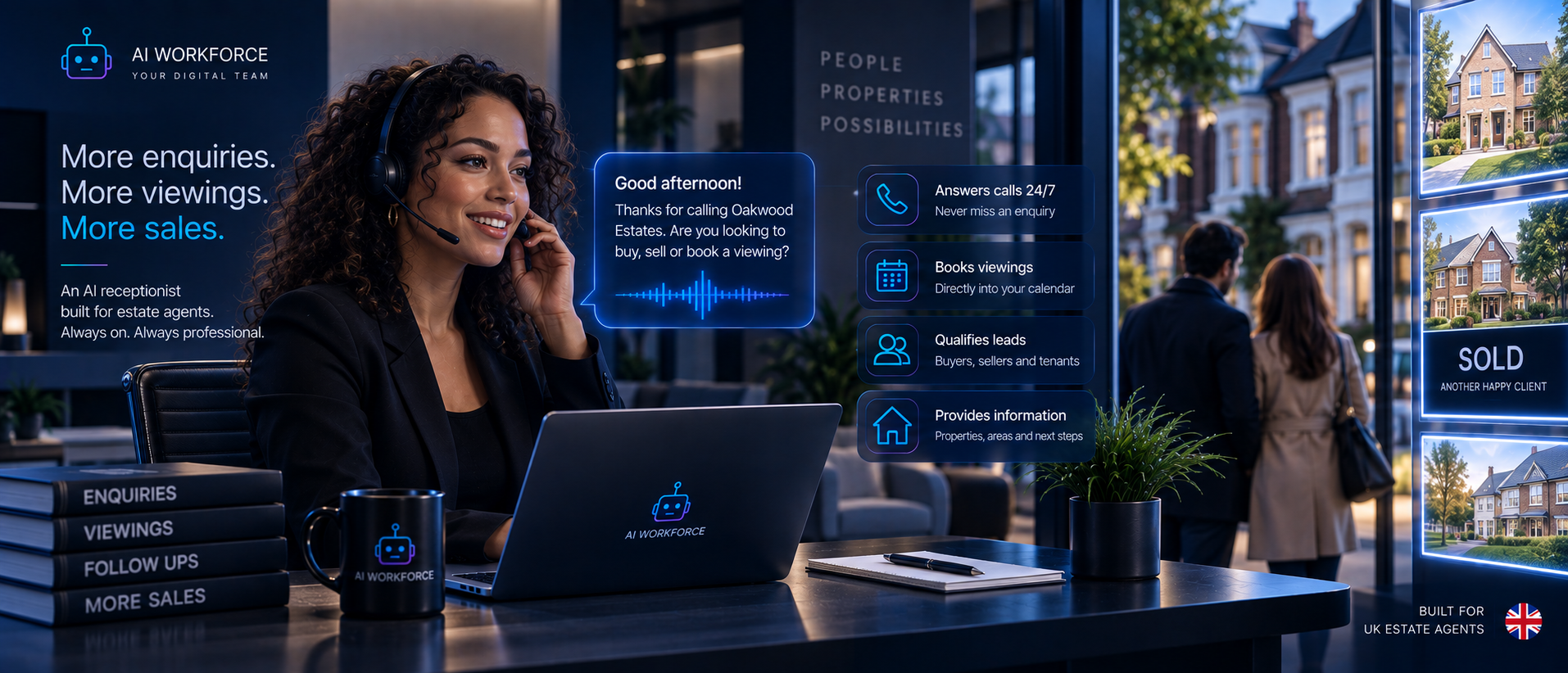
Quick answer: An AI receptionist for an estate agency can answer routine property enquiries from verified listing data, book viewings against real calendar availability, capture valuation and landlord leads, and take structured messages from existing vendors, buyers, landlords and tenants. It should not decide who qualifies for a tenancy or purchase, make affordability judgements, quote information that isn't in the current listing record, or resolve disputes, legal questions or safeguarding concerns. Negotiators, valuers and branch staff remain necessary for negotiation, viewings requiring accompaniment or expertise, complaints, and anything the system cannot verify from approved data. Used well, it reduces missed calls during viewing runs, peak periods and out-of-hours windows, while routing anything sensitive or ambiguous to a person.
At a Glance
What it is: a voice AI system that answers estate agency phone lines and handles calls using approved listing data, calendar rules and defined workflows
Best suited to: agencies with multiple live listings, negotiators regularly out on viewings, and call volume that spikes around new listings or weekends
Strongest use cases: property enquiries, viewing bookings, valuation and landlord lead capture, after-hours and overflow cover
Biggest benefit: fewer missed enquiries, viewing and valuation calls when negotiators are on the road or the branch is at capacity
Biggest risk: answering from stale or incomplete listing data, for example confirming a property is available when it is SSTC or let agreed
Typical implementation: phased rollout starting with FAQ and viewing calls, then valuation capture, then wider call types once accuracy is proven
Key human handoff requirement: negotiation, complaints, legal or contractual questions, safeguarding, and anything outside the approved listing or transaction data must route to a person
What's Covered
How It Handles Calls
Booking and Qualification
Leads and Existing Clients
Risk and Compliance
Buying and Rollout
Reference
What Is an AI Receptionist for an Estate Agency?
An AI receptionist for an estate agency is a voice AI system connected to the branch or agency phone number that answers calls about live listings, viewings, valuations and existing transactions using information the agency has approved in advance. It is not a generic call-answering script bolted onto a phone line: to be useful for property calls it needs a live connection to listing data (price, availability status, bedrooms, key features, council tax band and similar), access to negotiator or branch diaries for booking, and a defined set of rules for what it can answer directly versus what it must hand to a person.
This is distinct from a general answering service or a generic AI receptionist used across unrelated industries: an estate agency's calls are dominated by time-sensitive, transaction-linked information, whether a listing is still on the market, whether a viewing slot is free, whether a landlord's property has been valued yet, that a generic FAQ bot has no reliable way to answer without a direct data connection. For a broader comparison of AI receptionists against outsourced human answering services across sectors, see our AI receptionist vs answering service guide.
Why Estate Agents Miss Valuable Calls
Estate agency call patterns make missed calls structurally likely, not just a staffing problem. Negotiators spend a meaningful share of the working day out of the office conducting viewings, valuations and appraisals, which is precisely when property enquiry calls tend to arrive. Branches can experience peaks after new listings go live, around weekend viewing activity, and when several active listings generate enquiries at the same time, and call volume can exceed what the desk can answer in real time. Enquiries can also arrive outside branch opening hours, particularly when prospective buyers or tenants are browsing listings in their own time. A single popular listing can generate several enquiry calls within the same hour, all wanting broadly the same information at once. None of this requires an invented statistic to be true; it follows directly from how negotiators' diaries and buyer browsing habits actually work, and it can mean some enquiry, viewing and valuation calls go to voicemail or ring out when an agency relies solely on available staff answering live.
What Calls Can an AI Receptionist Handle?
Estate agency calls fall into a small number of recurring categories, and they are not equally suited to automation.
Property enquiries. Is the property still available, what's the asking price or rent, is parking included, is it furnished or unfurnished, are pets considered, what council tax band applies, how many bedrooms. These are automatable when the answer exists in the current, approved listing record, and should never be answered from memory or inference if the listing data doesn't cover the question.
Viewing requests. A caller wants to book, move or cancel a viewing on a specific property. Automatable where a calendar system with real negotiator or branch availability is connected; covered in detail below.
Vendor and landlord enquiries. A homeowner wants a valuation, or a landlord wants a property appraised for letting. Partly automatable: the AI can capture postcode, property type and basic details and route or book a valuer, but the valuation judgement itself is never automated.
Existing client calls. A seller wants an update on their sale, a landlord has a query, a tenant is reporting a maintenance issue, a buyer is asking about progression. These are the calls to treat most carefully: the AI can identify the caller and route or capture a detailed message, but should not invent or guess at where a transaction currently stands, since getting this wrong damages trust more than a missed call would.
Complaints, negotiation conversations, contractual and legal questions, and anything ambiguous or emotionally charged sit outside what any of these call types should be answered by AI, regardless of category, and should escalate to a person. For broader call-handling design patterns beyond estate agency specifics, see our AI call handling guide.
The AI Workforce Estate Agency Call Routing Model
This is an AI Workforce framework, not an industry standard.
Six Call Categories
1. Property Information: AI answers directly from verified, current listing data — price, availability, features, council tax band and similar
2. Viewing/Appointment: AI collects caller and property details and books directly where calendar rules and availability allow
3. New Business Opportunity: valuation, landlord and vendor leads are captured, qualified against a fixed set of questions, and routed to the right branch or valuer immediately
4. Existing Transaction: AI identifies the caller where possible and routes to the handling negotiator or takes a detailed message, and never invents a progression update it cannot verify
5. Property Management/Maintenance: routine maintenance requests are captured and categorised for the property management team; anything matching a predefined emergency definition follows a fixed escalation path
6. Sensitive/Complex/Disputed: complaints, negotiations, legal questions, safeguarding concerns and anything ambiguous go straight to a person
The categories exist so that every incoming call is assigned a handling rule before the conversation goes further than a few exchanges, rather than the AI improvising its way through an unfamiliar call type.
Which Calls Should an Estate Agency Automate First?
The safest starting point is usually not every inbound call. Start with calls that are high-volume, repetitive and easy to verify against a fixed data source.
Best first: property availability, basic listing questions, viewing requests and valuation lead capture
Next: routine landlord enquiries and structured maintenance capture
Later or human-first: transaction progression, negotiation, complaints, legal questions and sensitive tenant matters
This sequencing matters because the easiest calls to automate are not necessarily the most commercially valuable, and the most commercially valuable calls are not always the safest to automate completely.
How Would It Handle a Property Enquiry?
A caller rings about a two-bedroom flat they saw on a portal. The AI asks which property, using the address or portal reference to identify the exact listing, then retrieves the current, approved listing record rather than relying on anything it might recall from an earlier call or a cached page. It answers the caller's routine questions- rent or price, whether it's furnished, parking- from that record. If the caller asks something the listing record doesn't cover, an unusual lease condition, for example, it says so plainly and offers to check with the branch rather than guessing. It then asks whether the caller would like to view the property, checks the connected calendar for negotiator or branch availability, and if a slot is available, captures the caller's name, phone number and email, confirms the booking, and sends a confirmation message. The lead is logged to the CRM immediately, tagged with the property and enquiry source. If nothing in the listing record matches what the caller is asking, or the property can't be identified from what the caller gives, the call escalates to a person rather than the AI producing an answer from general knowledge about the local area or the property type.
Can an AI Receptionist Book Property Viewings?
Yes, where it has a live connection to the relevant diary or diaries. In practice, this means checking negotiator- or branch-level availability, not just a single generic calendar, since different negotiators cover different postcodes or property types. The system needs to know standard viewing duration for the property type, any buffer time built in for travel between viewings, and whether the property requires an accompanied viewing (agent present) or can be unaccompanied, since this affects which diary the booking actually needs to sit on. Rescheduling and cancellation should be handled with the same rules as an initial booking, checking availability before confirming a change rather than simply accepting whatever time the caller requests. Confirmation should go to the caller by text or email immediately, and the booking should be written back to the CRM and calendar in the same step to avoid a slot being offered twice. If the diary or calendar system is unavailable at the time of the call, the safe behaviour is to take the caller's details and preferred times and arrange a callback to confirm, rather than confirming a slot the system cannot actually verify is free. Double-booking prevention depends entirely on this live connection; a system quoting availability from a static or cached calendar will eventually double-book a viewing. The underlying calendar-routing and booking controls are similar to those used by an AI appointment setter, although an estate-agency workflow also needs property-specific routing and viewing rules on top.
Can It Qualify Buyers and Tenants?
An AI receptionist can collect a defined, factual set of information: whether the caller is looking to buy, sell, rent or let; the property or location they're interested in; budget or rent range; desired move-in or completion timeframe; mortgage position (agreed in principle, cash buyer, not yet arranged) where the agency's process asks for this; chain position where relevant to a sale; and whether the caller is a landlord or vendor rather than a buyer or tenant. This is straightforward data collection against a fixed script, comparable to what a front-desk negotiator would ask on a first call.
What it must not do is decide who is suitable for a specific property, reject an applicant, make any affordability determination, or draw inferences about a caller's circumstances, including anything that touches a protected characteristic, from how they speak or what they say. Those are judgements for a person, and in a lettings or sales context carry legal and regulatory weight that should never sit with an automated system. The AI's role ends at capturing accurate, factual information and passing it to the negotiator who will make the actual qualification decision.
Can It Capture Valuation and Landlord Leads?
This is one of the most commercially valuable things an AI receptionist can do for an estate agency, because a missed valuation or landlord enquiry can mean losing a valuable instruction opportunity, not simply missing an information request. A homeowner calling to ask about a valuation, or a landlord enquiring about letting a property, represents new business rather than an existing listing enquiry, and these calls are worth routing and capturing with more urgency than a routine FAQ call.
Worked example: a homeowner calls asking for a valuation. The AI captures the property's postcode and type, whether it's for sale or to let, and the homeowner's name and contact details, then checks which branch or valuer covers that postcode. Where the diary allows, it books a valuation appointment directly; where it doesn't, it arranges a callback within a stated timeframe. Either way, a CRM lead record is created immediately, before the call ends, so the enquiry cannot be lost even if the follow-up call is delayed. These calls can carry greater commercial value than a routine property-information enquiry because they may represent a potential new instruction rather than a question about an existing listing.
What About Existing Vendors, Buyers, Landlords and Tenants?
Calls from people already in a live transaction, a seller checking progress, a landlord with a query about their let, a buyer asking where their purchase stands, need more caution than a fresh enquiry, because the caller usually already has context the AI may not fully have. The safer design is to identify the caller where possible, using name and phone number or a reference, and route the call to the handling negotiator, or take a detailed message including what the caller wants to know. Answering from incomplete transaction data is a real risk here: a partial CRM record can be wrong or out of date at exactly the moment a caller wants a precise, current answer, and a confidently wrong answer to an existing client is worse for the relationship than a message that gets a same-day callback.
Maintenance and Emergency Calls
For agencies handling property management, maintenance calls need a clear split between routine and urgent. Routine requests- a dripping tap, a query about a service charge, a request to arrange an inspection- can be captured with a description, property address and the tenant's contact details, categorised, and passed to the property management team to schedule. Anything matching the agency's predefined urgent or emergency criteria — for example, a suspected gas leak, serious flooding, loss of property security, or another condition the agency has formally classified for urgent escalation — should follow the relevant fixed escalation path set by the agency in advance, typically an immediate transfer or an urgent notification to an on-call contact, rather than being queued with routine requests. The workflow should match the caller's description against agency-approved emergency triggers and immediately follow the predefined escalation or emergency instruction. Where the situation is unclear, it should escalate rather than attempt to assess the underlying safety risk itself.
AI Receptionist vs Human Receptionist for Estate Agents
For estate agencies specifically, the practical operating difference is less about cost and more about what each option is doing while negotiators are out on viewings. An individual receptionist or negotiator can only handle one live call at a time, while a staffed branch remains limited by how many people are available to answer simultaneously, and staff are often also managing walk-ins and admin between calls, which is exactly when enquiry calls get missed during a busy viewing day. An AI receptionist can handle multiple enquiry or viewing-booking calls concurrently, subject to the provider's telephony and concurrency limits, and works the same during a Saturday viewing rush as it does on a quiet Tuesday morning, but it should never be the one handling a vendor negotiation, a complaint about a botched viewing, or a landlord dispute. A broader comparison of AI versus human versus hybrid call handling, including cost structures and caller experience, is covered in our AI receptionist vs answering service guide, which this section deliberately doesn't repeat.
What Systems Should It Integrate With?
For an AI receptionist to be useful rather than risky in an estate agency, it needs a live connection to several systems rather than operating from a static script. This typically means the agency's CRM or property-management system, for lead capture, transaction status and client records; the listings or property database, which should be the single authoritative source of truth for price, availability and property details rather than the AI holding its own separate copy; negotiator and branch calendars, for viewing and valuation booking; the telephone system itself, for call routing and transfer; and email or SMS, for confirmations. Website lead forms are also commonly connected so that a caller's enquiry and an online enquiry about the same property land in the same record rather than creating duplicates. We don't claim specific named integrations here; confirm what any given platform actually supports for the systems your agency uses before assuming compatibility. The core principle that matters more than any specific integration list is that listing and property data must have one authoritative source the AI reads from, not several that can drift out of sync with each other.
What Happens If Property Information Changes?
Listing information changes constantly in an estate agency: a price gets reduced, a property goes under offer or becomes sold subject to contract, a viewing slot fills, a landlord changes the tenancy terms. An AI receptionist answering from anything other than the current, approved record will eventually tell a caller a property is available when it has gone SSTC, or quote a price that was reduced last week. The system should retrieve listing information at the point of the call rather than caching it indefinitely, and where two records disagree, a portal listing not yet updated against an internal system change- the safer behaviour is to escalate rather than pick one arbitrarily. This is a design and process issue as much as a technical one: whoever updates listing status internally needs to understand that a delay in updating the source system is a delay in the AI giving accurate answers to every caller in between.
Where Can an Estate Agency AI Receptionist Go Wrong?
Failure mode | Control |
|---|---|
Says a property is available when it's SSTC or let agreed | Retrieve status live at call time from the single authoritative listing source; never cache indefinitely |
Quotes an outdated asking price or rent | Same live retrieval requirement; flag conflicting records for human review rather than picking one |
Books the wrong branch or negotiator | Route bookings by postcode or listing owner, not a single shared calendar |
Creates a duplicate viewing booking | Real-time calendar write-back at the point of confirmation, not batched afterwards |
Fails to recognise an urgent maintenance issue | Fixed, agency-defined emergency criteria with a default to "treat as urgent" when unclear |
Mishears a postcode, name or email | Read back key details before confirming; spell out unusual names and postcodes |
Gives information not in the property record | Hard rule: if it's not in the approved listing data, say so and offer to check, don't infer |
Answers a legal or contractual question it should have escalated | Explicit escalation trigger for legal, contractual and dispute-adjacent language |
Loses context during a transfer to a person | Pass a call summary and captured details to the receiving negotiator, not just the call itself |
CRM or calendar integration failure mid-call | Fallback to message-and-callback rather than confirming anything the system can't verify |
None of these is reasons to avoid an AI receptionist outright; they're reasons to treat listing data accuracy, calendar integration reliability and escalation rules as the things worth getting right before expanding scope.
UK GDPR and Data Protection Considerations
This section is general information, not legal advice.
An AI receptionist handling estate agency calls processes personal data from the first call: caller names, phone numbers, email addresses, property interests, and in valuation and landlord calls, address and ownership details. Where calls are recorded or transcribed, that recording is itself personal data, and callers should generally be told a call may be recorded and why. A documented lawful basis, a defined retention period rather than indefinite storage, and clear privacy information covering how call data is used are standing requirements, not a one-off setup task. Any third-party platform or subprocessor handling call audio, transcripts or CRM data should be checked for where that data is stored and processed, and access to CRM records created from calls should be limited to those who need it, consistent with data minimisation. Human oversight of what the AI is capturing and how it's stored should be an ongoing part of running the system, not a one-time compliance check at setup. For general guidance on UK GDPR requirements, see the ICO's guidance hub. Our AI and GDPR compliance guide covers lawful basis, retention and processor due diligence in more depth.
How Much Does an AI Receptionist for an Estate Agent Cost?
Cost depends on call volume and minutes used, one-off setup and configuration, the number and complexity of integrations (CRM, listings database, calendars), telephony and number costs, whether human escalation cover is included or arranged separately, and the level of ongoing support. An agency with several branches, multiple listing feeds and CRM integrations will generally see a higher setup cost than a single independent branch answering FAQs and viewing requests. For detailed, dated figures from named UK providers, see our AI receptionist pricing guide, which this section doesn't attempt to duplicate.
Not Sure What This Would Look Like for Your Agency?
We can help you map your call types, listing data setup, calendar structure and escalation rules before recommending an approach.
Is an AI Receptionist Worth It for an Estate Agency?
Whether it's worth it depends on your own call volume, missed-call rate and conversion, not a generic industry claim. The KPIs worth tracking are the inbound answer rate, the enquiry capture rate (enquiries that result in a logged lead rather than a dropped call), the viewing-booking rate, the number of valuation leads captured, the number of landlord leads captured, the successful transfer rate to a person when escalation is needed, the incorrect-answer rate found on transcript review, the abandoned-call rate, and the cost per qualified enquiry.
Illustrative ROI Formula
This is an illustrative formula, not a benchmark. Insert your own numbers.
Monthly value = additional qualified enquiries captured × conversion rate × average gross profit attributable to conversion
An agency should build this out with its own real figures, its own historical missed-call volume, its own enquiry-to-instruction or enquiry-to-let conversion rate, and its own average fee or margin, rather than relying on any generic percentage claimed elsewhere.
Four-Week Rollout Plan
Week 1: analyse existing call types and missed-call patterns from real phone data, not assumptions
Week 2: build the knowledge base from current listing data, define routing and escalation rules
Week 3: pilot on after-hours and overflow calls only, while the desk continues handling live-hours calls
Week 4: review call transcripts and results, correct any inaccuracies, and expand scope only if accuracy supports it
Before You Buy: Estate Agency Checklist
Can the system connect live to your actual listings database, not a manually maintained separate copy?
Can it check negotiator or branch-level calendar availability, not just one shared calendar?
Does it distinguish accompanied from unaccompanied viewings when booking?
What happens if the calendar or CRM integration goes down mid-call?
Can it route valuation and landlord enquiries to the correct branch by postcode?
Does it create a CRM lead record immediately, before the call ends?
What's the defined escalation path for maintenance emergencies?
What triggers a transfer to a person, and can you review and adjust those triggers?
Can you review call transcripts to check for inaccurate answers?
How is stale or conflicting listing data handled?
What personal data is captured, where is it stored, and for how long?
Does the provider disclose subprocessors handling call audio or transcripts?
How quickly can the knowledge base be updated when a listing changes?
What does a pilot period look like before wider rollout?
Frequently Asked Questions
Can an AI receptionist book property viewings?
Yes, where it has live access to negotiator or branch calendars, correct viewing duration for the property type, and rules for accompanied versus unaccompanied viewings. If the calendar system is unavailable, it should take details and arrange a callback rather than confirming an unverified slot.
Can an AI receptionist answer questions about a property?
Yes, from the current, approved listing record, price, availability, features and similar. It should not answer anything the listing data doesn't cover, and should say so rather than guessing.
Can AI qualify estate agency leads?
It can collect factual information, budget, move date, mortgage position, and chain position, against a fixed set of questions. It should not decide who is suitable for a property or make affordability judgements; that stays with a person.
Can an AI receptionist handle valuation enquiries?
Yes, it can capture postcode, property type and contact details, check branch or valuer coverage, and book an appointment or arrange a callback, with a CRM lead created immediately.
Can it work outside estate agency opening hours?
Yes. It can answer enquiries that arrive during evenings, weekends or other periods when the branch is closed.
Can it transfer calls to a negotiator?
Yes, and it should, for negotiation, complaints, existing transaction details it can't verify, and anything outside its approved scope, passing a summary of the call along with the transfer.
Does an AI receptionist integrate with an estate agency CRM?
Capable platforms can connect to a CRM or property-management system for lead capture and status lookup, though exact supported integrations vary by provider and should be confirmed directly.
Can it handle landlord and tenant calls?
It can capture landlord enquiries and route or book a valuation, and can take routine maintenance reports from tenants with fixed escalation for anything matching a predefined emergency. It should not answer detailed tenancy or transaction questions from incomplete data.
Is an AI receptionist GDPR compliant?
It can be operated compliantly, but compliance depends on configuration, lawful basis, retention and processor arrangements, not the product alone. This is general information, not legal advice; see our AI GDPR compliance guide.
How much does an AI receptionist for an estate agent cost?
It depends on call volume, setup complexity, integrations and support level. See our AI receptionist pricing guide for dated figures from named UK providers.
Can AI replace an estate agency receptionist?
No, not entirely. It can handle a meaningful share of routine enquiries, viewing and lead-capture calls, but negotiation, complaints, legal questions and anything requiring judgement still need a person.
Key Takeaways
An AI receptionist should answer from live, approved listing data, never from memory or inference, to avoid quoting stale prices or availability
Viewing bookings require real calendar integration by negotiator or branch, with clear rules for accompanied versus unaccompanied viewings
Valuation and landlord leads are commercially different from routine FAQ calls and deserve immediate CRM capture and fast routing
Existing client calls are safer routed or messaged than answered from incomplete transaction data
Maintenance emergencies need a fixed, predefined escalation path; the AI shouldn't make the safety judgement itself
Human escalation belongs throughout the system, not as a single fallback category
Track answer rate, enquiry capture, viewing-booking rate, valuation and landlord leads, and incorrect-answer rate to judge whether it's working
Provider selection, pricing detail and AI-versus-human comparisons are covered in our other guides; this one focuses on how it operates inside an estate agency's actual call flow
See How This Would Work for Your Agency
We'll map your call types, listing data, calendar structure and escalation rules before recommending an approach.
About the author: Clara Miller is a Content Specialist at AI Workforce, covering how UK estate agencies apply AI to calls, viewings and lead handling.
Reviewed by: Rodi Taze, Co-Founder of AI Workforce, for accuracy of the call routing model, escalation design and UK compliance framing.
Reviewed: September 2026.
© 2026 AI Workforce Ltd. All rights reserved.