AI Sales Agent Pricing UK: Costs, Setup and Monthly Fees
Posted On: September 4, 2026
Written by Clara Miller, Content Specialist at AI Workforce · Reviewed by Rodi Taze, Co-Founder of AI Workforce · Last updated: September 2026
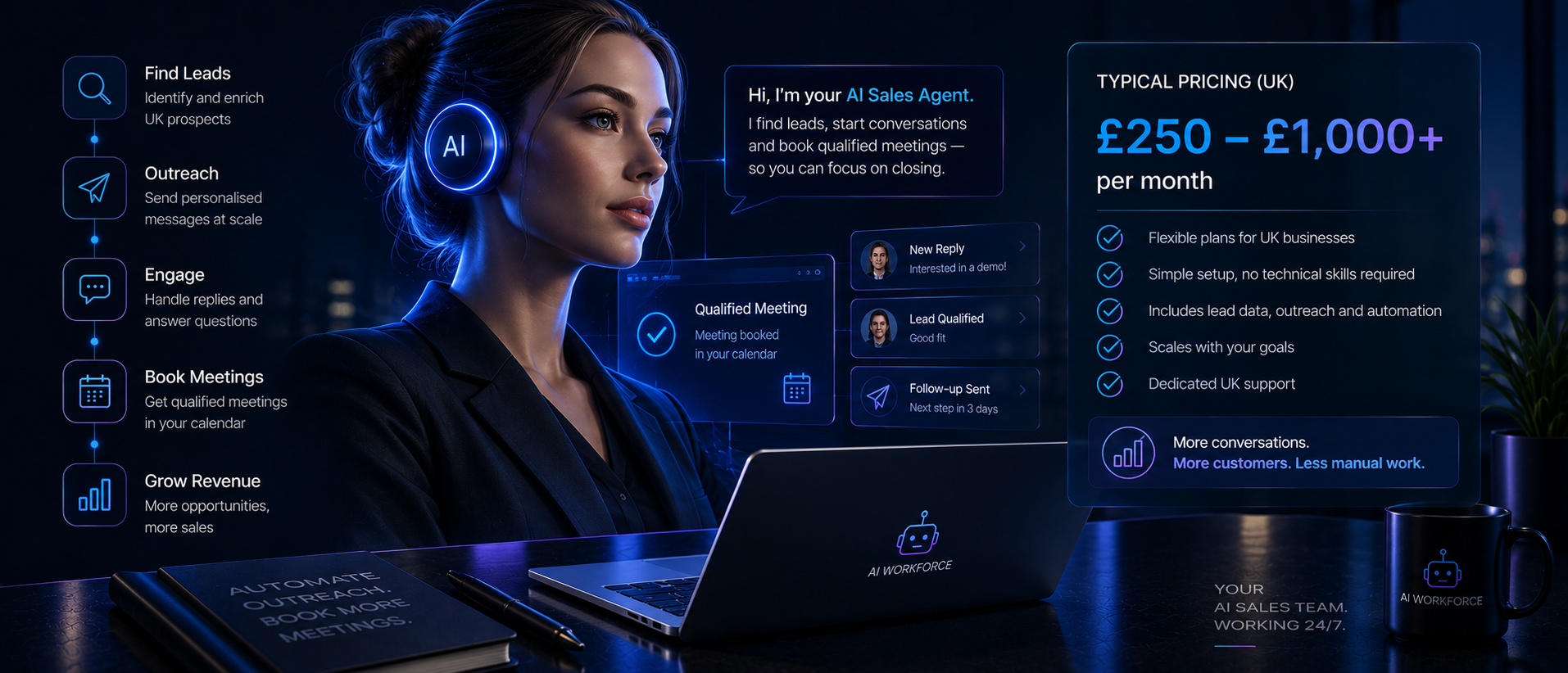
AI sales agents can cost from under £100 a month for simpler bundled software to several hundred pounds per user or agent each month for more capable platforms, before lead data, email infrastructure, voice calling, CRM integrations and implementation are added. The real cost therefore depends less on the headline licence fee and more on how much of the sales workflow the agent actually handles. This guide breaks down current UK pricing, published vendor examples, hidden costs and the full cost stack to help you estimate what an AI sales agent would realistically cost for your business.
Quick answer: AI sales agent pricing in the UK typically combines a platform or licence fee with usage charges for contacts, credits or conversations, plus separate costs for lead data, email infrastructure, voice calling and CRM integration. Published platforms checked for this guide range from roughly £67 a month for simpler bundled outreach software to several hundred pounds per user or agent each month for more advanced platforms. The true monthly cost depends on your lead volume, channels, integrations and how much of the sales workflow the agent is expected to handle.
AI Sales Agent Pricing at a Glance
Cost component | Typical charging model | What affects it |
|---|---|---|
Platform/licence | Per seat, per agent, or a flat monthly platform fee | Number of users, agents deployed, features unlocked |
Setup/implementation | One-off fee, or bundled into a managed plan | Number of workflows, CRM complexity, data migration |
Lead data/enrichment | Per credit, per contact, or bundled monthly allowance | Data provider used, contact volume, enrichment depth |
Email infrastructure | Bundled into platform fee, or per mailbox/sending domain | Send volume, deliverability tooling, warm-up needs |
Voice calling | Per minute, usually billed separately from the platform fee | Call volume, telephony provider, concurrency |
CRM / calendar integration | One-off build cost, sometimes an ongoing API usage fee | Which CRM, custom fields, bi-directional sync needs |
Monitoring/support | Included in platform fee, or a separate retainer | Oversight level, prompt updates, escalation handling |
Figures throughout this guide reflect publicly listed vendor rates checked in September 2026 and are illustrative rather than quotes. Vendor pricing changes; confirm current rates directly before budgeting.
Sterling comparisons in this guide use an illustrative exchange rate of £1 = $1.27, checked in September 2026. They are rounded for comparison, are not live exchange-rate quotations, and should be treated as indicative. Always check current vendor pricing and exchange rates before budgeting.
How Much Does an AI Sales Agent Cost in the UK?
There is no single market price for an AI sales agent, because "AI sales agent" describes a role rather than one product category. Some platforms sell a narrow AI SDR that only handles outbound prospecting and meeting booking; others sell a broader AI sales agent that can qualify inbound leads, run follow-up sequences, prepare briefing notes ahead of a call, and take actions inside a CRM such as updating deal stages or logging activity. The wider the role, the more cost components tend to stack up, which is the core reason pricing looks so inconsistent across vendors.
As a working reference point, checked directly against official vendor pricing pages in September 2026: Salesforce's UK Agentforce pricing currently lists the Agentforce User Licence at £4 per user per month, with usage billed separately through Flex Credits at £400 per 100,000 credits. Standard Agentforce actions consume 20 Flex Credits, while Agentforce Voice actions consume 30. Its bundled Agentforce 1 edition still starts at around £433 per user per month (converted from the $550 USD figure on Salesforce's current pricing page), including an add-on licence plus an annual credit allowance. Clay's current pricing page lists Launch at roughly £131 per month and Growth at roughly £351 per month (converted from $167 and $446 USD). Its live pricing page currently shows 3,000 monthly data credits on Launch and 6,000 on Growth, although Clay's own documentation still displays an older $185/$495 structure with different Launch credit allowances, so buyers should confirm the current plan price and included credits directly before budgeting. Instantly.ai currently lists its Starter bundle at roughly £67 per month on the discounted rate, versus roughly £74 on standard monthly pricing (converted from $85 and $94 USD), including 5,000 emails, 1,000 uploaded contacts and its AI Sales Agent feature. Its Scale bundle is listed at roughly £138 per month on the discounted rate (converted from $175 USD). HubSpot's Sales Hub, which includes AI-powered prospecting features consuming HubSpot Credits, runs from around £16 per seat per month on its Starter tier (monthly billing) to around £79 per seat per month on Professional, with a one-off onboarding fee of roughly £1,181 (converted from $20, $100 and $1,500 USD). These four vendors illustrate just how differently "AI sales agent" pricing can be structured: per user, per credit, per bundled plan, or per seat with a separate credit allowance.
For UK buyers, most of the leading platforms are US-headquartered and price in dollars, so currency movement is a real budgeting factor on top of the underlying pricing structure. Confirming currency, VAT treatment and any regional pricing before signing is worth doing explicitly rather than assuming a dollar price translates cleanly into pounds.
What Is Included in AI Sales Agent Pricing?
Breaking a quote into its underlying components is the most reliable way to compare vendors fairly, since a low headline number can hide a cost that appears elsewhere. This is also where the AI sales agent versus AI SDR distinction starts to matter in practice: an AI SDR's cost stack is mostly outbound-focused (data, sending infrastructure, sequencing), while an AI sales agent's stack typically also includes qualification logic, meeting preparation, and CRM read/write actions across the pipeline.
Platform/licence
This is the core subscription: a per-seat, per-agent or flat platform fee that unlocks the software itself. Salesforce Agentforce's £4 per user per month base licence versus its roughly £433 per user per month Agentforce 1 edition shows how wide this single line item alone can vary, before any usage is added. For a broader comparison of platform features across vendors, see AI Workforce's guide to the best AI sales automation tool platforms for 2026.
Setup and implementation
This covers configuring qualification criteria, connecting a CRM, defining what "qualified" means for a specific business, and testing before go-live. HubSpot, for example, publishes a separate one-off Professional onboarding fee of roughly £1,181 (converted from $1,500 USD) on top of its monthly seat price. A narrow, single-workflow deployment needs relatively little setup; an agent handling qualification, follow-up and CRM actions across multiple pipeline stages needs considerably more design and testing time.
Lead data and enrichment
An AI sales agent that qualifies or prioritises leads usually needs enriched contact and firmographic data to work from. Clay prices this through a credit system starting at roughly £0.04 per data credit (converted from $0.05 USD), with credits becoming more cost-effective at higher volumes. This is frequently billed separately from the core platform fee, even on platforms that describe data enrichment as a built-in feature.
Email infrastructure
Where the agent sends or replies to email, infrastructure costs cover mailboxes, sending domains, deliverability tooling and warm-up. Instantly.ai bundles this into its plan tiers, with the roughly £67 per month Starter plan covering 5,000 emails monthly and the roughly £394 per month Agency plan covering 500,000 (converted from $85 and $500 USD). Some platforms bundle infrastructure into the licence fee; others expect a business to bring its own mailboxes and sending domains.
Voice calling
Where the agent places or receives calls as part of qualification or follow-up, voice usage is billed separately from the core platform fee in almost every case, typically per minute, plus telephony charges from a carrier. This is covered in detail in the dedicated section below and in AI Workforce's AI voice agent pricing UK guide.
CRM and calendar integration
Connecting an AI sales agent to a CRM such as Salesforce or HubSpot, or to a calendar for booking meetings, is usually a one-off build cost, though some platforms add a usage fee for high-volume API calls. The complexity depends on how much the agent needs to read and write: looking up a contact record costs less to build than a workflow that updates deal stages, logs call outcomes and triggers follow-up tasks after every interaction. This is closely tied to how the agent fits into a wider sales process; see AI Workforce's guide to AI sales pipeline management for how these actions typically fit together.
Monitoring and support
Once live, an AI sales agent needs ongoing attention: reviewing qualification decisions, adjusting prompts and criteria as the business's offer changes, and monitoring for a rising error or complaint rate. Some providers bundle this into the platform fee; others charge a separate support retainer, particularly for a custom-built deployment.
The AI Workforce Sales Agent Cost Stack
Comparing AI sales agent platforms on subscription price alone consistently understates what a working deployment actually costs. This is an AI Workforce framework, not an industry standard, but it is a useful way to check whether a quote is genuinely complete before comparing it against another vendor's number.
Layer 1, Platform: the licence, seat or agent fee shown on the pricing page.
Layer 2, Data: lead sourcing, enrichment and verification, whether bundled or billed as credits.
Layer 3, Channels: email infrastructure, voice minutes and telephony, and any other messaging channel the agent uses.
Layer 4, Integration: CRM and calendar connections, custom fields, and workflow-specific build work.
Layer 5, Usage: credits, contacts, conversations or actions consumed, and any overage charges once included volume is exceeded.
Layer 6, Operations: monitoring, oversight, prompt updates and UK GDPR/PECR compliance work once the agent is live.
AI sales agent total cost of ownership = platform + data + channels + integration + usage + operations
A quote that only addresses Layer 1 (the headline platform price) without pricing the other five layers is incomplete. Ask a vendor to walk through all six before comparing their number against anyone else's.
How Are AI Sales Agents Priced?
Several pricing models coexist in this market, and understanding which one a vendor uses matters more than comparing headline numbers directly. Per-seat pricing charges a flat monthly fee per user, as with Salesforce's £4 per user base licence, and is the easiest model to forecast but can be poor value if a seat sits partly idle. Per-agent pricing charges for each autonomous digital worker deployed, regardless of how many humans oversee it. Per-contact or per-lead pricing scales with the number of prospects or accounts the agent works, which tracks activity closely but is harder to budget for in advance.
Per-credit pricing, used by Clay and, in a different form, by Salesforce's Flex Credits, sells a pool of consumable units that different actions draw down at different rates, such as 20 Flex Credits for a standard action and 30 for a voice action. Per-message or per-conversation pricing, such as Salesforce's roughly £1.57 per conversation rate (converted from $2 USD), charges for each discrete interaction the agent has with a prospect or customer. Per-minute pricing applies specifically to voice usage. Per-outcome pricing, charging only when the agent produces a defined result such as a qualified opportunity, remains less common than the other models but is worth asking about directly, since it shifts more risk onto the vendor.
Finally, platform pricing bundles several of the above into a single monthly plan fee, as Instantly.ai does with its Starter, Scale and Agency tiers, and custom pricing scopes every quote individually around a buyer's expected volume, as Salesforce's Agentforce 1 editions do above the base licence. Most real deployments combine two or three of these models at once, which is exactly why comparing one number across vendors rarely produces a fair comparison.
SaaS vs Managed vs Custom AI Sales Agent Pricing
Option | Best for | Typical cost pattern | Responsibility |
|---|---|---|---|
Self-service SaaS | Teams with a defined workflow who are comfortable configuring it themselves | Lower published starting price; usage-based scaling as volume grows | Business configures, maintains and monitors the agent |
Managed platform | Businesses that want a working agent without building it themselves | Platform fee plus a setup fee; usage billed on top | Provider builds and often maintains the workflow |
Custom build | Multi-step workflows spanning several systems, unusual integrations or specific governance needs | Higher, project-based upfront cost; usage plus an ongoing support arrangement | Shared, and should be defined explicitly in the project scope |
Self-service SaaS is often genuinely sufficient for a business with a narrow, well-defined use case, such as qualifying inbound leads against a fixed set of criteria. A custom build becomes worth the extra cost once the agent needs to span several systems, follow specific escalation rules, or fit an existing sales process rather than a generic template.
AI Sales Agent vs AI SDR Pricing
"AI SDR" and "AI sales agent" are often used interchangeably in vendor marketing, but they describe different scopes of work, and that difference shows up directly in pricing. An AI SDR is specifically a top-of-funnel tool: researching prospects, writing outbound messages, running sequences, and booking meetings. An AI sales agent covers a wider slice of the sales motion, potentially including inbound qualification, multichannel follow-up, meeting preparation, and actions inside a CRM such as updating deal stages, logging call outcomes or flagging at-risk opportunities. A platform sold purely as an AI SDR will typically price against outbound volume: prospects contacted, sequences run, meetings booked. A platform sold as a broader AI sales agent more often prices against a mix of usage and platform access, because the work spans more of the pipeline than outbound sending alone.
In practice, this means the two categories are not always directly comparable on price. A business evaluating only outbound prospecting and meeting booking should compare against AI SDR-specific pricing and vendor terms, which AI Workforce covers in full in its dedicated AI SDR pricing UK guide, including a detailed platform-by-platform comparison of Regie.ai, 11x, Artisan and Reply.io. A business evaluating a wider role, one that also qualifies, follows up and acts inside a CRM, should expect a broader cost stack, as set out above, and should not assume that an AI SDR's published price maps directly onto an AI sales agent's total cost. The two guides are complementary rather than duplicative: this article covers the wider role's cost structure, while the AI SDR guide goes deep on outbound-specific vendor pricing and contract terms.
What Does Voice Calling Add to the Cost?
Where an AI sales agent places or answers calls, whether for qualification, follow-up or meeting confirmation, voice usage is billed separately from the core platform fee in almost every case. This typically bundles speech-to-text, the language model deciding what to say, and text-to-speech into a per-minute rate, plus a separate telephony charge from a carrier for the phone line itself. Published per-minute rates from voice AI infrastructure vendors vary substantially in what they include, from a base hosting fee with model costs passed through separately, to an all-inclusive blended rate. Concurrency, the number of calls an agent can handle at once, also affects pricing and matters more for outbound calling campaigns run in a short window than for steady inbound volume. AI Workforce's AI voice agent pricing UK guide covers per-minute rates, telephony costs and concurrency pricing in full detail, and is worth reading alongside this guide wherever voice is part of the sales agent's channel mix.
What Does Email Outreach Add to the Cost?
Email is usually the lowest-cost channel in an AI sales agent's stack, but it is rarely free once volume, deliverability and follow-up automation are factored in. Instantly.ai's published plans illustrate the range: its roughly £67 per month Starter tier covers 5,000 emails and 1,000 uploaded contacts, while its roughly £394 per month Agency tier covers 500,000 emails and 100,000 uploaded contacts (converted from $85 and $500 USD), with a separate credits system layered on top for AI-driven reply handling. Costs to budget for beyond the headline plan price include additional sending domains and mailboxes for deliverability, domain warm-up time before a new domain can send at volume, and any per-reply or per-conversation charge for AI-generated follow-up. Where an AI sales agent's follow-up sequencing is a significant part of the deployment, AI Workforce's guide to AI follow-up automation for emails covers the workflow side of this in more depth.
What Do Lead Data and Enrichment Cost?
An AI sales agent that qualifies, scores or prioritises leads typically depends on enriched contact and firmographic data, and this is frequently billed separately from the core platform fee even when a vendor describes enrichment as a built-in feature. Clay's published pricing is a useful reference point for how this is often structured: data credits start at roughly £0.04 each (converted from $0.05 USD) and become more cost-effective at higher volumes. Clay's live pricing page currently shows a 3,000 monthly data credit allowance on Launch and 6,000 on Growth, though Clay's own documentation still displays an older structure with different Launch allowances, so buyers should confirm the current figures directly. Enrichment depth affects the cost too: a basic email and company lookup consumes fewer credits than a multi-source waterfall that verifies phone numbers, checks job-change signals and appends firmographic detail. For a broader look at how enrichment and prospecting tools fit into a UK sales stack, see AI Workforce's guide to the best AI sales prospecting tools.
Example AI Sales Agent Cost Scenarios
These are illustrative worked examples using the formula below, not quotes from any specific provider. Every assumption is stated so the formula can be re-run with your own numbers.
Estimated monthly cost = platform fee + (contacts or credits used × unit cost) + channel usage (email + voice) + integration/support + optional overage
Small business, single-channel qualification agent. Illustrative budgeting example, not a market benchmark or AI Workforce quote. Assume, purely for calculation purposes: a £130/month platform fee, 1,500 monthly data credits at £0.04 each, minimal email volume bundled into the platform fee, no voice usage, light CRM sync already in place.
£130 + (1,500 × £0.04 = £60) ≈ £190/month, before any one-off setup or configuration work.
Growing team, multichannel agent with follow-up and light voice. Illustrative budgeting example, not a market benchmark or AI Workforce quote. Assume, purely for calculation purposes: a £350/month platform and email-infrastructure bundle, 5,000 monthly data credits at £0.035 each, 400 minutes of voice usage at a blended £0.09/minute, plus a CRM integration retainer of £150/month.
£350 + (5,000 × £0.035 = £175) + (400 × £0.09 = £36) + £150 ≈ £711/month in recurring costs, excluding the one-off integration build.
Higher-volume operation, full qualification-to-CRM agent across email and voice. Illustrative budgeting example, not a market benchmark or AI Workforce quote. Assume, purely for calculation purposes: a £900/month platform fee at a higher tier, 20,000 monthly data credits at £0.03 each (volume pricing), 2,000 minutes of voice usage at £0.07/minute (volume discount), and a £400/month operations and monitoring retainer.
£900 + (20,000 × £0.03 = £600) + (2,000 × £0.07 = £140) + £400 ≈ £2,040/month, before any overage above included plan limits.
All figures above are illustrative assumptions built from the formula, not pricing quotes. Real costs depend on the provider, data source, channel mix and contact volume.
What Hidden Costs Should You Budget For?
Onboarding and initial configuration time, even on a "self-serve" platform
One-off onboarding fees, such as HubSpot's published tiers of roughly £1,181 to £2,756 (converted from $1,500 to $3,500 USD)
CRM field mapping, error handling and testing beyond the basic connection
Domain and mailbox warm-up time before new sending infrastructure reaches full volume
Additional data credits once included monthly volume is exceeded
Voice minutes and telephony charges, billed separately in almost every case
Concurrency limits on voice, requiring a higher tier for outbound campaigns run at pace
Ongoing monitoring and quality review of AI-generated qualification decisions and messaging
Prompt and workflow updates as the business's offer, ICP or process changes
API usage fees for high-volume CRM or calendar integrations
Compliance work: suppression list management, consent records and privacy information
Currency movement, since most leading platforms price in US dollars
Human oversight time reviewing AI-generated replies before they reach a prospect
AI Sales Agent vs Human Sales Rep Cost
The fair comparison is not a simple salary-versus-subscription calculation, because an AI sales agent and a human rep have genuinely different cost structures rather than one being a direct substitute for the other. An AI sales agent's costs are largely platform, data, channel usage and integration, all of which scale with volume and usage rather than headcount. A human sales rep's costs include base salary, commission, employer National Insurance, pension contributions, recruitment and ramp time, tools, and management overhead, alongside judgement, relationship-building and the ability to handle a genuinely unusual or high-stakes conversation that current AI sales agents are not well suited to.
Availability and consistency are clearer structural advantages for an AI sales agent: it can typically work outside normal hours and apply the same qualification criteria to every lead without the added cost of overtime or the natural variation between individual reps. But cost alone should not decide the split of work between the two. Complex, high-value or long sales-cycle deals, where a prospect's objections vary widely and trust matters, remain better suited to a human rep, at least with current AI capability, and this is where an AI sales agent typically works best as a support layer for a person rather than a wholesale replacement. Most UK sales teams that deploy an AI sales agent successfully use it to expand qualification and follow-up capacity, not to eliminate the human role in closing complex deals.
When Is an AI Sales Agent Worth Paying For?
Good fits tend to share a few characteristics: a high volume of inbound leads that currently go unqualified or unanswered for too long, a repeatable follow-up cadence that a person would otherwise have to run manually, meeting preparation that draws on the same handful of data sources every time, and CRM hygiene tasks, such as logging activity and updating deal stages, that are consistent enough to automate reliably. High-volume, well-defined qualification, where the same criteria apply to every lead, is where AI sales agents currently deliver the strongest return, because the task benefits from consistency and speed more than judgement. For meeting-booking specifically, see AI Workforce's guide to AI appointment setter tools for a closer look at that narrower use case.
Weaker fits include very low lead or deal volumes, where the fixed setup cost may not be recovered by the time saved; highly consultative or relationship-driven sales processes, where a person's judgement genuinely matters; and any situation where nearly every interaction requires substantial individual judgement rather than following a repeatable pattern. As with the SDR-specific guidance in AI Workforce's AI SDR pricing article, the deciding factor is task type and repeatability, not a blanket preference for AI over people.
Cost Per Held Qualified Opportunity: Measuring ROI
Monthly platform cost, and even the full cost stack above, only tell part of the story; the metric that actually determines value is cost per outcome the sales team can genuinely work with. Emails sent, calls placed, or conversations logged are activity metrics, not outcome metrics, and should not be used as the basis for an ROI calculation, because a system can increase all three while producing very little that a sales team can actually progress. The more useful formula is:
Cost per held qualified opportunity = total monthly sales-agent operating cost ÷ held qualified opportunities generated or progressed
Applying that formula against the AI Workforce Sales Agent Cost Stack set out above, a UK business should track, at minimum: opportunities the agent originates or meaningfully progresses, qualification acceptance rate by the human sales team, opportunity-to-close rate, and pipeline value influenced. An AI sales agent that produces a high volume of activity but a low rate of genuinely qualified, held opportunities is not delivering real ROI, regardless of how favourable its cost-per-email or cost-per-conversation figure looks in isolation. This mirrors the same discipline AI Workforce applies in its AI SDR pricing guide's cost-per-meeting analysis, extended here to the wider set of outcomes an AI sales agent can influence beyond meeting booking alone.
25-Point Buyer Checklist for an AI Sales Agent Platform
What exactly is covered by the platform or licence fee?
Is the pricing per seat, per agent, per contact, per credit or a bundled plan?
What happens once included volume, credits or contacts are exceeded?
Is lead data and enrichment bundled, or billed separately per credit?
Which data sources does the platform use, and how current is that data?
Is email infrastructure (mailboxes, sending domains) included or additional?
Is voice calling included, and if so, what is the per-minute rate?
Are telephony charges separate from the AI usage rate for voice?
Is there a one-off setup or onboarding fee, and what does it cover?
How is CRM integration priced, and does it cover bi-directional sync?
Can the agent write back to the CRM (update deal stages, log activity), or only read from it?
What is the minimum contract term, and are there annual commitment requirements?
Is pricing quoted in GBP, or does it require converting from another currency?
Is VAT included in the published price or added separately?
What level of human oversight is expected before AI-generated messaging reaches a prospect?
How does the platform define a "qualified" lead or opportunity, and can that be customised?
What reporting is available on opportunities generated versus activity performed?
How does the platform screen contacts for UK PECR corporate versus individual subscriber status?
Does the platform maintain and screen against a suppression or do-not-contact list?
What support is included, and what requires a separate retainer?
How are prompts, qualification criteria or workflows updated after go-live?
Can usage caps be configured to prevent unexpected overspend?
What happens to your data and configuration if you cancel?
Where is data processed and stored, and does that affect UK GDPR obligations?
What does a realistic six-month volume scenario cost, not just the entry-level tier?
Not sure what your sales volume would cost? AI Workforce can help you scope contacts, channels, integrations and the right qualification workflow before you commit to a platform. Talk to AI Workforce
UK GDPR, PECR and AI Sales Agents
This section is general information, not legal advice, and compliance requirements depend on the specific data, channel and recipient type involved.
UK GDPR applies to almost any AI sales agent workflow, because qualifying, scoring or contacting a lead nearly always involves processing personal data: a name, email address, phone number or anything discussed in a call or reply. This applies whether the platform sourced the data itself through built-in enrichment or the business supplied its own contact list, and a UK business needs a lawful basis for that processing, must provide appropriate privacy information, and must respect any objection to being contacted.
PECR applies specific rules to electronic marketing and telephone marketing, and the rules differ by recipient type and channel. Under PECR, the ICO draws a distinction between "corporate subscribers," meaning companies and similar incorporated bodies, and "individual subscribers," which includes sole traders and certain partnerships. Electronic mail sent to a corporate subscriber generally does not require PECR consent, but the same message sent to a sole trader is treated the same as marketing to an individual and normally does require consent or a valid soft opt-in. For voice calling specifically, live marketing calls and automated marketing calls are treated differently under PECR, with different screening and consent requirements for each, covered in more depth in AI Workforce's AI voice agent pricing UK guide.
In practice, a UK business evaluating any AI sales agent platform should confirm whether the platform screens contacts against corporate versus individual subscriber status before sending or calling, whether it maintains and screens against a suppression list, whether privacy information is provided to prospects in line with UK GDPR, and whether the vendor's own data sourcing practices are documented and auditable. AI Workforce's dedicated guide to AI and GDPR compliance for UK businesses covers these obligations in more depth and is worth reviewing before any AI sales agent platform goes live.
This section is general information rather than legal advice. Take independent legal advice on your specific data sources, channels and recipient types before relying on an AI sales agent for live outbound activity.
How to Scope an AI Sales Agent Budget
Before a provider, AI Workforce included, can put a meaningful number against an AI sales agent project, it helps to have answered a few questions in advance:
Is the primary need outbound prospecting, inbound qualification, follow-up, or a combination?
How many leads or contacts does the agent need to work with each month, even as a rough estimate?
Which channels are needed: email, voice, or both?
Does the agent need to read from and write to your CRM, or just read?
What does "qualified" mean for your business, and how consistently is that applied today?
Do you already have lead data, or does the platform need to source and enrich it?
What level of human oversight do you want before AI-generated messaging reaches a prospect?
Which countries or recipient types will be contacted, since that affects PECR obligations?
What level of ongoing support and monitoring is expected after go-live?
Get an AI Sales Agent cost estimate. Share your lead volume, channels and CRM setup, and AI Workforce will help you understand what a properly scoped AI sales agent would realistically cost. Get Your Free Estimate
Frequently Asked Questions
How much does an AI sales agent cost in the UK?
It depends on the platform, pricing model and channels used. Published platform prices range from roughly £67 a month for a bundled outreach plan to several hundred pounds per user per month for enterprise platforms, before setup, data, voice and integration costs are added. See the cost-stack framework above for what to price.
What is the difference between an AI sales agent and an AI SDR?
An AI SDR is specifically a top-of-funnel tool for outbound prospecting, sequencing and meeting booking. An AI sales agent covers a broader role that can also include inbound qualification, multichannel follow-up, meeting preparation and CRM actions such as updating deal stages. See the dedicated comparison section above and AI Workforce's AI SDR pricing UK guide for outbound-specific vendor pricing.
Do AI sales agent platforms charge setup fees?
Often, yes. HubSpot, for example, publishes a separate one-off Professional onboarding fee of roughly £1,181 (converted from $1,500 USD). Whether setup is a separate fee or bundled into the platform price varies by vendor and by how much configuration your workflow needs.
Is voice calling included in AI sales agent pricing?
Rarely as part of the base platform fee. Voice usage is typically billed separately, usually per minute, plus a telephony charge from a carrier. See AI Workforce's AI voice agent pricing UK guide for a full breakdown.
How much does lead data and enrichment cost?
This varies by provider and depth of enrichment. Clay's published data credits start at roughly £0.04 each (converted from $0.05 USD) and become more cost-effective at higher volumes, with monthly allowances varying by plan tier.
Do AI sales agent platforms require an annual contract?
Some do, particularly at enterprise tiers or on custom-scoped plans; others offer monthly billing with a discount for paying annually. Always confirm the minimum term, renewal rules and early-exit provisions in writing before comparing vendors.
What is a Flex Credit or a data credit?
These are consumable usage units some platforms sell instead of, or alongside, a flat subscription. Salesforce's Flex Credits, for example, are consumed at different rates depending on the action (20 credits for a standard action, 30 for a voice action), while Clay's data credits are consumed per enrichment lookup. Credit-based pricing scales closely with actual usage but is harder to forecast than a flat fee.
Are AI sales agents cheaper than hiring a human sales rep?
Often lower on a pure monthly-cost basis, but the comparison is not a simple substitution. A human rep brings judgement and relationship-building that current AI sales agents are not well suited to for complex, high-value deals. See the AI sales agent vs human sales rep section above for a balanced comparison.
How should I measure ROI on an AI sales agent?
Track cost per held qualified opportunity, not emails sent or calls placed. Activity metrics can look impressive while producing very little that a sales team can genuinely progress. See the ROI section above for the full formula.
What hidden costs should I expect?
Onboarding fees, data credit overages, mailbox and domain warm-up time, voice minutes and telephony, CRM integration complexity, and ongoing prompt or workflow updates are the ones most commonly missed. See the hidden costs section above for the full list.
Does UK GDPR apply to AI sales agents?
Yes, whenever the agent processes personal data, which covers almost all lead qualification and outreach activity. PECR applies separately to electronic and telephone marketing, with rules that differ by recipient type and channel. See the compliance section above; this is general information, not legal advice.
Is an AI sales agent suitable for a small UK business?
It can be, particularly for consistent lead qualification and follow-up on a manageable volume of leads. At very low lead volumes, the fixed setup cost may take longer to justify, so it is worth estimating realistic monthly volume before committing. AI Workforce's guide to AI automation pricing for UK small businesses covers the wider small-business budgeting picture.
How much does an AI SDR cost per month?
Most AI SDR platforms fall between roughly £70 and £400 a month per seat or workflow for the core subscription, before setup fees, lead data credits, voice minutes and email infrastructure are added. A realistic all-in monthly budget for a small UK business typically lands between £300 and £900 once those extras are included. See the cost stack above for what each layer adds.
What is the cheapest AI SDR tool available in the UK?
Entry-level bundled outreach plans start from around £67 to £100 a month, but the lowest published price rarely reflects the real cost once data enrichment, voice calling and setup are added. Compare total monthly cost against your actual workflow rather than the headline subscription price alone.
Is there a free AI SDR tool?
Most platforms offer a free trial or a limited free tier rather than a genuinely free ongoing plan. A free tier is normally capped on lead volume, email sends or seats, and lacks the data enrichment and voice features most outbound workflows need at scale.
How much should a small business budget per month for an AI SDR?
For a single-seat outbound workflow covering email sequencing, basic enrichment and CRM sync, £300 to £600 a month is a reasonable starting budget for most UK small businesses. Adding voice calling or higher-volume data enrichment typically pushes that toward £600 to £900 a month. See the example cost scenarios above for a fuller breakdown by use case.
Key Takeaways
AI sales agent pricing spans bundled plans from roughly £67 a month to enterprise platforms priced per user, per credit or per conversation, with setup, data, voice and integration frequently billed separately
An AI sales agent is a broader role than an AI SDR: prospecting, qualification, follow-up, meeting preparation and CRM actions, not outbound sending alone, so its total cost stack is wider too
The AI Workforce Sales Agent Cost Stack (platform, data, channels, integration, usage, operations) is a more reliable way to budget than the headline subscription price
Pricing models vary widely: per seat, per agent, per contact, per credit, per conversation, per minute or per outcome, and most real deployments combine several at once
Voice and email each add their own separate usage costs on top of the core platform fee in almost every case
Cost per held qualified opportunity, not emails sent or calls placed, is the metric that actually determines ROI
UK PECR and UK GDPR rules differ by recipient type and channel, and must be built into vendor evaluation, not treated as a formality after signing
The AI SDR pricing UK guide and this guide are complementary: use the AI SDR guide for outbound-specific vendor pricing, and this guide for the wider AI sales agent role
Sources and Further Reading
Pricing figures in this guide were checked directly against the following official sources in September 2026. Vendor pricing changes frequently; confirm current rates directly before budgeting.
Regie.ai, 11x, Artisan and Reply.io pricing, as compiled in AI Workforce's AI SDR Pricing UK guide (checked 15 August 2026)
This article is general information rather than legal or financial advice. Vendor pricing and regulatory guidance change; confirm current rates and requirements directly before budgeting or launching a live campaign.
About the Author
Clara Miller is a Content Specialist at AI Workforce. She writes about how UK businesses can evaluate AI sales, voice and workflow tools with a focus on genuine cost transparency rather than headline pricing.
About the Reviewer
This guide was reviewed by Rodi Taze, Co-Founder of AI Workforce, for accuracy and alignment with how AI Workforce scopes AI sales agent projects.
Reviewed: September 2026 · © 2026 AI Workforce Ltd. All rights reserved.