AI Voice Agent Pricing UK: Costs, Setup and Price Per Minute
Posted On: September 4, 2026
Written by Clara Miller, Content Marketing Specialist at AI Workforce · Reviewed by Rodi Taze, Co-Founder of AI Workforce · Last updated: September 2026
Quick answer: there is no single market price for an AI voice agent in the UK, because the total cost is normally a combination of several separate components rather than one fixed figure. A typical setup involves an implementation or configuration cost, a recurring platform or software fee, per-minute usage costs for the voice pipeline itself (speech-to-text, the language model and text-to-speech), telephony charges from a carrier, and optional costs for integrations, monitoring and support. Two providers quoting a similar headline price per minute can end up costing very differently once telephony, platform fees and integration work are added, so it is worth pricing the whole stack rather than comparing one number in isolation.
AI Voice Agent Pricing at a Glance
Cost component | Typical charging model | What affects it |
|---|---|---|
Setup/implementation | One-off fee, or included in a managed plan | Number of workflows, integrations, languages, testing depth |
Platform fee | Monthly subscription, sometimes £0 on pure usage-based plans | Concurrency included, features unlocked, support tier |
Voice usage (STT + LLM + TTS) | Per-minute rate | Model choice, voice quality, conversation length |
Telephony | Per-minute rate plus number rental | Inbound vs outbound, local vs mobile, country called |
Integrations | One-off build cost, sometimes ongoing usage fees | CRM, calendar, custom workflow complexity |
Maintenance/support | Monthly retainer or included in platform fee | Prompt updates, monitoring, QA, escalation handling |
Figures throughout this guide reflect publicly listed rates checked in September 2026 and are illustrative rather than quotes. Vendor pricing changes; confirm current rates directly before budgeting.
How Much Does an AI Voice Agent Cost in the UK?
Cost depends heavily on which route a business takes. An off-the-shelf SaaS voice agent, self-configured with minimal customisation, can start from close to nothing in platform fees plus a per-minute usage rate, but the buyer does the setup work themselves. A configured or managed deployment, where a provider builds the conversation flows, connects a CRM and tests the workflow, typically adds a one-off implementation fee on top of ongoing usage. A custom-built voice agent, designed around a specific multi-step workflow, bespoke integrations or unusual compliance requirements, sits at the top of the range and is normally quoted on a project basis rather than a fixed list price.
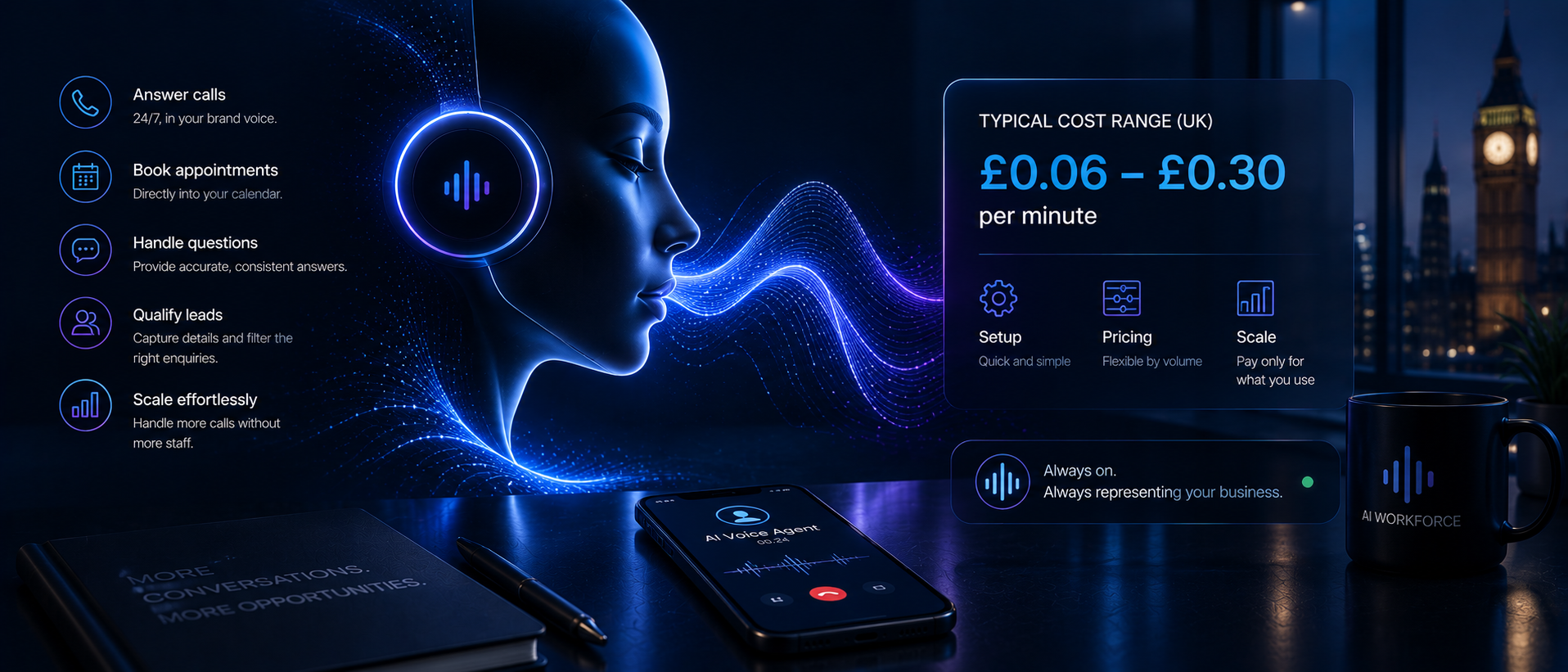
As a working reference point: public pricing structures from voice AI infrastructure platforms, checked in September 2026, vary substantially in what they actually include. Vapi lists a $0.05 per minute hosting fee, before speech-to-text, LLM and text-to-speech provider costs are added separately. Retell AI lists total voice AI pricing of roughly $0.07 to $0.31 per minute depending on which models are configured. Bland AI lists a bundled AI talk-time rate of roughly $0.11 to $0.14 per minute, with telephony charged separately. These figures are not directly comparable to one another, which is exactly why a single "AI voice agent cost" figure is not a reliable way to budget, and why it is worth checking what each advertised rate actually includes before comparing providers.
What Makes Up the Cost of an AI Voice Agent?
Breaking a quote into its underlying components is the most reliable way to compare providers fairly, since a low headline number can hide a cost that appears elsewhere.
Setup and implementation
This covers conversation design, defining what the agent should say and how it should handle different intents, connecting a knowledge base for FAQ-style answers, and testing before go-live. A simple single-purpose agent (for example, answering a fixed set of questions) needs relatively little setup. A multi-step workflow, such as qualifying a caller and booking a specific appointment type, needs considerably more design and testing time.
AI voice cost per minute
This is the rate charged for the AI processing itself, separate from the phone line. It typically bundles three underlying costs: converting speech to text, running the language model that decides what to say, and converting the response back to speech. Based on rates published in September 2026, Vapi's base infrastructure fee was $0.05 per minute with model, speech-to-text and text-to-speech costs passed through separately at the underlying provider's cost; Retell AI's blended rate across those same components ran from roughly $0.07 to $0.31 per minute depending on which models were selected; and Bland AI bundled all three into a single all-inclusive per-minute rate of $0.11 to $0.14 depending on plan tier, with a monthly platform fee on its higher tiers. These figures are US dollar list prices checked directly from each vendor's pricing page and are illustrative of how differently providers structure a "per-minute" quote, not a recommendation of any specific platform.
Telephony and phone numbers
The AI pipeline cost above does not include the phone line itself. As a reference point, Twilio's published UK destination rates in September 2026 were $0.0158 per minute for outbound calls to UK landlines, $0.0305 per minute to UK mobiles, $0.0100 per minute for inbound calls to a local or mobile number, and $3.50 per month to rent a UK local number. These are Twilio's published USD list rates for UK calling and should not be treated as sterling prices. Some voice agent platforms let a business bring its own telephony account at these pass-through rates; others bundle telephony into their own per-minute price at a markup. Either way, it is worth asking explicitly whether a quoted rate includes the phone line or not.
LLM and model usage
The language model deciding what the agent says next is usually priced by the model provider per unit of text processed, then converted into an effective per-minute cost based on how much the agent talks and listens. A more complex or verbose conversation can increase the model component of the cost because more tokens may be processed and generated, although the effect on the overall per-minute rate depends on the provider's pricing structure, since some platforms charge a fixed voice-engine rate regardless of conversational complexity.
CRM and calendar integrations
Connecting a voice agent to a CRM such as HubSpot or Salesforce, or to a calendar for booking appointments, is usually a one-off build cost rather than a per-minute charge, though some platforms add a usage fee for API calls at high volume. The complexity here depends on how much the agent needs to read or write: looking up a customer record costs less to build than a workflow that updates multiple systems after every call.
Monitoring and ongoing support
Once live, a voice agent needs some ongoing attention: reviewing call transcripts for misclassified intents, adjusting prompts as the business's offer changes, and monitoring for a rising escalation or failure rate. Some providers bundle this into a monthly platform fee; others charge a separate support retainer, particularly for a custom build.
The AI Workforce Voice Agent Cost Stack
Comparing providers on price per minute alone misses most of what actually drives total cost. This is an AI Workforce framework, not an industry standard, but it is a useful way to check whether a quote is genuinely complete.
Layer 1, Setup: conversation design, knowledge-base configuration, testing and initial go-live work.
Layer 2, Infrastructure: telephony, speech-to-text, text-to-speech, the language model and the platform hosting it all.
Layer 3, Integration: CRM, calendar and any other business systems the agent needs to read from or write to.
Layer 4, Usage: minutes, call volume, phone numbers and concurrency.
Layer 5, Operations: monitoring, optimisation, ongoing support and governance once the agent is live.
A quote that only addresses Layer 4 (a per-minute rate) without pricing the other four layers is incomplete. Ask a provider to walk through all five before comparing their number against anyone else's.
How Does AI Voice Agent Per-Minute Pricing Work?
A quoted "price per minute" for a voice agent can mean very different things depending on the provider, so it is not safe to compare two quotes on that single number alone. Some providers bundle speech-to-text, the language model, text-to-speech and their own platform markup into one all-inclusive rate. Others quote a low base infrastructure fee and pass every underlying model and telephony cost through separately at cost. A small difference in the advertised rate can therefore hide a much larger difference in what actually lands on the invoice once every component is added.
The practical way to compare providers is to ask what is included in the quoted figure, then add whatever is missing: telephony if it is not bundled, any platform or subscription fee, and any per-minute add-ons such as a knowledge base lookup or a live transfer. Recording and transcript storage is sometimes included and sometimes billed separately at higher call volumes.
Example AI Voice Agent Cost Scenarios
These are illustrative worked examples using the formula below, not quotes from any specific provider. Every assumption is stated so the formula can be re-run with your own numbers.
Estimated monthly cost = platform fee + (monthly minutes × effective voice cost per minute) + telephony + integrations / support + optional additional concurrency
Small business, 500 minutes/month. Illustrative budgeting example — not a market benchmark or AI Workforce quote. Assume, purely for calculation purposes: £0 platform fee (pure usage-based plan), a blended voice cost of £0.08/minute, telephony at roughly £0.02/minute plus one number rental (~£3.50/month), minimal integration needs.
500 × £0.08 = £40, plus telephony (500 × £0.02 = £10) plus number rental £3.50 ≈ £53.50/month in usage costs, before any one-off setup work.
Growing team, 2,000 minutes/month. Illustrative budgeting example — not a market benchmark or AI Workforce quote. Assume, purely for calculation purposes: a managed plan with a £150/month platform fee, blended voice cost of £0.09/minute (slightly higher due to a more capable model), telephony at £0.02/minute, plus a CRM integration.
2,000 × £0.09 = £180, plus telephony (2,000 × £0.02 = £40), plus the £150 platform fee ≈ £370/month in recurring costs, excluding the one-off integration build.
Higher-volume operation: 10,000 minutes/month. Illustrative budgeting example — not a market benchmark or AI Workforce quote. Assume, purely for calculation purposes: a committed-volume plan with a fixed platform fee (£400/month), a lower blended voice cost of £0.06/minute due to volume pricing, telephony at £0.018/minute (volume discount), multiple concurrent lines.
10,000 × £0.06 = £600, plus telephony (10,000 × £0.018 = £180), plus the £400 platform fee ≈ £1,180/month, before any additional concurrency charges above the plan's included limit.
All figures above are illustrative assumptions built from the formula, not pricing quotes. Real costs depend on the provider, models used, call length and country mix.
Inbound vs Outbound AI Voice Agent Pricing
Inbound and outbound voice agents are priced by the same underlying components, but the cost drivers differ in practice.
Inbound calling typically involves answering the phone, routing the caller to the right workflow, answering FAQs, booking appointments, and transferring to a person when needed. Minute volume here is largely demand-driven: it scales with how many calls come in, and a business has limited control over when they arrive.
Outbound calling adds cost drivers that are not purely about minutes consumed. Dialling itself, whether or not the call is answered, can incur a connection cost. Answer rates matter, since a campaign dialling 1,000 numbers to reach 300 live conversations still incurs some cost on the 700 unanswered attempts, depending on the provider's billing model. Voicemail detection, concurrency (how many lines can dial simultaneously), campaign pacing, and writing outcomes back to a CRM after every call all add cost beyond the simple per-minute rate. Outbound calling for marketing purposes also carries specific compliance obligations, covered in the GDPR and PECR section below, which can add a cost of its own in list screening and consent management. Where outbound calling sits alongside wider AI-driven sales prospecting, our AI SDR pricing UK guide covers the cost of that broader outbound workflow.
AI Receptionist vs AI Sales Calling Agent Costs
An AI receptionist and an AI outbound sales calling agent are often priced on similar underlying infrastructure, but the workflow requirements differ enough to affect the total cost. A receptionist often has a narrower and more predictable set of intents (answering a call, taking a message, booking a slot, transferring urgent calls), which can reduce conversation-design and testing complexity. An outbound sales agent usually needs more branching logic for objections, qualification and CRM outcomes, which can increase implementation complexity and, depending on the model configuration and call length, usage cost. For a fuller breakdown of receptionist-specific pricing, see our AI receptionist pricing UK guide.
SaaS vs Custom AI Voice Agent Pricing
Option | Best for | Cost structure | Customisation |
|---|---|---|---|
Self-service SaaS | Simple, single-purpose use cases; teams comfortable configuring it themselves | Low or no upfront cost; usage-based ongoing | Limited to what the platform's builder allows |
Managed/configured platform | Businesses that want a working agent without building it themselves | Moderate one-off setup fee; platform fee plus usage ongoing | Configured within the platform's framework |
Custom build | Multi-step workflows, unusual integrations, specific compliance or governance needs | Higher, project-based upfront; usage plus a support arrangement ongoing | Built around the business's exact process |
Responsibility for building and maintaining the workflow shifts across these three options. With self-service SaaS, the business configures and maintains it. With a managed platform, the provider typically builds it and often maintains it too. With a custom build, responsibility is shared and should be defined explicitly in the project scope.
Self-service SaaS is often genuinely sufficient for a business with a narrow, well-defined use case, such as answering the same handful of questions or booking a single appointment type. A custom build becomes worth the extra cost once the workflow spans several systems, needs specific escalation rules, or has to fit an existing sales or booking process rather than a generic template.
What Hidden Costs Should You Budget For?
These are the costs buyers most commonly overlook when comparing a headline per-minute rate:
Onboarding and initial configuration time, even on a "self-serve" platform
CRM integration and testing, including field mapping and error handling
Calendar routing logic for multiple staff, locations or appointment types
Workflow design for anything beyond a simple FAQ flow
Number rental and, for higher volumes, carrier charges that scale with concurrency
International calling rates, which are typically higher than domestic UK rates
Additional concurrency once a plan's included simultaneous-call limit is exceeded
Premium or additional voice options beyond the default
Call recording and transcript storage beyond a provider's included retention period
Ongoing monitoring and quality review of live calls
Prompt and workflow updates as the business's offer or process changes
API usage fees for high-volume integrations
Compliance work: list screening, consent records, and opt-out handling
Human escalation and transfer handling for calls the agent cannot complete
Does Concurrency Affect AI Voice Agent Pricing?
Yes. Concurrency, the number of calls a voice agent can handle at the same time, is usually capped by plan and directly affects both what a business can do and what it pays. If an agent's plan allows 10 simultaneous calls, the business can have up to 10 active conversations running at once; an 11th caller either waits, is routed elsewhere, or fails to connect, depending on how the workflow is configured.
Providers typically charge for concurrency in one of two ways: a fixed number of simultaneous lines included in a plan with an additional per-line monthly fee above that (Vapi, for example, published a rate of $10 per additional concurrent line per month on its Build plan in September 2026), or a higher-tier plan that includes a larger concurrency allowance as part of a fixed platform fee. This matters most for outbound campaigns, where dialling a large list in a short window needs high concurrency, versus spreading the same volume of calls across a working day, which needs far less. Pushing more simultaneous calls through a limit a provider has set, or attempting to route around a concurrency cap through workarounds, is not something this guide recommends; if a campaign genuinely needs higher concurrency, that is a plan or infrastructure conversation to have directly with the provider.
What Does an AI Voice Agent Cost Compared With a Human?
The fair comparison is not a simple salary-versus-subscription calculation, because AI and human call handling have different cost structures rather than one being a direct substitute for the other. An AI voice agent's costs are largely setup, a platform fee, and variable usage that scales with call volume, alongside ongoing maintenance. A human call handler's costs include salary or wages, employer costs such as National Insurance and pension contributions, recruitment and training time, and management overhead, but comes with judgement, empathy and the ability to handle a genuinely unusual situation that current AI voice agents are not well suited to.
Availability is one of the clearer structural differences: an AI voice agent can typically answer outside normal working hours without the added cost of shift or overtime pay, while a human team's out-of-hours coverage usually carries a premium. But cost alone should not decide which one handles a given call. Sensitive, complex or high-stakes conversations, a distressed caller, a serious complaint, or a negotiation with real commercial consequences, are better suited to a person, regardless of what an AI agent would cost to run instead.
For businesses making that choice specifically at the front desk, our guide to AI receptionist vs answering service in the UK compares AI, human and hybrid models across cost, call handling, booking, integrations, scalability and human judgement.
When Is an AI Voice Agent Worth Paying For?
Good fits tend to share a few characteristics: missed inbound calls that are currently going unanswered, appointment booking that follows a repeatable structure, repetitive lead qualification against a fixed set of criteria, high call volumes where the per-call admin cost adds up quickly, after-hours answering where no human cover currently exists, and routine outbound follow-up that a person would otherwise have to do manually.
Weaker fits include very low call volumes, where the fixed setup cost may not be recovered by the time saved; highly sensitive conversations where a person's judgement genuinely matters; complex negotiation that a scripted or even a well-trained model struggles to handle reliably; and any situation where nearly every call requires substantial individual judgement rather than following a repeatable pattern.
Not Sure What Your Call Volume Would Cost?
AI Workforce can help you scope monthly minutes, concurrency, integrations and the right inbound or outbound workflow before you commit to a plan.
What Should You Ask an AI Voice Agent Provider Before Buying?
What exactly is included in the quoted price per minute?
Are telephony charges separate from the AI usage rate?
Are failed or unanswered calls charged, and at what rate?
Is there a monthly platform fee on top of usage?
Is setup or configuration charged separately, and what does it cover?
How are CRM and calendar integrations priced?
What is the concurrency limit on our plan?
What happens to a call if that limit is exceeded?
How much does additional concurrency cost?
Are call recordings or transcripts charged separately, and for how long are they retained?
What support is included, and what requires a separate arrangement?
Can we export our own call data if we leave?
What happens to our data and configuration if we cancel?
Where is call data processed and stored?
How is human handoff configured and priced?
Can usage caps be configured to prevent unexpected overspend?
How are international calls charged compared with UK domestic calls?
How often, and how easily, can prompts or workflows be changed after go-live?
Are underlying model or carrier cost increases passed through automatically?
Is there a minimum contract length or usage commitment?
UK GDPR, PECR and AI Voice Calling
This section is general information, not legal advice, and compliance requirements depend on the specific type of call, who is being contacted and what the call is for.
UK GDPR applies to any call that processes personal data, which covers most business calling: a caller's name, number and anything discussed. Recording calls, or storing transcripts, is itself a form of processing that needs a lawful basis and a defined retention period, regardless of whether a human or an AI agent is on the call.
PECR sits alongside UK GDPR and applies specific rules to telephone marketing, and it treats live calls and automated calls differently. For live marketing calls, an organisation can generally call a number that is not registered with the Telephone Preference Service (TPS) or Corporate Telephone Preference Service (CTPS) and has not otherwise objected, though claims-management and pension-related marketing calls carry additional consent requirements. For automated marketing calls, the ICO currently describes these as calls made by an automated dialling system that plays a recorded message. These require specific consent under PECR, and general marketing consent or consent to receive live calls is not sufficient on its own. Conversational AI voice agents do not fit neatly into the traditional distinction between a live person speaking and a recorded-message automated call, so businesses using AI for outbound marketing should assess the specific implementation carefully and take appropriate legal advice rather than assuming either rule automatically applies.
For live marketing calls, businesses generally need to screen against the TPS and CTPS as applicable, alongside their own suppression or do-not-call list. Automated marketing calls are subject to a different rule: specific consent is required for that form of call, rather than TPS/CTPS screening being the deciding factor. How a conversational AI voice agent should be classified under PECR can depend on the specific implementation, so businesses should assess their own workflow rather than assuming the rules for either traditional live calls or recorded-message automated calls automatically apply. Inbound answering is generally lower-risk from a PECR marketing perspective, since the caller has initiated contact, but UK GDPR still applies to any personal data captured or recorded during that call.
Our dedicated guide to AI and GDPR compliance for UK businesses and our AI voice agents guide cover the wider framework and implementation considerations in more depth. Take independent legal advice before relying on an AI voice agent for live outbound marketing activity.
How to Scope an AI Voice Agent Budget
Before a provider, AI Workforce included, can put a meaningful number against a voice agent project, it helps to have answered a few questions in advance:
Is the primary need inbound, outbound, or both?
What is the expected monthly minute volume, even as a rough estimate?
What peak concurrency is needed, particularly for outbound campaigns run in a short window?
How many distinct workflows does the agent need to handle?
Which systems does it need to integrate with, such as a CRM or booking calendar?
Are appointments being booked, and if so, how complex is the scheduling logic?
Which countries will be called, since international rates differ from domestic UK rates?
What should trigger a handoff to a person, and how quickly does that need to happen?
What level of ongoing support and monitoring is expected after go-live?
Get an AI Voice Agent Cost Estimate
Share your call volume, workflow and integration needs, and AI Workforce will help you understand what a properly scoped voice agent would realistically cost.
Frequently Asked Questions
How much does an AI voice agent cost?
It depends on the route taken. A self-service SaaS platform can start from a low or zero platform fee plus a per-minute usage rate, while a managed or custom deployment adds a setup fee on top. There is no single market price; see the cost-stack framework above for what to price.
How much does an AI voice agent cost per minute?
Public pricing structures vary substantially by what they include. Vapi lists a $0.05 per minute hosting fee before model provider costs are added; Retell AI lists total voice AI pricing of roughly $0.07 to $0.31 per minute depending on configuration; Bland AI lists a bundled rate of roughly $0.11 to $0.14 per minute with telephony separate. These figures are not directly comparable, so the headline rate alone is not a reliable way to compare providers.
Are AI voice agents cheaper than call centres?
Often cheaper for repetitive, high-volume, structured calls, since AI usage costs scale with minutes rather than salaries and shift patterns. This is not universal, and the comparison should weigh setup and maintenance costs, not just a per-minute rate against an hourly wage.
What is included in AI voice agent pricing?
Typically some combination of setup, a platform fee, per-minute AI usage (speech-to-text, LLM, text-to-speech), telephony, and integration costs. Which of these are bundled together versus billed separately varies by provider, which is why the cost stack in this guide is worth checking against any quote.
Does an AI voice agent require a monthly subscription?
Not always. Some platforms are purely usage-based with no platform fee, particularly at lower volumes; others charge a monthly platform fee that unlocks higher concurrency, additional features or dedicated support.
How much does an AI receptionist cost?
This follows the same cost stack as a general voice agent, though a receptionist's narrower, more predictable set of intents often means lighter setup than a multi-step sales workflow. See our AI receptionist pricing UK guide for a receptionist-specific breakdown.
Does concurrency increase the cost?
It can. Many platforms include a concurrency allowance and charge extra for additional simultaneous calls, or require a higher plan tier once that allowance is exceeded.
Do unanswered AI calls cost money?
This depends on the provider and the telephony billing model. Some platforms charge only for connected call time; others may charge a small connection or dialling cost regardless of whether the call is answered. Confirm this directly with any provider before running an outbound campaign at volume.
Are phone charges included?
Sometimes, sometimes not. Some voice agent platforms bundle telephony into their own per-minute rate; others expect the business to bring its own telephony account (for example, a Twilio account) billed separately at the carrier's rates. Always ask explicitly which model a provider uses.
How much does an outbound AI calling agent cost?
The same underlying components apply as inbound, but outbound also needs to account for dialling costs, answer rates, voicemail detection and concurrency for campaign pacing, which is why outbound cost should not be judged purely by minutes consumed. See the inbound versus outbound section above.
Is an AI voice agent suitable for a small business?
It can be, particularly for missed inbound calls, after-hours answering or repetitive appointment booking. At very low call volumes, the fixed setup cost may take longer to justify, so it is worth estimating realistic monthly minutes before committing.
What hidden costs should I expect?
Integration work, calendar routing logic, additional concurrency, international calling rates, transcript storage beyond a provider's default retention, and ongoing prompt updates are the ones most commonly missed. See the hidden costs section above for the full list.
Does UK GDPR apply to AI voice agents?
Yes, whenever a call processes personal data, which covers most business calling. PECR applies separately and specifically to telephone marketing, with different rules for live calls versus automated calls. See the compliance section above; this is general information, not legal advice.
Can an AI voice agent transfer to a human?
Many modern voice agent platforms support a live or warm transfer to a person, usually triggered by a defined rule, such as a caller requesting it, the agent reaching the limit of what it can handle, or a sensitive topic being detected. This is worth confirming and testing directly with any provider, since transfer reliability varies.
Key Takeaways
The total cost of a voice agent is normally a combination of setup, platform fees, usage and telephony, rather than one fixed per-minute charge
Published per-minute rates bundle very different things: Vapi's $0.05 figure is hosting only, Retell's $0.07–$0.31 is a total voice AI rate, and Bland's $0.11–$0.14 bundles the AI pipeline with telephony billed separately, so headline rates are not directly comparable
Two providers quoting a similar headline rate can differ significantly once telephony, platform fees and integrations are included, so ask what a quote actually covers
Concurrency limits affect both what a business can do and what it pays, particularly for outbound campaigns run in a short window
Outbound calling should not be judged on minutes alone, since dialling costs, answer rates and campaign pacing all affect the real cost
Self-service SaaS is often genuinely sufficient for a narrow, well-defined use case; a custom build earns its cost once the workflow spans multiple systems
UK GDPR applies to any call processing personal data, and PECR treats live and automated marketing calls differently, so compliance requirements depend on the specific implementation
Price all five layers of the cost stack, setup, infrastructure, integration, usage and operations, rather than comparing providers on a single per-minute number
Sources and Further Reading
Pricing and regulatory figures in this guide were checked directly against the following official sources in September 2026. Vendor pricing changes frequently; confirm current rates directly before budgeting.
This article is general information rather than legal or financial advice. Vendor pricing and regulatory guidance change; confirm current rates and requirements directly before budgeting or launching a live campaign.
About the Author
Clara Miller is a Content Marketing Specialist at AI Workforce. She writes about how UK businesses can evaluate AI voice, sales and workflow tools with a focus on genuine cost transparency rather than headline pricing.
About the Reviewer
This guide was reviewed by Rodi Taze, Co-Founder of AI Workforce, for accuracy and alignment with how AI Workforce scopes voice-agent projects.
Reviewed: September 2026 · © 2026 AI Workforce Ltd. All rights reserved.