Best AI SDR Tools 2026: 6 Platforms Compared for B2B Sales Teams
Posted On: July 8, 2026
Last updated: August 2026 · Written by Seth Ayush, Co-Founder of AI Workforce · Reviewed by Rodi Taze
AI SDR tools can research prospects, run outreach, handle replies, qualify leads and book meetings, but the six platforms compared here differ substantially in price, autonomy and capability. We reviewed AiSDR, Artisan, Regie.ai, Reply.io, Salesforge and 11x across prospecting, outreach channels, qualification, meeting booking, CRM integration, pricing, limitations and human oversight to show which options best fit different B2B sales teams.
Quick Answer: AI SDR software automates part of the early sales pipeline, typically account research, outreach drafting or sending, reply classification, structured qualification and meeting booking, depending on the platform. It is a broad commercial category rather than one standard technical specification, so two products both marketed as an AI SDR can do genuinely different jobs. The safest way to evaluate one is to check exactly which parts of the SDR workflow it performs, test it against a known sample, and keep a human review step in place until the output has proven itself.
At a Glance
What it is: software that automates some or all of account research, outreach, reply handling and qualification, usually connected to a CRM and email or LinkedIn
What it does well: high-volume, structured research and consistent outreach cadence at a pace no rep could sustain manually
Where it commonly fails: stale or inferred data, misread replies, over-eager qualification and deliverability damage from poor list hygiene
Key legal considerations: UK GDPR for any identifiable business contact, and PECR separately for marketing emails, texts or calls
Safest way to evaluate a platform: pilot one contained workflow against a known sample, with human approval before live sends, before scaling to full autonomy
Last pricing check: August 2026.
Shortlist: Best AI SDR Tools by Use Case
For most smaller B2B sales teams, AiSDR is our strongest starting point. Salesforge is better suited to email-led outbound, Regie.ai provides a lower-cost AI-assisted prospecting option, Artisan is built for more autonomous end-to-end outbound, Reply.io is stronger for multichannel sales development, and 11x is aimed primarily at higher-volume enterprise teams.
Categories are based on each platform's own stated positioning and publicly documented capability, not independent testing by AI Workforce. Check each platform's current documentation, pricing and limitations before choosing.
Best for small B2B sales teams: AiSDR
Best for email-led outbound: Salesforge (Agent Frank)
Best low-cost AI-assisted prospecting workspace: Regie.ai (RegieGO)
Best for autonomous end-to-end outbound: Artisan (Ava)
Best for multichannel sales development: Reply.io (Jason AI)
Best for high-volume enterprise deployment: 11x (Alice)
What's Covered
Fundamentals
Comparison and Reviews
How It Works
Where It Works and Fails
Research, Outreach and Booking
Compliance
Cost
Buying and Rollout
What Is an AI SDR?
An AI SDR is software built to take on some or all of the job normally done by a sales development representative: researching accounts, sending outreach, following up, and qualifying a prospect before handing them to a closer. Instead of a person working through this manually, the software handles some combination of research, messaging and follow-up on its own.
The important qualifier is "some combination". AI SDR is a broad commercial label, not a standard technical specification. Depending on the vendor, a product marketed as an AI SDR might mainly draft emails from a template, run a full outbound sequence across email and LinkedIn, classify and route replies, ask a handful of qualification questions, update CRM fields, or extend into outbound calls. Some tools genuinely combine most of this into one workflow. Others are closer to a single-purpose research or writing assistant wearing a broader label. Treating every AI SDR as functionally interchangeable is one of the most common mistakes buyers make before a demo, and one of the most common sources of disappointment after signing up.
The role itself is not disappearing so much as splitting. The repetitive, high-volume layer of prospecting increasingly runs through software, while judgement-heavy qualification, senior stakeholders and relationship-building remain with a person. For a small sales team without a dedicated prospecting function, that split can matter even more than it does at a larger company, since one rep supported by an AI SDR can help cover more structured research and follow-up than existing headcount could manage manually, although greater activity does not necessarily produce better opportunities. AI SDR software overlaps heavily with AI lead generation tools and the educational guide to AI sales prospecting, though an AI SDR is usually more focused on working a defined list through to a booked meeting, while lead generation and prospecting are more focused on discovering, researching and prioritising that list in the first place. If you are choosing prospecting software specifically rather than a full AI SDR, see our Best AI Sales Prospecting Tools comparison.
How We Selected These Tools
This is a desk-based review of publicly available information: official pricing pages, product documentation and vendor-published feature lists, checked in August 2026. It is not hands-on testing of every plan and tier, and AI Workforce has not run live campaigns through every platform listed. All six platforms in this comparison publish or are reported on in US dollars; figures below are converted into pounds using an indicative August 2026 exchange rate so that UK readers can compare them consistently. Converted figures are approximate, exclude VAT, and should be treated as indicative only; confirm the exact current price for the plan you need directly with the provider before budgeting or shortlisting.
Platforms were assessed against a consistent set of criteria: lead sourcing, research and enrichment, prioritisation, email outreach, AI calling, multichannel support, personalisation, follow-up, reply handling, qualification, calendar booking, CRM integration, human handoff and autonomy controls, deliverability controls, reporting and auditability, UK suitability, UK GDPR and PECR considerations, pricing transparency, and team size or implementation burden. Every platform listed has at least one genuine limitation stated plainly, not softened into a strength.
Best AI SDR Tools 2026: Comparison Table
Platform | Best for | Channels | Autonomy | CRM | Price (from, £) | Main limitation |
|---|---|---|---|---|---|---|
Artisan (Ava) | Autonomous end-to-end outbound | Email, vendor-described social outreach, dialler handoff | Autonomous, approval configurable | Salesforce, HubSpot | Custom quote only | No published self-service price |
AiSDR | Small B2B sales teams | Email, LinkedIn, Aircall | Autonomous with co-pilot oversight | HubSpot native, Salesforce on higher tiers | From roughly £195/mo | Explore/Scale need quarterly commitment |
Regie.ai (RegieGO) | Low-cost prospecting workspace | Email, dialer, research | Configurable, sends from your inbox | Built-in CRM, HubSpot sync | Free tier; Pro from roughly £38/mo | Pro credits do not roll over |
Reply.io (Jason AI) | Multichannel sales development | Email, LinkedIn, calls, SMS | Configurable sequencing | Native CRM integrations | Engagement plan from £46/user/mo; Jason AI SDR from roughly £390/mo | Low base price is not the AI SDR price |
Salesforge (Agent Frank) | Email-led outbound | Email; LinkedIn functionality not publicly confirmed | Bounded autonomy, contact caps | Standard CRM integrations | Core from £31/mo; Agent Frank from roughly £390/mo | AI SDR priced separately from core plan |
11x (Alice) | High-volume enterprise deployment | Email and multichannel outbound; separate inbound voice agent available | High autonomy, enterprise controls | Salesforce, HubSpot | Growth from roughly £2,925/mo, billed annually | Highest price point, annual commitment |
See each platform review below for full pricing details, exact plan names and the specific limitation behind each summary above. Converted figures use an indicative August 2026 exchange rate, exclude VAT, and should be treated as approximate; confirm the exact current price for the plan you need directly with the provider.
Capability Matrix
The comparison table above answers "which should I shortlist". This matrix answers "what does it actually do". Each cell uses one of five evidence statuses: Yes (explicitly confirmed in current official documentation), No (the vendor does not currently present it as a capability), Limited (available only in a restricted or assisted form), Separate product/add-on (not part of the core AI SDR), or Not publicly confirmed (no clear official documentation found at the time of writing).
Calling terminology: these terms are not equivalent capabilities. "Human dialler" means software assists a human rep making the call. "AI-assisted calling" means AI supports parts of the calling workflow, such as summarising or logging. "AI voice calling" means the AI itself conducts the conversation. The Calling capability column below states which of these applies to each platform.
Tool | Prospecting | Research | Calling capability | Follow-up | Qualification | Booking | CRM | ||
|---|---|---|---|---|---|---|---|---|---|
Artisan | Yes | Yes | Yes | Vendor-described social outreach; confirm exact LinkedIn actions and account controls | Human dialler; warm prospects queued for a rep to call, not autonomous AI voice | Yes | Not publicly confirmed | Yes | Salesforce and HubSpot |
AiSDR | Yes | Yes | Yes | Yes | AI-assisted calling; Aircall-based | Yes | Yes | Yes | HubSpot; Salesforce on Scale |
RegieGO | Yes | Yes | Yes | Not publicly confirmed | Human dialler; built-in dialler workspace; autonomous AI voice calling not publicly confirmed | Limited | Limited | Not publicly confirmed | Built-in CRM and HubSpot |
Yes | Yes | Yes | Yes | Human dialler; calling steps within the multichannel sequence; autonomous AI voice calling not publicly confirmed | Yes | Yes | Not publicly confirmed | Native CRM integrations | |
Agent Frank | Yes | Yes | Yes | Not publicly confirmed | No | Yes | Not publicly confirmed | Yes | Not publicly confirmed |
11x Alice | Yes | Yes | Yes | Yes; multichannel outbound | Separate product; Julian is a distinct inbound voice agent, not autonomous outbound calling by Alice | Yes | Not publicly confirmed | Yes | Bidirectional Salesforce and HubSpot sync |
Where this matrix shows "not publicly confirmed", official documentation did not clearly establish the capability at the time of writing; confirm directly with the vendor before shortlisting on that basis, since feature scope changes faster than a desk review can track.
Platform Reviews
Artisan (Ava)
Best for: teams that want an autonomous AI BDR running outbound end to end, with a vendor-provided rollout team.
Ava researches leads from a stated database of 250 million-plus verified B2B contacts, drafts and sends email outreach under your reps' own names and sending domains, and Artisan describes "email and social on autopilot" as part of Ava's positioning; the exact LinkedIn actions and account controls available should be confirmed directly with Artisan before relying on them. Ava handles replies and books meetings. Artisan's own product documentation describes warm prospects being queued into a sales dialler for reps to call, rather than Ava conducting autonomous AI voice calls itself, so the calling layer is best understood as a handoff into a dialler rather than AI-run phone conversations. Artisan states that sending can be configured for approval-first review, with tone, CTAs and banned phrases locked by the buyer, so autonomy is adjustable rather than fixed. The platform syncs bi-directionally with Salesforce and HubSpot and is SOC 2 Type II certified, per Artisan's own trust documentation.
Pricing: Artisan does not publish self-service pricing. Every tier (Team, Scale and Enterprise) is scoped through a sales conversation based on lead volume, and the pricing page shows no published monthly figure for any plan.
Main limitation: without a published price, it is not possible to compare Artisan's cost per contact or per seat against self-service competitors without booking a call, which adds friction for a team that wants to size a budget before engaging a vendor.
AiSDR
Best for: a small B2B sales team, including a solo founder, that wants a self-service AI SDR without a long contract.
AiSDR combines an AI agent ("Ami") for strategy and prospecting with autonomous email and LinkedIn outreach, configurable co-pilot oversight, and native two-way HubSpot sync. AiSDR's own materials state that replies are handled within roughly 5 to 10 minutes. Salesforce sync, AI-generated videos and voice notes, and website visitor tracking are reserved for the top Scale tier. According to AiSDR's own published benchmarks, customers see a typical 1 to 3% conversion rate from cold contact to booked meeting, which the vendor frames as a directional planning figure rather than a guarantee.
Pricing: Solo runs roughly £195/month with monthly billing and no long-term contract, covering 200 AI-researched contacts, 1 user and 1 sending domain. Explore runs roughly £700/month (800 contacts, unlimited users) and Scale runs roughly £1,950/month (2,500 contacts, native Salesforce sync), both on a quarterly billing commitment. Figures are converted from AiSDR's published US dollar pricing using an indicative August 2026 exchange rate.
Main limitation: the Solo plan is genuinely self-service and month-to-month, but Explore and Scale both require quarterly commitment, and Salesforce integration is locked behind the most expensive tier.
Regie.ai (RegieGO)
Best for: a team that wants a low-cost way to test AI-assisted prospecting before committing to a larger contract.
RegieGO combines research, enrichment, drafting and an in-platform dialer into one workspace, and messages are sent from the user's own connected Gmail or Outlook rather than a separate sending domain. Regie.ai states that every contact is verified before sending, with throttled sending and automatic unsubscribe handling to protect domain reputation. The platform includes its own built-in CRM and syncs with HubSpot, so a team without an existing CRM can start immediately.
Pricing: Free tier includes 250 one-time credits with no card required. Pro costs roughly £38/month (or with a 17% discount billed annually), including 5,000 credits every month covering research, drafting, enrichment and dialling; credits do not roll over between billing periods. Enterprise pricing is custom, covering volume credits, team workspaces, custom CRM sync and SOC 2 controls. Figures are converted from Regie.ai's published US dollar pricing using an indicative August 2026 exchange rate.
Main limitation: unused Pro credits expire at the end of each billing cycle rather than rolling over, so inconsistent monthly usage can mean paying for capacity that goes unused some months and running short in others.
Reply.io (Jason AI)
Best for: a team that wants one platform covering email, LinkedIn, calls and SMS with AI-assisted sequencing and reply handling.
Reply.io sells two distinct products that are easy to conflate. Its established multichannel sequencing platform (email, LinkedIn, calls and SMS) is priced per user and has been in market considerably longer than most AI-native SDR challengers, which shows in the breadth of its channel and integration options. Separately, Jason AI is Reply.io's dedicated AI SDR product, priced on its own tier based on active-contact volume rather than a simple per-user licence, and adds AI-drafted messaging and automated reply classification on top of the sequencing platform.
Pricing: the general sales-engagement platform starts from roughly £46 per user per month when billed annually, covering email and multichannel sequencing without the dedicated AI SDR layer. Jason AI SDR is priced separately: Starter from roughly £390 per month and Growth from roughly £1,170 per month, both with unlimited users and pricing based primarily on active contacts and plan capacity; Enterprise is available by custom quote. Figures are converted from Reply.io's published US dollar pricing, including its dedicated Jason AI pricing page, using an indicative August 2026 exchange rate.
Main limitation: Reply.io's low per-user sales-engagement entry price should not be confused with Jason AI SDR pricing. The dedicated AI SDR starts at a materially higher price point, from roughly £390 per month, and the final cost depends on active-contact volume and selected channels rather than seat count alone.
Salesforge (Agent Frank)
Best for: a team whose outbound is primarily email-led and wants a lower entry price before scaling to a dedicated AI SDR product.
Salesforge's core sequencing plans (Pro and Growth) provide AI-assisted email drafting, sending infrastructure and standard CRM integrations at a comparatively low monthly cost. Agent Frank, Salesforge's dedicated AI SDR product, sits above the core plans and adds autonomous prospect research, personalisation and email outreach within a defined active-contact volume. LinkedIn functionality was not clearly confirmed in the official Agent Frank documentation reviewed, so buyers should verify its current scope directly with Salesforge.
Pricing: core Pro and Growth plans run from roughly £31 to £62/month. Agent Frank starts from approximately £390 per month for 1,000 active contacts when billed annually, based on the price displayed on Salesforge's Agent Frank product page in August 2026; email sending infrastructure is billed as an add-on rather than included in that headline figure. Monthly pricing, billing cadence and infrastructure costs should be confirmed directly with Salesforge, as these details can change between checks. Figures are converted from Salesforge's published US dollar pricing using an indicative August 2026 exchange rate.
Main limitation: the widely advertised low entry price applies to the core sequencer, not the AI SDR product; anyone shortlisting Salesforge specifically for autonomous prospecting should budget against the Agent Frank price, not the base plan, and should confirm whether sending infrastructure is included or billed separately.
11x (Alice)
Best for: an enterprise sales organisation that wants a high-volume, high-autonomy AI SDR with dedicated implementation support, and has the budget and contract length to match.
Alice handles outbound research, outreach and meeting booking across email and LinkedIn, and integrates with Salesforce and HubSpot. 11x markets Julian separately as an inbound sales agent for phone, chat and SMS conversations; this should not be presented as autonomous outbound calling by Alice. 11x positions Alice as a digital worker replacing a portion of a traditional SDR headcount, with enterprise security and reporting controls aimed at larger sales organisations.
Pricing: 11x's own Alice pricing page displays Growth from roughly £2,925 per month, billed annually. At the time of writing, the same pricing page contained inconsistent annualised wording elsewhere on the page, referencing a different annual total; confirm the binding annual figure directly with 11x before budgeting. Pro is custom quoted and billed annually; Enterprise is custom quoted with annual or multi-year terms. Figures are converted from 11x's published US dollar pricing using an indicative August 2026 exchange rate.
Main limitation: the published entry price puts Alice well above every other platform in this comparison, and Growth and Pro both require annual billing, with Enterprise sometimes running to multi-year terms, which makes 11x a poor fit for a team testing whether an AI SDR works before committing serious budget.
Where AI Workforce Fits
AI Workforce publishes this guide and also builds AI sales-development workflows for clients. We assess our own service using the same criteria as the platforms above and disclose where a standalone platform may be the better fit. AI Workforce's sales-development workflow can combine UK B2B lead building, research and enrichment, personalised outreach, AI outbound calling, structured qualification, meeting booking and human handoff within a connected workflow, delivered as a configured implementation rather than a self-service product. Unlike a standalone self-service AI SDR product, AI Workforce is configured around the client's own data sources, qualification criteria, channels and escalation rules. AI Workforce does not currently offer a self-service free trial or a published standalone AI SDR price, so teams wanting an instant self-service deployment may find products such as AiSDR, Regie.ai or Salesforge easier to start with; if your team wants a workflow built around your own data governance and qualification criteria rather than a fixed product, that is closer to what AI Workforce does. Genuinely compare both routes before committing, using the cost breakdown later in this guide.
Not sure whether you need a standalone AI SDR or a connected workflow?
AI SDR vs AI Sales Assistant vs Sales Automation vs Prospecting Tool
These categories overlap in marketing language far more than they overlap in what the software actually does. A quick reference before you shortlist:
Category | Primary purpose |
|---|---|
AI sales assistant | Helps an individual salesperson research, prepare, draft and update records; usually supports one deal or account at a time |
AI SDR | Executes defined sales-development activities (research, outreach, reply handling, qualification, booking) with controlled autonomy across many prospects at once |
Sales automation platform | Automates processes across the wider sales stack, from lead routing to forecasting, not limited to the SDR function |
Prospecting tool | Finds and enriches accounts and contacts; often a data source that feeds an AI SDR rather than a replacement for one |
Outbound sales agent | Executes outbound contact workflows, frequently used interchangeably with AI SDR by vendors, though scope varies |
Voice agent | Conducts voice interactions, such as outbound calling or inbound answering, as one channel within a broader workflow |
Our AI sales assistant guide, AI sales automation tools comparison, and Best AI Sales Prospecting Tools guide cover those adjacent categories in full. If you're specifically comparing tools designed to execute the wider outbound workflow, our Best AI Outbound Sales Agents comparison looks at platforms across prospecting, first-touch outreach, follow-up, reply handling, qualification and meeting booking. This guide focuses specifically on AI SDR platforms.
What Does AI SDR Software Actually Do?
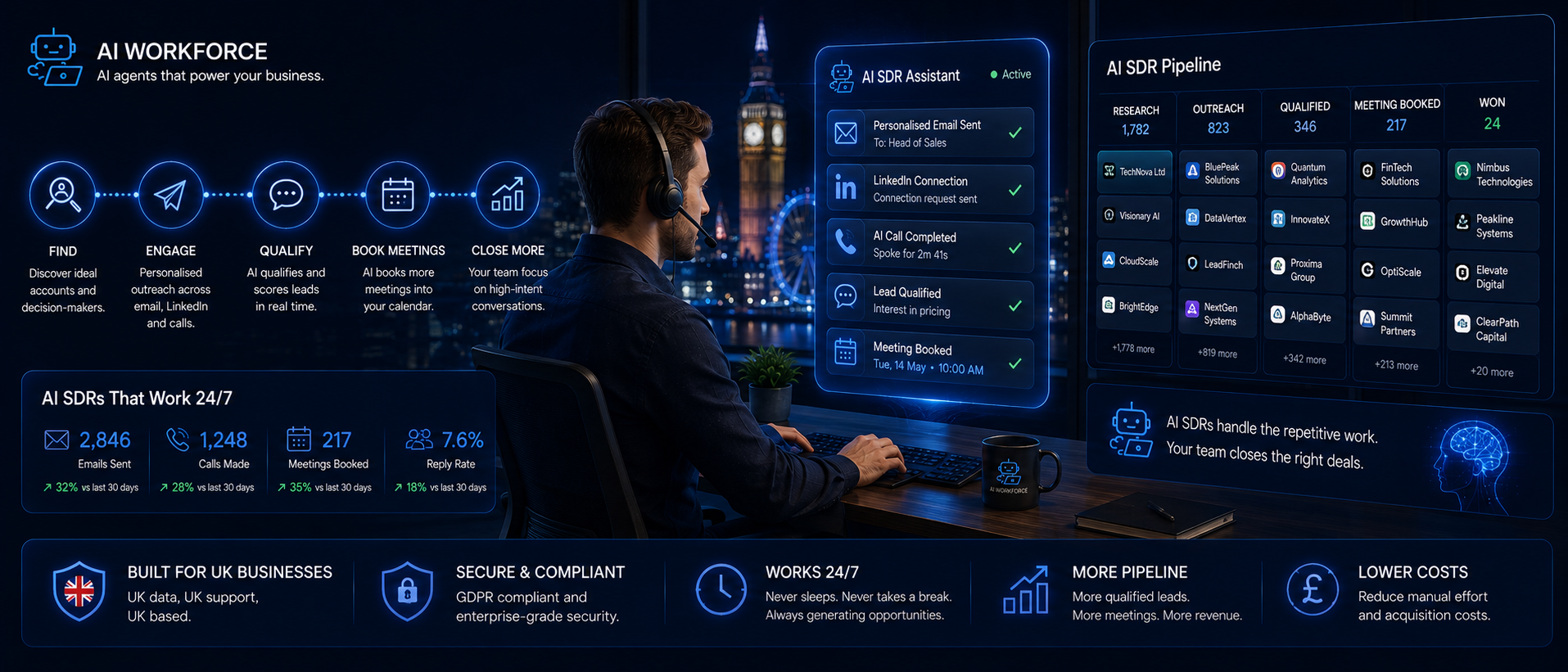
Underneath the marketing, most AI SDR platforms combine four building blocks: data, writing, sequencing and decision-making. The system pulls in lead and account data, drafts or sends a message, tracks what happened, and decides what to do next based on the result.
AI Workforce editorial framework, not an industry standard. A shorter way to summarise the same sequence for quick reference:
Find → Understand → Engage → Respond → Qualify → Book → Hand Off
A typical AI SDR workflow looks roughly like this: the system identifies or receives a target account, verifies and researches it against public sources and your CRM, prioritises it against your ideal customer profile, prepares a first-touch message using relevant signals, contacts the prospect once approved, monitors for a response, interprets the reply, follows up according to what it found, applies structured qualification criteria, books a meeting or hands off to a person, records everything back to the CRM, and the results feed into ongoing measurement. AI Workforce refers to this full, implementation-level sequence as:
Target → Verify → Research → Prioritise → Prepare → Contact → Monitor → Interpret → Follow Up → Qualify → Book → Hand Off → Record → Measure
This is AI Workforce's own descriptive framework for organising the stages, not an industry standard, and different vendors will label or combine these steps differently.
What separates a modern AI SDR from older sequence-and-template automation is the reasoning layer in the middle of that chain. A timer-based sequence could send message three on day seven regardless of what happened after message one. An AI SDR can read a reply, judge whether it signals genuine interest, a request for more information or a polite decline, and decide whether to continue, escalate to a person or stop. That judgement, applied consistently across a large number of active prospects, is where most of the actual productivity gain comes from, not simply the ability to write in bulk.
AI Workforce Insight: In AI Workforce's implementation experience, weak data, unclear qualification criteria and undefined decision ownership are recurring deployment problems, more often than the quality of the writing itself. Getting the decision logic right — a clear answer for what counts as genuine interest, what needs a human, and what should stop immediately — matters more than making any individual message read a little more naturally.
The AI Workforce AI SDR workflow model is an AI Workforce framework, not an industry standard.
The Autonomy Model
Not every AI SDR feature runs at the same level of autonomy, and higher autonomy is not automatically better. A simple four-level model helps when comparing platforms or configuring one you have already bought:
Assist: the system researches, drafts and recommends, but a person decides and acts
Review-first: the system prepares a specific action, such as a message or a qualification decision, for a person to approve before it goes live
Bounded autonomy: the system executes predefined, low-risk actions within set limits, such as sending a first-touch email to a pre-approved list, without per-message review
Human handoff: the system recognises uncertainty, sensitivity or high value and escalates to a person rather than continuing on its own
Most of the platforms compared above let you configure roughly where a given workflow sits on this scale, rather than forcing an all-or-nothing choice. AI Workforce combines this with a simple governance formula used internally when scoping how much autonomy a workflow should have:
Permission + Evidence + Confidence + Escalation + Auditability = Safe Autonomy
Again, this is an AI Workforce framework for structuring the decision, not a certification or industry standard.
AI SDR vs Human SDR
This guide focuses on what AI SDR software is, how it works and how to evaluate one. A separate, more detailed question — exactly where AI and human SDRs should each sit in your pipeline, how the economics compare, and how to build a working hybrid model — is covered in full in our dedicated AI SDR vs Human SDR comparison. The short version here is enough to make sense of the rest of this guide.
A person in this role brings judgement, tone and the ability to read a tricky reply and adjust in the moment. An AI SDR brings speed, consistency and the patience to send a fortieth structured follow-up without getting discouraged or forgetting it is due. Neither is a wholesale replacement for the other. Most sales teams that get real value from AI SDR software treat it as covering the structured, high-volume layer of prospecting, while people handle senior stakeholders, unusual objections and the relationship work that closes a deal.
Who Should Own Each Task?
The prose above explains the AI-versus-human split conceptually. This table makes the same split explicit, task by task.
Task | AI can assist | Conditional automation | Human should own |
|---|---|---|---|
Prospect research | Yes | Yes, with verified sources | Strategic account judgement |
Contact enrichment | Yes | Yes, with validation | Resolving conflicting data |
Email drafting | Yes | Yes, within approved rules | Sensitive or strategic messages |
Follow-up | Yes | Yes, based on reply state | Complex objections |
Reply classification | Yes | Yes, with confidence thresholds | Ambiguous or sensitive replies |
Qualification | Yes | Defined criteria only | Complex discovery and exceptions |
Booking | Yes | After qualification and routing checks | Non-standard arrangements |
CRM updates | Yes | Approved fields only | Resolving material conflicts |
Negotiation | Preparation only | No | Human |
Commercial decisions | Evidence and summaries | No | Human |
Where AI SDRs Work Well
Used deliberately, on a workflow it is genuinely suited to, an AI SDR removes a real amount of repetitive work:
Researching a large number of accounts in parallel rather than one at a time
Applying a consistent scoring and qualification standard, so sales and marketing stop arguing over which accounts are worth chasing
Maintaining a reliable follow-up cadence without a rep having to remember who is due a nudge
Operating outside standard office hours and across time zones, which matters for overnight enquiries and international prospect lists
Logging every touch back to the CRM as it happens, rather than in a batch update once a week
Sales teams are adopting this kind of tooling quickly. According to Salesforce's State of Sales 2026 report, 92% of sellers with access to AI agents say the technology benefits their prospecting work, and sellers expect agents to cut prospect research time by roughly 34% once fully implemented. That is a genuine signal of perceived value, though it is vendor-reported survey evidence about sentiment and expected time savings, not independent proof that adopting a specific AI SDR causes better commercial results for your business.
Where AI SDRs Commonly Fail
A fair account of this category has to include where it breaks, not just where it helps. Current AI SDR platforms can still:
Contact the wrong person, particularly with common names or similar company titles
Rely on stale job information, reaching out to someone who has already left the role
Fabricate a plausible but incorrect detail when a language model fills a gap in a thin record
Misread a polite decline or a request for more information as genuine buying interest
Fail to recognise an unsubscribe or opt-out request and continue a sequence regardless
Over-qualify a weak prospect against loosely defined criteria, or under-qualify an unusual but genuinely good fit
Send duplicate or repeated messages when contact records are not properly deduplicated
Damage sender or domain reputation through excessive volume or poor list hygiene
Write incorrect or incomplete fields back to the CRM from an ambiguous conversation
Continue a scripted sequence in a situation that actually calls for stopping and escalating to a person
Optimise for reply volume rather than for the quality of the pipeline it produces
None of this makes AI SDR software unsuitable for high-volume prospecting. It means a tested fallback, approved data sources, suppression-list checks and a genuine human review step matter more than how polished the writing looks in a demo.
AI Workforce Insight: In AI Workforce's implementation experience, deployments rarely fail because the language model writes poor emails. They fail because the CRM feeding it is messy, the qualification criteria were never clearly defined, or nobody actually decided which decisions the AI owns and which stay with a person. Fixing the writing is easy. Fixing those three things first is what actually determines whether a deployment works.
Failure Modes and Mitigations
The list above explains what goes wrong. This table explains how each risk is normally controlled.
Failure mode | Mitigation |
|---|---|
Bad or stale data | Verification against a reliable source and a defined refresh cycle |
Hallucinated personalisation | Require a sourced fact rather than a model-generated detail |
Generic outreach | Require a relevant, verifiable business trigger before a message goes out |
Deliverability problems | Throttled sending, authentication and ongoing monitoring |
Misread replies | Confidence thresholds, with low-confidence cases held for review |
Duplicate contacts | CRM deduplication before a record enters the workflow |
Missed opt-outs | Immediate, automatic suppression on any opt-out signal |
Unqualified meetings | A defined qualification gate before booking |
Incorrect CRM updates | Field-level permissions restricting what the system can change |
Calendar errors | Ownership and availability checks before a slot is confirmed |
Automation continuing after takeover | A clear stop signal the moment a person takes over a conversation |
How AI SDRs Research and Score Prospects
Underneath the interface, most AI SDR platforms pull data from public sources, your CRM and past deal history, then score each contact against criteria drawn from your best-fit customers. The system can review far more signals per account than a person realistically could, and rank accounts by how closely they match your target buyer profile.
That scoring is only as good as the data behind it, and not every data point deserves the same level of trust. It is worth understanding roughly where a given field sits before acting on it:
Observed data, such as a prospect's own behaviour on your site or engagement already recorded in your CRM, tends to be the most reliable, provided the identity match is current
Authoritative public sources, such as a company registry or a company's own leadership page, are trustworthy but can go stale between refreshes. Companies House can help verify public company information such as legal name, status, registered office, filing history and officers; it does not provide private contact details, prove buying intent, or grant permission to send marketing communications
Licensed third-party data is only as good as its refresh frequency, not just the reputation of the provider
Inferred data, such as an email address generated from a likely pattern rather than confirmed directly, needs validation before it reaches a message
Model-generated data, where a language model has filled a gap in a thin record rather than retrieved verified information, needs the closest scrutiny of all, since it can read as confident and specific while being simply wrong
Historical pipeline data can also carry forward past targeting bias, an unusually successful sales patch, or pricing and positioning that no longer applies, so a score built on that foundation reflects what worked before, not necessarily what is the strongest fit today. Clean CRM data matters more than a clever scoring model at this stage, since even a well-built algorithm produces weak results from outdated or incomplete records.
How AI SDRs Personalise Outreach
Generic outreach gets ignored, so most AI SDR platforms are built to pull details from a prospect's company, recent activity and role to shape a message rather than sending the same template to everyone. Whether that personalisation actually helps depends less on how much data went in and more on whether it gives the prospect a genuine reason to reply.
Weak: a first name, a job title and a generic compliment stitched into a template. It reads as personalised but gives the prospect nothing to actually respond to
Useful: a relevant, verifiable detail tied to a genuine business reason, leading to a specific and proportionate reason to talk. A recent hire in a relevant function connected to a real operational challenge your product addresses, stated plainly, is a good example
Risky: a personal detail with no obvious relevance to the business reason for reaching out, such as a life event or personal social media activity. It can read as surveillance rather than research, even when the underlying data was technically public
The same hierarchy used elsewhere in this guide for scoring applies to personalisation detail: observed fact → verified or sourced fact → vendor-supplied signal → AI inference. Customer-facing personalisation must not present an AI inference as an established fact.
A useful test before a message goes out: could the prospect read the personalised line and immediately understand why it is relevant to a business conversation, without wondering how you found it? If not, it is worth cutting or rewriting, regardless of how much research sits behind it. Teams that automate outreach well tend to feed the system strong first-party and authoritative data before worrying about how clever the writing sounds. For outreach that runs primarily through LinkedIn, our LinkedIn Automation Tools guide covers the platform-specific rules and risks in more depth, and our Best Cold Email Tools guide covers dedicated email-sending infrastructure and deliverability tooling.
How AI SDRs Handle Replies and Qualification
Once a prospect replies, the same system that sent the message typically classifies the response and, where configured, asks a small number of structured qualification questions before deciding what happens next. This is where the reasoning layer matters most, since a reply can be a genuine expression of interest, a request for more information, an objection, an out-of-office message, or an opt-out, and treating any of these as another can send the workflow badly off course.
Narrow, clearly defined qualification criteria tend to perform more reliably than an open-ended assessment left to the model's own judgment, both because they are easier to test in advance and because they give a rep a consistent basis for understanding why a lead was passed through. Reviewing which qualifying questions actually correlate with a closed deal is worth doing periodically, since criteria that made sense at launch can stop reflecting what a genuinely good-fit lead looks like as a product or market shifts.
Good lead qualification protects the sales pipeline from getting clogged with unqualified contacts, which keeps the pipeline healthier and easier for a rep to work. It also reduces the number of meetings a rep sits through with someone who was never a realistic fit, which is a large part of where the actual time saving comes from, not just the volume of messages sent. Qualification can consider fit, need, authority, timing and engagement, with confidence determining whether the result is applied automatically or reviewed by a person. Our dedicated AI lead qualification guide covers scoring, routing and qualification criteria in more depth.
What Happens After Each Type of Reply?
The reasoning layer only works if each reply type routes somewhere defined, rather than defaulting to the next scripted message regardless of content.
No response: continue the permitted follow-up sequence, within suppression and frequency limits
Interest: move into qualification, or straight to booking if the criteria are already met; our guide to AI appointment setting covers qualification, round-robin routing and calendar booking in more depth
Question: answer from an approved knowledge base, or route to a person if the question falls outside it
Not now: move to nurture rather than a hard disqualification
Wrong person: correct or reroute the record, and re-verify before any further contact
Opt out: stop all applicable marketing to that contact immediately, and update the suppression list
Complex objection: hand off to a person rather than attempting an automated response
Our AI follow-up automation guide covers timing, message logic, stop conditions and measurement in more depth.
Which Channels Does an AI SDR Use?
Most platforms combine several of the following, and the caveats differ by channel.
Channel | Typical AI SDR role | Main caution |
|---|---|---|
Draft, send, classify replies and follow up | Deliverability, PECR and suppression | |
Research, connection or messaging actions where supported | Platform terms and account risk | |
Voice | Dialler assistance or AI calls where explicitly supported | Consent, disclosure and call handling |
SMS/WhatsApp | Follow-up where supported and permitted | Consent and channel-specific rules |
Multichannel | Coordinate permitted actions across channels | Stop every channel after objection or takeover |
Can AI SDRs Book Meetings?
Yes, and for many teams this is the feature that makes the rest of the workflow feel worthwhile. Once a prospect responds with genuine interest, an AI SDR can offer available times, handle the scheduling back and forth, and confirm a booking directly onto a rep's calendar, removing one of the more tedious parts of the job. If appointment qualification, calendar routing and booking automation are the main requirements rather than the wider SDR workflow, see our guide to AI appointment setter tools.
This is not the same thing as a basic scheduling link, which has no sense of context and cannot qualify a lead or read intent from a reply. A well-built AI SDR checks the reply against qualification criteria before offering a time, so a rep is more likely to walk into a call that is already a reasonable fit. Our dedicated guide to AI sales meeting automation covers the booking and meeting-prep layer specifically, including cost, failure modes and how to measure whether it is working, in more depth than is useful to repeat here.
When Should an AI SDR Hand Off to a Person?
Whatever autonomy level a platform runs at, certain situations should always trigger a handoff to a human rep rather than continuing on script:
Strategic or high-value accounts
Unusual objections that do not match a defined response pattern
Custom pricing requests
Complaints or signs of distress
Regulated or professional questions the system is not equipped to answer
Conflicting information between data sources
Explicit requests for a person
Low-confidence classification of a reply's intent
System or integration failure
A potential opt-out that is not confidently understood
Building these triggers in deliberately, rather than assuming the platform will recognise them on its own, is one of the more reliable ways to reduce the failure modes described earlier in this guide.
UK GDPR, PECR and Deliverability
AI-generated outreach does not sit outside UK data protection and marketing rules simply because the message was drafted or sent by software. This section is general information rather than legal advice, but it sets out the main obligations that apply once an AI SDR is researching or messaging named business contacts.
UK GDPR applies wherever the platform processes information relating to an identifiable person, including named employees, directors and sole traders held in a prospecting database. A generic address such as info@company.co.uk generally involves less personal data processing than one naming a specific person, though the surrounding content still matters. Data minimisation and accuracy are standing operational requirements throughout a qualification and outreach workflow, not a one-off check at setup. Our guide to AI and GDPR compliance for UK businesses covers the underlying framework in more depth.
PECR governs marketing emails, texts and calls separately from UK GDPR, and applies regardless of whether a person or a platform sent the message. You must not email or text individuals without specific consent, subject to the soft opt-in for existing customers who bought or discussed a similar product and were given a clear opt-out. Corporate bodies, such as companies, Scottish partnerships, LLPs and government bodies, can generally be emailed or texted without that consent requirement, though you must still identify your organisation clearly and give a valid opt-out address, and it remains good practice to keep a suppression list. Sole traders and some partnerships count as individuals here, not corporate bodies, which is easy to miss on a mixed prospect list. The right to object to direct marketing applies at any time, and any objection must be honoured immediately rather than allowed to run through the remainder of a sequence. Where an AI SDR extends into outbound calling, live and automated calls are regulated differently again under PECR, and automated calls carry a materially stricter consent requirement than a live call made by a person, a distinction covered in more depth in our AI voice agents guide.
A compliance checklist worth working through before scaling any AI SDR activity:
A documented lawful basis for the personal data the platform processes, including a legitimate interests assessment where used
Clear identification of whether a contact is an individual, a sole trader or a corporate body, since the rules differ
A working suppression list, screened before every send
Transparency about where personal data came from, particularly where enriched or inferred rather than directly collected
A working route for a contact to object, and a process to act on it promptly
An assessment of whether the vendor is your processor, an independent controller, or a joint controller for the data it holds, including any subprocessors the vendor itself relies on
Awareness of where the vendor stores and processes data, including any international transfer
Beyond data protection law, AI SDR platforms that touch a third-party network carry a separate risk: breaching that platform's terms of service. LinkedIn's user terms, for example, prohibit scraping and unapproved automated access, and treat this as a contractual matter enforceable against the account holder, not just the tool provider. A vendor offering LinkedIn-based research or automation should be assessed against the platform's current terms before you connect a business account. Our LinkedIn Automation Tools guide covers this in more detail.
Deliverability is a related, practical risk once outreach is switched on. An AI SDR capable of sending thousands of messages faster than a person could send a hundred is not automatically an advantage. Sending volume and list quality affect inbox placement regardless of how the list was built, and a technically compliant campaign can still fail commercially if domain reputation is damaged by poor list hygiene or a sudden jump in volume. Before scaling, check that sending infrastructure is properly authenticated, that volume increases gradually rather than jumping overnight, and that bounce and complaint rates are monitored on an ongoing basis, not just at launch. Our Best Cold Email Tools guide covers dedicated sending and deliverability tooling in more depth.
What Commercial AI SDR Platforms Cost
The platform reviews above cover the specific published and reported figures for each vendor. In summary, commercial AI SDR software in 2026 clusters into roughly three bands:
Low-cost or assistive entry points: roughly £38 to £195/month (Regie.ai Pro, Reply.io's general sales-engagement plan, Salesforge core plans, AiSDR Solo), suited to a single seller or a very small team. This band includes general sales-engagement platforms as well as entry-level AI SDR tools; check which you are actually buying, since the two are priced very differently once you move to a dedicated AI SDR tier
Dedicated small-team AI SDR platforms: roughly £390 to £1,950/month (AiSDR Explore and Scale, Salesforge Agent Frank, Reply.io's dedicated Jason AI SDR tier), suited to a small sales team running a defined outbound motion
Enterprise platforms: from roughly £35,100/year and upward, billed annually (11x Alice Growth), or entirely custom-quoted with no published figure (Artisan Ava, 11x Pro and Enterprise), suited to larger sales organisations with dedicated budget and a longer implementation runway
Most platforms also carry hidden costs beyond the headline subscription: contact and enrichment data, sending mailboxes and domain warm-up, calling minutes, minimum seat counts, annual or quarterly commitments, and implementation or onboarding fees. Several vendors, including AiSDR and Reply.io, disclose per-channel or per-campaign add-ons directly on their pricing pages; others fold this into a custom quote. Always request an itemised breakdown rather than relying on the advertised headline price.
What a Configured or Custom AI SDR Workflow Costs
Separately from buying a commercial AI SDR platform, some UK businesses commission a bespoke research, scoring and outreach workflow built around their own data and CRM, rather than adopting an off-the-shelf product.
Configured and custom AI SDR costs vary substantially depending on data sources, channels, CRM integrations, qualification logic, AI calling requirements, implementation and ongoing support. These costs should be assessed separately from standalone software subscriptions. See our AI Automation Pricing UK guide for a fuller breakdown of the factors affecting implementation cost. If the workflow extends beyond the SDR stage into broader sales-agent responsibilities such as lead qualification, multichannel follow-up, voice or email outreach, CRM updates and pipeline actions, see our guide to AI sales agent pricing in the UK for the wider total-cost model.
Hidden costs worth budgeting for, whichever route you choose:
Contact and lead data
Enrichment credits
Sending mailboxes and domains, including warm-up time
Calling usage, where applicable
CRM licences
Implementation and onboarding
Ongoing human review time
Deliverability monitoring
Minimum seat counts
Annual or quarterly commitments
Support and maintenance
The most useful way to judge value, whether buying a commercial platform or commissioning a custom build, is not licence cost against salary, but cost per accepted opportunity: total platform, data and implementation cost, divided by the number of prospects that actually progress into a genuine sales-accepted opportunity. Software costing less than a full-time salary is not automatically equivalent to the output of several productive human reps once data, sending infrastructure and review time are properly accounted for.
A simple way to frame the return on that investment:
AI SDR value = human research and SDR time recovered + attributable pipeline contribution + measurable consistency value − software − data − enrichment − email infrastructure − calling − implementation − human review − correction costs.
Treat any worked figure against this formula as illustrative; the real numbers depend entirely on your own pipeline value, conversion rates and cost of rep time. Meetings booked, pipeline created and revenue closed are three different numbers; do not treat one as a proxy for another when judging whether a platform is paying for itself.
Illustrative cost drivers behind an AI SDR deployment; actual pricing depends on scope, data quality and channels used.
Standalone Platform vs Integrated Workflow
A genuine choice sits underneath most AI SDR shortlists: buy a standalone platform that runs its own research, sending and reply handling largely independently, or build the AI SDR function as one connected stage inside a wider sales workflow that already includes your CRM, meeting scheduling and follow-up automation.
Some self-service platforms can be configured quickly, although safe live deployment may still require mailbox preparation, domain warm-up, and testing before sending at volume. Enterprise and custom-quoted platforms generally require a longer procurement and implementation process, including a sales conversation, onboarding and CRM integration work, so how fast a platform can genuinely go live varies considerably across the six reviewed above. A standalone platform's main advantage is that it concentrates SDR-specific features, such as reply classification tuned for cold outreach, in one place. The trade-off is that a standalone tool can become another system your team has to check, and its data and logic do not automatically stay in sync with the rest of your sales stack unless the integration is genuinely two-way.
An integrated workflow, where prospecting, qualification, booking and follow-up share the same CRM records and the same escalation rules, tends to suit a team that already has several of these pieces in place and wants the AI SDR stage to slot into that structure rather than sit apart from it. It usually takes longer to set up properly and is less likely to be self-service. Neither approach is universally better; the right choice depends on how much of the surrounding workflow you already have working well, and how much appetite your team has for configuring one over buying the other.
What to Look for in an AI SDR Platform
Not every product marketed as an AI SDR lives up to the label, and the strongest options share a few things in common: they integrate cleanly with your existing CRM and email, they let you set guardrails so the system does not go off script or contact the wrong list, and they give you real visibility into what the agent actually did, not just a summary dashboard.
Put these questions to a vendor directly, and expect clear answers rather than marketing language:
Which parts of the SDR workflow does the platform actually perform: research, drafting, sending, reply classification, qualification, booking, or some combination?
Where does each data field come from, and is it observed, licensed or inferred?
How fresh is the data, and how often is each field actually refreshed?
Can sending require human approval, at least during an initial period?
How are opt-outs and unsubscribes handled, and how quickly does a suppression request take effect?
Can a sequence stop automatically after negative intent is detected, rather than continuing on schedule?
Can qualification criteria be customised to your own ideal customer profile, rather than a fixed generic script?
Can a human rep take over a conversation instantly if something looks wrong?
Can you inspect the full conversation history and reasoning behind a specific score?
What CRM fields can the platform modify, and can those permissions be restricted?
Is the underlying data collected through an approved API or partner programme, or through scraping?
How does the platform protect sender reputation, and what happens to deliverability if volume spikes?
Where is data processed and stored, and is your CRM data used to improve the vendor's own model?
A vendor that cannot answer most of these clearly, or treats the question as unusual, is a signal to slow down. Picking a good fit usually comes down to testing on a small segment first and watching how the platform actually performs, rather than trusting a demo built on a curated list.
Choosing an AI SDR as a Small Team
AiSDR is named best for a small sales team above, but the checklist below applies to whichever platform you are weighing. A small team without a dedicated RevOps or sales-operations function benefits from prioritising simplicity over maximum capability:
Simple implementation, without a lengthy onboarding project
Clear, published pricing rather than a mandatory sales call to find out the cost
A reasonable minimum commitment, ideally month-to-month at first
Reliable integration with the CRM you already use
A genuine human approval and override step, not just a settings toggle
Deliverability controls built in, rather than left entirely to the buyer to configure
Meeting-booking that integrates with your existing calendar
Low ongoing administrative burden for a team without spare capacity to manage the tool
The ability to start with one segment or list rather than the whole pipeline at once
No assumption that maximum autonomy is the goal; a smaller team often benefits more from staying in review-first mode for longer
A Four-Week AI SDR Pilot
Rolling an AI SDR into an existing workflow usually starts small: one stage, such as research or first-touch drafting, rather than the whole process at once. If you are not sure your data, systems and ownership are in a fit state to start at all, our AI readiness assessment is a useful self-check to run before committing to a pilot. A more controlled approach, run over roughly four weeks, works better for most teams than switching on autonomous end-to-end outreach on day one.
Week one: define your ideal customer profile, qualification criteria, suppression rules and a baseline for the metrics you will compare against.
Week two: test prospect research and scoring against known accounts, including good-fit, poor-fit and deliberately outdated records, so you can see how the system handles cases where you already know the right answer.
Week three: review message quality and reply classification against historical conversations, checking specifically for misread intent and missed opt-outs.
Week four: run a limited live segment with human approval before every send, and track outcomes through to accepted opportunity, not just export volume or messages sent.
Three B2B Scenarios
Scenario | Where an AI SDR typically helps most | What still needs a person |
|---|---|---|
Small UK sales team | Structured research and consistent first-touch outreach across a defined ICP | Reviewing early outbound drafts and taking over ambiguous, sensitive or high-value replies |
Recruitment company | Researching employer accounts and initial candidate or client outreach at volume | Judging cultural fit, sensitive conversations, negotiation |
Software business | Scoring inbound and outbound leads against technical fit criteria | Technical objections, custom pricing, security or procurement questions |
Professional-services firm | Account research and first-touch outreach to a defined target list | Relationship-led follow-up, scope discussions, referral handling |
Metrics That Matter
Meetings booked alone are not a sufficient measure, since a platform can produce more meetings while quietly lowering their quality. Track a broader chain of numbers that follows a prospect from research through to revenue, not just activity at the top:
Valid-contact rate and deliverability or bounce rate
Positive-reply rate, separate from total reply volume
Qualified reply rate, distinct from raw positive-reply rate
Opt-out and complaint rate
Qualification accuracy, checked against what actually became a real opportunity
Accepted-meeting rate, qualified meetings and meeting show rate
Cost per qualified meeting
Sales-accepted opportunities and, where visible, revenue influenced
Human correction rate, how often a rep rewrites or discards a first-draft message
Human time saved, measured against a real baseline
CRM-write error rate
Cost per accepted opportunity, not cost per message sent
Attributable pipeline and attributable revenue, tracked only where the link back to the AI SDR is credible
Review these over several weeks of real activity before deciding whether to expand an AI SDR to a new segment, channel or level of autonomy.
Is an AI SDR Right for Your Sales Team?
An AI SDR is generally a good starting candidate where you have a meaningful volume of similar accounts to prospect, reasonably clean CRM data, clear and structured qualification criteria, and a defined rule for when a conversation needs a person instead. It is a weaker fit, or at least needs closer human oversight, where your buying process routinely involves senior stakeholders, long or unusual sales cycles, or highly regulated, relationship-driven selling.
Measure the decision against cost per accepted opportunity and the quality of pipeline it produces, not against list size or emails sent. A smaller, well-validated pipeline a rep can trust beats a larger one that needs manual research all over again before it is any use.
Not Sure an AI SDR Is the Right Fit Yet?
Related Guides
LinkedIn Automation Tools
Sources and Further Reading
Artisan pricing
AiSDR pricing
Regie.ai pricing
Reply.io pricing
Salesforge Agent Frank pricing
11x Alice pricing
Salesforce State of Sales 2026 statistics
Companies House official service
ICO guidance on PECR and electronic marketing
LinkedIn User Agreement
Frequently Asked Questions
What does SDR stand for?
SDR stands for sales development representative, a role focused on researching, contacting and qualifying prospects before handing a genuine opportunity to a closing rep.
What is an AI SDR agent?
An AI SDR agent is software or an AI agent designed to perform defined sales-development tasks, such as prospect research, outreach preparation, follow-up, early-stage reply handling, qualification and meeting booking, with human oversight determining how much it executes autonomously.
What can an AI SDR automate?
Depending on the platform, an AI SDR can automate account research and scoring, outreach drafting or sending, follow-up cadence, reply classification, structured qualification questions, and meeting booking, with results written back to a CRM.
What are the best AI SDR tools in 2026?
Based on this guide's shortlist, Artisan (Ava) suits autonomous, end-to-end outbound; AiSDR suits small B2B teams; Regie.ai suits a low-cost way to test AI-assisted prospecting; Reply.io suits multichannel sales development; Salesforge suits email-led outbound; and 11x suits high-volume enterprise deployment. The right choice depends on team size, budget and how much autonomy you want from day one.
Can an AI SDR make calls?
Some AI SDR platforms support calling, but buyers should distinguish autonomous AI voice conversations from a conventional dialler used by human representatives. AiSDR documents Aircall-based calling, while 11x markets Julian as a separate inbound voice agent for phone, chat and SMS, distinct from Alice's outbound prospecting. Artisan's Ava queues warm prospects into a sales dialler for a representative to call rather than conducting autonomous phone conversations itself. Confirm the objective, disclosure controls, call handling and current pricing directly with each vendor.
How does an AI SDR protect deliverability?
The stronger platforms authenticate sending domains, verify contacts before sending, throttle volume, warm up new mailboxes gradually, and automatically process unsubscribes and bounces. Ask a vendor directly what happens to deliverability if sending volume spikes.
AI SDR versus AI sales assistant: what's the difference?
An AI sales assistant typically supports one salesperson with research, drafting and CRM updates for their own accounts. An AI SDR executes defined sales-development activities with controlled autonomy across a larger volume of prospects, usually as a more autonomous, higher-volume layer of the same broader function.
AI SDR versus sales automation: what's the difference?
Sales automation is the broader category, covering automation across the wider sales stack, including forecasting, lead routing and pipeline management. An AI SDR is a more specific product focused on the research-to-meeting stage of that stack.
Can an AI SDR replace a human SDR?
Not completely for most sales teams. AI SDRs are strongest at high-volume research, structured outreach and consistent follow-up, while human SDRs remain stronger at nuanced qualification, unusual objections, senior stakeholders and relationship building. Our AI SDR vs Human SDR guide covers this comparison in full.
How much does AI SDR software cost?
Commercial platforms in this guide range from roughly £38/month for a low-cost, self-service plan to £1,950/month or more for a dedicated team-level AI SDR, and from roughly £35,100 a year or a custom quote for enterprise deployment, all converted from published US dollar pricing at an indicative August 2026 rate. A separately commissioned custom workflow through a UK automation provider varies substantially depending on data sources, channels, CRM integrations and qualification logic; see our AI Automation Pricing UK guide for a fuller breakdown. Always ask for an itemised cost breakdown covering data, seats, channels and implementation, and check whether a quoted price is for a general sales-engagement plan or the vendor's dedicated AI SDR tier, since several vendors price these very differently.
Is AI SDR outreach legal in the UK?
It can be, but UK GDPR applies to any identifiable business contact, and PECR applies separately to marketing emails, texts and calls. Businesses need a documented lawful basis, transparency about data sources, a working suppression list, and channel-specific compliance for outbound messaging.
When should an AI SDR hand off to a person?
Common triggers include strategic accounts, unusual objections, custom pricing requests, complaints, regulated or professional questions, conflicting information, explicit requests for a person, low-confidence reply classification, system failure, and any potential opt-out that is not confidently understood.
What is the biggest risk of running an AI SDR unsupervised?
Errors compounding at volume before anyone notices: incorrect personalisation, contacting someone who has already opted out, or damaging sender reputation through poor list hygiene. A human review step for uncertain or high-value conversations reduces this risk considerably during the early stages of a rollout.
Is every AI SDR platform basically the same?
No. Some products mainly draft emails, others run a full research-to-booking workflow, and some extend into outbound calls. Pricing models also vary considerably, from flat per-seat subscriptions to credit-based and custom-quoted structures. Always check what a specific platform actually does and what it actually costs, rather than assuming the label covers the full sales development function at a comparable price.
Can an AI SDR get us in trouble with LinkedIn or similar platforms?
Potentially, yes. Several major platforms restrict scraping and unapproved automated access in their terms of service, and this is enforceable against the account holder, not only the tool provider. Ask any vendor whether their data collection uses an approved API or partner programme before connecting a business account.
Should a small team choose a standalone AI SDR or an integrated workflow?
A standalone platform is usually faster to start and suits a team without an existing structured workflow. An integrated workflow, where prospecting shares data and escalation rules with your CRM and meeting scheduling, tends to suit a team that already has several of those pieces in place. Neither is universally better; match the choice to what you already have working.
Key Takeaways
AI SDR is a broad commercial label, not a standard technical specification; check exactly which parts of the workflow — research, drafting, sending, qualification, booking — a specific platform actually performs
The platforms compared here span roughly £38/month self-service tools to £35,100-a-year enterprise deployments; price and autonomy level vary as much as feature lists do, and a low headline price sometimes belongs to a general sales-engagement plan rather than the vendor's dedicated AI SDR product
Used well, an AI SDR removes real repetitive work: high-volume research, consistent scoring and reliable follow-up cadence, at a pace no rep could sustain manually
Common failure points are specific: stale or inferred data, misread replies, missed opt-outs, duplicate outreach and deliverability damage from poor list hygiene, each with a defined mitigation
Personalisation is only useful when it gives a prospect a genuine business reason to reply; irrelevant personal detail reads as surveillance rather than research
UK GDPR and PECR both apply to AI-generated outreach in the same way they apply to a person sending the same message, including the right to object to direct marketing at any time
A standalone platform gets you sending fastest; an integrated workflow suits a team that already has CRM, booking and follow-up working well together
Roll an AI SDR in one stage at a time, starting with research or first-touch drafting, and keep human approval on sends until the pilot has proven itself
Measure cost per accepted opportunity, not list size, emails sent or meetings booked alone; meetings, pipeline and revenue are three different numbers
This article is general information rather than legal advice. The core UK GDPR and PECR rules are established, but regulatory guidance, enforcement priorities and the way they apply to newer AI SDR and outreach systems continue to develop. Pricing for third-party platforms is correct as of August 2026 and sourced from official vendor pricing pages and, where noted, independent buyer reports; confirm current figures directly with each vendor before budgeting. Take independent legal advice before relying on AI-sourced or AI-enriched data for a live outbound campaign.
Ready to Add an AI SDR to Your Sales Process?
About the Author
Seth Ayush is Co-Founder of AI Workforce, a British AI company building AI agents for UK businesses. He works on how AI Workforce's outreach and workflow agents are designed, tested and deployed, with a focus on reply-handling logic and escalation rules before a system is trusted with real prospects.
About the Reviewer
Rodi Taze is Co-Founder of AI Workforce and reviews its guidance on AI-agent implementation, workflow governance and commercial deployment. He reviewed this comparison for factual accuracy, UK business relevance and alignment with AI Workforce's implementation standards.
Reviewed: August 2026
© 2026 AI Workforce. All rights reserved.