AI for Financial Advisers: Practical Uses, FCA Rules and Key Risks
Posted On: August 2, 2026
Written by Luca Controlo, AI Adoption and Marketing Automation Lead at AI Workforce · Reviewed by Rodi Taze, Co-Founder of AI Workforce
Last updated: August 2026
AI has moved from a side experiment to a working part of UK financial advice, and the regulatory picture around it is unusually active right now. The FCA's Mills Review, published 6 July 2026, sets out how AI could reshape retail financial services through to 2030 and beyond, while research published by the FCA found that 75% of UK financial services firms have already adopted some form of AI. This guide covers where AI genuinely helps an advice practice, what the FCA and Consumer Duty expect, where client data and automated decisions need extra care, and where professional judgement has to stay firmly with the adviser.
Quick Answer: Financial advisers can use AI to support research, administration, record-keeping, drafting and client servicing, but existing FCA responsibilities remain with the regulated firm and adviser. AI should support professional judgement rather than turn an automated output into a recommendation by default. FCA-published research into AI adoption across UK financial services found 75% of firms have already adopted some form of AI and 84% have an individual accountable for their AI approach, while the Mills Review found that one in five UK adults are already open to AI making financial decisions for them. None of that changes who is responsible for the advice a client actually receives.
At a Glance
What it is: AI tools that speed up research, administration, meeting notes and client communication in a financial advice practice, used alongside adviser judgement rather than instead of it
Where it helps most: meeting transcription, CRM updates, first-draft research summaries, scenario modelling preparation and routine client correspondence
Where it should not be trusted alone: personal recommendations, suitability decisions, vulnerability judgements and anything with a significant financial consequence for a client
Biggest risk: treating an AI-prepared output as a finished recommendation rather than information the adviser still has to verify and take responsibility for
What matters most in year one: one well-measured pilot, a clear FCA and Consumer Duty position, and a defined approach to client data and automated decisions
What's Covered
What Is AI for Financial Advisers?
The AI Workforce Financial Adviser AI Model
What Can AI Actually Automate?
The Financial Adviser AI Boundary Matrix
AI for Meetings, CRM and Administration
AI for Research and Analysis
AI for Client Communications
Worked Example: Annual Review to Recommendation
What Should Never Be Left to AI Alone?
FCA, Consumer Duty and Human Oversight
Vulnerable Customers and AI
UK GDPR and Client Data
What Types of AI Tools Are Available?
What Does Research Tell Us About AI Financial Advice?
How to Choose an AI Tool
How to Measure Whether It's Working
Common Mistakes
A Four-Week Rollout
Frequently Asked Questions
Key Takeaways
What Is AI for Financial Advisers?
AI for financial advisers covers everything from a meeting assistant that drafts a call summary to a defined workflow that prepares research, flags inconsistencies and speeds up the paperwork around a recommendation. What has changed since the early experimental period is not the novelty of the tools, but how deliberately the better practices now use them: a specific task handed to AI, a specific point where the adviser checks the result, and a clear line for what never reaches a client without that check.
Financial advisers can use AI to support research, administration, record-keeping, drafting and client servicing, but existing FCA responsibilities remain with the regulated firm and adviser. AI should support professional judgement rather than turn an automated output into a recommendation by default.
Most advice firms use AI the way they use any other piece of software: as one more step in an established process rather than a replacement for the whole thing. A tool that drops into an adviser's existing CRM or meeting platform tends to get adopted faster than a standalone system that requires learning a new interface, which is a large part of why the categories covered later in this guide are built to sit on top of existing workflows rather than replace them.
The AI Workforce Financial Adviser AI Model
Most advice workflows that use AI well, even without naming it explicitly, follow a similar underlying pattern. We call this the AI Workforce Financial Adviser AI Model, and it is a useful way to check whether a given task, or a given tool, is actually being used safely.
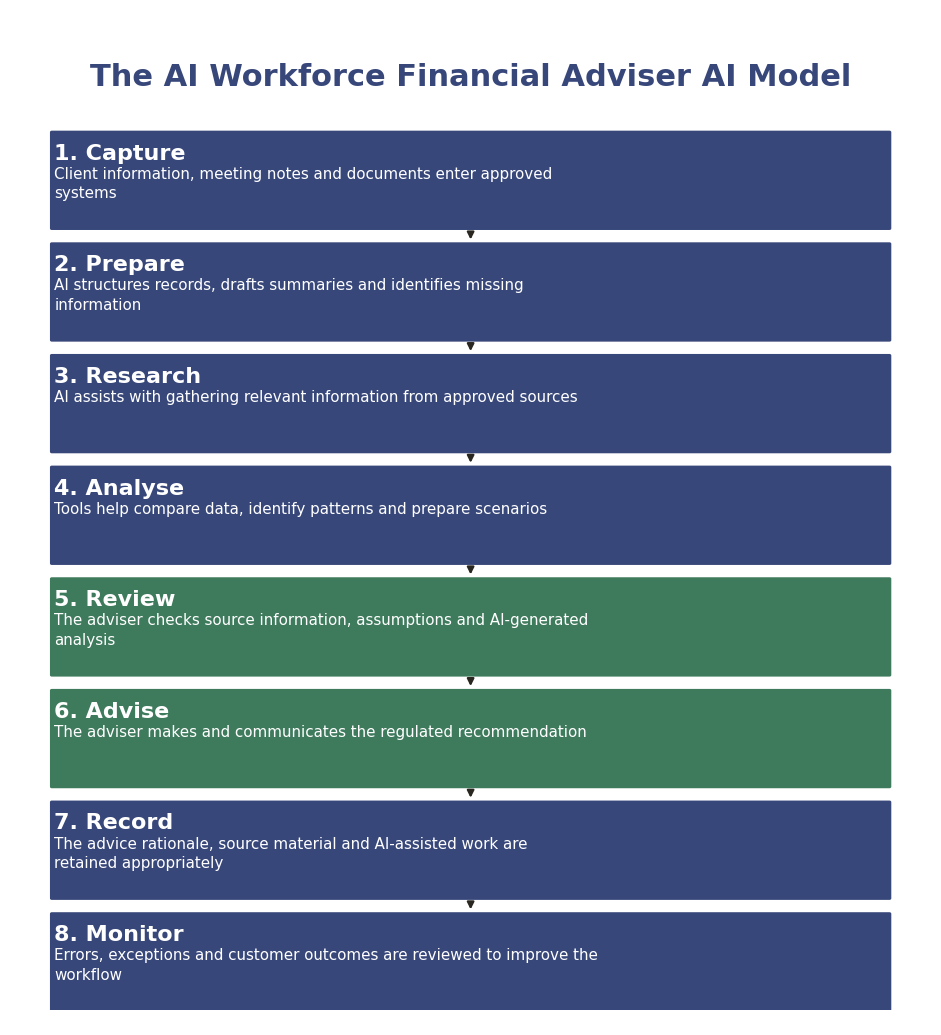
AI Workforce developed the Financial Adviser AI Model as a practical framework for deciding where AI can accelerate advice work without replacing professional judgement.
Capture: client information, meeting notes and documents enter approved systems
Prepare: AI structures records, drafts summaries and identifies missing information
Research: AI assists with gathering relevant information from approved sources
Analyse: tools help compare data, identify patterns and prepare scenarios
Review: the adviser checks source information, assumptions and AI-generated analysis
Advise: the adviser makes and communicates the regulated recommendation
Record: the advice rationale, source material and relevant AI-assisted work are retained appropriately
Monitor: errors, exceptions and customer outcomes are reviewed so the workflow can be improved
AI can accelerate Capture, Prepare, Research and Record heavily. Analyse can be AI-assisted. Review and Advise remain adviser-led. A workflow that skips straight from Prepare to Advise, with no genuine Review step, is the one that turns an AI-drafted scenario into an unchecked recommendation.
What Can AI Actually Automate?
It helps to separate this by task type rather than treating "AI for financial advisers" as one single capability.
Producing a first-pass summary of a client meeting or call from a transcript
Structuring a research request and gathering relevant background from approved sources
Preparing scenario comparisons and cash flow modelling inputs for the adviser to check
Drafting routine client correspondence, follow-up emails and review reminders
Updating CRM records, chasing outstanding documents and logging actions automatically
Flagging an inconsistency between what a client has said and what a record shows, for the adviser to investigate
None of this requires AI to exercise the judgement a client is actually paying for. It requires AI to handle the mechanical research and drafting well, and an adviser to do the thinking that turns prepared information into advice.
The Financial Adviser AI Boundary Matrix
Not every task in an advice practice carries the same risk, and treating them all the same is where AI adoption in financial advice tends to go wrong. This is how we group advice tasks by how much AI autonomy is appropriate.
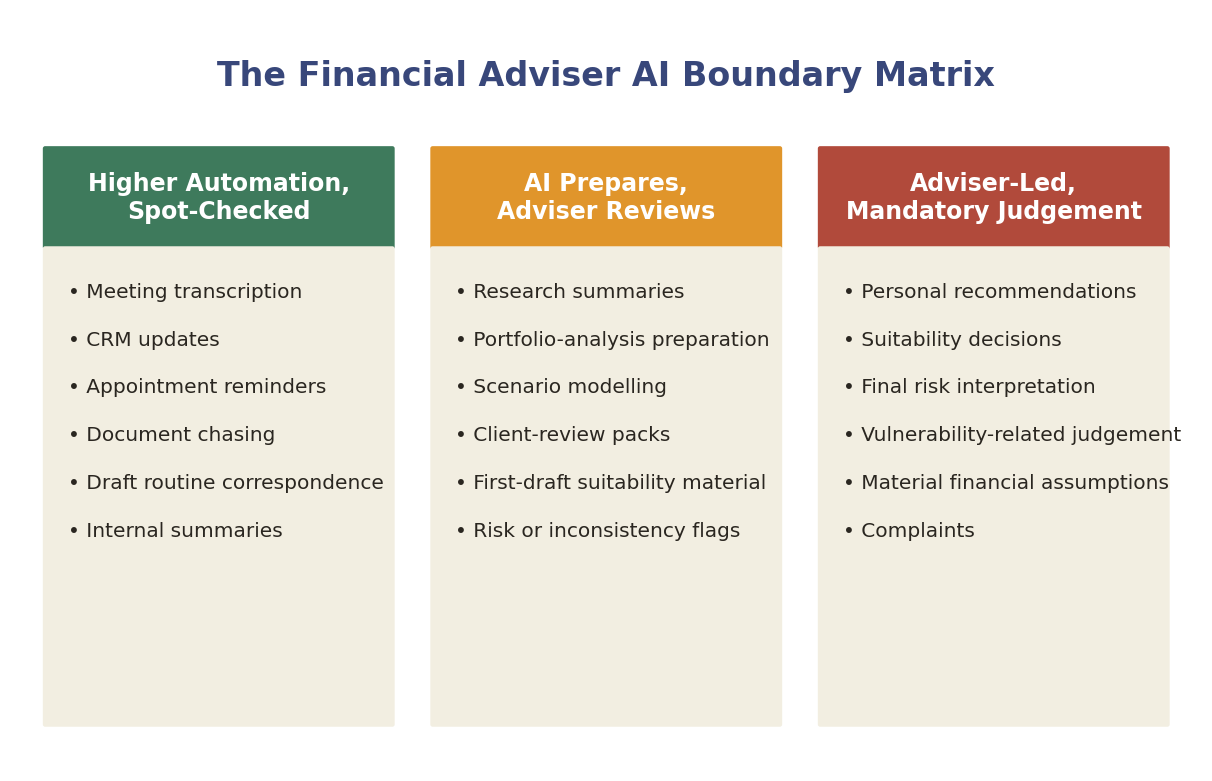
AI Workforce developed the Financial Adviser AI Boundary Matrix as a methodology for deciding which parts of advice work are safe to automate and which require mandatory professional judgement.
Higher Automation, Spot-Checked
Meeting transcription
CRM updates
Appointment reminders
Document chasing
Draft routine correspondence
Internal summaries
AI Prepares, Adviser Reviews
Research summaries
Portfolio-analysis preparation
Scenario modelling
Client-review packs
Preparation of factual material for a suitability report
Risk or inconsistency flags
Adviser-Led, Mandatory Judgement
Personal recommendations
Suitability decisions
Final risk interpretation
Vulnerability-related judgement
Material financial assumptions
Complaints
Anything creating a significant financial consequence for a customer
A task sitting in the top tier today is not necessarily permanent, and a task in the bottom tier is not automatically off-limits forever. The point of the matrix is to make the current boundary explicit, so moving a task up a tier is a deliberate decision rather than something that happens because a tool technically could.
AI for Meetings, CRM and Administration
Admin work has traditionally eaten a large share of an adviser's week, and this is where the clearest early wins tend to show up. A meeting assistant that transcribes a client conversation and drafts a structured summary within minutes of the call ending removes the split attention that comes from listening and writing notes at the same time. Our guide to the best free AI meeting note takers covers how these tools work in more detail.
A CRM updated automatically after a meeting, with action items flagged rather than relying on memory, saves real time and reduces the chance of something getting missed. This usually sits toward the higher-automation end of the boundary matrix above, provided changes are reversible, an audit log is available, and any consequential downstream action is separately controlled rather than triggered blindly off an AI-logged update.
AI for Research and Analysis
Research and early analysis are where AI shows a clear, fast win in advice work. Given a defined brief, a research tool can pull together background on a product, a market development or a technical rule considerably faster than a manual first pass. Ask one to compare scenarios from a defined dataset, and it can prepare cash flow projections and portfolio comparisons for the adviser to check, rather than starting from a blank spreadsheet.
This works best with a specific, narrow question rather than an open-ended request. A well-scoped brief- what the adviser actually needs to know and what decision it will feed into- saves a large amount of back-and-forth later, and it gives the adviser a clear basis for checking the output afterwards. The research and analysis AI produces is a starting point for the Review stage of the model above, not a finished conclusion.
AI for Client Communications
Drafting client emails, review reminders and routine updates is exactly the kind of repetitive work AI now handles well. A first-draft client update that used to take an adviser a disproportionate amount of time relative to its importance can often be produced in a fraction of that time, freeing time for the conversations that actually need a person.
Providing advice that is genuinely personalised to a client's circumstances still requires the adviser's judgement, but the drafting and formatting around it does not. That judgement stays a human responsibility, and time saved on routine correspondence gets reinvested in exactly the conversations that matter most, including the ones covered in the AI executive assistant guide for advisers managing a high volume of client scheduling and admin.
Worked Example: Annual Client Review to Adviser Recommendation
To make the model above concrete, here is what a well-run annual review looks like across a single working morning, following each stage of the AI Workforce Financial Adviser AI Model.

Illustrative timeline. A production workflow also needs a defined record of assumptions and sources, not just the steps shown here.
09:00, Capture: the meeting assistant records an approved annual review and produces a transcript
09:45, Prepare: AI creates a structured summary of changed circumstances, objectives and outstanding documents
10:00, Research: approved systems gather relevant product and market information
10:20, Analyse: AI prepares scenario comparisons and flags inconsistencies for investigation
10:45, Review: the adviser checks source information, assumptions, risk profile and anything AI has flagged
11:15, Advise: the adviser decides whether any recommendation is appropriate and records the rationale
11:30, Record: approved notes and actions are saved to the CRM
11:40, Follow-up: AI drafts the client email, which the adviser reviews before sending
AI prepared the information and removed administrative work. It did not determine what the client should do.
What Should Never Be Left to AI Alone?
Complex financial situations still need a person's judgement, particularly where a client's circumstances do not fit a standard scenario. An adviser brings context a model does not have access to: a family situation, a change in risk appetite, a conversation that happened off the record. Personal recommendations, suitability decisions, final risk interpretation, vulnerability-related judgement, material financial assumptions and complaints all belong firmly in the Adviser-Led tier of the boundary matrix above.
Human oversight stays essential precisely because the stakes are high enough that a wrong recommendation has real consequences for a client's finances. Client relationships built on trust depend on a person being accountable for the advice given, and that accountability does not shift depending on which tool helped prepare the underlying information.
FCA, Consumer Duty and Human Oversight
This is the section a serious guide to AI in financial advice cannot skip.
Does the FCA Allow Financial Advisers to Use AI?
Yes. The FCA does not prohibit financial advisers from using AI and actively supports responsible AI adoption through initiatives including its AI Lab and AI Live Testing. Existing rules still apply. A firm using AI remains responsible for suitability, Consumer Duty outcomes, governance, data protection and any regulated advice delivered through its service.
The FCA wants safe and responsible adoption of AI in UK financial markets, and it is already operating well beyond a wait-and-see approach: its AI Lab supports firms testing AI solutions, and AI Live Testing gives firms a supervised environment to trial systems in real-world conditions. FCA-published research into AI adoption across UK financial services, not limited to advice firms specifically, found that 75% of firms have already adopted some form of AI, and 84% have an individual accountable for their AI approach.
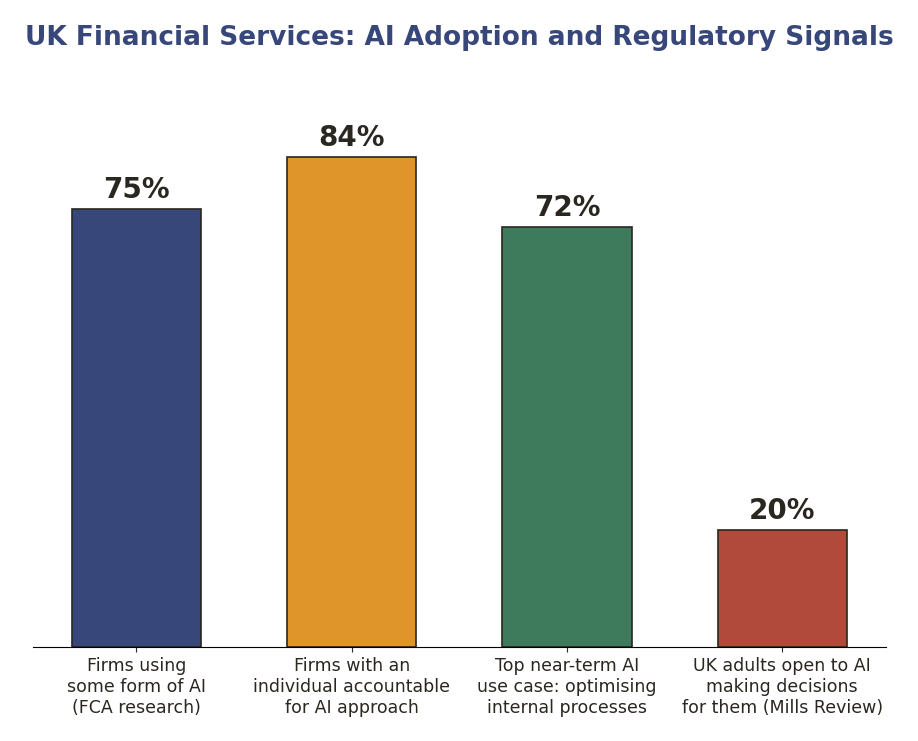
Sources: FCA research on AI in UK financial services, and the FCA's Mills Review consumer survey.
The FCA's Mills Review, published 6 July 2026 and led by executive director Sheldon Mills, looked specifically at how AI could reshape retail financial services through to 2030 and beyond. Drawing on a survey of more than 5,000 UK financial services consumers, the review found that retail financial services are moving from human-led toward AI-enabled and increasingly delegated services, and that one in five UK adults are already open to AI making decisions for them, even though consumer adoption will ultimately depend on trust, control and access. The review made seven priority recommendations to the FCA Board, including scaling up the AI Lab and building the foundations for what it calls agentic finance, AI systems that can recommend actions, initiate transactions and execute decisions within agreed parameters.
It is worth being precise about what this does and does not mean for an individual advice firm. The FCA's approach is to facilitate responsible AI adoption while applying its existing regulatory framework, not to impose a separate blanket AI requirement on every firm. There is no rule that every advice firm must have a formal AI plan simply because AI is prominent in the FCA's own work. What does apply, regardless of whether a firm uses AI at all, is Consumer Duty, which sets high standards of consumer protection across financial services and requires firms to put their customers' needs first. AI does not change the firm's obligation to deliver and evidence good outcomes for retail customers.
Who Is Responsible for Advice Prepared With AI?
Who is responsible for financial advice prepared using AI? Existing FCA responsibilities remain with the regulated firm and adviser, whatever tool assisted the preparation. AI can support research, administration and analysis, but it does not assume responsibility for a personal recommendation, a suitability assessment or Consumer Duty outcomes.
Vulnerable Customers and AI
The FCA's Consumer Duty places particular weight on outcomes for customers in vulnerable circumstances, and this is an area where AI needs deliberate, documented caution rather than a general assumption that a system will cope. A client experiencing bereavement, a health condition, financial difficulty or low capability to engage with complex information may communicate in ways an AI summarisation or sentiment tool was not built to interpret reliably, and a missed signal of vulnerability has a materially different consequence to a missed signal in a routine enquiry.
In practice this means vulnerability indicators, whether raised directly by a client or inferred from a conversation, should route to a person rather than being resolved automatically, and any AI-prepared summary of a client interaction should be checked specifically for whether it has captured or flattened a sign of vulnerability the adviser needs to see. This sits firmly in the Adviser-Led tier of the boundary matrix above, alongside suitability decisions and complaints.
UK GDPR and Client Data
Advisers handle some of the most sensitive personal data that exists in a client relationship: income, assets, health information relevant to protection or later-life advice, family circumstances and long-term financial goals. Where AI processes that personal data, it falls within the scope of UK data protection law in the same way any other processing does. This section is general information rather than legal advice.
Lawful basis and data minimisation. An AI tool should have a documented lawful basis for the personal data it processes, and should be scoped to use only the data a specific workflow genuinely needs, not everything a connected system happens to expose.
Vendor retention and model training. Before client data goes into an AI tool, it is worth knowing whether that specific product retains input data, whether it is used to train the underlying model, and what the vendor has committed to in writing. This varies by product and by pricing tier and should be checked for each tool rather than assumed either way.
International transfers. Check where a vendor actually processes and stores client data, and confirm a valid transfer mechanism applies if data leaves the UK.
Role-based access and audit logs. An AI tool connected to client records should have access to only what a specific task requires, and every action it takes on a record should be logged and reviewable.
DPIA screening. Where AI processing of client data is likely to result in a high risk, for example, large-scale profiling or automated scoring, a Data Protection Impact Assessment should be considered before the work begins, assessed against the ICO's own screening criteria rather than assumed to apply, or not apply, by default.
Significant automated decisions. The Data (Use and Access) Act 2025 reorganised the automated decision-making framework into Articles 22A to 22D, and defines a solely automated decision as one made without meaningful human involvement. The post-DUAA framework permits a broader range of significant solely automated decisions involving non-special-category personal data, subject to the applicable lawful-basis requirements and Article 22C safeguards, including giving the individual meaningful information about the decision, the ability to make representations, the ability to contest it, and access to genuine human intervention. Additional restrictions continue to apply where special category data, such as health information relevant to protection or later-life advice, is involved. The ICO's guidance in this area was still being finalised at the time of writing, so this remains a developing area to check before relying on any workflow that makes a significant decision about a client without a person's involvement.
AI-assisted advice versus solely automated decision-making. In an advice context, these are meaningfully different. Where AI prepares research, analysis or a draft, and the adviser genuinely reviews it before a recommendation is made, the safeguards that apply to solely automated significant decisions are unlikely to be the primary concern, since a person remains meaningfully involved in the decision. Where a system would determine an outcome for a client with no real adviser review, that is a materially higher-risk design that needs to be assessed against the automated decision-making rules directly, not assumed to be covered by general good practice. Our dedicated guide to AI and GDPR compliance for UK businesses covers the underlying framework in more depth.
Compliance note: this is general information, not legal advice. Check current FCA, ICO and Consumer Duty guidance, and take independent advice for anything that could materially affect a client or a regulated recommendation.
What Types of AI Tools Are Available?
Rather than naming a single best tool, which becomes outdated quickly and can read as an endorsement, it is more useful to understand the categories on the market and what each is built for. Every category still needs a defined level of human review, which varies by how consequential the output is.
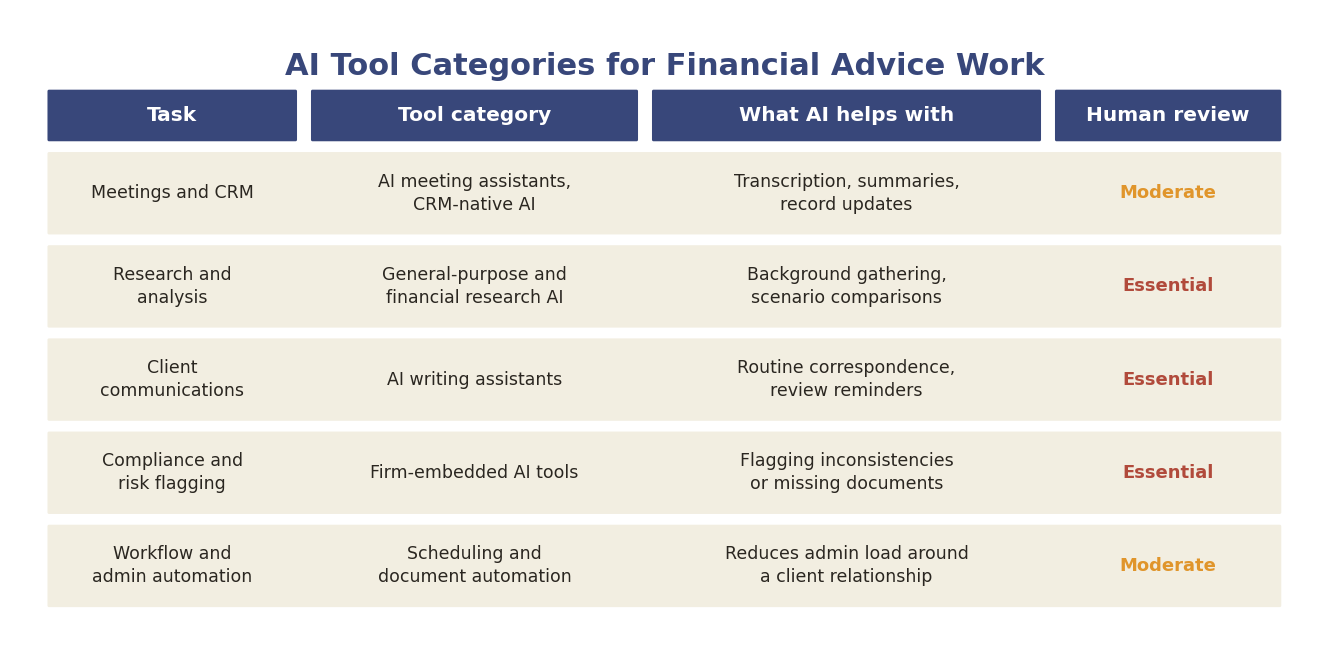
Illustrative categories. Which one matters most to your practice depends on where your actual bottleneck sits.
Meetings and CRM: AI meeting assistants and CRM-native AI handle transcription, summaries and record updates. Human review: moderate, spot-check for accuracy and missed detail.
Research and analysis: general-purpose assistants and dedicated financial research tools help gather background and prepare scenario comparisons. Human review: essential; every material figure and assumption needs an adviser check.
Client communications: AI drafts routine correspondence, review reminders and follow-up emails. Human review: essential for anything client-facing or containing specific figures.
Compliance and risk flagging: tools built into a firm's systems can flag a potential inconsistency or missing document before it reaches review. Human review: essential; a flag is a prompt to investigate, not a resolved compliance decision.
Workflow and admin automation: scheduling, document chasing and internal reporting reduce the admin load around a client relationship. Human review: moderate, spot-check rather than verify every item.
A tool that embeds AI directly into software an adviser already uses, a CRM, a meeting platform, a planning tool, tends to get used far more consistently than a separate app that needs its own login. Picking the one that fits an existing workflow tends to matter more than picking the newest one.
What Does Research Tell Us About AI Financial Advice?
Research published through MIT Sloan in 2026 highlights how quickly consumers are already turning to generative AI for financial guidance. The research, led by MIT Sloan assistant professor Taha Choukhmane, notes industry survey evidence suggesting that more than half of adults in the United States and the United Kingdom have already used large language models for personal financial guidance, likely more than the share who consult a human financial adviser directly. In simulations built to test the quality of that guidance, following AI-generated advice moved people closer to the saving, spending and investing patterns recommended by standard economic models over a lifetime, generally saving more during working years and reducing equity exposure as they aged.
That demonstrates demand and accessibility, but it does not turn a general-purpose AI model into a regulated financial adviser, and the same research found real limitations: the AI struggled to adjust spending after income shocks, tended to passively hold portfolios rather than actively rebalance them, and recommended too little gradual drawdown in retirement. Outcomes also varied considerably depending on the quality of the prompt a person wrote, with less financially literate users receiving noticeably less favourable simulated outcomes from otherwise identical AI tools. For UK advice firms, the more important implication is that clients may increasingly arrive having already consulted AI and expect their adviser to validate, challenge or contextualise what it told them.
How to Choose an AI Tool
Picking one AI solution and testing it on a real, low-stakes engagement beats months of committee-driven evaluation. A firm that wants measurable results should track one clear metric, hours saved or turnaround time on a specific task, rather than trying to prove value across everything at once.
Before comparing specific products, it helps to be clear on the actual bottleneck: is research taking too long, is CRM upkeep falling behind, is admin eating into client-facing time? A tool chosen to fix a specific, named problem tends to get adopted. A tool chosen because it looked impressive in a demo often does not.
How to Measure Whether It's Working
Whether an AI tool is actually helping is a different question from whether it is being used. We call this the AI Workforce Financial Advice AI Measurement Hierarchy, a set of indicators worth tracking together rather than relying on any single number.
Cases Assisted: how many client cases are using AI in a defined, recorded way
Data Correction Rate: how often an adviser has to correct an AI-prepared figure, summary or assumption during Review
Exception Capture Rate: how often an AI-generated flag or inconsistency turns out to be a genuine issue worth investigating
Adviser Review Time: how long the Review stage takes relative to the time AI saved at Research and Analyse
Net Time Saved: the actual time saved once Review and any corrections are accounted for, not the raw time AI took to produce an output
Customer Outcome Exceptions: complaints, corrections, or poor outcomes traced back to an AI-assisted step
The strongest pair to track together is Data Correction Rate and Exception Capture Rate. A high correction rate paired with a rising Net Time Saved is a sign the workflow is working as intended: AI is doing the heavy lifting on preparation, and the adviser's judgement is catching what needs catching. A low correction rate on its own is not necessarily good news; it can mean the Review stage is not being done thoroughly, which is worth investigating rather than assuming it is a good sign.
Common Mistakes
Common mistakes to avoid: treating an AI-prepared scenario or summary as a finished recommendation, letting AI-generated correspondence reach a client without review, feeding client data into a consumer-tier tool without checking its data and training policy, assuming vulnerability will be reliably flagged by a general-purpose summarisation tool, rolling AI out across every workflow at once instead of piloting one, and measuring how often AI is used rather than whether its output holds up under Review.
A Four-Week Rollout
Week one: pick one workflow, most commonly meeting notes or CRM updates, and test it on a real but low-stakes case with a defined verification step.
Week two: review what the tool produced against what the adviser would have produced manually. Note where it needed correction and why.
Week three: extend to a second, related workflow, keeping the same review-before-advise discipline, and start tracking the Measurement Hierarchy indicators above.
Week four: review Data Correction Rate and Net Time Saved together, decide whether to extend the pilot to more advisers or cases, and set a recurring review date rather than leaving the setup unreviewed indefinitely.
If you are still deciding whether now is the right moment, our AI readiness assessment is a useful starting point before committing to the rollout above.
Frequently Asked Questions
Can financial advisers use AI in the UK?
Yes. The FCA wants safe and responsible adoption of AI in UK financial markets and supports this through its AI Lab and AI Live Testing programme. AI can support research, administration, drafting and analysis, but existing FCA responsibilities remain with the regulated firm and adviser.
Does the FCA allow financial advisers to use AI?
The FCA does not prohibit AI use and is actively encouraging responsible adoption, but it does not create a separate blanket AI requirement either. Firms are expected to apply existing regulatory obligations, including Consumer Duty, to however they choose to use AI.
Can AI give regulated financial advice?
Potentially, but only within a properly designed and regulated automated advice service. The FCA already recognises automated advice models capable of making personal recommendations, provided the firm holds the appropriate permissions and meets suitability and other regulatory requirements. For a normal advice practice using generative AI as an assistant, AI-generated research or analysis should not simply be treated as regulated advice in its own right. The authorised firm remains responsible for meeting the applicable suitability, Consumer Duty and other regulatory requirements.
What financial adviser tasks can AI automate?
Meeting transcription, CRM updates, research preparation, scenario modelling inputs, routine client correspondence and document chasing are common starting points. Suitability decisions and final recommendations should stay adviser-led.
Can financial advisers put client data into ChatGPT?
It depends on the specific tool, its pricing tier and its data-handling terms. A free consumer-tier tool and a business tier with a proper data processing agreement are materially different. Check the vendor's data retention and model-training policy before using any AI tool on client data.
How does Consumer Duty apply to AI?
Consumer Duty requires firms to put customers' needs first and deliver good outcomes across products, price and value, understanding, and support. AI does not change that obligation; firms still need to evidence good outcomes regardless of which tools were used to prepare the advice process.
Will AI replace financial advisers?
The evidence does not support that. Research shows growing consumer use of AI for financial guidance, but the judgement, accountability and regulated responsibility that justify an adviser's role remain with the adviser, not the tool.
Do financial advisers need human oversight of AI?
Yes. Personal recommendations, suitability decisions, vulnerability judgements and material financial assumptions should stay adviser-led, with AI supporting preparation rather than producing the decision.
What are the best AI tools for financial advisers?
There is no single best tool. Meeting assistants and CRM-native AI suit admin, research tools suit preparation, and general-purpose assistants suit drafting. The right choice depends on where your actual bottleneck sits.
Can AI write a suitability report?
AI can prepare a first draft or structure supporting material, but the suitability assessment itself, and everything in the report that reflects it, needs the adviser's genuine review and professional sign-off.
Does UK GDPR apply to AI financial advice?
Yes. Any AI tool processing client personal data falls within UK GDPR in the same way any other processing does, including rules on lawful basis, data minimisation, international transfers and significant automated decisions.
What should financial advisers automate first?
Meeting transcription and CRM updates are the lowest-risk, highest-return starting point for most practices, since the evidence is unambiguous and the review step is quick.
Key Takeaways
AI speeds up research, meetings, CRM administration and drafting; it does not replace an adviser's professional judgement or regulated responsibility
Research published by the FCA found 75% of UK financial services firms have already adopted some form of AI, with the Mills Review finding one in five UK adults already open to AI making decisions for them
Consumer Duty applies to AI-assisted advice the same way it applies to any other process; AI does not change the firm's obligation to deliver and evidence good outcomes
The Financial Adviser AI Boundary Matrix separates work that can run with light spot-checking from work that needs mandatory adviser judgement
Vulnerability, suitability and personal recommendations should always stay adviser-led, regardless of how capable a tool appears
UK GDPR and the post-DUAA automated decision-making rules apply to AI processing client data; solely automated significant decisions carry specific safeguards
Start with one measured pilot, track correction and exception capture rates alongside time saved, and expand only once the workflow has proven itself
Ready to Bring AI Into Your Advice Practice Safely?
AI Workforce helps UK financial advice practices identify which parts of their workflow are genuinely ready for AI, set the right verification steps before a recommendation reaches a client, and introduce AI without exposing client data or regulated responsibility to unnecessary risk.
Related Guides
Sources and further reading
FCA, AI and the future of retail financial services (The Mills Review)
Bank of England, Financial Stability in Focus: Artificial intelligence in the financial system
MIT Sloan, Half of Americans now ask AI for financial advice, but how good is it?
ICO, The Data (Use and Access) Act 2025, what does it mean for organisations?
About the Author
Luca Controlo is AI Adoption and Marketing Automation Lead at AI Workforce. He works with UK financial services firms on how AI tools are introduced, tested and governed alongside FCA and Consumer Duty responsibilities.
Reviewed: August 2026