Best AI CRM Software UK 2026: 6 CRMs Compared
Posted On: July 25, 2026
Last updated: August 2026 · Written by Rodi Taze, Co-Founder of AI Workforce · Reviewed by Clara Miller, Content Marketing Specialist
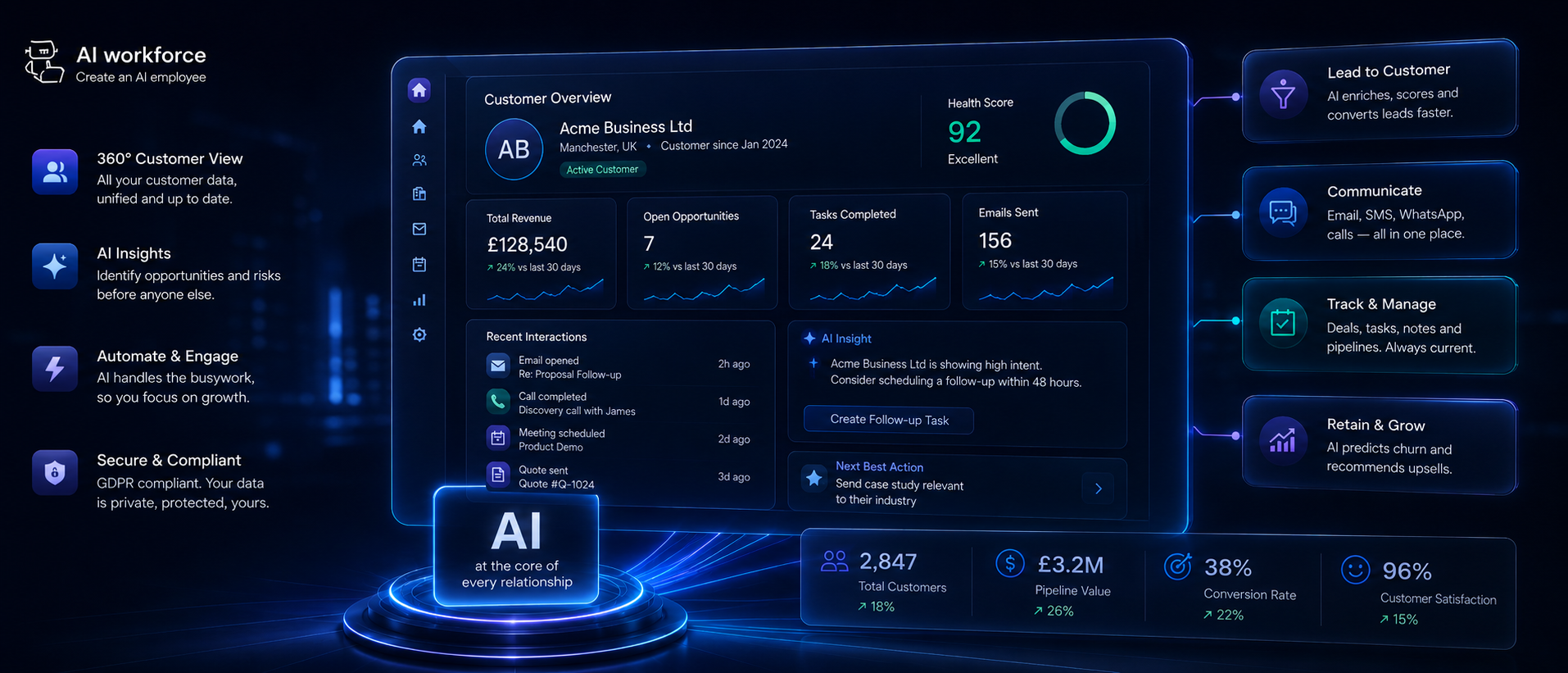
Most CRMs are good at storing information and poor at doing anything with it. A record sits there until a rep opens it, and nothing happens in between unless someone remembers to check. An AI CRM is customer relationship management software that uses artificial intelligence to organise and interpret customer data, summarise interactions, enrich records, surface priorities, recommend next actions and, where permissions allow, automate defined CRM updates. The harder question is not whether a CRM can do this. It is which platform does it well, what it will realistically cost, and which of its automatic actions should happen unattended versus stay in front of a person to confirm.
This guide compares leading AI CRM platforms by what their AI layer actually does, alongside pricing, UK relevance and genuine limitations, then covers the governance framework needed to run any of them safely. There is no single best AI CRM: the right choice depends on your existing tooling, team size, budget and how much of the record you want AI updating automatically versus recommending only.
Quick Answer
There is no single best AI CRM for every business. Salesforce suits established enterprise sales teams that need predictive AI and Agentforce automation across a highly customisable platform. HubSpot suits small and mid-sized UK businesses wanting AI built into every tier, including the free CRM. Microsoft Dynamics 365 Sales suits teams already running Microsoft 365 and Teams, since its Copilot features work natively across that ecosystem. Zoho CRM suits businesses prioritising affordability and broad feature coverage. Pipedrive suits teams wanting simple, visual pipeline management with AI layered on top rather than a feature-heavy platform. Freshsales suits teams wanting an affordable sales CRM with AI capabilities available on its higher paid tiers. The comparison below checks each candidate against current official documentation and pricing, not hands-on testing, unless stated otherwise. Zendesk is not included in this shortlist: Zendesk Sell, its sales CRM product, is being retired on 31 August 2027, so it is not a sensible new sales CRM purchase in 2026.
At a Glance
What it is: a comparison of AI CRM platforms by what their AI layer actually automates, core CRM strength, UK relevance, pricing and genuine limitations, alongside a governance framework for deciding what AI should update automatically versus only recommend
Best pick, one sentence: for most UK businesses, the right AI CRM is the one whose Govern layer, permissions and confidence thresholds you can actually configure, not the platform with the longest AI feature list
Best suited to: teams with enough CRM volume that manual data entry, scoring and follow-up are visibly eating into selling or service time
Typical cost: CRM subscriptions with AI included commonly range from free to around £150 a user a month depending on tier, with native AI add-ons or credits often billed separately; a custom AI workflow layered on top of an existing CRM commonly costs £3,000 to £10,000 to build, with £200 to £800 a month ongoing
Biggest benefit: a CRM that reflects reality without a person updating every field by hand, so reports and prioritisation are based on current data
Biggest risk: AI writing a confident but wrong update into the system of record, since a wrong CRM entry misleads everyone who later relies on it, not just the person who created it
What's Covered
Above-the-Fold Shortlist
Best for established enterprise sales teams: Salesforce, for predictive scoring, conversation intelligence and Agentforce automation across a highly customisable Sales Cloud platform.
Best for small UK businesses: HubSpot, for a free-forever CRM with its Breeze Assistant included on every tier, including the free plan.
Best for the Microsoft ecosystem: Microsoft Dynamics 365 Sales, for Copilot features that work natively inside Outlook, Teams and the wider Microsoft 365 suite a business may already run.
Best for affordability and breadth: Zoho CRM, for a large feature set including its Zia AI layer at a lower per-seat price than most competitors.
Best for simple pipeline management: Pipedrive, for a visual, easy-to-adopt pipeline with AI-powered reporting and email tools layered on top rather than a sprawling feature list.
Best-value sales CRM with AI on paid tiers: Freshsales, for contact scoring and deal insights on Pro, predictive intelligence on Enterprise and separately metered Freddy AI Agent usage.
Zendesk is deliberately left off this shortlist. It remains a strong customer-service and CX platform, but Zendesk has announced that Zendesk Sell, its sales CRM, will be retired on 31 August 2027, which rules it out as a new sales CRM recommendation for 2026.
Comparison Methodology
This comparison is based on a review of each vendor's official pricing and product documentation, not hands-on testing of every platform, and should be treated as a snapshot rather than a permanent ranking, since vendor capability and pricing in this category change frequently. Every candidate is assessed consistently against: core CRM functionality; activity capture; summaries and drafting; enrichment and data-quality controls; lead and account prioritisation; deal intelligence and forecasting; next-action recommendations; workflow automation; integrations and APIs; permissions and auditability; UK suitability; pricing transparency; implementation complexity; and best-fit business. Prices were checked 22 August 2026 against each vendor's official pricing page. Where a vendor publishes pricing in US dollars, AI Workforce converted it to sterling using an illustrative rate of approximately £0.73 per US dollar, checked 22 August 2026; this is a rounded estimate, not a live exchange-rate quotation, and actual sterling cost will vary with exchange rates, VAT and billing term. Confirm current pricing directly with each vendor before budgeting.
Master Comparison Table
Swipe to see all columns →
CRM | Best for | UK relevance | Indicative price | Main limitation |
|---|---|---|---|---|
Salesforce | Enterprise sales teams needing predictive AI and Agentforce automation | GBP pricing published directly; widely used by UK enterprise and mid-market teams | Starter Suite £20/user/mo; Pro Suite £80/user/mo; Core £156/user/mo; Advanced £316/user/mo; Max £440/user/mo. Checked 13 September 2026 | AI capability is an add-on from Core upward rather than being uniform, so cost rises quickly once a team wants Agentforce or broader predictive AI |
HubSpot | Small and mid-sized UK teams wanting AI included from the free tier upward | Available to UK businesses; displayed figures converted from HubSpot's published US pricing | Free, up to 2 users; Starter from approx £7/seat/mo; Professional from approx £66/seat/mo; Enterprise from approx £110/seat/mo. Converted from published US pricing, checked 22 August 2026 | Deeper Breeze Agents and customisation are reserved for Professional and Enterprise, so the free and Starter tiers are AI-assisted rather than agentic |
Microsoft Dynamics 365 Sales | Teams already standardised on Microsoft 365, Outlook and Teams | GBP pricing published directly for the UK | Professional £50/user/mo; Enterprise £80.70/user/mo; Premium £115.30/user/mo, excl. VAT, paid yearly. Premium includes 1,000 Copilot Credits. Checked 22 August 2026 | Deepest AI and agentic capability sits in Enterprise and Premium, and running agents beyond included capacity requires separately purchased Copilot Credits and an Azure subscription |
Zoho CRM | Affordability and broad feature coverage across sales, service and marketing | GBP pricing available via Zoho's currency selector | Free (3 users); Standard from approx £15/user/mo; Professional from approx £26/user/mo; Enterprise from approx £37/user/mo; Ultimate from approx £47/user/mo, billed annually. Converted from published US pricing, checked 22 August 2026 | Zia's individual AI features unlock at different tiers rather than as one bundle, so entry-tier pricing does not reflect the full AI feature set |
Pipedrive | Simple, visual pipeline management with AI layered on top | Prices shown in USD by default; VAT applied for UK and EU customers | Lite approx £10/seat/mo; Growth approx £28/seat/mo; Premium approx £43/seat/mo; Ultimate approx £58/seat/mo, billed annually. Converted from published US pricing, checked 22 August 2026 | Lighter on deep customisation and enterprise-grade governance controls than Salesforce or Dynamics 365 |
Freshsales | Sales teams wanting an affordable CRM with AI available on its paid tiers | General, not UK-specific; prices shown in USD | Free (3 users); Growth approx £7/user/mo; Pro approx £28/user/mo; Enterprise approx £43/user/mo, billed annually. Freddy AI Agent usage is separately priced by sessions. Converted from published US pricing, checked 22 August 2026 | The free and Growth tiers provide limited AI depth; contact scoring and deal insights require Pro, while predictive intelligence is concentrated in Enterprise. Freddy AI Agent usage is separately metered |
Individual CRM Reviews
Each review below is based on current public documentation and pricing, not hands-on testing, unless stated otherwise.
Salesforce
Best for: established enterprise and mid-market sales teams that want predictive AI, conversation intelligence and increasingly autonomous Agentforce capability inside a highly customisable platform.
What its AI does: Salesforce's AI capability is available as Agentforce, an add-on offered from the Core tier upward rather than being uniform across the product. Core and Advanced add Agentforce access, conversation intelligence and predictive lead and opportunity scoring, and Max bundles Salesforce's fullest sales-AI package with the most comprehensive included usage allowances.
Core CRM strengths: deep customisation, a mature partner and integration ecosystem, and strong reporting, forecasting and customisation tools.
Relevant integrations: an extensive AppExchange marketplace, native Slack integration, and broad support for third-party data, marketing and finance tools.
Official pricing: Starter Suite £20/user/month; Pro Suite £80/user/month; Core £156/user/month; Advanced £316/user/month; Max £440/user/month. Salesforce publishes these prices directly in GBP for UK visitors. Checked on 13 September 2026 against Salesforce's official Sales Cloud pricing page (salesforce.com/uk/sales/pricing).
Genuine limitation: the depth of AI functionality varies considerably by edition rather than being uniform across the product, so a team evaluating Salesforce on its AI capability needs to price the specific tier that includes the Agentforce add-on it actually wants, not the headline product name.
Best-fit business: a UK sales organisation with the budget and complexity to justify a highly customisable platform, and the governance maturity to configure Agentforce's permissions properly before switching on autonomous actions.
HubSpot
Best for: small and mid-sized UK businesses wanting AI features included from the free CRM tier upward, without needing a separate specialist tool.
What its AI does: the Breeze Assistant ships on every tier, including the free CRM, and handles drafting, summarisation and content generation; more than 100 embedded AI features are spread across HubSpot's Marketing, Sales and Service hubs; autonomous Breeze Agents, which can take bounded actions rather than only assist, are reserved for Professional and Enterprise plans.
Core CRM strengths: an intuitive interface, a genuinely usable free tier, and tight native integration between its CRM, marketing, sales and service hubs.
Relevant integrations: a large App Marketplace, native Gmail and Outlook sync, and common integrations with e-commerce, support and finance tools.
Official pricing: Free, up to 2 users; Starter from approximately £7 per seat/month; Professional from approximately £66 per seat/month; Enterprise from approximately £110 per seat/month. Starter includes 500 HubSpot Credits, Professional includes 3,000 and Enterprise includes 5,000. Figures are converted from HubSpot's published US Sales Hub pricing; HubSpot's own site should be checked for current UK-specific figures. Checked 22 August 2026 (hubspot.com/pricing/sales).
Genuine limitation: the free and Starter tiers are AI-assisted rather than agentic, so a team wanting Breeze Agents to take bounded actions automatically needs to budget for Professional or Enterprise.
Best-fit business: a small UK team that wants a single platform covering CRM, marketing and service with AI included from day one, and does not yet need deep custom object modelling or enterprise-grade governance.
Microsoft Dynamics 365 Sales
Best for: teams already standardised on Microsoft 365, Outlook and Teams, who want Copilot features that work natively inside tools staff already use daily.
What its AI does: Copilot in Dynamics 365 provides contextual insights and recommendations, lead and opportunity summaries, meeting preparation summaries, and email summary and reply drafting; Enterprise and Premium tiers add access to prebuilt agents, including a Sales Qualification Agent, Sales Opportunity Agent, Sales Research Agent and a Sales Close Agent in preview; Premium includes 1,000 monthly Copilot Credits, additional AI-powered recommended actions and data enrichment.
Core CRM strengths: deep native integration with Outlook, Teams and the wider Power Platform, strong reporting via Power BI, and enterprise-grade customisation through Power Automate and Power Apps.
Relevant integrations: native to the Microsoft 365 suite, plus LinkedIn Sales Navigator bundled into the separate Microsoft Relationship Sales offering.
Official pricing: Professional £50/user/month; Enterprise £80.70/user/month; Premium £115.30/user/month, all excluding VAT and paid yearly. Microsoft publishes these prices directly in GBP for the UK. Premium includes 1,000 Copilot Credits a month; running agents beyond included capacity requires separately purchased Copilot Credits, priced pay-as-you-go or via a pre-purchase plan, and an active Azure subscription. Checked 22 August 2026 against Microsoft's official Dynamics 365 Sales pricing page (microsoft.com/en-gb/dynamics-365/products/sales/pricing).
Genuine limitation: the most useful agentic features sit in Enterprise and Premium, and meaningful agent usage beyond what is bundled requires an additional Azure subscription and Copilot Credit spend, which is easy to underestimate when budgeting.
Best-fit business: a UK business already paying for Microsoft 365 and Teams, where CRM data living inside the same ecosystem as email and calendar outweighs the appeal of a CRM-first platform like Salesforce or HubSpot.
Zoho CRM
Best for: businesses prioritising affordability and broad feature coverage across sales, service and marketing without a large per-seat budget.
What its AI does: Zia is not one uniformly included feature. Its recommendations, communication intelligence, anomaly detection, scoring and predictive capabilities vary by CRM edition, organisation size and feature. Businesses should compare the current Zoho edition matrix against the exact Zia capabilities they need rather than assuming the full assistant is included with an entry plan.
Core CRM strengths: a genuinely usable free tier for up to three users, broad workflow automation, and a large native app ecosystem across the wider Zoho suite.
Relevant integrations: native integrations across Zoho's own productivity suite, Google and Microsoft calendar and email sync, and Zoho Marketplace extensions.
Official pricing: Free, for up to 3 users; Standard from approximately £15/user/month; Professional from approximately £26/user/month; Enterprise from approximately £37/user/month; Ultimate from approximately £47/user/month, all billed annually. Zoho publishes pricing in multiple currencies including GBP via a currency selector on its pricing page; figures here are converted from commonly published US pricing and should be checked directly against Zoho's GBP toggle. Checked 22 August 2026 (zoho.com/crm/zohocrm-pricing.html).
Genuine limitation: Zia's capabilities are distributed across multiple editions, so Zoho's entry price does not represent the cost of its complete AI feature set.
Best-fit business: a cost-conscious UK small business wanting broad CRM functionality and a credible AI layer without Salesforce or Microsoft-level per-seat pricing.
Pipedrive
Best for: teams that want a simple, visual pipeline with AI-powered reporting and email tools layered on top, rather than a large feature-heavy platform.
What its AI does: AI-powered report creation from text prompts, AI-powered multi-email tools for drafting, summarising and replying to emails, custom scoring models, and company data enrichment from the Premium tier upward.
Core CRM strengths: a genuinely intuitive pipeline interface, fast onboarding, and a strong marketplace of 500-plus integrations.
Relevant integrations: native integrations with Zapier, Zoom, Lemlist and common email providers, plus a large app marketplace.
Official pricing: Lite approximately £10/seat/month; Growth approximately £28/seat/month; Premium approximately £43/seat/month; Ultimate approximately £58/seat/month, all billed annually. Prices are shown in USD by default on Pipedrive's site and VAT is applied for UK and EU customers; figures here are converted from Pipedrive's published US pricing. Checked 22 August 2026 against Pipedrive's official pricing page (pipedrive.com/en/pricing).
Genuine limitation: Pipedrive is lighter on deep customisation, custom objects and enterprise-grade governance controls than Salesforce or Dynamics 365, so a business that outgrows a simple pipeline may need to migrate later.
Best-fit business: a small UK sales team that wants to be productive quickly and values pipeline simplicity over the breadth of AI feature coverage found in larger platforms.
Freshsales
Best for: sales teams wanting an affordable CRM with genuine AI capability on its paid tiers, rather than a large enterprise-grade platform.
What its AI does: Freddy AI works inside Freshsales itself, not just in Freshworks' separate helpdesk products, but it is not part of the free plan. The free tier covers basic CRM functionality only. Contact and deal scoring, and deal insights that flag which opportunities need attention, are available from Pro upward. Predictive intelligence on likely outcomes is concentrated in Enterprise. A Freddy AI Agent that can be given bounded tasks is billed separately by session where available.
Core CRM strengths: a clean, fast-to-adopt sales interface, a genuinely usable free tier for small teams, and native visibility into contact activity and engagement across email and calls.
Relevant integrations: native integrations across the wider Freshworks suite, including Freshdesk for support handoff, plus common email, calendar and telephony tools.
Official pricing: Free, up to 3 users; Growth approximately £7/user/month; Pro approximately £28/user/month; Enterprise approximately £43/user/month, billed annually. Freddy AI Agent usage is priced separately by session rather than included in the seat price. Figures are converted from Freshworks' published US pricing; check Freshworks' official pricing page directly for current UK-specific rates. Checked 22 August 2026 (freshworks.com/crm/pricing).
Genuine limitation: the free and Growth tiers provide limited AI depth, so a team drawn in by Freshsales' low entry price needs to budget for Pro or Enterprise to get scoring, insights and predictive intelligence, and agent sessions are a separate usage-based cost on top of the subscription.
Best-fit business: a cost-conscious UK sales team that wants a straightforward CRM and is prepared to budget for Pro or Enterprise to unlock genuine AI scoring and insight, without the governance overhead of an enterprise platform.
A note on Zendesk: Zendesk remains a strong, widely used customer-service and CX platform, with Intelligent Triage classifying incoming tickets by intent, entity, sentiment and language. It is not included in the shortlist or comparison table above because Zendesk has announced that Zendesk Sell, its sales CRM product, will be retired on 31 August 2027. A business already using Zendesk for support can reasonably keep using it for that purpose, but choosing Zendesk Sell as a new sales CRM in 2026 would mean adopting a product on a confirmed path to retirement.
Not Sure Which CRM Fits Your Business?
AI Workforce can review your current CRM, team size and workflows against the comparison above and recommend the right platform and AI layer for your business, not a CRM we sell ourselves.
What Is an AI CRM?
An AI CRM is a customer relationship management system with a layer of intelligence built on top of the same records a traditional CRM already stores: contacts, companies, deals, tickets and activity history. A CRM on its own stores information. An AI CRM reads that information, works out what needs attention, and in defined cases updates the record itself, instead of leaving every field dependent on a person remembering to check it.
Contact storage, activity logging and pipeline views are table stakes at this point. What actually separates a modern platform from a basic contact list is what happens after the data lands: whether the system can summarise a call, score a lead against real signals, flag a deal that has gone quiet, or draft a follow-up a rep can send with a light edit, rather than leaving all of that to whoever happens to notice first.
This matters more every year because customer relationships now generate more activity than any person can review by hand: emails, calls, meetings, support tickets and web behaviour, often across several disconnected tools. An AI CRM's job is to turn that volume into a short, prioritised list a person can actually act on, and to handle the mechanical parts of keeping records current without waiting for someone to have a spare ten minutes.
Traditional CRM vs CRM Automation vs AI CRM vs Agentic CRM
These four terms describe genuinely different levels of capability, and treating them as interchangeable is a common source of disappointment when a business buys "AI CRM" expecting one thing and receives another.
Traditional CRM: stores customer and deal state. Contacts, companies, deals and tickets live here, and a person has to update every field manually.
Rules-based CRM automation: performs deterministic actions when predefined events occur, such as sending a reminder five days after no activity or assigning a new lead to the next rep in a rotation. No interpretation is involved; the trigger and the action are both fixed in advance.
AI-assisted CRM: summarises, scores, drafts and recommends. It reads unstructured content, such as an email or call transcript, and turns it into something structured and useful, but a person still decides what happens next. This overlaps with the AI sales-assistant category, where the emphasis is specifically on helping individual reps with research, meeting preparation, call summaries, follow-up drafting and CRM administration while the salesperson stays in control. Our Best AI Sales Assistant Software comparison covers that category in detail.
Agentic CRM: interprets context and can take bounded actions across CRM records and connected systems, such as updating a deal stage, creating a task, or triggering a workflow in another tool, within limits a business has explicitly defined.
Most platforms marketed as "AI CRM" in 2026 sit somewhere between AI-assisted and agentic, with the balance shifting further toward agentic capability as vendors add more autonomous features, as reflected in the individual reviews above. Knowing which level a specific tool actually operates at, rather than assuming from the marketing page, is the first useful question to ask before comparing anything else.
The AI Workforce CRM Intelligence Model
A CRM's AI layer is easier to reason about and to govern once it is broken into distinct stages rather than treated as one undifferentiated "AI" feature. At AI Workforce, we use a CRM Intelligence Model built on five layers, each with a different job and a different level of risk.
The AI Workforce CRM Intelligence Model
Illustrative model. The specific rules behind Act and Govern should reflect your own risk tolerance and sales or service process, not a generic template.
Record: the underlying contacts, companies, deals, tickets and activity history a traditional CRM already stores.
Context: the emails, calls, meetings, documents and account history that give a record meaning beyond its raw fields.
Interpret: summarisation, classification, scoring and risk detection, turning context into something structured a person or a workflow can use.
Act: routing, task creation, field updates, follow-up drafting and escalation, the layer where the system actually does something.
Govern: permissions, confidence thresholds, audit trails and human approval, the layer that decides how much autonomy the Act layer is actually given.
Most of the disappointment businesses report with AI CRM tools traces back to a missing or weak Govern layer, not a weak Interpret layer. Modern language models are generally competent at summarising a call or drafting a follow-up. The harder, less solved problem is deciding which of those outputs should write directly into the CRM unattended, and which should sit in front of a person first. The next two sections work through that distinction directly.
What Can AI Safely Automate in a CRM?
Some CRM updates are safe to apply without a person reviewing each one, because the evidence is unambiguous and the event is verifiable rather than inferred from tone or a plausible-sounding pattern.
Illustrative split. Your own risk tolerance and process should determine exactly where a given action lands.
Logging an email or call as activity against the correct record
Generating a meeting or call summary from a transcript
Creating a follow-up task after a defined trigger, such as a call ending with no next step logged
Enriching a new record with firmographic data, with the source of that data recorded alongside it
Suggesting a lead or deal score as a recommendation a person can see and act on
Flagging a stalled deal, an ageing ticket or a record with no recent activity for review
These are the actions where getting it wrong costs a little time to correct, not a wrong number in a forecast or a mishandled customer relationship. The next section covers the actions that sit on the other side of that line.
What Should Require Human Approval?
A separate set of actions should never be applied by AI without a person confirming them first, because a mistake here is expensive in a way a missed reminder is not.
Changing a deal's stage based on inferred intent rather than confirmed evidence
Changing a deal's commercial value
Merging or deleting records, even where the match looks obvious
Sending a reply to a customer on a sensitive, escalated or high-value account
Closing a deal as won or lost without a hard-rule condition, such as a signed contract or a confirmed loss reason, behind it
Overwriting a person's manually verified field with lower-quality third-party enrichment
Changing a support ticket's priority or resolution status on an account already flagged as at risk
Rather than a single automation switch, the safest way to bound these decisions is by the model's own confidence in a specific update: high confidence and verifiable evidence can move to automatic, medium confidence should be recommended for a person to confirm, and low or conflicting evidence should hold for review rather than guess in either direction. This is the same confidence-based governance approach we use across AI Workforce's sales and service content, applied here to CRM writes specifically.
AI CRM for Sales, Marketing and Customer Service
An AI CRM's value looks different depending on which part of the business is using it, even though the underlying record often sits in the same system.
In sales, the clearest wins are the most repetitive ones: lead and deal scoring, stalled-deal detection, and call or email summarisation, all handled consistently and at any hour, without waiting for a manager's reminder. A rep working from a scored, prioritised list spends the day differently to one working from an unsorted queue. Our guide to AI sales pipeline management explains how these CRM signals can be used to manage accepted opportunities, stage movement, stalled deals and forecasting without handing commercial judgement to AI.
In marketing, the same underlying record supports segmentation, campaign attribution and lead handoff quality. A CRM with a strong Interpret layer can flag which marketing-sourced leads are actually converting, rather than leaving that judgement to a monthly report built after the fact.
In customer service, a system that remembers every past interaction can route a request to the right person immediately, rather than making a customer repeat themselves. Sentiment signals in a support ticket can catch a frustrated tone before it turns into a cancellation, and a consistent record across support, sales and marketing means every team is working from the same enriched account view rather than three partial ones.
The common thread across all three functions is the same: the CRM stores and coordinates that activity, and AI is most useful where it turns raw activity into a short, prioritised, explainable list, not where it is left to make consequential decisions unsupervised. For the detailed mechanics of outreach, prospecting, follow-up and AI SDR tooling that sit around this CRM layer, see our dedicated guides linked under Related Guides below, since this section deliberately does not expand into a complete sales or marketing automation guide.
CRM-Native AI vs Specialist AI Tools
Businesses evaluating this space usually end up choosing between the AI built directly into their CRM and specialist AI tools that connect alongside it, and for most teams the right answer is both, used for different jobs.
CRM-native AI tends to have an advantage in full context, since it already has the complete record without a data sync; fewer sync problems, because there is no second system that can drift out of date; easier adoption, since a rep is not learning a new interface; and stronger permissions alignment, inheriting the CRM's existing access controls.
Specialist AI tools tend to have an advantage in deeper capability in a narrow task, such as conversation intelligence pulled directly from calls, more sophisticated enrichment sourcing, or a scoring model trained across a wider dataset than one business's own CRM history can provide.
Neither category is universally better, and framing native AI as automatically superior overstates the case; a specialist tool can genuinely outperform native functionality on the specific task it was built for. The strongest setups typically use CRM-native automation for record integrity- the things that must never drift out of sync with reality- while specialist tools supply extra intelligence layered on top where it is genuinely needed.
Where AI CRM Automation Goes Wrong
A fair account of this technology has to include where it fails, not just where it helps:
Writing a confident but factually wrong update into a record, because the underlying signal was weaker than the output sounded
Treating engagement, such as an email open, as proof of a genuine change in deal status
Overwriting a person's manually verified field with lower-quality third-party enrichment
Merging or deleting records that were only a partial match
Closing a deal or resolving a ticket automatically with no hard-rule condition behind the change
Letting a stale enrichment field quietly become the basis for a scoring decision
Granting an AI feature broader read or write permissions than the specific workflow actually needs
A forecast or health score built on model confidence alone, with no observed fact behind it
None of this makes the category unsuitable. It means the Govern layer of the CRM Intelligence Model, and a habit of checking what the system actually changed rather than assuming it worked, matter more than how capable the AI looks in a demo.
Replace Your CRM or Add AI to the Existing System?
This is one of the more consequential commercial decisions in this category, and it deserves a direct answer rather than defaulting to whichever option a vendor happens to be selling.
Replace your CRM when:
Its data model genuinely cannot support the business, such as no support for the objects or relationships your sales or service process actually needs
Adoption is poor because the platform's workflows do not fit how your team actually sells or supports customers
Essential integrations, such as your finance system or a core product tool, are unavailable or unreliable
Permissions, reporting or pipeline management are structurally inadequate, not just missing a feature you could work around
Add AI around the existing CRM when:
It already contains trusted customer history that would be expensive and risky to migrate
Staff adoption of the current platform is strong, and switching would create real disruption
The main problem is administrative work, research or follow-up, not the CRM's structure itself
APIs and integrations allow controlled automation to be layered on top without touching the core data model
Migrating would create more cost and disruption than the AI capability would deliver in value
AI Workforce's position on this is not to sell CRM replacements. Where a business's existing CRM is fundamentally sound, adding a governed AI layer on top, whether native or specialist, is usually the lower-risk path. Where the underlying CRM itself is the constraint, no amount of AI will fix that, and the more honest recommendation is to address the platform choice first.
UK GDPR, PECR and Companies House Enrichment
An AI CRM is unusually sensitive from a data protection standpoint, because it can potentially both read and write into the system of record, and because a CRM commonly holds named contacts, call transcripts, email history, behavioural data, inferred scores and personal notes together in one place. This section is general information rather than legal advice.
UK GDPR applies to that processing regardless of whether a person or an AI system is the one updating the record. The most common lawful basis for holding and processing B2B CRM data is legitimate interests, supported by a documented purpose, necessity and balancing assessment, rather than assumed by default. Data minimisation still applies: an AI layer should read and write only what a specific workflow genuinely needs, not everything a connector happens to expose. Where a CRM's AI layer is used to inform downstream marketing communications, PECR rules on electronic marketing apply to those messages separately from the CRM's own data protection obligations.
Automated decisions matter specifically here. Where a CRM's AI layer makes a significant decision about an individual solely through automated processing, such as an automated scoring outcome that meaningfully affects how they are treated, additional safeguards can apply under UK data protection law, including transparency, the ability to make representations and access to human intervention. AI Workforce's recommended operating model is more cautious than the legal minimum: consequential CRM decisions, particularly anything affecting how a named individual is treated, should stay reviewable by a person.
Companies House enrichment deserves a specific mention, since several CRMs and connected enrichment tools pull from it. Companies House can support official company-name, registration-number, status, incorporation-date, registered-office and SIC-code fields, and this data is free and publicly available. It does not supply private contact details for named individuals, and public availability of a company's official record does not itself grant permission to market to a specific person at that company; that separate justification still needs to exist under UK GDPR and PECR.
Permissions deserve as much attention as the AI features themselves. Role-based access, read versus write access, field-level permissions, audit logs, data provenance, the ability to reverse or roll back an automated change, and clarity on whether a vendor trains its own models on your customer data are all governance questions worth answering before an AI layer is given write access to a live CRM. Where third-party connectors are involved, confirm what each one can actually read and write, not just what the workflow was designed to use. Our guide to AI and GDPR compliance for UK businesses covers the underlying framework in more depth (AI and GDPR Compliance for UK Businesses).
What Does an AI CRM Cost?
Cost depends on whether you are buying a CRM subscription with native AI included, adding a specialist AI layer on top of an existing platform, or commissioning a custom workflow. These are genuinely different purchases and should be budgeted separately.
CRM subscriptions with native AI: as shown in the comparison table above, official published pricing ranges from free entry tiers to around £280 to £440 a user a month at the top of Salesforce's range, with most mid-market platforms sitting between roughly £15 and £110 a user a month depending on tier. The AI-specific capability, particularly agentic features, is usually concentrated in the higher tiers rather than spread evenly.
AI add-ons or credits: several platforms meter agentic or advanced AI usage separately from the base subscription, such as Microsoft's Copilot Credits for running agents beyond included capacity. Budget for this as a variable cost, not a fixed one.
External automation added around an existing CRM: for a custom-built AI layer specifically, rather than a CRM subscription, indicative ranges based on the types of UK small business automation projects AI Workforce encounters are:
Simple automation (roughly £500 to £2,000): for example, automated activity logging and stalled-record flagging connected to an existing CRM
Mid-range build (roughly £3,000 to £10,000): for example, scoring, summarisation and recommend-only routing built around defined confidence thresholds
Custom AI (£10,000 and up): for example, a bespoke scoring and forecasting model trained on your own historical CRM data, integrated with confidence-based automatic writes
Ongoing monthly cost (roughly £200 to £800): monitoring, maintenance and periodic retuning as your data and processes change
Within any of these tiers, the total figure is really made up of five components worth pricing out individually: implementation, the initial build and CRM integration; software, platform or per-seat licensing; AI credits, usage-based cost for the generative and scoring layer; data costs, licensed enrichment billed separately from the platform; and maintenance, ongoing monitoring and retuning as your CRM structure changes. A more detailed breakdown of UK automation cost drivers generally is covered in our guide to AI automation pricing (AI Automation Pricing UK).
Migration and Implementation Considerations
A CRM with impressive AI may still be the wrong choice if migration and ongoing administration costs outweigh the benefit, so these deserve fuller treatment than a single line item in a pilot plan.
Data migration: exporting and re-importing contacts, companies and deals accurately, including custom fields that may not map cleanly between platforms
Field mapping: deciding how each source field corresponds to a field in the new system, and what happens to data that does not have an equivalent
Duplicate resolution: identifying and merging duplicate records before they pollute the new system, since AI-assisted merging still needs human confirmation on anything but the most obvious matches
Historical activities: deciding whether call logs, emails and past activity migrate in full, in summary, or not at all
Ownership rules: re-establishing which rep or team owns which record once record IDs change
Workflow rebuilding: automation rules, assignment logic and approval processes generally need to be rebuilt rather than migrated automatically
Reporting continuity: historical reports and dashboards commonly do not transfer, so year-over-year comparisons may need a manual bridge
Integration replacement: every connected tool, from email to finance software, needs to be reconnected and tested against the new platform
Staff training: adoption time and productivity dip during the transition, which should be budgeted as a real cost, not assumed away
Ongoing CRM administration: a platform switch does not remove the need for continued admin time; it usually just changes what that time is spent on
Most vendors compared above offer migration assistance or partner-led migration services; ask specifically what is included versus billed separately before treating a low subscription price as the full cost of switching.
How Do You Evaluate an AI CRM Vendor?
Before committing to a platform, put these questions to the vendor directly:
Which CRM updates does the AI layer apply automatically, and which does it only recommend?
Can automation authority be set separately by confidence tier, rather than as one blanket setting?
What permissions does the AI feature actually require, and can read and write access be scoped separately?
Can I see why the AI made a specific recommendation or update, not just that it happened?
Can every automated change be traced back to what triggered it, and reversed if it was wrong?
Does the platform separate genuine evidence, such as a confirmed calendar event, from an inferred pattern?
Is customer data used to train the vendor's own wider models, and can that be disabled?
How does the platform handle a low-confidence or conflicting-signal update by default?
What is included in the published price, and what requires a separate add-on, credit purchase or custom quote?
A vendor that cannot answer these clearly, or treats the questions as unusual, is a signal to slow down.
A Four-Week AI CRM Pilot
Rolling AI capability into a live CRM against a constrained slice of records is safer than switching on full automation across the whole system from day one.
Illustrative roadmap. Expand to additional record types or automatic writes only once the earlier stages have proven themselves.
Week one, data and permissions: audit duplicate records, required fields, connected integrations, access permissions and CRM ownership before adding any AI capability on top.
Week two, low-risk automation: turn on activity logging, call and meeting summaries, enrichment suggestions and task creation, all of it visible to a person rather than silent.
Week three, recommendation mode: enable scoring, risk flags and next-best-action suggestions on live records, but do not let the system write any of them automatically yet.
Week four, controlled writes: turn on automatic updates only for deterministic, low-risk fields, while every commercially or personally significant change stays under human review.
How Do You Measure AI CRM ROI?
Number of AI actions taken is not a sufficient measure, since a system can look busy while quietly degrading data quality. Track a broader set of indicators instead:
CRM field completeness, the proportion of required fields that are actually populated
Duplicate-record rate across contacts and accounts
Time spent on CRM administration per rep or per agent, measured against a real baseline
Percentage of open opportunities or tickets with a valid, recorded next action
Lead-routing time, from a record landing in the CRM to reaching the right owner
Stage or status accuracy, how often a record's recorded state actually matches reality when checked
Forecast error, comparing predicted to actual outcomes over a full quarter
Human override rate, how often a person reverses or edits an AI-suggested update
Response time and, where service is included, resolution time
The single most useful metric for judging whether the system can actually be trusted is the AI correction rate: the percentage of AI-generated CRM updates that a person subsequently changes or reverses. A low, stable correction rate is a stronger signal of a healthy rollout than raw automation volume, though it is worth reading alongside override rate rather than alone, since a low correction rate can also mean people are not checking closely enough to catch a mistake.
Which Type of AI CRM Fits Your Business?
A small team with straightforward pipeline needs is usually better served by a CRM's native AI features than by adding a specialist layer on day one; HubSpot's free-tier Breeze Assistant, Zoho's Standard-tier feature set or Freshsales' affordable paid tiers are reasonable starting points precisely because the AI ships inside a platform many small businesses already use, at a price that does not require a separate business case.
A growing sales or service team with genuine volume, and a specific pain point native AI does not solve well, such as deep conversation intelligence or forecasting built on a wider dataset, is where a specialist tool layered on top of CRM-native automation tends to earn its cost.
An enterprise team with multiple departments, several connected systems and real compliance exposure needs to treat this as a governance decision as much as a feature decision: confidence-based routing, audit logging and clearly scoped permissions matter more at that scale than which vendor has the longest AI feature list. This is also where Salesforce's Agentforce or Microsoft's Dynamics 365 Premium tier tend to earn their higher per-seat pricing, since the governance tooling at that level is genuinely more mature.
AI Workforce Insight: the AI CRM rollouts that hold up over time are the ones where every automatic write traces back to a defined piece of evidence, not a plausible pattern the model inferred. That single design decision, made early through the Govern layer of the CRM Intelligence Model, is what keeps a CRM trustworthy instead of confidently wrong, regardless of which platform you choose.
Not Sure Whether to Switch CRM or Automate Around it?
AI Workforce can assess your CRM, data sources and workflows before recommending whether to augment your existing system or plan a migration.
Related Guides
AI Sales Pipeline Management: A Practical Guide for B2B Teams
AI Appointment Setter: A Practical Guide to Automated Booking
Sources and Further Reading
Salesforce UK: Sales Cloud Pricing (salesforce.com/uk/sales/pricing)
HubSpot: Sales Hub Pricing (hubspot.com/pricing/sales)
Microsoft: Dynamics 365 Sales Pricing UK (microsoft.com/en-gb/dynamics-365/products/sales/pricing)
Zoho CRM: Pricing and Editions (zoho.com/crm/zohocrm-pricing.html)
Pipedrive: CRM Pricing Plans (pipedrive.com/en/pricing)
Freshworks: Freshsales Pricing Comparison (freshworks.com/crm/pricing)
Zendesk: retirement of Zendesk Sell notice (zendesk.com/sell)
Companies House: official UK company registration and status data (find-and-update.company-information.service.gov.uk)
ICO: Guide to UK GDPR automated decision-making (ico.org.uk/for-organisations/uk-gdpr-guidance-and-resources)
ICO: PECR business-to-business marketing guidance (ico.org.uk/for-organisations/direct-marketing-and-privacy-and-electronic-communications)
Frequently Asked Questions
What is the best AI CRM in 2026?
There is no single best AI CRM; it depends on team size, budget and existing tooling. Salesforce suits enterprise sales teams needing predictive AI and Agentforce automation. HubSpot suits small UK businesses wanting AI from the free tier upward. Microsoft Dynamics 365 Sales suits teams standardised on Microsoft 365. Zoho CRM suits businesses prioritising affordability and breadth.
Which AI CRM is best for a UK small business?
HubSpot's free-tier Breeze Assistant and Zoho CRM's Standard tier are reasonable starting points for a small UK business, since both ship AI inside a platform many small teams already use, without requiring enterprise-level per-seat spend.
Which CRM has the strongest AI features?
Salesforce and Microsoft Dynamics 365 currently offer the deepest agentic capability, with Salesforce's Agentforce add-on at the Max tier and Dynamics 365 Premium bundling prebuilt agents that can take bounded actions rather than only recommend them. That depth comes at a materially higher per-seat price than entry-tier competitors.
What is the difference between AI CRM and sales automation?
An AI CRM is the system of record with an intelligence layer that reads, interprets and, within limits, updates records itself. Sales automation more broadly covers outreach, sequencing, prospecting and follow-up, much of which happens around the CRM rather than inside it. See our guides to AI sales automation and AI sales pipeline management for that broader category.
Should a business replace its CRM or add an AI layer?
Replace the CRM when its underlying data model, integrations or permissions structurally cannot support the business. Add AI around the existing CRM when the platform itself is sound and the real problem is administrative work, research or follow-up rather than the system's structure.
Can AI clean CRM records automatically?
For low-risk, verifiable actions such as logging activity or flagging obvious duplicates, yes. Merging or deleting records, even where a match looks obvious, should stay under human review, since an incorrect merge can permanently mix two genuinely different customers' histories.
Can AI reliably predict which deals will close?
AI-assisted forecasting can be a useful input, but it should be read alongside forecast error tracked over a full quarter, not treated as a guaranteed prediction. A forecast built on model confidence alone, with no observed fact behind it, is one of the more common failure modes covered above.
Are AI CRMs GDPR compliant?
It depends on how they are configured and used, not on the platform alone. UK GDPR applies to CRM data regardless of whether a person or an AI system processes it. Permissions need to be scoped to what each workflow genuinely needs, changes should be logged and reversible, and consequential decisions should stay reviewable by a person.
How much does an AI CRM cost?
Published CRM subscriptions with AI included range from free to around £280 to £440 a user per month at the top of Salesforce's range, with most mid-market platforms between roughly £15 and £110 a user per month. A custom AI workflow layered on top of an existing CRM commonly costs £3,000 to £10,000 to build, with £200 to £800 a month in ongoing costs.
Can AI replace CRM data entry?
Largely, yes, for the mechanical parts: logging activity, drafting summaries and enriching records. It should not replace the judgement calls, such as confirming a deal is genuinely closed or that two records are true duplicates, which should stay with a person.
Key Takeaways
There is no single best AI CRM; Salesforce, HubSpot, Microsoft Dynamics 365, Zoho, Pipedrive and Freshsales each suit a different priority, from enterprise agentic automation to free-tier small business coverage to affordable embedded AI
Vendor AI capability varies significantly by plan and edition, not just by product, so compare tiers directly rather than a vendor's headline feature list
The AI Workforce CRM Intelligence Model, Record, Context, Interpret, Act and Govern, separates the layer that generates output from the layer that decides how much autonomy it gets
A defined set of actions, closing a deal, changing its value, merging records, should always require human approval regardless of model confidence
Replacing a CRM and adding AI around an existing one are genuinely different decisions; treat the underlying platform choice separately from the AI capability layered on top
An AI CRM is unusually sensitive from a data protection standpoint because it can both read and write into the system of record; permissions deserve as much attention as the AI features themselves
Companies House can support official company fields but does not supply private contact details or marketing permission on its own
Migration and ongoing administration costs are a genuine part of the total cost of any CRM decision, not just the subscription price
Track AI correction rate alongside field completeness and forecast error, not just automation volume, to judge whether a rollout can actually be trusted
Start narrow: audit data and permissions, enable low-risk automation, run in recommendation mode, then automate only deterministic writes first
This article is general information rather than legal advice. Take independent advice on data protection obligations specific to your own CRM setup and customer base.
Ready to Make Your CRM Work for You?
We'll help you map your CRM data against the Intelligence Model, decide what AI should update automatically versus recommend, and build a piloted rollout that keeps your records trustworthy from week one.
About the Author
Rodi Taze is Co-Founder of AI Workforce. He works with UK businesses to design CRM automation that stays governed as autonomy increases, with a particular focus on making confidence-based write permissions practical rather than theoretical.
This guide was reviewed by Clara Miller, Content Marketing Specialist at AI Workforce, for clarity, structure and alignment with how UK sales and service teams actually evaluate and adopt AI CRM tools.
Reviewed: August 2026
© 2026 AI Workforce. All rights reserved.