
AI Blog Writer: A Practical Guide for UK Marketing Teams
Posted On: July 29, 2026
Last updated: August 2026 · Written by Luca Controlo, AI Adoption and Marketing Automation Lead at AI Workforce · Reviewed by Rodi Taze, Co-Founder of AI Workforce
An AI blog writer can turn a brief into a structured first draft in minutes rather than hours, and that speed genuinely changes how much a small marketing team can publish. It does not remove the work of deciding what to say, checking that it is accurate, or making sure it is worth a reader's time. This guide covers what an AI blog writer actually does well, what still needs a person, and how a UK marketing team can use one without publishing generic content that neither readers nor search engines want.
Quick Answer: An AI blog writer is a tool that drafts blog post structure and body copy from a brief, using a generative AI model. It works best as one stage inside a governed workflow: intent, source, brief, draft, verify, edit, optimise, publish, learn, rather than a single prompt that goes straight to publish. It saves the most time on structuring and drafting; it does not remove the need for a named person to verify facts, add original insight and approve what goes live.
At a Glance
What it is: a tool that drafts blog post structure and copy from a brief, within a workflow a person defines and checks
Best suited to: teams publishing blog content regularly enough that manual first-draft writing is visibly limiting output
Biggest benefit: faster structuring and drafting, not faster judgement about what is worth publishing
Biggest risk: publishing a draft with an unverified statistic, a fabricated source or a generic angle that adds nothing a reader could not already find
Key consideration: Google does not penalise a blog post for being AI-drafted. Its spam policies target content produced at scale primarily to manipulate rankings, whether AI, humans or both produced it
What's Covered
What Is an AI Blog Writer?
AI Blog Writer vs AI Content Creation vs a Generic AI Chat Tool
The AI Workforce Blog Model
What Can an AI Blog Writer Actually Do?
Where Does AI Save the Most Time in Blog Writing?
Free vs Paid AI Blog Writing Tools: What Actually Differs
What Should AI Never Publish Without Review?
The Blog Verification Checklist
Does Google Penalise AI-Written Blog Content?
How Do You Avoid Generic AI Blog Content?
From Interview to Published Post: A Worked Example
Choosing an AI Blog Writing Tool: What to Look For
What Data Should You Put Into an AI Blog Writing Tool?
How Should You Measure AI Blog Writing?
A Four-Week Rollout Plan
Is an AI Blog Writer Worth It?
Related Guides
Frequently Asked Questions
Key Takeaways
What Is an AI Blog Writer?
An AI blog writer takes a brief containing a topic, notes, a target keyword and sometimes an outline, then produces a first draft: a headline, structure and body copy under each heading. The model generates that draft from patterns learned across large amounts of text, which is a genuinely different starting point to an empty document, but it is still a starting point rather than a finished piece.
This is narrower than AI content creation as a whole. Our guide to AI content creation covers the wider workflow across formats, social captions, email copy, ad variations and repurposing one source into several channels. An AI blog writer is one part of that picture, focused specifically on producing and structuring long-form blog content. The two overlap at the drafting stage, but the checks that matter for a blog post- search intent, heading structure, internal linking, on-page SEO- are specific enough to warrant their own workflow.
A blog draft still needs a person checking facts, tone and anything that reads as slightly off, since an AI model can sound confident while being wrong. Different tools handle this differently: some lean on rigid templates, others draft more freely from a short prompt, and quality varies with how much real context the brief actually gives the tool.
AI Blog Writer vs AI Content Creation vs a Generic AI Chat Tool
These three get used almost interchangeably, which makes it harder to know what a specific tool actually does for a blog workflow.
A generic AI chat tool is the underlying model, used directly through a chat interface with no blog-specific structure, SEO checks or workflow attached.
An AI blog writer is that same kind of model applied to a blog-specific brief, usually with added structure: heading suggestions, an SEO checker, a meta description draft, sometimes a content score against top-ranking pages.
AI content creation is the broader discipline that an AI blog writer sits inside: the same verification and editorial principles apply, extended across every format a marketing team produces, not just blog posts.
Knowing which of these three a specific tool actually is matters, because the review step that keeps a blog post safe to publish should sit at the same place regardless: after the draft, before anything goes live.
The AI Workforce Blog Model
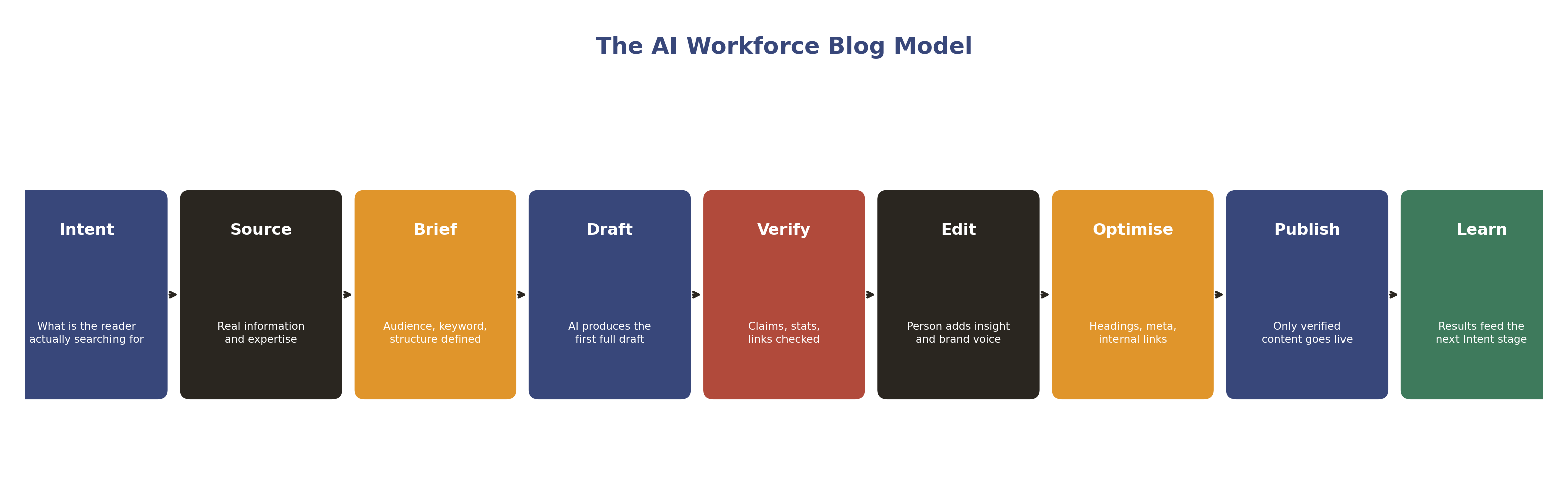
Treating blog writing as one step, prompt and publish, is where generic content and factual errors both start. At AI Workforce, we use a nine-stage model that keeps a named person accountable at every stage that carries real risk.
The AI Workforce Blog Model
Intent: what is the reader actually searching for, and what does a genuinely good answer to that search look like
Source: what real information, expertise, data and internal examples the AI is allowed to draw on for this post
Brief: audience, target keyword, structure and word count a person defines before drafting starts
Draft: AI produces the full first draft from that brief and source material
Verify: every claim, statistic, quotation and internal link is checked against a named source
Edit: a named person adds original insight, brand voice and anything the AI could not know on its own
Optimise: headings, meta title, meta description, internal links and readability are checked against the original search intent
Publish: only a post that has passed verification, editing and optimisation goes live
Learn: search performance and reader engagement feed into the Intent stage for the next post
AI Workforce Insight: An AI blog writer can structure, draft and suggest. A named person remains accountable for what the business actually publishes under its own name.
What Can an AI Blog Writer Actually Do?
An AI blog writer can produce a structured first draft from a brief in minutes, generate heading variations, suggest a meta title and description, draft body copy under each section and, in many tools, flag gaps against what is already ranking for a target keyword. It can also help with the earlier and later steps around a single draft: a handful of blog post ideas from a topic area, several title variations to test, and a first pass at repurposing an existing post into a shorter update.
None of this changes what still needs a person: deciding what the business genuinely has to say on a topic, checking that what the AI produced is accurate, and making the editorial call on whether a piece adds something a reader could not already find on page one of the search results.
Where Does AI Save the Most Time in Blog Writing?
The clearest time saving shows up in structuring and first-draft production, not at either end of the process. An AI blog writer can turn a real brief into a full structured draft, headings and body copy, in a fraction of the time a fully manual first pass would take, and it can produce several heading or title variations at once rather than one person working through them serially.
Writers increasingly split the work by strength: a person leads on the angle, original insight and the edit that makes a post worth reading, while the tool leads on structure and first-draft speed. Production speeds up once that split is clear, because a writer spends less time producing a first pass and more time improving a draft that already exists, rather than starting from nothing.
Free vs Paid AI Blog Writing Tools: What Actually Differs
Free tiers of general AI chat tools can produce a usable first draft for a single, narrow post, a how-to piece rather than a full pillar page with a dozen subsections, and for a team publishing occasionally that may be enough. Functionality and limits vary considerably between providers and change often enough that a specific comparison would date quickly; it is worth testing a tool's free tier directly against your own brief rather than relying on a general claim about what free plans typically include.
Depending on the provider, paid tiers may add features such as SEO analysis, reusable brand guidance, team collaboration, approval workflows, larger usage allowances and CMS integrations. Those features can make production more efficient, but none removes the need for Verify and Edit.
The practical test is not price. It is whether a tool's output, on your actual brief and your actual brand voice, needs a light edit or a substantial rewrite before it clears your own verification checklist.
What Should AI Never Publish Without Review?
A blog workflow should never let a draft go live without a person checking it, but some categories of content carry enough risk that they deserve an explicit rule rather than an assumed "someone will catch it" review.
AI-drafted blog content should never be published without human review where it includes a statistic, a study or research finding, a quotation attributed to a real person, a legal, medical or financial claim, a comparison with a named competitor or product, a specific price or availability claim, or any date-sensitive or current-events reference that could go stale after publication. It should also never be the sole check on whether an internal link actually resolves to the page the anchor text describes.
The Blog Verification Checklist
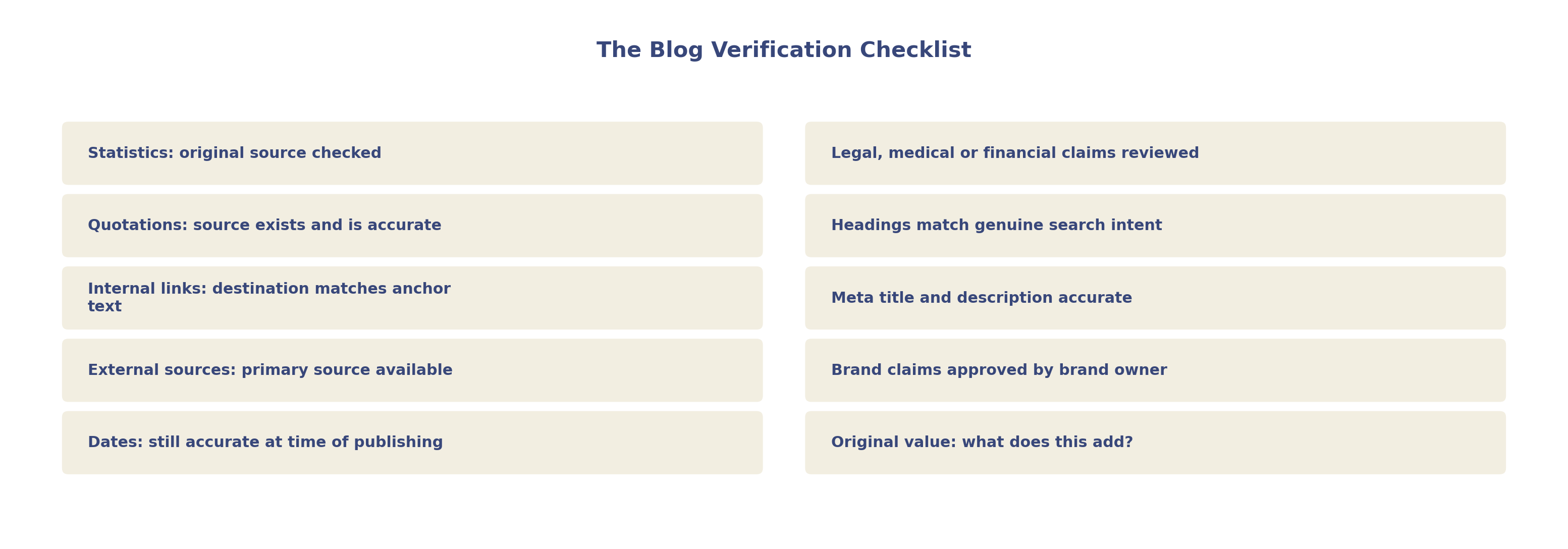
"A person read it" on its own is too vague to be a reliable control. A defined checklist makes the review step something that can actually be audited and improved over time, rather than depending on how careful one person happened to be on a given afternoon.
Statistics: has the original source been checked, not just the AI's summary of it?
Quotations: does the quoted source actually exist and say what is attributed to them?
Internal links: does the destination page actually exist and match what the anchor text promises?
External sources: is there a primary source available, rather than a secondary summary of one?
Dates: is any date-sensitive detail still accurate at the point of publishing?
Legal, medical or financial claims: has someone with the relevant expertise reviewed them?
Headings and structure: do they genuinely match what the target reader is searching for?
Meta title and description: do they accurately describe the page, reflect the search intent and give a searcher a clear reason to click?
Brand claims: have they been approved by whoever owns the brand and product messaging?
Original value: what does this post add that the search results do not already contain?
The last item on that list, original value, is the one most generic AI blog writing advice skips. It is the difference between a tool helping a person say something worth reading and a tool producing a plausible-sounding restatement of what is already published elsewhere.
Does Google Penalise AI-Written Blog Content?
This is one of the first questions a marketing team asks before scaling up AI-assisted blogging, and the honest answer is more specific than a simple yes or no.
Google's own guidance on generative AI content states that AI can be useful for researching a topic and adding structure to original content. Google's spam policies do not single out AI-generated content as a category to be penalised. What they target is scaled content abuse: using automated tools, AI or otherwise, to generate large numbers of pages without adding value for users, or creating pages where the content makes little sense to a reader but contains search keywords. The policy is technology-neutral: the issue is producing content at scale primarily to manipulate rankings rather than benefit users, not whether AI happened to be involved in drafting it.
In practical terms, the difference looks like this:
Risky approach: a keyword list in, AI drafts, a large batch of thin, largely interchangeable posts published automatically, with no meaningful research or editorial input behind them
Sound approach: genuine search intent identified, real source material gathered, an AI-assisted first draft produced from that material, the draft verified and edited by a named person, and only then published
The Blog Model and verification checklist set out earlier in this guide are the practical version of staying on the right side of that distinction.
How Do You Avoid Generic AI Blog Content?
The most reliable defence against generic AI blog content is not trying to make the prose sound more human. It is publishing something the AI could not have produced on its own from a bare prompt.
A simple way to frame it: do not publish the AI's knowledge. Publish your organisation's knowledge, with AI helping express it clearly and quickly. A post becomes harder to replicate, and more genuinely useful, when it contains an original framework, a real internal example, first-party data, a named methodology, or honest coverage of a limitation rather than only the upside.
A useful test before publishing: if a competitor fed the same topic and the same generic prompt into the same tool, would they get something close to this post? If the answer is yes, the post is missing the original layer that makes it worth publishing under your name rather than anyone else's.
From Interview to Published Post: A Worked Example
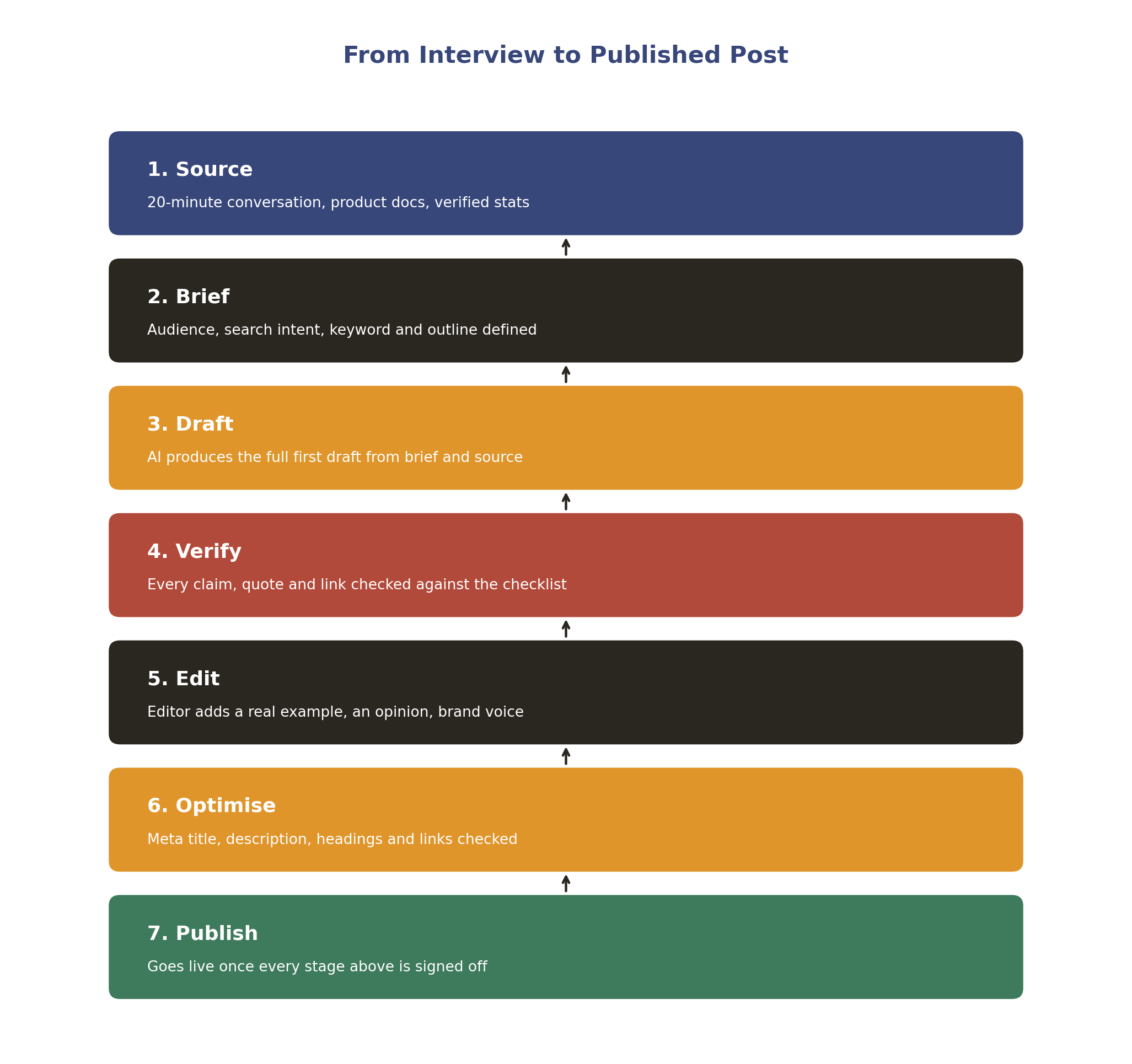
Illustrative example: turning one internal conversation into a single, well-sourced blog post.
Imagine a business sits down with an internal specialist for twenty minutes about a question their customers regularly ask.
Source: the conversation notes, existing product documentation and any statistics that have already been verified for other content.
Brief: a person defines the target reader, the search intent, the primary keyword and a heading outline before drafting starts.
Draft: the AI blog writer produces a full first draft, headings and body copy, from that brief and source material.
Verify: every statistic, quotation and internal link is checked against the checklist above.
Edit: an editor adds a genuine example from the conversation, a real opinion, and anything the AI had no way of knowing.
Optimise: the meta title and description are checked, headings are adjusted for readability, and relevant internal links are added.
Publish: the post goes live only once every stage above has been completed and signed off.
Learn: search performance and engagement from this post feed into the brief for the next one.
Choosing an AI Blog Writing Tool: What to Look For
Rather than a list of named products, which dates quickly in a market that moves this fast, it is more useful to know what to check for in any AI blog writing tool you are evaluating:
Does it work from a real brief, headings, keywords, and audience, rather than only a one-line prompt?
Does it show where a suggested fact or statistic came from, rather than presenting an unsourced claim?
Does it support brand voice through real examples, past posts, a style guide, rather than a generic prompt every time?
Does it check internal links or flag ones that may not resolve?
Does it integrate with the CMS or publishing workflow your team actually uses?
Does it support a genuine review step before anything can publish automatically?
Does its SEO guidance draw on genuine search data, rather than generic keyword density advice?
For the wider workflow around Search Console data, technical monitoring and reviewed SEO recommendations, see our AI SEO Automation guide.
Tools built for a specific format, a pillar-page structure tool, a meta description generator, can be a strong fit where a workflow needs format-specific templates or built-in checks. General-purpose AI tools are often stronger for flexible research and editing across a wider range of post types. Neither category is automatically better; the right choice depends on the specific workflow, not on which tool has the most recognisable name.
What Data Should You Put Into an AI Blog Writing Tool?
This is particularly relevant if a marketing team pastes customer interviews, internal documents, employee comments or unpublished company material into a generative AI tool to speed up drafting. This section is general information rather than legal advice.
The ICO's guidance on AI and data protection is built around the core UK GDPR principles: lawfulness, fairness and transparency, purpose limitation, data minimisation, accuracy, storage limitation, security and accountability, all applied specifically to how AI systems process personal data. Where source material for a blog post includes personal data, a customer's name in a case study, an employee's comments used as a quote, that processing needs the same lawful basis and the same care as any other use of personal data, regardless of whether a generative AI tool is doing the processing.
Before pasting customer or employee material into a blog writing tool, it is worth knowing what data you are actually sending, why you are processing it for this purpose, what the vendor does with that data once submitted, whether it is used to train the vendor's own wider models, and whether the personal information is genuinely necessary for the post, or could be anonymised first. Our guide to AI and GDPR compliance for UK businesses covers the wider framework in more depth.
How Should You Measure AI Blog Writing?
Posts published per month is a tempting metric because it is easy to track, and it is close to the wrong measure entirely. A team publishing twice as much content that ranks for nothing, or that needs constant factual correction after publication, has not actually gained anything.
Organic impressions and clicks for the post
Non-brand keyword rankings, since these reflect genuine search visibility rather than existing brand recognition
Engaged reading time or scroll depth, as a proxy for whether people actually read what was published
First-Draft Acceptance Rate: the share of AI drafts that need only a light edit, rather than a substantial rewrite, before they clear the verification checklist
Correction rate, how often a published post needed a factual fix after going live
Internal link clicks, showing whether the post is doing its job within the wider content structure
CTA conversion rate and qualified leads generated, where relevant to the post
Production time per approved post, measured against a real manual baseline
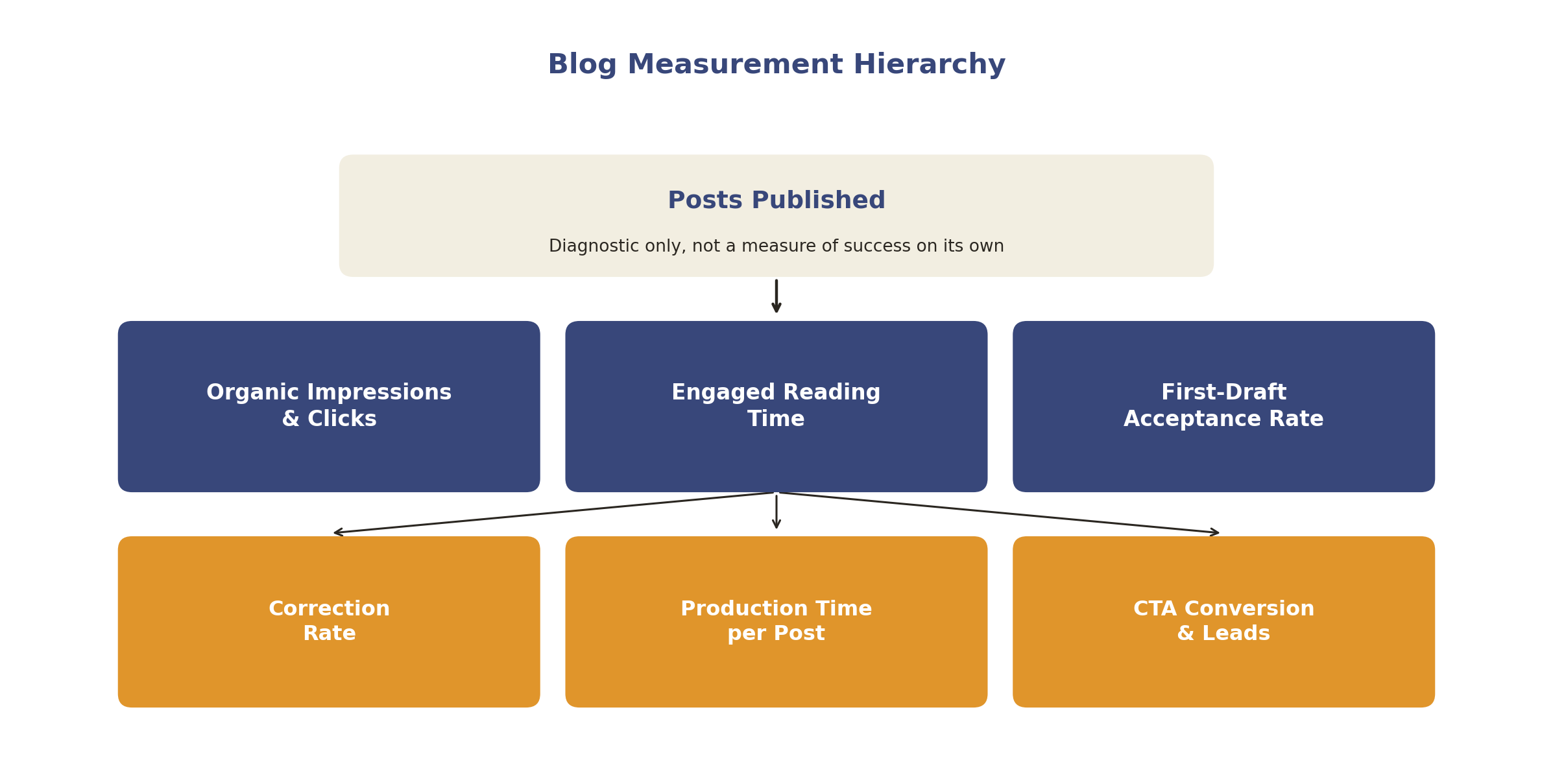
First-Draft Acceptance Rate deserves particular attention, since it is the clearest signal of whether the Brief and Source stages are actually working. A consistently low acceptance rate usually means the brief is too thin, not that the tool itself is the problem. Correction rate matters just as much: if AI lets a team publish twice as fast but causes more factual corrections after the fact, the productivity gain is not real; it has just moved the cost from production time to reputational risk.
A Four-Week Rollout Plan
Week one: benchmark current production honestly, time per post, organic performance and correction rate on recent content, before adding a tool on top of an unmeasured baseline.
Week two: introduce AI drafting for one post type, with a named person reviewing and verifying every post against the checklist before it publishes.
Week three: track First-Draft Acceptance Rate and correction rate on that first post type, and adjust the brief template based on what the numbers show.
Week four: expand to a second post type or a higher publishing volume, while keeping the verification checklist and named editor in place for anything published under the brand.
If you are not sure whether your team's brief quality and review capacity are ready for this level of AI-assisted output, our AI Readiness Assessment is a useful self-check to run before starting week one. Our guide on how to write an AI agent brief also covers the same brief-writing discipline in more depth, applied to AI agents generally rather than blog posts specifically.
Is an AI Blog Writer Worth It?
An AI blog writer tends to deliver the most value for a team publishing regularly enough that manual first-draft writing is visibly limiting output, and where a genuine verification and editorial process is already in place, or is being built alongside the tool rather than as an afterthought. It is a weaker fit for a team that only publishes occasionally, where the blank page was never really the bottleneck, or for a team not yet willing to invest in the review step that keeps AI-assisted blog content accurate and original.
Judge it against First-Draft Acceptance Rate, correction rate and organic performance, not posts published per month. A small content team can genuinely produce the output of a larger one this way, provided the Verify, Edit and Optimise stages hold as volume increases rather than being the first thing dropped once a workflow feels reliable.
Related Guides
Frequently Asked Questions
Does Google penalise AI-written blog content?
No, not for being AI-generated specifically. Google's guidance says generative AI can be useful for research and structuring original content. Google's spam policies target scaled content abuse: producing content at scale primarily to manipulate search rankings rather than help users. That can involve AI-generated, human-written or hybrid content; the use of AI itself is not the issue.
Do I need writing skills to get good results from an AI blog writer?
It helps considerably. An AI blog writer is a drafting partner, not a replacement for judgement: knowing what a genuinely good post looks like, and what your brand should never say, still matters even when a model writes the first version.
Are AI content detectors reliable?
Treat AI detection and AI bypass claims cautiously. Detection tools can produce false positives and false negatives, and passing an AI detector is not a meaningful quality standard for a blog post. For search, the more useful question is whether the content is accurate, original, genuinely useful and created primarily for readers rather than to manipulate rankings. Verification and editorial review are therefore much stronger controls than an AI detector score.
Is a free AI blog writer good enough for regular publishing?
It depends on your volume and post length. A free tier can be genuinely useful for a single, narrow post, but functionality and usage limits vary between providers and change often, so it is worth testing a tool's free tier directly against your own brief rather than assuming what it includes.
What should never be published from an AI blog draft without human review?
Statistics, quotations, legal, medical or financial claims, competitor comparisons, and any date-sensitive detail should always be checked against a named source before publishing. The Blog Verification Checklist in this guide sets out a fuller list.
How is an AI blog writer different from AI content creation generally?
An AI blog writer is focused specifically on drafting and structuring long-form blog posts. AI content creation is the broader discipline it sits inside, covering every format a marketing team produces, from social captions to email copy, using the same underlying verification and editorial principles.
Key Takeaways
An AI blog writer removes the blank page, not the need for editorial judgement
The Intent, Source, Brief, Draft, Verify, Edit, Optimise, Publish, Learn model keeps a person accountable at every stage that carries real risk
Google does not penalise a post simply because AI helped draft it; its spam policies target scaled content created primarily to manipulate rankings
A defined verification checklist is a stronger control than a vague instruction to have someone review it
The strongest defence against generic AI content is publishing your organisation's knowledge, not the AI's
First-Draft Acceptance Rate is a clearer signal of a working brief than posts published per month
Personal data used as source material for a blog post still needs a lawful basis and genuine data minimisation
Start narrow with one post type and a genuine verification step before expanding volume
This article is general information rather than legal advice. Take independent advice on data protection obligations specific to your own content operation and customer data.
Ready to Write Blog Posts Faster?
If your team is still starting every post from a blank page, or publishing AI drafts without a real verification step, it's worth seeing how much of the process can be sped up without losing your voice or your accuracy. Get in touch, and we'll help you find the right starting point.
About the Author
Luca Controlo is AI Adoption and Marketing Automation Lead at AI Workforce, writing on AI adoption and marketing automation drawing on the team's implementation work with UK small and medium-sized businesses.
This guide was reviewed by Rodi Taze, Co-Founder of AI Workforce, for accuracy against current Google search guidance and UK data protection practice.
Reviewed: August 2026