LinkedIn Lead Generation: How to Build a B2B Pipeline
Posted On: September 29, 2026
Last updated: September 2026
Written by Rodi Taze, Co-Founder of AI Workforce · Reviewed by Clara Miller, Content Specialist at AI Workforce
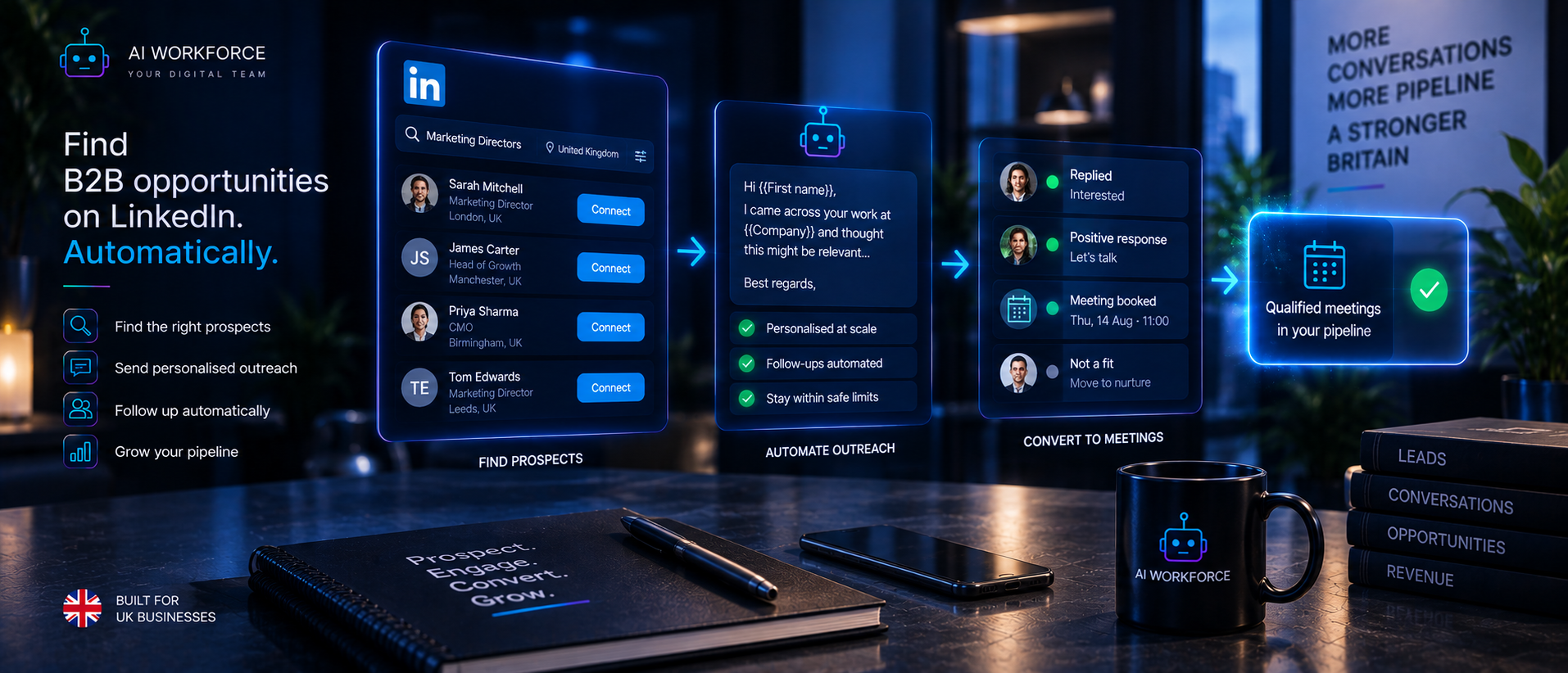
Quick answer: LinkedIn lead generation is not simply collecting profile URLs. A finding on LinkedIn is a starting point, not a qualified prospect; a profile does not confirm that a role is current, that the company fits your target market, that you have the right contact, or that anyone involved has a current need. A practical workflow moves through distinct stages: define the market, identify accounts, identify contacts, verify, enrich, prioritise, and prepare for outreach. The objective is a smaller, better-defined list of prospects with enough verified context for a salesperson or outreach workflow to decide what happens next.
What Is LinkedIn Lead Generation?
LinkedIn lead generation is the process of using LinkedIn to identify companies and people who might be relevant to your business, then building enough verified context about them to decide whether they are worth contacting. LinkedIn can support company discovery, contact discovery, role research, account research, trigger research and prioritisation. What it cannot do is confirm that someone found on the platform is actually qualified; finding someone is the start of the process, not the result of it, and verification involves cross-checking that role research against other current evidence.
This is a distinct activity from prospecting, outreach, qualification and the broader AI SDR role, and treating them as interchangeable causes confusion when designing a workflow or choosing a tool.
LinkedIn Lead Generation vs Prospecting vs Outreach
Stage | Main question | Output |
|---|---|---|
Lead Generation | Who might fit? | Candidate accounts and contacts |
Prospecting | Which candidates are worth attention? | Researched, prioritised prospects |
Outreach | Should we start a conversation? | Initiated conversation |
Qualification | Does the engaged prospect meet factual criteria? | Qualified, unqualified, or human review |
This article covers the first stage, and touches on prioritisation as it feeds into it. For the research and prioritisation layer in more depth, see AI Workforce's AI Sales Prospecting guide. For what happens once a prospect is outreach-ready, see AI Workforce's LinkedIn Outreach Automation guide.
The AI Workforce LinkedIn Lead Generation Model
The following is an AI Workforce implementation framework rather than an official LinkedIn process or industry standard.
Market → Account → Contact → Verify → Enrich → Signal → Prioritise → Outreach-Ready
Market. Define the ICP and exclusions before searching.
Account. Identify companies matching the ICP.
Contact. Identify plausible people inside those accounts.
Verify. Confirm company, employment, role and other critical facts.
Enrich. Add relevant business context from approved sources.
Signal. Record current evidence that may affect timing.
Prioritise. Rank prospects using transparent criteria.
Outreach-Ready. Enough verified context exists for a person or governed outreach workflow to decide whether to initiate contact.
Step 1: Define the Market Before Searching LinkedIn
ICP design should cover geography, industry, company size, business model, relevant technology or process, growth stage where relevant, target department, role and seniority, and explicit exclusion criteria. "UK SMEs" is too broad to be operationally useful; it does not tell anyone who to search for or how to judge whether a result fits.
A worked example: UK recruitment agencies, 10 to 100 employees, serving professional sectors, targeting Managing Director or Head of Operations, excluding existing customers and accounts already in an active opportunity. This is an illustration of how narrow a usable ICP can be, not a claim that it is the right target market for every business.
Step 2: Find Target Accounts
In an account-first workflow, LinkedIn's company search, or Sales Navigator's account search where available, can be used to identify candidate companies, filtered by geography, headcount, industry, current hiring activity, and company growth or change signals, then organised into account lists. None of these filters proves intent; they narrow the field to companies that plausibly fit the market definition. A company can fit the ICP perfectly and still not be ready to buy anything; fit and readiness are separate questions.
Step 3: Find the Right Contact
Account fit does not establish contact relevance; the company and the individual should be evaluated separately. Useful criteria include function, seniority, responsibility, likely involvement in the relevant buying or operational process, current employment, and whether multiple stakeholders are worth identifying rather than just one.
The most senior person is not automatically the correct contact. A Director may be the right target for a strategic decision, a Head of Department for an operational one, and a manager or day-to-day user for something that needs their buy-in before it reaches anyone more senior. Which one matters depends on what is actually being offered.
Step 4: Verify Before Enriching
Before adding any further context, check that the person still works there, that their role and title are current, that the company is still active, that the company fits the ICP, that there is no duplicate CRM record, that there is no existing opportunity already open with that account, that there is no suppression or prior objection on file, and that no obvious data conflict exists. Enrichment on top of incorrect identity data simply creates a richer wrong record.
Step 5: Enrich With Business-Relevant Context
Useful enrichment includes the company website, Companies House records where appropriate, company size, industry, current vacancies, relevant public company announcements, current technology or process where this is lawfully and reliably known, CRM history, and any prior interactions with the business. This guide does not encourage collecting personal details that have no bearing on the business relationship. Enrichment should answer a specific business question, not simply maximise the number of fields on a record.
Data point | Why it matters | Source/provenance | Freshness requirement |
|---|---|---|---|
Company website | Confirms current offering and positioning | Company's own site | Check at time of research |
Companies House record | Confirms the company is active and its registered details | Check at time of research | |
Company size/headcount | Confirms fit against the ICP | LinkedIn, company website, Companies House | Periodically reverified |
Current vacancies | May provide relevant evidence of hiring activity or organisational change | LinkedIn, company careers page | Time-sensitive, listings expire |
Public company announcement | Can provide timely, verifiable context | Company press releases, verified news sources | Time-sensitive |
CRM history | Prevents duplicate or conflicting outreach | Internal CRM | Checked before any new contact |
Step 6: Separate Fit, Timing, Engagement and Intent
These four categories are commonly collapsed into one vague idea of "interest". They should be kept separate because each represents a different type of evidence.
Fit asks whether the account or contact matches the ICP.
Timing evidence asks whether something is happening that makes the conversation potentially more relevant now: hiring, expansion, a leadership change, a new office, a relevant vacancy, or a publicly announced initiative.
Engagement asks whether the prospect has actually interacted with your business: a reply, a content download, event attendance, or a visit to owned digital property where this is lawfully measured.
Confirmed intent asks whether the person has explicitly expressed a relevant need or a desire to evaluate or buy something.
Fit does not equal timing, timing does not equal engagement, and none of the three equal confirmed buying intent. Not every observable event is an intent signal, and this guide avoids labelling one as such unless a person has actually said something that supports it.
Step 7: The AI Workforce LinkedIn Evidence Ladder
The following is an AI Workforce implementation framework, a hierarchy of evidence strength, not a universal lead score and not an official LinkedIn or industry standard. A prospect does not necessarily move sequentially through every level.
Level 1, Static Fit Evidence. Industry, geography, company size, role.
Level 2, Current Business Context. Hiring, growth, vacancies, a relevant company change.
Level 3, First-Party Engagement. Direct interaction with the business.
Level 4, Explicit Need. The prospect states a relevant problem or requirement themselves.
Level 5, Agreed Commercial Next Step. The prospect explicitly agrees to a call, an evaluation, or another commercial action.
Step 8: Score Prospects Transparently
A single opaque score, a prospect rated "92/100" with no explanation, hides several different questions that deserve to be answered separately: account fit, contact relevance, timing evidence, and first-party engagement. Scoring each of these individually gives a salesperson something they can actually interrogate and disagree with.
An illustrative AI Workforce planning formula: Prospect Priority = 40% Account Fit + 30% Contact Relevance + 20% Timing Evidence + 10% First-Party Engagement. These weights are illustrative AI Workforce planning weights, not validated industry defaults, and each business should test its own weights against its own historical outcomes rather than adopting this split by default. A score is an input to a decision, not an instruction, and a person should always be able to override it.
Step 9: Use AI for Research Without Letting It Invent Facts
AI can help summarise account information, classify industry, identify relevant public context, compare an account against the ICP, suggest a likely relevant role, and prepare research notes for a person to review. It should not invent company events, infer sensitive personal attributes, invent technology usage, claim a prospect has a pain point without evidence, claim buying intent from weak signals, or fabricate mutual connections. A simple working rule covers most of this: no source, no factual personalisation claim.
Step 10: The AI Workforce Outreach-Ready Prospect Record
An outreach-ready record should contain enough information for a person to evaluate the prospect without re-researching it from scratch. Account fields: company name, website, industry, size, geography, ICP status, and relevant account context. Contact fields: name, role, current employment verified, role relevance, and a LinkedIn reference. Evidence fields: timing evidence, source, date checked, and confidence or verification status. Governance fields: suppression status, existing CRM owner, previous contact history, existing opportunity, and lawful-use notes where required. Workflow fields: priority, reason for priority, next recommended action, and owner.
LinkedIn Sales Navigator for Lead Generation
LinkedIn describes Sales Navigator as an "AI-powered B2B sales tool" offering advanced search filters, account and lead lists, alerts on job changes and role shifts, account intelligence summarising company priorities, and CRM-related integrations. It is a research and prioritisation environment, not evidence of purchase intent, and not permission to automate LinkedIn account actions. Using it does not guarantee better leads; it provides search, list and account-research functionality that can support the research and organisation stages described in this guide. For the platform boundaries around automating actions, see AI Workforce's LinkedIn Automation Limits guide.
LinkedIn Lead Generation for UK Small Businesses
A smaller business does not necessarily need an enormous lead list, dozens of data providers, or an opaque intent platform. A lightweight version of this workflow can still work: a defined ICP, LinkedIn or Sales Navigator search, account verification, contact verification, context from the company website and Companies House, a transparent priority judgement, and an outreach-ready record. This is one workable approach for a smaller team, not a claim that it is universally better than a more resourced setup.
UK GDPR and LinkedIn Lead Data
Names, job titles and other profile data can be personal data, and the fact that a profile is public does not remove UK GDPR obligations. A lawful basis is still required to process this data for lead generation purposes, and where legitimate interests are relied on, this needs a genuine assessment rather than an assumption. Transparency about how the data will be used matters, the right to object must be respected, and a suppression list should be actively maintained. Data should not be retained indefinitely without a reason, and recording the source and provenance of each record supports both accuracy and accountability. LinkedIn's own platform rules and UK GDPR obligations are separate layers, covered in more detail in AI Workforce's LinkedIn Automation Limits and AI GDPR Compliance UK guides.
What Should Not Be Used as a Lead-Generation Signal?
Personal interests unrelated to the business relationship should be avoided. Sensitive personal data, and any inference about health, religion, politics or similar attributes, should not be used. A profile view should not be treated as buying intent. A job title alone should not be treated as confirmed authority. Company growth should not be treated as a confirmed need. A single public post should not be treated as purchase intent. AI-generated assumptions without a source should not be recorded as fact. Stale information should not be relied on without reverification. Scraped data of uncertain provenance should not be used at all. Each of these substitutes a weak or absent signal for genuine evidence, which is exactly the gap this guide is trying to close.
How to Pilot a LinkedIn Lead Generation Workflow
The following is an AI Workforce implementation methodology, not an industry standard.
Stage 1, Define. Set the ICP, exclusions, and the fields to be captured.
Stage 2, Historical Test. Run the model against known past prospects and accounts to see whether it would have surfaced them.
Stage 3, Recommendation Mode. AI researches and prioritises, but a person decides what actually becomes outreach-ready.
Stage 4, Controlled Live Use. Use the workflow on a bounded live segment and measure accuracy and correction burden.
Stage 5, Expand or Hold. Expand only if the evidence from earlier stages supports it, there is no fixed rollout timeline.
How to Measure LinkedIn Lead Generation
The number of profiles collected, contacts exported, or records added to a list are activity counts, not measures of quality. Relevant measures include: ICP match rate, account verification rate, contact-role accuracy, stale-data rate, duplicate rate, correction rate, the percentage accepted by sales, the percentage rejected by sales, qualified reply rate after outreach begins, accepted opportunities, human research time, cost per sales-accepted prospect, and cost per accepted opportunity. A larger list is not automatically better lead generation.
Worked Example: Building a LinkedIn Lead List for a UK B2B Company
A UK B2B company is targeting recruitment agencies. Market: UK recruitment agencies within a defined size range. Account: A candidate recruitment company matching that range is identified through LinkedIn company search. Contact: The Managing Director and Head of Operations are both identified as plausible contacts. Verify: both are confirmed as current employees in their stated roles, and the company is confirmed active. Enrich: the company website and Companies House record are checked, along with any current hiring activity. Signal: a verified, relevant business event is recorded if one genuinely exists, and left blank if it does not. Priority: a transparent score is calculated from account fit, contact relevance and timing evidence. Outreach-ready: the resulting record contains the reason for selection, the supporting evidence, and its source.
At that point, the process for this guide stops. The next stage, initiating the actual LinkedIn conversation, belongs to AI Workforce's LinkedIn Outreach Automation guide.
Common LinkedIn Lead Generation Failure Modes
A vague ICP that fails to narrow anything meaningfully. Collecting profiles instead of prospects, treating a search result as if it were already qualified. Stale job titles that no longer reflect the person's actual role. The wrong contact at the right company. The right contact at the wrong company. Duplicate CRM records created by repeated, uncoordinated research. An opaque AI score with no visible reasoning behind it. Treating weak signals as confirmed intent. Records with no provenance attached. Enrichment that adds irrelevant personal detail rather than business context. Scraped or uncertain-provenance data used without verification. No suppression check before adding a new record. List size treated as a measure of success in itself. No ability for a person to override the system's prioritisation.
How to Evaluate a LinkedIn Lead Generation Tool
Where does the data actually come from? Is LinkedIn access authorised, or does the tool rely on scraping? Can it separate account fit from contact relevance rather than blending them into one score? Can it show why a particular prospect was prioritised? Does it preserve the source and provenance of each data point? How often is the data refreshed, and can it identify stale records? Can a person override its scoring? Can it detect duplicates? Does it integrate with a CRM? Does it honour suppression lists? What personal data does it retain, and for how long? Can it distinguish fit, timing, engagement and confirmed intent, or does it collapse them into one label? Does it claim "intent" without showing the underlying evidence? For a comparison of specific tools against these questions, see AI Workforce's Best AI LinkedIn Automation Tools guide.
Sources and Methodology
All sources above were checked directly in September 2026 and quoted or summarised from their current published wording. The AI Workforce LinkedIn Lead Generation Model, LinkedIn Evidence Ladder, transparent priority model, outreach-ready record, pilot methodology and measurement framework are AI Workforce implementation frameworks and illustrations rather than official LinkedIn processes, industry standards or independently verified benchmarks.
Frequently Asked Questions
What is LinkedIn lead generation?
The process of using LinkedIn to identify companies and people who might be relevant to your business, then verifying and enriching that information until you have a prospect worth deciding whether to contact.
Is LinkedIn good for B2B lead generation?
It can be a useful source of company and contact data for B2B businesses, but its value depends on how well the resulting information is verified and organised, not on how many profiles are collected.
How do you generate leads from LinkedIn?
By defining a clear target market, identifying candidate accounts and contacts, verifying that information, enriching it with relevant business context, and prioritising the results before any outreach begins.
What is the difference between a LinkedIn lead and a prospect?
In the terminology used in this guide, a lead is a candidate account or contact that has not yet completed the verification and enrichment process. A prospect is a candidate whose company, role and fit have been checked and is ready to be evaluated for outreach.
Can AI generate LinkedIn leads?
AI can help research, verify context and organise candidate accounts and contacts, but it should not invent facts, and important claims should retain a source.
Is LinkedIn Sales Navigator useful for lead generation?
It can support the search, list-building and research parts of the process, but it does not by itself confirm intent or guarantee lead quality.
Can I automate LinkedIn lead generation?
Research, verification support and enrichment can be assisted by automation with human review. Automating LinkedIn account actions is a separate matter governed by LinkedIn's own platform rules, covered in AI Workforce's LinkedIn Automation Limits guide.
Does a LinkedIn profile view show buying intent?
No, a profile view on its own is not evidence of buying intent and should not be recorded as such.
How do I know if a LinkedIn lead is ready for outreach?
When the account and contact have been verified, relevant context and provenance are recorded, suppression and existing-opportunity checks are complete, and there is enough evidence for a person to decide whether initiating contact is appropriate.
Is it legal to use LinkedIn data for B2B prospecting in the UK?
Using publicly available profile data for B2B prospecting is not automatically unlawful, but processing personal data for this purpose requires an appropriate lawful basis under UK GDPR, which depends on the specific circumstances.
Do I need consent to store LinkedIn lead data?
Not always; other lawful bases such as legitimate interests can apply in some circumstances, but this requires a genuine assessment rather than an assumption, and the right to object must be respected regardless of the basis used.
How should LinkedIn leads be stored in a CRM?
With the account and contact details, the evidence and source behind any prioritisation, verification status, suppression status, and the next recommended action, so the record is usable without re-researching it from scratch.
Key Takeaways
A LinkedIn profile is not a lead, a lead is not a verified prospect, and a verified prospect is not yet a qualified opportunity; each step requires its own verification. Define the market before searching so later account and contact decisions can be evaluated against explicit criteria. Account fit, contact relevance, timing evidence and first-party engagement are separate questions that should not be collapsed into one score or one label. Every important fact should keep its source and provenance. Use transparent priority criteria that a person can inspect and override rather than relying solely on an unexplained composite score. AI can meaningfully assist the research and organisation work in this process, but should not be allowed to invent facts or infer intent it cannot support. Outreach-ready is the intended endpoint of this workflow; the conversation itself is a separate stage. And success should be measured by sales acceptance and downstream outcomes, not by how many records were collected.
Written by Rodi Taze, Co-Founder of AI Workforce · Reviewed by Clara Miller, Content Specialist at AI Workforce