Speed to Lead: Response Time Benchmarks, Statistics & AI
Posted On: August 18, 2026
Last updated: August 2026 · Written by Clara Miller, Content Specialist at AI Workforce · Reviewed by Seth Ayush, Co-Founder and Head of Product Design at AI Workforce
Speed to lead is the time between a prospect submitting an enquiry and receiving a meaningful first response from an appropriate person or capable assistant, and it is a widely studied factor in whether an inbound enquiry progresses to contact and qualification. This article sets out what speed to lead actually means, what the widely cited research really shows (and where it is often overstated), realistic response time benchmarks by lead type, and the practical strategies, from automated lead routing to lead scoring, that improve response time without burning out a rep. If your business generates inbound leads and you are not tracking how fast you respond to a lead, this is worth ten minutes of your time.
Quick Answer: Speed to lead is the gap between a prospect submitting an enquiry and receiving a meaningful first response from an appropriate person or capable assistant. Human-response time should be tracked separately where automation is involved. A frequently cited 2011 study found companies took an average of 42 hours to respond to a test web enquiry, and separate research found leads contacted within five minutes were far more likely to be qualified than leads contacted later. Both findings are real, but neither proves that a five-minute response is required for every lead, or that faster response alone guarantees more closed revenue.
Research Snapshot: What the Evidence Actually Shows
Before going further, it is worth being precise about where the commonly quoted speed to lead statistics come from, because they are frequently blended together in ways that overstate what was measured.
Swipe to see all columns →
Finding | What was measured | Important limitation |
|---|---|---|
42-hour average response time | A 2011 Harvard Business Review audit of 2,241 US companies, measuring response to a test web enquiry | Historical (2011), US-based, limited to companies that responded within 30 days; 23% never responded at all |
Roughly 7x higher qualification likelihood | Companies that attempted to contact a lead within an hour were nearly seven times as likely to qualify it as companies that waited even an hour longer, related HBR analysis of 1.25 million sales leads across 42 US companies | Measures odds tied to attempting contact within the hour, not the whole qualification process; observational data, not closed revenue |
More than 60x higher qualification likelihood | Companies that attempted contact within an hour were more than 60 times as likely to qualify the lead as those that waited 24 hours or longer, same dataset | Same historical, US-based limitations apply |
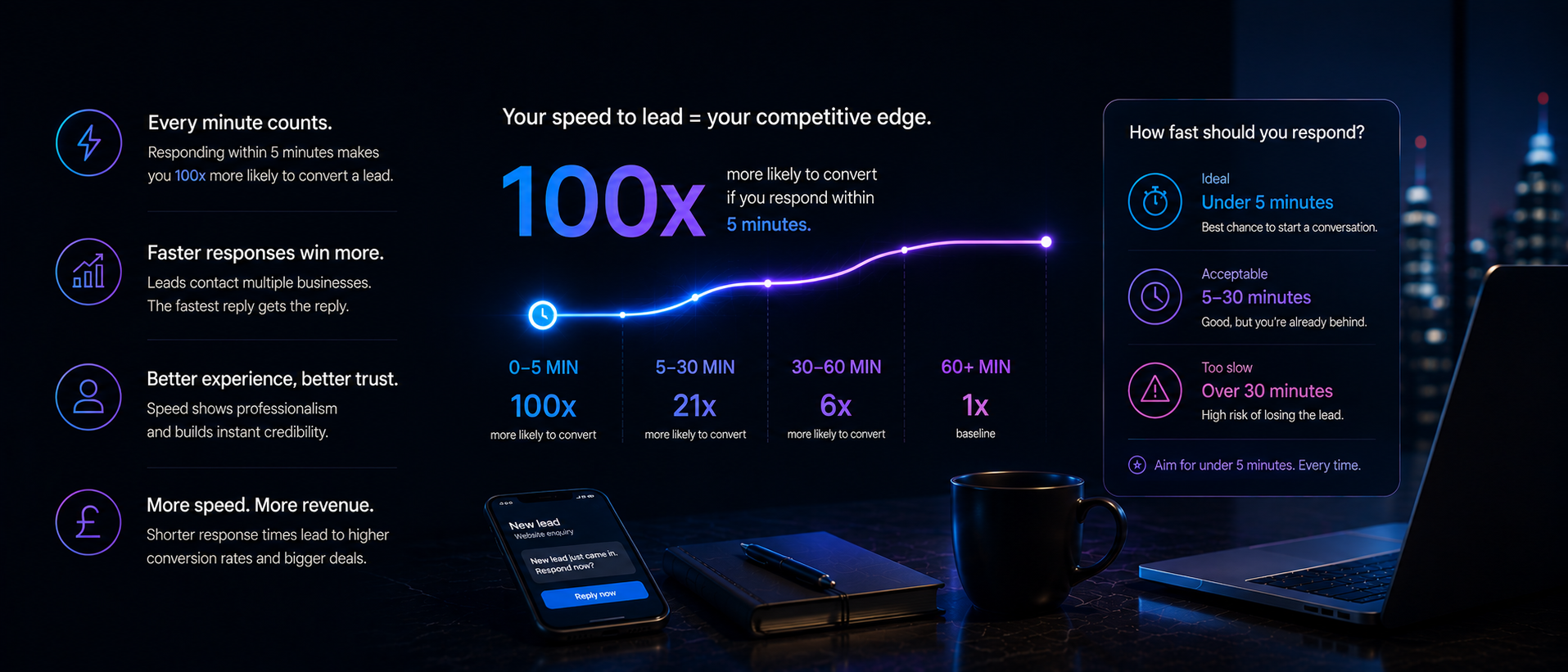
Roughly 100x higher contact odds | Contacting a lead within five minutes versus waiting 30 minutes, earlier Lead Response Management research | Contact odds, not qualification or sales odds; vendor-linked research |
Roughly 21x higher qualification odds | Qualifying a lead within five minutes versus waiting 30 minutes, same dataset | Qualification odds, not confirmed closed revenue |
Two things are worth being explicit about. First, the 42-hour figure is genuinely old: it comes from a 2011 audit and should be treated as evidence of a long-standing, structural problem with lead response rather than a current UK B2B benchmark. Second, the studies behind these numbers primarily measured contact and qualification, not whether a lead eventually became closed revenue. Faster follow-up is consistently associated with better contact and qualification outcomes, but the size of the effect on actual closed deals will vary by channel, market and sales process. The full original findings are set out in Harvard Business Review's The Short Life of Online Sales Leads, and the five-minute figures come from separate Lead Response Management research conducted using InsideSales.com data with academic researcher James Oldroyd, reported in the InsideSales Lead Response Report, based on more than 15,000 leads and 100,000 call attempts across six companies. This was vendor-linked research, not an MIT institutional study, even though Oldroyd was affiliated with MIT at the time.
HBR Analysis: Qualification Likelihood by Response Window
These figures come from the HBR-linked dataset only. They should not be combined with the Lead Response Management figures below, which use a different baseline and a different dataset. Swipe to see all columns →
Response window | Qualification likelihood |
|---|---|
Attempted contact within one hour | Reference |
Waited an additional hour | Within-one-hour attempts were nearly 7x as likely to qualify |
Waited 24 hours or longer | Within-one-hour attempts were more than 60x as likely to qualify |
Lead Response Management Research: Five Minutes vs Thirty Minutes
These figures come from the separate Lead Response Management dataset only. Do not read this table alongside the HBR panel above as a single continuous scale. Swipe to see all columns →
Comparison | Reported finding |
|---|---|
Contact attempt at 5 minutes versus 30 minutes | Approximately 100x higher contact odds at 5 minutes |
Qualification attempt at 5 minutes versus 30 minutes | Approximately 21x higher qualification odds at 5 minutes |
What Is Speed to Lead and Why Does It Matter?
Speed to lead is the elapsed time between a prospect submitting an enquiry and receiving a meaningful first response from an appropriate person or capable assistant, not simply an automated receipt landing in their inbox. It sounds like an operational detail, but speed to lead matters because a prospect's interest is typically highest at the exact moment they fill in a form or start a chat. Every hour that passes after that moment, their attention can drift elsewhere, sometimes to a competitor who happened to respond faster.
This is why response time has become a core metric for B2B sales teams rather than a nice-to-have. A lead that arrives at 9 am and does not hear back until the next day may have cooled by the time anyone calls. Speed to lead is not about rushing the sales process; it is about making sure a real conversation starts while the prospect is still paying attention, and while the rep still has a reasonable chance of reaching them at all.
What Are Realistic Lead Response Benchmarks by Lead Type?
Rather than treating five minutes as a universal law, it is more useful to set a response target by intent. A demo request or pricing enquiry is a different signal than someone downloading a guide, and the response benchmark should reflect that difference.
Starting points to validate against your own data, not universal industry standards. Swipe to see all columns →
Lead type | Suggested initial target | What counts as a response |
|---|---|---|
Live chat or call request | Immediate | A person, or a capable live assistant that can genuinely help |
Demo or pricing request | 5 to 15 minutes during coverage hours | Useful human contact, or a clear booking route |
High-intent paid enquiry | 5 to 15 minutes during coverage hours | Relevant first response, not a generic acknowledgement |
Existing-customer enquiry | Based on your support priority tiers | Correct routing to the right team, not a sales sequence, from a person or a capable AI assistant |
Content download or gated resource | Same working day, or a defined nurture workflow | Relevant follow-up, not an aggressive sales call |
Newsletter registration | No immediate sales response required | A welcome message and a preference confirmation |
It is worth building your own lead response benchmarks rather than relying solely on generic figures, because average response time varies by sector, deal size and how leads are currently distributed across the team. Track your own response time for a month, segment it by lead source and intent, and use that as the baseline you are trying to beat.
How Fast Should You Respond on Each Lead Channel?
Intent is not the only variable that shapes a sensible target; the channel a lead arrives through also affects what a realistic response time looks like.
Recommended starting targets to test against your own internal data, not universal research-backed standards. Swipe to see all columns →
Channel | Suggested initial target | Notes |
|---|---|---|
Phone enquiry | Immediate, or a callback within minutes | A missed call is often a lost lead unless it is answered or returned quickly |
High-intent website form | 5 to 15 minutes during coverage hours | Applies to demo, pricing or sales-intent forms; lower-intent forms warrant a more relaxed target |
Live chat | Immediate | A delayed reply usually means the visitor has already left the page |
Booked demo request | Confirmation within minutes, human contact well before the slot | The booking itself is not the response; a person should still check the fit beforehand |
Email enquiry | Same working day, faster for high-intent messages | Email sets a slightly slower expectation than chat or phone, but not an open-ended one |
LinkedIn or social message | Within one working day | Response norms vary by platform and audience; treat this as a starting point to test |
How Does Slow Lead Response Actually Damage Outcomes?
Slow lead response does not just delay a sale; it is associated with materially worse contact and qualification outcomes, and it compounds in ways that are easy to underestimate. When a prospect reaches out, they are often comparing several options at once. A slow response can signal that the business may be similarly slow throughout onboarding, support and delivery, which erodes trust before the sales conversation has even started.
Response time slips are also compounding operationally. A rep who is already behind on lead follow up tends to fall further behind, because new leads keep arriving while older ones sit untouched. It is reasonable to say this damages conversion rates over time, but most of the public evidence measures contact and qualification rather than final closed revenue; treat the conversion-rate link as a strong, well-supported association rather than a guaranteed multiplier for your specific business.
Acknowledgement Is Not the Same as a Meaningful Response
A common mistake is treating an automated confirmation as a successful speed to lead outcome. It is worth being precise about the difference between four things that are often blurred together:
Acknowledgement time: time until an automated message confirms the enquiry has arrived. Useful, but not a response
First meaningful response time: time until a person, or a capable AI assistant, provides useful help, asks a relevant qualifying question, or offers an appropriate next step such as booking time
First human response time: time until an appropriate employee engages directly
Qualification time: the point at which fit and next steps are actually established, which is what most of the underlying research measured
An automated assistant can, in some cases, deliver a genuinely useful first meaningful response, not just an acknowledgement, but reporting should never imply a person responded when they did not. Track all four metrics separately so acknowledgements, capable-assistant responses, genuine human contact and qualification are never conflated in reporting.
Why Average Response Time Is a Weak Primary Metric
Averages hide poor performance. A team can respond to most leads quickly while leaving a meaningful minority untouched for days, and an average alone will not surface that. A more honest measurement set includes:
Median response time, alongside the average
80th or 90th percentile response time, to catch the worst-served leads
Percentage of leads answered within your defined SLA
Percentage of leads never answered at all
Time to first meaningful response, tracked separately from acknowledgement time
Time to qualification
Performance during and outside working hours
Response time broken down by source, intent and owner
A simple measurement formula: first-response time equals the timestamp of the first meaningful response minus the timestamp of valid lead creation. Exclude spam, test submissions, duplicate enquiries, and generic automated receipts, unless you are explicitly measuring acknowledgement time as a separate metric. Report both a business-hours definition and an elapsed-hours definition, so the team cannot improve the headline number simply by changing how overnight leads are counted.
How Can AI Improve Speed to Lead?
AI capabilities relevant to speed to lead are covered across this article; this section brings them together in one place. Used well, AI can:
Answer calls or chats immediately, including outside normal working hours
Capture contact details and enquiry intent accurately
Ask approved qualification questions to establish basic fit
Score and route leads to the right rep or team the moment they arrive
Offer suitable calendar slots and confirm a booking
Create CRM records and follow-up tasks automatically
Provide out-of-hours coverage so an enquiry is never left completely unanswered overnight or at weekends
Escalate complex, sensitive or high-value enquiries to a person rather than attempting to resolve them alone
A capable AI receptionist can pick up missed calls and after-hours enquiries so a phone lead is never simply lost, while a well-configured AI lead qualification workflow can ask the right questions immediately rather than waiting for a rep to become available. For enquiries that are ready to book, appointment booking automation can turn a meaningful first response straight into a confirmed slot. If the next step is to qualify the enquiry, route it to the right calendar and book the meeting automatically, see our guide to AI appointment setter tools. Where outbound follow-up is also part of the motion, our guide to AI SDR tools covers how AI-assisted response and human handoff typically work together.
None of this removes the need for human judgement. Pricing exceptions, objections, sensitive enquiries, regulated decisions and genuinely high-value opportunities should still route to a person, with AI handling the surrounding speed and consistency rather than the decision itself.
Best Speed to Lead Tools and Automation
The best speed-to-lead tool depends on where the delay occurs. A team missing calls needs a different solution from one where enquiries already reach the CRM but sit unassigned. In practice, improving speed to lead usually involves a small stack covering immediate response, routing, qualification, booking, CRM updates and SLA monitoring rather than one standalone "speed to lead" product.
Swipe to see all columns →
Need | Tool or automation type | What it should do |
|---|---|---|
Instant inbound response | AI receptionist / conversational AI | Answer calls or chats, capture intent and provide an appropriate next step |
Lead routing | CRM routing / workflow automation, e.g. HubSpot | Assign each enquiry immediately using ownership, territory, availability or intent rules |
Lead qualification | AI qualification / lead scoring | Ask approved questions, structure information and prioritise leads without silently rejecting them |
Calendar booking | AI appointment setter / scheduling automation, e.g. Calendly | Offer appropriate slots and create a confirmed next step |
CRM updates | CRM workflow automation | Create records, log interactions and trigger follow-up tasks |
Follow-up | Email / SMS / AI follow-up workflow | Continue an approved sequence when a lead has not yet progressed |
SLA monitoring | CRM reporting / response-time alerts | Flag leads approaching or exceeding the defined response window |
Diagnose the bottleneck before choosing a tool. Missed inbound calls point to an AI receptionist or call-handling solution; forms sitting unnoticed point to CRM routing; a rep who is simply unavailable points to availability-based routing or a capable AI first response; slow qualification points to an AI qualification workflow; a lead ready to meet but waiting for coordination points to appointment scheduling; a lead forgotten after first contact points to follow-up automation; and leads exceeding the target response window point to SLA monitoring and alerts. No single platform typically solves every stage at once, so most teams combine two or three of the categories above around their actual bottleneck.
How Do You Improve Speed to Lead Without Overloading Your Team?
Improving speed to lead does not mean asking reps to sit by the phone all day. The first practical step is automated lead routing, which sends each new enquiry directly to the right rep or team the moment it arrives, rather than sitting in a shared inbox waiting to be noticed. Our guide to automating sales outreach with an AI agent covers how AI agents can handle first-touch drafting and routing in more depth, including the governance controls worth putting in place before switching it on.
A second way to improve speed to lead is lead scoring, which ranks incoming leads by how closely they match your ideal customer profile, so reps can prioritise the leads worth responding to first when several arrive at once. Our guide to AI lead qualification covers how scoring models are typically built and where they tend to go wrong.
To close the gap between lead creation and any contact at all, many teams also introduce an automated first-touch acknowledgement. As covered above, this should never be counted as the meaningful response itself, but it can reassure a prospect enough to wait rather than move on to a competitor. Our guide to AI follow-up automation covers how to build this without treating an acknowledgement, or a weak signal like an email open, as genuine engagement.
Not Sure Whether Routing or Scoring Would Fix Your Bottleneck First?
AI Workforce can map your current lead flow, spot where response time is actually slipping, and recommend the automation that fits your volume and team size.
What Strategies to Improve Speed Actually Work in Practice?
Beyond automated lead routing and lead scoring, several practical strategies are commonly used by B2B sales teams. Setting a formal response window for each intent tier, for example, a rule that every demo request must be contacted within 15 minutes during working hours, gives reps a clear standard to work toward rather than a vague sense that faster is better.
Assigning leads based on real-time availability, rather than a fixed rotation, is another strategy that works well. If a rep is on a call or away from their desk, routing the next lead to someone who is actually free avoids the common failure mode where a lead sits untouched simply because the assigned rep happened to be busy.
A further strategy worth trying is separating lead qualification from full sales conversations. Where lead volume justifies it, a specialist responsible for initial qualification can confirm basic fit and free up account executives to focus on qualified opportunities rather than spending time on leads that were never a good match; for smaller teams, the same qualifying questions can simply sit at the start of the first call instead.
A Simple Speed-to-Lead Routing Flow
1. Lead created: enquiry submitted through a form, chat or call
2. Intent classified: lead scored and matched against the response matrix above
3. Routed instantly: sent to the right available rep, or a capable AI agent if no rep is free
4. Meaningful response: a real answer or booking route, not just an acknowledgement
5. Qualification and handoff: fit confirmed and the lead moves into the pipeline
How Should B2B Sales Teams Structure Lead Routing?
Lead routing decisions have an outsized effect on response time, because even the fastest rep cannot respond to a lead they have not yet seen. In B2B sales specifically, routing usually needs to account for existing relationships alongside raw speed: a lead from an existing account should typically route to the rep who already owns that relationship, while a genuinely new lead can route to whichever rep is next available.
Automated lead routing tools can apply rules based on lead source, company size, territory or product interest, which helps route leads to reps with the most relevant expertise rather than purely on a first-come basis. It is worth reviewing routing rules periodically, since a structure that worked well for a small team quickly becomes a bottleneck as headcount grows.
What Role Does Lead Scoring Play, and Where Does It Go Wrong?
Lead scoring helps a sales team decide where to focus first, rather than treating every enquiry identically. A lead that matches the ideal customer profile, has shown strong buying signals, or has requested a demo should generally receive the fastest possible response, since these signals indicate a genuinely hot lead worth prioritising over a lower-intent enquiry.
It is worth being honest about the limits of scoring, though. A model trained on historical data can reinforce past bias, undervalue an unfamiliar but genuinely promising segment, or drift out of date as buying behaviour changes.
Validate scores regularly against actual outcomes, not just initial contact rates
Manually review a sample of rejected or deprioritised leads to catch systematic blind spots
Define clear fallback rules for when data is incomplete, rather than letting the model guess
Monitor for scoring drift as your customer base and market change
Set a maximum response time even for lower-scored enquiries, so nobody disappears from the pipeline entirely
How Do You Build a Business Case for Faster Lead Response?
Building a business case for faster lead response starts with measuring the current state honestly. Pull the actual time to first meaningful response today, broken down by lead source and rep, and compare it against the intent-based benchmarks covered earlier. In many businesses, this exercise alone reveals a meaningful share of leads sit well outside any reasonable target, alongside the well-known 42-hour historical benchmark as context for how widespread the problem has been.
The next step is connecting response speed to outcomes you can actually measure internally, such as contact rate, qualification rate and, over a longer window, conversion to opportunity. Rather than assuming a specific external multiplier applies to your business, run your own comparison using data you already have. This grounds the business case in evidence from your own pipeline rather than a historical study from a different market and decade, and our guide to AI automation pricing in the UK sets out what routing and scoring automation typically costs to build.
Common Mistakes to Avoid
Counting an automated receipt as a meaningful response
Optimising purely for speed while response quality deteriorates
Applying the same five-minute target to every lead type regardless of intent
Routing by fairness or rotation instead of availability and expertise
Ignoring evenings, weekends and staff leave when setting response targets
Reporting only an average, which hides poorly served leads
Letting lower-scored leads disappear from the pipeline entirely
Measuring qualification rate without ever checking eventual revenue outcomes
Automating outreach without consent and preference controls in place
Failing to give a prospect an obvious route to reach a human
What About UK Data Protection and Marketing Rules?
Responding quickly does not remove the need to handle a lead's data properly. Worth keeping in mind: the purpose for which details were originally submitted, marketing consent and the Privacy and Electronic Communications Regulations (PECR) where they apply, honouring objections and suppression requests promptly, data minimisation, call recording rules if calls are part of your follow-up, clearly identifying automated interactions, and appropriate handling of personal lead data under UK GDPR. Our guide to AI and GDPR compliance for UK businesses covers the wider framework.
This section is general information, not legal advice.
How Do You Sustain a Fast Lead Response Culture Long Term?
Improving response time once is straightforward compared with sustaining it. Response time slips are common after an initial push, particularly as a team grows, new reps join without the same training, or lead volume increases faster than headcount. Building fast lead response into onboarding, rather than treating it as a one-off initiative, helps new reps inherit the standard rather than needing to be retrained into it later.
Regular reporting keeps speed to lead visible at a management level, not just a rep level. Pairing this with well-governed lead automation, so the system nudges reps when a lead is approaching the edge of the target response window, reduces reliance on manual discipline alone, as covered in more depth in our guide to AI sales pipeline management.
Finally, sustaining fast lead response depends on treating it as a shared team metric rather than an individual performance measure only. A routing system that automatically reassigns leads nearing the edge of the response window to another available rep protects the overall standard without placing unreasonable pressure on any one person, and the same routing logic can also hand a lead to a capable AI agent when no rep is immediately free. The goal is a system built for speed by design, not a team relying on heroics to hit the number. If you are unsure where to start, our AI Readiness Assessment is a reasonable first step.
Frequently Asked Questions
What does speed to lead mean?
Speed to lead is the elapsed time between a prospect submitting an enquiry and receiving a meaningful first response from an appropriate person or capable assistant. It excludes an automated acknowledgement, which confirms receipt but is not itself a response.
What is a good lead response time?
A good target depends on lead intent. Live chat and phone enquiries generally warrant an immediate response, demo and pricing requests suit a 5 to 15 minute target during coverage hours, and lower-intent leads such as content downloads can reasonably wait until the same working day.
How can AI reduce lead response time?
AI can answer calls or chats immediately, capture contact details and intent, ask approved qualification questions, score and route leads, offer calendar slots, and escalate complex or high-value enquiries to a person, providing coverage outside normal working hours.
Is the 42-hour average response time still accurate today?
The 42-hour figure comes from a 2011 Harvard Business Review audit of 2,241 US companies, among those that responded to a test enquiry within 30 days. It is widely cited as evidence of a long-standing response problem rather than a current, verified UK B2B benchmark. Measure your own response time rather than assuming this figure applies directly to your business.
Does contacting a lead within five minutes guarantee a sale?
No. The research behind the "five minutes" figure measured contact and qualification odds, not guaranteed sales or revenue. Faster response is consistently associated with better contact and qualification outcomes, but the effect on closed revenue will vary by business, market and sales process.
Should every lead get a five-minute response target?
No. A five-minute target makes sense for high-intent leads such as demo requests or live chat, but is often unnecessary or disproportionate for lower-intent leads such as newsletter sign-ups or gated content downloads. An intent-based response matrix works better than one universal rule.
Does an automated acknowledgement count as a fast response?
Not on its own. An automated receipt confirms an enquiry has arrived, but it is not a meaningful response. Track acknowledgement time, first meaningful response time, first human response time and qualification time separately. An automated assistant may provide a genuinely useful first meaningful response, but reporting should never imply that a person responded when they did not.
What is the biggest mistake teams make when trying to improve speed to lead?
Optimising purely for speed while letting response quality slip, or relying on an average response time that hides a meaningful share of leads being left unanswered for days.
What tools can improve speed to lead?
Speed to lead usually improves through a combination of CRM routing, AI reception or conversational AI, lead qualification, scheduling, follow-up automation and response-time alerts. The right tool depends on whether the bottleneck is initial response, routing, qualification, booking or follow-up.
Key Things to Remember
Speed to lead is the time between a prospect submitting an enquiry and a rep making meaningful first contact, not simply an automated acknowledgement
The widely cited 42-hour average response time comes from a 2011 study of US companies and should be treated as historical context, not a current UK benchmark
Leads contacted quickly are consistently more likely to be contacted and qualified, but the research did not measure guaranteed sales or closed revenue
A five-minute response target fits high-intent leads best; lower-intent leads generally warrant a more relaxed, intent-based target
Automated lead routing and lead scoring help a team improve response time, but scoring models need regular validation to avoid reinforcing bias
Track median, percentile and unanswered-lead rates alongside the average, since averages alone hide poorly served leads
A strong business case for faster response uses your own contact and qualification data, alongside the historical research as context
Sustaining fast response long term means building it into onboarding, reporting on it regularly, and treating it as a shared team standard with proper UK GDPR and PECR safeguards in place
Improving speed to lead usually requires fixing a specific bottleneck, missed calls, unassigned forms, slow qualification, booking friction or forgotten follow-up, rather than buying a single all-purpose "speed to lead" tool
Want a Proper First-Response SLA That Reflects Your Actual Pipeline?
AI Workforce helps UK sales teams define intent-based response targets, build automated routing and scoring, and set up governance that respects UK GDPR and PECR from day one.
About the Author
Clara Miller is a Content Specialist at AI Workforce. She researches and writes practical guides about AI adoption, sales automation and business workflows, with a focus on turning technical subjects into clear guidance for UK organisations.
About the Reviewer
Seth Ayush is Co-Founder and Head of Product Design at AI Workforce, a UK company building AI agents and automation for business workflows. He works on how AI Workforce's sales and workflow agents are designed, tested and deployed, with a particular focus on routing, qualification, CRM integration, escalation and human oversight.
Reviewed for technical and practical accuracy: August 2026.