AI Lead Qualification: How It Works for B2B Sales Teams
Posted On: July 24, 2026
Last updated: August 2026 · Written by Rodi Taze, Co-Founder of AI Workforce · Reviewed by Clara Miller, Content Marketing Specialist
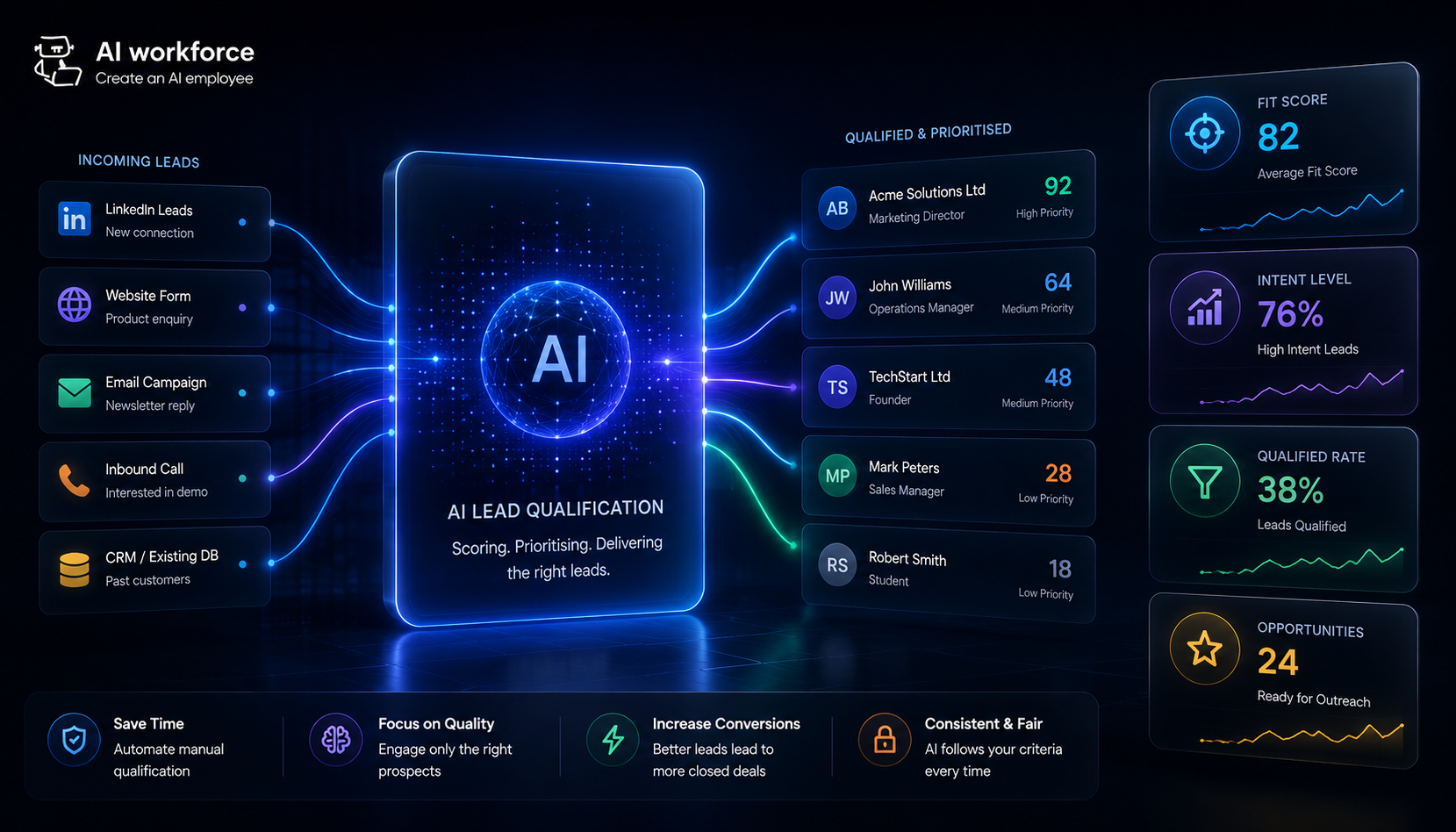
Not every lead deserves the same amount of a rep's time, but most teams still treat them as if they do. AI lead qualification changes that by capturing what a lead says, asking only the questions that matter, verifying key details, assessing fit, need, authority, timing and engagement, and routing the lead to the right next step, rather than leaving it to whoever happens to reply first or shout loudest in a pipeline review. The hard part is not the scoring itself. It is deciding exactly what AI is allowed to ask and infer, what it should never decide from, what outcome to assign when the picture is not clear-cut, and when a low-confidence or high-value case still needs a person to look at it before anything happens.
Quick Answer: AI lead qualification uses artificial intelligence and predefined business criteria to collect information about a lead, verify important details, assess fit, need, authority, timing and engagement, classify or score the opportunity and route it to the appropriate next step. A typical workflow captures the lead, asks only necessary questions, verifies key information, assesses the lead against defined criteria, assigns an outcome, routes or books where appropriate, escalates uncertain or high-value cases to a person and records the evidence in the CRM.
At a Glance
What it is: an AI-driven workflow that captures a lead, asks progressive questions, verifies key details, assesses fit, need, authority, timing and engagement, checks confidence, assigns an outcome and routes the lead to the appropriate next step, handing uncertain or high-value cases to a person
Best suited to: B2B teams with enough lead volume, across web, chat, phone or email, where manual triage is inconsistent, slow, or dependent on whichever rep happens to be free. For the chat channel specifically, see our guide to AI chatbots for lead management.
Typical cost: varies by lead volume, channels, CRM integrations and how much of the routing workflow is automated; see our AI Automation Pricing guide for the cost drivers
Biggest benefit: every lead gets assessed the same way, immediately, on every channel, instead of sitting untouched until someone notices it
Biggest risk: AI disqualifying a genuinely good lead on thin evidence, or routing a poor-fit lead to a rep as if it were ready, both of which are expensive in ways that are easy to miss until the numbers are reviewed later
What's Covered
Fundamentals
The Scoring Model
Channels & Workflow
Outcomes & Routing
Examples & Governance
Buying & Rollout
What Is AI Lead Qualification?
AI lead qualification is the process of using AI to capture information about a lead, verify what matters, assess whether it is a genuine fit for what you sell, whether it has described a real need, whether the right people are involved, whether the timing is realistic and whether it has shown genuine engagement, then acting on that assessment by assigning an outcome, scoring, or routing the lead accordingly.
Manual qualification does not scale evenly. A rep who is busy triages leads faster and more loosely. A rep who is careful triages more slowly and inconsistently with a colleague working the same criteria. Neither failure mode is really about effort. It is that qualification, done manually, depends on whoever happens to be doing it that day, and on which channel the lead came in through, rather than a defined and repeatable standard applied consistently across web forms, chat, phone and email.
AI does not remove judgement from this process. It applies a consistent standard to every lead, at any hour and on any channel, and surfaces the reasoning behind a decision so a person can review or override it. Done well, that consistency is the actual value, not speed for its own sake.
How Does Automated Lead Qualification Work?
At a workflow level, automated lead qualification follows a repeatable sequence, regardless of which channel the lead arrives through:
Capture: the lead's initial enquiry, form fill, chat message, call or email is logged against a record, new or existing
Collect: any information already provided or attached to the record is gathered before asking for more
Enrich: available third-party data is appended to fill gaps, subject to data-minimisation and lawful-basis checks
Ask: the system asks only the questions genuinely needed for the next decision, not a fixed long-form questionnaire
Verify: key details, such as company identity, email domain or stated need, are checked against available data rather than taken at face value
Assess: fit, need, authority, timing and engagement are evaluated against defined criteria, informed by verified details and any enrichment
Score: the assessment is combined into a transparent, weighted view of the lead, alongside a separate confidence rating
Check missing information: any field that is unknown or conflicting is flagged rather than guessed at, and triggers a further question or human review where it matters to the outcome
Route or nurture: the lead is sent to the right person, queue or workflow, booked directly where the process allows it, or placed in nurture if it is not yet ready
Human review or action: uncertain, high-value, sensitive or explicitly requested cases are handed to a person, with the reasoning and evidence attached; otherwise the routed action proceeds
CRM update: the questions asked, answers given, evidence used, outcome and routing decision are written back to the CRM for anyone who looks at the record later
This sequence is the backbone the rest of this guide works through in more depth, section by section.
Lead Qualification vs Lead Scoring vs Lead Routing vs Enrichment vs Nurture
These five terms get used loosely, often interchangeably, but they describe different jobs, and conflating them is one of the more common reasons a qualification project underperforms.
Lead enrichment adds information to a record, such as company size, industry or role, without making any decision about the lead
Lead scoring converts signals into a number or tier, ranking leads relative to each other
Lead qualification is the judgement of whether a lead meets a defined bar to be treated as sales-ready, informed by scoring but not identical to it
Lead routing decides which person, team or queue a qualified lead goes to next
Nurture is what happens to a lead that is not yet qualified, but is worth staying in contact with rather than discarding
A high score does not automatically mean a lead is qualified, and a qualified lead still needs to be routed correctly to be worth anything. Treating these as one undifferentiated step is where a lot of the ambiguity in this space actually comes from.
What Information Should AI Collect?
The article's qualification model, covered next, scores fit, need, authority, timing and engagement, but scoring is only as good as the information behind it. Progressive qualification means asking only what is needed for the next useful decision, not running every lead through a fixed long questionnaire.
Useful questions to draw from, asked selectively rather than all at once, include:
What are you trying to achieve?
Which service or product are you interested in?
What is your current process?
What problem needs solving?
Is there an active project?
What is the expected timing?
Which company or team is involved?
Who else participates in the decision?
Is there an appropriate commercial range or purchasing process?
What should happen next?
Established sales qualification frameworks such as BANT, CHAMP or MEDDICC can inform which of these questions matter most for a given business, but they should be treated as optional reference points rather than a mandatory checklist every lead must complete. A lead that has already answered three of these through its initial enquiry should not be asked all ten again.
The AI Workforce Lead Qualification Model
AI Workforce editorial framework, not an industry or regulatory standard. Each business should adapt the criteria to its own customers, sales process and risk profile.
A single blended score hides more than it reveals, because a lead can be an excellent fit with no confirmed need, or showing strong engagement with no realistic fit at all, and a single number cannot tell the difference. At AI Workforce, we use a Qualification Model built on seven dimensions, assessed separately and combined only at the end into a defined next action, rather than blended into one number from the start.
Fit → Need → Authority → Timing → Engagement → Confidence → Next Action
Fit: does the company, person and use case match what the business can actually serve, based on firmographic and technographic signals such as industry, company size, tech stack and geography
Need: has the lead described a problem, requirement or desired outcome, rather than only browsed or engaged passively
Authority: is the person engaging part of the buying group, or can they identify who is, rather than the assessment resting on a single unverified contact
Timing: is there an active project or a realistic timeframe, rather than only a hypothetical future interest
Engagement: has the lead shown genuine first-party interaction, such as a direct pricing enquiry or a specific implementation question, reviewed on its own rather than folded into another dimension
Confidence: how reliable the underlying evidence actually is across all five dimensions above, which determines how much autonomy AI should be given to act on them
Next action: route, review, nurture, support, book or disqualify, the actual output the other six dimensions exist to produce
Evidence quality applies across every dimension above, not just one of them: a conclusion drawn from a direct statement carries more weight than one inferred from behaviour, regardless of which dimension it feeds into.
Combination logic matters more than any single dimension. A lead with high fit and a clearly described need but low timing is worth nurturing, not routing to a rep today. A lead with strong engagement but poor fit, for example, a student researching the category rather than a buyer, should be filtered out regardless of how much content they have viewed. A lead with high fit and high timing but only weak behavioural evidence of need is a candidate for a person to review, not an automatic disqualification. The combination is the actual decision. Any one dimension read in isolation will mislead you.
The AI Workforce Lead Qualification Model is an AI Workforce framework, not an industry standard.
Worked example: an 80-person UK accountancy firm requests pricing and asks a specific question about implementation timelines on your site.
Fit: high, an 80-person UK accountancy firm matches the ideal customer profile
Need: high, a specific implementation question was asked directly, not inferred from browsing alone
Authority: medium, the enquiry came from an operations manager who has not yet confirmed who else is involved
Timing: medium, the stated project is planned for a future quarter rather than now
Engagement: strong, the pricing request and implementation question are direct statements, not inferred signals
Confidence: high, company and activity data are both verified
Next action: nurture with a scheduled follow-up, rather than immediate routing to a rep, because timing and authority have not yet been confirmed
Not Sure Where Your Leads Are Falling Through?
A Transparent Scoring Example
The sections above criticise opaque, unexplained scores throughout this guide, so it is worth showing what a transparent, weighted score actually looks like in practice.
Factor | Weight | Evidence |
|---|---|---|
Fit | 35% | Industry, size, geography and use case |
Need | 25% | Problem or required outcome stated directly |
Timing | 15% | Active project or relevant timeframe |
Engagement | 15% | First-party interaction with the business |
Data confidence | 10% | Completeness and reliability of information |
These weights are illustrative only. They must be tested against your own historical sales outcomes and adjusted until they actually predict which leads convert, not applied as a default.
Authority is treated here as a separate completeness and routing condition rather than a weighted factor. A business may include it in the score where appropriate, but an unidentified buying group should usually trigger another question or human review rather than an automatic rejection.
A scoring model held to this standard should be:
Explainable: any person should be able to see which evidence produced which outcome
Reviewable: a person can inspect and question the reasoning, not just the final number
Overrideable: a rep or manager can change the outcome, and that override is recorded
Validated against real outcomes: the weights are checked against actual conversion data, not assumed
Periodically retuned: thresholds and weights are revisited as the ideal customer profile and market shift
How Should AI Handle Missing or Conflicting Qualification Information?
A confidence score is not the same as complete qualification. Every qualification decision rests on information that falls into one of four states, and how AI handles each of them matters as much as the scoring model itself:
Known: the information has been directly stated by the lead or verified against a reliable source
Inferred: the system has drawn a reasonable conclusion from indirect signals, but it has not been confirmed
Unknown: the information genuinely has not been provided or found, and should be recorded as unknown rather than guessed
Conflicting: two sources disagree, such as a stated company size that does not match enrichment data
When essential information is unknown or conflicting, AI should ask another question, recommend human review, or leave the field marked unknown. It must not manufacture a plausible-sounding answer to fill the gap. A qualification system that quietly guesses at missing information will look accurate in a demo and fail in ways that are hard to detect once it is handling real volume.
From FAQ to Qualification to Human Handoff
A large share of inbound qualification, particularly through chat and voice, follows a recognisable workflow that starts with an answered question rather than a form field:
The lead asks a common question
AI provides an approved answer, drawn from a defined knowledge base rather than an open-ended response
The system identifies possible need, timing or engagement signals from the nature of the question or the follow-up
It asks a limited number of relevant qualification questions, drawn from the list above
It records the lead's exact answers, not a paraphrased summary
It checks fit and routing criteria against those answers and any available enrichment
It books, routes or nurtures the lead where the evidence supports it
It hands off to a person for uncertainty, high value or sensitive judgement, with the full exchange attached
Human handoff at the end of this sequence should be treated as a normal, expected outcome of good qualification, not a system failure or something to minimise in reporting. A workflow that hands off appropriately is doing its job correctly; one that never hands off anything is a warning sign, not a success metric.
Inbound Lead Qualification and Routing
Inbound leads have already taken an action: a form fill, a chat message, a call, or a reply to a campaign. That action indicates engagement, not necessarily readiness to buy, and the qualification workflow needs to distinguish between the two rather than treating every inbound contact as a hot lead.
Inbound enquiries typically arrive through one of several patterns, each with a slightly different qualification path:
Website enquiry: a general contact form fill with limited context, usually needing several follow-up questions before fit and need are clear
Form submission: a more specific request, such as a demo or pricing form, which carries a stronger first-party indication of interest than a general enquiry
Chat conversation: a real-time exchange where progressive questioning can happen naturally within the conversation itself
Inbound telephone call: a call where intent is often clear quickly, but verification and note-taking need to happen live
Email enquiry: a written request that may contain most of the qualifying information already, reducing how much needs to be asked
Existing-customer detection: the system recognises the contact or company already has an active account, and routes to account management or support rather than new-business sales
Support enquiry mistakenly entering sales: a request that reads like a sales enquiry but is actually a service issue, needing rerouting rather than qualification
Urgent or high-value request: an enquiry carrying signals of scale, urgency or seniority that justify faster or more senior handling than the standard queue
Uncertain enquiry requiring human review: an enquiry where the available answers are incomplete, contradictory, or simply do not map cleanly onto any defined outcome
The common thread is that an inbound action tells you a person is present and engaged. It does not, by itself, tell you whether they are a fit, whether the timing is right, or whether they are even a genuine buyer rather than a support case, a supplier, a job applicant or a duplicate contact. Qualification is the step that answers those questions before routing happens.
Voice, Chat and Email Qualification
Different channels need proportionate qualification handling, since the mechanics of capturing and verifying information differ meaningfully between a phone call, a chat window and an email thread.
Voice
Understand and confirm the enquiry back to the caller before proceeding
Ask a defined, limited set of qualification questions rather than an open-ended interview
Repeat important details, such as a name, company or requested date, back to the caller for confirmation
Classify, route, book or escalate based on the answers given
Record a summary and transcript where appropriate, so a person reviewing the call later has the full context
Avoid claiming perfect accent or background-noise handling; voice AI performance varies by conditions and should be tested against your own realistic call environment, not assumed
For the wider technology, limitations and implementation considerations, see our guide to AI voice agents.
Chat and web
Answer approved FAQs from a defined knowledge base rather than generating open-ended responses
Ask progressive qualification questions only where the conversation indicates genuine interest
Capture contact details accurately, with basic format verification
Route or book directly where the criteria are met with sufficient confidence
Offer a human handoff visibly and easily, rather than only as a last resort
Email and replies
Classify the reply by type: genuine interest, a request for more information, a proposed meeting time, a wrong-person reply, or an opt-out request
Route each classification to the appropriate next action rather than treating every reply the same way
Keep this scoped to classification and routing of inbound replies; the mechanics of outbound sequencing and follow-up cadence are covered in our dedicated guide to AI follow-up automation
Outbound Lead Qualification
Outbound qualification is a different job to inbound qualification, and treating them as the same process is a common source of misplaced confidence. An inbound lead has already initiated contact or shown first-party engagement. An outbound prospect has not necessarily expressed interest, so qualification here is closer to prioritisation based on fit than to confirming genuine interest. If the challenge comes earlier in the funnel — finding, enriching and validating potential prospects before qualification begins — our Best AI Lead Generation Tools comparison covers leading platforms for company discovery, contact data, enrichment, intent signals and AI-assisted research.
A typical outbound qualification workflow runs: prospect research, initial contact, response, discovery questions, an assessment of fit, need and timing, then human handoff or the next workflow step. Research and prioritisation happen before contact, using the same fit criteria as inbound qualification. Once a prospect responds, the same progressive questioning principles apply, but the starting confidence should be lower, since a reply does not by itself confirm need, authority or timing.
A high prospecting score is not the same as a qualified lead. It reflects how well a prospect matches the ideal customer profile before any contact has been made, not whether that prospect is interested, has budget, or is ready to talk. Our AI Sales Prospecting: How It Works guide covers how prospects are researched and prioritised before outreach, and our AI SDR Tools guide covers how outreach and qualification extend into a full outbound motion.
Outcomes Beyond Qualified and Unqualified
A binary qualified-or-disqualified outcome is where a lot of qualification systems fall short, because most real leads do not sit cleanly on either side of that line. A more useful set of operational outcomes includes:
Sales-ready: fit, need, authority and timing are all sufficiently confirmed to route to a rep now
Needs human review: the evidence is incomplete, contradictory, or sits right at a threshold
Nurture: fit is confirmed, but timing is not yet there; worth staying in contact with, not discarding
Service or support: the enquiry is a support matter rather than a new-business opportunity
Existing customer: the contact or company already has an active relationship and should route to account management
Partner or supplier: the enquiry is a business development or supplier approach rather than a prospective customer
Duplicate or spam: the record matches an existing lead already in progress, or shows clear signs of not being genuine
Disqualified: the lead does not meet defined fit criteria and is not a realistic prospect for the foreseeable future
A lead marked nurture or needs human review today is not necessarily lost; it may simply not be ready yet, and treating every non-sales-ready outcome as a permanent rejection discards opportunities that would have converted later with the right follow-up.
Confidence-Based Routing and the Cost of False Positives vs False Negatives
Qualification decisions are not equally risky. Some should apply automatically, some should be recommended for a person to confirm, and some should simply be held for review. Which bucket a decision falls into should depend on how confident the system actually is in the underlying evidence, an approach we call the AI Workforce Confidence Routing Model when applied to qualification specifically.
The AI Workforce Confidence Routing Model is an AI Workforce framework, not an industry standard.
When a lead requests a demo through a defined form with a confirmed business email and a specific stated need, that is high confidence, and automatic routing to a rep is reasonable. When intent signals are present but fit is only partially confirmed, that is medium confidence, and the system should recommend qualification rather than route it automatically. When signals conflict, for example, strong content engagement from a personal email address with no confirmed company, that is low confidence, and the correct action is to hold the lead for a person to review rather than qualify or discard it automatically.
Every qualification system makes two kinds of mistakes, and they are not equally expensive. A false positive routes an unqualified lead to a rep, wasting their time on a call that was never going to close. A false negative disqualifies a lead that would genuinely have converted, quietly losing revenue that never shows up as a visible failure, because a discarded lead does not generate a complaint the way a wasted call does.
Which mistake matters more depends on deal economics. For a high-value enterprise deal, a false negative is usually the costlier error, since a single missed opportunity can be worth far more than several wasted calls, so qualification thresholds should lean cautious about disqualifying. For a high-volume, lower-value product, a false positive is often costlier in aggregate, since rep time spent on unqualified leads compounds quickly across volume, so thresholds can reasonably lean stricter. There is no universally correct threshold. There is only the threshold that matches what a specific business actually loses on each type of error.
How Should AI Route a Qualified Lead?
Confidence determines whether a decision applies automatically, but routing determines where it goes once it does. A qualified lead's destination should be decided against defined criteria, not left to a default queue:
Product or service requested
Territory or geography
Company size
Industry specialism
Deal-value band
Existing account owner
Existing-customer status
Language
Urgency
Qualification outcome
Named strategic-account rules
If no routing rule matches, or more than one owner appears valid, the lead should go to a monitored human-review queue rather than letting the system guess at an owner. A wrong guess here is worse than a short delay, since a lead sent to the wrong rep or territory commonly sits unworked until someone notices the mismatch. Once a lead is sales-accepted, our guide to AI sales pipeline management covers how AI can manage the opportunity's stages, next actions, stalled-deal alerts and CRM updates from that point onward.
Where a qualified, sales-ready lead is offered a meeting directly rather than routed to a queue, the booking step follows its own short sequence: qualify, then check booking rules and ownership, retrieve permitted availability, offer suitable times, confirm the selected slot, record the outcome, and hand off any exceptions to a person. This guide keeps that sequence brief by design; the mechanics of calendar logic, rescheduling and confirmation messaging are covered in our dedicated guide to AI appointment setter tools.
What Should Always Require Human Review?
Regardless of how confident a qualification model is, certain situations should route to a person by default rather than being resolved automatically:
High-value opportunities, above a defined deal-size threshold
Conflicting or incomplete answers that do not resolve cleanly to an outcome
Unusual requirements that fall outside the defined qualification criteria
Complaints, or anything that reads as dissatisfaction with an existing service
Vulnerable people, or any enquiry suggesting the person may need extra care in how they are handled
Regulated or professional advice questions that sit outside what an automated system should answer
Complex pricing enquiries involving custom terms, discounts or non-standard structures
Strategic accounts, named or flagged in advance as requiring senior handling
Existing customers with an unresolved issue attached to their record
Explicit requests for a person, which should always be honoured promptly rather than deflected
System or integration failure, where the qualification workflow itself cannot complete reliably
Low confidence, where the evidence does not clearly support any single outcome
Treating this list as a standing checklist, rather than a one-off design decision, is what keeps a qualification system safe as volume grows and edge cases accumulate.
Three B2B Qualification Examples
The accountancy-firm worked example above shows the model in detail. It is worth seeing how the same approach applies across different types of B2B enquiry.
Scenario | AI collects | Likely next action |
|---|---|---|
Software enquiry | Company size, use case, integration requirements and timing | Route to the appropriate rep, or ask for missing details first |
Recruitment agency enquiry | Employer or candidate status, vacancy details and urgency | Route to the correct consultant based on specialism and location |
Professional services enquiry | Required service, context, urgency and who else is involved in the decision | Human review for complex, custom or high-value work |
Each of these follows the same underlying workflow: capture, ask, verify, assess, confidence, classify, route, but the specific questions and routing rules differ by business type. A qualification system built around one of these should not be assumed to transfer unchanged to another.
Common Failure Modes and Mitigations
Risks are discussed throughout this guide. It is worth consolidating them into one place, since a team designing or reviewing a qualification system benefits from seeing the full list together.
Failure mode | Mitigation |
|---|---|
Incorrect company or contact data | Verify against a reliable source before acting; flag unverified fields rather than treating them as fact |
Hallucinated missing information | Mark unknown fields as unknown; never let AI generate a plausible-sounding answer to fill a gap |
Opaque scoring | Use an explainable, weighted model a person can inspect, not a single unexplained number |
False intent assumptions | Treat engagement as evidence to weigh, not proof of need or readiness on its own |
Outdated CRM records | Schedule periodic data-quality review; do not assume CRM fields are current by default |
Duplicate leads | Match against existing records before creating a new one, and merge or flag duplicates for review |
Incorrect routing | Send unmatched or ambiguous cases to a human-review queue rather than guessing at an owner |
Historic bias | Periodically audit qualification outcomes against actual conversion data across different lead types |
Excessive qualification questions | Ask only what the next decision genuinely requires; skip questions already answered elsewhere |
Rejecting unconventional but valuable leads | Route low-confidence or atypical cases to human review rather than automatic disqualification |
Automation continuing after human takeover is required | Build a clear handoff signal that stops automated actions the moment a person takes over |
CRM Write-Back and Auditability
What a qualification system writes back to the CRM matters as much as the decision itself, since a record that only shows a final score gives nobody enough context to trust or challenge it later. A complete write-back should capture:
Captured lead details, exactly as provided
The questions asked during qualification
The lead's actual answers, not a paraphrased summary
The source of any enrichment used
Observed facts, distinct from inferred conclusions
AI inferences, clearly labelled as such
The fit, need, authority, timing and engagement assessment
The confidence rating behind that assessment
The outcome assigned
The routing decision made
The next action, and who owns it
A summary and timestamp of the full interaction
It is worth distinguishing four categories of information feeding into any qualification decision, since conflating them is a common source of misplaced confidence in a system's output:
Category | What it is | Example |
|---|---|---|
Observed information | What the lead directly stated or did | "We need this live by March" |
Official or public data | Verifiable third-party records | Companies House registration status |
Vendor-supplied enrichment | Third-party data appended to the record | Firmographic data from an enrichment provider |
AI inference | A conclusion the system drew from the above | "Likely mid-market buyer, medium urgency" |
A qualification system should never silently overwrite a person's manually verified CRM field with a lower-confidence AI inference. Where an inference conflicts with an existing verified field, that conflict should be flagged for review, not resolved automatically in the AI's favour.
Want to See Exactly What Your CRM Should Be Recording?
Companies House, UK GDPR and PECR
Lead records are personal data whenever they relate to an identifiable person, which covers the great majority of B2B lead data: a name, an email address, a role, and any behavioural or enrichment data attached to them. UK GDPR applies to that processing regardless of whether a person or an AI system is doing the scoring.
Automated qualification and profiling still fall within UK data protection law. Where a system makes a significant decision about an individual solely through automated processing, additional safeguards can apply, including transparency, the ability to make representations and access to human intervention. The Data (Use and Access) Act 2025 introduced a more permissive framework for significant automated decisions in some circumstances, while retaining safeguards including the right to information, the ability to challenge a decision, representation and human intervention. Businesses should assess whether their particular qualification decision is sufficiently significant to engage these provisions rather than assuming every automated lead score does; current ICO guidance on the Data (Use and Access) Act 2025 and GOV.UK guidance on the Act set out the current position. AI Workforce's recommended operating model is more cautious than the legal minimum: consequential or low-confidence disqualification decisions should remain reviewable by a person even where fully automated processing may technically be available.
A working qualification programme should also address, proportionately to its own risk profile:
Retention periods: define how long lead and qualification data is kept, and delete or anonymise it once no longer needed
Processors and subprocessors: know which vendors process lead data on your behalf, and confirm appropriate contractual protections are in place
International data transfers: check where enrichment or qualification data is processed and stored, and whether an appropriate transfer mechanism applies
Special-category data: avoid collecting sensitive personal data, such as health or political information, through a qualification workflow unless there is a clear, lawful and genuinely necessary reason to do so
The right to object: individuals can object to direct marketing at any time, and that objection must be honoured without further qualification-related processing of their data for that purpose
Documenting the lawful basis: record which lawful basis applies to each category of qualification processing, rather than assuming one basis covers everything
Avoiding unnecessary questions: do not ask qualification questions that go beyond what is genuinely needed to assess fit, need, authority, timing and engagement
Companies House is a useful source for verifying company identity during qualification, but its scope is narrower than it might first appear. It can support:
Registered company name
Company number
Status, such as active or dissolved
Incorporation date
Registered office address
SIC code, indicating industry classification
Officers, where relevant to understanding formal company roles, while recognising that an officer listing does not prove current buying authority or authority for a particular transaction
It does not provide private contact details for named individuals, does not prove that a specific person has buying authority, and does not grant permission to market to an individual at that company. Public availability of a company's official record is a useful fit and verification signal; it is not, on its own, a lawful basis for contacting a named person.
Third-party enrichment data needs its own scrutiny. Confirm your enrichment provider has a lawful basis for the data it holds, and avoid pulling in more than is genuinely useful for qualification, since data minimisation applies to enrichment the same way it applies to any other processing. Behavioural signals also depend on how they were collected; where cookies, pixels or similar technologies are involved in tracking pricing page visits or content engagement, the relevant PECR and transparency requirements should be assessed separately from the qualification decision itself. Where outbound qualification feeds into cold outreach, PECR rules on unsolicited electronic marketing apply to what happens after qualification, not the scoring step itself. Our guide to AI and GDPR compliance for UK businesses covers the underlying framework in more depth. This section is general information rather than legal advice.
AI Qualification Software, Platforms and Bots
These three terms are often used interchangeably in vendor marketing, but they describe different scopes of product:
AI lead qualification software: a focused tool that collects or analyses lead information and supports scoring, classification and routing, typically as one component within a wider sales stack
AI lead qualification platform: a broader system that may combine multiple channels, workflows, CRM integration, enrichment, analytics and governance controls in one product
AI lead qualification bot: a conversational voice, chat or messaging system specifically designed to ask questions, record answers and route the lead, usually the front-end component of a software or platform product
Understanding which of these a vendor is actually offering, rather than assuming from the marketing term used, is a useful first filter before evaluating features. A strong buyer checklist, covered later in this guide, is more useful than a vendor list here, since vendor capability and pricing in this category change frequently and any list would be stale within months of publication. Where a qualified lead needs a fuller sales-assistant layer rather than just scoring and routing, our Best AI Sales Assistant Software guide covers that adjacent category.
Build vs Buy
Whether to buy off-the-shelf qualification software, build a custom workflow, or extend existing CRM automation depends on how standard your qualification needs are, not on which option sounds more sophisticated.
Off-the-shelf software: faster to set up, with standard CRM integrations and predefined workflows; suits businesses whose qualification criteria and routing logic are reasonably standard
Custom workflow: more suitable when your questions, routes, channels, data sources or approval rules are genuinely business-specific and would need heavy configuration to fit an off-the-shelf tool
Existing CRM automation: appropriate when your CRM already contains trusted data and reliable workflows, and the qualification layer is the only missing piece, rather than needing a wholesale replacement
None of these paths is universally superior. A business with straightforward, well-understood qualification criteria commonly overpays for a custom build it did not need; a business with genuinely unusual routing logic across multiple channels commonly underperforms by forcing that logic into an off-the-shelf tool that was not designed for it. The right starting question is whether your qualification needs are standard or genuinely specific, not which approach is more impressive.
What Does AI Lead Qualification Cost?
AI lead qualification costs vary depending on lead volume, channels, CRM integrations, enrichment requirements, qualification complexity and how much of the routing workflow is automated. Some businesses can add qualification to existing CRM or sales software with light configuration, while more complex multi-channel workflows require additional implementation. The total figure typically breaks down into five components worth pricing individually: implementation, the initial build and CRM integration; software, platform or per-seat licensing; AI credits, usage-based cost for the scoring and generative layer; data costs, licensed enrichment billed separately; and maintenance, ongoing monitoring and retuning as thresholds drift. For a detailed breakdown of the factors affecting UK AI automation costs, see our AI Automation Pricing guide. If qualification is only one part of a wider AI sales agent that also handles follow-up, email or voice outreach, CRM updates and pipeline actions, see our guide to AI sales agent pricing in the UK for the broader total-cost model.
A simple way to frame the return on that investment:
Monthly qualification value = human qualification time recovered + attributable improvement in conversion or routing − software costs − implementation costs − review time − correction time − ongoing operating costs.
Treat any worked figure against this formula as illustrative; the real numbers depend entirely on your own pipeline value, conversion rates and cost of rep time.
How Do You Evaluate a Vendor?
Before committing to a platform, put these questions to a vendor directly:
Which qualification decisions does the system apply automatically, and which does it only recommend?
Can the fit, need, authority, timing and engagement criteria be configured to match our own ideal customer profile, rather than a generic template?
How is confidence actually calculated, and can that threshold be adjusted?
Can I see why a specific lead was scored or routed the way it was, not just the resulting number?
Can every automated qualification decision be traced back to what triggered it, and reversed if it was wrong?
Does the platform separate fit, need, authority, timing and engagement, or collapse them into one blended score?
How does the system handle missing or conflicting information by default?
How does the system handle a low-confidence or conflicting-signal lead by default?
Which channels does it genuinely support, and which are add-ons or roadmap items?
What exactly gets written back to the CRM, and can that be configured?
Can AI sales assistants or adjacent tools already in use qualify leads, or does this remain a separate step?
A vendor that cannot answer these clearly, or treats the questions as unusual, is a signal to slow down.
Implementation and Test Plan
Rolling out AI lead qualification against a constrained slice of your lead flow is safer than automating every routing decision from day one.
Week one, criteria and baseline: define your ideal customer profile, agree on disqualifying criteria, and measure how your current manual process actually performs, so you have a real baseline to improve on rather than an assumed one
Week two, historical testing: run historical leads through the scoring model and compare its qualification decisions against what actually happened, without touching any live leads
Week three, recommendation mode: let AI score and recommend qualification and routing on live leads, but keep a person confirming every decision before it takes effect
Week four, constrained automation: turn on automatic routing only for high-confidence decisions, such as a defined-form demo request with a confirmed business email, while medium- and low-confidence leads stay in recommend-only or human-review mode
Before rolling out beyond the pilot, test the system explicitly against a broader set of scenarios than a single historical batch will naturally cover:
An ideal lead
A clearly unsuitable lead
An ambiguous lead
A lead with incomplete answers
A lead with contradictory answers
A pricing-only enquiry
A support enquiry mistakenly entering the sales queue
An existing customer
A duplicate contact
Spam or clearly non-genuine submissions
A high-value account
An urgent request
An explicit request for a person
An opt-out or privacy request
A deliberate integration or system failure
Voice input with accent variation and background noise
An unexpected or off-script question
A system that performs well on straightforward cases but fails silently on these edge cases is not ready for full automation, regardless of how strong its headline accuracy looks.
How Do You Measure AI Lead Qualification, and Is It Worth It?
Volume of leads scored is not a sufficient measure on its own, since a system can process a large number of leads while quietly misrouting a meaningful share of them. Track a broader set of qualification-specific indicators:
Precision: the proportion of leads marked qualified that a rep actually accepts as worth working
Recall: the proportion of genuinely qualified leads the system actually identifies, rather than missing
False-positive rate: how often an unqualified lead is routed to a rep as if it were ready
False-negative rate: how often a genuinely qualified lead is disqualified or overlooked
Sales-accepted rate: the proportion of AI-qualified leads a rep formally accepts into their pipeline
Time to qualified handoff: how long it takes from a lead entering the system to being routed
Override rate: how often a person changes or reverses an AI qualification or routing decision
Opportunity creation rate from qualified leads: tracked against your previous manual baseline
Cost per sales-accepted lead: factoring in both the platform cost and rep time saved
Qualification completion rate: the share of leads that reach a defined outcome rather than stalling mid-workflow
Routing accuracy: how often a lead reaches the correct owner first time
Missing-information rate: how often essential fields remain unknown, a signal of whether the questions asked are sufficient
Score-correction rate: how often a person changes a score after review, distinct from a full routing override
Time to first response: how quickly a qualified lead receives any human or automated follow-up
Meeting conversion from qualified leads: the share of sales-ready leads that convert into a booked meeting
Human qualification time recovered: hours no longer spent on manual triage, measured against a real baseline
Pipeline or revenue influenced: tracked only where attribution back to qualification is credible, not assumed
Metric | What it reveals |
|---|---|
Sales acceptance | Whether reps trust qualified leads |
Routing accuracy | Whether leads reach the correct owner |
Missing-information rate | Whether qualification questions are sufficient |
Override rate | Whether human reviewers regularly disagree |
Opportunity conversion | Whether qualification predicts downstream value |
Human time recovered | Whether automation produces operational savings |
One of the most useful operational trust metrics is the override rate on qualification decisions: a low, stable override rate is a stronger signal of a healthy rollout than raw volume processed. Read it alongside precision and false-negative performance rather than on its own, since a low override rate can also mean reps are not reviewing recommendations closely enough to catch a mistake.
AI lead qualification is worth evaluating wherever manual triage is visibly inconsistent, slow, or dependent on whichever rep is free, or wherever reps are spending meaningful time on leads that were never realistically going to convert. Its value depends on whether fit, need, authority, timing and engagement are genuinely tracked as separate signals, whether outcomes go beyond a binary qualified or disqualified, and whether the system's confidence in a specific decision is matched to how much autonomy it is given, not on how sophisticated the scoring model sounds in a vendor demo.
AI Workforce Insight: the qualification systems that hold up over time are the ones where a low-confidence decision defaults to a person reviewing it, not to AI guessing in either direction. Treating uncertainty as a routing signal in its own right, rather than forcing every lead into qualified or disqualified, is what keeps the false-positive and false-negative rates both low at the same time.
A good qualification system is not the one that qualifies the most leads. It is the one where a rep, a sales manager and a pipeline review can all trust that a qualified lead is actually worth the time it takes to work, and that everything else was routed, nurtured or escalated appropriately rather than simply discarded.
Related Guides
AI Outbound Sales Automation
Best AI CRM Software
Sources and Further Reading
ICO: Data (Use and Access) Act 2025 guidance
GOV.UK: Data (Use and Access) Act 2025 changes
ICO: UK GDPR guidance
ICO: PECR and direct marketing guidance
Companies House: find and update company information
GOV.UK: Companies House guidance
Frequently Asked Questions
What is AI lead qualification?
AI lead qualification is the process of using AI to capture a lead's details, verify what matters, assess its fit, need, authority, timing and engagement, then scoring, classifying or routing it accordingly, instead of relying on manual triage that varies by rep, channel and workload.
Is lead qualification the same as lead scoring?
No. Scoring converts signals into a number or tier. Qualification is the judgement of whether a lead meets a defined bar to be treated as sales-ready. A high score does not automatically mean a lead is qualified.
Can AI qualify a lead automatically without a person reviewing it?
Potentially, where the organisation has predefined a low-risk, high-confidence scenario and the required qualification criteria are satisfied. Medium-confidence, conflicting, high-value or consequential cases should remain recommend-only or route to human review.
What should AI never use to disqualify a lead?
Weak signals such as a single email open, the absence of a reply, or a job title alone should never be sufficient on their own to disqualify a lead. They should feed into a broader score rather than trigger an automatic decision.
What questions should AI ask to qualify a lead?
Only the questions genuinely needed for the next decision, drawn from areas such as the lead's goal, current process, active project, timing, company and decision-making process. Frameworks such as BANT, CHAMP or MEDDICC can guide which questions matter most, but should not be applied as a fixed script for every lead.
Is a false positive or false negative worse in lead qualification?
It depends on deal economics. For high-value deals, a missed genuinely qualified lead usually costs more than a few wasted calls, so thresholds should lean cautious. For high-volume, lower-value products, wasted rep time on unqualified leads often costs more in aggregate.
What should always be escalated to a person rather than handled automatically?
High-value opportunities, conflicting or incomplete answers, complaints, vulnerable people, regulated advice questions, complex pricing, strategic accounts, explicit requests for a person, system failures and low-confidence cases should all route to a person by default.
How much does AI lead qualification cost?
Costs vary by lead volume, channels, CRM integrations, enrichment requirements and how much of the routing workflow is automated. See our AI Automation Pricing guide for a fuller breakdown of what drives that cost.
Does AI lead qualification work for outbound as well as inbound leads?
Yes, but they need different treatment. Inbound leads have already initiated contact or shown first-party engagement, so qualification can assess the reason for the enquiry, fit, need and timing. Outbound prospects have not necessarily expressed interest, so initial qualification is closer to fit-based prioritisation.
Can AI sales assistants qualify leads?
Some AI sales assistant tools include qualification as part of a broader set of capabilities, such as research, drafting and follow-up. Whether that qualification is explainable, reviewable and confidence-scored in the way this guide describes varies by product, so it is worth checking rather than assuming. See our Best AI Sales Assistant Software guide for a fuller comparison.
Does UK GDPR affect automated lead qualification?
Yes. Automated scoring and profiling involving personal data are subject to UK GDPR. Where solely automated processing produces a legally or similarly significant decision, additional safeguards can apply under the Data (Use and Access) Act 2025 framework. AI Workforce recommends human review for consequential or low-confidence qualification decisions even where full automation may legally be available.
Can Companies House data confirm whether a lead is a real buyer?
It can confirm that a company exists and is active, along with details like registration number, status and registered office. It cannot confirm that a specific individual has buying authority, and it does not provide private contact details or marketing permission.
How do I know if my qualification system is actually working?
Track precision, recall, false-positive and false-negative rates, and override rate, rather than volume of leads processed alone. A low, stable override rate on qualification decisions is a useful operational trust signal when read alongside precision, recall, sales acceptance and downstream opportunity outcomes.
What is an AI lead qualification bot?
An AI lead qualification bot is a conversational system operating through chat, voice or messaging that asks defined qualification questions, records the lead's answers and routes, books or escalates the enquiry according to business rules.
What is AI lead qualification software?
AI lead qualification software collects or analyses lead information, assesses fit, need, authority, timing and engagement, supports scoring and classification and routes the lead to an appropriate next step. A broader platform may also include multiple channels, CRM integration, enrichment, analytics and human-handoff controls.
Key Takeaways
AI lead qualification follows a full workflow: capture, ask, verify, assess, confidence, classify, route, human handoff and record, not just a scoring step
Qualification, scoring, routing, enrichment and nurture are distinct steps, and treating them as one blended process is a common source of poor results
The AI Workforce Qualification Model scores Fit, Need, Authority, Timing, Engagement and Confidence separately and combines them into a defined next action, rather than blending everything into one opaque number
A transparent, weighted scoring example should be explainable, reviewable, overrideable, validated against real outcomes and periodically retuned
Missing or conflicting information should be marked known, inferred, unknown or conflicting, never guessed at to fill a gap
Ask only the questions genuinely needed for the next decision; frameworks like BANT or MEDDICC inform this; they should not replace judgement
Outcomes should go beyond qualified and disqualified to include nurture, needs human review, service, existing customer, partner and duplicate
Weak signals such as a single email open, a job title alone, or the absence of a reply should never be sufficient on their own to qualify or disqualify a lead
Confidence-based routing — high confidence to automatic, medium to recommend-only, low to human review — gives a team an actual governance model rather than one blanket automation setting
A defined list of situations: high value, conflicting answers, complaints, vulnerable people, explicit requests for a person should always route to a human by default
Everything a qualification system does should be written back to the CRM with observed facts, official data, enrichment and AI inference clearly distinguished
Companies House can confirm company identity but not individual buying authority or marketing permission
Track override rate alongside precision and recall, not just volume of leads processed, to judge whether a rollout can actually be trusted
Start narrow: define your criteria, test against history and edge cases, run in recommendation-only mode, then automate only the high-confidence decisions first
This article is general information rather than legal advice. Take independent advice on data protection obligations specific to your own lead data and marketing activity.
Ready to Qualify Leads More Consistently?
About the Author
Rodi Taze is Co-Founder of AI Workforce. He works with UK businesses to design lead qualification and routing systems that stay accountable, with a particular focus on making confidence-based automation practical rather than theoretical.
About the Reviewer
This guide was reviewed by Clara Miller, Content Marketing Specialist at AI Workforce, for clarity, structure and alignment with how UK B2B sales teams actually evaluate and adopt qualification software.
Reviewed: August 2026
© 2026 AI Workforce. All rights reserved.