How to Automate Sales Outreach With an AI Agent: Step-by-Step Guide
Posted On: May 12, 2026
Written by Clara Miller, Content Marketing Specialist at AI Workforce · Reviewed by Rodi Taze, Co-Founder of AI Workforce · Last updated: September 2026
Sales outreach can be automated far beyond scheduled email sequences. A well-designed AI workflow can identify suitable prospects, enrich and score them, draft relevant outreach, run approved follow-ups, classify replies and update the CRM before handing a qualified opportunity to a salesperson. The key is to automate the structured parts without giving AI unrestricted control over pricing, complaints, opt-outs or sensitive accounts. This guide shows the process step by step.
Quick Answer: To automate sales outreach with AI, start by defining your ideal customer profile and exclusions, connect your CRM and trusted lead data, enrich and score prospects, then use AI to draft first-touch outreach and approved follow-ups. The workflow should classify replies, stop automatically on opt-outs, route qualified prospects to a salesperson and write every action back to the CRM. Start with one channel and one contained workflow before expanding. Keep pricing, complaints, sensitive conversations and compliance decisions under human or hard-rule control.
How to Automate Sales Outreach With AI in 8 Steps
This sequence reflects how a well-governed AI outreach workflow is typically built, moving from setup and data through outreach, follow-up, classification and measurement.
Define Your ICP and Exclusions: set target company type, role, geography and account exclusions, and identify strategic accounts and contacts that must never enter automation.
Connect Your CRM and Trusted Lead Data: connect your CRM, approved enrichment sources, first-party signals, relevant company data and suppression records. The CRM stays the system of record.
Enrich and Validate Prospects: verify company, role, contact details and account context. Never let the model invent missing details.
Score and Prioritise Prospects: use explainable criteria: ICP fit, account value, relevant buying signals, past engagement, existing relationship and suppression state.
Generate First-Touch Outreach: draft email, LinkedIn or other approved-channel messaging from verified context, with human review required initially.
Automate Follow-Ups: run approved sequences based on no response, timing and channel permissions; suppression and opt-outs override every follow-up rule.
Classify Replies and Hand Off Qualified Leads: classify as interested, objection, not now, wrong person, opt-out or uncertain. Qualified prospects go to a person; uncertain or sensitive replies escalate rather than get guessed at.
Write Everything Back to the CRM and Measure Results: log outreach sent, replies, qualification, handoff, meetings, opt-outs and human overrides, measuring quality and accepted opportunities rather than message volume.
What's Covered
Foundations
Data, Personalisation and Systems
Governance and Risk
Choosing and Measuring
What Is AI Outreach, Really?
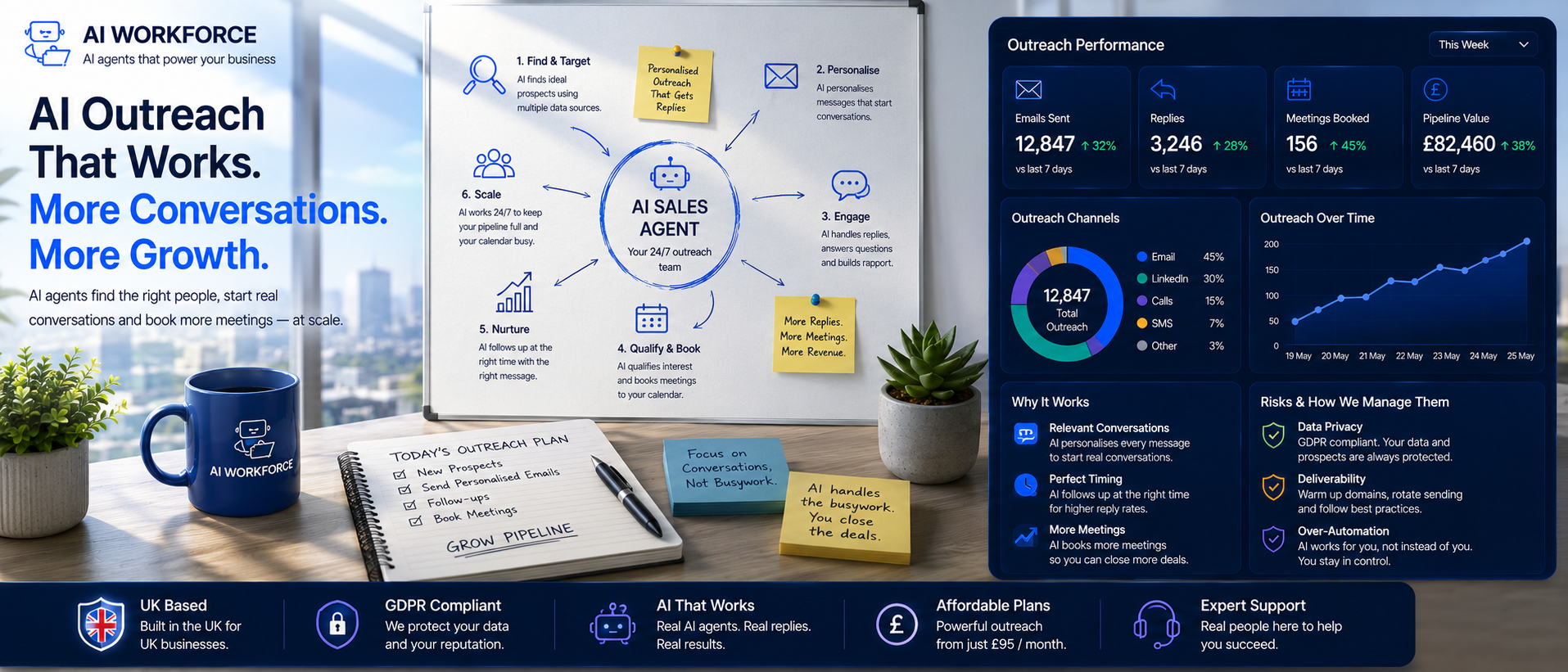
AI outreach is the use of AI to research prospects, write messages, follow up automatically, and move leads through your pipeline, without a rep having to do each step by hand. It is not a chatbot on your website. It is an end-to-end outreach process where AI handles the volume work so your team can focus on the conversations that actually close.
The simplest version is an AI agent that monitors a list of target accounts, spots a buying signal, such as a new hire, a funding round, or a job posting, and drafts a relevant outreach message in response. The rep reviews it, sends it, and moves on. More advanced setups let the agent send, follow up, and qualify leads automatically before a human ever touches the thread.
The goal is not to remove the human entirely. It is to remove the repetitive tasks that take up a rep's day so they can spend more time on calls and relationship work that AI cannot replicate.
Manual outreach: best for high-value, bespoke relationships that need a fully human touch
Sales automation: best for fixed, predictable sequences with no adaptation
AI outreach: best for personalised, multi-step workflows across channels
AI SDR: best for end-to-end prospect engagement, from research through to a booked call
How Does an AI Agent Handle Sales Outreach?
An AI outreach agent works by combining a few core capabilities: research, writing, sequencing and decision-making. It can pull lead data from multiple sources, understand the context around a prospect, and use that context to draft a message that feels relevant rather than generic. This is what separates it from a basic template blaster.
The agent typically operates inside a defined workflow. A lead enters the system, the agent enriches their profile, scores them against your ideal customer profile, and decides which outreach sequence to place them in. It sends the first message, waits for a response, and handles the follow-up automatically if there is no reply. An AI SDR running this kind of loop can manage a large number of active prospects simultaneously. Our guide to AI SDR tools looks at how these platforms handle full-workflow prospect engagement in more depth.
What makes this different from older automation is the classification layer. Earlier tools could send a sequence on a timer. An AI agent can classify a reply and apply decision logic to continue, escalate or stop. That capability, applied across a pipeline, is where the productivity gain comes from. More advanced setups let the agent send, follow up, and qualify leads automatically before a human ever touches the thread. Once a prospect is qualified and ready to meet, our guide to AI appointment setter tools covers calendar routing, booking and confirmation in more depth.
AI Workforce insight: in our experience, the quickest improvements usually come from automating follow-ups, lead enrichment and CRM updates rather than the first outreach message. Those workflows are repetitive, measurable and easier to supervise while a team builds confidence in the system.
Signs Your Sales Team Is Ready for AI Outreach
A few practical signals suggest a team is ready to introduce AI outreach. If two or three of these sound familiar, that's a reasonable place to start a pilot:
SDRs spend hours a week on manual research
CRM records are incomplete or outdated
Follow-ups are frequently missed
Reply rates have been declining
Lead enrichment is still done manually, account by account
Reps spend more time on admin than on conversations
A practical rollout tends to follow five steps: choose one workflow, connect your CRM and data sources, test on a small list, review the results, then expand once you're confident in the output. Skipping the small-scale test and turning on full volume from day one is the most common way this goes wrong. If lead volume itself is the bottleneck rather than process, our guide to AI lead generation tools covers building the top of the pipeline.
What Triggers an AI Outreach Workflow?
The most effective AI-powered outreach is based on signals rather than static lists. A trigger is an event that tells the system a prospect is worth contacting now. Common triggers include a prospect visiting your pricing page, a company posting a relevant job role, a senior hire being announced at a target account, or a prospect engaging with your content on LinkedIn.
When a trigger fires, the workflow activates. The agent gathers context around that signal, checks whether the account is already in your CRM, and either updates the existing record or creates a new one. It then moves the prospect into the right workflow, whether that's a cold outreach sequence, a re-engagement flow, or a fast-track path to a rep's calendar.
Real-time triggers are particularly useful in B2B. A prospect changes into a role that may carry greater buying responsibility; a well-configured system can catch that and send a timely, relevant note faster than a manual process would.
Lead Data, Enrichment and Qualification
Generating leads is only half the job. The other half is knowing which ones are worth pursuing. AI handles this through enrichment and scoring. Enrichment means pulling in firmographic data (company size, industry, tech stack, funding stage) to fill out a thin prospect record. Scoring means ranking prospects based on how closely they match your ideal customer profile. Our guide to AI sales prospecting software compares platforms built specifically for this stage.
An agent can qualify leads automatically based on those scores, routing high-fit accounts to your best reps and putting low-fit leads into a nurture track or dropping them. This means reps spend time on prospects that are more likely to buy, which is one of the biggest levers on sales efficiency.
Research is also faster with AI. What might take a rep twenty minutes per account (checking LinkedIn, the company site, recent news) an agent can do in seconds, surfacing the most relevant context alongside the draft message so a rep is up to speed before they step in.
Can AI Personalise Messages at Scale?
Yes, and this is where generative AI changes sales outreach. Traditional sequences relied on merge tags: first name, company name, industry. That's surface-level. An AI agent can read a prospect's recent activity, their company's latest news, and their role, then write a message that references something genuinely specific. The result can be a message that feels more contextually relevant than a basic merge-tag template, provided the underlying data is accurate.
This lets you personalise outreach at a scale that used to require a team of researchers. Every prospect can get a first touch that speaks to their actual situation. Relevant, accurate personalisation can make outreach more useful to the recipient, while shallow, stale or invented personalisation can damage credibility. It also means outreach is less likely to feel like spam, which protects domain reputation over time. Generative AI should write only from verified data retrieved by the workflow; if a signal cannot be confirmed, leave it out.
The key is giving the agent good inputs. If enrichment data is shallow, the personalisation will be shallow too. Feed the agent quality lead data, clear positioning and honest context for the outreach, and the output improves considerably. Good AI outreach is still rooted in good sales thinking; AI just executes it faster.
How Does AI Fit Into Your CRM and Pipeline?
The outreach tool and your CRM need to work together, or you end up with data in two places and no reliable picture of what's happening. A well-integrated agent writes every action back to the CRM automatically: messages sent, replies received, meetings booked, and qualification status updated. The team knows where each prospect stands without chasing updates manually. Our guide to AI follow-up automation looks at how these write-backs work for follow-up sequences specifically.
When the agent moves a lead from "contacted" to "replied" to "meeting booked," that happens in the CRM close to real time, not in a spreadsheet updated once a week. Sales operations can trust the numbers because the system is filling them in.
More complete and timely CRM records can improve visibility into pipeline activity, provided write-backs are accurate and reviewed.
The CRM should remain the system of record. AI can enrich, update and organise information, but important sales decisions should still be traceable and reviewable by the team.
Email, LinkedIn and Other Outreach Channels
LinkedIn and cold email remain the two dominant channels for B2B outreach, and AI changes how both work. For cold email, an agent can draft sequences tailored to a prospect segment, test variations, and adjust based on open and reply rates. On LinkedIn, AI can monitor prospect activity, flag engagement opportunities, and draft connection requests or follow-up notes based on recent posts. Some tools integrate directly with LinkedIn to execute these actions; others surface the draft for a rep to send manually, which keeps a human touch while still removing the research work. The automation method matters here: check platform terms and use approved APIs or integrations rather than unofficial workarounds.
If email is the main outbound channel you are building around, our guide to the best cold email software compares leading platforms on deliverability, personalisation, pricing and UK compliance.
The strongest sequences combine both channels: a cold email on Tuesday, a LinkedIn connection request on Thursday, a follow-up email the next week referencing the connection. An agent can coordinate this across channels without a rep having to track it manually, which is where multi-channel outreach has historically fallen apart for smaller teams.
For teams using LinkedIn as part of that process, our guide to LinkedIn automation tools compares prospecting, research, CRM and sequencing tools, including the platform-policy risks that differ between them.
What Should AI Automate vs What Should Stay Human?
Not every part of outreach is equally safe to automate, and it's worth being deliberate about where to start.
Generally lower-risk: CRM updates, follow-up reminders, lead enrichment, meeting confirmations, drafting first-touch emails for review
Higher-risk, needs closer oversight: pricing discussions, contract negotiations, enterprise proposals, anything with legal or contractual implications, and handling customer complaints
Governance and Controls
Rolling out AI outreach without controls is where most of the real risk sits. Worth having in place:
Approval rules for what an agent can send without review, and what always needs a human check
Domain protection and sending limits, to avoid triggering spam filters or damaging deliverability
Suppression lists, enforced at system level, for anyone who has opted out or asked not to be contacted
CRM permissions, so an agent only has the access a task genuinely needs
An audit log of what was sent, when, and to whom
A named owner responsible for what the system sends under your brand
An escalation process for when something goes wrong
Documented brand guidelines so tone stays consistent across an agent's messages
A regular review schedule to catch drift in quality or tone over time
Human decision: commercial judgement — what to say, how to handle an objection, whether to offer a concession. Hard system rule: suppression, opt-outs, sending caps and other non-negotiable controls, enforced in the application/workflow layer, not left to an AI model to remember or infer.
UK GDPR and PECR
Cold email and outreach in the UK sit under the Privacy and Electronic Communications Regulations (PECR) as well as UK GDPR. The rules differ depending on who you're contacting: sole traders and some partnerships are treated as individuals, so you generally need specific consent, or an existing-customer "soft opt-in," before emailing them. Corporate bodies (limited companies, LLPs, Scottish partnerships, government bodies) can be emailed without that same consent requirement, but you must always identify yourself clearly, provide a working opt-out, and maintain a suppression list of anyone who objects.
This corporate exemption is often why cold email works as a B2B channel in the UK at all, but it isn't unlimited: if you're processing personal data (an individual's name and role at a company) to power AI enrichment or personalisation, UK GDPR obligations around lawful basis, data minimisation and retention still apply, and this is worth checking with whoever handles data protection at your organisation. Enrichment providers and AI tools used in the pipeline should also be checked for what they do with the data they process, and how long they retain it. See the ICO guidance on electronic mail marketing for the full detail. Our guide to AI GDPR compliance for UK businesses covers the broader obligations that apply when AI tools process personal data.
This section is general information rather than legal advice.
Where AI Outreach Commonly Goes Wrong
The most common failure is volume without relevance. Teams deploy an agent, turn up the volume, and start sending messages that are technically personalised but feel hollow. Reply rates drop, domain reputation suffers, and the tool gets blamed for problems that were really about strategy.
The second failure is poor CRM hygiene: if the data feeding the system is wrong (duplicate contacts, outdated titles, bad email addresses) the outreach it generates will be wrong too. A weak or poorly defined ideal customer profile causes the same problem from a different angle, sending relevant-sounding messages to the wrong people. Incorrect timing (sending a signal-based message too late to be relevant) has a similar effect.
Performance also degrades without a human review process. A well-run team treats AI drafts as a starting point, not a finished product, especially in the early stages, catching the occasional off-brand tone or inaccurate claim before it goes out.
Common mistakes to avoid: sending too much too quickly, buying poor-quality data, ignoring domain reputation, personalising without genuine relevance, never reviewing AI output, and using one generic sequence for every type of buyer.
When AI Outreach Is the Wrong Choice
AI outreach isn't the right fit for every sales motion. It tends to add less value for very small prospect lists where a rep can reasonably know every account personally, relationship-led enterprise sales built on long-standing personal trust, complex procurement processes with multiple stakeholders and bespoke requirements, highly regulated negotiations where every word needs careful review, and existing customers who need considered, account-specific management rather than sequenced outreach. In these cases, the time saved rarely outweighs the loss of a genuinely personal, carefully judged approach.
How to Evaluate AI Outreach Tools
Evaluating tools for outreach comes down to a few practical questions. Does it connect to your existing CRM? Does it support the channels your prospects actually use? Can it trigger outreach based on the signals that matter to your business, not just the ones the tool was built around? And critically, does it give your team visibility into what it's doing?
The best tools give you control over every step of the workflow: which template an agent used, which trigger fired, what the prospect did next, all visible in one place. If a tool can't show you that, you're flying blind.
Outreach platform: best for sequencing across email and other channels
CRM-native tools: best if you're already using the same CRM for existing customers
AI SDR platforms: best for full-workflow, end-to-end prospect engagement
Enrichment platforms: best for lead research and data quality specifically
Sales engagement platforms: best for coordinating multi-channel outreach in one place
The right fit depends on where your team's biggest bottleneck actually is, and that should drive your evaluation rather than a vendor's feature list. Our guide to the best AI outbound sales agents compares specific platforms across these categories in more depth.
If you are comparing the cost of a broader AI sales agent rather than outreach software alone, our guide to AI sales agent pricing in the UK breaks down the wider cost stack across lead data, email and voice channels, CRM integration, usage and ongoing support.
How Should You Measure AI Sales Outreach?
Rather than vague claims that AI "improves" outreach, it's more useful to track outcome metrics that reflect genuine pipeline quality, not just message volume or open rate:
Valid-contact rate
Reply rate
Positive reply rate
Qualification accuracy
Meetings booked
Meeting show rate
Sales-accepted opportunity rate
Opt-out rate
Complaint rate
Human takeover rate
CRM correction rate
Time saved per rep
Cost per accepted opportunity
Alongside these outcome metrics, it can help to look at how specific workflows shift operationally, as illustrative before/after examples rather than the primary measure of success:
Follow-up consistency: manual and inconsistent → automated and reliable
CRM updates: incomplete and delayed → logged automatically as actions happen
Lead research: manual, minutes per account → enriched automatically in seconds
Pipeline visibility: delayed, dependent on manual updates → close to real time
Message volume and open rate are easy to report but tell you little about pipeline quality; the outcome metrics above are what actually indicate whether an AI outreach workflow is working.
Where to Start
The best first step is to pick one workflow and automate it properly rather than running AI across the entire outreach process at once. A good candidate is the follow-up sequence for cold prospects who haven't replied after the first message: high-volume, lower-risk, and currently manual for most teams. Automating that workflow can reduce repetitive follow-up admin while keeping the first-touch message and higher-value conversations under closer human control.
Once that's working, extend to the first outreach touch, then to triggered outreach, then to fuller lead qualification. Prove the value in one contained workflow before expanding. Teams that succeed with AI outreach rarely flip a switch; they build one thing at a time.
The strongest sales teams are unlikely to replace relationship-building with AI. Instead, they use it to remove repetitive work, improve timing, and maintain consistency, leaving people to focus on conversations, trust and closing. Used well, AI outreach does not replace sales professionals. It helps them spend less time researching, updating records and chasing follow-ups, and more time having the conversations that create revenue.
Frequently Asked Questions
Is AI sales outreach the same as a chatbot?
No. A chatbot responds to messages on your website. AI outreach researches prospects, drafts and sends messages, and manages follow-ups proactively across channels like email and LinkedIn.
Will AI outreach replace my sales reps?
Most current use cases support reps by removing repetitive research and follow-up work, rather than replacing the relationship-building and closing that still need a person.
Is cold email to businesses legal under UK rules?
Corporate bodies can generally be emailed without specific consent under PECR, but you must identify yourself clearly, provide an opt-out, and maintain a suppression list. Sole traders and some partnerships are treated as individuals and need consent or a soft opt-in.
How much personalisation is enough?
Personalisation should reference something genuinely specific to the prospect, not just their name and company. Shallow personalisation from thin data often performs worse than a well-written generic message.
What's the biggest risk with AI outreach?
Sending high volumes of low-relevance messages, which damages reply rates and domain reputation, and giving an agent unrestricted CRM or sending access before governance is in place.
Do I need a large list to get started?
No. A small, well-defined pilot list is a better starting point than a large one, since it's easier to review results and catch problems early.
How do I know if my data is good enough for AI outreach?
If your CRM has duplicate, outdated or incomplete records, that's worth fixing before automating outreach. Poor data quality is one of the most common reasons AI outreach underperforms.
Can AI outreach work across multiple channels at once?
Yes. Many platforms coordinate email and LinkedIn (and sometimes other channels) as part of a single sequence, so a rep doesn't have to track timing manually.
Key Takeaways
An AI outreach agent handles research, writing, sending and follow-up, so reps focus on conversations that close
Trigger-based outreach can make timing more relevant by using real signals such as job changes, hiring activity or site engagement rather than relying only on static lists
AI can personalise messages at scale, but only if the enrichment data going in is solid and verified
Your CRM and outreach tool must be integrated, or pipeline data will stay unreliable
Governance (approval rules, sending limits, suppression lists and a named owner) matters as much as the technology
UK GDPR and PECR apply to outreach; the rules differ for individuals versus corporate bodies
Start with one workflow, prove the value, then expand, rather than automating everything at once
Keep humans in the review loop early on. AI drafts should be a starting point, not an unchecked output
Measure outcome metrics like qualification accuracy and accepted opportunities, not message volume
Ready to Introduce AI Outreach Safely?
AI Workforce helps sales teams identify which outreach workflows are worth automating, connect them to your CRM, and introduce the right level of oversight from day one.
About the author: Clara Miller is a Content Marketing Specialist at AI Workforce, covering practical AI adoption for UK sales and marketing teams.
Reviewed by: Rodi Taze, Co-Founder of AI Workforce, for accuracy against current UK GDPR and PECR guidance.
Reviewed: September 2026.
© 2026 AI Workforce Ltd. All rights reserved.