UK AI Business Benchmark 2026: Adoption, Productivity and Readiness
Posted On: August 19, 2026
Last updated: August 2026 · Written by Seth Ayush, AI Implementation Specialist at AI Workforce · Reviewed by Rodi Taze, Co-Founder of AI Workforce
Most UK coverage of artificial intelligence and the workforce blurs two very different questions together: how many businesses have tried an AI tool, and how many are actually running AI in live, monitored work. This benchmark keeps those questions separate. It pulls together the most credible public data available on UK AI adoption, productivity, investment, jobs and government policy for 2026, organised so a reader can see exactly what each figure measures, who collected it, and when.
This is not yet a scored index. It is the first, publicly sourced edition of a benchmark that AI Workforce intends to build into a repeatable index over future editions, once a documented scoring methodology and first-party operational dataset exist. Read on to see what the current public evidence shows, and where the real gaps in that evidence are.
UK AI Business Benchmark 2026: Key Indicators
Indicator | Figure | Source |
|---|---|---|
AI adoption (businesses with 10+ employees) | 35% | ONS, June 2026 |
Microbusiness adoption (0-9 employees) | 28% | ONS, June 2026 |
Large-business adoption (250+ employees) | 49% | ONS, June 2026 |
Extensive AI use among adopting businesses | ~10% | ONS, June 2026 |
AI-related UK job postings | 180,000 | PwC, 2025 |
Financial firms using AI | 75% of respondents | Bank of England/FCA, 2024 |
Fully autonomous financial-services use cases | 2% | Bank of England/FCA, 2024 |
Medium-sized businesses reporting reduced headcount | Just under 7% | ONS, June 2026 |
Methodology and Limitations
This benchmark draws on three tiers of evidence, kept separate rather than blended into a single unverified score.
Level 1: official national data. Figures from the Office for National Statistics (ONS), the UK government, the Bank of England and the Financial Conduct Authority (FCA). These are the most representative sources available and are cited directly beside the relevant statistic.
Level 2: credible independent research. Named reports such as PwC's 2026 AI Jobs Barometer, the Work AI Index UK 2026, and academic research from the University of Oxford and King's College London. Each is attributed to its named publisher, with the collection period noted where available.
Level 3: AI Workforce first-party evidence. This edition does not yet include first-party operational data. AI Workforce has not conducted a representative survey of UK businesses for this report, and no claim in this article should be read as based on original AI Workforce research unless stated. Future editions are intended to add anonymised client workflow data, readiness-assessment results and pilot outcomes, reported separately from national statistics rather than merged into them.
Limitations of this edition: public data on AI adoption mostly measures self-reported use of any AI tool, not verified operational maturity. A business that occasionally uses a writing assistant and a business running monitored AI workflows across customer service and sales are both counted as “AI adopters” in most public surveys, which is a genuine limitation of the underlying evidence, not just of this article.
AI Business Maturity: Why Adoption Is Not the Same as Maturity
A more useful question than “does this business use AI?” is where a business sits on a maturity curve. This benchmark uses four descriptive stages, not yet scored, to frame the data that follows:
Stage | Definition |
|---|---|
Exploring | Testing tools without a defined workflow or measurable outcome |
Piloting | Running a bounded workflow under structured human review |
Operating | Using AI in live work with monitoring and a named owner |
Scaling | Expanding proven workflows based on measured outcomes |
Public adoption statistics, including the ONS figures below, do not currently distinguish between these stages. A business reporting “AI use” could be anywhere on this curve. Future editions of this benchmark aim to report what share of adopters have reached the operating or scaling stage, which would be a more useful measure of genuine business impact than adoption alone.
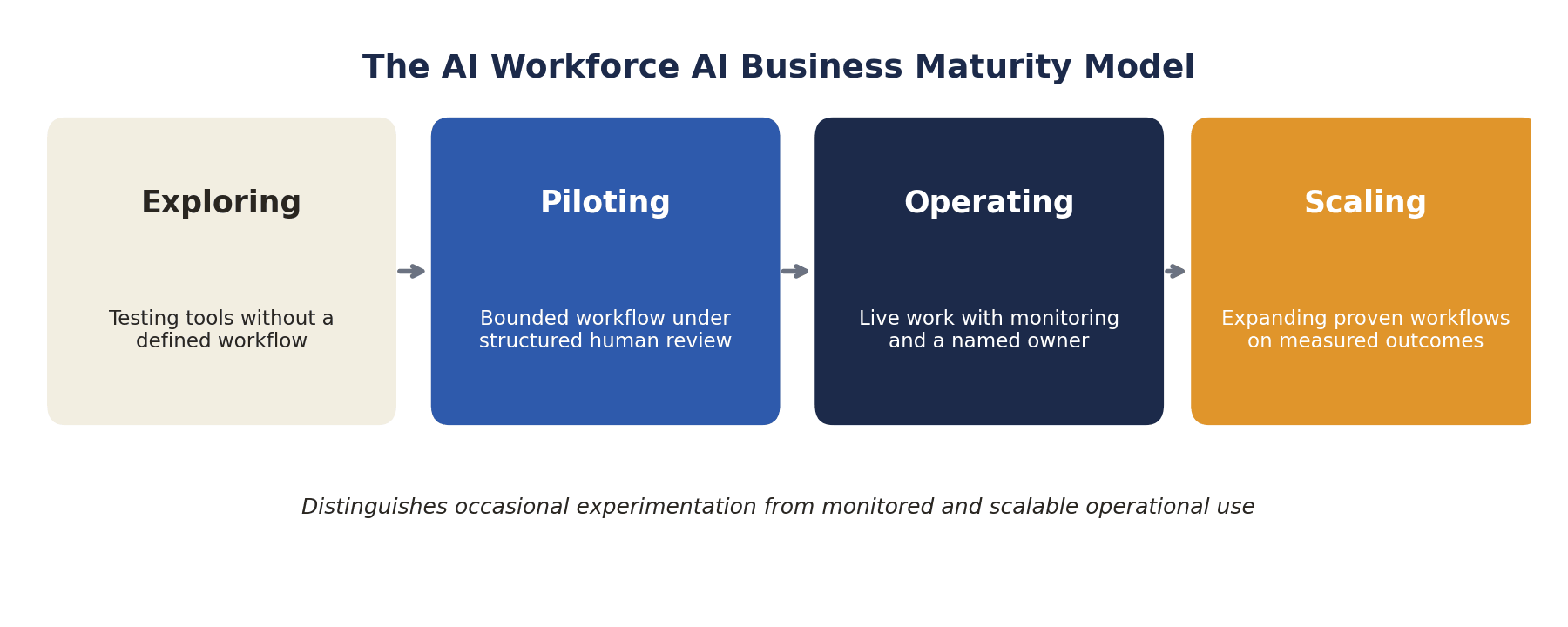
The AI Workforce AI Business Maturity Model distinguishes occasional experimentation from monitored and scalable operational use.
Which AI Maturity Stage Describes Your Business?
Review your data, processes, governance and implementation readiness before moving from experimentation to a live workflow.
How Widespread Is AI Adoption Across UK Business?
According to the Office for National Statistics (ONS, “Artificial intelligence in UK businesses: 2023 to 2026”, published 20 July 2026), self-reported AI use among UK businesses with 10 or more employees rose from approximately 12% in late 2023 to approximately 35% in June 2026, based on the ONS Business Insights and Conditions Survey. Adoption is uneven by size: the same release reports 28% adoption among businesses with 0-9 employees against 49% among businesses with 250 or more employees, and the Information & Communication sector leads by a wide margin, while construction lags well behind.
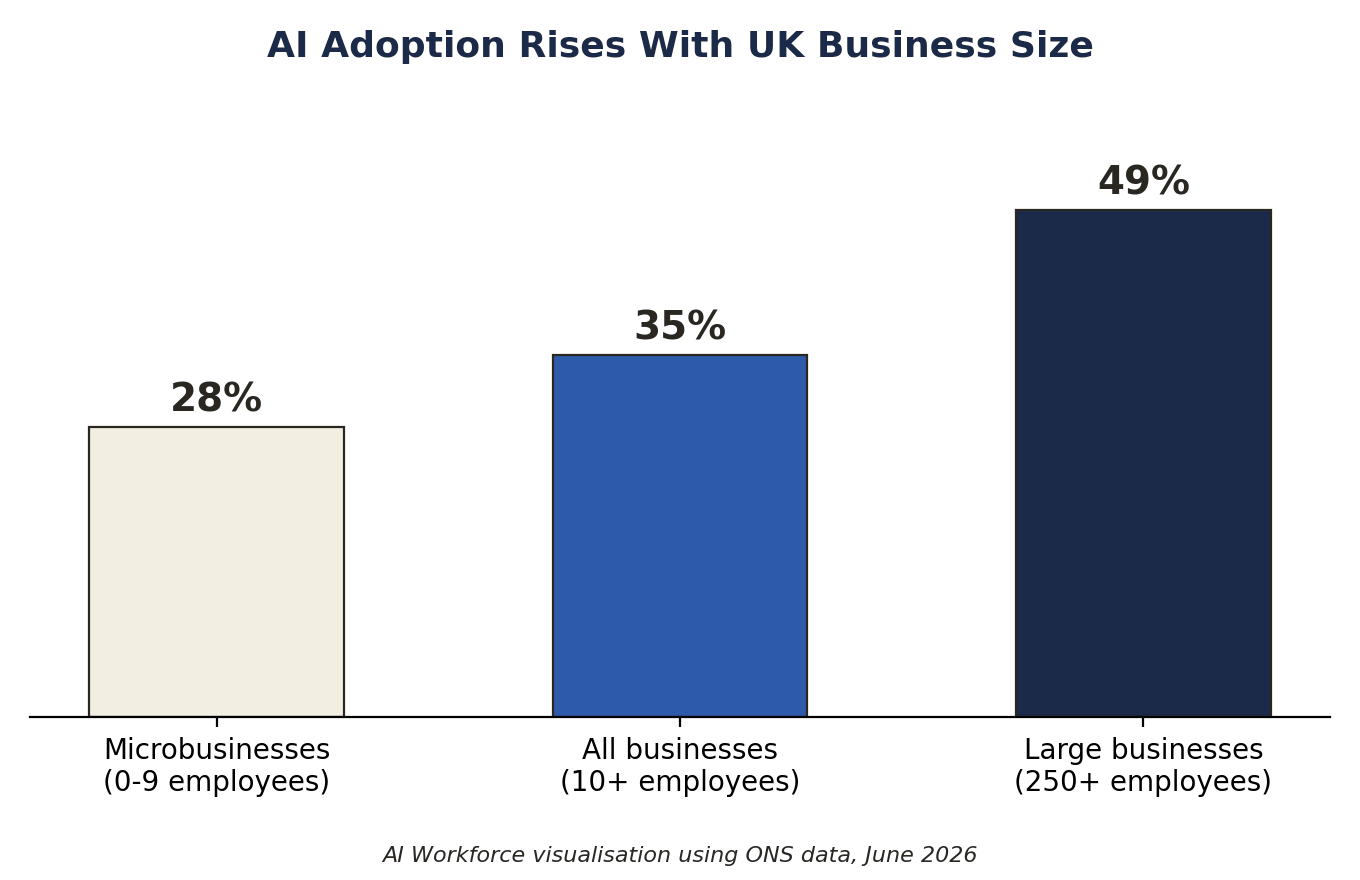
AI adoption rises with business size, although reported use does not necessarily mean operational maturity. AI Workforce visualisation using ONS data, June 2026.
The same ONS data shows adoption is widening rather than deepening: only around 10% of adopting businesses report extensive AI use, while most are trying a single application for a narrow task rather than building an AI strategy around structured, monitored workflow. Public data cannot currently tell us how many of these businesses have moved past the exploring stage described above. Smaller employers weighing up their options can find a practical starting point in guidance on AI agents for small businesses.
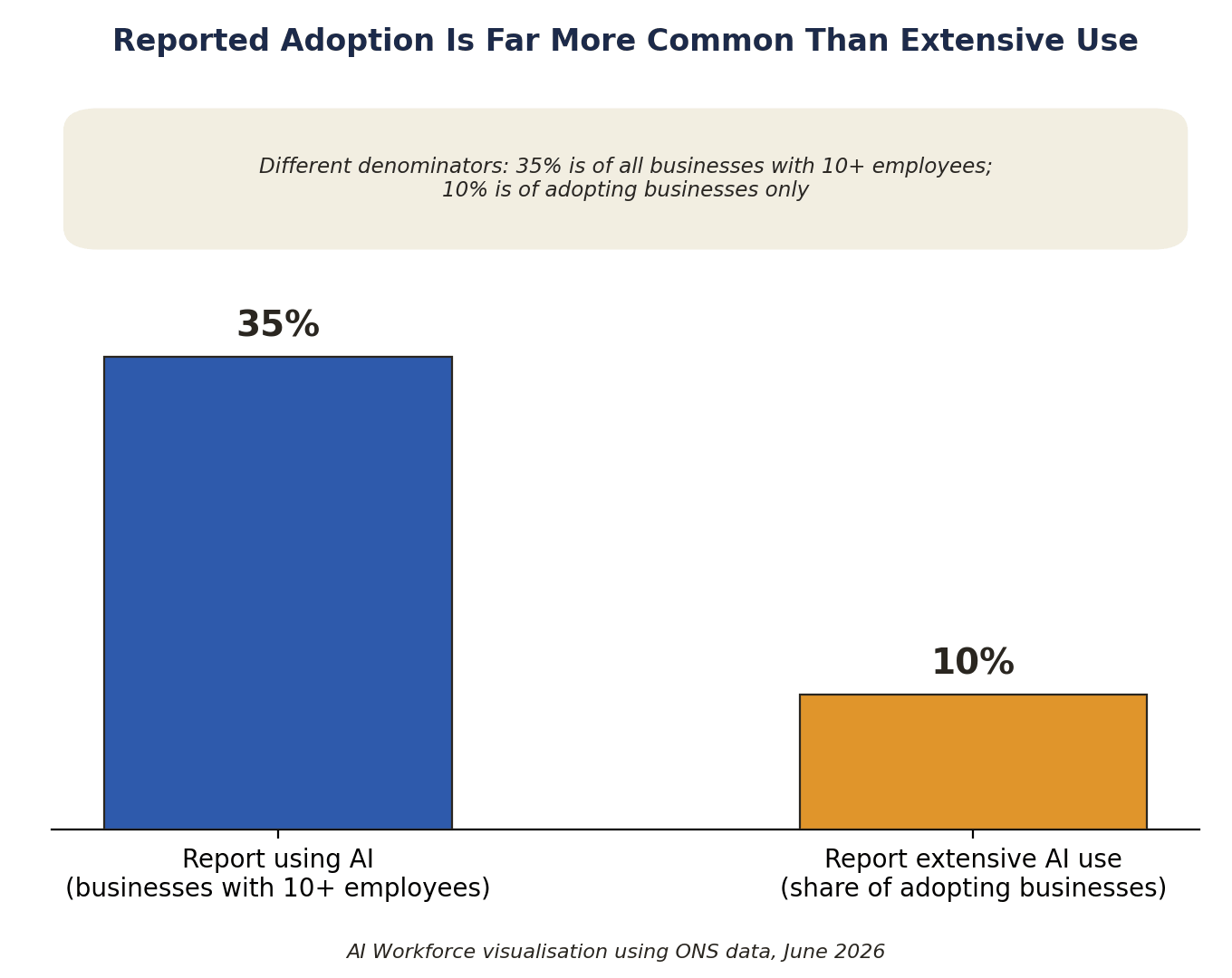
Reported adoption is considerably broader than extensive use. The 35% figure covers businesses with 10 or more employees; the 10% figure is the share of adopting businesses reporting extensive use.
What Does the 2026 AI Jobs Barometer Reveal About the UK Job Market?
PwC's 2026 AI Jobs Barometer, based on analysis of more than a billion job adverts globally, found that specialist AI job postings in the UK rose 61% year-on-year, moving from around 112,000 in 2024 to roughly 180,000 in 2025, even as overall UK vacancies fell by 6.6% over the same period. Specialist AI roles accounted for approximately 2.2% of UK job postings in PwC's analysis, up from 1.3% a year earlier.
The same barometer found the average wage premium for workers with demonstrable AI skills roughly tripled, from around 11% in 2024 to 34.2% in 2025, reaching considerably higher in consumer-facing sectors. Most of this growth is coming from roles applying AI within an existing job rather than building the underlying systems, which PwC found grew far faster than specialist AI research and development roles. Businesses hiring for these roles are increasingly asking what good AI implementation looks like in practice, which is why a clear AI agent brief matters before any project starts.
Which Sectors Are Attracting the Most AI Investment?
A joint Bank of England and FCA survey, published November 2024, found 75% of responding regulated financial-services firms were already using AI in some form, up from 58% in the equivalent 2022 survey, with a further 10% planning adoption within three years. These figures describe the survey's respondent pool of regulated firms, not the whole UK financial-services sector or wider economy. The same survey found fully autonomous decision-making remained rare, at 2% of use cases, indicating firms are keeping most AI-influenced decisions under human oversight so far.
Government-reported private investment has averaged around £200 million a day since mid-2024, according to a UK government announcement dated January 2025 and updated July 2026, with tens of billions of pounds in new data-centre commitments announced since the launch of the AI Opportunities Action Plan. This scale of funding is one reason ministers frame 2026 as a pivotal year for the UK's ambitions in AI infrastructure and research, though the government's own figures describe investment commitments rather than verified, delivered spending.
Is Productivity Actually Improving Across the UK Workforce?
Published survey evidence on productivity is more mixed than headline claims suggest. The BoE/FCA survey found perceived AI benefits, including efficiency and personalised customer experience, were expected to grow by 21% over three years against a smaller expected rise in perceived risk, but this measures sentiment among survey respondents, not independently verified output data.
Separate research on time saved, published as the Work AI Index UK 2026 by the Work AI Institute at Glean, found UK digital workers report saving an average of 12 hours a week through everyday AI use. The UK figures sit within a wider international survey of 6,000 digital workers across the US, UK and Australia, so the findings reflect digital knowledge workers specifically rather than the UK workforce as a whole. The same report found a substantial share of that saved time, around 6.3 hours, is then spent double-checking outputs, fixing errors or supplying extra context, a pattern the researchers called “bot sitting.” Taken together, these figures suggest reported productivity gains are real for some tasks but are frequently self-reported and partly offset by supervision time, rather than independently measured net gains.
What Is the UK Government Doing to Support AI Growth?
The UK government's AI Opportunities Action Plan was published in January 2025, setting out roughly 50 recommendations aimed at accelerating infrastructure, skills and adoption, alongside a target of significantly expanding the UK's public compute capacity by 2030. Government AI policy has since focused on attracting private investment, supporting data-centre construction, and encouraging sectors such as financial services and the public sector to adopt AI more consistently, based on the gov.uk investment announcement cited above.
Alongside infrastructure, the government has pushed workforce development programmes aimed at building demand for AI skills among non-specialist workers, on the reasoning that most of the near-term workforce impact will come from people applying AI within existing jobs rather than a small number of new AI-only roles.
What Are the Biggest Barriers to Growth for UK Firms?
The BoE/FCA survey found that regulatory constraints around data protection, resilience and cybersecurity were perceived as significant barriers to AI adoption in financial services, alongside talent shortages and concerns about the safety and robustness of AI models. The same survey found 46% of respondent firms reported only a partial understanding of the AI technologies they use, particularly where they relied on third-party AI providers, which points to a governance and visibility gap rather than a pure skills gap.
ONS data separately shows smaller UK businesses are markedly less likely to have adopted any AI tools than large employers, though among those that have adopted, staff tend to use the tools more intensively across their day-to-day tasks. Public data does not currently isolate cost, confidence and in-house expertise as distinct barriers for smaller firms, which is a genuine gap this benchmark cannot fill from existing sources. Understanding likely costs upfront, covered in guidance on AI automation pricing, can help smaller firms plan realistically rather than delay adoption indefinitely.
How Is the Labour Market Responding to Demand for AI Skills?
The rise in AI-related job postings documented by PwC's barometer sits alongside a labour market where overall vacancies have been falling, meaning employers are increasingly selective and experience with AI is becoming a differentiator even in postings that are not AI-specific roles.
A King's College London study, conducted with the AI Objectives Institute and published February 2026, analysed hundreds of millions of job postings across 39 countries and found occupations with a large share of AI-automatable tasks saw a 6.1% average decline in postings, but the effect depended heavily on which tasks were automated, not just how many. Where AI removed routine, lower-skilled tasks, wages for the remaining specialised work tended to rise; where AI could perform the more specialised tasks, wages fell as scarce expertise became less scarce. This research indicates the labour market effect of AI is not uniformly positive or negative, but depends on task composition within each role, a distinction general adoption statistics do not capture.
What Does the Near-Term Outlook Look Like for the UK Workforce?
Reported reductions in workforce headcount associated with AI use remain uncommon in current ONS business-survey data, with just under 7% of medium-sized businesses reporting a headcount reduction linked to AI, while roughly half report no headcount impact at all. These findings are self-reported and may change as adoption deepens.
As AI use becomes more embedded in ordinary business operations, the more defensible near-term claim is that task composition within roles is shifting gradually rather than jobs disappearing wholesale, consistent with the King's College London findings above. Whether this pattern holds through 2026 and beyond will depend on how many businesses move from the exploring and piloting stages described earlier into genuine operating and scaling use.
Practical Implications for UK Businesses
The clearest gap in current public data is the absence of any measure of operational maturity: how many businesses have moved from trying a tool to running a monitored, accountable AI workflow. Until that data exists at a representative level, any UK business benchmarking itself against national headlines should treat adoption statistics as a floor, not a ceiling, on what “using AI” can mean. For the wider evidence base, our guide to UK AI statistics brings together current UK figures on adoption, productivity, jobs, skills and investment with their original sources and data periods.
Businesses considering where they sit on the maturity curve described above may find it useful to assess their own workflows, governance and human-review processes directly, since public statistics cannot answer that question for an individual organisation. Those weighing implementation routes often ask whether to build or buy AI agents, and measuring outcomes with defined AI agent KPIs is a practical way to move from piloting to operating with confidence.
Reliable UK-wide public measures for AI-supported sales and customer-service outcomes were not identified for this edition. These are priority areas for future AI Workforce first-party research.
What Comes Next for This Benchmark
This first edition is built entirely from public, cited sources. Future editions are intended to add, in order: a first-party survey of UK SMEs using stable, repeatable questions; anonymised operational data from consenting AI Workforce clients, covering completion rates, correction rates, escalation accuracy and human-intervention levels; and, once a documented scoring methodology exists across these components, a genuine composite AI Business Index score that can be compared across editions, business sizes and sectors.
Not Sure Where Your Business Sits on the AI Maturity Curve?
AI Workforce can help you assess your current AI workflows, governance and human-review processes against the four-stage maturity model above.
Key Things to Remember
This is a benchmark built from public, cited sources, not yet a scored index; a composite score requires a documented methodology and first-party data that do not yet exist
Self-reported AI use among UK businesses with 10 or more employees rose from approximately 12% in late 2023 to approximately 35% in June 2026, although these figures do not distinguish occasional use from monitored operational use
Specialist AI job postings rose 61% year-on-year in the UK according to PwC's 2026 AI Jobs Barometer, with the average wage premium for AI skills roughly tripling between 2024 and 2025
75% of surveyed UK financial services firms reported already using AI as of the BoE/FCA 2024 survey, but only 2% of use cases involved fully autonomous decision-making
Reported time savings from AI, such as the 12 hours a week found by the Work AI Index UK 2026, are frequently offset by supervision time, so headline productivity claims should be read alongside that caveat
King's College London research found the labour market effect of AI depends on which tasks within a role are automated, not simply how exposed the role is overall
The biggest documented barriers to AI growth include regulatory uncertainty, limited understanding of third-party AI systems, and talent shortages, based on BoE/FCA survey findings
Reported reductions in workforce headcount associated with AI use remain uncommon in current ONS business-survey data, although these findings are self-reported and may change as adoption deepens
Reliable UK-wide public measures for AI-supported sales and customer-service outcomes were not identified for this edition; these are priority areas for future AI Workforce first-party research
Sources and Further Reading
Bank of England/FCA: Artificial intelligence in UK financial services 2024
UK government: UK AI sector attracts £200 million a day in private investment
King's College London: Study identifies key elements which determine impact of AI on jobs
About the Author
Seth Ayush is an AI Implementation Specialist at AI Workforce. He works with UK businesses to scope, pilot and govern AI agent deployments, with a focus on the operational evidence that separates genuine AI maturity from surface-level adoption.
About the Reviewer
Rodi Taze is Co-Founder of AI Workforce. He works with UK businesses to map AI workflows, define baselines and build practical measurement frameworks for AI adoption and performance.
Reviewed for technical and practical accuracy: August 2026.
Frequently Asked Questions
Everything you need to know about this topic
According to the Office for National Statistics (ONS, “Artificial intelligence in UK businesses: 2023 to 2026”, published 20 July 2026), self-reported AI use among UK businesses with 10 or more employees rose from approximately 12% in late 2023 to approximately 35% in June 2026, based on the ONS Business Insights and Conditions Survey. Adoption is uneven by size: the same release reports 28% adoption among businesses with 0-9 employees against 49% among businesses with 250 or more employees, and the Information & Communication sector leads by a wide margin, while construction lags well behind. AI adoption rises with business size, although reported use does not necessarily mean operational maturity. AI Workforce visualisation using ONS data, June 2026. The same ONS data shows adoption is widening rather than deepening: only around 10% of adopting businesses report extensive AI use, while most are trying a single application for a narrow task rather than building an AI strategy around structured, monitored workflow. Public data cannot currently tell us how many of these businesses have moved past the exploring stage described above. Smaller employers weighing up their options can find a practical starting point in guidance on AI agents for small businesses. Reported adoption is considerably broader than extensive use. The 35% figure covers businesses with 10 or more employees; the 10% figure is the share of adopting businesses reporting extensive use.
PwC's 2026 AI Jobs Barometer, based on analysis of more than a billion job adverts globally, found that specialist AI job postings in the UK rose 61% year-on-year, moving from around 112,000 in 2024 to roughly 180,000 in 2025, even as overall UK vacancies fell by 6.6% over the same period. Specialist AI roles accounted for approximately 2.2% of UK job postings in PwC's analysis, up from 1.3% a year earlier. The same barometer found the average wage premium for workers with demonstrable AI skills roughly tripled, from around 11% in 2024 to 34.2% in 2025, reaching considerably higher in consumer-facing sectors. Most of this growth is coming from roles applying AI within an existing job rather than building the underlying systems, which PwC found grew far faster than specialist AI research and development roles. Businesses hiring for these roles are increasingly asking what good AI implementation looks like in practice, which is why a clear AI agent brief matters before any project starts.
A joint Bank of England and FCA survey, published November 2024, found 75% of responding regulated financial-services firms were already using AI in some form, up from 58% in the equivalent 2022 survey, with a further 10% planning adoption within three years. These figures describe the survey's respondent pool of regulated firms, not the whole UK financial-services sector or wider economy. The same survey found fully autonomous decision-making remained rare, at 2% of use cases, indicating firms are keeping most AI-influenced decisions under human oversight so far. Government-reported private investment has averaged around £200 million a day since mid-2024, according to a UK government announcement dated January 2025 and updated July 2026, with tens of billions of pounds in new data-centre commitments announced since the launch of the AI Opportunities Action Plan. This scale of funding is one reason ministers frame 2026 as a pivotal year for the UK's ambitions in AI infrastructure and research, though the government's own figures describe investment commitments rather than verified, delivered spending.
Published survey evidence on productivity is more mixed than headline claims suggest. The BoE/FCA survey found perceived AI benefits, including efficiency and personalised customer experience, were expected to grow by 21% over three years against a smaller expected rise in perceived risk, but this measures sentiment among survey respondents, not independently verified output data. Separate research on time saved, published as the Work AI Index UK 2026 by the Work AI Institute at Glean, found UK digital workers report saving an average of 12 hours a week through everyday AI use. The UK figures sit within a wider international survey of 6,000 digital workers across the US, UK and Australia, so the findings reflect digital knowledge workers specifically rather than the UK workforce as a whole. The same report found a substantial share of that saved time, around 6.3 hours, is then spent double-checking outputs, fixing errors or supplying extra context, a pattern the researchers called “bot sitting.” Taken together, these figures suggest reported productivity gains are real for some tasks but are frequently self-reported and partly offset by supervision time, rather than independently measured net gains.
The UK government's AI Opportunities Action Plan was published in January 2025, setting out roughly 50 recommendations aimed at accelerating infrastructure, skills and adoption, alongside a target of significantly expanding the UK's public compute capacity by 2030. Government AI policy has since focused on attracting private investment, supporting data-centre construction, and encouraging sectors such as financial services and the public sector to adopt AI more consistently, based on the gov.uk investment announcement cited above. Alongside infrastructure, the government has pushed workforce development programmes aimed at building demand for AI skills among non-specialist workers, on the reasoning that most of the near-term workforce impact will come from people applying AI within existing jobs rather than a small number of new AI-only roles.
The BoE/FCA survey found that regulatory constraints around data protection, resilience and cybersecurity were perceived as significant barriers to AI adoption in financial services, alongside talent shortages and concerns about the safety and robustness of AI models. The same survey found 46% of respondent firms reported only a partial understanding of the AI technologies they use, particularly where they relied on third-party AI providers, which points to a governance and visibility gap rather than a pure skills gap. ONS data separately shows smaller UK businesses are markedly less likely to have adopted any AI tools than large employers, though among those that have adopted, staff tend to use the tools more intensively across their day-to-day tasks. Public data does not currently isolate cost, confidence and in-house expertise as distinct barriers for smaller firms, which is a genuine gap this benchmark cannot fill from existing sources. Understanding likely costs upfront, covered in guidance on AI automation pricing, can help smaller firms plan realistically rather than delay adoption indefinitely.
The rise in AI-related job postings documented by PwC's barometer sits alongside a labour market where overall vacancies have been falling, meaning employers are increasingly selective and experience with AI is becoming a differentiator even in postings that are not AI-specific roles. A King's College London study, conducted with the AI Objectives Institute and published February 2026, analysed hundreds of millions of job postings across 39 countries and found occupations with a large share of AI-automatable tasks saw a 6.1% average decline in postings, but the effect depended heavily on which tasks were automated, not just how many. Where AI removed routine, lower-skilled tasks, wages for the remaining specialised work tended to rise; where AI could perform the more specialised tasks, wages fell as scarce expertise became less scarce. This research indicates the labour market effect of AI is not uniformly positive or negative, but depends on task composition within each role, a distinction general adoption statistics do not capture.
Reported reductions in workforce headcount associated with AI use remain uncommon in current ONS business-survey data, with just under 7% of medium-sized businesses reporting a headcount reduction linked to AI, while roughly half report no headcount impact at all. These findings are self-reported and may change as adoption deepens. As AI use becomes more embedded in ordinary business operations, the more defensible near-term claim is that task composition within roles is shifting gradually rather than jobs disappearing wholesale, consistent with the King's College London findings above. Whether this pattern holds through 2026 and beyond will depend on how many businesses move from the exploring and piloting stages described earlier into genuine operating and scaling use.