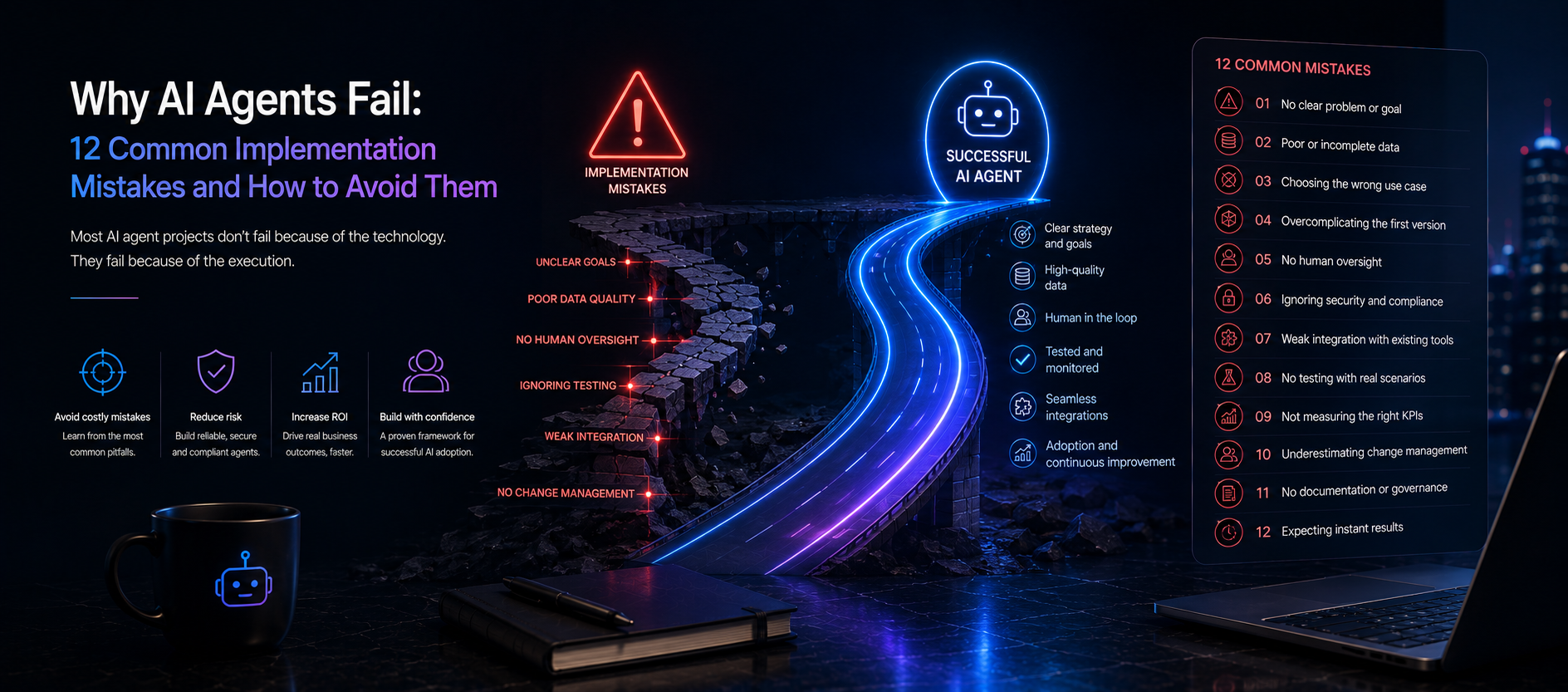
Why AI Agents Fail: 12 Common Implementation Mistakes and How to Avoid Them
Posted On: August 18, 2026
Last updated: August 2026 · Written by Seth Ayush, AI Implementation Specialist at AI Workforce · Reviewed by Rodi Taze, Co-Founder of AI Workforce
Each stage between pilot and production is a point where an implementation mistake can surface.
AI agents rarely fail because of one dramatic technical defect. More often, they fail because the business chose the wrong task, provided unreliable data, granted too much autonomy, skipped realistic testing or launched without clear ownership. Unlike a single-prompt chatbot, an AI agent completes multi-step tasks using tools and business systems with limited human input, which is exactly why these implementation decisions carry so much weight. When an agent is packaged around an ongoing business role, with defined responsibilities, permissions and human oversight, vendors may describe it as an AI employee. Our guide to what an AI employee is explains role-based framing and how it differs from the underlying AI agent technology. These 12 implementation mistakes explain why promising AI agent pilots break down in production, and what businesses can do to prevent them. This article is worth reading before your next agent deployment, not after something has already gone wrong in front of a customer.
Quick answer: AI agents often fail in production because implementation discipline is missing, even when the underlying model is capable enough for the intended task. The 12 most common mistakes are: an undefined business outcome, automating a broken process, choosing the wrong use case or risk level, an overcomplicated multi-agent architecture, poor data and weak grounding, excessive autonomy granted too early, unvalidated tool calls and integrations, ignored context and memory limits, testing the demo instead of the real workflow, launching without observability, weak human handoffs, and treating deployment as the finish line rather than the start of ongoing operation.
The AI Workforce 12-Mistake Framework: AI agent failures can be reduced by addressing four implementation stages: choosing the right task, designing the agent safely, testing the real workflow, and operating the agent after launch.
Stage | Mistakes |
|---|---|
Select | Outcome, process and risk level |
Design | Architecture, grounding, autonomy, tools and context |
Test | Realistic workflow evaluation |
Operate | Observability, handoffs and ongoing ownership |
The AI Workforce 12-Mistake Framework: the implementation risks to address when selecting, designing, testing and operating an AI agent.
The Five Failure Symptoms and Their Implementation Causes
Before working through the 12 mistakes in detail, it helps to see how the visible symptoms of agent failure map back to their underlying implementation cause. A team that only treats the symptom, without fixing the mistake behind it, tends to see the same failure return in a different form a few weeks later.
Failure symptom | Likely implementation cause |
|---|---|
Hallucinated answer | Weak grounding or missing data validation |
Cascading error across steps | Unvalidated handoff in a multi-agent system |
Lost or contradicted instructions | Poor context and memory design |
Incorrect system action | Weak tool call validation or excessive permissions |
Silent production degradation | Missing monitoring and named ownership |
The 12 Implementation Mistakes at a Glance
# | Mistake | What it looks like in practice |
|---|---|---|
1 | No clearly defined business outcome | Nobody can say what the agent is meant to achieve or how success is measured |
2 | Automating a broken process | The agent executes existing confusion faster and at greater scale |
3 | Wrong use case or risk level | The first deployment touches payments, refunds or regulated advice |
4 | Overcomplicated multi-agent architecture | Several agents hand work to each other with no validation between steps |
5 | Poor data or weak grounding | Outputs are not checked against approved sources before they are used |
6 | Too much autonomy too early | The agent can send messages, edit records or move money with no review |
7 | Unvalidated tool calls and integrations | Wrong tool selection, malformed parameters or unconfirmed actions |
8 | Ignored context and memory limits | The agent loses track of earlier instructions as a task grows longer |
9 | Testing the demo, not the real workflow | Clean prompts pass; messy, real-world inputs were never tried |
10 | No observability or audit trail | Nobody can reconstruct what the agent actually did after something goes wrong |
11 | Weak human handoffs and escalation rules | The agent does not know when to stop, and handoffs lose context |
12 | Treating deployment as the end of the project | Nobody owns the agent once it is live, so drift goes unnoticed |
1. Starting Without a Clearly Defined Business Outcome
The most common implementation mistake happens before a single line of a system prompt is written: deploying an agent without specifying the task it owns, what a successful outcome means, which KPI will measure it, and what the existing human baseline actually is. Without this, there is no way to tell whether the agent is genuinely working or simply producing outputs that look busy.
Teams that skip this step tend to discover the gap only when someone in leadership asks whether the agent is actually paying for itself, and nobody has an answer grounded in evidence. A defined AI agent KPI framework, covering an outcome measure, a quality measure, a cost measure and a risk guardrail, gives the project something concrete to be measured against from day one rather than retrofitted after launch.
AI Workforce insight: in our experience, the projects that struggle most are rarely held back by model quality. They are held back by a business that never agreed, in writing, on what the agent was actually meant to achieve. Our wider guide to AI agents for small businesses covers how to identify the right first use case before this mistake becomes a problem.
2. Automating a Broken or Poorly Understood Process
An AI agent will not repair unclear responsibilities, inconsistent data entry or unnecessary workflow steps. It will simply execute the broken process faster and at greater scale, which tends to make an existing problem more visible rather than less. Automating chaos does not produce order; it produces chaos at a higher volume, delivered with more confidence than the manual version ever had.
Process mapping before implementation is not a bureaucratic formality. Documenting how a task is actually done today, by whom, and what a good outcome looks like, surfaces the inconsistencies an agent would otherwise inherit silently. A workflow that varies depending on who is doing it is not ready to be automated until that variation has been resolved or deliberately narrowed. An AI Readiness Assessment is a practical way to check whether a process is documented and consistent enough to automate before committing to a build.
3. Choosing the Wrong Use Case or Risk Level
Businesses often choose a highly visible or highly consequential workflow for their first deployment, reasoning that a bigger win justifies the investment. This is usually the wrong instinct. Early agents should normally begin with bounded, repeatable and reversible tasks rather than payments, regulated advice or consequential customer decisions, where a mistake is expensive and hard to undo. A bounded role such as an AI receptionist can be a practical starting point when its approved answers, transfer rules and escalation boundaries are clearly defined, whereas payments, regulated advice and irreversible account changes normally require much tighter controls.
A lower-risk starting point still delivers a genuine, measurable result, and it gives the team a controlled environment to learn how the agent actually behaves against real inputs before expanding its scope. Businesses that start with a customer-facing, high-stakes workflow tend to discover their agent's limitations in the worst possible setting: in front of the customer, with no fallback ready. A written AI agent brief is a useful forcing function here, since it requires the scope, permissions and risk level to be agreed before the build starts rather than negotiated after something has already gone wrong.
4. Using an Overcomplicated Multi-Agent Architecture
A multi-agent system introduces additional handoffs, additional failure points, more latency, higher cost and considerably more debugging complexity than a single agent doing the same work. More complex architectures also increase model, integration, monitoring and maintenance costs, which should be included when calculating the full cost of an AI agent rather than assumed away at the design stage. It is tempting to assume that splitting a task across several specialised agents makes the system more robust, since each agent has a narrower job, but that is not automatically true. Many workflows remain more reliable with one agent paired with deterministic tools than with several agents passing work between each other.
When a small error occurs in one step of a chain, the next agent typically treats that output as reliable input and continues from there. The error does not stay contained; it moves downstream, and by the time it surfaces, several agents may already have acted on flawed information. Where a genuinely complex workflow does need more than one agent, every handoff between them needs its own validation step, not an assumption that a completed step is automatically a correct one. Deciding whether to build or buy an AI agent is worth doing before architecture decisions like this one, since it changes how much of this complexity your team is responsible for maintaining.
5. Giving the Agent Poor Data or Weak Grounding
Hallucination, where an agent produces a confident, well-formed output that is simply wrong, is one of the most visible causes of agent failure. But the underlying implementation mistake is not that hallucination exists; no current model eliminates it entirely. The mistake is allowing a generated claim or decision to proceed without approved sources, retrieval controls, data validation, citations, or review before a consequential action is taken.
A hallucinated fact early in a chain of decisions can shape everything that follows: a drafted response, an updated record, a triggered follow-up action, all built on a single incorrect output that nobody caught. Grounding responses in verified source data and adding review checkpoints before high-consequence actions execute reduces the chance that a single wrong answer becomes a costly mistake that reaches a customer or a financial system. Where the agent handles personal data, the ICO's guidance on AI and data protection is a useful reference for what counts as an appropriate accuracy and validation standard before an automated action is taken.
6. Granting Too Much Autonomy Too Early
Autonomy should expand in step with evidence, not with enthusiasm. An agent that is trusted from day one to send messages, edit customer records, issue refunds, create or cancel appointments, move money or delete information carries a blast radius that most businesses have not actually tested for. The permissions an agent holds should always be a deliberate decision, not a default setting left unexamined.
Staged permissions, human approval for higher-consequence actions, and a preference for reversible actions over irreversible ones give a business room to catch a mistake before it reaches a customer. Expanding autonomy should be a decision earned through a documented pilot with a clean track record, not something granted on the assumption that the agent will probably be fine. OpenAI's practical guide to building agents makes a similar point, recommending that human-intervention thresholds be treated as a first-class design decision rather than an afterthought.
7. Failing to Validate Tool Calls and System Integrations
An agent that calls the wrong tool, passes malformed parameters, or misinterprets what a tool call actually returned can fail in ways that look nothing like a typical software bug. Wrong tool selection, changed API responses, timeouts, duplicate actions and partial workflow completion all sit under this mistake, and each one needs its own check rather than being lumped together as a vague integration problem.
One distinction matters more than any other here: the difference between an agent attempting an action and confirming that it actually succeeded. An agent that sends a request to update a record has not necessarily updated the record; a downstream failure, a timeout or a malformed response can leave the agent believing an action succeeded when it did not. Validating outcomes, not just validating that a call was made, is what closes this gap.
A small AI agent error becomes a production incident when downstream handoffs and actions are not validated.
8. Ignoring Context, Memory and Instruction Limits
Every model has a finite context window, and agents can lose track of earlier instructions as a task grows longer, dropping something important to make room for new information. This is a real and common implementation mistake, but it is not the only cause of an agent losing coherence partway through a task. Context failures can also come from poor retrieval, irrelevant history being carried forward, conflicting instructions accumulated over a long conversation, or weak summarisation that drops the wrong details.
Deliberate context management, deciding what stays in the working context and what gets summarised, discarded or retrieved only when needed, addresses this directly. Teams handling longer or more complex agent tasks generally find that disciplined context and memory design, not simply switching to a model with a larger window, is what keeps an agent coherent as a task grows.
9. Testing the Demo Instead of the Real Workflow
This is one of the most consequential mistakes on this list, and one of the easiest to make without noticing. A demo built around a handful of clean prompts tells a team almost nothing about how an agent will behave against the messy, unpredictable inputs a real workflow eventually produces. Missing edge cases, no adversarial testing, no representative evaluation set, and no comparison against the existing manual process all mean the same thing: the agent has been tested against an easier problem than the one it will actually face.
Moving directly from a promising prototype to full production, without an intermediate stage where the agent handles real but limited-stakes traffic under close review, is how teams end up discovering their failure modes in front of customers rather than in a controlled pilot. Testing how the agent behaves when a system it depends on fails, not just when everything works as expected, is just as important as testing the happy path.
Not Sure Whether Your AI Agent Is Ready for Production?
Use AI Workforce's readiness assessment to identify gaps in your process, data, testing, permissions and human oversight before expanding the agent's autonomy.
10. Launching Without Observability or an Audit Trail
When something goes wrong, the first question is always the same: what actually happened. Answering that requires a clear, queryable record covering the input and output of each step, the model and prompt version in use, retrieved sources, tool calls and their results, escalation decisions, human corrections, and the final business outcome. Without this record, teams are left trying to reconstruct a probabilistic system's behaviour from a single final output and a lot of guesswork.
A traditional software system usually fails in well-understood ways, with an error thrown or a stack trace pointing to the problem. An agent can fail silently, producing a technically well-formed but substantively wrong output with no exception raised anywhere. Investing in this kind of audit trail before scaling a deployment, rather than after the first serious incident, generally makes a real difference to how quickly a team can identify what actually happened, though the exact time saved depends on how detailed the existing logging already was. NIST's AI RMF Measure guidance similarly recommends objective, repeatable testing and continued monitoring once a system is in production, not just at launch.
11. Designing Weak Human Handoffs and Escalation Rules
A human-in-the-loop system can still fail even when a person is genuinely available to step in, if the handoff itself is poorly designed. This happens when the agent does not know when to stop, when escalation thresholds are vague rather than specific, when context is lost during the handoff so the person has to start over, when nobody actually owns the escalated case, or when staff over-trust the agent's summary rather than checking the underlying detail themselves.
This is one of the implementation gaps most often missing from technical discussions of agent failure, because it sits at the boundary between the system and the organisation rather than inside the model itself. A clear, specific threshold for when an agent must hand off, paired with a named person responsible for picking up that handoff and a complete summary of what the agent already established, closes most of this gap.
12. Treating Deployment as the End of the Project
An agent that works well at launch does not stay that way automatically. Model updates, prompt changes, API changes, data drift, expanding use cases and changing customer behaviour can all quietly shift how an agent performs, and none of them announces themselves. Without a named owner, a regular performance review and clear rollback or shutdown thresholds, this drift accumulates until a serious incident forces the issue. This governance discipline mirrors the NIST AI Risk Management Framework, which organises AI risk management around four ongoing functions: govern, map, measure and manage, rather than a single pre-launch checklist.
Once an agent is deployed, use a defined AI agent KPI framework to track falling accuracy, rising correction rates, missed escalations and a deteriorating cost per successful outcome, rather than waiting for a complaint to reveal that something has changed. Treating deployment as the start of an ongoing operational responsibility, not the finish line, is what separates an agent that keeps working from one that quietly degrades until somebody notices.
A Before-Deployment Checklist
Before any agent goes live, even for a limited pilot, it is worth confirming the following in writing rather than assuming they have been covered informally:
The business outcome, success definition and owning KPI are documented
The underlying process has been mapped and known inconsistencies addressed
The first use case is bounded, repeatable and reversible
Data sources are approved, and grounding and validation checks are in place
Permissions match a staged autonomy plan, not a default maximum
Every tool call has a corresponding outcome check, not just a call-succeeded check
Context and memory handling has been deliberately designed, not left to defaults
The evaluation set includes messy, adversarial and failure-mode inputs, not only clean examples
Logging captures inputs, outputs, tool calls, escalation decisions and corrections
Escalation thresholds are specific, and a named person owns escalated cases
A named owner and a review schedule exist for after launch
The architecture is no more complex than the workflow requires, and every multi-agent handoff has an explicit validation step
What to Do When an Agent Fails
When a failure happens despite this preparation, the response matters as much as the original design. Start by isolating which of the 12 mistakes is the likely root cause, using the audit trail rather than guesswork, and confirm whether the failure was isolated or part of a wider pattern. Correct the specific case if it reached a customer or a business record, then decide whether the agent should continue operating, operate with tighter restrictions, or pause on the affected task type while the underlying cause is fixed.
Every genuine failure is also useful evidence. Feeding it back into the evaluation set, adjusting the relevant guardrail, and re-running the evaluation before restoring full autonomy is what prevents the same mistake from recurring in a slightly different form a few weeks later.
Building an AI Agent for Production?
AI Workforce can help you scope, pilot and govern an AI agent deployment, so these 12 mistakes are addressed before launch, not discovered after.
Frequently Asked Questions
Do most AI agent failures come down to the model itself?
Not always. Model limitations matter, but many production failures also involve unclear outcomes, poor data, excessive autonomy, weak testing or missing ownership.
Is a multi-agent system always riskier than a single agent?
Not always, but it introduces more handoff points where an error can be missed. A single agent paired with deterministic tools is often more reliable for a workflow that does not genuinely need several specialised agents working together.
How much autonomy should a new agent have on day one?
Start with the minimum needed to complete the task, with human approval on higher-consequence actions, and expand only once a documented pilot shows a clean track record against defined guardrails.
What is the single highest-leverage fix on this list?
There is no universal single fix, but two steps have disproportionate value: define the successful business outcome before building, then test the agent against realistic, messy and failure-mode inputs before expanding its autonomy. The first tells you what the agent must achieve; the second reveals whether it can achieve it safely.
Who should own an AI agent after it goes live?
A named operational owner or team should be accountable after launch. This may include members of the build team, but ownership must extend beyond technical delivery to performance reviews, incident response, permissions, escalation and the authority to restrict or pause the agent.
Key Things to Remember
AI agents often fail because of implementation decisions surrounding the model, including unclear outcomes, weak data, excessive autonomy, unrealistic testing and missing ownership
Define the business outcome, success measure and owning KPI before deployment, not after
Automating a broken process makes the existing problem faster and larger, not better
Start with a bounded, reversible use case rather than a high-stakes first deployment
A multi-agent system adds handoffs and failure points; validate every handoff rather than assuming a completed step is a correct one
Ground outputs in approved sources and review high-consequence actions before they execute
Expand autonomy in step with evidence from a documented pilot, not by default
Validate that a tool call actually succeeded, not just that it was made
Design context and memory handling deliberately rather than leaving it to default behaviour
Test against messy, adversarial and failure-mode inputs, not only a clean demo
Log inputs, outputs, tool calls, escalations and corrections so a failure can be reconstructed
Give every agent a named owner, a review schedule, and clear rollback or shutdown thresholds
Sources and Further Reading
About the Author
Seth Ayush is an AI Implementation Specialist at AI Workforce. He works with businesses to scope, pilot and govern AI agent deployments, with a focus on the operational decisions that determine whether an agent survives contact with production.
About the Reviewer
Rodi Taze is Co-Founder of AI Workforce. He works with UK businesses to map AI workflows, define baselines and put practical KPI and governance frameworks in place before and after deployment.
Reviewed for technical and practical accuracy: August 2026.
Planning an AI agent deployment? Talk to AI Workforce about your use case.