Losing Leads? How AI Chatbots Fix Lead Management for Small Businesses
Posted On: August 16, 2026
Written by Luca Controlo, AI Adoption and Marketing Automation Lead at AI Workforce · Reviewed by Rodi Taze, Co-Founder of AI Workforce
Last updated: August 2026
Quick Answer: An AI chatbot can stop website enquiries from being ignored by acknowledging visitors and gathering initial information. However, reducing lost leads requires more than chat. A complete AI lead-management workflow captures enquiries from different channels, records them in the CRM, applies approved qualification criteria, routes them to the right person, triggers follow-ups and books the next conversation while retaining human oversight for exceptions.
At a Glance
Faster acknowledgement helps, but lead loss is usually caused by a combination of slow responses, fragmented channels, weak routing, inconsistent qualification and missed follow-ups.
A chatbot can prevent a website visitor from being ignored, but it cannot fix lead management on its own.
The AI Workforce Lead Continuity Model connects capture, qualification, CRM records, routing, follow-up and booking into one process.
UK GDPR applies when AI processes personal information for lead scoring or profiling; PECR may also apply where the workflow uses electronic marketing, telephone calls or tracking technologies.
Measuring response time, qualification rate and booking rate matters more than measuring chat volume alone.
What's Covered:Why Small Businesses Lose Leads · What Can an AI Chatbot Fix? · What Can't a Chatbot Fix on Its Own? · The AI Workforce Lead Continuity Model · How a Connected AI Lead Workflow Operates · How AI Qualification Should Work · CRM, Routing and Multi-Channel Follow-Up · Worked Example · What Should Still Go to a Person? · UK Data Protection and Direct Marketing · How to Measure Performance · Common Mistakes · FAQs · Key Takeaways
Why Small Businesses Lose Leads
There are a few key reasons a business ends up losing ground on its pipeline, and most have nothing to do with the product itself. A sluggish reply and inconsistent handling of a new lead sit at the top of the list: a message arrives through a form, a chat widget, a phone call or an email, and because no one owns that channel closely enough, it sits untouched for hours.
A common reason your business might be losing leads is the absence of a clear next step the moment someone gets in touch. There should be an obvious, repeatable action: a reply sent, a question asked, a booking link shared. Without that structure, sales teams get pulled toward other priorities and interest cools before anyone circles back. Even when demand is healthy, businesses can lose opportunities because nobody owns the next step.
The cost of losing leads rarely shows up on a spreadsheet, which is exactly why it goes unaddressed. Every unanswered message represents an opportunity that was never properly assessed. Across a quarter, these missed opportunities can represent a meaningful amount of potential pipeline, particularly where acquisition costs or average contract values are high.
A widely cited 2011 study discussed by Harvard Business Review, The Short Life of Online Sales Leads, analysed 1.25 million US sales leads across B2B and B2C companies. Businesses attempting contact within an hour were nearly seven times as likely to qualify the lead, defined as having a meaningful conversation with a decision-maker, as businesses waiting at least one additional hour. They were more than 60 times as likely to qualify it as businesses waiting at least 24 hours. The research did not measure closed revenue, was conducted in the United States, and is now historical evidence rather than a current benchmark, so it should be treated as evidence that response delay matters rather than as a guaranteed conversion multiplier. The finding suggests that a prompt attempt to contact a lead can materially improve the likelihood of reaching a meaningful sales conversation. It does not establish the likelihood of a completed sale.
Leads go cold because buying interest is time-sensitive. When a potential customer shows interest by filling in a form, they may be comparing several potential suppliers at the same time, and a slow response pushes them toward whoever answers first. Delayed responses create doubt about whether your business is still active, and by the time someone finally replies, the contact may already be talking to a rival, never going to buy from you at all, no matter how good the eventual answer turns out to be.
What Can an AI Chatbot Fix?
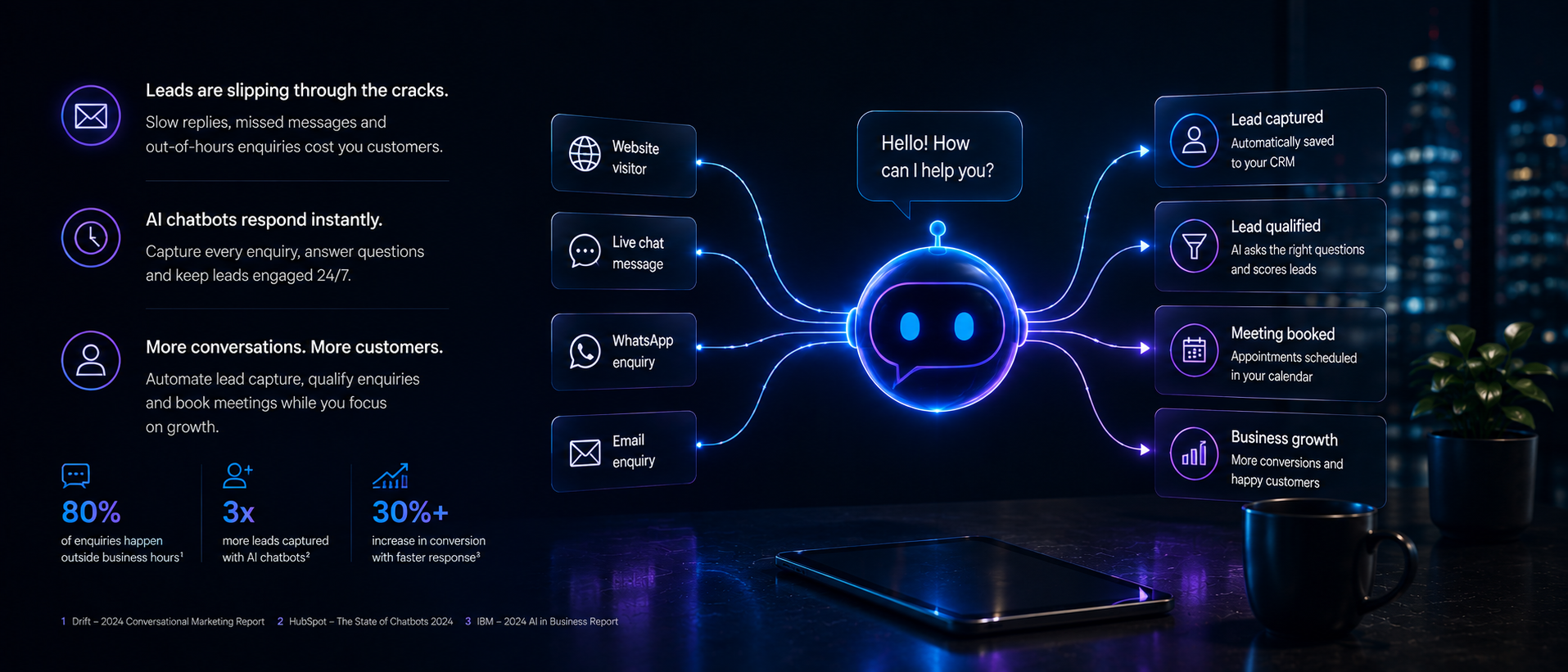
An AI chatbot replies in minutes instead of hours, which keeps a conversation alive while interest is still high. Rather than needing a free member of staff, it can greet a visitor, ask a few qualifying questions, and collect company information immediately, day or night. Website enquiries can arrive outside normal working hours, particularly where customers research suppliers in the evening or across different time zones, so this matters for lead generation more than it might first appear. For why that first-minutes window matters so much, see our guide to speed to lead response time.
Good chatbot software helps a small business stay responsive around the clock, giving the human team a head start the moment they log back on. That is a genuinely useful fix, and it is the part of the story that most articles stop at.
What Can't a Chatbot Fix on Its Own?
A chatbot can prevent a website visitor from being ignored, but it cannot fix lead management on its own. Leads also arrive through forms, email, telephone calls, LinkedIn, WhatsApp and referrals. Preventing lead loss requires a connected process that captures every enquiry, records it in the CRM, qualifies it consistently, triggers the right follow-up and gives a person enough context to continue the conversation.
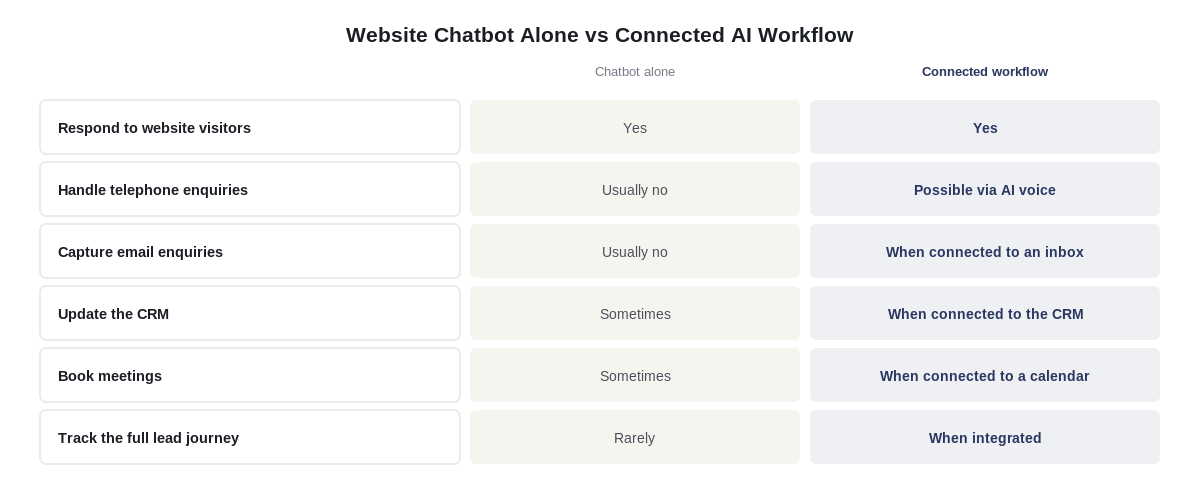
The table below sets out where a website chatbot alone reaches its limits, and where a connected workflow picks up the slack.
Capability | Website chatbot alone | Connected AI lead-management workflow |
|---|---|---|
Respond to website visitors | Yes | Yes |
Handle telephone enquiries | Usually no | Possible through AI voice or reception |
Capture email enquiries | Usually no | When connected to an inbox |
Update the CRM | Sometimes | When connected to the CRM |
Qualify consistently | Limited | Yes, using approved criteria |
Trigger follow-up | Basic | Multi-step and multi-channel |
Book meetings | Sometimes | When connected to a calendar |
Route exceptions to people | Limited | Built into the workflow |
Track the complete lead journey | Rarely | When channels and records are integrated |
The AI Workforce Lead Continuity Model
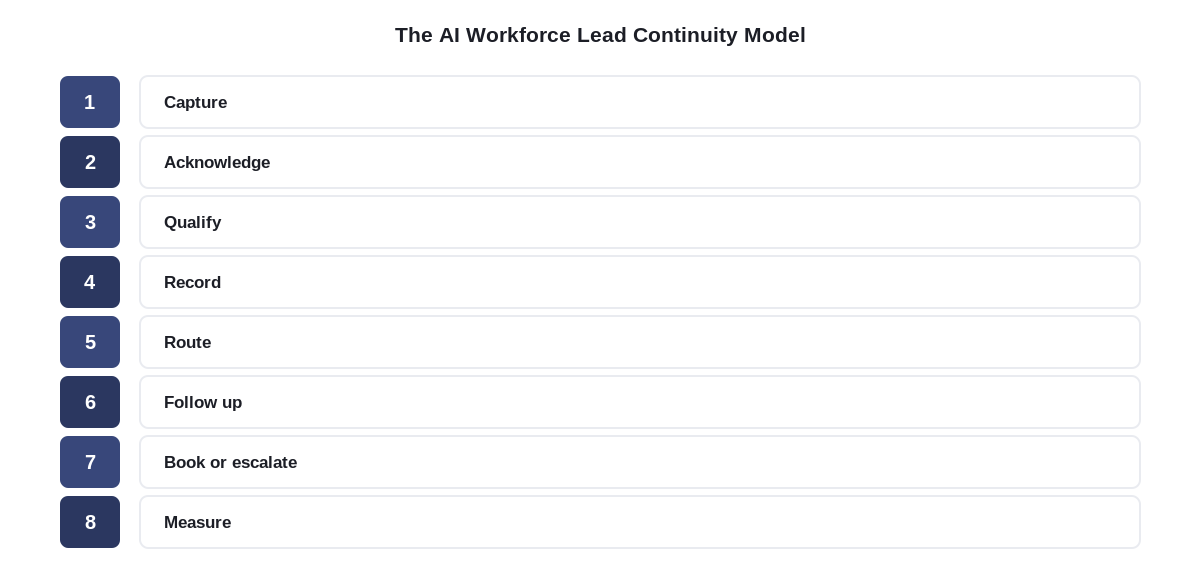
Rather than treating a chatbot as the finish line, AI Workforce structures lead handling as a connected sequence: lead arrives through any channel, AI captures it, acknowledges it, qualifies it, records it, routes it, follows up, books a meeting, and hands it to a person.
Capture: collect enquiries from chat, forms, email, calls and other approved channels.
Acknowledge: confirm receipt promptly and explain what happens next.
Qualify: gather the minimum information needed to understand intent and fit.
Record: create or update the contact and activity in the CRM.
Route: assign the lead based on urgency, service, location or value.
Follow up: trigger an approved sequence across the appropriate channels.
Book or escalate: schedule the next conversation or pass the lead to a person.
Measure: track response time, qualification, bookings, conversion and drop-off.
How a Connected AI Lead Workflow Operates
In practice, this looks like a sequence rather than a single tool. A person submits a website form, sends an email or calls the business. The system acknowledges the enquiry, and AI asks approved questions about need, location, timeframe and preferred contact method. The contact and conversation are logged in the CRM, and a suitable lead is routed to the correct person.
From there, a booking link or appointment is offered. If the lead does not respond, an approved follow-up sequence begins across the appropriate channel rather than repeating the same message. Replies, calls and outcomes are recorded so the team can see what actually happened, and complaints, unusual requests or sensitive conversations are escalated to a person rather than handled automatically.
The specific mix depends on which agents, integrations and package a business selects, and typically draws on capabilities such as B2B and B2C lead building, enriched contact data, CRM synchronisation, email and social workflows, WhatsApp or Telegram workflows where appropriate, AI voice calling, AI receptionist cover, automated meeting booking, and follow-up and activity tracking, always with human approval and escalation built in. Not every customer receives every function automatically; the final scope and cost of adding AI depend on the selected agents, usage allowances, integrations and implementation requirements.
How AI Qualification Should Work
AI qualification plays a growing role in this process, asking the right questions before a lead ever reaches a person. Instead of every message landing in one shared inbox, it can score each contact automatically, comparing signals such as budget and stated needs against a business's ideal customer profile, or ICP.
This kind of lead scoring reduces the time spent manually assessing low-fit or incomplete enquiries and puts more attention on contacts who are genuinely likely to convert, which helps the team prioritise attention without treating the score as a final decision. Without it, teams often chase the wrong contacts and watch good enquiries fail to convert simply because effort went to the wrong place first. Scoring should inform prioritisation, not silently discard leads: a low score is a reason to route differently, not a reason to ignore someone.
Not sure where your leads are slipping through the cracks?
CRM, Routing and Multi-Channel Follow-Up
A structured follow-up system is what separates businesses that convert consistently from those relying on luck. Inconsistent follow-up, where one contact gets three chasers and another gets none, is really a slow follow-up problem in disguise: clear rules for how many follow-up attempts should occur, over what timeframe, and what happens if nobody responds, need to exist before anything else works.
A CRM such as HubSpot, Salesforce, Pipedrive, Zoho or Odoo can provide the central record, but the product name matters less than whether every enquiry, response, assignment and follow-up is logged consistently. When follow-up is automated and logged inside a CRM, fewer contacts are overlooked and the team can see which enquiries progressed to qualification.
Consistent, relevant follow-up can help more captured leads progress to qualification or booking, and this is where AI earns its keep. Lead nurturing means sending a relevant follow-up based on what a contact actually asked about, and that kind of personalisation feels like genuine attention rather than automation for its own sake, which is exactly what steady lead conversion depends on. Automated routing and scheduled follow-up can help a small team manage periods of higher enquiry volume, provided exceptions and replies are reviewed, because interest is captured while it is fresh rather than left to fade. Estimating a lead's likely priority, while recognising that the estimate may be wrong, can help a small team decide where to focus first. It should not be used to exclude a contact automatically.
Worked Example: From Enquiry to Booked Meeting
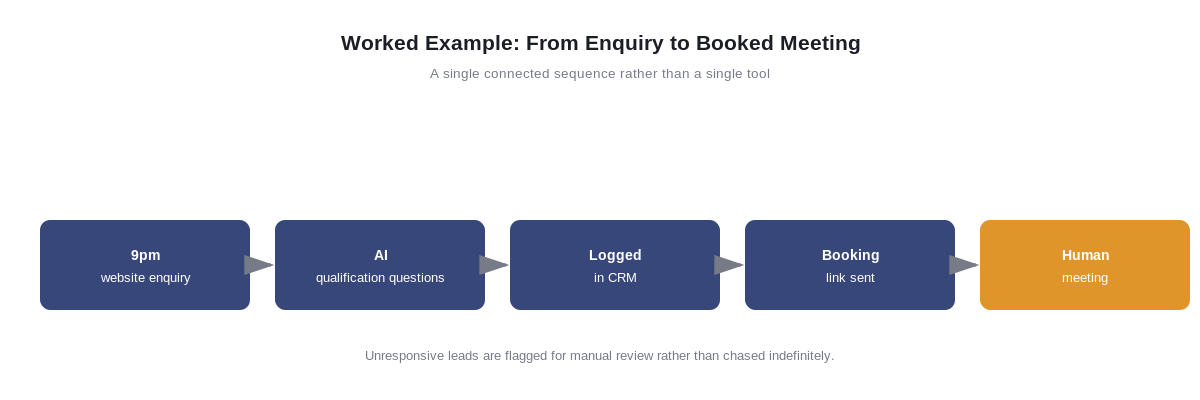
A visitor lands on a website at 9pm and asks the chatbot about pricing. The chatbot answers what it can, gathers name, company and rough requirement, and logs it as a new contact in the CRM. The next morning, the system sends a short email confirming what was discussed and offering a booking link. The lead books a 15-minute call directly. If they had not responded within two days, an approved follow-up message would have gone out on the same channel they first used, and if they still hadn't replied after a defined period, the record would sit flagged for a person to review manually rather than being chased indefinitely.
What Should Still Go to a Person?
Response time can materially affect whether a new enquiry reaches a meaningful sales conversation, but speed is not the same as good judgement. Complaints, unusual requests, high-value opportunities, anything involving a vulnerable customer, and conversations where a lead explicitly asks for a human should be routed to a person rather than kept inside the automated sequence. Businesses that automate the initial acknowledgement can prevent an enquiry from sitting unattended while the team prepares a fuller response, provided the handoff is clean and well timed.
A dependable response process can help a small business compete more effectively, especially when other suppliers respond inconsistently. Clear CTAs, fast replies, and a smooth handoff from chatbot to person build trust before a sales conversation even begins. Better response and follow-up processes can improve the proportion of leads that reach qualification or booking, but the effect should be measured against the business's own baseline rather than assumed.
UK Data Protection and Direct Marketing
UK GDPR applies whenever lead management involves processing personal information, including named contacts, conversation records and lead profiles. PECR may also apply where the workflow uses electronic marketing messages, telephone calls, cookies or similar tracking technologies. Small businesses using AI for this work therefore need to understand which rules apply to each stage of the process. The ICO says organisations using personal information to generate or profile leads must act fairly, explain the profiling, establish a lawful basis and respect objections, per its guidance on collecting information and generating leads. Where a chatbot collects personal information, it should provide or link to clear privacy information explaining how the information will be used.
What UK businesses need to check:
Explain what information is being collected and why.
Collect only what is necessary.
Establish an appropriate lawful basis.
Keep information accurate and secure.
Do not infer sensitive characteristics unnecessarily.
Explain relevant profiling clearly.
Respect objections and opt-outs.
Apply PECR to email, text, WhatsApp and telephone marketing.
Screen live marketing calls against TPS and CTPS where required.
Obtain specific consent for automated marketing calls.
Avoid rejecting or deprioritising potentially valuable leads solely because an opaque score is low.
Route sensitive, high-value or unusual enquiries to a person.
How to Measure Lead-Management Performance
A lead-management scorecard should track more than reply volume, and it's worth comparing your own figures against the broader trends covered in our AI sales statistics guide. A generic "we received your message" auto-reply is not the same as a meaningful response, so measurement needs to distinguish between the two:
Median time to first meaningful response
Percentage of leads acknowledged
Percentage successfully routed
Qualification rate
Meeting-booking rate
Lead-to-opportunity conversion
Follow-up completion rate
Human-escalation rate
Duplicate or incomplete CRM records
Opt-out and complaint rate
Cost per qualified lead
Cost per booked meeting
Common Mistakes
The most common mistakes are treating chat as the whole solution, letting a lead-scoring model quietly filter out contacts without human review, leaving follow-up rules inconsistent across the team, and never checking whether an automatic acknowledgement is actually improving qualification or booking rates rather than just reply speed.
Want to connect your lead response and follow-up properly?
Frequently Asked Questions
How quickly should a business respond to a new message?
Businesses attempting contact within an hour were nearly seven times as likely to qualify a lead as businesses waiting at least one additional hour. A chatbot can acknowledge the enquiry and collect useful information, but a generic automated confirmation should not be treated as equivalent to a meaningful sales response.
Does an AI chatbot replace human staff?
No. It can acknowledge the enquiry, gather basic details and complete an initial set of approved questions. It should then route the conversation to a person at an agreed point or whenever the enquiry falls outside the approved workflow. This preserves speed while retaining human judgement and relationship-led conversation where they matter.
What is the simplest way to improve results straight away?
A basic automated acknowledgement can close the first-response gap, but it should be tested to confirm whether it improves qualification and booking rates, not just assumed to work. Even a basic chatbot or workflow, paired with one qualifying question, is a reasonable place to start.
Key Takeaways
A sluggish reply and a missing next step are two of the biggest reasons a business loses ground on its pipeline, but fragmented channels and weak routing matter just as much.
Businesses contacting a lead within an hour were found to be nearly seven times as likely to qualify it, according to research discussed by Harvard Business Review; the study measured qualification, not closed revenue.
A chatbot can stop a website visitor from being ignored, but it cannot capture phone calls, email or WhatsApp enquiries on its own.
The AI Workforce Lead Continuity Model connects capture, acknowledgement, qualification, CRM records, routing, follow-up, booking and measurement into one process.
Lead scoring should prioritise attention, not silently discard contacts a business hasn't reviewed.
A dependable CRM and clear rules for chasing up, regardless of which platform is used, stop good contacts from disappearing quietly.
UK GDPR applies when AI processes personal information for lead management, while PECR may also apply to electronic marketing, calls, cookies and similar tracking technologies.
Measuring qualification rate, booking rate and human-escalation rate matters more than measuring reply speed alone.
Sources: Harvard Business Review: The Short Life of Online Sales Leads, 2011 (1.25 million US B2B and B2C sales leads; measured qualification, not closed revenue; historical evidence rather than a current benchmark) · Information Commissioner's Office, guidance on collecting information and generating leads
Related reading: AI Sales Agents · AI Receptionist Pricing UK · AI SDR Pricing UK · AI Sales Statistics · AI Agent Cost · AI Automation Pricing UK · AI Readiness Assessment · AI and GDPR · AI Workforce pricing
About the author: Luca Controlo is AI Adoption and Marketing Automation Lead at AI Workforce. Luca researched the lead-management workflows, response processes and multi-channel automation covered in this guide.
Reviewed by Rodi Taze, Co-Founder of AI Workforce. Rodi reviewed the sales-process assumptions, qualification boundaries and practical application of AI agents across the lead journey. Reviewed August 2026.