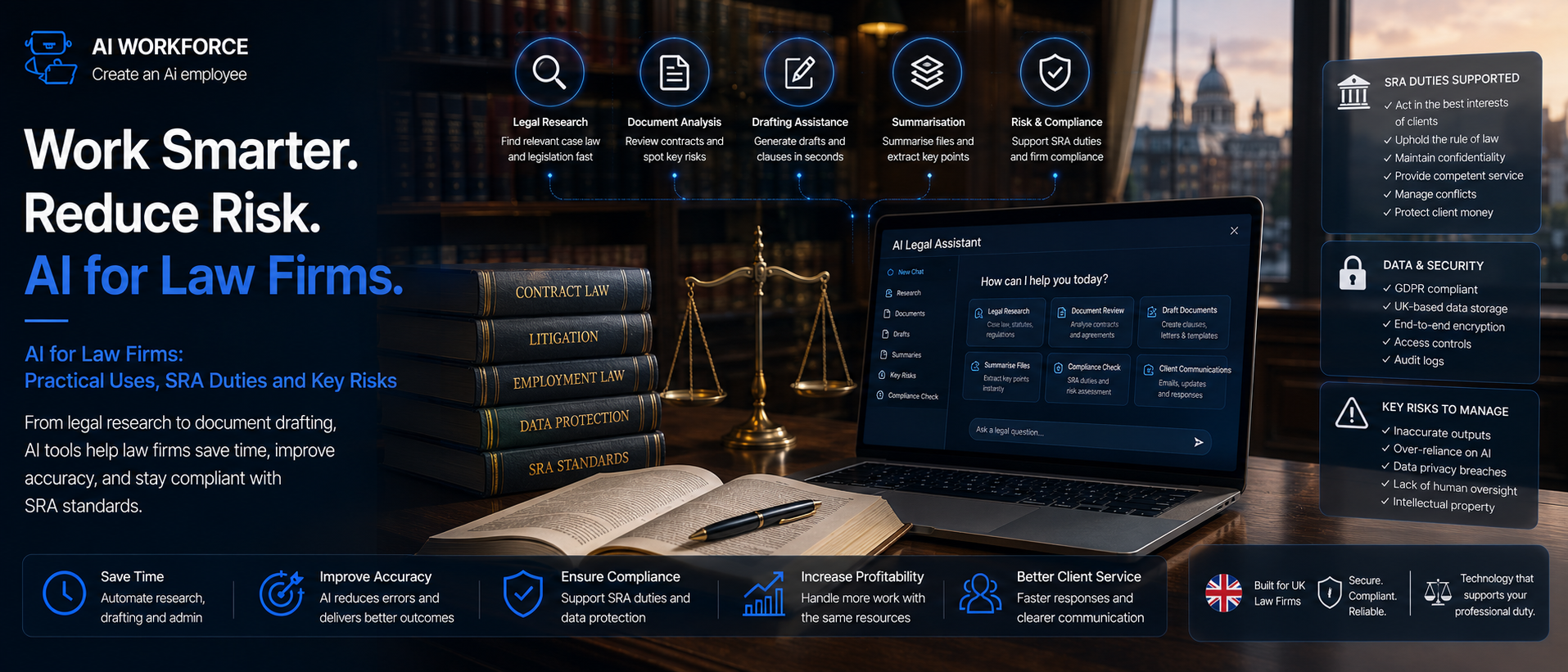
AI for Law Firms: Practical Uses, SRA Duties and Key Risks
Posted On: August 4, 2026
Written by Seth Ayush, Co-Founder of AI Workforce · Reviewed by Clara Miller, Content Marketing Specialist at AI Workforce
Last updated: August 2026
Quick answer: Can law firms use AI? Yes. UK law firms can use AI to support drafting, legal research, document review and administrative work. AI can also assist with preparing court submissions and litigation materials. Solicitors remain responsible for competence, confidentiality and professional judgement. Any AI-generated work that will be relied upon for legal analysis, filed with a court, used to advise a client or otherwise materially affect a matter should receive appropriate human verification.
At a Glance
Document summaries: suitable for AI, human review required
Contract comparison: suitable for AI, human review required
Meeting transcription: suitable for AI, light review
Legal research: suitable for AI, essential human review
Client advice: AI can draft only, essential human review
Court submissions: AI may assist with drafting or preparation, but full solicitor verification is essential before filing or reliance
What's Covered
What Does AI Mean for Modern Law Firms?
How Are Law Firms Using AI Today?
The AI Workforce Legal AI Model
What Are the Practical Use Cases by Department?
The Legal AI Boundary Matrix
What Does the SRA Expect From Firms Using AI?
What Does the SRA's AI Misuse Warning Mean for Law Firms?
How Does AI Help With Legal Research and Drafting?
Where Does AI Still Fall Short?
Where Do Firms Typically Save Time?
What About Confidentiality, Privilege and Data Protection?
Should Clients Be Told When AI Is Used?
Will AI Replace Solicitors?
What Questions Should You Ask an AI Vendor?
How Do You Create a Law Firm AI Policy?
What Records Should a Firm Keep?
How Do You Run a Safe Pilot?
AI Readiness Checklist for Law Firms
Frequently Asked Questions
Key Takeaways
What Does AI Mean for Modern Law Firms?
In a legal context, AI generally refers to tools that can read, summarise or draft text, extract information from documents, or flag patterns across a large volume of material. Generative AI, the type behind tools like ChatGPT and Copilot, gets the most attention because it can produce a first draft rather than just search or classify existing text. Much of this sits under the broader umbrella of lawtech, alongside more established document management and matter management systems.
None of this is a single technology. A firm might use one system for transcription, another for contract review, and a third for drafting client updates, each with a different risk profile and a different level of oversight required.
In our experience, firms that begin with administrative workflows, such as meeting notes, document summaries and enquiry triage, usually achieve quicker adoption than those attempting to automate legal drafting immediately. Starting with lower-risk tasks allows lawyers to become comfortable with the technology before introducing it into more complex legal workflows. Firms exploring automation beyond research and drafting can also see how AI agents for small businesses are structured around defined tasks, permissions and human escalation.
How Are Law Firms Using AI Today?
Adoption varies considerably by firm size, practice area and risk appetite. Larger firms with dedicated innovation and legal operations teams tend to pilot new tools on a single practice group before rolling them out more widely, while smaller firms are often experimenting with general-purpose tools already available to staff. The same pattern is playing out across other regulated professions, from accountants to financial advisers, where compliance concerns are shaping adoption in similar ways.
Many firms are trialling document review, contract analysis and first-draft correspondence. Some clients increasingly expect faster turnaround and more efficient service, but firms still need to protect accuracy and confidentiality while meeting that expectation.
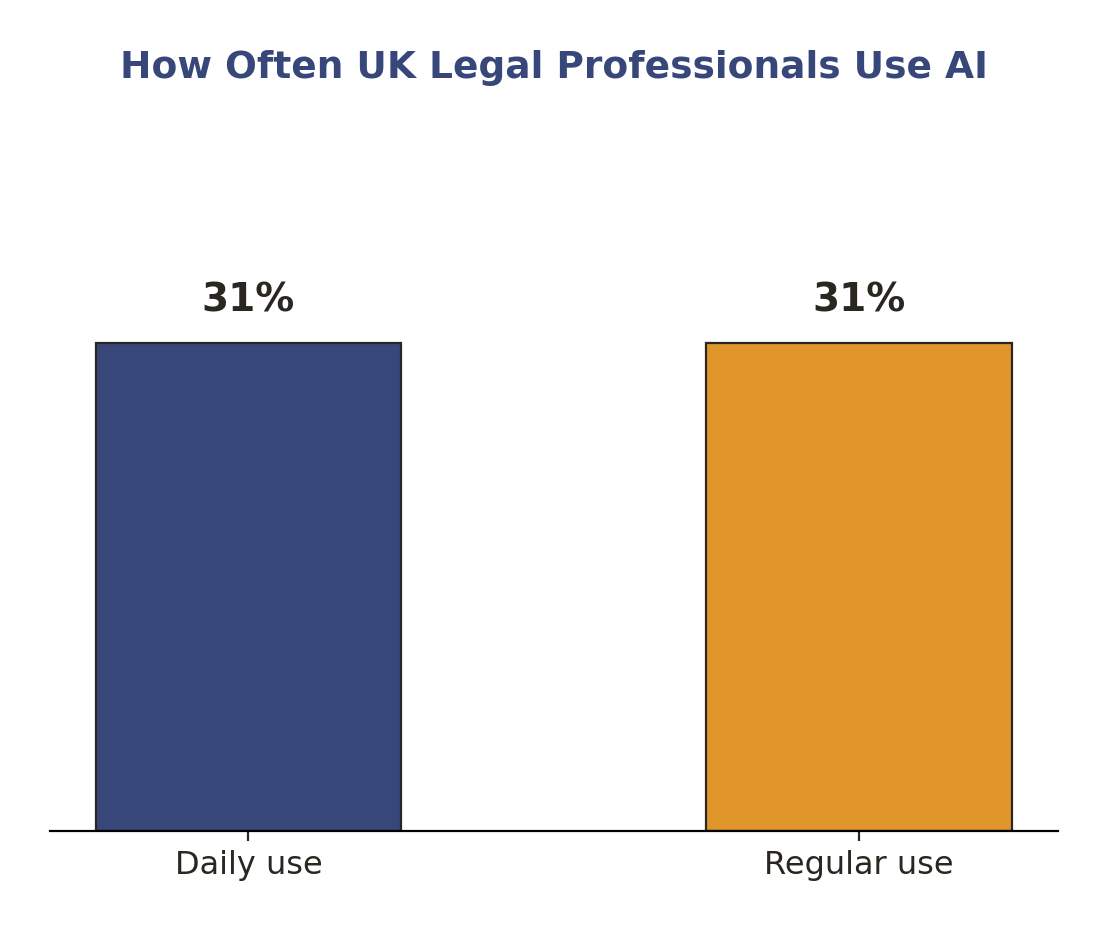
Source: Profitability in Law: Global Report 2026, LEAP Legal Software, March 2026 (survey of 700 legal professionals across six countries).
The AI Workforce Legal AI Model
Most well-run AI workflows in a law firm follow a similar underlying pattern. We call this the AI Workforce Legal AI Model, and it is a useful way to check whether a specific tool, or a specific task, is genuinely ready for AI involvement.
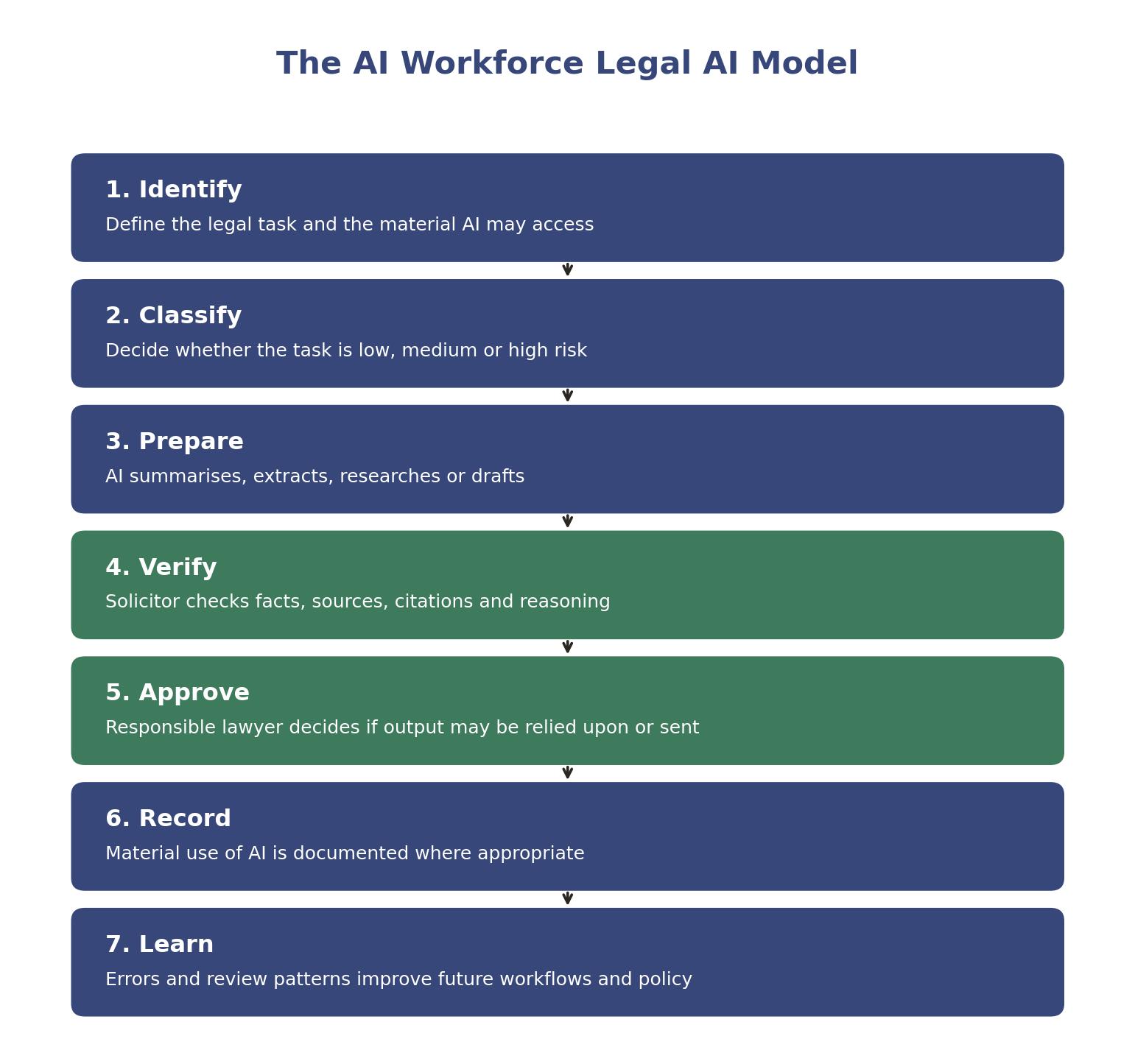
The seven stages behind a well-governed AI-assisted legal workflow.
Identify: define the legal task and the material the AI may access
Classify: decide whether the task is low, medium or high risk
Prepare: AI summarises, extracts, researches or drafts
Verify: a solicitor checks facts, sources, citations and legal reasoning
Approve: the responsible lawyer decides whether the output may be relied upon or sent
Record: material use of AI is documented where appropriate
Learn: errors and review patterns improve future workflows and policy
A workflow that jumps from Prepare straight to a client or a court, with no genuine Verify or Approve step, is one to be cautious about, regardless of how fluent the AI output reads.
This framework is an AI Workforce implementation model, not an SRA-mandated process. Firms should adapt it to their practice areas, professional obligations, clients and risk profile.
What Are the Practical Use Cases by Department?
Solicitors can use AI to assist with document summarisation, contract comparison, research, drafting, meeting notes, chronology preparation, knowledge retrieval and routine administration. AI should prepare or support the work; a solicitor should verify any output affecting advice, legal rights, court documents, regulatory interpretation or a client's matter.
The best examples of AI adoption tend to be specific to the department, not generic:
Law-firm activity | How AI can assist | Main risk | Required oversight |
|---|---|---|---|
Legal research | Find starting points and summarise authorities | Fabricated or outdated citations | Verify against authoritative sources |
Document review | Extract clauses, dates and issues | Missing context or material detail | Solicitor reviews relevant source documents |
Drafting | Prepare first drafts | Incorrect law, facts or tone | Solicitor edits and approves |
Client intake | Capture information and route enquiries | Confidentiality and incorrect classification | Human escalation for sensitive or uncertain cases |
Meeting notes | Transcribe and summarise discussions | Omissions and recording or privacy issues | Check material decisions and obtain required permissions |
Court documents | Assist with preparation | False authorities or misleading submissions | Full professional verification before filing |
Administration | Classify documents and update workflows | Incorrect routing or permissions | Audit logs and exception handling |
Client intake is one area where this plays out directly: many firms now use an AI receptionist for law firms to capture enquiry details and route them to the right fee earner, with escalation to a person for anything sensitive or unclear.
By department, the pattern holds: corporate teams lean on it for due diligence and clause comparison, employment for disciplinary summaries and policy updates, conveyancing for title summaries, litigation for chronologies and disclosure support, and private client for estate summaries.
In each case, the tool produces a first attempt, but a qualified solicitor remains responsible for checking accuracy, legal relevance and tone before anything is sent.
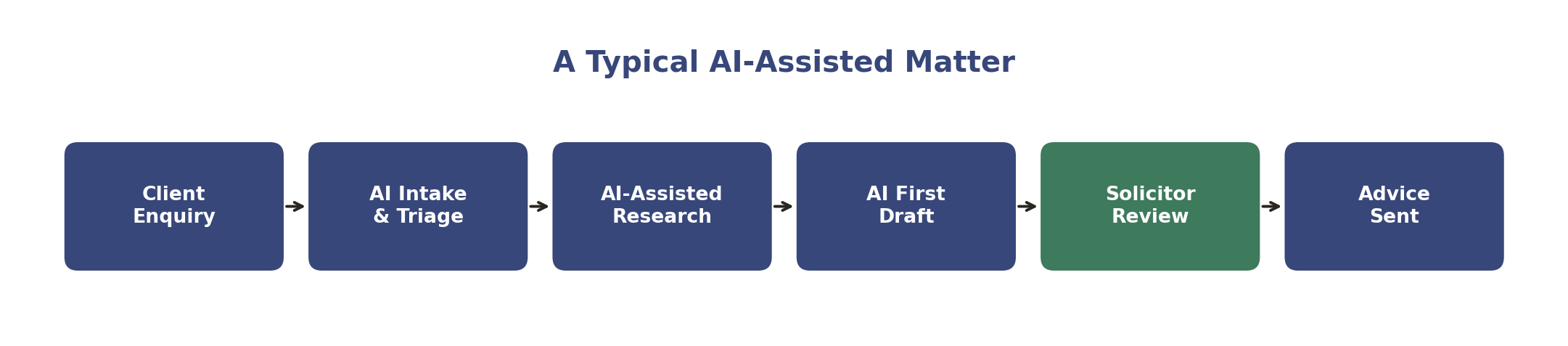
Illustrative flow across a typical matter. AI supports several stages; the solicitor review stage is never skipped.
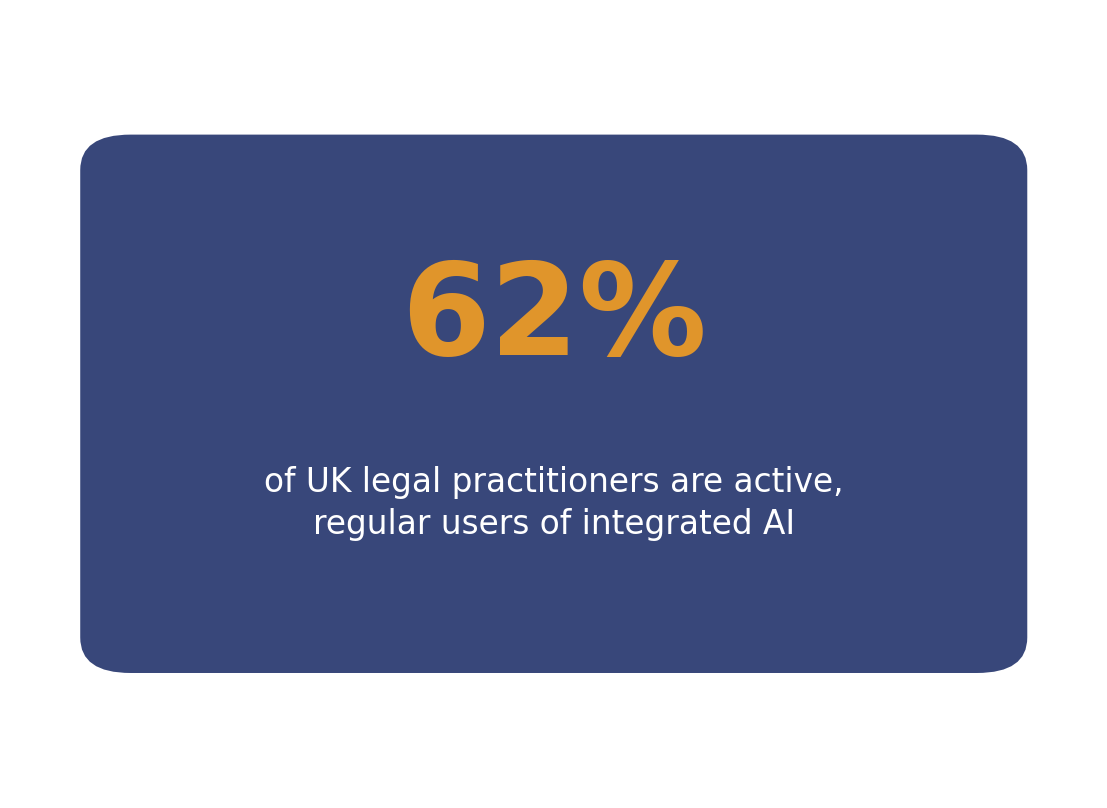
Source: Profitability in Law: Global Report 2026, LEAP Legal Software, March 2026 (survey of 700 legal professionals across six countries).
The Legal AI Boundary Matrix
Not every task in a matter carries the same level of risk, and it helps to think in terms of three tiers rather than a simple suitable or not suitable label.
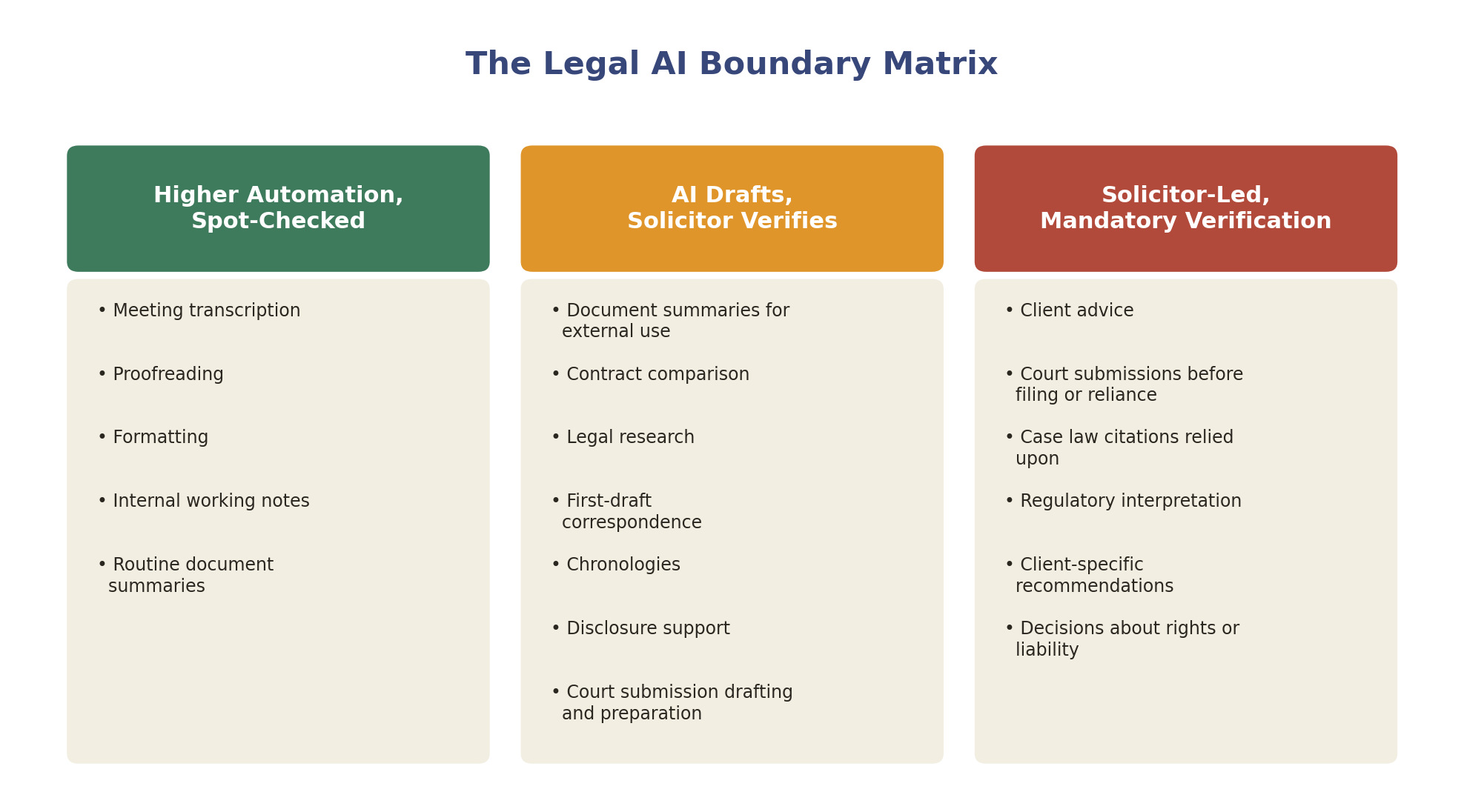
Illustrative starting point. Your own risk appetite, practice area and client base should adjust where a task sits.
Higher automation, spot-checked: meeting transcription, proofreading, formatting, internal working notes, routine document summaries
AI drafts, solicitor verifies: document summaries for external use, contract comparison, legal research, first-draft correspondence, chronologies, disclosure support, court submission drafting and preparation
Solicitor-led, mandatory verification: client advice, court submissions before filing or reliance, case law citations relied upon in any document, regulatory interpretation, client-specific recommendations, anything involving a decision about rights or liability
A task moving up a tier for a complex or high-stakes matter should be a deliberate decision, not something that happens by default because a tool technically could produce a draft.
What Does the SRA Expect From Firms Using AI?
The SRA says solicitors and firms may use technology they consider appropriate for their business, subject to its Principles and Standards, but doing so does not reduce or transfer their professional responsibilities. Its 17 August 2026 warning notice says appropriate human oversight, informed professional judgement and a proportionate, risk-based approach are essential. The SRA highlights inaccurate information, confidentiality and insufficient oversight among the principal risks.
Several distinct sources sit behind that expectation, and it's worth keeping them separate. The SRA Principles and Codes of Conduct set the underlying regulatory obligations that already apply, AI or not. The Misuse of AI warning notice, published 17 August 2026, is a formal warning explaining how those existing obligations apply specifically to AI use, and the SRA has confirmed it will have regard to the notice when exercising its regulatory functions, so it should not be treated as informal guidance. The SRA's earlier compliance tips for AI and technology offer more general practical guidance. And the AI Workforce Legal AI Model, covered above, is our own implementation recommendation for how firms can put these obligations into practice, not an SRA-mandated process.
The SRA's compliance material highlights risks including inaccurate outputs, data protection, bias, accountability and inadequate oversight. It also stresses the need for firms to understand how technology interacts with their regulatory obligations and to maintain appropriate governance around its use. In practice, that means a solicitor needs to understand a tool well enough to review its output critically, including recognising when it might be wrong.
That expectation is not theoretical. In R (Ayinde) v London Borough of Haringey [2025] EWHC 1383 (Admin), the Divisional Court dealt with grounds of claim that cited legal authorities which turned out not to exist, generated with the help of an AI tool and never checked before being filed. The court described including fictitious citations in a document put before it as an extremely serious matter capable of leading to contempt proceedings, a regulatory referral, strike-out, and a wasted costs order, and the case is now widely cited as a warning about relying on AI-generated legal research without verification.
Separately, the Civil Justice Council has consulted on whether additional rules are needed for the use of AI in court documents. Its work has considered both documents prepared by legal professionals and the particular issues surrounding witness statements. Until any resulting rules or guidance are formally adopted, legal representatives remain subject to existing professional duties and court requirements.
Sources: Solicitors Regulation Authority, Misuse of AI warning notice, 17 August 2026 · Solicitors Regulation Authority, compliance tips for solicitors regarding the use of AI and technology · Civil Justice Council, use of AI in preparing court documents
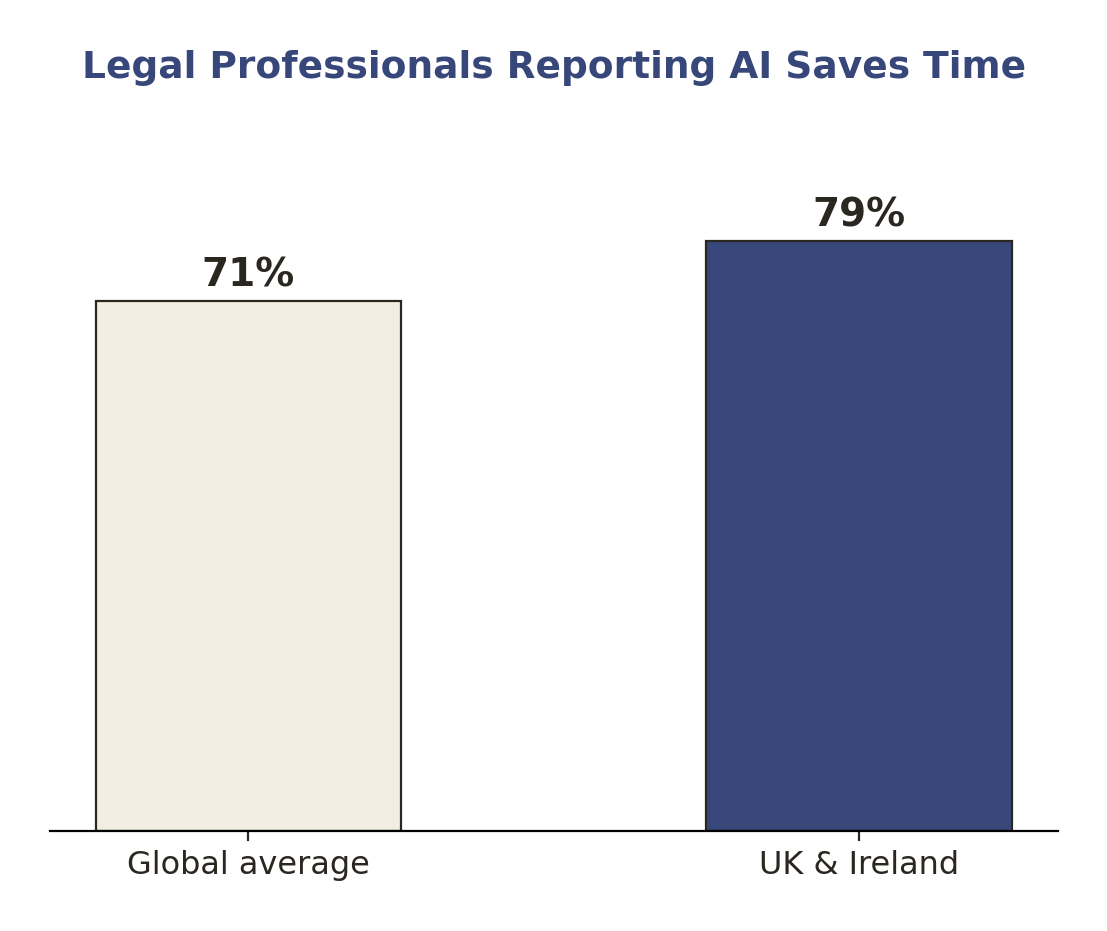
Source: Profitability in Law: Global Report 2026, LEAP Legal Software, March 2026 (survey of 700 legal professionals across six countries).
What Does the SRA's AI Misuse Warning Mean for Law Firms?
The SRA's 17 August 2026 warning notice sets out where it has identified misuse of AI in legal practice, particularly around inaccurate information and client confidentiality, and it confirms one point clearly: using AI does not transfer professional responsibility away from the solicitor or the firm. In practice, that warning translates into several specific expectations.
Fabricated or unverified authorities. As Ayinde shows, submitting AI-generated citations or legal propositions without checking them against an authoritative source can expose a firm to contempt proceedings, a regulatory referral, strike-out, or a wasted costs order. It is not enough for a statement to sound correct; it needs checking against the underlying law.
Confidential or privileged material. Firms need to know where client data goes when it is entered into an AI tool, including whether it is retained, used for model training, or accessible to a third party, before any confidential or privileged material is submitted.
Responsibility for employees' use of AI. A firm remains accountable for how its people use AI, whether through an approved tool or an employee's own initiative, which makes an approved-tools list and a written policy more than a formality.
Supervision and training. Junior staff in particular need enough training to know when AI output requires escalation, and supervisors need to understand the tools well enough to review the output critically.
Court submissions and client advice. These remain the highest-risk categories. AI may assist with preparation, but full solicitor verification is essential before anything is filed or relied upon.
Incident reporting and corrective action. Where misuse does occur, firms are expected to have a route for identifying it, correcting it and learning from it, consistent with the Record and Learn stages of the AI Workforce Legal AI Model above.
Source: Solicitors Regulation Authority, Misuse of AI warning notice, 17 August 2026
How Does AI Help With Legal Research and Drafting?
AI can help identify potentially relevant authorities and summarise judgments faster than a manual search, which is useful early in a matter when the goal is simply to find a starting point. The same caution applies to drafting: a fluent first draft is not the same as a correct one, and the time saved needs to be reinvested in careful review rather than skipped altogether. The Law Society's guidance on generative AI stresses the same accuracy checks and human-led review, and has also published a practical discussion of ILTA guidance on using generative AI responsibly in court-ordered disclosure.
Sources: Law Society, generative AI essentials · Law Society, generative AI in legal disclosure: a practical guide
Where Does AI Still Fall Short?
AI tools are useful but imperfect, and it helps to know where they tend to struggle: hallucinated citations, misunderstood factual nuance, missed recent judgments or legislative changes, overlooked procedural context, and a limited grasp of commercial considerations outside the strict legal question. None of this makes the tools unusable; it's the reason a qualified person needs to stay in the loop on anything that leaves the firm.
Where Do Firms Typically Save Time?
The exact time saved depends heavily on the tool, the task and the firm, but the illustrative examples below give a sense of scale for common tasks. These are indicative ranges, not audited figures from a specific firm.
Contract summary: around 40 minutes manually, around 8 minutes with AI
Meeting notes: around 30 minutes manually, around 3 minutes with AI
Client update: around 20 minutes manually, around 5 minutes with AI
Chronology: around 2 hours manually, around 25 minutes with AI
Illustrative example only, not measured data from a specific firm.
Released capacity is not automatically a financial saving. The benefit depends on whether the firm reallocates the time to client work, backlog reduction, faster turnaround or another measurable outcome.
What About Confidentiality, Privilege and Data Protection?
Before any client information goes into a third-party tool, it's worth getting clear answers to a specific set of questions: where is the data stored, are prompts retained, is data used to train the underlying model, what processor and subprocessor arrangements are in place, does data leave the UK, who has access, how long is information kept, are there audit logs, what does the contract say about confidentiality and breach notification, and does the tool support matter-level permissions so one client's data can't leak into another's context.
Firms should also identify the lawful basis for processing, minimise the personal data submitted, consider whether a data protection impact assessment is required using the ICO's own risk-based screening criteria rather than assuming one is automatically needed, and decide how affected individuals will be given clear information about the use of AI. Our wider guide to AI and GDPR compliance for UK businesses covers these accountability and governance questions in more depth, beyond the legal-sector specifics here.
Firms operating across the EU should also assess whether the EU AI Act applies to their role and use case. The Act follows a risk-based framework, and certain transparency obligations under Article 50 have applied since 2 August 2026, following detailed guidelines the European Commission published in July 2026. Exactly what a law firm must do depends on whether it is acting as a deployer, provider or another type of operator, and on the specific AI system being used.
Sources: ICO, guidance on AI and data protection · European Commission, guidelines on transparency obligations under Article 50 of the AI Act
Should Clients Be Told When AI Is Used?
Firms should decide when the use of AI is material enough to disclose to a client. Relevant factors may include whether client data is processed by a third party, whether the system contributes to substantive legal work, and whether the use could affect confidentiality, cost or the client's expectations. The SRA's own compliance material is explicit that it should always be made clear to clients where they are interfacing with AI. Depending on the use case, it is also worth reviewing whether engagement letters need updating, whether consent is appropriate, how AI-assisted work is described in billing, and whether the use of AI has any bearing on professional indemnity cover.
Will AI Replace Solicitors?
AI is far more likely to change the way solicitors work than replace them. Routine administrative tasks will increasingly be automated, while client relationships, negotiation, advocacy, legal judgement and ethical decision-making will remain fundamentally human responsibilities. We've seen the same question asked about financial advisers, and the answer tends to be the same: AI changes the job before it changes the headcount.
What Questions Should You Ask an AI Vendor?
Beyond data handling, it's worth pressing a vendor on a few other points: what happens if the tool gets something wrong, what evidence exists that it performs well on legal-specific tasks rather than general text, whether the firm can opt out of model training and have data deleted on request, what independent security certifications and audit logs exist, whether professional indemnity or contractual liability is capped, and which subprocessors are used.
A vendor that can't answer these clearly is a warning sign, regardless of how polished the product demo looks. Implementation costs are part of this due diligence too. Our guide to AI automation pricing is a useful starting point for budgeting before you approach vendors.
How Do You Create a Law Firm AI Policy?
A policy that actually gets followed tends to cover a specific list of points rather than general principles: which tools are approved and which are prohibited, permitted use cases, restrictions on client data, human review requirements, citation verification, confidentiality and privilege, record keeping, staff training, escalation procedures, incident reporting, vendor approval, and a schedule for periodic review. Our broader guide on writing an AI agent brief covers a similar level of specification for any AI system that takes action on a firm's behalf, not just generative drafting tools.
Without this level of detail, staff tend to fall back on whatever consumer tool they already use at home, which is exactly the scenario a policy is meant to prevent.
What Records Should a Firm Keep?
For higher-risk uses, firms should keep enough information to show what tool was used, what instructions were given, what output was produced, who reviewed it, and what changes were made before the work was relied upon or sent to a client. That record should also capture the original instructions, any corrections made, final approval, and any incidents or failures worth learning from.
How Do You Run a Safe Pilot?
Starting with one lower-risk, measurable use case gives a firm real-world evidence before it commits to wider adoption. Document summarisation is often a practical pilot, provided confidential material is handled through an approved system. Track time saved, error rate and staff confidence over a few weeks, and involve the people who'll actually use the tool day to day rather than rolling out a decision made entirely at partner level. Our guide to the AI readiness assessment is a useful starting point before committing to a pilot.
Firms that expand slowly, one practice group or task at a time, tend to end up with more consistent adoption than those that mandate a tool firm-wide on day one.
AI Readiness Checklist for Law Firms
AI policy in place
Approved tools list
Human review process
Staff training completed
DPIA screened for and completed where required
Vendor security reviewed
Client engagement terms reviewed
Audit trail enabled
Frequently Asked Questions
Is ChatGPT safe for law firms?
It depends on the version, configuration and information being processed. A firm should not put confidential or privileged client material into any general-purpose AI service without first checking its contractual terms, data retention and model-training settings, and whether the use is permitted under the firm's own AI policy. Legal-specific or enterprise deployments may offer stronger controls, but still require proper vendor due diligence.
Can solicitors use AI?
Yes. There is no rule against using AI in legal practice. Existing duties of competence, supervision and confidentiality apply to AI-assisted work the same way they apply to any other task.
Does the SRA allow AI?
The SRA has not prohibited the use of AI. Its Principles, Codes of Conduct and August 2026 Misuse of AI warning notice require firms to remain accountable, protect confidentiality, verify material outputs and maintain appropriate human oversight.
Can AI write legal contracts?
AI can produce a first draft of a contract or clause, but it shouldn't be treated as a finished, reliable document. A qualified solicitor needs to review, amend and take responsibility for anything that goes to a client.
Is AI confidential?
It depends on the tool. Some AI systems retain prompts or use them for model training, which can create confidentiality risks. Firms should check a vendor's data handling policy before entering any client information.
Should clients be told AI was used?
There's no blanket rule, but firms should consider disclosure when a system processes client data via a third party or contributes meaningfully to legal work, and update engagement terms accordingly.
Can AI provide legal advice?
AI can generate information and draft material that resembles legal advice, but a law firm should not treat that output as reliable professional advice without appropriate solicitor review. Where advice is provided to a client through the firm, the responsible solicitor remains accountable for its accuracy, relevance and professional suitability.
Can using AI put legal professional privilege at risk?
Potentially. Uploading privileged material to a third-party AI service without appropriate confidentiality, contractual and security protections may create legal and professional risks. Firms should assess the specific provider, processing arrangements and intended use before submitting privileged material.
Key Takeaways
AI can improve speed and consistency, but it does not remove professional responsibility
Every AI-generated citation, legal proposition and client-facing draft should be checked
Confidentiality, privilege and data protection must be considered before client information is entered into any tool
Firms should approve specific tools and use cases rather than allowing unrestricted adoption
A written AI policy should cover supervision, data handling, record keeping and escalation
Starting with one low-risk, measurable pilot is safer than a firm-wide rollout
Ready To Explore AI Safely?
Whether you're experimenting with AI for the first time or looking to formalise its use across your firm, AI Workforce can help you identify suitable use cases, design secure workflows and introduce AI with appropriate safeguards. Book your AI Readiness Review to see where your firm could save time while maintaining professional standards.
About the Author and Reviewer
Seth Ayush is Co-Founder of AI Workforce. He works directly with UK businesses, including regulated professional practices, on how AI tools are scoped, governed and rolled out safely, with a particular focus on where human review and escalation need to sit.
Clara Miller is a Content Marketing Specialist at AI Workforce, responsible for research accuracy and editorial standards across AI Workforce's regulated-sector guides.
This article provides general information and is not legal advice. It does not constitute a substitute for advice from a qualified solicitor on your firm's specific circumstances.
Related Guides
Sources and Regulatory References
Solicitors Regulation Authority: Misuse of AI, warning notice (17 August 2026)
Law Society: Generative AI in legal disclosure, a practical guide
European Commission: Guidelines on transparency obligations under Article 50 of the AI Act
Civil Justice Council: Use of AI in preparing court documents
Reviewed against SRA and ICO guidance: August 2026