AI Receptionist for Law Firms: Calls, Intake and Booking
Posted On: July 28, 2026
Last updated: August 2026 · Written by Seth Ayush, Co-Founder of AI Workforce · Reviewed by Clara Miller, Content Marketing Specialist
Unanswered calls cost law firms real business, and a good first impression starts the moment the phone rings. This guide looks at how an AI receptionist for law firms actually works, what it should be trusted to do, and where a firm's conflict and confidentiality obligations mean a human still has to be involved. None of this replaces a solicitor's legal advice, and it is general information rather than legal advice itself.
Quick Answer
An AI receptionist for a law firm answers the phone, identifies whether the caller is a new enquiry or an existing client, captures approved information, and books a consultation or routes the call. It should never provide legal advice, confirm the firm can act, assess the merits of a matter, calculate a deadline, or collect a detailed case history before the firm's conflict-check process has run.
At a Glance
What it is: software built for law firm call answering, intake and booking, using the firm's approved information rather than a generic script
Best suited to: firms losing new enquiries to missed calls, or wanting consistent intake across multiple fee-earners and practice areas
Biggest benefit: incoming enquiries can be answered, captured and routed consistently, including during overflow and outside normal office hours
Biggest risk: collecting sensitive case information, or appearing to accept an instruction, before a conflict check has taken place
Key legal considerations: SRA conflict and confidentiality obligations, legal professional privilege, UK GDPR, and criminal offence data rules for calls involving criminal defence
What's Covered
What Is an AI Receptionist for Law Firms?
What Can It Actually Handle?
What Should It Never Do Without a Solicitor or Member of Staff?
How Should New Enquiries and Conflict Checks Work?
How Does Client Intake and Booking Work?
Existing Client Calls vs New Enquiries
AI Receptionist vs Human Receptionist vs Virtual Receptionist vs Answering Service
When Should an AI Receptionist Transfer a Call to a Person?
Which Legal Practice-Management Systems Can It Connect To?
What Client Data Does It Process and What Does UK GDPR Require?
Confidentiality, Privilege and Call Recording
How Much Does an AI Receptionist for a Law Firm Cost?
How to Evaluate a Provider
Who Owns the System After Launch?
A Four-Week Law Firm Pilot
How Should You Measure It?
Does It Work Across Different Practice Areas?
Is It Worth It for Your Firm?
Related Guides
Frequently Asked Questions
Key Takeaways
What Is an AI Receptionist for Law Firms?
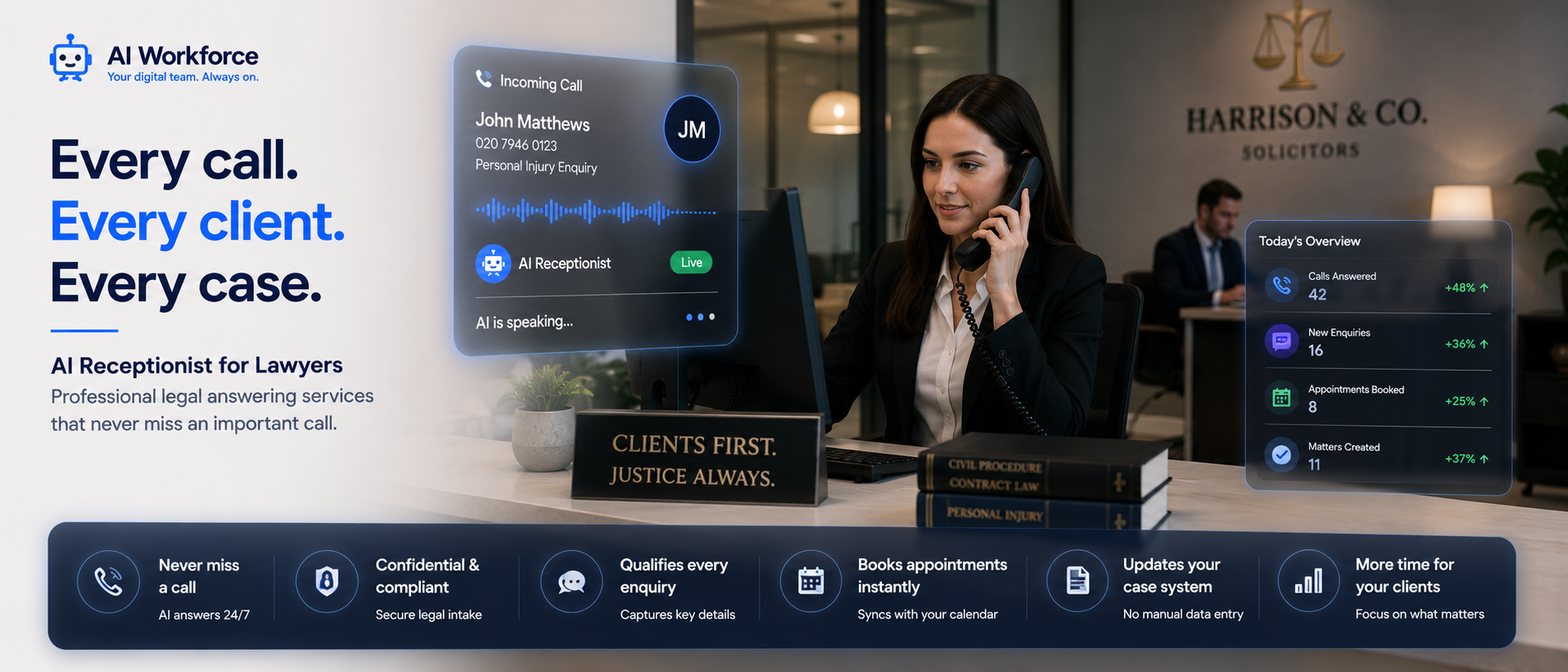
An AI receptionist built for law firms answers the phone, works out what the caller needs, and acts on it within a defined scope, whether that means booking an initial consultation, routing an urgent call to the right solicitor, or capturing a message. It uses speech recognition to convert what is said into text and natural language processing to follow a real conversation rather than matching against a fixed script.
What makes a system like this different from a generic AI receptionist is the vocabulary it is built around: practice areas, matter types, and the language clients actually use to describe a legal problem. Where the transfer to a person is configured correctly, the system can pass the captured context along, reducing the need for a caller to repeat basic information they have already given. That consistency only has real value once it is paired with a clear boundary around what the system should never attempt to decide on its own, which is the focus of the next two sections.
What Can It Actually Handle?
A well-configured system can answer routine questions about the firm, published fee information or approved pricing information, opening hours, and what to bring to a first meeting, using information the firm has specifically approved rather than an invented answer. It can capture a new enquiry's basic details, confirm which practice area it relates to, and check real-time availability to book an initial consultation directly into a solicitor's diary.
For an existing client, it can follow the firm's approved verification process and, once appropriate checks are satisfied, route the caller to the responsible fee-earner or take an approved message. It should not reveal matter information merely because a caller claims to be the client. Call volume in a law firm often spikes around a marketing push, a change in the law, or simply a busy Monday morning, and this is exactly the kind of predictable, repetitive load a properly configured system can absorb, freeing fee-earners and support staff from routine phone answering.
AI can handle: opening hours and office location, booking an initial consultation, capturing a new enquiry's basic details, routing a verified existing client to their fee-earner, published fee information, and message-taking
Human decision required: confirming the firm can act, conflict-check decisions, legal advice, assessing a matter's prospects, calculating or interpreting a deadline, and any complaint or vulnerable-caller situation, where the receptionist should limit itself to intake only
What Should It Never Do Without a Solicitor or Member of Staff?
This is the most important governance decision in a law firm AI receptionist deployment, and it deserves a written policy rather than an assumption that the system will simply know where the line is.
An AI receptionist should never provide legal advice, confirm that the firm can act for a caller, assess the merits or prospects of a matter, calculate or communicate a limitation or court deadline, accept instructions on the firm's behalf, quote or commit to a fee beyond a firm's published general rates, give an undertaking, discuss a settlement position, or disclose privileged or confidential information about another client. It should not attempt to identify a conflict of interest itself; that remains a decision for the firm's conflict-check process. It should not collect a detailed substantive account of the dispute before that process has run. The limited information required to perform the conflict check, which may include the identities of relevant parties, should be captured only for that purpose.
A caller can, without anyone intending it, hand an AI receptionist their own identity, the opposing party's identity, the nature of a dispute, confidential details, or information about an existing client. Collecting more of that than the conflict check genuinely requires, in an open-ended way, is one of the clearest ways this kind of tool can create risk for a firm rather than reduce it. The safer design captures only what a firm's own intake policy specifically permits, and routes anything beyond that to a person.
Illustrative split. Your own firm policy should determine exactly where each task lands.
Routine enquiry: A caller asks whether the firm handles residential conveyancing and wants to arrange an initial consultation. The receptionist retrieves approved information about the service, captures the caller's name and contact details, and books an appropriate slot.
High-risk enquiry: A caller describes an ongoing dispute, names the opposing party, and asks whether they should take a particular action before a deadline. The receptionist does not advise them, does not confirm the firm can act, and does not calculate the deadline. It captures only the limited information permitted by the firm's intake policy, such as the caller's own contact details and a general description of the enquiry type, and routes the matter through the firm's conflict-check and solicitor-review process before anything further is discussed.
"An AI receptionist can identify, capture, book and route a legal enquiry. It should not decide whether the firm can act, provide legal advice, assess the merits of a matter, or bypass the firm's conflict and solicitor-review process."
AI Workforce Insight: AI can identify, capture, book and route. The firm still decides whether it can act.
How Should New Enquiries and Conflict Checks Work?
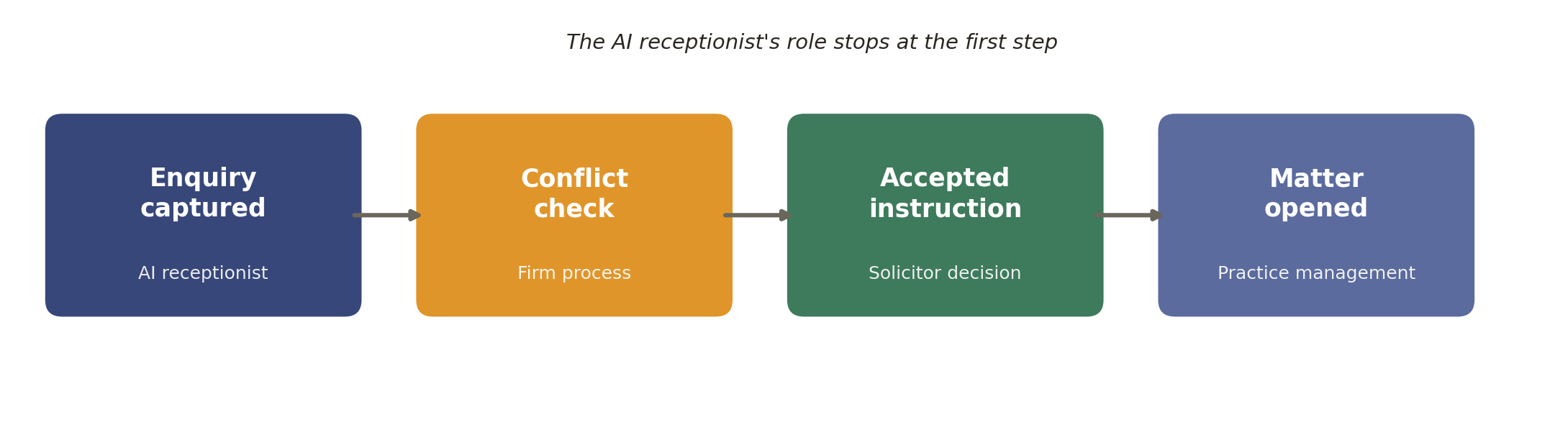
A new enquiry is not the same thing as an accepted instruction, and an AI receptionist should be configured to respect that distinction rather than collapse it. The sequence that protects a firm looks like this: enquiry captured, then conflict check, then accepted instruction, then matter opened.
An AI receptionist can help with the first step, capturing the caller's own details and a general description of what the enquiry concerns. It should not be relied on to run or replace the conflict-check step itself, and it should not automatically create a matter record from every call. An enquiry only becomes a matter once the firm has actually decided to accept the instruction. Under the SRA Code of Conduct for Solicitors, a firm must not act where there is a client conflict, or a significant risk of one, between two or more clients in the same or a related matter, and separately must manage own-interest conflicts between the firm and a client. The firm's professional obligations remain with the firm; deploying an automated receptionist does not transfer responsibility for conflict decisions to the technology. An AI receptionist collecting a full case history from a caller before that check has run works directly against this obligation, since it can put confidential information about a prospective client, and potentially about an existing one, into circulation before anyone has confirmed the firm is even able to accept the matter.
In practice, this means the receptionist's intake script for a new enquiry should stay deliberately narrow: the caller's own name and contact details, the general nature of the enquiry, and, if genuinely needed, the identity of any opposing party for conflict-checking purposes only, captured and routed to the person who runs that check rather than discussed further on the call.
Illustrative sequence. The conflict check and the decision to accept an instruction stay with the firm, not the receptionist.
How Does Client Intake and Booking Work?
Within that boundary, this is where a legal AI receptionist earns its keep fastest. A prospective client can book an initial consultation over the phone, with the system checking real-time availability and confirming a slot without a follow-up email being needed. This removes the back-and-forth of finding a time that works for both sides, and it means a firm is less likely to lose a new enquiry simply because nobody was free to check the diary at the moment someone called.
An intake process built this way helps route each caller correctly, flagging an urgent matter, a particular practice area, or a general question about the firm's services, so a person can prioritise appropriately, rather than the system making a judgement about whether the enquiry itself has merit. The receptionist can apply the firm's approved escalation rules, for example routing calls that mention a court date, custody situation or completion problem to a person, without deciding the legal urgency or merits of the matter itself. It also means nobody on the team needs to interrupt a client meeting to answer a routine phone query.
Integration with a firm's practice-management or CRM system means an approved intake call gets logged automatically, syncing contact details and the general nature of the enquiry without anyone needing to re-type them later. A receptionist connected this way can save real time for intake teams handling a high volume of calls, and it gives partners a clearer view of how many new enquiries are coming in and where they originate, while the decision to accept the matter and open a file stays with the firm.
Existing Client Calls vs New Enquiries
Treating every caller the same way is where a generic answering service falls short for a law firm specifically. An existing client calling about a matter already in progress has a different set of needs, and different permissions, from someone enquiring for the first time.
For an existing client, the receptionist can follow the firm's approved verification process and, once the appropriate checks are satisfied, route the caller to the responsible fee-earner or take an approved message, without needing them to re-explain their situation from scratch. It should not reveal matter information merely because a caller claims to be the client, and it should not offer an update on the substance of their matter unless that information has been specifically approved for the system to share, and it should not speculate about timing, outcome, or next steps on the fee-earner's behalf.
For a new enquiry, the receptionist should follow the narrower intake process described above, since the firm has not yet decided whether it can act. Configuring these as two clearly different pathways, rather than one general call-handling flow, is what keeps the system aligned with how a firm actually needs to treat each type of caller.
Illustrative pathways. The specific rules should reflect how your own firm structures intake and existing-client calls.
AI Receptionist vs Human Receptionist vs Virtual Receptionist vs Answering Service
These labels are not used consistently across the market, so it is worth being precise about what each one usually means before comparing providers.
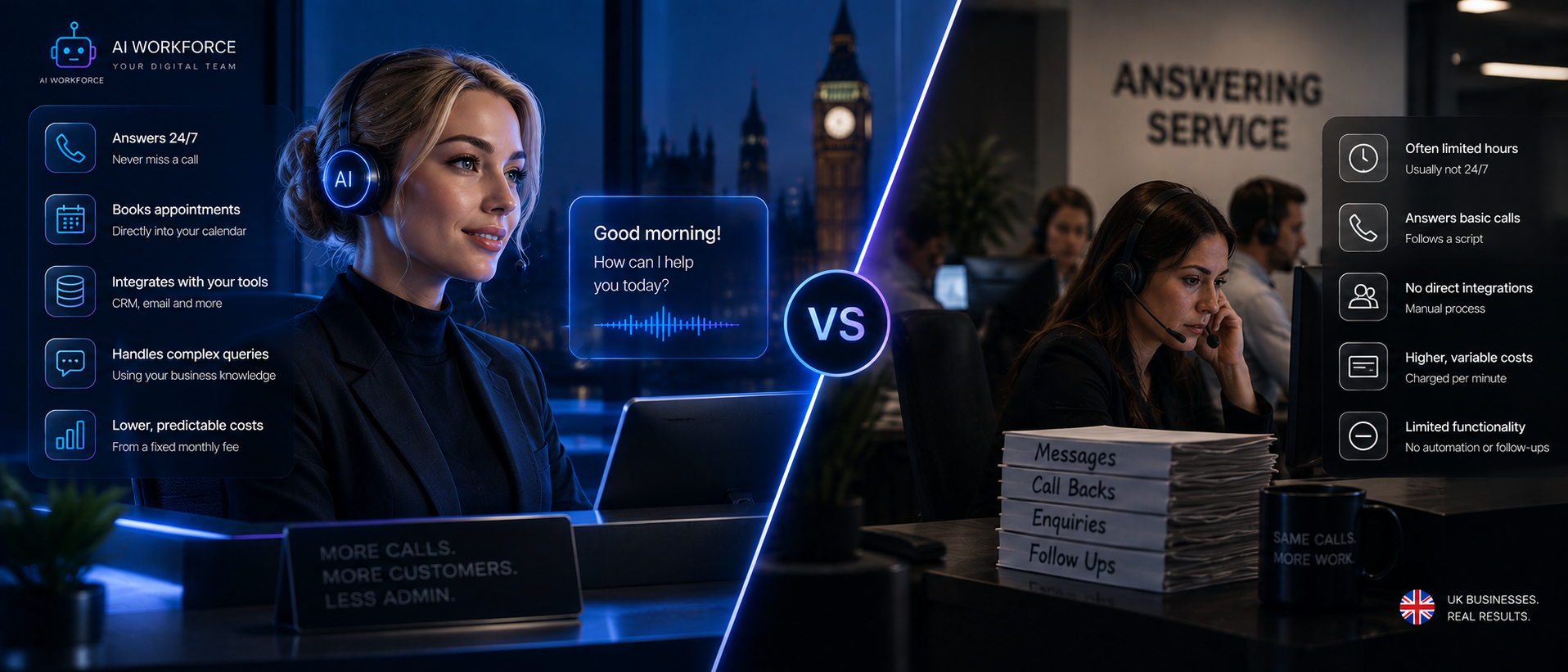
A traditional answering service usually focuses on answering calls and taking messages, often through human operators. Some services also provide appointment booking, intake or call transfer, so capabilities depend on the provider and package. A virtual receptionist normally refers to a remote human receptionist service, although some providers now use the term loosely for technology-assisted or AI-supported call handling. An AI receptionist uses speech and language technology to speak with callers directly and complete configured actions such as capturing details, routing calls, or booking consultations. Because these terms overlap in marketing material, firms should compare the actual service on offer rather than the label: who or what answers, which actions it can perform, when a person becomes involved, and how caller data is processed.
Capability | AI receptionist | Human receptionist | Answering service |
|---|---|---|---|
Out-of-hours availability | Configurable, potentially 24/7 | Requires staffing or cover | Depends on package |
Natural conversation | Yes, within tested scope | Yes | Usually |
Appointment booking | Configurable | Yes | Provider dependent |
Approved administrative FAQs | Yes | Yes | Often limited |
Legal judgement | No | Only if appropriately qualified | No |
Distressed or vulnerable callers | Escalate | Better suited | Depends on operator and service |
System integration | Potentially automated | Usually manual or system assisted | Provider dependent |
Human empathy | Limited | Strong | Stronger where human staffed |
This is a general comparison, since individual providers vary considerably in what they actually deliver.
The strongest approach blends automation with people: routine calls get handled instantly, and anything genuinely complex still reaches a solicitor or a trained member of staff. Our AI Answering Service guide covers the underlying call-handling architecture, built around what we call the AI Workforce Call Model, in more depth than is useful to repeat here.
An AI receptionist frees fee-earners and support staff from routine phone duty, and typically costs a fraction of a full-time hire once salary, cover and training are all added up. It also needs to sound professional and consistent every time, which is harder to guarantee with a rotating team of temporary or part-time cover. A human receptionist retains a real advantage for a genuinely difficult call, particularly one involving a distressed or vulnerable caller, which is exactly why the strongest setups keep a person available rather than removing them from the picture entirely.
When Should an AI Receptionist Transfer a Call to a Person?
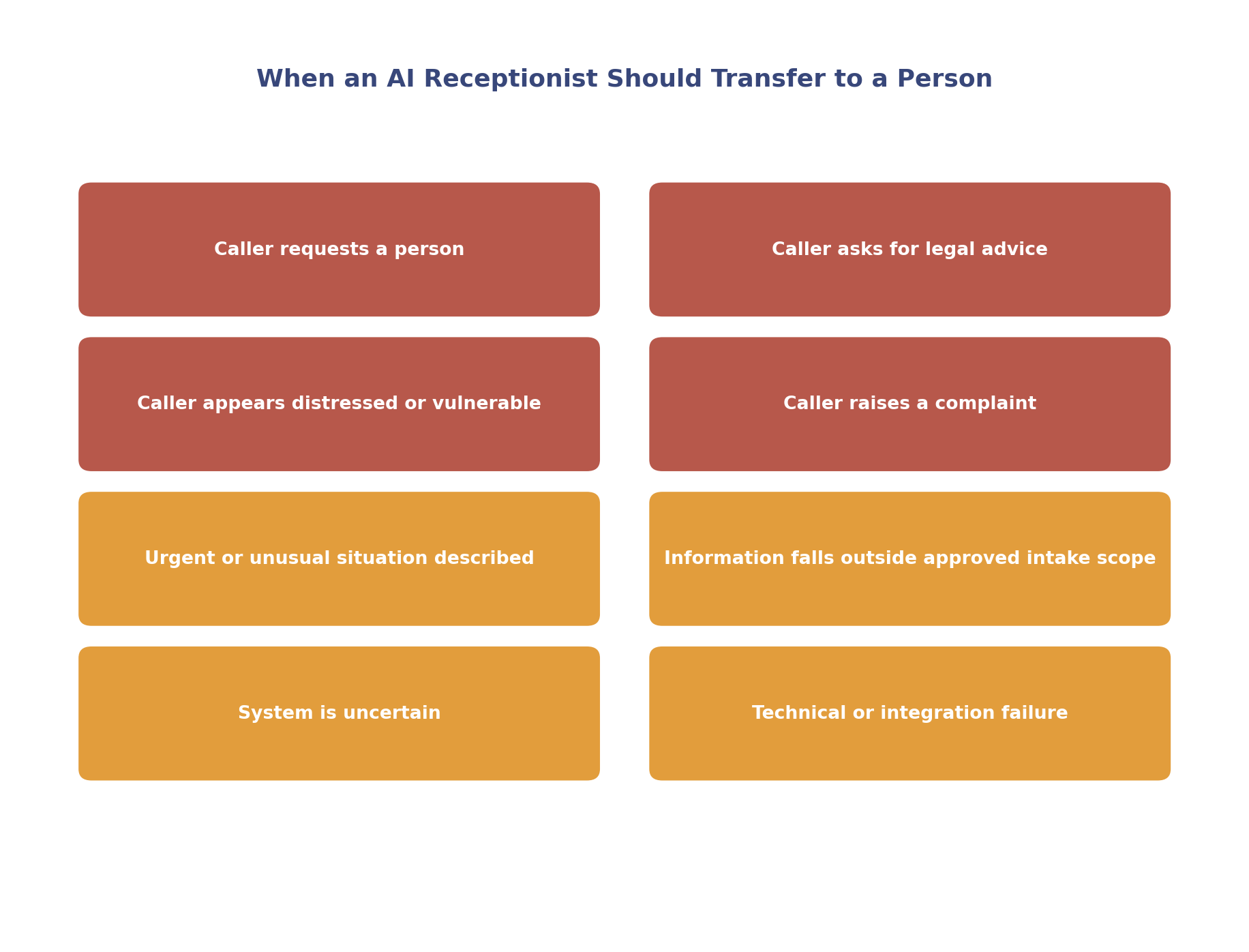
An AI receptionist should transfer or escalate when a caller requests a person, asks for legal advice, appears distressed or vulnerable, raises a complaint, describes an urgent or unusual situation, provides information outside the approved intake scope, or when the system is uncertain. Every deployment also needs a fallback for technical or integration failures, reducing the risk of callers being disconnected or left without a clear next step.
Which Legal Practice-Management Systems Can It Connect To?
Integration with a firm's practice-management or case-management system is where a meaningful share of the time saving comes from: a booking or a message captured over the phone should land in the same system fee-earners already work from, rather than needing to be re-entered by hand.
Whether that is possible, and how well it works, depends on the specific practice-management system in use and the provider's own integration capability, not on AI receptionists as a category. It is worth confirming directly with any vendor which specific systems they have actually built and tested against, and, just as importantly, which fields the AI can read and which it can write, rather than accepting a general claim that integration is supported. A firm should be able to restrict the AI to creating an enquiry record without opening a matter, keeping the enquiry-to-matter distinction described earlier enforced technically, not just as a policy.
What Client Data Does It Process and What Does UK GDPR Require?
An AI receptionist for a law firm may record or transcribe, and will process, personal data from the first call it answers, and legal enquiries can be unusually sensitive. This section is general information rather than legal advice.
Routine contact data covers a caller's name, phone number and the general nature of their enquiry, standard personal data under UK GDPR and the most straightforward category to handle. Matter-related data covers the practice area involved, an opposing party's name where captured for conflict-checking purposes, and other details specific to an enquiry, without straying into a full account of the dispute.
Special category and criminal offence data deserves particular care. A caller may volunteer health, disability, racial or ethnic origin, religious or other special category information, particularly in family, personal injury or immigration matters, which needs an Article 9 condition before it can be processed. Separately, and specifically relevant for a firm handling criminal defence work, information about criminal allegations, charges or convictions is not special category data under UK GDPR; it is governed by its own regime under Article 10 and the Data Protection Act 2018, which permits this kind of processing only under the control of official authority or where domestic law provides a specific safeguard. A firm's own processing of this data as part of representing a client sits within that framework, and it is worth confirming with your data protection adviser exactly how your firm's lawful basis and safeguards are documented for this category specifically, rather than treating it as equivalent to special category data more broadly.
Both special category and criminal offence data should be collected only where genuinely necessary for the defined intake workflow, and callers should be told clearly, and early in the call, that they may be speaking with an automated assistant and that the call may be recorded, consistent with ICO guidance on transparency and data minimisation. Our AI GDPR Compliance guide covers the underlying UK GDPR framework, including lawful basis and automated decision safeguards, in more depth.
Confidentiality, Privilege and Call Recording
A law firm's confidentiality obligations, and the possibility that a call touches material protected by legal professional privilege, deserve separate treatment from the general data protection points above.
Confidentiality is a core professional obligation under the SRA Code of Conduct: a firm must keep the affairs of current and former clients confidential, subject to narrow exceptions. An AI receptionist that records, transcribes or stores call content sits inside that obligation the moment a caller shares anything about their situation, which is a further reason the intake script for a new enquiry should stay narrow rather than inviting a caller to explain their full circumstances.
Legal professional privilege is a separate but related concept. Legal advice privilege protects confidential communications between a solicitor and client made for the purpose of giving or receiving legal advice, whether or not litigation is in progress. Litigation privilege protects certain communications made for the dominant purpose of existing or reasonably contemplated adversarial litigation. Some intake communications may later form part of privileged communications depending on the circumstances, but privilege should not simply be assumed because someone contacted the firm seeking representation. Either way, the content may be highly confidential and commercially or personally sensitive, which is reason enough to minimise what the receptionist collects before the firm has reviewed the enquiry.
On call recording specifically: callers should be told that a call may be recorded and transcribed, and a firm needs an appropriate lawful basis and a defined retention period for that recording, separate from the disclosure itself, consistent with ICO guidance on call recording. Recordings and transcripts of legal enquiries should be treated as confidential firm records, with access restricted to those who need it, and it is worth confirming with any vendor which of their staff or systems, including any third-party transcription or model provider, can access that content, and where it is stored.
This section is general information rather than legal advice. Firms should assess their own professional, confidentiality and data-protection obligations before deploying an automated client-facing system, and should refer to current SRA guidance on the use of AI where relevant.
How Much Does an AI Receptionist for a Law Firm Cost?
AI receptionist prices vary according to call volume, minutes, telephony, integrations, setup and whether human overflow is included. Our AI Receptionist Pricing UK guide compares current published prices and explains the full cost stack.
A staffed receptionist role carries salary plus employer National Insurance, pension contributions, recruitment and cover for holidays and sickness, so the fair comparison is against the total employment cost of the role, not a headline salary figure. Setup timelines vary by provider and by how much configuration a firm needs; a legal deployment should be judged on whether the knowledge base, escalation rules, conflict-routing and test calls have been done properly, not on how quickly it can technically be switched on. Our AI Automation Pricing UK guide covers UK implementation cost drivers more broadly.
How to Evaluate a Provider
Put these questions to a vendor directly before committing budget, and expect specific answers rather than marketing language.
Before You Sign
Which practice-management or CRM systems has the provider actually built and tested integrations against?
Can we restrict what information the AI can read and write in those systems?
Can it create an enquiry record without automatically opening a matter?
How does the conflict-check workflow operate, and where does the receptionist's role in it stop?
What happens when a caller asks for legal advice, or asks the system to confirm the firm can act?
Can the system calculate or communicate deadlines? It should not, unless deliberately authorised through a specifically governed workflow with its own testing and oversight.
Where are call recordings and transcripts stored, and for how long?
Which subprocessors, including any transcription or model provider, receive call data?
Is customer or caller data used to train the vendor's own wider models?
What happens if the practice-management, calendar or CRM integration is unavailable?
Can a caller ask to speak to a person immediately, and is that honoured without friction?
How are vulnerable or distressed callers identified and escalated?
Who Owns the System After Launch?
A common gap in AI receptionist rollouts is assuming the vendor's initial setup is the end of the project. In practice, someone at the firm needs to own the knowledge base, the escalation rules and the conflict-routing logic on an ongoing basis, updating them as practice areas, fee-earners or firm policy change. Without a named owner, an intake script can quietly drift out of date, continuing to route calls to a solicitor who has left, or failing to reflect a new practice area the firm has taken on.
This does not need to be a large role. It typically means one person, often someone already responsible for compliance, practice management or office administration, reviewing call transcripts periodically, updating the approved knowledge base, and confirming the escalation and conflict-routing rules still match how the firm actually wants new enquiries handled.
Any change affecting conflict intake, legal-risk escalation or what the receptionist may communicate should be documented and approved before deployment, rather than changed casually inside a prompt. Treating these settings with the same change-control discipline as a firm's other client-facing procedures is what keeps the system's behaviour predictable as it evolves.
A Four-Week Law Firm Pilot
Rolling out a law firm AI receptionist against a properly built and tested knowledge base, with conflict-routing rules agreed in advance, is considerably safer than switching on full call coverage from day one.
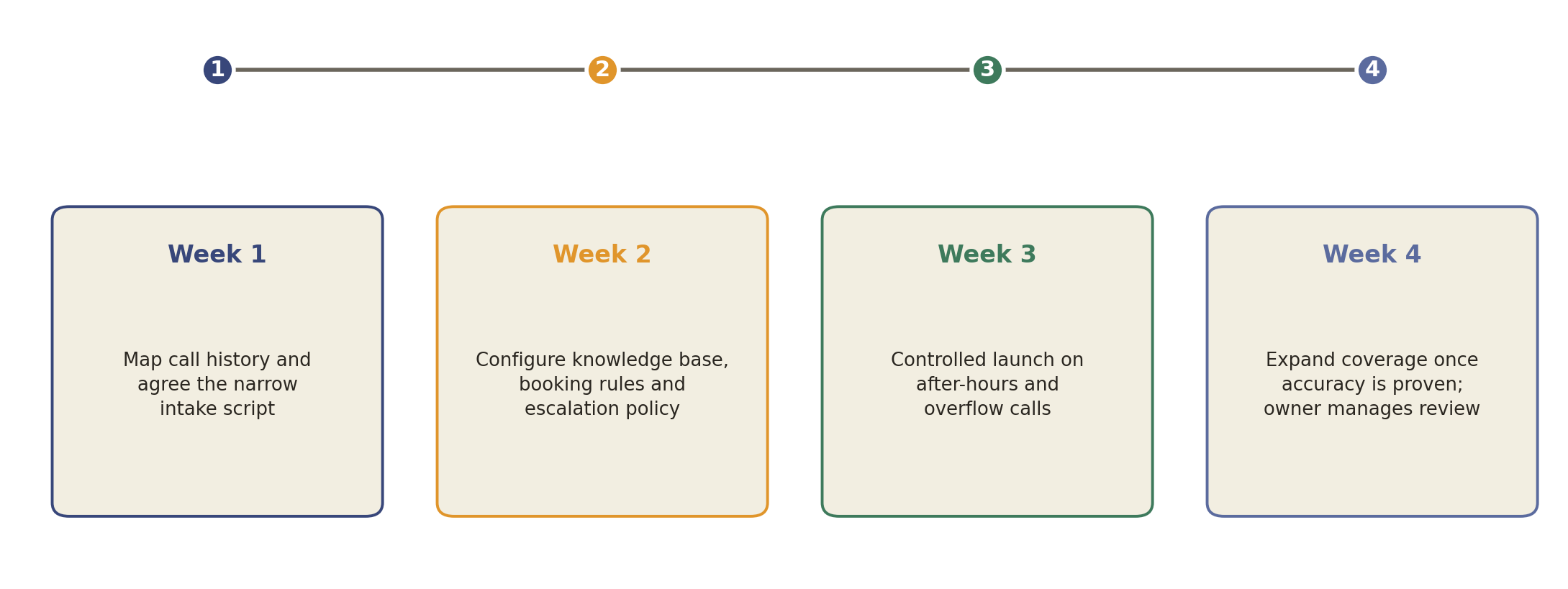
Illustrative roadmap. Expand coverage only once earlier stages have proven themselves against real calls.
Week one: map real call history, identify common enquiry types by practice area, and agree the narrow intake script for new enquiries with input from whoever runs the firm's conflict-check process.
Week two: configure the knowledge base, booking rules and escalation policy, and test against known scenarios, including a deliberately high-risk enquiry, to confirm the system routes it correctly rather than continuing the conversation.
Week three: controlled launch on after-hours and overflow calls, with every transcript reviewed before the next batch of calls goes live.
Week four: expand coverage once classification accuracy and escalation accuracy are proven, with the named system owner from the section above now managing ongoing review.
How Should You Measure It?
Call volume answered is not a sufficient measure on its own. Track answer rate, booking completion rate, escalation accuracy specifically for high-risk or conflict-sensitive calls, successful transfer rate, incorrect-answer rate, and repeat-call rate. Escalation accuracy deserves particular attention in a legal context, since it shows whether the system is correctly recognising when a call needs to stop being an automated conversation and become a person's decision, particularly around conflict-relevant details and requests for legal advice.
A law firm deployment also has a measurement need most generic receptionist rollouts do not: over-collection. Track an intake-policy breach rate, the proportion of calls where the system captured or communicated information outside the firm's approved intake scope, such as a detailed account of a dispute before a conflict check has run. A low, stable breach rate is a clearer sign of a well-governed rollout than call volume or booking numbers alone.
Does It Work Across Different Practice Areas?
Sensitive family matters often arrive at emotionally difficult moments, and a calm, consistent voice on the other end of the phone matters more than most people realise, alongside particularly careful handling of any special category data a caller volunteers. Conveyancing firms see significant seasonal spikes around exchange and completion dates, while personal injury and immigration practices both rely heavily on fast, accurate first contact to progress a new enquiry.
Criminal defence solicitors face a different challenge again: calls can arrive at any hour, and capturing basic details correctly before a solicitor is reachable can matter considerably to how quickly they can act, while the criminal offence data points above apply directly to this practice area. A system built to handle this range of scenarios should adapt its intake questions to the enquiry type automatically, while keeping the same underlying boundary: capture what is needed, and route anything requiring judgement to a person.
Is It Worth It for Your Firm?
An AI receptionist tends to deliver the most value for a firm handling a meaningful volume of routine enquiry and booking calls, alongside a smaller number of genuinely complex or sensitive conversations that still need a solicitor. It works best alongside the team already in place, not instead of it, with legal advice, conflict decisions, and anything touching on whether the firm can act on a matter remaining a solicitor's responsibility.
Related Guides
Frequently Asked Questions
Does this replace a solicitor?
No. It handles the phone, the intake, and routine questions, but anything requiring legal judgement, including whether the firm can act, still goes to a qualified solicitor. Every firm using this kind of tool should keep a person available for genuinely sensitive conversations.
Will an AI receptionist run our conflict checks?
No, and it should not be configured to try. It can capture the limited information a firm's own conflict-check process needs, such as the caller's identity and, where relevant, an opposing party's name, and route that to the person who runs the check. The decision itself stays with the firm.
What happens if a caller asks for legal advice on the call?
A properly configured system should decline to answer and either transfer the call or capture only the limited contact and enquiry information permitted by the firm's intake policy.
Is client data handled by an AI receptionist covered by UK GDPR?
Yes. Names, contact details and the general nature of an enquiry are personal data. A caller may also disclose special category data, such as health or racial or ethnic origin, which needs an Article 9 condition. Information about criminal allegations or convictions is treated separately under Article 10 and the Data Protection Act 2018, which matters particularly for firms handling criminal defence work.
Does this cover multiple offices?
Multi-site firms typically route calls by location, practice area or department, so nothing gets tangled between branches, and partners can see how enquiries are being distributed across the practice.
How much does a law firm AI receptionist cost?
Prices vary by call volume, minutes, telephony, integrations and setup. Our AI Receptionist Pricing UK guide compares current published prices in detail.
Is this the same as legal AI drafting or research tools?
No. This guide covers answering, intake and booking calls, not drafting documents or conducting legal research. Those are separate tools with their own governance considerations.
Key Takeaways
AI can identify, capture, book and route a legal enquiry, but it should never provide legal advice, confirm the firm can act, or assess a matter's prospects
A new enquiry is not an accepted instruction; conflict checks should happen before a matter is opened
Conflict decisions remain with the firm, not the receptionist
Existing clients require appropriate verification before matter information is shared
Confidentiality and UK GDPR apply to call data, and some content may engage legal professional privilege
Criminal offence data requires separate consideration from special category data under UK GDPR
A named person should own the knowledge base and escalation rules after launch, not just at initial setup
Begin with after-hours or overflow calls before expanding to full coverage, reviewing every transcript along the way
This article provides general information and is not legal advice. Firms should assess their own professional, confidentiality and data-protection obligations before deploying automated client-facing systems.
See How an AI Receptionist Would Handle Your Firm's Calls
Bring us three common call types from your firm. We can show you what the receptionist could handle, what information it should capture and where it should transfer to a person, without crossing into legal advice or conflict decisions.
Book an AI Receptionist Demonstration
About the Author
Seth Ayush is Co-Founder of AI Workforce. He works on how AI Workforce's call-handling and receptionist agents are designed, tested and governed, with a particular focus on permission scoping and escalation logic before a system is trusted with live client and enquiry calls.
This article was reviewed by Clara Miller, Content Marketing Specialist at AI Workforce, for clarity, structure and alignment with how UK law firms actually evaluate and adopt AI receptionist tools.
Reviewed: August 2026