AI for Restaurants UK: Uses, Tools, Benefits and Risks
Posted On: August 14, 2026
Written by Clara Miller, Content Marketing Specialist at AI Workforce · Reviewed by Rodi Taze, Co-Founder of AI Workforce · Last updated: August 2026
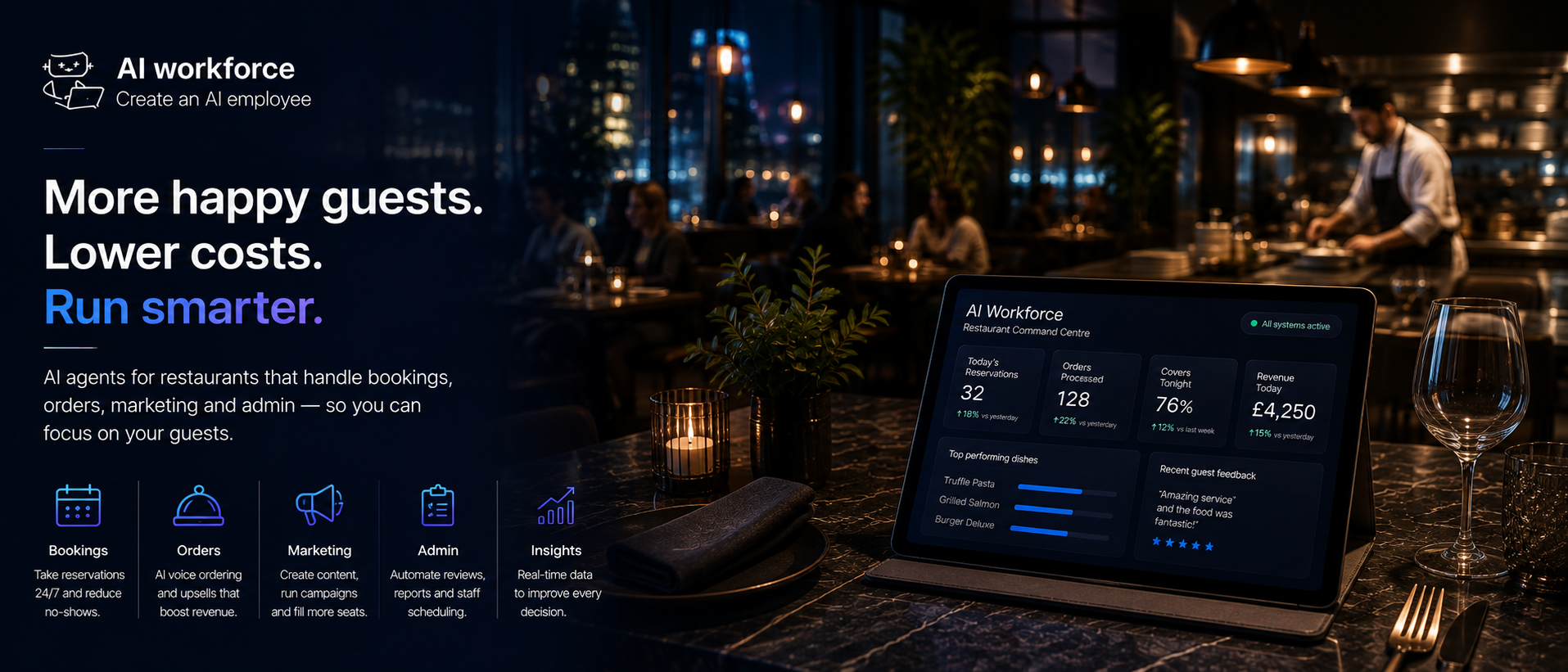
AI is becoming a practical part of restaurant operations, particularly in demand forecasting, reservations, workforce scheduling, inventory management and routine guest communication. The strongest use cases are repetitive, data-heavy tasks where an AI system can prepare or recommend an action while a manager remains responsible for decisions affecting staff, food safety, customers or high cost.
Quick Answer
UK restaurants use AI to forecast demand, prepare staff rotas, manage reservations, monitor inventory, personalise marketing and answer routine guest enquiries. It works best on repetitive tasks with measurable outcomes. Food-safety decisions, complaints, employee discipline, major staffing changes and significant supplier or financial commitments should remain manager-led.
At a Glance
What it is: AI tools used to forecast demand, manage bookings, support scheduling, monitor inventory and automate routine restaurant administration
Where it helps most: Demand forecasting, reservations, inventory, rota preparation, guest communications and marketing drafts
Where it shouldn't decide alone: Food-safety matters, complaints, employee discipline, material staffing decisions and significant supplier or financial commitments
Biggest risk: Automating an operational decision without checking whether the underlying data or prediction is reliable
Best starting point: One repetitive workflow with a clear before-and-after metric
What Is AI for Restaurants?
AI for restaurants covers the tools that help an operator forecast demand, manage bookings, prepare staff schedules, track inventory and handle routine guest or supplier communication. AI adoption in UK restaurants is moving beyond experimentation. Research published through UKHospitality found that 85% of UK restaurant leaders planned to invest in technology, including AI and automation, while around two-thirds believed AI or automation could improve their business across the operational areas surveyed, with marketing and promotions, inventory management, payments and menu optimisation among the strongest perceived opportunities. International evidence points in the same direction: the US National Restaurant Association's 2024 Technology Landscape Report found that 76% of operators believed technology gave them a competitive edge. The Association's own guidance on choosing AI tools recommends identifying the operational problem first, then selecting a tool built for hospitality that solves it, rather than buying a platform and looking for a use afterwards.
85%
of UK restaurant leaders plan to invest in technology, including AI and automation
77%
see opportunity in marketing, promotions and inventory management
76%
see opportunity in payments and menu optimisation
Source: Square Future of Commerce report, via UKHospitality.
That problem-first approach is the difference between AI that earns its place in a kitchen and AI that gets switched off after a month. A single well-configured forecasting or scheduling tool, properly tested against real restaurant data, is usually a more sensible starting point than a broad platform trying to automate several unproven workflows at once.
How Are UK Restaurants Using AI?
An operator running a single kitchen and a much larger group face different pressures, but both have to balance variable demand against labour cost, staff availability and service levels. Day to day, AI in a restaurant often looks quiet: a system flagging that Friday night is trending toward a busier service than usual, an assistant drafting a supplier email, or a chatbot answering a repeated question about opening hours. None of it replaces the people running the floor. It removes the small, repetitive tasks that eat into their time, mirroring the broader pattern behind AI agents for small businesses.
76%
of US operators expect technology to give them a competitive edge (National Restaurant Association, 2024)
1
problem to solve first, before rolling AI out anywhere else
0
consequential people decisions it should make without meaningful human oversight
A restaurant group testing one idea at a single site can learn what actually works before rolling it out across a wider restaurant chain, rather than gambling the whole budget on a system nobody has properly tested. Deploying AI one problem at a time reduces the risk of expensive mistakes and makes it much easier to identify whether the tool is genuinely improving the operation.
Which Restaurant AI Use Cases Are the Best Starting Point?
For most UK restaurants, the strongest starting points are demand forecasting, reservation handling, inventory alerts, first-draft staff scheduling, routine guest enquiries and marketing drafting or support. These are good starting points because they are repetitive and measurable, so a manager can quickly tell whether the tool is actually helping. Food safety, complaints, employment decisions and major financial commitments should remain human-led regardless of how mature a restaurant's AI use becomes.
Restaurant need | AI use |
|---|---|
Unpredictable covers | Demand forecasting |
Missed calls and bookings | AI receptionist/reservation AI |
Food waste | Demand and inventory forecasting |
Time-consuming rotas | Workforce scheduling |
Repetitive guest questions | Voice or chat AI |
Marketing admin | Drafting and campaign support |
The AI Workforce Restaurant AI Model
AI Workforce developed the Restaurant AI Model as a practical framework for deciding where AI can improve restaurant operations without removing managerial responsibility.
Capture → Forecast → Recommend → Act → Monitor → Escalate → Record → Learn
Capture: approved reservations, sales, staffing, inventory and operational data enter the system.
Forecast: AI predicts covers, product demand, staffing pressure or likely exceptions.
Recommend: the system suggests a rota, prep quantity, stock order or response.
Act: low-risk actions complete automatically; consequential ones need approval.
Monitor: actual covers, stock, labour hours and outcomes are compared to forecast.
Escalate: unusual demand, staff issues or food-safety concerns go to a manager.
Record: forecasts, decisions and manager overrides are retained where appropriate.
Learn: forecast errors and overrides are reviewed so the workflow improves.
What Can Restaurant AI Automate?
Restaurant AI is most reliable at high-volume, predictable tasks with a checkable outcome: total covers, portions to prep, whether a table is free, whether a stock item needs reordering. It automates repetitive tasks, freeing staff to focus on customers rather than paperwork, which is exactly the benefit the National Restaurant Association highlights in its own guidance on choosing AI tools for hospitality. It is far less reliable and should not be trusted for judgement-heavy decisions involving a specific person: whether a complaint has been handled fairly, whether an employee's performance is acceptable, or whether a guest's unusual request should be accommodated.
What are the best uses of AI in restaurants? The strongest uses are demand forecasting, reservation handling, inventory alerts, first-draft rota preparation, routine guest communication and marketing support. These tasks are repetitive, measurable and relatively easy for a manager to verify before the recommendation affects staff, customers or significant spend.
What Are the Main Benefits of AI in Restaurants?
The main benefits of restaurant AI are better demand planning, lower food waste, more efficient rota preparation, fewer missed calls and reservations, faster routine guest communication and less administrative work. The value comes from improving repeated operational decisions rather than replacing managers on the small number of decisions where judgement matters most.
Less waste: better forecasts support smarter prep and purchasing.
Better staffing: rotas can be prepared around predicted demand.
More bookings captured: voice and booking AI can answer enquiries when staff are busy.
Less admin: routine supplier, marketing and guest messages can be drafted automatically.
Faster exception detection: stock, demand and scheduling anomalies can surface earlier.
The AI Workforce Restaurant AI Boundary Matrix
AI Workforce developed the Restaurant AI Boundary Matrix to set clear automation boundaries for restaurant operations.
Higher automation, spot-checked | AI prepares, manager reviews | Manager-led, mandatory judgement |
|---|---|---|
Opening hours and menu FAQs | Staff rota suggestions | Food-safety decisions |
Reservation confirmations and reminders | Prep quantities | Complaints and service recovery |
Routine marketing drafts | Table-turn predictions | Employee performance or discipline |
Inventory alerts | Stock-order recommendations | Major staffing changes |
First-pass demand forecasts | Guest segmentation and offers | Supplier-contract commitments |
Standard supplier reminders | Supplier-price anomaly flags | Material pricing or dynamic-pricing changes |
AI can model pricing scenarios, but customer-facing dynamic pricing can create reputational and fairness concerns quickly, so material changes should remain a commercial decision rather than an autonomous system action.
AI for Demand Forecasting and Food Waste
Better forecasting combines historical sales, reservations, weather patterns and local events to produce a more systematic demand estimate than relying on intuition alone. Getting the forecast right has a direct effect on the bottom line, because a kitchen that over-orders is throwing money away and one that under-orders is turning guests away.
These tools can break demand down by dish, which supports better inventory management and reduces food waste at the same time, and can generate a same-day prep list without a manager touching a spreadsheet. The supply chain benefits too: when a business can forecast demand with more confidence, orders to suppliers become more consistent, which cuts the amount thrown away from over-cautious "just in case" ordering. Food waste is a genuinely high cost in UK hospitality: WRAP says the sector throws away around 1.1 million tonnes of food each year, around 75% of which could have been eaten, costing businesses and organisations £3.2 billion. WRAP separately puts the average cost at about £10,000 per outlet each year. None of this removes the need for a manager's judgement, but it gives that judgement far better information to work with.
Can AI help reduce food waste in restaurants? Yes. Better demand forecasting can help managers align prep quantities and purchasing more closely with expected covers and dish demand, reducing one of the causes of avoidable overproduction. The actual reduction depends on forecast quality and whether managers act on the recommendations.
AI for Reservations and Guest Communication
Reservation management is one of the most visible ways AI shows up to guests. A conversational booking system can hold something close to a real exchange rather than forcing a guest to fill out a rigid form, and voice AI is now appearing at the reservation line itself, in much the same way an AI appointment setter handles booking conversations for other service businesses, a pattern covered in more depth in our AI Receptionist UK guide. OpenTable now supports integrations with specialist voice-AI providers that can answer restaurant calls, handle guest enquiries and make, modify or cancel reservations through the restaurant's booking system, reducing the amount of routine booking administration handled manually, though platform-published figures on adoption or performance should be read as vendor research rather than independent measurement.
Can AI take restaurant reservations by phone? Yes. AI voice agents can answer restaurant phone calls, respond to routine questions, check availability and create or amend reservations through an integrated booking system. Complaints, unusual requests and anything outside approved booking rules should be escalated to a member of staff.
Booking
Handles a real back-and-forth, not just a rigid form.
Wait Times
Better table-turn prediction, not a fixed rule of thumb.
Guest Interaction
Smoother experience the guest rarely notices is happening.
Beyond the booking itself, better table-turn prediction can help reduce wait times by estimating how long a table is likely to remain occupied, rather than relying entirely on a fixed rule of thumb.
Recommended Guide
AI Receptionist UK: Costs, Providers & Small Business Guide
Covers the phone-answering and booking mechanics behind AI voice reservations in more depth.
Staff still make the calls that matter: seating a regular in their favourite spot, spotting a guest who needs extra attention, handling a complaint with real empathy. AI handling the logistics simply means people spend less time juggling a booking sheet and more time actually hosting.
AI for Staff Scheduling
Labour is one of a restaurant's highest controllable costs, and it is exactly where AI scheduling tools have found genuine traction. A system that studies past sales, upcoming reservations and factors such as weather can prepare a rota around expected demand more systematically than relying on memory alone.
AI Can Handle | Always a Manager |
|---|---|
First-draft rota from demand data | Final say on who works which shift |
Flagging over- or understaffed shifts | Respecting preferences and fairness |
Matching shifts to predicted demand | Handling a personal request or dispute |
Because labour is one of a restaurant's highest controllable costs, better forecasting and rota preparation can produce meaningful savings, but the actual benefit depends on demand volatility, staffing rules and how accurately the system predicts covers. The strongest tools still leave a manager the final say over who works which shift, while automation removes the guesswork from the first draft. This is where restaurant labour forecasting and workforce scheduling overlap: expected demand informs the first-draft rota, while a manager remains responsible for the final staffing decision.
Can AI create restaurant staff schedules? Yes. AI scheduling tools can prepare first-draft rotas using expected demand, reservations, staff availability and historical sales. A manager should still review the final rota, particularly where the decision affects fairness, availability, working patterns or an individual employee.
AI-generated rotas should remain recommendations rather than automatic employment decisions. Managers should be able to see the information the system used, override the recommendation, and handle requests, fairness issues and individual circumstances directly.
AI for Inventory and Purchasing
Inventory management is a strong starting point for many kitchens, since AI-assisted systems can track stock levels and flag when a supplier order needs to go out before anyone runs short. A POS system that flags an unusual transaction and models that predict which dishes are about to become unprofitable due to rising supplier costs are both examples of the same underlying pattern: AI doing the repetitive monitoring work so a person can make the final call with better information.
AI for Marketing
A well-targeted marketing campaign can personalise offers around a guest's past visits rather than sending the same generic discount to an entire mailing list, giving the restaurant a more relevant starting point without necessarily increasing its marketing budget. Generative AI is increasingly used here too, drafting a menu description, a social caption or an email that a manager then reviews rather than writes from scratch. Marketing is one of the easiest AI use cases for restaurants to trial because drafting and campaign output can be tested quickly against a clear before-and-after result, mirroring the wider shift toward AI copywriting across UK marketing teams, where AI drafts and a person verifies before anything goes out.
Recommended Guide
AI Marketing Agents: How They Work, Use Cases & Risks
How AI agents draft, personalise and sequence marketing campaigns, including email.
AI can also help restaurants identify lapsed guests, prepare loyalty campaigns and draft responses to reviews. The risk rises when personalisation moves from broadly useful segmentation into sensitive profiling or targeting based on assumptions about individual guests. Marketing AI should therefore prepare audiences and messages while a person remains responsible for the final campaign and offer.
Stop losing margin to guesswork
See how AI Workforce can help forecast demand, manage reservations and build smarter schedules without cutting people out of the decisions that matter. Speak to Emma, our AI receptionist, and test it for yourself.
Worked Example: Friday Dinner Service
09:00 · Capture: The system combines reservations, recent sales, weather and historical Friday demand.
09:05 · Forecast AI predicts 168 covers, with unusually high demand for two menu items.
09:10 · Recommend It proposes prep quantities and flags that the rota may be short one front-of-house employee between 19:00 and 21:00.
09:20 · Review The manager checks a local event the system hasn't fully accounted for and increases expected covers manually.
09:30 · Act Approved prep quantities and supplier requirements are updated; the manager adjusts the rota.
Service · Monitor Actual covers and stock usage are tracked against the forecast.
Service · Escalate: An unexpected delivery shortage is sent to the manager rather than resolved automatically.
After · Learn: Forecast error, waste and manager overrides are recorded for the next comparable service.
AI improved preparation and visibility. It did not decide how the restaurant should respond to an unexpected staffing, food-safety or guest issue.
What Should Restaurant AI Never Decide Alone?
"Restaurant AI should not independently make food-safety decisions, resolve serious complaints, discipline employees, make major supplier commitments or take actions with significant financial or reputational consequences. It can surface information and prepare options, but these decisions should remain manager-led."
Rodi Taze
Co-Founder, AI Workforce
AI, Allergens and Food Safety
Can restaurants use AI to answer allergen questions? AI can retrieve verified allergen information from an approved, current source, but it should never guess whether a dish is safe for a specific guest. Where information is unavailable, ingredients have changed, or cross-contamination risk is uncertain, the system should immediately escalate to trained staff.
The Food Standards Agency requires food businesses to provide accurate allergen information and manage cross-contamination appropriately. An AI-generated answer is therefore only as reliable as the approved ingredient and allergen information behind it. If a guest asks about an allergy and the system cannot retrieve a verified answer, the safest workflow is to escalate the question to a trained member of staff rather than generate one.
For takeaway and delivery orders, FSA guidance requires allergen information to be available before the purchase is completed and again when the food is delivered, which means any AI ordering or phone system needs access to accurate, current allergen information at both stages.
The same principle applies in the kitchen. AI may flag a temperature, stock or preparation issue, but food-safety decisions should remain with appropriately trained staff operating under the restaurant's established food-safety procedures.
Staff Scheduling, Worker Data and UK GDPR
Scheduling tools process personal data the moment they touch staff availability, and some also process performance or behavioural data. Employee availability, shift history and any performance-related input used to build a rota are personal data under UK GDPR. Where a scheduling or workforce AI system makes a significant decision solely through automated processing, without meaningful human involvement, the UK's post-DUAA automated-decision-making framework, explained in our AI and GDPR Compliance for UK Businesses guide, may apply. Article 22A defines this as solely automated decisions with a legal or similarly significant effect on a person, with safeguards applying to qualifying decisions. A rota recommendation that a manager genuinely reviews and can change is materially different from a system autonomously making a consequential decision about a worker. The mere presence of a manager is not enough if the human review is only nominal.
For Restaurant Scheduling, In Practice
Employee availability and shift history are personal data and should be handled accordingly
Avoid using an opaque performance score to build or justify a rota with no visible reasoning
Make staff aware that scheduling recommendations are AI-assisted where that is the case
Do not let an AI-generated score or ranking become an automatic disciplinary trigger
Keep a manager responsible for exceptions, fairness and any dispute about a shift
Recommended Guide
AI and GDPR Compliance for UK Businesses
The full UK GDPR framework behind lawful basis, retention and vendor due diligence.
What AI Tools Are Available for Restaurants in the UK?
Restaurant AI tools and software generally fall into six practical categories: demand forecasting, inventory and purchasing, reservations, workforce scheduling, customer-service AI and marketing automation. The right starting point depends on the operational problem a restaurant actually has, not which platform has the longest feature list.
Need | Tool category | AI helps with | Human review |
|---|---|---|---|
Demand | Forecasting AI | Covers and item demand | Moderate |
Inventory | Stock/purchasing AI | Reorder alerts, waste patterns | Essential for large orders |
Reservations | Reservation AI | Booking, wait estimates, table allocation | Moderate |
Staffing | Workforce AI | Demand-based rota preparation | Essential |
Customer service | Voice/chat AI | FAQs, bookings, routine enquiries | Escalate exceptions |
Marketing | Generative AI | Emails, menus, social drafts | Essential |
Thinking in categories rather than chasing a "top 10 tools" list is the more durable approach, since specific vendors and pricing change far more often than the underlying job each category does. Restaurants building guest profiles for repeat visits and personalised offers are often relying on the same underlying AI CRM technology used across other customer-facing businesses.
How to Choose a Restaurant AI Tool
Choosing where to start matters more than which specific software gets picked. Before committing budget, ask a vendor directly:
Before You Choose a Vendor
What data does the tool actually need to work well?
How does it integrate with the POS and management software already in use?
What happens when it gets something wrong?
Is it built for a large multi-site operator, or an independent kitchen with a much smaller budget?
Recommended Guide
AI Readiness Assessment: Is Your Business Ready for AI?
A structured way to check the fundamentals before committing budget to any AI rollout.
The most successful rollouts begin with a single, well-defined problem, whether that is forecasting, scheduling or reservations, rather than an ambitious plan to change everything on day one.
What should a restaurant automate first? Start with a repetitive workflow where the outcome is easy to verify, usually reservation handling, routine guest enquiries, first-pass demand forecasting or inventory alerts. Avoid starting with food safety, employee performance or any workflow where a wrong decision could materially affect a person.
The AI Workforce Restaurant AI Measurement Hierarchy
AI Workforce developed the Restaurant AI Measurement Hierarchy to help operators judge AI on operational outcomes rather than adoption alone.
Service Periods Assisted (Coverage) → Forecast Error (Predicted vs actual) → Waste Rate (Discarded vs purchased) → Labour Variance (Actual vs planned) → Manager Override Rate (Manager rejections) → Guest Escalation Rate (Corrections needed) → Guest Experience Exceptions (Complaints & errors) → Net Cost Saved (Savings minus cost)
A falling Forecast Error paired with a falling Waste Rate is meaningful. A falling Manager Override Rate by itself is not necessarily positive; it can simply mean managers have stopped checking recommendations. Guest Experience Exceptions capture complaints, incorrect bookings, missed special requests, or customer-service failures traced back to an AI-assisted step.
How do you measure ROI from restaurant AI? Track Forecast Error, Waste Rate, Labour Variance, Manager Override Rate, Guest Escalation Rate, Guest Experience Exceptions and Net Cost Saved together. A restaurant AI rollout should improve operational outcomes after manager review and system costs are included, not simply increase the number of tasks automated.
Common Mistakes
Buying a broad platform before identifying the specific problem it needs to solve
Letting a scheduling tool set the rota with no manager review
Treating a marketing draft as ready to send without a human check
Ignoring a rising Manager Override Rate instead of investigating why recommendations are being rejected
Rolling out full coverage on day one instead of piloting on one section of the business
Recommended Guide
AI Automation Pricing UK: Costs, ROI & Budget Guide
How to budget for a rollout and avoid overpaying for capability you won't use.
A Four-Week Rollout
Week 1, Pick One Problem: Forecasting, scheduling or reservations- not all three at once.
Week 2, Configure & Test: Connect the POS or management software, run it quietly alongside existing processes.
Week 3, Controlled Launch: Live for one section of the business; review results and overrides weekly.
Week 4, Expand: Scale to the next site or the next use case once the first is proven.
Restaurants use AI most successfully when the rollout is treated as an ongoing process rather than a one-off project. A team that reviews what is working every few months, drops what is not, and keeps everyone involved is far more likely to see AI improve performance in a way that lasts.
Key Takeaways to Remember
AI works best as a set of narrow tools solving specific problems, not one system replacing an entire operation overnight
Better forecasting improves demand prediction, which directly reduces food waste through better inventory management
Reservation systems reduce wait times and improve service without removing staff judgement
Staff scheduling recommendations should always be manager-reviewed, and worker data used to build a rota is personal data under UK GDPR
Food-safety decisions, complaints, discipline and major financial commitments should stay manager-led
AI can organise allergen information and answer routine questions, but it should never independently decide whether a dish is safe for someone with an allergy
Track Forecast Error and Waste Rate together with Manager Override Rate and Guest Experience Exceptions to judge whether a tool is actually working
Start with one clear problem, pilot it, measure it, then expand
Sources
National Restaurant Association, 2024 Restaurant Technology Landscape Report
National Restaurant Association, Choosing the Right AI Tools for Your Restaurant
ICO, Automated decisions can streamline the hiring process – with the right safeguards in place
ICO, Employment practices and data protection: monitoring workers
WRAP, The true cost of waste in hospitality and food service
Food Standards Agency, Allergen checklist for food businesses
Food Standards Agency, Allergen information for non-prepacked foods: best practice
This article is general information rather than legal or financial advice. Take independent advice specific to your own business.
Ready to Put AI to Work in Your Restaurant?
We'll help you pick the one problem worth solving first and pilot it properly before you scale.
About the Author
Clara Miller is a Content Marketing Specialist at AI Workforce, a British AI company building AI agents for UK businesses. She writes guides that explain how AI automation actually works in practice for UK restaurants and other small and medium-sized businesses.
Reviewed by Rodi Taze, Co-Founder of AI Workforce
Reviewed: August 2026