AI Receptionist UK: A Practical Guide for Small Businesses
Posted On: July 27, 2026
Last updated: August 2026 · Written by Clara Miller, Content Marketing Specialist · Reviewed by Seth Ayush, AI Workforce
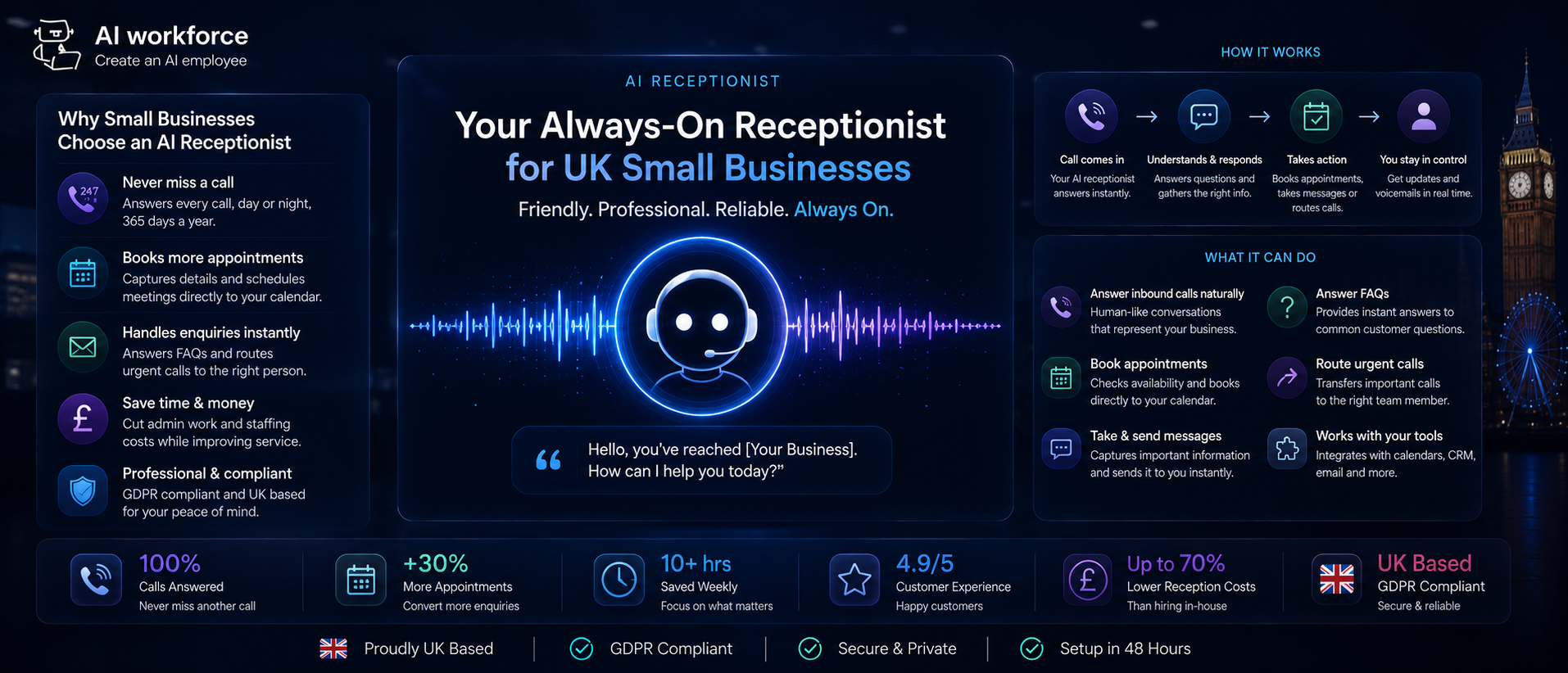
An unanswered phone call can mean a missed enquiry, delayed service or a caller trying another business. An AI receptionist can increase call coverage by answering routine enquiries when staff are unavailable: it picks up the phone quickly, answers routine questions from approved business information, and books work even when the team is on a job or closed for the evening.
This guide walks through how these tools work, what they typically cost in the UK, how to properly compare providers, and what should never be left to AI alone. If you're comparing options for the first time, keep reading.
Quick Answer
An AI receptionist is software that answers a business phone number, holds a natural conversation with the caller, and completes approved actions such as answering FAQs, taking messages, routing calls and booking appointments. It can increase the proportion of calls answered without requiring an additional staffed shift, although performance still depends on telephony capacity, configuration and integration reliability. It is not foolproof. Complaints, emergencies, payment disputes and anything outside its approved knowledge should always reach a person.
At a Glance
What it is: AI front-desk software for answering, booking, routing and message capture
Best suited to: small businesses losing enquiries because calls arrive when staff cannot answer
Current pricing examples: published UK entry prices can begin in the tens of pounds per month, with total cost increasing with usage, integrations and human backup
Potential benefit: broader call coverage without another staffed shift
Key risk: giving a wrong answer or mishandling a call that should have reached a person
What Is an AI Receptionist and How Does It Work?
An AI receptionist is software that answers a business number the way a trained person would, using natural speech technology to understand a caller and respond without a rigid menu of options. It handles the routine part of a conversation, freeing an actual team member from picking up the same handful of questions all day. It feels different from an automated phone menu almost immediately, since it responds to what a caller actually says rather than requiring a button press.
Business owners are adopting this quickly because the underlying maths is simple: a missed call can be a missed job, and wider call coverage closes that gap without needing another staffed shift. Accent recognition varies by provider, model, line quality and caller, so UK regional accents should be tested against real call scenarios rather than assumed from a demo.
For businesses that currently rely on staff availability or voicemail, AI receptionist software can provide an additional call-handling layer during busy or out-of-hours periods, though it is not a guarantee that every single call is captured; telephony outages, concurrency limits and integration failures can still affect coverage, which is why a fail-safe path still matters and is covered later in this guide.
AI Receptionist vs AI Answering Service vs AI Voice Agent vs Traditional Answering Service
These terms overlap heavily in vendor marketing, which makes it harder to know exactly what a specific product does.
AI receptionist is the commercial, front-desk product most small businesses actually buy: answering, booking, routing, CRM logging and provider comparison sit under this umbrella
AI answering service describes the narrower call-answering job specifically: FAQs, messages and basic routing, which may or may not include the fuller booking and routing workflow. For the deeper mechanics of how a call should move from answered to resolved, see our AI Answering Service guide
AI voice agent is the broader underlying conversational technology that can power a receptionist and can also handle outbound calls and other use cases beyond front-desk coverage
A traditional answering service uses human operators answering on behalf of one or more businesses. The amount of business-specific knowledge, booking capability and integration varies by provider
This guide is the buyer-focused version of that picture: what to look for, what it costs in the UK, and how to compare providers. For the broader conversational technology underneath it, including outbound calling, see our AI voice agents guide.
The AI Workforce Receptionist Fit Check
Before comparing providers, it's worth working through five questions that determine whether an AI receptionist will actually fit how your business runs. At AI Workforce, we call this the Receptionist Fit Check.
Illustrative framework. The right answer to each question depends on your own call patterns, not a generic template.
Call Type: what proportion of your calls are genuinely routine- hours, pricing, availability- versus calls that need judgement? A business with mostly routine calls may have more scope for bounded automation than one where most calls require judgement.
Knowledge: can the answers a caller needs actually be grounded in information you control- your services, pricing and policies- rather than left for the system to guess at?
Booking: do you have clear, consistent scheduling rules, appointment types, durations, buffers, that a system could apply the same way every time? Our AI Appointment Setter guide covers this in more depth.
Escalation: which calls must always reach a person, and can that list be written down rather than left to the system's judgement?
Integration: which calendar, CRM and phone system does a receptionist need to connect to, and does the provider you're considering actually support that without a complicated migration? See our AI CRM guide for what good CRM integration looks like.
A business that is well suited on Call Type and Knowledge but has not defined Escalation is not ready to expand automation yet, not because the technology can't help, but because the boundary hasn't been defined. Working through these five questions before evaluating providers is what turns "we should get an AI receptionist" into a workable brief. If you want a broader read on organisational readiness before adopting AI tools generally, our AI Readiness Assessment covers that in more depth.
Here's what that looks like in practice. A plumbing company receives a call at 7:30 pm. The caller reports a leaking radiator. The system identifies the enquiry as a service request, captures the postcode and problem, checks whether it falls inside the company's service area, offers the next available slot and sends confirmation. If the caller instead reports flooding near electrics or another safety issue, the workflow stops normal booking and follows the company's emergency escalation rule.
Someone in the business should own the receptionist's knowledge base, because an accurate system in January can become an inaccurate one by March if prices, opening hours or booking rules change and nobody updates them.
What Should an AI Receptionist Never Handle Alone?
A fair account of this technology has to be explicit about where a person should stay involved, not just where AI helps. The workflow should normally escalate to a person, or follow a predefined emergency or safety procedure, where a call involves:
an emergency or a safety-sensitive issue
a safeguarding concern
a complaint or a dispute
a payment dispute
an unusual pricing or discount request
a request for legal advice
sensitive medical information beyond a defined routing rule
a question with no answer in the system's approved information
repeated misunderstanding within the same call
an explicit request from the caller to speak to a person
Illustrative split. Your own risk tolerance and call patterns should determine exactly where a given task lands.
None of this is a reason to avoid the technology. It's a reason to define the boundary in writing before a system goes live, so the automated portion stays trustworthy precisely because it was never asked to handle what it shouldn't. Our recommended standard is to tell callers clearly and early that they are speaking with an AI receptionist, rather than allowing them to assume they are speaking to a person.
How Does AI Receptionist Fit Vary by Business Type?
Fit varies meaningfully by business type, and being upfront about that is more useful than a blanket yes.
Trades (plumbers, electricians, builders): a practical use case. Calls arrive constantly while staff are on-site or up a ladder, and capturing a job's details on the first ring has an immediate, visible payoff.
Dental and clinic-style bookings: suitable for bounded administrative calls with clinical escalation controls. Booking volume is high and predictable, but appointment and health-related data needs careful handling. Our guide to AI receptionists for dentists covers dental-specific booking, urgent-call escalation and practice-management integration, while our AI and GDPR compliance guide covers the wider data-protection requirements.
Estate agents: practical for listing enquiries and viewing bookings. Enquiries, viewing requests and routing to the right negotiator are exactly the repetitive, structured calls this technology handles well. Our guide to AI receptionists for estate agents covers property enquiries, viewing bookings, valuation leads, listing-data accuracy and human escalation in detail.
Recruitment agencies: practical for routine candidate and vacancy enquiries where teams handle frequent candidate calls, interview scheduling, vacancy enquiries and new client opportunities. An AI receptionist can answer routine vacancy questions, capture candidate details, book interviews against live consultant availability and route existing candidate or client matters to the right person, while anything sensitive or consequential stays human-led. Our guide to AI receptionists for recruitment agencies covers candidate calls, interview booking, client enquiries, ATS/CRM integration and human escalation in more detail.
Staffing agencies: practical for bounded after-hours operational calls where worker and client enquiries continue outside the normal office day. An AI answering workflow can capture shift call-offs, identify urgent requests for replacement cover, route time-sensitive calls to the on-call team, and record payroll or timesheet enquiries for the correct desk, while staffing decisions and sensitive worker matters stay human-led. Our guide to AI answering services for staffing agencies covers 24/7 worker enquiries, shift call-offs, urgent client cover, payroll and timesheet routing, and human escalation in more detail.
Restaurants and hospitality: practical for routine booking and information calls where staff regularly miss calls during service. An AI receptionist can answer opening-hours and menu questions, capture bookings and route unusual requests to staff. Our guide to AI for restaurants in the UK covers how this fits alongside demand forecasting, staff scheduling, inventory and other restaurant AI use cases.
Solicitors and other regulated advice services: conditional use. Intake and appointment booking work well; anything resembling regulated advice or a sensitive matter needs to escalate, not be answered. The same principle applies in financial services: our guide to AI tools for mortgage brokers explains how AI receptionists can capture enquiries and book appointments while mortgage advice and suitability decisions remain broker-led.
Emergency or crisis-facing services: autonomous handling is generally inappropriate; restrict to predefined routing where applicable. The consequences of a wrong call are too high for anything beyond routing to specialist, human-led procedures.
If you'd like a broader sense of where call answering typically sits against other early automation priorities, our guide to AI agents for small businesses covers that context.
How Does This Compare to a Traditional Receptionist Setup?
An AI receptionist versus a traditional answering service comes down to who is actually on the other end of the line: one is software, the other is a person, often working from a script and shared across several clients at once.
Illustrative comparison. The right choice still depends on call volume, budget and how much judgement a typical call requires.
Versus a fully human-staffed setup, an AI-driven option scales during a busy patch without needing extra staff rostered on, subject to the provider's own concurrency and telephony limits. A human receptionist still has real advantages for genuinely complex or sensitive calls. A hybrid model can use AI for defined routine call handling while keeping a person available for calls requiring judgement or physical front-desk work.
How Much Does an AI Receptionist Cost in the UK?
AI receptionist pricing varies widely by call allowance and functionality, and the honest starting point is that there is no single "typical" number worth anchoring to. As one current UK example, IONOS prices its AI Receptionist, as of August 2026, at three tiers: £39 a month excluding VAT for 30 calls, £69 a month excluding VAT for 100 calls with added features such as a website chat agent and call forwarding, and £99 a month excluding VAT for unlimited calls with outbound calling and appointment scheduling added. Pricing can change quickly; always check a provider's current pricing page directly before budgeting, and confirm whether quoted figures include VAT.
Other providers price differently. RingCentral AIR starts at £32 in the UK with 100 minutes included, with additional 100-minute bundles available beyond that. Moneypenny advertises its AI Receptionist from £25 a month as a headline starting price, though the exact figure for your setup is quoted rather than published in a fixed tier list, since it depends on call volume and how much human backup is included.
A staffed receptionist carries salary and employer costs that are materially higher than a typical AI receptionist subscription; salary, employer National Insurance, pension contributions and holiday cover all add up, although the two are not direct substitutes, since a person can handle a far broader range of judgement-based work than an AI system should be given on its own. Whatever the headline monthly figure, check what's actually included: some providers charge extra for call forwarding, SMS confirmations or additional integrations, so compare the expected monthly cost at your own call volume rather than the headline subscription alone. For the broader infrastructure behind those costs, including speech-to-text, language-model usage, text-to-speech, telephony, phone numbers and concurrency, see our guide to AI voice agent pricing in the UK. For a wider view of what UK small businesses typically pay for AI tools beyond call answering, see our guide to AI automation pricing in the UK.
Comparing AI Receptionist Providers
Rather than naming one product as the winner, it's more useful to understand how a few well-known UK-relevant options actually differ, since the right one depends on your call volume and how much human backup you want built in.
This is a desk-based comparison using current provider documentation and pricing, checked in August 2026, rather than hands-on testing of every platform.
IONOS AI Receptionist (from £39 a month excluding VAT), worth considering for self-service. It learns from your existing website, lets you customise greeting and tone, sends a call summary and history by email, and is positioned around UK data handling and GDPR compliance. It is fully automated, with no human fallback built into the product itself.
Moneypenny (advertised from £25 a month, quoted against your setup), worth considering where human fallback matters. It takes a hybrid approach: AI handles routine calls, with optional escalation to your own team or to Moneypenny's human receptionists when judgement is needed. It supports payment taking during a call and offers sector-specific configurations for legal, property, automotive and accountancy businesses.
RingCentral AI Receptionist (AIR) (from £32 a month for 100 minutes), worth considering where wider telephony integration matters. It offers multi-language support including UK English, contextual call transfers, call routing by name or department, and detailed call analytics. It also offers a standalone version that can sit in front of an existing phone system rather than requiring a full platform switch.
Beyond these three, expect a wider and fast-changing market of platforms built specifically for trades, clinics and professional services. Put these questions to any provider directly before committing:
Does the platform answer strictly from information you control, or can it generate an answer when it doesn't know something?
What triggers a transfer to a person, and can that list be configured to match the escalation rules covered above?
Does it integrate with the calendar, CRM and phone number you already use?
How are simultaneous calls actually handled, and what happens once capacity is reached?
Is every call recorded, transcribed and logged, and can you inspect that record afterwards?
What is the real pricing at your own call volume, not just the headline monthly figure?
Which AI Receptionists Are Worth Considering for a UK Small Business?
There is no universal best provider. Based on current published positioning and features, IONOS may be worth considering for self-service, RingCentral AIR where broader telephony integration matters, and Moneypenny where access to human backup is important. Verify the exact features, integrations and pricing directly before choosing. Use the Receptionist Fit Check earlier in this guide to work out which of those priorities matters most before you start comparing quotes.
Is There a Trial Worth Testing First?
Where a provider offers a free trial, use it to test the system against your own call scenarios rather than relying only on a vendor demo. Judge a trial the way you'd judge a paid plan: does it capture the right information, and does it know when to transfer a call rather than guessing?
A free trial is different from a permanently free receptionist plan. Trials are useful for testing real call scenarios, but ongoing production use normally moves onto a paid allowance or usage model once the trial period ends. Test more than one provider against the same scenarios if practical, using the same evaluation criteria.
Before You Buy: A Checklist
Before committing to a provider, check:
existing phone number compatibility, so you're not forced onto a new number
the simultaneous call limit, and what happens once it's reached
UK accent testing against your own team and customer base, not just a demo voice
calendar integration with the system you already use
CRM integration, and what fields it can actually read and write
transfer rules, and whether they match your own escalation list
knowledge-base grounding, and whether the system will say "I don't know" rather than guess
fail-safe behaviour if an integration or the phone line itself goes down
recording and transcription options, and where that data is stored
retention controls for call recordings and transcripts
SMS capability, if written confirmations matter to your customers
the actual monthly cost at your real call volume, not the advertised entry price
A Four-Stage Rollout
Rolling out an AI receptionist against a defined, tested setup is safer than switching on full call coverage from day one.
Illustrative roadmap. Expand coverage only once the earlier stages have proven themselves.
Stage 1, analyse calls: review your actual call history to identify common call types, booking patterns and the calls that already need a person, and use that to build your escalation list.
Stage 2, build and test: configure the knowledge base, booking rules, calendar and CRM connections, and the specific transfer triggers from the never-handle-alone list above.
Stage 3, controlled launch: put the system live on out-of-hours or overflow calls first, while your existing team continues handling calls during business hours, and review every transcript from this period.
Stage 4, expand or hold: increase coverage only after reviewing transcripts, failed calls and transfers from the controlled launch, and only where that review shows the system is escalating correctly.
Do not judge the pilot only on whether callers liked the voice. A natural-sounding system that gives the wrong answer is a worse receptionist than a slightly less polished system that retrieves the right information and escalates correctly.
How Should You Measure an AI Receptionist?
Call volume answered isn't a sufficient measure on its own, since a system can process a large number of calls while quietly giving wrong answers or mishandling bookings. Track a broader set of indicators:
Answer rate, the share of inbound calls actually picked up
Abandoned-call rate, how often a caller hangs up mid-conversation, since a good answer rate can still hide poor call handling if callers are giving up before the call resolves
Booking completion rate, for calls where booking was the goal
Successful transfer rate: how often an escalated call actually reaches a person cleanly
Incorrect-answer rate: how often the system gave information that was wrong or ungrounded
Human takeover rate: how often a person has to step in mid-call
Repeat-call rate: callers who call back because the first call didn't resolve their need
Cost per successfully handled call, measured against your real call volume, not the advertised entry price
Incorrect-answer rate is particularly useful for checking whether the system remains grounded in approved information rather than guessing. Track it alongside escalation accuracy, successful resolution and call outcomes rather than relying on call volume alone.
Related Guides
AI Answering Service: A Practical Guide for UK Small Businesses
AI Appointment Setter: A Practical Guide to Automated Booking
AI CRM: A Practical Guide to AI-Powered Customer Relationship Management
Sources and Methodology
IONOS AI Receptionist, pricing and product pages
RingCentral AIR, pricing and product pages
Moneypenny AI Receptionist, pricing and product pages
The AI Workforce Receptionist Fit Check, worked plumbing example, evaluation checklist, rollout model and measurement framework are AI Workforce frameworks and illustrations rather than industry standards or independent benchmarks. Provider comparison is desk-based and uses provider-published information checked in August 2026; AI Workforce has not hands-on tested every provider in this article.
Frequently Asked Questions
What is an AI receptionist?
An AI receptionist is software that answers a business phone number, understands what a caller needs, and completes approved actions such as answering questions, taking messages, routing calls and booking appointments, escalating anything outside its approved scope to a person.
How much does an AI receptionist cost in the UK?
It varies by provider and call volume. As one current example, IONOS prices its AI Receptionist at £39, £69 and £99 a month excluding VAT across three tiers as of August 2026; other providers price by minute or call allowance, so compare the expected monthly cost at your own call volume rather than the headline figure alone.
Is an AI receptionist cheaper than hiring a person?
The cost structures are different. A staffed role includes salary and employer costs; AI costs include subscription or usage, telephony, setup, integrations and monitoring. They are not direct substitutes because a person can cover duties outside the AI workflow.
Can an AI receptionist handle multiple calls at once?
Yes, subject to the provider's own concurrency and telephony limits, unlike a single person who can only take one call at a time.
Does an AI receptionist understand UK regional accents?
Accuracy varies by provider, model, line quality and caller, which is why accent testing should be part of any trial rather than assumed.
Is a free trial the same as a free plan?
No. A free trial is useful for testing real call scenarios, but ongoing production use normally moves onto a paid allowance or usage model once the trial ends.
What should an AI receptionist never handle without a person?
Emergencies, safeguarding concerns, complaints, payment disputes, legal questions, sensitive medical details beyond a defined routing rule, and anything outside its approved information should always reach a person or be flagged for one.
Does GDPR apply to AI receptionist call data?
Yes. Call recordings, transcripts and caller details are personal data whenever they relate to an identifiable person, and UK GDPR applies regardless of which provider handles the call. Our guide to AI and GDPR compliance covers this in more depth.
How do I choose between providers?
Start with your own call patterns rather than a feature list: how many calls come in, what proportion are routine versus urgent, and which systems a provider needs to integrate with. Test at least two providers against the same real call scenarios before committing.
Key Takeaways
AI receptionists can increase call coverage for routine, bounded workflows subject to telephony and system capacity
The Receptionist Fit Check evaluates Call Type, Knowledge, Booking, Escalation and Integration before provider selection
Emergencies, safeguarding, disputes and questions outside approved information need defined human or emergency escalation
Fit varies by sector and call type; regulated, clinical and crisis-facing workflows require tighter boundaries
Compare providers using current pricing, integration support, concurrency, grounding and escalation controls
A free trial is not the same as a permanently free plan; test real call scenarios before committing to a paid tier
Start with overflow or out-of-hours coverage and expand only after reviewing real calls
Measure incorrect answers, escalation, booking completion and successful resolution alongside answer rate
This article is general information rather than legal or financial advice. Vendor pricing and features change; confirm current details directly with any provider before committing.
Book Your Free AI Receptionist Review
If your team is struggling to answer routine calls consistently, we can map your call types, escalation rules and integrations before comparing which receptionist setup fits the workflow.
About the Author
Clara Miller is a Content Marketing Specialist at AI Workforce. She covers how UK small businesses evaluate and adopt AI call-handling and front-desk tools, with a focus on separating genuine capability from vendor marketing claims.
This guide was reviewed by Seth Ayush at AI Workforce for clarity, structure and alignment with how UK small businesses actually evaluate and adopt AI receptionist providers.
Reviewed: August 2026