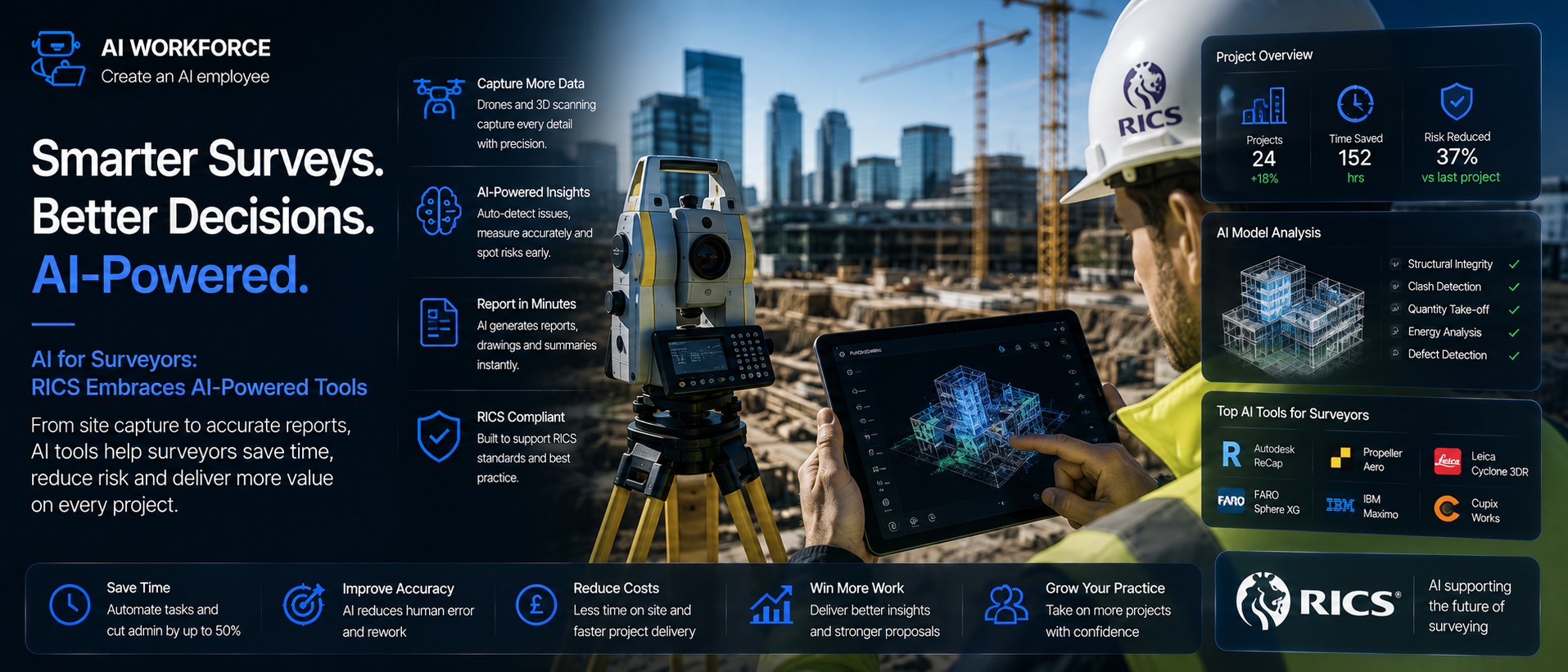
AI for Surveyors: Practical Uses, RICS Rules and Key Risks
Posted On: August 3, 2026
Written by Luca Controlo, AI Adoption and Marketing Automation Lead at AI Workforce · Reviewed by Rodi Taze, Co-Founder of AI Workforce
Last updated: August 2026
Quick answer: AI tools can help surveyors with document review, report drafting, data extraction, site and property research, early rights-of-light or daylight screening, workflow administration and quality-control checks. AI should support rather than replace professional judgement, and surveyors remain responsible for verifying outputs used in professional advice or regulated work. Since 9 March 2026, RICS members and regulated firms have also been subject to a dedicated professional standard covering AI outputs that have a material impact on the delivery of surveying services. Firms must also make and retain the records required by the standard, including materiality determinations and reliability decisions where applicable. The opportunity is therefore no longer simply to adopt AI faster. It is to use it in a way that preserves professional judgement, transparency and accountability.
At a Glance
Since 9 March 2026, RICS members and regulated firms have been subject to the professional standard on responsible AI use where AI outputs have a material impact on the delivery of surveying services
The standard requires governance, risk management, professional judgement, oversight, transparency with clients and, for firms building their own AI, responsible development practices
AI and specialist analytical software can support surveying tasks including defect detection, report drafting, document analysis, point-cloud and geospatial interpretation, rights-of-light and daylight/sunlight screening, and routine administration
Named tools exist for this profession, but their maturity varies considerably, and firms should verify capability against their own workflows rather than assume adoption
A surveyor's sign-off, and the professional judgement behind it, is the part no system replaces
This article provides general information about AI implementation and the RICS professional standard. It is not surveying, legal or professional-regulatory advice. Members and regulated firms should consult the current RICS standard and obtain appropriate advice for their circumstances.
What's Covered
1. What Is AI for Surveyors? | 13. How Can Different Surveying Disciplines Use AI? |
2. What Does the 2026 RICS AI Standard Require? | 14. Worked Example: Building Survey Inspection to Client Report |
3. Best AI Tools for Surveyors by Use Case | 15. What Should Never Be Left to AI Alone? |
4. The AI Workforce Surveying AI Model | 16. When Do Surveyors Need to Tell Clients They Use AI? |
5. What Can AI Actually Automate? | 17. UK GDPR and Client Confidentiality |
6. The AI Workforce Surveying AI Boundary Matrix | 18. How to Choose an AI Tool |
7. AI for Site Inspections and Fieldwork | 19. The AI Workforce Surveying AI Risk Register |
8. AI for LiDAR, Point Clouds and GIS | 20. How to Measure Whether It's Working |
9. AI for Survey Reports: What the Named Tools Actually Do | 21. Common Mistakes |
10. Can AI Review Property Documents? | 22. A Four-Week Rollout |
11. AI for Site and Property Research | 23. Frequently Asked Questions |
12. What Can AI Do in Rights-of-Light and Daylight Work? | 24. Key Takeaways |
What Is AI for Surveyors?
AI for surveyors covers the tools and techniques now used across building surveying, residential surveying, land and boundary surveying, valuation and geospatial work to speed up data capture, analysis, drafting and reporting. Depending on the use case, modern surveying tools may combine computer vision, machine learning, geospatial processing, optical character recognition and generative AI to interpret captured information or prepare a first-pass output. Most of this sits under the broader umbrella of proptech and geospatial technology, alongside more established survey and reporting software.
Since 9 March 2026, this is no longer only a technology question. The standard applies to AI outputs that have a material impact on the delivery of surveying services, and firms must make and retain the records required by the standard, including materiality determinations and reliability decisions where applicable. That changes what a responsible AI workflow needs to include: governance, records, risk controls and professional judgement, not simply a tool that saves time.
In our experience, firms that treat AI as something that supports the surveyor's judgement, rather than something that replaces it, are the ones getting genuine value from it under the new standard rather than exposure.
What Does the 2026 RICS AI Standard Require?
RICS published its first global professional standard on the responsible use of AI in surveying practice in November 2025, and it came into effect for all members and regulated firms on 9 March 2026. Since 9 March 2026, RICS members and regulated firms have been subject to the professional standard where AI outputs have a material impact on the delivery of surveying services. Deciding whether a specific use meets that bar is a matter of professional judgement, and RICS has said that grey areas will become clearer as the standard beds in; ultimately, it is for RICS's Regulatory Tribunal to determine whether a given use was material.
In practical terms, the RICS AI standard requires surveying firms to identify materially impactful AI systems, understand and govern their use, assess vendors before adoption, apply professional judgement to material outputs, document reliability decisions, maintain appropriate records and explain relevant AI use to clients.
The standard sets requirements across several areas:
Knowledge requirements: members and firms need enough understanding of an AI tool to assess whether it is appropriate for a task, without needing to become AI or computer science experts
Practice management: including data governance, system governance and risk management, such as maintaining a risk register for AI use
Procurement and due diligence: assessing a tool before adopting it, including asking a vendor what information it can provide about how the system works and its known limitations
Output reliability and assurance: for an AI output with a material impact, professional judgement must be applied and a written reliability decision made. That decision must be prepared by, or under the supervision of, an appropriately qualified and named surveyor who accepts responsibility for its use. For automated or high-volume outputs, RICS provides for reliability assurance through randomised dip samples taken at regular intervals appropriate to the system, risk and output, rather than requiring identical scrutiny of every single output (see the RICS standard, September 2025). This is not a general licence to spot-check all AI-assisted professional reports; firms should check the exact sampling provision in the current standard before relying on it
Client communication and transparency: telling clients when and how AI is used in delivering their service, covered in more detail below
Responsible development: additional obligations for firms building their own AI systems, including assessing data quality, sustainability impact and legal compliance before general deployment
The standard is deliberately written without heavy technical detail, so that it stays usable as the underlying tools change. RICS has published supporting case studies covering construction, valuation, commercial property, residential property, land and natural resources, and building surveying specifically. Its building surveying material discusses AI-based defect detection, using computer vision to flag issues such as cracks, damp, corrosion or incomplete installation, alongside AI-assisted report generation using natural language processing to convert site notes and images into structured documentation.
RICS AI Compliance Checklist for Surveying Firms
Identify AI systems that could materially affect service delivery
Record why each system is, or is not, considered material
Complete appropriate vendor and system due diligence before adoption
Maintain AI-related governance and risk controls, including a risk register
Assign a named, appropriately qualified surveyor to material reliability decisions
Record those reliability decisions in writing
Explain material AI use to clients in terms of engagement, before it is used
Provide clients with routes to challenge, seek redress or opt out
Protect personal, private and confidential data; obtain express written consent under the RICS standard before uploading a client's private or confidential data where required
Periodically review AI performance, risk registers and governance controls
What Counts as Material AI Use Under the RICS Standard?
There is no fixed list of tools or tasks that automatically count as material. Whether an output has a material impact depends on whether it is capable of influencing delivery of the surveying service and, if so, the nature of that influence, based on the specific facts and circumstances. RICS's own guidance points to outputs that make the surveyor's work meaningful, for example, a summary relied on when writing a report, an output composing all or a significant part of a professional opinion, or an output recommending which part of a building to investigate for a fault, as typically material. Routine administrative uses, such as drafting an internal email, are unlikely to meet that bar on their own.
Firms must apply professional judgement to this question and keep a written record of the AI systems they consider capable of materially affecting service delivery, and their reasoning why. Where the answer is genuinely unclear, treating the use as material, and applying the standard's requirements to it, is the safer default.
The wider profession's adoption of AI, though, is more uneven than the pace of regulatory change might suggest. RICS's 2025 global research found that 45% of surveyed organisations reported no AI use, while just 1% had scaled AI across projects. The study drew on responses from more than 2,200 built environment professionals worldwide.
Source: RICS, Artificial intelligence in construction report 2025, survey of more than 2,200 built environment professionals globally.
Sentiment is considerably more positive than usage: a large majority of surveying and construction professionals surveyed agreed AI will help the profession deliver greater value in the future, even where their own firm has not yet deployed it. That gap between enthusiasm and actual deployment is precisely why RICS built a governance-first standard rather than simply encouraging faster adoption.
Best AI Tools for Surveyors by Use Case
Rather than naming specific products, which change quickly, the table below sets out the type of tool that fits each common surveying use case, and the professional control that should sit alongside it.
Swipe to see all columns →
Surveying use case | Appropriate tool category | Required professional control |
|---|---|---|
Report drafting | Surveying report assistant | Surveyor verifies every material statement |
Document review | Document extraction and review tool | Extracted data checked against source |
Property research | Research and record-comparison workflow | Legal and planning status independently verified |
Rights-of-light screening | Specialist modelling or screening tool | Qualified specialist reviews assumptions and results |
Daylight/sunlight analysis | Specialist analytical software | Surveyor validates inputs, methodology and output |
Site-image analysis | Computer-vision or inspection platform | No replacement for required physical inspection |
Data extraction | OCR and document automation | Material fields verified before reliance |
CRM and administration | Workflow or practice-management automation | Client records checked proportionately |
Client follow-up | Approved communication workflow | Material or professional advice reviewed |
AI governance | Risk-register and audit documentation | Named owner maintains and reviews records |
The AI Workforce Surveying AI Model
Most surveying AI tools follow a version of the same underlying pattern, whether they are drafting a report, classifying a defect or interpreting a point cloud. AI Workforce developed the AI Workforce Surveying AI Model as a practical implementation framework for deciding where AI can support a surveying workflow without replacing professional judgement. It is a useful way to check whether a specific tool, or a specific task, is actually a good fit for automation.
The eight stages behind a well-governed surveying AI workflow.
Capture→Analyse→Flag→Prepare→Verify→Approve→Record→Learn
Capture: approved site information is collected, including photographs, measurements, scans and notes
Analyse: AI or specialist software identifies patterns, extracts information or compares captured material against defined criteria
Flag: anomalies, potential defects, missing information and low-confidence results are surfaced for review
Prepare: the system drafts a report section, summary, schedule or visualisation
Verify: a surveyor checks measurements, source information, observations and any AI-generated conclusions
Approve: the responsible professional decides what can be relied upon or communicated to the client
Record: material AI use, review and relevant decisions are documented in line with company and RICS requirements
Learn: recurring errors and corrections are reviewed so the workflow, instructions and controls can improve
A workflow that jumps from Analyse straight to a client report, valuation or professional recommendation, without Verify and Approve, is the wrong model for professional surveying. Those two stages are what the RICS standard is really asking every firm to build around.
What Can AI Actually Automate?
The clearest starting point for most firms is the repetitive, administrative side of a job: tagging photographs, logging measurements, formatting a report against a firm's own template. Automation built into existing software can often handle this without anyone needing to change how they already work, which is part of why it tends to be where firms start.
This kind of support is meant to free up the problem-solving parts of a job, the parts that actually need years of experience, rather than to remove the surveyor from the process. The result, done well, is a genuine gain in efficiency rather than a marginal one: where a tool improves the consistency of data capture, it can also reduce the amount of manual correction and report preparation needed afterwards.
Feature extraction, the process of pulling a specific detail such as a boundary line or a structural crack out of a much larger image or dataset, is where this pays off most clearly. Our guide to AI document automation covers the same underlying extraction and validation pattern as it applies to business paperwork more broadly, and the same logic of extract, validate, then route to a person for anything uncertain applies directly to survey data.
The AI Workforce Surveying AI Boundary Matrix
Not every task carries the same risk, and treating them all the same is where AI rollouts in surveying tend to go wrong. AI Workforce developed the AI Workforce Surveying AI Boundary Matrix to give firms a usable rule for where that risk boundary actually sits, grouping surveying work by how much autonomy is appropriate.
Illustrative starting point. Your own risk tolerance, insurer requirements and RICS materiality assessment should adjust where a task sits.
Higher automation, spot-checked
Photo organisation and tagging, meeting transcription, formatting, extracting structured fields from a known template, routine calculations performed by established software, draft internal working notes.
AI prepares, surveyor verifies
Defect identification from images, condition-report drafting, comparison of survey observations, extraction from leases or title documents, point-cloud interpretation, first-draft client reports, risk flags, comparable-property research, rights-of-light and daylight/sunlight screening.
Surveyor-led, mandatory professional judgement
Final valuation opinions, material defect conclusions, causation, boundary opinions, professional recommendations, advice affecting legal rights, signed survey reports, final rights-of-light conclusions, and anything carrying significant safety, financial or legal consequences.
RICS has framed the new standard specifically around preserving the surveyor's skill, experience and professional judgement rather than replacing it. This matrix is one practical way to make that boundary explicit for your own firm, rather than leaving "human judgement still matters" as a general principle nobody can actually apply to a specific task.
AI for Site Inspections and Fieldwork
Data collection on site used to mean hours of manual note-taking that someone then typed up back at the office. AI-assisted tools can now help process captured data considerably faster than that manual step, turning notes, photographs and measurements into a structured first draft much sooner after the visit, though the exact time saved depends heavily on the tool, the job type and how much review the firm chooses to keep in place.
Automating the most repetitive fieldwork tasks, tagging photographs, logging measurements, formatting a report template, is usually where a firm starts. Our guide to AI agents for small businesses covers the broader pattern of using defined, permissioned automation for repetitive multi-step tasks, which applies just as much to a survey workflow as it does to back-office administration.
AI for LiDAR, Point Clouds and GIS
This distinction matters, and it is worth being precise about it. LiDAR, photogrammetry and GIS are not themselves AI technologies. LiDAR is a sensing and mapping technology that captures millions of data points across a site in minutes; GIS platforms layer that information against existing maps, boundaries and planning data. Neither is inherently AI.
What AI adds is a layer on top of that data: automated classification and computer vision applied to a point cloud or a set of images to identify surfaces, structures or potential anomalies within the dataset. A surveyor might use LiDAR to create a point cloud, then apply automated classification or computer vision to identify surfaces, structures, geometric changes or anomalies that warrant professional investigation, rather than working through the raw dataset entirely by hand. There is genuine, published research on combining deep-learning techniques with point-cloud data to automate geometric measurement and compliance assessment, so the broader proposition that AI can meaningfully speed up interpretation of this kind of data is well supported, even though the sensing technology itself is not AI.
Visualisation tools then turn the combined output into something a client can understand: a three-dimensional view of a site rather than a page of coordinates. This kind of detail increasingly feeds into land value assessments and the descriptions used in a formal report, though the underlying professional opinion still needs a surveyor's sign-off.
AI for Survey Reports: What the Named Tools Actually Do
A handful of platforms are built specifically for this profession, and it's worth being precise about what each one actually offers rather than treating "AI in surveying" as a single undifferentiated category.
GoReport is a surveying and reporting platform used for digital site inspections, data capture and report generation, with newer AI-assisted features designed to support report drafting and quality control. Its own materials describe using AI to expand shorthand field notes into polished report content and to help flag inconsistencies, while keeping a surveyor in control of the final output rather than operating as a standalone AI tool. It is a real, actively used platform in residential and building surveying, though we would not describe it as one of the most widely used platforms in the sector without independent adoption data to support that.
LandSurv.ai takes a different approach, aimed at land and civil engineering work rather than residential reporting. It describes itself as an AI-powered toolkit offering specialised agents, including tools for processing raw survey data, boundary analysis, civil plans, DXF file analysis and GIS visualisation, built to help process and interpret geospatial data more quickly than manual methods alone. As with any newer, specialist platform, firms should test it against their own workflows and professional requirements, ideally on a non-critical job first, before relying on it in live work.
In both cases, and with any similar tool, the output is a strong first draft, not a finished product. The review step, where a qualified surveyor checks the output against what was actually observed on site, is exactly where professional experience continues to matter most, and exactly what the RICS standard now requires you to be able to demonstrate.
Can AI Review Property Documents?
AI can extract, classify and summarise property information, but any material fact relied upon in a report, valuation or professional opinion must be checked against the original source. AI should not independently confirm title, lease interpretation, planning status or legal effect.
This applies across the range of documents a surveying job typically involves: leases, title documents, planning documents, schedules, previous survey reports, inspection notes, photographs, and specifications and supporting records. AI-based extraction can pull relevant fields and flag inconsistencies across these documents considerably faster than manual review, but the interpretation of what a lease clause or a planning condition actually means, and its effect on the job in hand, remains a professional judgement. Our guide to AI document automation covers the underlying extraction and validation pattern in more depth.
AI for Site and Property Research
AI can help collect and organise public information relevant to a job, compare records against each other, identify discrepancies for review, prepare a preliminary research pack, and record sources and retrieval dates so the research trail is auditable later.
It must not be treated as independently verifying legal title, planning status, boundaries, rights or easements, building-control compliance, or current property condition. Those all remain matters for a qualified surveyor, and in some cases a solicitor or conveyancer, to confirm from primary sources.
What Can AI Do in Rights-of-Light and Daylight Work?
Not every rights-of-light, daylight or sunlight analysis platform uses artificial intelligence. Many established systems rely on geometric modelling, defined calculations and specialist analytical methods. The distinction matters: AI may assist with screening, classification, data organisation or scenario comparison, but the underlying technical assessment may be produced by conventional specialist software.
AI and specialist software can support early rights-of-light and daylight/sunlight screening by organising site and model data, highlighting potentially sensitive receptors, comparing scenarios and identifying areas requiring specialist investigation. These outputs are preliminary screening or analytical support, not a final professional conclusion. On the design side, our guide to AI tools for architects explains how architects use AI for early massing, daylight screening and site analysis before specialist verification.
Public evidence of firms using specifically AI-labelled rights-of-light or daylight tools remains limited. Some specialist surveying and proptech providers offer digital modelling, screening or analytical platforms, but those capabilities should not automatically be described as AI. Verify each provider's current documentation before making that distinction, and cite a vendor's own materials rather than presenting an unverified deployment as established fact.
In practice, this kind of support covers:
Early development-risk screening
Organising drawings, model information and site data
Highlighting windows, rooms or neighbouring properties requiring investigation
Comparing development scenarios
Preparing results for specialist review
Recording assumptions and data sources
Escalating uncertain or material results
RICS describes rights of light as a specialist area carrying potentially significant implications for development, compensation and legal remedies. See RICS Rights of Light standard.
It is worth being precise about terminology here, since the two are commonly confused: rights of light is a potentially enforceable private legal right, while daylight and sunlight assessment is commonly carried out within planning and development contexts. The two should not be treated as interchangeable.
Can AI provide a reliable early rights-of-light risk screen?
AI-assisted tools may provide a useful early indication of where rights-of-light risk warrants closer investigation, provided the inputs, assumptions and limitations are understood. An early screen should not be treated as a definitive legal or professional conclusion.
Do AI-generated daylight and sunlight results need surveyor review?
Yes. AI-generated daylight, sunlight or rights-of-light results should be reviewed by an appropriately qualified surveyor or specialist before they inform design, planning, valuation, negotiation or client advice. The reviewer should check the input data, assumptions, methodology, confidence and limitations.
Can AI make a final rights-of-light conclusion?
No. Rights-of-light work combines technical analysis with legal, planning, valuation and professional considerations. AI can support analysis, but a qualified specialist must interpret the result and determine what advice is appropriate.
How Can Different Surveying Disciplines Use AI?
Building surveying: notes, photographs, defect flags and report preparation
Quantity surveying: document comparison, measurement preparation and cost-data organisation
Valuation and commercial property: research-pack preparation and anomaly identification, with valuation judgement retained by the surveyor
Rights of light: early screening and analytical support
Planning and development: document organisation, scenario comparison and research preparation
Land and geospatial surveying: classification and interpretation of point clouds or spatial datasets
Worked Example: Building Survey Inspection to Client Report
To make the model above concrete, here is what a well-governed AI-assisted workflow looks like for a single building survey.
A single inspection, shown against each stage of the Surveying AI Model.
09:00, Capture: the surveyor arrives on site and records dictated notes, measurements and property photographs
10:30, Capture continued: photographs are automatically associated with the relevant rooms or defects as they are taken
11:00, Analyse: approved software reviews the captured material for potential recurring defects or observations that appear inconsistent with the surveyor's own notes
11:10, Flag: anything low-confidence, unusual or inconsistent is surfaced rather than silently included in the draft
11:15, Prepare: the system produces a structured first draft using the firm's own approved reporting template
12:00, Verify: the surveyor checks every material observation, corrects terminology and rejects any unsupported inference the system has made
12:30, Approve: the surveyor determines the final condition rating, professional conclusions and recommendations, and decides what can go to the client
12:40, Record: the approved report is saved, along with whatever AI-use record the firm's governance policy and the RICS standard require
AI reduced the mechanical work of organising evidence and preparing the first draft. It did not inspect the property, determine causation, or assume professional responsibility for the report. That remained with the named surveyor throughout.
What Should Never Be Left to AI Alone?
The role of the surveyor is not disappearing. It is shifting toward the judgement calls a system genuinely cannot make on its own: interpreting an ambiguous finding, weighing context a photograph cannot capture, and standing behind a professional opinion. Where a surveyor is professionally responsible for a valuation, report or recommendation, using AI does not transfer that responsibility to the software, no matter how capable the tool becomes.
What changes is the balance of the working day: less time on formatting and data entry, more time on the analysis and client conversation that actually needs a trained person. That shift is only safe, though, if final valuation opinions, material defect conclusions, causation, boundary opinions and anything with significant safety, financial or legal consequences stay firmly in the surveyor-led tier of the boundary matrix above.
When Do Surveyors Need to Tell Clients They Use AI?
Where AI materially affects delivery of a surveying service, RICS requires specified information about that use to be included in the documents governing the client relationship, typically the terms of engagement, before the AI system is used. This should cover:
when AI will be involved in delivering the service
which parts of the process AI will be involved in
the extent of professional indemnity cover for the firm's use of AI, where available
the internal process for a client to contest use of an AI system
how a client can seek redress if they feel they have been negatively affected by AI use
whether, and how, a client can opt out of AI being used in the delivery of their service
Clients are also entitled, on request, to further detail: the type of AI system used, the nature and basic workings and limitations of its algorithm, an overview of the due diligence carried out before using it, how related risks are identified and addressed, and the decisions made about the reliability of its output. RICS has published a dedicated client information note setting this out in full. Treating this as a checkbox exercise misses the point: getting ahead of these questions in a client's terms of engagement, rather than only when asked, is what actually builds the trust the standard is designed to protect.
UK GDPR and Client Confidentiality
Surveying practices routinely handle personal data: homeowner names and addresses, photographs taken inside private homes, tenant information, title documents, financial information, client correspondence and property-access details. Where a document or dataset contains information relating to an identifiable person, UK GDPR applies to processing it, in exactly the same way it applies to any other personal data.
RICS's own client information note addresses this directly for AI specifically: firms must prepare any data intended for an AI system in a way that protects privacy, such as anonymising it where practical.
AI Workforce compliance note: under the RICS standard, a firm must not upload a client's private or confidential data to an AI system unless it has express written consent in advance from the affected client or stakeholder, and has taken reasonable steps to satisfy itself that doing so does not pose an unacceptable risk (see the RICS client information note). This is a distinct professional-standard obligation. It does not itself supply a UK GDPR lawful basis, is separate from any contractual confidentiality obligation, and is separate from consent as one of several possible lawful bases for processing under UK GDPR. Firms need to satisfy all of these separately, not treat one as covering the others.
Before connecting any AI tool to real client data, it is worth having clear answers on lawful basis, data minimisation, how long the vendor retains uploaded documents and extracted data, whether submitted material is used to train or improve the vendor's own models, where documents and data are actually processed and stored, and what access and audit controls exist. For higher-risk uses, for example, large-scale processing of special category data, it is also worth assessing whether a Data Protection Impact Assessment should be screened for and completed where required. Our dedicated guide to AI and GDPR compliance for UK businesses covers the underlying principles in more depth.
Compliance note: this is general information, not legal advice. Check current RICS and ICO guidance and take independent advice for anything that could materially affect a client or a member of the public.
How to Choose an AI Tool
Staying ahead of the curve doesn't mean chasing every new AI product that launches. It means picking one genuinely useful tool for a specific task, learning it properly, testing it against real jobs, and expanding from there once it is demonstrably paying off. Firms that treat AI as a co-pilot for the team, rather than a wholesale replacement for existing workflows, tend to get the most value from it.
Work through this checklist before committing to a platform:
Intended use: what specific task the tool is meant to support, and whether that matches how it will actually be used
Data quality: how the tool performs on your own site data rather than a vendor's polished demo
Explainability: whether the vendor can explain how the system reaches an output, in terms your team can actually assess
Audit logs: whether the tool keeps a record of inputs, outputs and changes that supports your RICS record-keeping obligations
Permissions: who within the firm can use, configure or approve outputs from the tool
Source traceability: whether an output can be traced back to the source document, image or dataset it was drawn from
Professional-review controls: whether output reliability decisions can be attributed to a named, appropriately qualified surveyor as the standard requires
Vendor data handling: what happens to uploaded client data, where it is processed, and whether it trains the vendor's own models
Integration: whether it works with the reporting software and templates you already use
Known failure modes: what the vendor discloses about where the tool is less reliable
Business continuity: what happens to your data and workflow if the vendor changes terms or stops trading
Cost and implementation burden: how pricing scales with your volume of jobs, and what it takes to get the team using it properly
Evidence from comparable surveying work: whether the vendor can point to genuine use in a similar practice area, not just a general AI capability
If you are still working out whether your firm is ready to commit budget to this at all, our AI readiness assessment is a useful starting point.
The AI Workforce Surveying AI Risk Register
RICS-regulated firms need risk controls and a risk register informing their AI governance. The table below is a practical starting structure for that record.
This is an AI Workforce implementation framework, not an official RICS template.
Swipe to see all columns →
Field | What to record |
|---|---|
Use case | The surveying task supported by AI |
Data source | Documents, photographs, scans or records used |
Tool/vendor | The system and version where relevant |
Output | Draft, classification, flag, analysis or recommendation |
Materiality | Why the output is or is not materially influential |
Human reviewer | Named responsible person or role |
Known failure modes | Errors, bias, missing data or unsupported inferences |
Verification method | How outputs are checked |
Escalation route | What happens when confidence is low or an error is found |
Review date | When the workflow and control will be reassessed |
How to Measure Whether It's Working
The most useful signal is not how many jobs pass through a tool, but how much of the AI-prepared output survives a surveyor's review without material correction. AI Workforce developed the AI Workforce Surveying AI Measurement Hierarchy to give firms a consistent way to track this: Jobs Processed, Material Correction Rate, Exception Capture Rate, Review Time and Net Time Saved, read together rather than in isolation.
Material correction rate: the share of AI-prepared outputs requiring a substantive professional correction, a wrong measurement, a missed defect, an unsupported conclusion, rather than a cosmetic edit
Exception capture rate: the share of genuinely unusual or low-confidence issues the system correctly routes to a surveyor for review, instead of silently letting them pass through in the draft
Review time: how long verification and correction actually take, tracked separately from drafting time rather than folded into a single vague "time saved" figure
Net time saved: drafting or processing time saved, minus the review and correction time it took to get the output to a state a surveyor could approve
A high material correction rate, or a low exception capture rate, on a specific task or defect type is a sign that the tool, or the way it has been briefed, is not yet reliable enough for that use case, and it should move down the boundary matrix rather than being pushed through faster. Reviewing these figures periodically, alongside a manual spot check of a sample of AI-assisted reports, gives a far more honest picture than judging a new tool on speed alone in its first few weeks.
Common Mistakes
Common mistakes to avoid: assuming a tool needs little to no review from day one rather than building in a genuine verification step, connecting a platform to every job type at once instead of proving it on one first, treating a named platform's existence as evidence that a workflow is already industry standard, skipping the terms-of-engagement disclosure that the RICS standard requires, and not documenting the reliability decision behind an AI-assisted output that could have a material impact on the service delivered.
A Four-Week Rollout
Week one: pick a single, well-defined task, most commonly report drafting or photo organisation, and trial one approved tool in a controlled environment or on appropriately selected low-risk workflows, with a surveyor reviewing every output in full.
Week two: review what the tool got right and where it needed correction. Note recurring error patterns by job type, property type or defect category.
Week three: update your terms of engagement and internal governance documentation to reflect the AI use, in line with the RICS standard's transparency requirements.
Week four: review the correction rate and time genuinely saved, decide whether to extend the tool to a second task or job type, and set a recurring review date.
Frequently Asked Questions
What are the best AI tools for surveyors?
The best tool depends on the workflow. Report assistants suit first-draft reporting, document tools support leases and planning records, computer-vision systems can flag potential defects, and specialist platforms can support geospatial or early rights-of-light screening. Every material output must remain traceable and subject to appropriate professional review.
What is the RICS AI standard for surveyors?
The RICS Responsible use of artificial intelligence in surveying practice professional standard has been effective since 9 March 2026. It applies to AI outputs that have a material impact on the delivery of surveying services and sets requirements covering baseline knowledge, practice management and governance, procurement and due diligence, output reliability and assurance, client transparency, and, where relevant, the responsible development of AI systems.
Is AI mandatory for surveyors?
No. Using AI is not compulsory. What is mandatory, since 9 March 2026, is that any use of AI with a material impact on surveying services complies with RICS's professional standard on responsible use, regardless of whether the firm has adopted AI widely or is only trialling it on one task.
Does the RICS AI standard cover simple tools like spellcheck or email drafting?
Generally no. RICS's own guidance says everyday administrative uses, such as drafting an email or booking a meeting room, are unlikely to have a material impact on surveying services, though members should apply professional judgement rather than assume every low-level use is automatically exempt.
Can a surveyor rely entirely on an AI-generated report?
No. AI-generated report content is a first draft, not a finished, reliable output. Where AI output has a material impact on the service, the responsible surveyor or firm should apply the review, reliability and accountability requirements set out in the current RICS standard before relying on that output.
Can AI provide a reliable early rights-of-light risk screen?
AI-assisted tools may provide a useful early indication of where rights-of-light risk warrants closer investigation, provided the inputs, assumptions and limitations are understood. An early screen should not be treated as a definitive legal or professional conclusion.
Do AI-generated daylight and sunlight results need surveyor review?
Yes. They should be reviewed by an appropriately qualified surveyor or specialist before they inform design, planning, valuation, negotiation or client advice, with the input data, assumptions, methodology, confidence and limitations all checked.
Is GoReport the same thing as an AI tool?
Not exactly. GoReport is a survey data capture and reporting platform that has added AI-assisted features, such as expanding shorthand notes and flagging inconsistencies, within a broader, established reporting workflow rather than being a standalone AI product.
What happens if a firm doesn't comply with the RICS AI standard?
Non-compliance is a professional conduct matter for RICS-regulated members and firms, in the same way as breaching any other RICS professional standard. Ultimately, it is for RICS's Regulatory Tribunal to determine whether a specific use of AI fell within scope and whether the standard's requirements were met.
Do I need to tell every client I use AI?
You need to disclose AI use in your terms of engagement wherever it could have a material impact on the surveying service you are delivering to that client, including what parts of the process are involved and how they can opt out or seek redress, as set out in RICS's client information note.
Key Takeaways
Since 9 March 2026, RICS's professional standard on responsible AI use applies to all members and regulated firms wherever AI has a material impact on surveying services
The standard requires governance, risk management, professional judgement, transparency with clients and, for firms building their own tools, responsible development practices
A well-governed AI workflow moves through Capture, Analyse, Flag, Prepare, Verify, Approve, Record and Learn, never straight from Analyse to a client-facing conclusion
Grade tasks by risk: high automation for admin and formatting, surveyor verification for drafting, defect flags and rights-of-light or daylight screening, surveyor-led judgement for valuations, causation and anything with legal or financial consequences
Rights of light is a potentially enforceable legal right; daylight and sunlight assessment sits within planning and development. AI can support early screening in both, but a qualified specialist must interpret the result
LiDAR and GIS are sensing and mapping technologies, not AI themselves; AI is the layer applied on top to classify and interpret the data they generate
Named platforms such as GoReport and LandSurv.ai are real and useful, but their maturity and adoption vary, and each should be tested against your own workflow before relying on it in live work
Where AI materially affects delivery of a surveying service, firms must give clients specified information about how it will be used and build that transparency into the client relationship
A surveyor's sign-off, and the professional judgement behind it, remains the part no system can replace
Ready to Bring AI Into Your Surveying Practice Safely?
AI Workforce helps surveying firms identify where AI can genuinely save time, where professional judgement must remain in control, and how to introduce AI in line with the new RICS standard.
Related Guides
Sources and Regulatory References
About the Author
Luca Controlo is AI Adoption and Marketing Automation Lead at AI Workforce, where he works with UK professional-services and built-environment firms on responsible AI adoption.
Reviewed by Rodi Taze, Co-Founder of AI Workforce.
This article provides general information about AI implementation and the RICS professional standard. It is not surveying, legal or professional-regulatory advice. Members and regulated firms should consult the current RICS standard and obtain appropriate advice for their circumstances.