AI Agent KPIs: Metrics, SLOs & Performance Thresholds
Posted On: August 18, 2026
Last updated: August 2026 · Written by Clara Miller, Content Specialist at AI Workforce · Reviewed by Rodi Taze, Co-Founder of AI Workforce
AI agent performance should be measured across six areas: business outcomes, quality, user experience, cost, reliability and risk, not by activity volume or uptime alone. This guide sets out the metrics that matter for each area, the formulas behind them, a role-by-role KPI matrix, risk guardrails and stop thresholds, and a worked dashboard example to help you evaluate whether an AI agent is actually working before you present results to anyone.
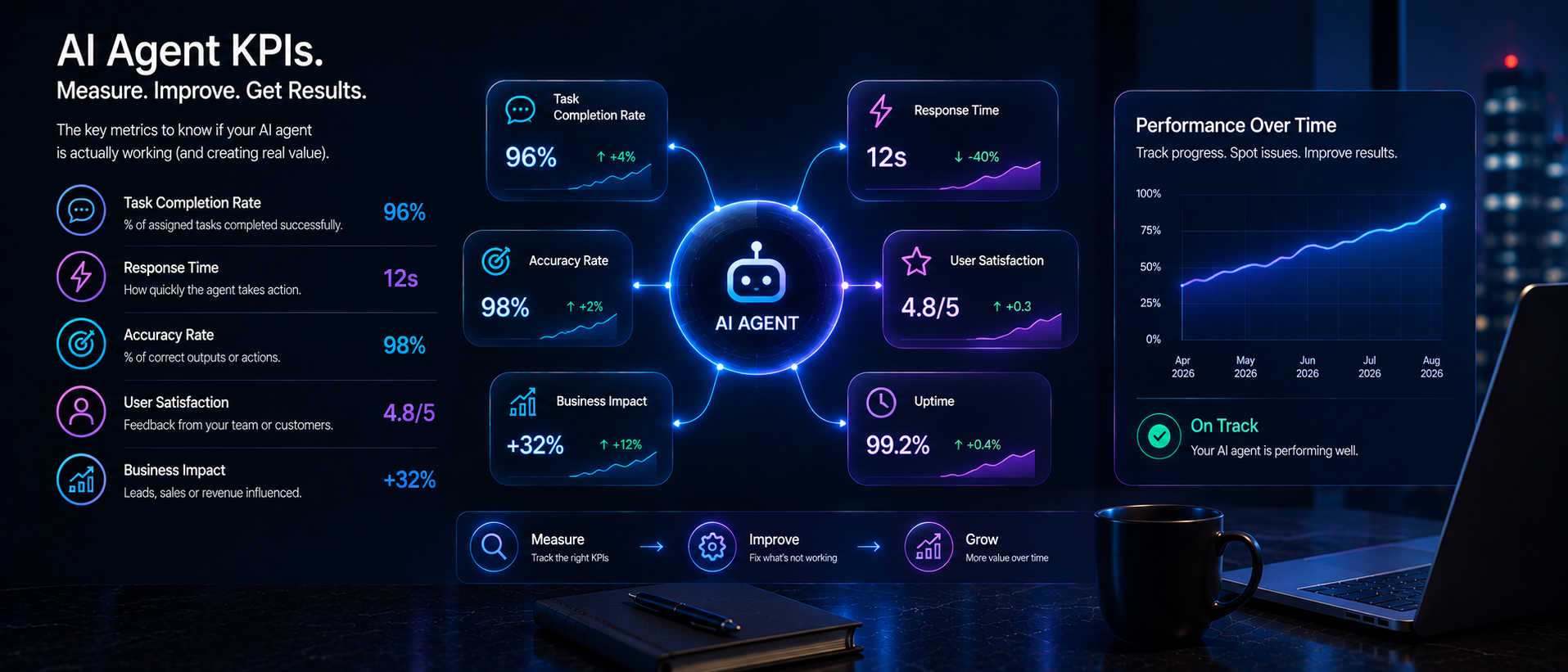
Measuring AI agent performance means tracking specific KPIs together, not one number in isolation: correct task completion rate, human-correction rate, missed-escalation rate, tool-call success rate, cost per successful outcome, net human hours recovered, ROI and policy-violation rate. Each should carry a defined guardrail and intervention threshold, and the right targets differ by agent role and risk tier — an AI SDR is judged on accepted opportunities, an AI receptionist on correctly resolved calls, a support agent on correct first-contact resolution, not on activity volume.
Core AI agent KPIs: correct completion rate · human-correction rate · missed-escalation rate · tool-call success · cost per successful outcome · net human hours recovered · ROI · policy-violation rate
For production agents, these KPIs can also be translated into service-level objectives (SLOs), such as a minimum tool-call success rate or maximum missed-escalation, latency or material-error threshold, with a predefined action when an SLO is breached.
AI Workforce developed the KPI Stack and six-layer measurement model set out below as practical operating frameworks for evaluating business AI agents.
Every AI agent should be measured using four connected elements: an outcome KPI, a quality measure, a cost measure and a risk guardrail.
The four elements every AI agent should be measured against, developed by AI Workforce. | |
Element | Question it answers |
|---|---|
Outcome KPI | Did the agent achieve the intended business result? |
Quality measure | Was the result correct and usable? |
Cost measure | Was the outcome economical after review and maintenance? |
Risk guardrail | Did the agent stay within acceptable operational and governance limits? |
The six-layer measurement model and the four-part KPI stack set out in this guide are AI Workforce frameworks, developed to translate established AI evaluation and risk-management principles, including NIST's AI Risk Management Framework, into practical, day-to-day agent measurement for UK businesses.
What's Covered
Foundations
Formulas and Accuracy
Escalation and Adoption
Cost, Risk and Governance
Implementation
Reference
What Metrics Should You Track for an AI Agent?
AI agent performance is rarely captured by one headline metric. A useful set of AI agent metrics spans several categories at once, from whether the agent completed the task correctly through to whether it stayed reliable, safe and economical while doing so.
Metric category | Example AI agent KPI |
|---|---|
Outcome | Correct task completion rate |
Quality | Material correction or factual-error rate |
Reliability | Tool-call success, integration failures and latency |
Human intervention | Escalation and missed-escalation rate |
Cost | Cost per successful outcome |
Business value | Net human hours recovered or conversion impact |
Risk | Policy violations, unsafe actions or rollback events |
The exact AI agent KPIs that matter, and the threshold each should be held to, depend on the agent's role and its risk tier, covered in more detail throughout this guide, rather than a fixed list applied identically to every deployment.
Why Do Traditional Metrics Fail for AI Agents?
Many conventional software dashboards emphasise deterministic measures such as uptime, latency and error rate. These remain necessary for AI agents, but they do not show whether a probabilistic, multi-step workflow produced the correct business outcome. An AI agent might complete a task correctly using a completely different approach each time, take longer on a harder question and still deliver more business value than a faster, shallower answer, or resolve most requests fine while quietly failing on a narrow but important category nobody is watching. Metrics fail here because they measure activity rather than outcome.
The deeper problem is that AI agent metrics need to answer a different question than legacy performance measurement ever had to. A call centre dashboard could measure average handle time and assume that shorter was better. Applied uncritically to an AI agent, the same logic can reward an agent for closing a conversation quickly rather than for actually resolving what the person needed. Uptime, latency and error rate matter, but they answer whether the AI system is running, not whether it is helping.
This gap explains why so many AI performance reviews quietly stall. Teams report high uptime and reasonable accuracy scores, then discover six months later that adoption has flattened, escalations are climbing, or the agent handles routine requests well but nobody trusts it with anything that matters. Fixing this starts with picking metrics that actually matter to the business case, and being precise about what "success" means for each specific agent, which is where a role-by-role framework becomes essential rather than optional. An AI agent, unlike a single-prompt chatbot, completes multi-step tasks with limited human input, which is exactly why a single technical score cannot capture whether it succeeded.
This approach is not invented in isolation. NIST's AI Risk Management Framework organises AI risk management around four functions: govern, map, measure and manage. Its Measure guidance specifically recommends objective, repeatable testing, documented evaluation sets, comparison against defined benchmarks and continued monitoring once a system is in production, not just at launch. That directly supports the baseline, pilot and re-evaluation approach set out later in this article. OpenAI's own practical guide to building agents similarly recommends establishing an evaluation baseline before deployment and treating human intervention thresholds as a first-class design decision, not an afterthought.
KPI Framework by AI Agent Type
Different agent roles fail in different ways, and the activity metric that looks impressive on a dashboard is often the wrong thing to be measuring. An AI SDR that sends thousands of emails is not succeeding if none of them convert. An AI receptionist that answers every call is not succeeding if it gives callers wrong information. Every agent needs an outcome KPI, a quality measure, a cost measure and a risk guardrail, defined before deployment rather than after.
AI Workforce AI Agent KPI Matrix: better performance measures by agent type, August 2026. These are starting measures to adapt to the agent's own workflow, risk and business objective, not universal performance targets. | |||
Agent | Misleading activity metric | Better outcome KPI | Essential guardrail |
|---|---|---|---|
AI SDR | Emails sent | Sales-accepted opportunities and held meetings | Opt-outs, complaints and deliverability |
AI receptionist | Calls answered | Correctly resolved or appropriately handed-off calls | Incorrect information and failed transfers |
Appointment agent | Conversations handled | Accurate, completed appointments | Duplicate bookings, correction rate and no-shows |
Lead agent | Leads generated | Sales-accepted qualified opportunities | Invalid records and qualification precision |
Marketing agent | Content produced | Qualified traffic, conversions or influenced pipeline | Approval rate, factual errors and brand compliance |
Support agent | Containment rate | Correct first-contact resolution | Reopened cases and inappropriate containment |
Admin agent | Tasks processed | Net human hours recovered | Correction and exception rate |
Finance agent | Documents processed | Accurate first-pass processing | Material errors and correctly detected exceptions |
This table is worth returning to before any KPI conversation, because it exposes the most common measurement mistake in one place: reporting on what the agent did rather than what it achieved. A support agent with a high containment rate that is quietly refusing to escalate legitimate cases looks successful on the dashboard and is actually creating risk. Every agent role listed here, and any new one your business adds, deserves this same four-part treatment before it goes live, whatever the underlying use case: AI agents for small businesses covers the wider landscape these roles sit within.
The exact outcome KPI changes by role, and the difference matters in practice. An AI SDR should be judged on accepted opportunities and held meetings, an AI receptionist on correctly resolved or appropriately handed-off calls, and an AI appointment setter on accurate, completed bookings rather than conversation volume.
The Six Layers of AI Agent Measurement
A single completion score compresses too much information to be useful on its own. The AI Workforce Six-Layer AI Agent Measurement Model separates measurement into six layers, each answering a different question about the same agent.
Layer 1: Eligibility and exposure. How many tasks were eligible for automation? How many were actually routed to the agent? Which tasks were excluded, and why? Without an eligibility denominator, completion and adoption rates are easily misleading, since a small, easy subset of tasks can produce an artificially strong completion rate.
Layer 2: Technical operation. Uptime, latency, tool-call success, integration failure rate, valid structured-output rate, and model or API errors. These establish whether the system operates, not whether it succeeds.
Layer 3: Outcome quality. Correct task completion, human-correction rate, factual-error rate, reversal or reopen rate, duplicate or unintended actions, and appropriate escalation rate.
Layer 4: User experience. Satisfaction, abandonment, repeat use, number of turns required, complaint rate, and handoff-context completeness.
Layer 5: Business value. Net human hours recovered, cost per successful outcome, qualified opportunities, revenue or pipeline influenced, avoided errors, and reduced waiting or resolution time.
Layer 6: Risk and governance. Data incidents, inappropriate autonomous actions, missed escalations, policy violations, opt-out or suppression failures, human overrides, and cases requiring rollback.
AI agents operate across all six of these layers simultaneously, and a KPI framework that only looks at the final outcome will miss where a specific failure actually originated. A production AI deployment that reports strong Layer 3 outcome quality but has never measured Layer 6 risk and governance has not actually been measured, it has been partially measured, and the gap is exactly where problems tend to surface first.
How Do You Define a Successful Outcome?
Before any of the six layers can be scored, "success" needs a precise, written definition for each agent, not a general impression of what good looks like. A successful outcome should specify: what the agent was asked to do, what counts as correct, what level of human involvement is acceptable within that definition, and what would disqualify an otherwise-completed task from counting as successful.
Task completion should be tracked across four states, not three. The first three describe increasingly involved but still acceptable outcomes: correct autonomous completion, where the agent resolves the task entirely on its own; correct completion with human intervention, where a person corrected or confirmed something along the way; and appropriate escalation, where the agent recognised its limits and handed off. The fourth state is the one most frameworks miss, and it is the most dangerous: incorrect or unsafe completion without appropriate escalation, where the agent confidently finished a task and got it wrong, with nobody catching it. An agent can be fluent, fast and entirely wrong at the same time, and a completion count that does not separately track this fourth state will not show it.
Defining success in writing, before deployment, also gives the business something to measure the baseline against, which is covered in more detail later in this article. Ownership of that definition should not sit solely with the team that built the agent. NIST's AI RMF Measure guidance specifically notes that risk assessment benefits from involvement beyond the people closest to development. For any agent above the lowest risk tier, involve the workflow owner, a domain expert who understands what "correct" actually means for that task, a risk or compliance owner where relevant, a representative of the people who will use or be affected by the agent, and, for high-risk agents specifically, someone independent of the build team.
AI Workforce Insight
The businesses that get the clearest read on AI agent success are the ones that wrote their definition of a successful outcome down before switching the agent on, and had a named person outside the build team agree it. A definition invented after the fact, or approved only by the people who built the system, tends to shift to match whatever number the agent happened to produce.
Core KPI Formulas
Precise formulas make AI agent metrics reusable across teams and comparable over time, rather than each report inventing its own interpretation of what a number means.
Correct autonomous completion rate
Correct autonomous completion rate = correctly completed tasks without human intervention ÷ eligible tasks attempted by the agent
Human-correction rate and review coverage
Human-correction rate = completed outputs requiring material correction ÷ outputs reviewed
Review coverage = outputs reviewed ÷ total outputs
Report the correction rate alongside review coverage, always. A 2% correction rate based on reviewing 1% of outputs is not equivalent to a 2% correction rate from reviewing every output, and reporting the first without the second overstates confidence in the number. Define "material correction" before measurement begins: a material correction changes the outcome, the data recorded, or the action taken; a stylistic edit to wording is not the same thing and should be tracked separately.
Cost per successful outcome
Cost per successful outcome = total agent operating cost ÷ correctly completed outcomes
Costs should include platform and model usage, infrastructure, human review, monitoring, maintenance, integration support and amortised implementation cost.
Net human hours recovered and cycle-time improvement
Net human hours recovered = previous human labour time − remaining human handling time − review time − correction time − allocated maintenance and administration time
Cycle-time improvement = previous elapsed completion time − agent-assisted elapsed completion time
These are two different things and should not be collapsed into one figure. Agent operating time is not necessarily human labour time; a ten-minute automated run does not consume ten minutes of employee capacity unless someone must wait for or actively supervise it. Net human hours recovered measures freed labour capacity. Cycle-time improvement measures how much faster the customer or downstream workflow gets an outcome. Both are genuine benefits, but they are not interchangeable, and reporting one as if it were the other overstates the case.
Escalation rate
Escalation rate = cases handed to a person ÷ eligible agent-handled cases
Track appropriate and inappropriate escalations separately rather than as one combined figure.
Missed-escalation rate
Missed-escalation rate = cases that should have escalated but did not ÷ cases requiring escalation
This is often more important than the raw escalation rate, since it captures the cases where the agent pushed ahead when it should have stopped.
ROI
Measured financial value = realised labour value + verified avoided cost + incremental contribution attributable to the agent − losses or remediation costs caused by the agent
ROI = (measured financial value − total agent cost) ÷ total agent cost × 100
Do not treat all time recovered as cash savings unless it actually reduces expenditure, avoids hiring, or creates measurable productive capacity elsewhere in the business. Avoid counting influenced pipeline or unrealised opportunity as measured financial value unless the attribution method connecting the agent to that outcome is clearly explained and defensible; unattributed pipeline influence belongs in a separate, clearly labelled category, not inside the ROI calculation itself.
How Do You Measure Accuracy and Task Completion?
"Accuracy" is not one universal metric, and treating it as though it were is a common source of confusion between teams reviewing the same agent. What counts as accurate depends on the type of task.
Task type | What "accuracy" actually means |
|---|---|
Answering a factual question | Factual correctness against an approved source |
Classifying an enquiry or reply | Classification precision and recall against labelled examples |
Choosing which tool or system to use | Correct tool selection for the situation |
Filling in a tool call | Correct parameter selection, matching the required format |
Updating a record | Correct record update, verified against the source system |
Following business rules | Policy compliance, checked against the defined ruleset |
Taking an action | Action success, confirmed by the receiving system, not just attempted |
Matching expert judgement | Human agreement rate against a domain expert's own assessment |
Delivering the intended result | Outcome validity, whether the end result was actually correct and usable |
Use the definition that matches the specific task before setting a target, rather than applying one general "accuracy" figure across an agent that does several different kinds of work.
Task completion sounds simple until you try to define it precisely. As set out above, the cleanest approach separates task completion into four states rather than three: correct autonomous completion, correct completion with human intervention, appropriate escalation, and incorrect or unsafe completion without appropriate escalation. Collapsing these into a single completion percentage hides exactly the information a team needs to improve the system, and specifically hides the fourth state, which is the one most likely to cause real harm.
A second layer worth measuring is how well the agent completes a task relative to what a person would have done in the same situation, using the actual previous process as the comparison point rather than a theoretical ideal. If human agents historically resolved a request correctly eight times out of ten, an AI agent completing it correctly seven times out of ten with faster response times may still represent a real improvement, provided the accuracy gap is understood and acceptable for that specific task and its risk tier.
That last qualifier matters. It is not accurate to say a modest accuracy trade-off for lower cost is generally acceptable; whether it is depends entirely on the task's risk tier. For lower-risk workflows, a modest quality difference may be acceptable where the cost and capacity benefits are substantial. Higher-risk tasks, such as payments, regulated communications, eligibility decisions or changes to customer records, need minimum quality and safety thresholds that cannot be traded away for speed or cost. The risk-tier framework later in this article sets out how to apply that distinction consistently.
What Does Good Performance Actually Look Like?
There is no universal benchmark for what a "good" completion rate, correction rate or escalation rate looks like across all AI agents, and any guide that publishes one without defensible supporting data should be treated with caution. What counts as good performance depends on task risk, the human baseline it is being compared against, the cost of an error, whether that error is reversible, the volume the agent handles, the direct impact on a customer, and the regulatory environment the task sits within.
A low-risk internal task with a fully reversible error and a weak human baseline can reasonably run with a lower accuracy threshold and lighter review than a high-risk, customer-facing, hard-to-reverse task with a strong human baseline already in place. Rather than adopting a fixed number from elsewhere, set the target for each agent using the risk-tier framework below, the documented baseline for that specific task, and the actual cost of getting it wrong, then treat that as the number worth defending rather than a generic industry figure.
Escalation, Human Intervention and Handoff Quality
Escalation rate, tracked properly, is one of the more diagnostic AI agent metrics available, because it tells you exactly where the agent's boundaries currently sit. A rising escalation rate is not automatically bad; it can mean the agent is correctly recognising the limits of what it should handle rather than pushing through with a low-confidence answer. A falling escalation rate is not automatically good either, since it can also mean the agent has quietly started attempting requests it should be handing off.
The more useful measurement sits one level deeper than the raw percentage: why is the agent escalating, and does that reason match what you would expect from a well-designed system. Escalations because a request falls outside the agent's defined scope are healthy and expected. Escalations because of a data gap, a tool failure, or genuine ambiguity point to a fixable problem rather than a natural boundary. Categorising escalation reasons, rather than only counting them, is what turns this metric into something actionable, and tracking the missed-escalation rate specifically, cases that should have escalated but did not, is frequently more revealing than the headline escalation figure.
It is also worth measuring how AI and human collaboration actually performs after an escalation happens. If a person has to start the conversation over because context was lost in the handoff, that is a real cost the escalation number alone does not capture. Handoff-context completeness, whether the receiving person got a full summary of what the agent already established, should be tracked as its own metric rather than assumed from the escalation rate.
Adoption, Exposure and Trust
Adoption metrics answer a different question from performance metrics: not whether the agent works, but whether people are choosing to rely on it. The distinction that matters most here is between exposure and adoption. The percentage of eligible tasks actually routed to the agent is exposure, not necessarily adoption, particularly where routing happens automatically and the user never actively chose it.
A more honest picture separates several related figures: agent exposure rate, the proportion of eligible tasks the agent was given; voluntary activation rate, where a person had a genuine choice and selected the agent; repeat-use rate, whether people who used it once choose to again; opt-out or bypass rate, how often people avoid or route around the agent when they have the option; eligible-task coverage, how much of the addressable workload the agent could plausibly handle; and active-user adoption, the proportion of eligible users engaging with it regularly.
A technically strong agent that people quietly route around is not succeeding, whatever its accuracy score suggests. Business impact metrics and adoption metrics should be read together rather than separately: an agent with excellent technical performance but low voluntary adoption will show almost no measurable business impact, not because the underlying AI system is weak, but because too few interactions are reaching it to move the numbers that matter. A content-generating role such as an AI marketing agent makes this especially visible. Strong output volume accompanied by low approval rates may indicate a quality or brand-compliance problem, while weak conversion or influenced-pipeline results may show that technically acceptable content is not producing meaningful business value.
Cost per Successful Outcome and ROI
Calculating AI agent ROI starts with an honest accounting of cost per successful outcome, not cost per interaction. Costs need to include the API or infrastructure spend, human review time still required, ongoing maintenance and monitoring, and the amortised cost of the original build. Many early ROI calculations only include the visible subscription or usage fee and miss the maintenance and oversight cost that keeps a production AI system reliable, which quietly inflates the apparent return. Our guide to AI automation pricing in the UK covers the underlying UK cost drivers behind these figures in more depth.
Avoided-hire savings deserve particular scrutiny before being counted as a real saving. They are only defensible where demand genuinely required additional capacity, hiring was planned or reasonably necessary, the agent actually absorbed that specific work, and existing staff did not simply inherit equivalent review and correction work in its place. Claiming a headcount saving that has actually just shifted into unmeasured correction time is one of the more common ways an ROI figure is quietly overstated.
Baseline comparisons also need more nuance than a single "before versus after" number provides. It is not accurate to say that comparing an AI agent against an inefficient previous process automatically overstates the improvement; comparing against the real previous process measures the real operational change that happened. What matters is being clear about which comparison is being made. A useful way to structure this is across four reference points: the actual baseline, what happens today before any change; the optimised manual baseline, what the process might achieve without AI if it were simply fixed; the agent-assisted result, what happens with the AI agent in place; and the target state, the business outcome actually required. Comparing the agent-assisted result only against the actual baseline shows the real operational change achieved. Comparing it against the optimised manual baseline shows what portion of that gain is specifically attributable to AI rather than to fixing a poor workflow. Both comparisons are useful; conflating them is the error.
ROI should be reviewed on a schedule, not treated as a one-off calculation done at launch and forgotten. Performance degradation is common as usage patterns shift, as the range of requests broadens beyond what the agent was originally tested for, or as underlying data quality drifts.
Risk Guardrails and Stop Thresholds
Not every KPI should carry the same acceptable threshold, because not every task carries the same consequence when the agent gets it wrong. A risk-tier framework makes this explicit rather than leaving it to individual judgement.
AI Workforce Risk-Tier Framework: measurement expectations by risk tier, August 2026. Assign every agent workflow to a tier before setting KPI targets; the measurement expectation, not just the KPI target, should scale with risk. | ||
Risk tier | Example | Measurement expectation |
|---|---|---|
Low | Internal summarisation | Sampled review and correction rate |
Medium | Appointment booking or CRM updates | High action accuracy, rollback and duplicate detection |
High | Payments, eligibility or regulated advice | Strict pre-deployment evaluation, human approval and incident thresholds |
A KPI target is incomplete without an intervention threshold attached to it. For every metric that matters, define the specific number that triggers investigation, restriction of the agent's autonomy, a rollback of a specific action, or a full shutdown of the workflow. A missed-escalation rate that climbs past a defined threshold, for example, should trigger an automatic review rather than simply appearing as a worse number on next month's dashboard. Guardrail metrics belong in Layer 6 of the six-layer framework above, and they need to be reviewed with the same regularity as the business-value metrics that tend to get more attention.
In production AI systems, some of these thresholds can also be expressed as service-level objectives (SLOs): defined performance or reliability expectations the agent should remain within. An AI agent SLO might cover a maximum missed-escalation rate, minimum tool-call success rate, maximum acceptable latency or maximum material-error rate. The important point is that an SLO should trigger investigation or intervention when breached, not exist only as a reporting target.
When Should You Stop or Restrict an AI Agent?
A KPI framework is not complete until it defines the specific conditions that should trigger a pause, a restriction, or a full stop, decided in advance rather than in the moment something goes wrong. Treat any of the following as a trigger for immediate review, not a number to note and revisit later:
A material-error guardrail has been breached
The missed-escalation rate has exceeded its defined threshold
A data or security incident has occurred
Cost per successful outcome has risen above the documented manual baseline
User or customer complaints are rising
Voluntary adoption is falling
A required integration is repeatedly failing
No measurable business improvement has appeared after the agreed pilot period
The agent is operating outside its approved scope
When a trigger fires, the decision should be one of four: continue in review mode with tighter human oversight, expand with additional restrictions in place, redesign and retest the specific part that failed, or stop the workflow entirely. Deciding this in advance, as part of the original KPI framework, removes the pressure to keep a struggling agent running simply because switching it off feels like admitting the project failed.
How Do You Establish a Reliable Baseline?
Without a documented "before" state, comparing performance after deployment is closer to opinion than evidence. Establishing a baseline properly means recording, before the agent goes live, how the task was actually being done: the real completion rate, the real error rate, the real time taken and the real cost, using the process as it genuinely operated rather than as it was supposed to operate on paper.
Business value should never be inferred from AI adoption numbers alone; adoption tells you people are using the agent, not that using it is helping them. A documented baseline, paired with the four-reference-point structure described above, is what allows a business to say with confidence how much of an observed improvement is actually attributable to the AI agent, rather than to a workflow fix that happened at the same time, or to a naturally quieter period. Our AI Readiness Assessment covers how to check whether your data, processes and ownership are actually in a fit state to establish this kind of baseline before a pilot begins.
A Four-Week KPI Pilot
Reliable evidence about an agent's performance is built in stages, not produced by a single evaluation run before launch. Four weeks is a practical starting structure for a reasonably high-volume, low-to-medium risk workflow, not a universal proof period. Low-volume, seasonal or high-risk workflows may genuinely need a longer evaluation before autonomy can safely expand, and the pilot length should be set against the agent's risk tier and volume, not applied as a fixed rule regardless of context.
This staged approach mirrors OpenAI's practical guide to building agents, which recommends establishing an evaluation baseline before deployment and treating human-intervention thresholds as a first-class design decision rather than an afterthought, and NIST's AI RMF Measure guidance, which recommends objective, repeatable testing and continued monitoring once a system is in production.
Week one, before launch: define eligible tasks, establish the manual baseline, set minimum success and safety thresholds for each risk tier, create a representative evaluation set, and agree who judges ambiguous outcomes
Week two, during the pilot: start with full human review of every output, categorise failures by cause rather than just counting them, compare performance by task type and risk tier, record review and correction time separately from operating time, and maintain a comparable manual group where practical
Week three, before expanding autonomy: check the missed-escalation and material-error rates specifically, review edge cases the pilot surfaced, confirm that logging and rollback actually work when tested, and require named approval before granting the agent any expanded permissions
Week four, production decision: this should not automatically mean production. Reach one of four decisions: continue in review mode, expand with restrictions, redesign and retest, or stop. Whichever is chosen, re-run the evaluation set whenever the prompt, model, integration or policy subsequently changes, and monitor operational failures continuously rather than only at scheduled review points from this point onward
This pilot structure applies whether the agent handles appointment booking, lead qualification or document processing; the specific KPIs change by role, but the evaluation discipline does not. Our guide on how to write an AI agent brief covers how to define the scope, permissions and escalation rules that this pilot then tests against, and our guide to build versus buy an AI agent covers how evaluation requirements should factor into that earlier decision.
A Worked Example Dashboard
A filled example is more useful than abstract advice alone. The figures below are hypothetical, illustrating how a completed KPI dashboard should read after a pilot, not a benchmark from a real deployment.
Illustrative AI Workforce dashboard, hypothetical figures for a customer-service agent pilot. | ||||
KPI | Baseline | Pilot result | Guardrail | Decision |
|---|---|---|---|---|
Correct autonomous completion | 0% | 71% | Minimum 70% | Continue |
Material correction rate | N/A | 8% | Maximum 10% | Continue |
Missed-escalation rate | N/A | 3% | Maximum 1% | Restrict autonomy |
Cost per correct outcome | £8.20 | £4.70 | Maximum £6 | Positive |
User satisfaction | 4.1/5 | 4.0/5 | Minimum 4/5 | Monitor |
Four of the five guardrails are met, but the missed-escalation rate has breached its threshold. Because this is a safety and control measure, not simply one metric among five, the correct decision is to restrict the agent's autonomy on the case types driving that result rather than approve an unrestricted production rollout. This is exactly the lesson the framework is designed to enforce: one serious guardrail failure should not disappear inside a favourable average.
How Do You Build an Executive Dashboard?
An AI agent dashboard should combine business KPIs with reliability, safety, cost and human-intervention metrics rather than presenting task volume as the headline measure.
A KPI dashboard for AI agents fails most often not because the underlying data is wrong, but because it tries to show everything at once. The version that actually gets used tends to lead with three or four business metrics: resolution rate, cost per successful outcome, escalation rate and a satisfaction or trust signal, with the more granular technical and layer-by-layer metrics available one click deeper for the team that needs to act on them.
Track performance data on a consistent cadence rather than only reviewing it when something goes wrong. A monthly review that compares current numbers against both the previous month and the original baseline catches drift early and gives a credible, evidence-based answer the next time someone in leadership asks whether the multiple AI agents now running across the business are actually paying for themselves.
The single most important habit is treating the dashboard as a decision-making tool rather than a reporting exercise. Every metric on it should map to a decision someone would actually make differently depending on what the number shows. If a metric would not change anyone's next action, it does not belong on the main dashboard, however easy it was to capture.
A Reusable KPI Worksheet
The framework in this article works best as a worksheet completed once per agent role, not a set of ideas held in someone's head. For each agent, record: the agent role; the definition of an eligible task; the written definition of a successful outcome; the specific formula being used for each KPI; the documented baseline; the target; the guardrail and its intervention threshold; the current result; the named owner; the review cadence; and the required action if a guardrail is breached.
Completing this worksheet for every live agent, and keeping it current as thresholds and results change, is what turns the KPI stack from a one-off pilot exercise into an ongoing governance habit. It is also the single document most useful to hand to a new team member, an auditor, or a board asking whether AI investment across the business is actually working.
Common Measurement Mistakes
Reporting activity metrics, emails sent, calls answered, tasks processed, as if they were outcome metrics
Treating adoption or exposure as proof of value, when it only shows the agent is being used, not that using it is helping
Trading accuracy for cost on tasks the risk tier does not actually permit
Counting avoided-hire savings without checking whether the work was genuinely absorbed rather than quietly shifted to correction time
Measuring escalation rate without categorising why the agent escalated, or tracking the missed-escalation rate at all
Reporting a correction rate without also reporting review coverage, so a low correction rate from a tiny sample looks safer than it is
Comparing performance against an idealised baseline rather than the documented, real previous process
Reviewing ROI once at launch and never again, missing performance degradation as usage patterns shift
Building a dashboard with every available metric rather than the handful that would actually change a decision
Letting the team that built the agent be the only ones who define and judge what counts as a successful outcome
Frequently Asked Questions
What is the single most important AI agent KPI?
There is not one. A defensible KPI framework always pairs an outcome KPI with a quality measure, a cost measure and a risk guardrail for the specific agent role, since any single metric can be gamed or misread in isolation.
How is a KPI different from a guardrail?
A KPI tracks how well an agent is performing against a defined target. A guardrail defines the threshold at which that performance becomes unacceptable and triggers investigation, restriction or shutdown. Every KPI worth tracking should have a guardrail attached to it.
What counts as a material correction?
A material correction changes the outcome, the data recorded, or the action taken by the agent. A wording or tone edit that does not change the substance of the output should be tracked separately and not counted in the human-correction rate.
Can I compare AI agent cost directly against a human agent's salary?
Only if the comparison includes the AI agent's full operating cost, platform, infrastructure, review time, monitoring and maintenance, against the human role's fully loaded cost, including employer costs and management time. Comparing a subscription fee against a gross salary understates both sides.
How often should KPIs be reviewed?
Operational failures should be monitored continuously. Quality metrics deserve a weekly review in the early stages of a deployment. Business value and ROI should be reviewed monthly, and the full evaluation set should be re-run whenever the model, prompt, integration or policy changes.
Does a high task completion rate mean the agent is working well?
Not on its own. A high completion rate paired with a rising human-correction rate, a rising missed-escalation rate, a breached safety threshold or declining voluntary adoption points to a problem the completion number alone will not surface.
Key Things to Remember
Every agent role needs an outcome KPI, a quality measure, a cost measure and a risk guardrail, defined before deployment, not a single completion score
Measurement works best across six layers: eligibility and exposure, technical operation, outcome quality, user experience, business value, and risk and governance
Task completion needs four states, not three; incorrect completion without escalation is the most dangerous and most commonly omitted category
Accuracy is not one metric; define what it means for each specific task, whether that is factual correctness, classification precision or confirmed action success
Accuracy can only be traded for cost on lower-risk tasks; higher-risk tasks need minimum quality thresholds that cannot be traded away
Adoption and exposure are not the same thing; a technically strong agent nobody voluntarily uses will show almost no measurable business impact
Missed-escalation rate is often more revealing than the raw escalation rate, since it captures cases the agent should have handed off but did not
Report human-correction rate alongside review coverage; a low correction rate from a tiny reviewed sample is not the same as a low correction rate from full review
Net human hours recovered and cycle-time improvement measure different things and should be reported separately, not combined into one figure
Establish a documented baseline before launch; comparing performance after deployment without one is closer to opinion than evidence
Define the specific triggers that should stop or restrict an agent in advance, and commit to one of four responses: continue, restrict, redesign, or stop
Every KPI needs an intervention threshold attached to it, the specific number that triggers investigation, restriction or rollback
Review technical failures continuously, quality weekly at first, and business value and ROI on a monthly schedule, not once at launch
Build an AI Agent KPI Framework for Your Business
AI Workforce can help you define successful outcomes, establish a defensible baseline and set the guardrails that determine when an agent should continue, be restricted or stop.
Sources and Further Reading
About the AuthorClara Miller is a Content Specialist at AI Workforce. She researches and writes practical guides about AI adoption, agent measurement and business workflows, with a focus on turning technical evaluation concepts into clear guidance for UK organisations.
About the ReviewerRodi Taze is Co-Founder of AI Workforce. He works with UK businesses to map AI workflows, define baselines and put practical KPI and governance frameworks in place before and after deployment.
Reviewed for technical and practical accuracy: August 2026.