Best AI Answering Services for Small Business in 2026
Posted On: July 27, 2026
Last updated: August 2026 · Written by Rodi Taze, Co-Founder of AI Workforce · Reviewed by Clara Miller, Content Marketing Specialist
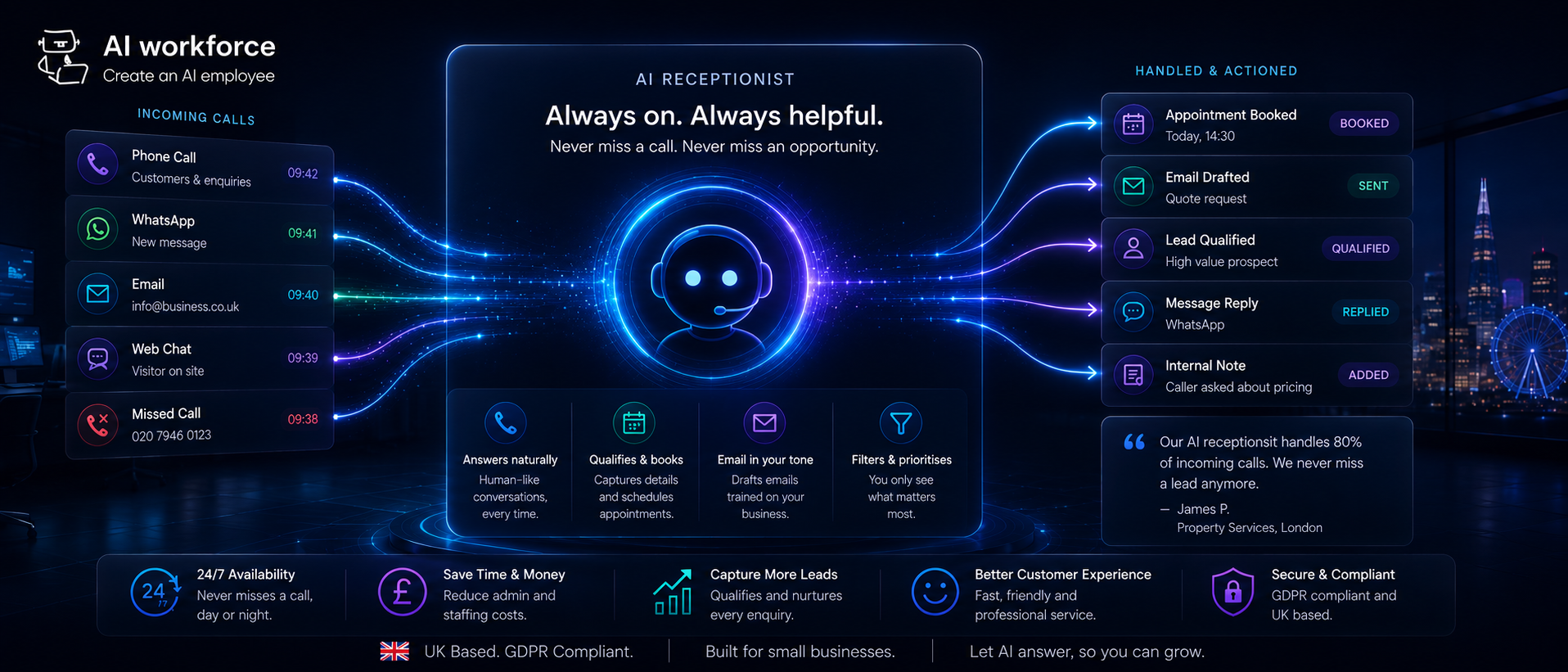
Every ringing phone a small business cannot get to could be a customer who calls the next name on the list. An AI answering service changes that: it can answer calls your team cannot reach, subject to the service's availability, telephony capacity and configuration; answer from approved business information, book an appointment where it can, and hand anything uncertain to a person.
This guide compares leading AI answering services by the job they perform, including straightforward call answering, message capture, routing, appointment booking, human escalation and UK small-business suitability. There is no universal winner: the right choice depends on your call volume, required actions, existing phone system and the calls that must always reach a person.
Quick Answer: There is no single best AI answering service for every business. Rosie suits straightforward small-business call answering with an accessible entry tier. WiseCall suits UK-focused businesses and states that it uses UK-based infrastructure and support across calls, email, WhatsApp and SMS. RingOne suits businesses that want to keep an existing phone system and simply divert missed calls. Smith.ai suits businesses wanting a human-and-AI hybrid, where the AI can escalate to a live receptionist rather than a voicemail, though buyers should confirm exactly when that applies. AIAnswerPhone suits low call volume at an accessible UK entry price. Goodcall suits businesses building custom workflows with configurable logic flows and forms. The comparison below checks each candidate against current public documentation and pricing, not hands-on testing, unless stated otherwise.
At a Glance
What it is: a comparison of AI answering services by call-handling capability, routing, booking, human escalation, UK suitability and pricing, alongside implementation guidance for governing one safely
Best pick, one sentence: for most UK small businesses, the right AI answering service is the one that answers strictly from approved business information and escalates cleanly, not the platform with the most advertised features
Best suited to: businesses with a visible, recurring missed-call problem, whether that is after-hours coverage, a busy front desk, or no dedicated receptionist at all
Typical cost: ranges from roughly £47 a month for a UK entry-level plan to several hundred pounds a month for higher call volumes, plus separate charges for overage minutes or calls
Biggest benefit: capturing calls that might otherwise go to voicemail or remain unanswered, without adding headcount
Biggest risk: a system that invents an answer the knowledge base does not contain, or fails to escalate a call that genuinely needed a person
What's Covered
The Comparison
How It Works
Governance & Risk
Buying & Rollout
Above-the-Fold Shortlist
Best for straightforward small-business call answering: Rosie, for an accessible entry tier with 24/7 answering, message taking and simultaneous-call handling
Best UK-focused option: WiseCall, which states it runs on UK-based infrastructure with UK carrier connectivity and UK-based support across calls, email, WhatsApp and SMS
Best for an existing business-phone system: RingOne, for diverting an existing UK number to an AI receptionist without porting or new hardware
Best human-and-AI hybrid: Smith.ai, which markets AI-first call handling backed by a North America-based live-agent network rather than voicemail; confirm exactly when a call reaches that live network before buying
Best for low call volume: AIAnswerPhone, for an accessible UK entry price with a straightforward per-plan minute allowance
Best for custom workflows: Goodcall, for configurable logic flows and forms rather than a fixed script
These selections reflect current public product documentation and pricing checked in August 2026. They are category recommendations rather than a single universal ranking; check every capability, price and limitation against each vendor's own documentation before you buy.
There is no single "best overall" service in this comparison. Straightforward answering, UK-based support, existing-system compatibility, human escalation, low-volume pricing and custom workflow logic are different priorities, and the right choice depends on which of these matters most for your business.
Comparison Methodology
AI Workforce reviewed each provider's own product and pricing pages in August 2026, alongside services surfaced in UK search results for this category, including RingOne, AIAnswerPhone and WiseCall. This is a documentation-based comparison, not a controlled hands-on test of every platform, so capabilities are attributed to current public sources rather than presented as independently verified performance. We assessed each provider against: inbound call handling; message accuracy; routing and transfers; booking; human escalation; integrations; call transcripts and summaries; UK numbers and suitability; pricing transparency; included minutes or calls and overage charges; privacy and governance; and small-business simplicity. Prices checked 22 August 2026. Confirm current details directly with each vendor before budgeting.
Master Comparison Table
This is an at-a-glance view. Messages, routing, booking, integrations and each provider's main limitation are covered in full under Individual Provider Reviews below, so this table stays scannable rather than repeating every detail twice.
Service | Best for | AI/human/hybrid | 24/7 | Human escalation | UK suitability | Pricing |
|---|---|---|---|---|---|---|
Rosie | Straightforward small-business answering | AI, with warm/live transfer on higher tiers | Yes | Warm and live transfer (Scale and above) | General, not UK-specific; US-based numbers by default | Professional $49/mo (approx £36), 250 min; Scale $149/mo (approx £109), 1,000 min; Growth $299/mo (approx £218), 2,000 min |
WiseCall | UK-focused answering across channels | AI, with routing to a person | Yes | Yes, escalates or offers callback | Vendor states UK-based infrastructure and support | Starter £99/mo excl. VAT, 100 AI calls; Professional £199/mo, 300 calls; Business £399/mo, 750 calls |
RingOne | Diverting an existing UK phone system | AI, with mobile-first routing | Yes | Approvals inbox for human sign-off, not live call transfer | Strong; UK numbers, GBP pricing, works with any existing provider | £59.99/mo, 125 AI min; £219.99/mo, 500 min; £399.99/mo, 1,000 min |
Human-and-AI hybrid escalation | Hybrid; AI-first, markets North America-based live-agent backup | Yes | Vendor markets live-agent backup; confirm which plans include Smith.ai staff versus transfer to your own team | General, not UK-specific; agents are North America-based | Free: 25 calls/mo, $3/extra call; Pro: from £110/mo for 75 calls, extra from £1.83; Enterprise: from £365/mo for 300 calls, extra from £1.58 | |
AIAnswerPhone | Low call volume, accessible UK entry | AI | Yes | Not described as live transfer; message- and notification-based | Strong; built for UK small businesses, GBP pricing | Starter £47/mo, 350 min; Growth £77/mo, 750 min; Pro £97/mo, 1,250 min |
Goodcall | Custom workflows and logic flows | AI | Yes | Not described as live transfer; routes to directory contacts | General, not UK-specific | Starter $79/agent/mo (approx £58), 100 unique customers/mo; Growth $129/mo (approx £94), 250 customers; Scale $249/mo (approx £182), 500 customers |
Prices checked 22 August 2026 and converted to sterling at an illustrative rate of $1 ≈ £0.73 (£1 = $1.3699) where a vendor publishes in dollars; see the currency note under "How Much Does an AI Answering Service Cost?" for the exact rate used. Confirm current rates directly with each vendor before budgeting.
Individual Provider Reviews
Each review below is based on current public documentation and pricing, not hands-on testing, unless stated otherwise.
Rosie
Best for: solo owners and small businesses wanting a straightforward, accessible AI answering service.
How it handles calls: answers 24/7, trains automatically on the business's Google profile and website, and handles multiple simultaneous calls without a busy signal.
Verified actions: custom message taking, sending appointment links by text, and automatic spam detection on every plan.
Routing and escalation: basic on the entry Professional tier; warm transfer (briefing a team member before connecting) and live transfer are added on the Scale tier, with waterfall transfers across multiple numbers on Growth.
Booking capability: direct calendar booking is available from the Scale tier upward, not on the entry Professional plan.
Integrations: native iOS and Android apps, Zapier integration connecting to over 1,000 apps, and calendar sync on paid tiers.
Official pricing: Professional $49/month (approximately £36), 250 minutes; Scale $149/month (approximately £109), 1,000 minutes; Growth $299/month (approximately £218), 2,000 minutes. Checked 22 August 2026 against Rosie's official pricing page.
Included usage: minute allowances rise with each tier; exact overage-minute pricing is not published on the general pricing page and should be confirmed directly.
Genuine limitation: the entry tier does not include calendar booking or live transfer, and the platform is US-first, with UK area-code availability and UK-specific compliance details needing direct confirmation.
Best-fit small business: a solo owner or small team wanting an accessible, well-reviewed answering service, willing to upgrade a tier for booking or live transfer.
WiseCall
Best for: UK businesses wanting an AI front desk that answers across more than just the phone. WiseCall states that captured data is stored on UK-based infrastructure and that it provides UK-based support.
How it handles calls: answers in the business's name 24/7, asks qualifying questions, and sends a structured summary to the team after every call; the same knowledge base also covers email, WhatsApp, live chat and SMS.
Verified actions: appointment booking, call transfers and routing, and structured call summaries with full transcripts, included on every plan.
Routing and escalation: configurable; the system routes urgent enquiries to an on-call number and offers a callback or transfer when it cannot resolve an enquiry.
Booking capability: included on every plan, with calendar and practice-system integrations such as Dentally for healthcare bookings.
Integrations: Dentally, Slack, Calendly, Notion, HubSpot, Salesforce, Google Calendar, Mailchimp and n8n, confirmed as commonly connected systems, with exact setup depending on the business's stack.
Official pricing: Starter £99/month excluding VAT, 100 AI calls; Professional £199/month, 300 AI calls; Business £399/month, 750 AI calls; each plan also includes an allowance of AI email replies, WhatsApp messages, live chat conversations and SMS messages. Checked 22 August 2026 against WiseCall's official pricing page.
Included usage: allowances scale by plan across all five channels; additional usage is available as a top-up pack.
Overage charges: not published as a flat per-unit rate on the general pricing page; confirm current overage terms directly with WiseCall.
Genuine limitation: every plan requires a 12-month minimum term billed monthly by Direct Debit, which is a longer commitment than several UK competitors' rolling monthly plans.
Best-fit small business: a UK business wanting one AI front desk across phone, email, WhatsApp, live chat and SMS, with UK-based support and infrastructure, and comfortable with a 12-month term.
RingOne
Best for: UK small businesses and tradespeople wanting to keep their existing phone number and simply divert missed calls to an AI receptionist.
How it handles calls: rings the owner's mobile first, with AI failover if unanswered, or routes straight to AI depending on configuration; answers 24/7 in a configurable voice.
Verified actions: books jobs, drafts quotes from the business's own price list, sends missed-call text-backs, and screens robocalls before the phone rings.
Routing and escalation: an approvals inbox is the core escalation mechanism; quotes, bookings and reminders drafted by the AI wait for a one-tap human sign-off before reaching a customer, rather than a live mid-call transfer to a person.
Booking capability: yes, jobs and appointments are booked and logged automatically, with the business owner approving quotes before they are sent.
Integrations: an auto-CRM built into RingOne's own dashboard, with CSV export; no third-party CRM or calendar integration is listed on the public pricing page.
Official pricing: RingOne £59.99/month, 125 AI minutes included; RingOne 500 £219.99/month, 500 minutes; RingOne 1000 £399.99/month, 1,000 minutes; extra minutes billed from 40p to 45p depending on tier; a VoIP-only plan without AI is available from £16.99/month. Checked 22 August 2026 against RingOne's official pricing page.
Included usage: minutes rise with each tier, and per-minute overage rates fall as the plan size increases.
Overage charges: extra minutes purchased from credit at 40p to 45p per minute depending on plan.
Genuine limitation: the platform is built around asynchronous approvals rather than live call transfer to a person, so it suits businesses comfortable reviewing quotes and bookings after the call rather than needing an instant human handoff during it.
Best-fit small business: a UK tradesperson or small business that wants to keep its existing number, contract and handset, and add AI cover for calls it cannot answer directly.
Smith.ai
Best for: businesses wanting AI-first call handling backed by Smith.ai's live-agent network, rather than a voicemail or message-only escalation path, once the exact terms of that backup are confirmed.
How it handles calls: answers with AI first, using lead qualification and intake questions. Smith.ai markets the service as backed by its North America-based live-agent network for calls the AI cannot resolve; buyers should confirm which plans and configurations include transfer to Smith.ai staff rather than transfer to the buyer's own team.
Verified actions: lead qualification, call routing, appointment booking via Calendly, Acuity and other calendar tools, and recording, transcription and call summaries.
Routing and escalation: Smith.ai markets its AI Receptionist as backed by live agents, but buyers should confirm when a call transfers to Smith.ai staff, when it transfers to their own team and how that human handling is charged, rather than assuming every escalated call automatically receives an included Smith.ai receptionist.
Booking capability: yes, integrated with several calendar tools; complex or custom calendaring is available as an add-on on the human-first plans.
Integrations: Clio, HubSpot, Salesforce, Zapier and other CRMs are natively supported.
Official pricing (AI-first plans): each plan bundles a monthly fee with an included number of calls, plus a higher rate for calls beyond that allowance. Free: $0/month, 25 calls included, then $3.00 per additional call. Pro: from $150/month (approximately £110) for 75 included calls, an effective $2.00 per call, with additional calls from $2.50. Enterprise: from $500/month (approximately £365) for 300 included calls, an effective $1.67 per call, with additional calls from $2.17. Checked 22 August 2026 against Smith.ai's official AI-receptionist pricing page.
Included usage: included call allowances and effective per-call rates step down as volume tiers increase within each plan; larger Pro and Enterprise bundles carry different included-call and overage rates than the entry tier shown here.
Overage charges: calls beyond a plan's included allowance are billed at that plan's overage rate, which is higher than the plan's effective included rate, not simply the headline monthly fee divided by calls made.
Genuine limitation: live-agent backup is staffed from North America, not the UK, and the terms under which a call actually reaches a Smith.ai receptionist versus the buyer's own team need direct confirmation; overage on top of the bundled monthly fee can become the larger cost at real volume, so pricing should be modelled against actual call counts rather than the headline monthly price alone.
Best-fit small business: a business that wants a genuine human safety net behind the AI, is comfortable confirming the exact escalation terms with Smith.ai directly, and can plan for per-call pricing and North America-based live agents.
AIAnswerPhone
Best for: UK sole traders and small businesses with lower call volume wanting an accessible, simple entry price.
How it handles calls: is configured to answer inbound calls 24/7, subject to service availability, telephony capacity and configuration, with a choice of professional greeting voices, capturing the caller's name, phone number and reason for calling, and providing full call transcripts.
Verified actions: custom greeting text, business-hours and out-of-hours greetings, and a website content scanner that trains the assistant on the business's own site.
Routing and escalation: email notification contacts on every plan, with up to 10 departments and auto-detection on the Pro tier; live call transfer is not described as a feature on the public pricing page. WhatsApp notification availability on the Starter plan is presented inconsistently on the provider's pricing page: its plan card lists one WhatsApp contact, but its detailed comparison table appears to show WhatsApp as unavailable on Starter, so confirm this directly before purchasing.
Booking capability: not listed as a native feature; the service is oriented around message capture and notification rather than direct calendar booking.
Integrations: custom integrations are listed as a Pro-tier feature, without specific named platforms confirmed on the general pricing page.
Official pricing: Starter £47/month, 350 minutes included (approximately 140 calls); Growth £77/month, 750 minutes (approximately 300 calls); Pro £97/month, 1,250 minutes (approximately 500 calls). No setup fees, no contracts, cancel anytime. Checked 22 August 2026 against AIAnswerPhone's official pricing page.
Included usage: minute allowances scale with each tier, with an approximate calls-per-month figure based on an average 2.5-minute call.
Overage charges: not published as a flat rate on the general pricing page; confirm current overage terms directly with AIAnswerPhone.
Genuine limitation: no native calendar booking or live call transfer is described on the entry tiers, so businesses needing either should confirm availability directly before choosing this provider over a booking-capable alternative.
Best-fit small business: a UK sole trader or small business with modest call volume wanting message capture and notifications at one of the lowest published UK entry prices in this comparison.
Goodcall
Best for: businesses wanting to build custom call-handling logic rather than relying on a fixed script.
How it handles calls: answers with unlimited minutes and AI tokens on every plan, using configurable "skills" for common questions and "flows" for more complex, conditional logic.
Verified actions: structured "form" flows capture and qualify caller information; "logic" flows route a caller differently depending on their answers or whether they are a new or returning caller.
Routing and escalation: calls can be routed to directory contacts, who receive a notification and can have calls transferred to their line; live mid-call transfer to a person is not described as a distinct product feature separate from directory-contact routing.
Booking capability: not a native feature; achieved via Zapier connections to a calendar or booking tool.
Integrations: native Zapier integration and Google Voice compatibility; conditional call forwarding lets a business keep its existing number and forward unanswered calls to Goodcall.
Official pricing: Starter $79 per agent per month (approximately £58), 100 unique customers included; Growth $129 per agent per month (approximately £94), 250 unique customers; Scale $249 per agent per month (approximately £182), 500 unique customers. Checked 22 August 2026 against Goodcall's official pricing page.
Included usage: pricing is based on unique customers served per month, not call minutes or AI tokens, both of which are unlimited on every plan; a per-customer overage fee of $0.50 applies beyond the plan's included allowance.
Overage charges: $0.50 per additional unique customer beyond the plan's monthly allowance.
Genuine limitation: the platform is not UK-specific, and calendar booking and live human transfer both rely on integrations rather than native features, so the total workflow needs more setup than a UK provider built specifically around booking and escalation.
Best-fit small business: a business with the technical appetite to configure custom logic flows and forms, prioritising workflow flexibility over a UK-specific, plug-and-play setup.
What Is an AI Answering Service?
An AI answering service is software that answers your business phone the way a trained receptionist would, using natural speech technology to understand a caller and respond from approved business information instead of playing a rigid phone tree. Incoming calls can be answered automatically, within the capacity and availability of the configured telephony platform, classified by what the caller actually needs, and either resolved directly, booked as an appointment, or transferred to a person.
This is different from a basic voicemail system, which only records a message, and different from a traditional keypad menu, which only routes a call along a fixed set of options. An AI answering service holds an actual conversation, and it draws on your specific business details, hours, services, pricing and booking rules, rather than a generic script.
This matters because calls rarely arrive on a predictable schedule, and a missed call during a busy morning can be a lost customer by the afternoon. Wide, consistent availability, including outside standard office hours, is what separates a business that captures most enquiries from one that only catches the calls it happens to be free for. The governing principle worth holding onto through the rest of this guide is simple: an AI answering service should answer from approved business information, not invent an answer when the knowledge base does not contain one.
Compare AI Answering Services Against Your Own Call Volume
Use the AI Agent Brief framework to document your required actions, escalation rules, integrations, and stop conditions before speaking to a vendor.
AI Answering Service vs Receptionist, Human Service and Voicemail
These terms overlap in vendor marketing, which makes it harder to compare products or to know what you are actually buying.
AI answering service describes the specific job of answering inbound calls: FAQs, messages and basic routing, without necessarily managing a wider front-desk workflow
AI receptionist covers the fuller front-desk job: answering, booking, routing, capturing caller details and coordinating with a calendar or CRM, of which answering calls is one part. See our dedicated AI receptionist guide for the broader UK category
AI voice agent is the broader underlying technology that can power an answering service or receptionist, and can also handle outbound calls, sales qualification and other conversational workflows beyond front-desk coverage. See our AI voice agents guide
A traditional human answering service is a human-operated call-handling service, historically working from a script, that an AI answering service now competes with directly, particularly on price and out-of-hours availability
Voicemail only records a message with no interaction, no routing and no booking capability
Comparison | Availability | Simultaneous calls | Consistency | Judgement on complex calls | Setup | Escalation | Pricing model |
|---|---|---|---|---|---|---|---|
AI answering service | 24/7 | Multiple at once | High, if knowledge base is current | Limited; should escalate rather than guess | Days, once knowledge base is built | Transfer, message or callback per configured rules | Monthly subscription plus per-minute or per-call usage |
Human answering service | Business-hours or 24/7, depending on provider and plan | Limited by the number of available agents rather than one call across the entire service | Varies by agent and script adherence | Generally stronger for emotional or ambiguous calls | Faster to start, slower to scale | Genuine human judgement throughout | Usually per call, minute or bundled allowance; human coverage commonly costs more |
Voicemail | 24/7 | Unlimited, but no interaction | N/A, no response given | None; caller must call back or wait | Immediate | None; caller leaves a message and waits | Usually included with a phone line |
An AI answering service and an AI receptionist overlap heavily in practice, and many products blend the two. This guide focuses on the answering and call-handling workflow itself: what a provider should be allowed to do, what it should never do, and how to govern it. For businesses operating at higher call volumes or managing a dedicated customer-service operation, our AI Call Centre Agents guide covers the wider contact-centre model, including agent assist, autonomous AI agents, CRM integration, human escalation and measuring successful resolution alongside containment.
If you are deciding between an AI receptionist, a human answering service or a hybrid of the two, see our full guide to AI receptionist vs answering service in the UK, which compares cost, call handling, booking, integrations, scalability and human judgement side by side.
The AI Workforce Call Model
A call is not one decision. It is a sequence of smaller decisions, and treating it as one step- answer the phone- is where a lot of AI answering service deployments go wrong. At AI Workforce, we use a Call Model built on seven stages, each answering a distinct question.
Illustrative model. The specific rules behind each stage should reflect your own business information and escalation policy, not a generic template.
Answer: pick up the call promptly and disclose appropriately, since a caller should not have to guess whether they are speaking to a person or a system
Identify: determine who is calling, and look up any existing record, where that is relevant to the call
Understand: classify what the caller actually needs, rather than matching on a single keyword
Retrieve: pull the answer from approved business information, hours, services, pricing, booking rules, not from a general-purpose guess. Where information conflicts, the workflow should have a defined source of truth, for example, the live booking system over an older FAQ document, rather than letting the model choose whichever answer looks most plausible
Act: answer the question, book the appointment, route the call or take a message, based on what Retrieve actually found
Escalate: transfer anything outside permitted scope to a person, rather than attempting to resolve it anyway
Record: write the outcome, a transcript or summary, and any next action, into the relevant system so nothing depends on someone remembering it later
The combination is what makes this reliable. Understand without a genuine Retrieve step is how a system ends up improvising an answer that sounds confident and is wrong. Act without a working Escalate path is how a caller with a real problem gets stuck talking to a system that cannot help them. Record ties the whole sequence to a system of record, so a call is never just a conversation that happened and then disappeared.
Confidence routing sits underneath every stage rather than being a separate box in the model. A high-confidence match, such as a clearly stated opening-hours question with an unambiguous answer in the knowledge base, can be answered automatically. A medium-confidence case, such as a booking request where the caller's intent is fairly clear but a detail is missing, should retrieve an answer and then confirm it with the caller or offer a transfer, rather than proceeding blind. A low-confidence case, where the system cannot classify the intent clearly, or the knowledge base does not contain a matching answer, should not improvise. It should transfer to a person or take a detailed message. This is the same confidence-based governance principle used across AI Workforce's other models, applied here to call handling specifically.
What Can an AI Answering Service Handle?
An AI answering service is built to absorb everyday questions, hours, directions, pricing ranges, and simple booking requests, freeing an actual member of staff from answering the same handful of questions on repeat. Multiple calls at once is where this earns its keep: a single person can only take one call at a time, but a properly configured system can hold several simultaneous conversations, so nobody hears a busy signal during a rush.
A properly configured AI answering service should be given access to approved information about your business ahead of time- your services, pricing, and scheduling rules- so it can answer confidently rather than guessing. Not every platform works the same way technically; some retrain or fine-tune a model, most instead configure prompts and retrieval systems against a knowledge base, but the practical requirement is the same either way. The strongest platforms also integrate directly with a calendar and CRM, checking real availability and booking an appointment in the same call rather than just taking a message for someone to action later.
Estate agencies are a good example of why that live-data connection matters. A caller may want to know whether a property is still available, book a viewing or request a valuation, so the system needs current listing data and real negotiator availability rather than a static FAQ. Our guide to AI receptionists for estate agents covers that property-specific workflow in detail, including viewing booking, valuation-lead capture, listing-data freshness and human escalation.
Recruitment agencies have a similar need for live routing because incoming calls can involve candidates, existing placements, interview scheduling and new client vacancies. An AI receptionist can answer routine vacancy questions, capture candidate or client details, book interviews against consultant availability and route existing matters to the consultant or desk responsible, while sensitive or consequential conversations remain human-led. Our guide to AI receptionists for recruitment agencies covers that workflow in detail, including candidate calls, interview booking, ATS/CRM integration and human escalation.
Staffing agencies have an additional out-of-hours call-handling problem because worker enquiries do not necessarily stop when the office closes. Temporary workers may call about a shift, report that they cannot attend an assignment, raise a timesheet or payroll query, while clients may need urgent cover outside normal hours. An answering service can capture and classify those calls, route urgent call-offs or client requests to the on-call team and leave lower-priority administrative matters for the correct desk to handle later. Our guide to AI answering services for staffing agencies covers 24/7 worker enquiries, shift call-offs, urgent client cover, payroll and timesheet routing, and where a person should take over.
Restaurants are a strong example of this kind of workflow because reservation calls often arrive during busy service periods. An AI answering service can handle routine booking requests, opening-hours questions and simple guest enquiries, while unusual requests or complaints still go to staff. Our guide to AI for restaurants in the UK covers how call answering fits alongside demand forecasting, staff scheduling, inventory and other restaurant AI workflows.
If qualification, calendar routing and booking logic are the main workflows you want to automate, see our guide to AI appointment setter tools for the dedicated booking and qualification layer.
The right platform for your business usually comes down to integration: does it connect to your existing CRM, does it support SMS follow-ups, and does it work with the tools you already run. Every platform handles the underlying conversation a little differently, so it is worth testing more than one against your own real call scenarios before committing.
When Should It Transfer to a Person?
This is the single most important governance decision in an AI answering service deployment, and it deserves an explicit, written policy rather than an assumption that the system will "know" when something is beyond it. A call should transfer to a person when:
the caller explicitly asks to speak to a person
the call involves a complaint or a dispute
there is an emergency or a safety-sensitive issue
the call involves a payment dispute
the caller asks for an unusual pricing or discount arrangement
the query touches a legal or regulatory question
a safeguarding concern is raised
the system has misunderstood the caller more than once in the same call
the intent classification confidence is low
the caller is a VIP or an existing high-value customer, where your policy calls for a person by default
the system cannot access the information it needs to answer correctly
A well-configured escalation policy is not a sign the system is weak. It is what makes the automated portion trustworthy, because it means every call that does go through the system was one it was actually equipped to handle. As the comparison table above shows, providers differ significantly in how they escalate: some transfer live to a staffed team (Smith.ai), some route to an approvals inbox for asynchronous sign-off (RingOne), and some rely primarily on notifications and messages rather than a live handoff (AIAnswerPhone, Goodcall). Match the escalation mechanism to what your business actually needs, not just to whichever provider markets "human backup" most prominently.
Where Do AI Answering Services Go Wrong?
A fair account of this technology has to include where it fails, not just where it helps:
Giving out incorrect business information because the knowledge base was never kept up to date
Hallucinating an answer when the knowledge base genuinely does not contain one, rather than saying so and transferring
Misclassifying caller intent and routing or answering based on the wrong assumption
Poor transfer logic that drops a call or sends it to the wrong person
Booking the wrong appointment type or duration because the booking rules were not specific enough
Creating a duplicate booking when a caller calls back to check or amend an existing one
Struggling to understand a caller with a strong accent, a poor line, or heavy background noise
Noticeable latency or awkward interruptions that make the conversation feel unnatural
Writing incorrect or incomplete details back to the CRM from an ambiguous exchange
Failing badly when a connected calendar or CRM integration goes down, rather than failing safely
Weak escalation rules that let a call that should have transferred continue anyway
Being used for conversations that genuinely need a person, regardless of how well configured the system is
None of this makes the category unsuitable. It means the escalation rules and knowledge base discipline covered above matter more than how natural a demo call sounds, and a habit of reviewing real transcripts, not just call volume, is what catches these failures before a caller does.
UK Phone, Privacy and Recording Considerations
Beyond the general UK GDPR obligations covered below, several commercial factors are specific to choosing a UK-facing AI answering service, and vendor branding does not reliably indicate them. Never infer UK hosting, UK support or UK call quality from a ".co.uk" domain or Union Jack styling alone; confirm each of the following directly.
UK number availability: confirm whether the provider issues a genuine UK geographic or non-geographic number, and in which area codes, rather than only a US-format number with international call routing
Number porting and forwarding: some providers, such as RingOne, are built around diverting or forwarding an existing number without porting; others expect a dedicated new number, with porting available separately
UK English voices: confirm the voice options include a UK English accent if that matters for your brand, rather than assuming a "British" label matches every caller's expectation
UK business hours: confirm whether escalation, live transfer or support operates on UK time, not a US or other overseas time zone
UK-based support: WiseCall specifically advertises UK-based support; Smith.ai's live-agent network is North America-based even where the AI layer answers first, which matters if a caller expects to reach someone in a UK working day
Data location versus international processing: ask directly where call recordings, transcripts and any connected language-model processing are stored and processed, since a UK-facing product can still route data internationally
GBP pricing and VAT: RingOne, AIAnswerPhone and WiseCall publish pricing in pounds; Rosie, Goodcall and Smith.ai publish in dollars, so the sterling figures in this guide are illustrative conversions, not the vendor's own quoted price, and VAT treatment should be confirmed separately
Call-minute or call-based charging: confirm whether usage is measured by minutes, calls or unique customers, and how additional usage is charged. RingOne publishes per-minute overage rates; Rosie and AIAnswerPhone use minute allowances but require buyers to confirm their additional-usage treatment directly; Smith.ai and Goodcall charge by call or unique customer
UK mobile and landline transfers: where live or warm transfer is offered, confirm it reaches standard UK mobile and landline numbers without an additional international-call charge
An AI answering service records, transcribes and processes caller information, so it carries real UK data protection obligations from the first call it answers. This section is general information rather than legal advice.
Call recording and transcription: callers should be told that a call may be recorded and transcribed, why it is recorded, and how long it will be retained, and how that disclosure happens, whether spoken at the start of the call or covered in an existing recorded-line notice, should be a deliberate decision rather than an afterthought. Transparency about the recording is only one part of this. The business also needs an appropriate lawful basis for the recording itself, separate from the disclosure, before it starts
Personal data: names, phone numbers, appointment details and transcripts are personal data whenever they relate to an identifiable person, so UK GDPR applies to that processing in the same way it applies to any other personal data your business handles
Data retention: recordings and transcripts should be kept only as long as they are genuinely needed, with a defined retention period rather than an indefinite default, and a documented reason for whatever period is chosen. RingOne, for example, states recordings are kept for 30 days by default; confirm each vendor's own retention default and whether it can be changed
Processors and sub-processors: voice, transcription and language model providers involved in running the service are typically processing personal data on your behalf, so it is worth knowing exactly which providers sit behind your platform and where they process and store that data, particularly for a provider whose live-agent or infrastructure backbone sits outside the UK
Sensitive information: healthcare, legal, financial and other higher-risk call content needs stronger controls than a general enquiry line, since it is more likely to touch special category data or information with a higher consequence if handled incorrectly
AI disclosure: as an AI Workforce governance standard, we recommend telling callers clearly and early in the call that they are speaking with an automated assistant, rather than only disclosing this if asked. Separately, UK data protection transparency requirements apply wherever the system processes personal data, regardless of whether a caller has been given this specific disclosure
Our guide to AI and GDPR compliance for UK businesses covers the underlying framework, including lawful basis, retention and vendor due diligence, in more depth.
How Much Does an AI Answering Service Cost?
Two distinct cost categories apply here: the price of the commercial providers compared above, and the cost of a custom-built call-handling workflow with AI Workforce or a similar provider.
Off-the-shelf answering-service pricing: entry-level UK plans start around £47 to £60 a month (AIAnswerPhone, RingOne), with US-priced entry tiers converting to a broadly similar range (Rosie's Professional tier, Goodcall's Starter tier). Mid-tier plans generally run £77 to £150 a month, and higher-volume or hybrid plans reach £250 to £400 a month or more (WiseCall Business, RingOne 1000, Smith.ai Enterprise). Several providers price per agent (Goodcall) or per unique customer rather than a flat monthly fee, which changes the total cost significantly at higher volume.
Usage and overage charges: every provider limits included usage through minutes, calls or unique customers. Several publish exact overage rates: RingOne charges roughly 40p to 45p per minute, Smith.ai charges from roughly £1.58 to £1.83 per call above its bundled allowance depending on plan, and Goodcall charges $0.50 per additional unique customer, while Rosie, WiseCall and AIAnswerPhone require buyers to confirm some additional-usage charges directly, since exact overage pricing is not published on their general pricing pages. Modelling overage against your own historical call volume, not a vendor's average case, is the only reliable way to estimate a realistic monthly bill. For the broader infrastructure cost behind those answering-service plans, including speech-to-text, language-model usage, text-to-speech, telephony, phone numbers and concurrency, see our guide to AI voice agent pricing in the UK.
Human-overflow costs: Smith.ai markets its AI service as backed by live agents, but buyers should confirm whether human handling is included in their selected plan, how calls reach that network and whether additional charges apply. Per-call rates on hybrid plans tend to be the highest in this comparison. A human answering service used purely for overflow- calls the AI cannot handle- is a separate cost worth pricing against your actual escalation rate rather than assuming it will be rare.
Custom implementation costs: for a custom-built call-handling workflow specifically, rather than a commercial platform subscription, indicative ranges based on the types of UK small business automation projects AI Workforce encounters, as covered in our AI automation pricing guide, are:
Simple automation (roughly £500 to £2,000): a basic FAQ and message-taking configuration on a single number, with no calendar or CRM integration
Mid-range build (roughly £3,000 to £10,000): a full answering and booking workflow with calendar and CRM integration, custom routing and a properly built knowledge base
Custom AI (£10,000 and up): a multi-line deployment with team-wide routing, a bespoke knowledge base drawing on multiple systems, and extensive testing across call scenarios
Ongoing monthly cost (roughly £200 to £600): monitoring, maintenance and knowledge base updates, before call minutes and transcription usage are added
Total-cost example at realistic monthly call volume: for a small business handling roughly 200 calls a month, a commercial off-the-shelf plan might cost £77 to £150 a month if within the included allowance (AIAnswerPhone Growth, Rosie Scale, RingOne 500), or notably more once overage on a per-call platform is included, since 200 calls on Smith.ai's Pro plan would mean 125 calls beyond the included 75, adding roughly £230 in overage on top of the £110 base fee. A custom-built workflow at this volume would typically fall in the £3,000 to £10,000 build range plus roughly £200 to £600 a month ongoing. A custom workflow may become worth evaluating when call volume, integration complexity or multi-line requirements exceed the limits of an off-the-shelf service, but total cost should be modelled over the expected contract period rather than assumed.
Dollar-priced vendors above are converted at the illustrative rate given in the master comparison table; this is a rounded estimate, not a live exchange-rate quotation, and the actual sterling cost will vary with exchange rates, VAT and payment-provider fees. Confirm current pricing directly with each vendor before budgeting.
How to Compare and Test a Provider
Rather than relying on a demo call alone, put these questions to a vendor directly before committing:
Does the platform answer strictly from an approved knowledge base, or can it generate an answer when the knowledge base does not have one?
What triggers a transfer to a person, and can those rules be configured to match the escalation list above rather than a generic default?
Is escalation a live mid-call transfer, an approvals inbox, or a notification and message, and does that match how your business actually wants to handle urgent calls?
Does it integrate with the calendar and CRM you already use, or does it require switching systems?
How are simultaneous calls handled, and what happens once capacity is reached?
Is every call recorded, transcribed and logged, and can you inspect that record after the fact?
How is caller disclosure handled, and can the wording be configured to your own standard?
What is the actual pricing structure, including included usage and overage rate, and does it scale predictably with call volume?
What happens if the CRM, calendar, knowledge base or telephony integration is unavailable? A safe answer is that the system takes a message rather than continuing to act as though it can still book or confirm something
Where is the number based, where are agents or infrastructure located, and does that match your UK support and availability expectations?
A vendor that cannot answer these clearly, or treats the questions as unusual, is a signal to test further before committing to a long contract. Platforms in this space generally fall into a few groups: UK-focused providers built specifically for small-business front-desk coverage (RingOne, AIAnswerPhone, WiseCall), broader AI voice-agent platforms configured for answering as one of several use cases (Goodcall), and hybrid AI-plus-human services (Smith.ai, and Rosie on its higher tiers). It is worth trialling more than one against your own real call scenarios rather than assuming any single product is the right fit without testing it.
A Four-Week Rollout Plan
Rolling out an AI answering service against a defined, tested knowledge base is safer than switching on full call coverage from day one.
Illustrative roadmap. Expand to additional lines or fuller automation only once the earlier stages have proven themselves.
Week one, map calls: analyse your actual call history to identify the common call types, FAQs, booking patterns and cases that already need a person, and build the escalation list from real examples rather than assumptions
Week two, build and test: configure the knowledge base, calendar and CRM connections and routing rules, then run test calls covering both routine questions and the edge cases identified in week one
Week three, controlled launch: put the system live on after-hours or overflow calls first, while your existing team continues to handle calls during business hours, and review every transcript from this period
Week four, expand: increase coverage to a larger share of inbound calls only after reviewing transcripts, failed calls and transfers from the controlled launch, and only where those reviews show the system is escalating correctly
How Should You Measure an AI Answering Service?
Call volume answered is not a sufficient measure on its own, since a system can process a large number of calls while quietly giving wrong answers or mishandling bookings. Track a broader set of indicators:
Answer rate, the share of inbound calls actually picked up
Abandoned-call rate, callers who hang up before being helped
Booking completion rate, for calls where a booking was the goal
Successful transfer rate: how often an escalated call actually reaches a person cleanly
Caller-intent classification accuracy
Human takeover rate, how often a person has to step in mid-call
Incorrect-answer rate, how often the system gave information that was wrong or not properly grounded in the knowledge base
Failed booking rate
Average response latency
Repeat-call rate: callers who call back because the first call did not resolve their need
Percentage of calls resolved without human intervention
Cost per successfully handled call
Lead-to-booking rate, where the call originated from a marketing or sales enquiry
The incorrect-answer rate is the standout metric for this workflow specifically, since it is the clearest signal of whether the system is respecting the boundary between retrieving an approved answer and inventing one. A low, stable incorrect-answer rate over time is a stronger signal of a healthy rollout than raw call volume handled.
AI Workforce Insight: the answering services that hold up over time are the ones built around a simple discipline: answer confidently from what is actually known, and hand off cleanly the moment a call goes outside that. Systems optimised purely for how few calls reach a human tend to produce more wrong answers and more frustrated callers, not fewer, because the incentive quietly shifts away from getting the answer right.
Sources and Further Reading
Rosie: Pricing: official plans, minutes and feature tiers cited throughout the Rosie review and comparison table
WiseCall: Pricing: official plans, channel allowances and the vendor's UK-infrastructure and support statements
RingOne: Pricing: official plans, included minutes and overage rates cited in the RingOne review and pricing section
Smith.ai: AI Receptionist Pricing: official AI-first plans and per-call rates cited in the Smith.ai review
AIAnswerPhone: Pricing: official plans and minute allowances, and the source of the flagged WhatsApp-availability inconsistency on the Starter plan
Goodcall: Pricing: official per-agent, unique-customer pricing structure
ICO: Guide to the UK GDPR: lawful basis, transparency and data protection principles applied to call recording and transcripts
ICO: Recording calls and telephone conversations: call recording and transparency obligations referenced in the UK compliance section
ICO: International transfers guidance: relevant where a provider's infrastructure, live agents or processors sit outside the UK
ICO: Business-to-business marketing guidance
Prices checked: 22 August 2026. Vendor pricing changes; confirm current rates directly with each vendor before budgeting.
Frequently Asked Questions
What is the best AI answering service for a small business?
There is no single best service; it depends on your call volume, budget and existing phone system. Rosie suits straightforward answering at an accessible price. WiseCall suits UK businesses and states that it uses UK-based infrastructure across multiple channels. RingOne suits keeping an existing number. Smith.ai suits businesses wanting live-human backup, once the exact escalation terms are confirmed. AIAnswerPhone suits low call volume. Goodcall suits custom workflow logic.
What is the difference between an AI answering service and an AI receptionist?
An AI answering service focuses specifically on answering calls, FAQs, messages and basic routing. An AI receptionist covers the fuller front-desk workflow, answering, booking, routing and CRM coordination, of which call answering is one part. Many products offer both; see our AI receptionist guide for the broader category.
AI answering service versus voicemail?
Voicemail only records a message with no interaction, routing or booking, and callers frequently hang up rather than leave one. An AI answering service holds an actual conversation, answers from approved business information, and can book an appointment or transfer to a person, which is why it captures more of the enquiries that would otherwise be lost.
AI answering service versus a human answering service?
A human answering service generally offers stronger judgement on emotional or ambiguous calls, but costs more per minute or call and typically covers one call at a time per agent. An AI answering service handles multiple calls simultaneously at a lower cost, but needs a well-governed escalation policy to hand off calls genuinely requiring human judgement.
Can AI take accurate messages?
Yes, when the caller's request is reasonably clear, and the knowledge base is current. Accuracy drops with poor call quality, strong accents, or ambiguous requests, which is why reviewing real call transcripts, not just message-taking volume, is the more reliable way to judge a provider's accuracy.
What should a small business test before going live?
Test the provider against your own real call scenarios, not just a vendor demo: routine questions, an edge case the knowledge base should not have an answer for, and a call that should clearly transfer to a person. Confirm what happens if the CRM, calendar or knowledge base integration goes down.
Are AI answering services available 24/7?
Most are, and 24/7 coverage is one of the main reasons small businesses adopt this category, since it closes the gap that after-hours and overnight calls previously fell into. Confirm whether out-of-hours-only or overflow-only configurations are available at no extra cost, since several providers, including WiseCall, support this on every plan.
What happens when the service cannot transfer a call?
A properly governed system should take a detailed message or offer a callback rather than leaving the caller with nothing, and the specific mechanism varies by provider: some use a live transfer to a staffed team (Smith.ai), some use an approvals inbox for later sign-off (RingOne), and some rely on notifications to a team member (AIAnswerPhone, Goodcall).
Is an AI answering service GDPR compliant?
It can be, but compliance depends on how it is configured and governed, not on the product alone. UK GDPR applies to any personal data the system processes, and retention, disclosure and processor arrangements all need to be addressed.
Can calls be recorded and transcribed?
Most providers in this comparison support recording and transcription, but whether either is enabled by default, and how long recordings are retained, varies by provider and configuration. Callers should be told this is happening, and a defined retention period should apply to the recordings and transcripts.
How long does setup take?
A basic configuration can often be live within a day, and WiseCall specifically advertises drafting a receptionist directly from a business's website. A more sophisticated setup with CRM integration, complex routing and a fully built knowledge base typically takes longer and should be tested properly before full call coverage begins.
Should callers be told they are speaking with AI?
We recommend it. Clear, early disclosure avoids ambiguity and supports transparent use of AI. Separate UK data protection transparency requirements may also apply depending on how personal data, recordings and transcripts are processed.
Key Takeaways
There is no single best AI answering service for 2026; the right choice depends on call volume, required actions, existing phone system and which calls must always reach a person
Rosie, WiseCall, RingOne, Smith.ai, AIAnswerPhone and Goodcall each suit a different priority, from straightforward small-business answering to UK-based support, existing-system compatibility, live human backup, low call volume and custom workflow logic
An AI answering service should answer from approved business information, not invent an answer when the knowledge base does not contain one
The AI Workforce Call Model, Answer, Identify, Understand, Retrieve, Act, Escalate and Record, separates a call into distinct decisions rather than one step
Escalation mechanisms differ significantly by provider: live transfer, an approvals inbox, or notification-based messaging, and the right fit depends on how urgently your business needs a human handoff
UK commercial value goes beyond a UK-sounding brand: confirm UK numbers, porting, UK-based support, data location and GBP pricing directly rather than assuming them
Off-the-shelf pricing ranges from roughly £47 a month for a low-volume UK entry plan to £250 to £400 or more for higher-volume or hybrid plans, with overage charged separately by minute, call or unique customer depending on the provider
UK GDPR applies to call recordings and transcripts from the first call onward, and callers should be told they are speaking with an automated assistant
Roll out on after-hours, or overflow calls first, reviewing real transcripts before expanding to full call coverage
Track incorrect-answer rate alongside answer rate and booking completion, not call volume alone, to judge whether a rollout can actually be trusted
This article is general information rather than legal advice. Take independent advice on data protection obligations specific to your own call recording, transcription and retention practices, and confirm all provider pricing, features and UK suitability directly with each vendor before purchasing.
Ready to Stop Missing Calls?
We'll help you map your real call patterns, define what the AI can answer automatically versus what should always reach a person, and build a piloted rollout that keeps every caller's experience consistent from week one.
About the Author
Rodi Taze is Co-Founder of AI Workforce. He works with UK businesses to design call-handling systems that separate what AI can safely automate from what should always reach a person, with a particular focus on escalation policy and data governance.
This guide was reviewed by Clara Miller, Content Marketing Specialist at AI Workforce, for clarity, structure and alignment with how UK small businesses actually evaluate and adopt AI answering services.
Reviewed: August 2026
© 2026 AI Workforce Ltd. All rights reserved.