AI Sales Meeting Automation: How AI Agents Book More Meetings
Posted On: July 7, 2026
Last updated: September 2026 · Written by Seth Ayush, Co-Founder of AI Workforce
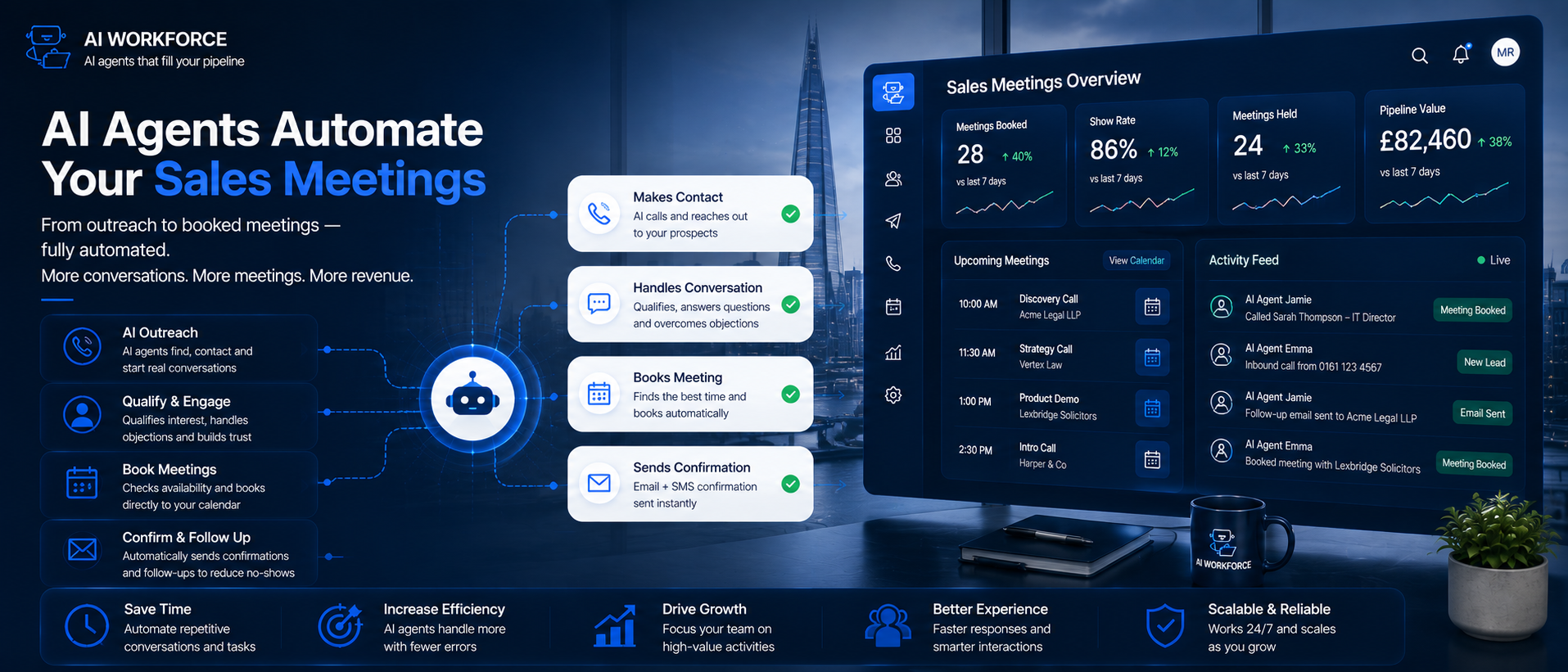
Booking a sales meeting used to mean emails going back and forth, missed replies, and reps losing hours every week to get one call on the calendar. AI agents can now read a reply, check calendars, qualify the lead and book the meeting without a person carrying out each step. This guide explains how that actually works, what it costs, where it can go wrong, and how to decide if it fits your sales team.
Quick Answer: AI sales meeting automation uses AI agents to handle the manual work around booking a sales call: reading a lead's reply, checking calendar availability, sending an invite, qualifying the lead against defined criteria, and preparing a summary before the rep joins the call. It does not replace the sales conversation itself. It can reduce the manual administration around scheduling, qualification and meeting preparation, while the sales conversation and higher-judgement decisions remain with the rep.
At a Glance
What it is: AI agents that handle meeting booking, lead qualification, meeting prep and follow-up around a sales call
Practical use case: teams with recurring reply and meeting volume where scheduling, qualification or preparation creates measurable administrative work
Indicative custom-build cost: AI Workforce planning ranges for a defined workflow are discussed below; commercial scheduling platforms use different pricing models
Potential benefit: reducing manual scheduling and preparation work while responding to booking requests under defined rules
Key risks: misread intent, over-restrictive qualification or incorrect calendar actions
What's Covered
What Is AI Sales Meeting Automation?
How Does an AI Agent Book a Meeting?
Traditional Scheduling vs AI Meeting Automation
Who This Is For
How AI Agents Qualify Leads Before a Meeting
How AI Improves Meeting Prep
What Happens After the Meeting Is Booked?
What This Costs
Where AI Scheduling Can Go Wrong
Governance and Data Considerations
What to Look for in an AI Sales Platform
Choosing the Right Setup for Your Sales Team
How to Measure Whether It's Working
FAQs
Key Takeaways
What Is AI Sales Meeting Automation?
AI sales meeting automation is the use of AI to handle the manual work involved in booking, qualifying, and preparing for a sales meeting. Instead of a rep manually checking availability, sending calendar invites and digging through notes beforehand, an AI agent reads the lead's reply, finds a time that works for both sides, and sends the invite without a person carrying out each step. A basic scheduling link primarily exposes available slots and allows a person to choose one. An AI meeting workflow can add reply interpretation, qualification, routing, preparation and CRM actions around that scheduling step. The same principles apply outside sales too, covered in our guide to automating appointment booking.
This matters because a meaningful part of the work around booking a sales call is repetitive: checking calendars, sending confirmations, chasing a reply. These repetitive steps can be represented as explicit workflow rules, while ambiguous replies and qualification exceptions can be routed to a person. Many teams use AI scheduling to reduce response delays and remove friction from booking, although the actual result depends on the workflow, the audience and the quality of the implementation, not something that follows automatically from switching the tool on.
How Does an AI Agent Book a Meeting?
An AI scheduling agent typically connects to a calendar, a CRM, and the email or chat channel where the conversation is happening. When a lead replies to an outreach message or an enquiry, the agent reads the reply, works out whether the person wants to book a call, and offers times that fit both sides. Once the lead picks a time, the agent confirms the booking and sends the relevant details.
If qualification, calendar routing and booking are the main problems you are trying to solve, rather than the wider meeting-preparation workflow, our guide to AI appointment setter tools covers that specific category in more depth.
The conversational system can classify common reply types, such as a reschedule request, pricing question or request for more information, then select among the actions permitted by the workflow.
At AI Workforce, our agents are built to fit into a connected sales workflow, generating and qualifying leads, then handling the scheduling and prep work covered in this guide, so a business can move from finding a prospect to a booked, qualified conversation with less manual handling at each step.
One operational use case is responding outside normal working hours, provided the workflow, calendar and escalation routes remain available, and a person still reviews how the agent is handling replies during the early stages of a rollout.
A typical automated meeting booking workflow looks roughly like this:
A lead replies to an earlier message or submits an enquiry
The agent reads the reply and works out whether it signals interest in a call
The agent checks the reply against basic qualification criteria
The agent checks calendar availability for the relevant rep
The agent offers suitable times and confirms the booking once one is chosen
Confirmation details and reminders are sent automatically
A short meeting prep summary is compiled from CRM and conversation history
The rep joins the call already briefed
Notes and outcomes are logged back to the CRM after the call
A follow-up step is triggered if the meeting does not progress immediately
The AI Workforce Sales Meeting Workflow separates meeting automation into ten operational steps: Reply → Intent → Qualification → Calendar → Offer → Confirm → Remind → Prepare → Record → Follow-Up. It is an AI Workforce implementation framework rather than an industry standard.
Illustrative workflow. A production system also needs monitoring, logging and a tested escalation path around these steps.
Traditional Scheduling vs AI Meeting Automation
"AI meeting booking" gets compared against two quite different things, and it helps to separate them. Manual scheduling allows a rep to interpret the full conversation but requires that person to perform each scheduling and CRM step. A scheduling link automates slot selection but usually does not interpret the surrounding conversation. An AI meeting workflow can connect reply interpretation, qualification, calendar actions and CRM updates within defined permissions.
Task | Manual (rep) | Scheduling link | AI meeting automation |
|---|---|---|---|
Reading replies and understanding intent | Manual, one by one | Cannot do this | Automatic |
Checking calendar availability | Manual | Automatic, no context | Part of the same flow |
Qualifying the lead | Varies person to person | No qualification | Applies configured criteria; exceptions escalate |
Meeting prep | Manual research | None | Compiled automatically |
CRM updates | Often delayed or inconsistent | Does not touch the CRM | Can write updates automatically with appropriate integration and permissions |
When Does AI Sales Meeting Automation Make Sense?
It is worth evaluating where recurring scheduling, qualification or meeting-preparation work creates measurable administrative load. It may be less relevant where meeting volume is very low or every booking requires substantial case-specific judgement.
Examples of workflows that can be evaluated include:
SaaS and software companies with a steady flow of inbound demo requests
Recruitment agencies coordinating interviews across multiple candidates and clients
Estate agents and property businesses booking viewings and valuation calls
Professional services firms, such as accountants or consultancies, managing initial enquiry calls
Accountancy practices, where an agent can respond to new enquiries, ask a few qualifying questions about business size or needs, and book an initial consultation
Law firms and solicitors' practices, where an agent can gather basic case details from an enquiry before booking a consultation, leaving the substantive advice to a person
Construction and trades businesses, where an agent can respond to quote requests, gather project details, and schedule a site visit
B2B companies running outbound sales development with meaningful reply volume
How AI Agents Qualify Leads Before a Meeting
Before booking, an AI agent can apply defined qualification questions and route the result according to configured criteria. The purpose is to distinguish leads that meet the agreed booking threshold from those requiring another action or human review.
Keep the criteria narrow, explicit and testable rather than asking the model to make an open-ended judgement about whether a lead is "good".
Compare the criteria against historical outcomes and review them as the product, market or sales process changes.
How AI Improves Meeting Prep
Meeting prep involves checking notes, past emails and CRM fields to piece together context before a call. An AI agent can compile relevant CRM fields, previous messages and approved account context into a short pre-meeting summary.
The value should be evaluated using preparation time, rep-rated usefulness and factual correction rate rather than assuming a summary automatically improves the meeting or shortens the sales cycle.
AI Workforce operational observation: in our own workflow design, short summaries focused on what the lead said, agreed next steps and relevant CRM context are easier for reps to review immediately before a meeting than long transcript-style summaries. This is an internal observation rather than an independent benchmark.
Illustrative summary. Your own data quality and review process still determine which side of this list you land on.
What Happens After the Meeting Is Booked?
Once a meeting is on the calendar, the work is not finished. An AI agent can continue to manage the details: sending reminders, handling last-minute reschedule requests, and keeping meeting details accurate across every invite, including time zones, which is a common source of small errors when a rep is juggling several conversations at once.
After the call, the same agent can log notes back into the CRM and trigger the next step in the workflow, whether that is a proposal, a follow-up call, or a nurture sequence for a meeting that did not progress. This keeps the pipeline updated without a rep needing to manually update every record by hand, provided the agent's CRM permissions are scoped correctly and its updates are checked periodically. For teams that also want the meeting itself captured, transcribed and summarised, our guide to the best AI meeting assistant tools compares leading platforms for transcription, action items, CRM updates, pricing and governance.
What This Costs
Cost depends on the scope of the workflow rather than a fixed price for "AI scheduling" as a category. The ranges below are AI Workforce internal planning ranges based on our scoping approach for custom automation builds. They are not UK market averages, guaranteed quotations or commercial-software subscription prices:
A defined scheduling and qualification workflow: £3,000 to £10,000 to build, covering calendar and CRM integration, qualification logic and escalation rules
A broader custom workflow that adds meeting prep and post-call follow-up: scope-dependent, potentially £10,000 and up, depending on how many systems it touches
Ongoing monthly cost: £200 to £800 for monitoring, maintenance and usage, scaling with volume
Subscription-based scheduling and sales engagement tools are often priced differently, on a monthly or per-seat basis. A more detailed breakdown of what drives automation pricing is covered in our guide to AI automation pricing.
Illustrative cost drivers. Actual pricing depends on scope, integrations and how much of the workflow is automated end-to-end.
Where AI Scheduling Can Go Wrong
A fair account of this technology has to include where it fails, not just where it helps. Current AI scheduling and qualification agents can still:
Misread a reply's intent, treating a polite decline as interest or a request for more information as a booking request
Offer times that do not actually reflect a rep's real availability if calendar syncing is misconfigured
Apply qualification criteria too strictly, filtering out a lead that a person would have recognised as a good fit
Get time zones wrong, particularly for leads outside the business's home region
Continue a scripted booking flow in a situation that calls for stopping and handing over to a person
Log inaccurate or incomplete notes back into the CRM if the source conversation was ambiguous
None of this makes the technology unsuitable. A pilot should therefore measure escalation, qualification and calendar accuracy alongside the apparent smoothness of the booking experience.
Governance and Data Considerations
An agent with access to a calendar, a CRM and an email or chat channel is handling genuine business and personal data, and the same basic discipline that applies to a human employee doing the same task should apply here too.
Only connect the calendar, CRM and messaging permissions the workflow genuinely needs
Keep a record of what the agent can do without approval, such as booking directly versus proposing a time for confirmation
Log what the agent does, not just what it was told, so actions can be reviewed and errors traced back to a cause
Set a clear escalation path for replies the agent is not confident about, and monitor how often it is actually used
If the same system is also responsible for the initial outreach that generated the reply, the UK GDPR and PECR considerations covered in our AI sales outreach guide apply to that part of the workflow
Booking from an existing inbound or replied conversation is a different processing activity from using the same system for unsolicited outbound marketing. Where the system processes identifiable contact data, UK GDPR still applies. If it also initiates marketing email, SMS or calls, PECR applies separately to those outreach activities. AI does not remove your compliance responsibilities. Businesses still need to consider lawful basis, data retention, opt-outs and where enrichment data actually comes from, whether a person or an agent is the one acting on it.
For businesses scoping their first agent, our guide on writing an AI agent brief covers how to define permissions and escalation rules before development starts.
AI Workforce Sales Meeting Automation Checklist
Not every platform marketed for this purpose covers the same ground. Before comparing vendors, it is worth checking whether a platform actually offers:
Native CRM integration, rather than a workaround built on exports and imports
Real calendar integration that reflects genuine rep availability, not a static link
Configurable qualification logic, rather than a fixed, one-size-fits-all script
A clear human handoff point for replies the system is not confident about
Visible conversation history, so a rep can see exactly what the agent said and why
Basic reporting on response time, booking rate and qualification accuracy
Clarity on where data is processed and stored, particularly for any enrichment features
Support for the specific channels your leads actually reply on, not just email
A platform that cannot show you what it is doing, and why, is harder to trust with real conversations, regardless of how capable the demo looks.
Choosing the Right Setup for Your Sales Team
Choose the starting layer based on the measurable bottleneck. If replies are being missed or answered slowly, evaluate booking and confirmation first. If preparation is creating significant manual work, evaluate meeting summaries first. Introduce one layer at a time so errors, correction burden and escalation performance can be measured before scope expands.
Teams with higher reply and meeting volume have more repetitive work available to automate. A small sales team can still evaluate the same layered approach at a smaller scale. Our guide to AI agent vs chatbot covers the broader distinction between a system that only answers questions and one that can actually complete a task like this end to end, which is useful context when evaluating vendors.
A Four-Stage Sales Meeting Automation Pilot
Stage 1, Map: define reply types, booking rules, qualification and escalation.
Stage 2, Historical Test: test against known replies and historical booking outcomes.
Stage 3, Recommendation Mode: let AI classify and propose actions while a rep approves them.
Stage 4, Controlled Automation: automate bounded booking actions and monitor errors, handoffs and corrections.
Illustrative pilot. Pace depends on reply volume, data quality and how much oversight the use case warrants.
How to Measure Whether It's Working
Meetings booked alone is not a sufficient measure, since a system can produce more meetings while lowering their quality. A broader set of indicators gives a clearer picture:
Response time to a reply, and how consistently that response goes out
No-show rate, before and after introducing the workflow
Qualification accuracy, checked against which meetings actually progressed
Rep-reported usefulness of meeting prep summaries
CRM data accuracy and how often a human correction is needed
Time saved per rep, measured against a real baseline rather than assumed
Booking correction rate
Human takeover rate
Incorrect intent-classification rate
Define an observation period appropriate to your meeting volume before deciding whether to expand the workflow to a new team or channel.
Sources and Further Reading
The AI Workforce Sales Meeting Workflow, qualification approach, failure-mode examples, evaluation checklist, internal cost ranges, measurement framework and pilot methodology described in this guide are AI Workforce frameworks and planning assumptions rather than industry standards or independently verified benchmarks.
Frequently Asked Questions
Is AI sales meeting automation the same as a scheduling link?
No. A scheduling link only shows open slots. An AI agent reads the actual reply, understands intent, qualifies the lead where relevant, and can prepare context for the rep before the call, not just find a time.
Will this replace the sales conversation itself?
No. It handles the admin around booking, qualifying and preparing for a meeting. The conversation, and the judgement that goes with it, still sits with the rep.
How much does an AI scheduling agent cost?
AI Workforce's internal planning ranges for a defined workflow are £3,000 to £10,000 to build, with £200 to £800 a month in ongoing costs. These are not UK market averages. Subscription-based tools are often priced differently, so it is worth checking which pricing model a quote is based on.
Can an AI agent qualify leads accurately?
Accuracy depends on the criteria, underlying data and how exceptions are handled. Narrow, explicit criteria can be tested against historical outcomes before being trusted for live booking decisions.
What are the key risks of automating meeting booking?
Misread intent, incorrect qualification and calendar errors are the main risks. A human review step during the early stages of a rollout reduces exposure to each.
Does this apply to UK GDPR and PECR?
Scheduling and preparation after a lead has already engaged are different processing activities from unsolicited outbound marketing. UK GDPR still applies to identifiable contact data, while PECR becomes relevant where the same workflow initiates marketing email, SMS or calls.
How do I know if my sales team is ready for this?
If replies are being missed, follow-ups are inconsistent, or reps are spending noticeable time on scheduling and prep instead of selling, that is usually a reasonable starting signal.
Can AI agents handle phone-based meeting booking?
Some AI sales agents extend into voice, calling a prospect, qualifying interest and scheduling a meeting directly over the phone rather than by message. Voice introduces additional considerations around disclosure, consent and call quality, so it is worth treating as its own deployment rather than assuming the same rules as written scheduling apply. Our AI voice agents guide covers this in more detail.
Key Takeaways
AI sales meeting automation handles the admin around booking, qualifying and preparing for a call, not the sales conversation itself
AI agents can read a reply, offer suitable times and confirm a booking without a person carrying out each step
Defined qualification criteria can be applied before booking, with exceptions routed to a person
Meeting summaries can reduce manual preparation work; measure usefulness and correction rate rather than assuming an impact on sales outcomes
AI Workforce's internal planning ranges for a defined custom workflow are £3,000 to £10,000, with ongoing costs typically scoped separately; these are not UK market averages
Key failure modes include misread intent, incorrect qualification, calendar errors, time-zone mistakes and failed escalation
Start with the measurable bottleneck rather than automating the full meeting workflow at once
Track response time, no-show rate and qualification accuracy, not meetings booked alone
Find Out Where AI Can Remove Your Sales Admin Bottlenecks
Not sure where the biggest bottleneck sits in your current booking and follow-up process? We'll help you identify where an AI agent can genuinely save time without adding risk.
About the Author
Seth Ayush is Co-Founder of AI Workforce, a British AI company building AI agents for UK businesses. He works on how AI Workforce's outreach and workflow agents are designed, tested and deployed, with a focus on getting reply handling and escalation logic right before a system is trusted with real prospects.
Reviewed: September 2026