AI Sales Prospecting: How It Works for B2B Sales Teams
Posted On: July 9, 2026
Last updated: September 2026 · Written by Rodi Taze, Co-Founder of AI Workforce
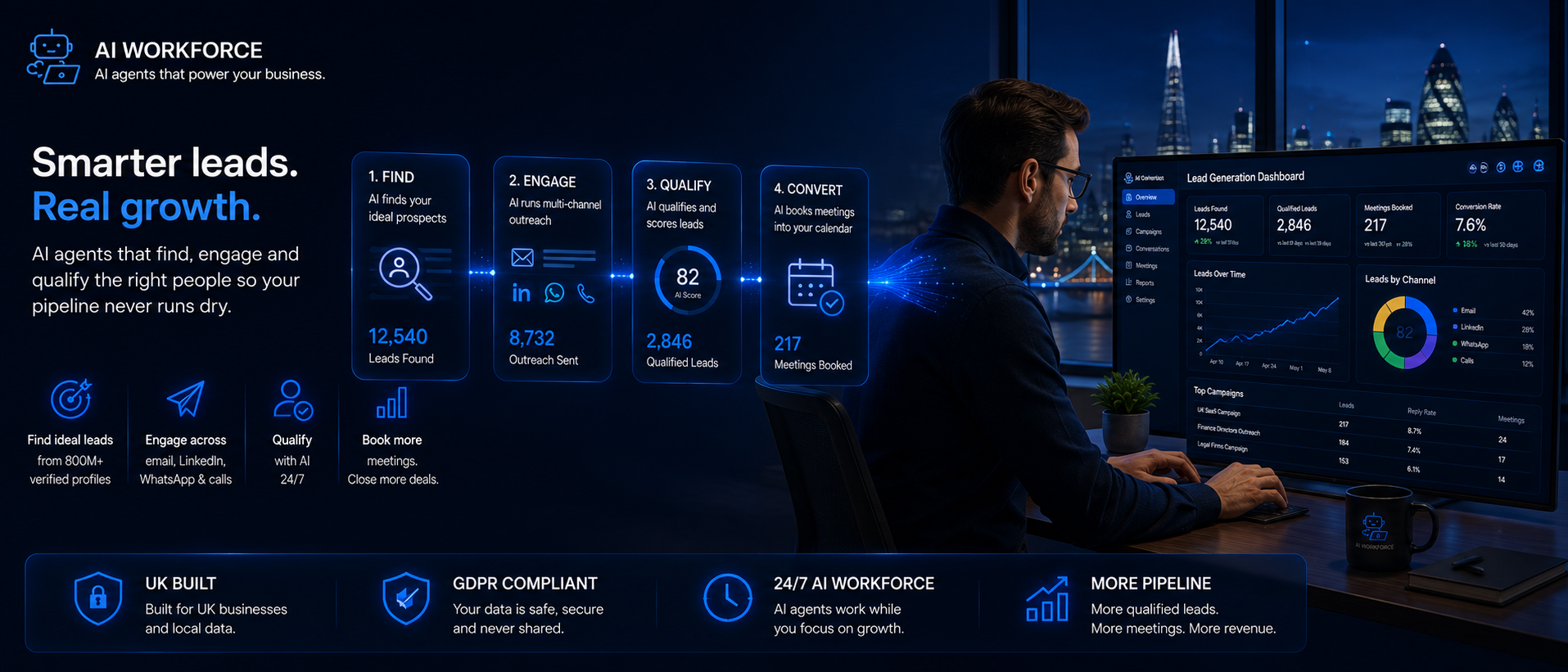
Instead of a rep building a prospect list by hand and guessing who to call first, AI prospecting software can assist with research, apply defined scoring criteria and prepare a first message for review. This can reduce the amount of manual research required across a prospect list, but speed is only part of the evaluation. This guide explains what these systems actually do, how they fit together, where they still need a person, and how to implement and measure one before it touches a live campaign.
Quick Answer: AI sales prospecting uses artificial intelligence to identify, research, prioritise and prepare relevant companies and decision-makers for outreach. AI can analyse company, contact and behavioural data, enrich records and recommend which prospects deserve attention. It should support rather than replace human judgement, particularly when research, scoring or personalisation affects who a business contacts.
Looking for software? Compare the Best AI Sales Prospecting Tools by research capability, data coverage, pricing and best-fit use case.
At a Glance
What it is: software that identifies, researches, scores and prepares B2B prospects for outreach, usually connected to a CRM
Practical uses: repeatable account research, enrichment, scoring and first-draft outreach preparation
Key failure modes: stale CRM data, misread buying signals, generic-sounding messages and scores that reflect historic bias
Key legal considerations: UK GDPR for any identifiable business contact, and PECR separately for marketing emails, texts or calls
Lower-risk implementation approach: roll out one stage at a time, starting in recommendation mode, and pilot against a known sample before trusting live outreach
What's Covered
What Is AI Sales Prospecting?
The AI Workforce Prospecting Model
What AI Prospecting Systems Actually Do
How AI Sales Prospecting Differs from AI Lead Generation and AI SDR
Data Layers Behind a Prospecting System
Fit, Timing and Engagement
Account, Contact and Signal Scoring
Account Selection vs Contact Selection: A Transparent Scoring Example
AI-Assisted vs Traditional Prospecting
What Makes AI Prospecting Personalisation Useful Rather Than Creepy?
What AI Still Can't Do Reliably
When Should a Rep Ignore the AI Score?
Common Failure Modes and Mitigations
A Practical UK Prospecting Workflow
UK GDPR, PECR and Compliance for AI Prospecting
Deliverability and Platform-Term Risks
What AI Sales Prospecting Costs
Where AI Workforce Fits
A Twelve-Step Implementation Plan
How Small UK Businesses Should Start
Metrics That Matter
Is AI Sales Prospecting Worth It?
Related Guides
FAQs
Key Takeaways
What Is AI Sales Prospecting?
At its core, AI sales prospecting means using software to find, research and prioritise potential buyers instead of doing it entirely by hand. Reps have used digital tools for prospecting for years, from spreadsheets to basic database lookups, but AI prospecting software can use models and defined rules to analyse, enrich and rank the data rather than simply storing it, using signals such as job changes, funding news and website visits to time outreach better, and scoring contacts against a defined ideal customer profile rather than leaving that judgement entirely to individual reps.
The category overlaps heavily with AI lead generation, though prospecting is usually more focused on researching and reaching a defined list of target accounts, while lead generation is more focused on discovering new accounts in the first place. If discovering and enriching new leads is your main requirement, our Best AI Lead Generation Tools comparison covers company discovery, contact data, enrichment, intent signals, pricing and UK suitability. Many platforms now blur the line by bundling discovery, scoring and outreach into one product, an overlap covered in our wider roundup of AI sales assistant software, which is convenient but makes it easy to assume every feature carries the same level of risk, when it does not.
How do AI SDR tools find prospects? AI SDR and prospecting systems generally find prospects by applying an ideal customer profile to company and contact data, enriching incomplete records, researching relevant business context and prioritising the resulting accounts. Only selected, reviewed prospects should then enter outreach, follow-up or qualification workflows. See our AI SDR tools guide for how that outreach layer works in more depth.
The AI Workforce Prospecting Model
Rather than treating prospecting as one undifferentiated task, it helps to separate it into six distinct questions:
Stage | Question |
|---|---|
Market | Which segment are we targeting? |
Account | Which companies match the ICP? |
Contact | Who is the relevant person or buying group? |
Signal | What changed or happened that warrants research? |
Priority | Which prospects deserve attention first? |
Action | What should happen after human review? |
The AI Workforce Prospecting Model is an AI Workforce framework, not an industry standard.
An account with strong Market and Account fit but no current Signal may be suitable for lower-priority outreach or nurture, depending on the sales strategy. A Signal without genuine Account fit should not override a weak underlying match. Reading any one stage in isolation can produce misleading prioritisation because strong performance at one stage does not compensate automatically for weakness elsewhere.
What AI Prospecting Systems Actually Do
Not every platform performs the same functions, so buyers should verify which of the following building blocks a product actually supports. The functional building blocks are:
Discover: surface companies and contacts that may match a defined profile
Research: gather relevant context on a company or person from available sources
Enrich: add missing firmographic, technographic or contact details to a thin record
Match: compare an account or contact against the ideal customer profile
Signal: flag activity that may indicate relevance or changed circumstances
Score: rank accounts and contacts using defined criteria
Prepare: draft a first-touch message or briefing using sourced context
Route: send a prioritised prospect into a CRM, queue or outreach workflow
A given tool may support only a subset of these functions, and it is worth checking which ones specifically before assuming a platform covers the full list.
How AI Sales Prospecting Differs from AI Lead Generation and AI SDR
AI lead generation focuses mainly on discovering potential buyers and building a usable lead pool. AI sales prospecting starts with those potential buyers and focuses on researching, prioritising and preparing the right outreach. Many platforms perform both, but the business goals and quality checks are different.
Lead generation asks where new potential buyers can be found. Its main input is the wider market and available data sources; its core activity is discovery and enrichment; its output is a validated lead list; its main risk is data quality, and its key metric is cost per usable lead
Prospecting asks which accounts on a defined target list are worth pursuing, and how. Its main input is an already-defined account or contact universe; its core activity is research, prioritisation and outreach preparation; its output is a prioritised prospect with usable context for a rep; its main risk is poor prioritisation or weak personalisation; and its key metric is cost per accepted opportunity
An AI prospecting system primarily researches and prioritises accounts and contacts. An AI SDR may use that research but extends into outreach, follow-up, qualification, and sometimes meeting booking. Some vendors bundle both functions, but the jobs and evaluation criteria remain different. If you're comparing platforms that take prospects beyond research into first-touch outreach, follow-up, reply handling, qualification and booking, see our Best AI Outbound Sales Agents comparison. See our comparison of AI SDRs and human SDRs for how the AI-versus-human split is typically assessed.
In practice, a lead generation tool hands off a validated list, and a prospecting tool picks that list up, researches each account in more depth, decides who to approach first and prepares the actual outreach. Treating lead generation and prospecting as the same activity can result in a larger list without improving the research, prioritisation or validation required before outreach.
Data Layers Behind a Prospecting System
A prospecting engine typically pulls from several distinct data layers, each with a different reliability profile:
CRM data: your own historical pipeline, ownership and engagement records
Company and firmographic data: sector, size, geography and growth stage
Contact data: names, roles, seniority and verified contact details
Public business information: official registries and company-published sources
First-party engagement: a prospect's own behaviour on your site or in your product
Enrichment providers: third-party services filling gaps in a thin record
Intent and signal data: third-party or first-party activity that may suggest relevance
Permitted third-party sources: data accessed through an approved API or partner programme, as distinct from scraped or unauthorised sources
The AI layer cannot turn stale, incomplete or incorrectly matched records into reliable prospect intelligence. Model quality cannot compensate for stale, incomplete or incorrectly matched records. Historical pipeline data can also carry forward previous targeting bias, unusual sales periods, or pricing and positioning that no longer apply, so scoring models should be checked against current commercial strategy rather than assumed to remain representative.
Fit, Timing and Engagement
Account, contact and signal scores, covered below, describe what is being scored. Fit, timing and engagement describe the type of evidence behind any of those scores, and collapsing them into one unexplained "intent" number can cause a prospecting tool to overstate what the underlying evidence actually supports:
Fit: does the account or person match the ideal customer profile, based on sector, size, role and technology?
Timing: has something changed, such as a funding round, a hire or a leadership change, that warrants further investigation?
Engagement: has the account interacted directly with the business, such as a website visit, a reply or a content download?
None of these three, alone or combined, proves confirmed buying intent. A vendor presenting a single blended score should be asked to expose fit, timing and engagement as separate components.
Account, Contact and Signal Scoring
A single "87 out of 100" lead score hides more than it reveals, because it usually blends three genuinely different questions into one number:
Account score: does this company fit, based on sector, size, geography, technology stack, growth stage and use case? A perfect account can still have the wrong contact attached to it
Contact score: does this person fit, based on role, seniority, function and their likely influence over the buying decision? The right title at the wrong company is just as unhelpful as the reverse
Signal score: is there current activity worth acting on now, such as recent hiring, a funding round, a relevant job advert or engagement with your content? Signals expire quickly and should be weighted less the older they get
A tool that combines all three into a single opaque number makes it hard to tell whether an account scored well because it is genuinely a strong fit, because the contact looks senior, or because something happened last week. Asking a vendor to expose these as separate components, rather than one blended figure, makes the score far more useful for a rep deciding who to approach first and what to say.
Account Selection vs Contact Selection
Account selection asks whether the company is worth pursuing. Contact selection asks who within that company is relevant to the buying process. A strong account with the wrong contact is still a poor prospecting outcome, and treating the two as one combined decision is a common source of wasted outreach.
AI Workforce Transparent Prospect Priority Model: Prospect priority = 40% account fit + 25% contact relevance + 20% timing evidence + 15% first-party engagement.
This weighting is illustrative and must be validated against your own actual outcomes, not adopted as a default. Any scoring model should include a defined human override for exceptions, covered below, and a periodic review to check whether the weighting still reflects what is actually converting.
AI-Assisted vs Traditional Prospecting
Area | Traditional approach | AI-assisted approach | Human role |
|---|---|---|---|
Research | One account at a time | Processes records using the configured workflow | Verify important findings |
Prioritisation | Rep judgement | Defined scoring criteria | Override unusual cases |
Context | Manual browsing | Automated summaries | Interpret ambiguity |
Personalisation | Written manually | First draft from sourced context | Approve final message |
Accountability | Salesperson | Still the business and salesperson | Retains responsibility |
What Makes AI Prospecting Personalisation Useful Rather Than Creepy?
Not all AI personalisation lands the same way, and the difference usually comes down to whether the message gives a prospect an actual business reason to reply.
Weak: a first name, a job title and a generic compliment stitched into a template. It reads as personalised but gives the prospect nothing to respond to
Useful: a relevant company event tied to a genuine business reason, leading to a specific, proportionate proposition. For example, a new office opening connected to a real operational challenge that your product addresses, stated plainly
Risky: personal information with no obvious relevance to the business reason for reaching out, such as referencing a life event or personal social media activity. It can come across as surveillance rather than research, even where the data was technically public
A useful test before a message goes out: could the prospect read the personalised line and immediately understand why it is relevant to a business conversation, without wondering how you found it? If not, it is worth cutting or rewriting, regardless of how impressive the underlying research was.
What AI Still Can't Do Reliably
Set against that genuine value, AI prospecting has clear limits where the required information is not present in the underlying data or depends on relationship context and judgement. Examples include:
Read office politics or figure out who genuinely holds the budget within a buying committee, as opposed to who holds the most senior title
Detect a change in budget or priority that has not yet shown up anywhere in public or CRM data
Build the kind of trust and relationship history that shortens a sales cycle, particularly for higher-value or longer-consideration purchases
Explain, with any real confidence, why a specific deal went cold or a specific prospect stopped responding
Judge internal politics, competing priorities or timing issues that a rep would normally pick up from a real conversation
None of this makes the category less useful. In the workflow described here, AI prospecting operates as a research, scoring and drafting layer feeding human judgement rather than replacing it, the same division of labour our digital workforce guide sets out across other business functions.
When Should a Rep Ignore the AI Score?
A score is an input, not an instruction, and there are specific situations where a rep's own knowledge should override it:
A strategic account already known to leadership or an existing relationship, where the account plan should not be dictated by an automated score
A major organisational change at the account, such as a merger, a leadership departure or a restructure, that has not yet reached any data source the tool uses
A prior offline relationship or introduction that the tool has no way of seeing
An unusual buying structure, such as a committee-led purchase or a public sector procurement process, that does not fit a standard scoring model
A deliberate move into a new market or segment, where a low score may simply reflect the absence of historical pattern rather than poor fit
A direct conflict between two data sources that the tool has resolved silently rather than flagging
Building this into a workflow explicitly, rather than leaving it as an unwritten exception, is what keeps a scoring system useful instead of something reps quietly route around.
Common Failure Modes and Mitigations
Failure mode | Consequence | Mitigation |
|---|---|---|
Stale contact data | Wrong person or former employee | Reverify before outreach |
Hallucinated company research | False personalisation | Require a named source |
Duplicate accounts | Conflicting outreach | Check CRM ownership and suppression |
False intent assumption | Poor prioritisation | Treat signals as research prompts |
Black-box scoring | Reps cannot challenge results | Expose score factors |
Weak ICP | Large irrelevant list | Define exclusions and test historically |
Ownership conflict | Several reps contact one account | Check CRM ownership before routing |
A confident-looking score or a well-written message is not the same as an accurate one. Salesforce's State of Sales 2026 report found that 74% of sales professionals report they are actively working on data cleansing to get more value from AI, and 51% of sales leaders using AI say disconnected systems are slowing their AI initiatives down. These vendor-reported survey findings illustrate why data quality and system connectivity remain relevant implementation concerns. They do not independently establish the performance of any specific prospecting tool.
A Practical UK Prospecting Workflow
For UK-focused prospecting specifically, a sensible sequence runs: define ICP → find matching UK companies → verify company status → identify relevant people → enrich and verify → research the account → check signals → prioritise → human review → hand to outreach or AI SDR → update CRM.
Companies House is genuinely useful for verifying that a UK company and its officers exist and are correctly identified. Companies House makes information on the public register available for public access and reuse, but downstream users remain responsible for complying with applicable data-protection and marketing requirements; it is not proof of buying authority, and it does not grant marketing permission on its own. Treat it as a company-verification step within the workflow above, not a shortcut around the compliance obligations covered below.
UK GDPR, PECR and Compliance for AI Prospecting
AI prospecting does not sit outside UK data protection and marketing rules simply because the contacts are business prospects rather than consumers. This section is general information rather than legal advice, but it sets out the main obligations that apply once a tool is researching or messaging named business contacts.
UK GDPR applies wherever a platform processes information relating to an identifiable person, including named employees, directors and sole traders held in a prospecting database. A generic address such as info@company.co.uk generally involves less personal data processing than one naming a specific person, though the surrounding content still matters. Our guide to AI and GDPR compliance for UK businesses covers the underlying framework in more depth.
Corporate versus individual subscribers matters once a tool moves from research into sending messages, since PECR governs marketing emails, texts and calls separately from UK GDPR. Unsolicited electronic-mail marketing to individual subscribers normally requires consent unless every condition of the soft opt-in is met. Corporate subscribers can generally receive B2B electronic-mail marketing without prior consent under PECR, although UK GDPR may still apply to named contacts and every message must identify the sender and provide a valid opt-out route. "Individual subscriber" is the legally relevant PECR category; it includes sole traders and certain partnerships, which is easy to miss on a mixed prospect list.
Legitimate interests is not an automatic fallback. The ICO is explicit that this basis cannot be assumed as the default for prospecting. Using it properly requires a documented assessment covering purpose, necessity and a balancing test, and depends on the processing being proportionate, low-impact and aligned with what the individual would reasonably expect.
A compliance checklist worth working through before scaling any AI prospecting activity:
A documented lawful basis for the personal data each tool processes, including a legitimate interests assessment where used
Clear identification of whether a contact is an individual subscriber, a sole trader or a corporate body, since the rules differ
A working suppression list, screened before every send
Transparency about where personal data came from, particularly where enriched or inferred rather than directly collected
A working route for a contact to object, and a process to act on it promptly
Defined data retention periods for prospecting and scoring data, not an indefinite default
An assessment of whether each vendor is your processor, an independent controller, or a joint controller. The contract's label does not settle this; the role depends on who decides the purposes and means of processing
Awareness of where a vendor stores and processes data, including any international transfer
Channel-specific rules, since PECR treats live calls, automated calls and electronic mail differently
Deliverability and Platform-Term Risks
Beyond data protection law, AI prospecting and outreach tools carry a second category of risk: breaching the terms of the platforms the data or activity actually touches. Several major professional networks restrict automated access, scraping and third-party automation of member data. LinkedIn's user terms, for example, prohibit scraping and unapproved automated access to the platform, and treat this as a contractual matter enforceable against the account holder, not just the tool provider. A vendor offering LinkedIn-based research or automation should be assessed against the platform's current terms, not simply on whether the workflow technically works today; see our LinkedIn automation tools guide for that platform-policy risk specifically.
LinkedIn can be useful for identifying relevant companies, decision makers and role changes, but the tool used to access or automate that information matters. If LinkedIn forms part of your prospecting workflow, our LinkedIn automation tools comparison covers prospecting, enrichment, CRM and sequencing platforms, including how their access methods affect platform-policy risk.
Before adopting a tool that touches a third-party platform, it is worth asking directly: is the data collected through an approved API or partner programme, or through scraping; does the workflow require sharing your account credentials with the vendor; could the activity breach the source platform's terms of service; what happens if the source platform restricts or blocks the account's access; and is your business responsible for account suspension risk, or does the vendor carry that risk?
Deliverability is a related, practical concern once outreach is switched on. Sending volume and list quality affect inbox placement regardless of how the list was built, and a technically compliant campaign can still fail commercially if domain reputation is damaged by poor list hygiene or a sudden jump in volume. See our cold email software guide for deliverability practice in more depth.
What AI Sales Prospecting Costs
AI prospecting pricing tends to follow the same general pattern as AI automation projects across other business functions. Bespoke implementation costs vary substantially depending on data sources, integrations, workflow complexity and governance requirements. See our AI Automation Pricing guide for a fuller breakdown of what drives that cost.
Beyond the build cost, most commercial prospecting platforms price the ongoing service separately, commonly through some combination of per-seat subscriptions, per-contact or per-enrichment credits, or usage-based API costs. These vary considerably by vendor and are worth requesting as a clear, itemised breakdown rather than a single headline price. If you are comparing specific platforms and their published pricing, see our Best AI Sales Prospecting Tools comparison.
Two useful cost measures are cost per usable prospect and cost per accepted opportunity. Cost per usable prospect divides total platform, data and implementation cost by the number of records that actually pass validation and match your criteria; it evaluates data and research efficiency. Cost per accepted opportunity connects prospecting output to downstream sales acceptance, since it accounts for how many of those prospects actually progress.
AI Workforce Prospecting Value Model: Monthly prospecting value = research time recovered + attributable pipeline contribution − software and data costs − enrichment costs − implementation costs − human review time − correction time − ongoing operating costs. This is an AI Workforce planning formula, not an accounting standard or independent ROI benchmark; treat any worked example as illustrative, since the actual figures depend entirely on your own pipeline value, close rates and internal cost of time.
AI Workforce Insight: producing a large list or first draft is only one part of prospecting. The more consequential decision is which accounts are worth a rep's attention and which messages have enough verified context to be ready for outreach. We would rather see a smaller, well-validated list with a clear reason for each score than a large export a rep has to research all over again before it is any use.
A Twelve-Step Implementation Plan
Define your ideal customer profile, exclusions and target contact roles
Audit your existing CRM data quality and suppression list before adding a new tool
Choose which functions- discovery, research, enrichment, scoring or drafting- you actually need automated
Shortlist and pilot two or three tools against the same sample of accounts
Run the tool against a known historical sample, including accounts you have already won, lost and rejected
Compare its scoring and research accuracy against your current manual process
Start in recommendation mode, with a person reviewing every list before it reaches outreach
Define explicit rules for when a rep should override the AI score
Move a limited, defined segment into controlled live use once recommendation mode is trusted
Track the measurement framework below from the start of the pilot, not just after full rollout
Review failure modes and correction rates on a fixed schedule, not only when something goes visibly wrong
Expand scope only where evidence, not assumption, shows the earlier stage is working
How Small UK Businesses Should Start
A small UK business should start with one narrow ICP, one or two trusted data sources and simple, explainable prioritisation. Review early prospect batches manually and judge results by qualified conversations and accepted opportunities rather than list size. For a smaller team, a lightweight approach using one or two trusted sources, combined with manual verification against Companies House for company legitimacy, may be easier to evaluate and govern than a large multi-source enterprise platform.
Where AI Workforce Fits
AI Workforce is the publisher of this guide and also builds AI-supported sales workflows. A standalone prospecting tool may be enough when a business only needs better data or research.
A connected workflow becomes more relevant when verified prospect research needs to feed into scoring, permitted outreach, follow-up, qualification, CRM updates and human handover. No named integration should be assumed unless it has been verified for the proposed implementation.
See How AI Prospecting Could Fit Your Sales Workflow
Review your current research, data and hand-off process.
Metrics That Matter
A proper evaluation goes well beyond a single accuracy percentage or a count of emails sent. Track a chain of numbers that follows a prospect from discovery through to revenue, not just activity at the top:
Prospect acceptance rate, the share of AI-selected accounts a rep agrees are worth pursuing after review
ICP match rate, how closely the accounts produced actually match the defined ideal customer profile
Contact-role accuracy, how often the identified contact is genuinely the right person
Research correction rate, how often a person has to fix or discard an AI-generated research detail
Duplicate-account rate across reps and workflows
Valid-contact rate, the share of contacts that pass basic verification
Meaningful-reply rate downstream, once outreach is switched on
Cost per accepted prospect and cost per accepted opportunity
Attributable pipeline or revenue, where visible
Human correction rate on first-draft messages specifically, kept separate from research correction rate
Time saved on research and drafting, measured against a real baseline
Once outreach is switched on, it is also worth tracking deliverability specifically: hard-bounce rate, spam-complaint rate, unsubscribe rate, mailbox-provider deferral or block rate, and any change in domain reputation after launch. Once a prospect replies, our guides to automating sales outreach with an AI agent and AI follow-up automation cover the next stages of the conversation. Our AI lead qualification guide covers how to assess whether that prospect is genuinely sales-ready. Once qualified and ready to meet, our guide to AI appointment setter tools covers calendar routing, booking and confirmation, while our AI sales meeting scheduling guide covers the wider meeting workflow. Our AI CRM and sales pipeline management guides then cover how the opportunity is recorded and managed as it progresses.
Is AI Sales Prospecting Worth It?
AI sales prospecting is worth evaluating where manual research and list building consume significant rep time. Its value depends on how many prospects pass validation, progress into accepted opportunities and do so without creating compliance, deliverability or CRM problems. Measure cost per usable prospect and cost per accepted opportunity rather than list size or emails sent before judging whether a tool has paid for itself.
Related Guides
Best AI Sales Prospecting Tools
AI Lead Generation Tools
AI SDR Tools for 2026
Will AI SDRs Replace Human SDRs?
Best AI Sales Assistant Software
AI Follow-Up Automation
Cold Email Software
LinkedIn Automation Tools
Best AI CRM Software
AI Sales Pipeline Management
Automating Sales Outreach with an AI Agent
AI Sales Meeting Scheduling
AI and GDPR Compliance for UK Businesses
AI Automation Pricing UK
AI Readiness Assessment
Frequently Asked Questions
What is AI sales prospecting?
AI sales prospecting uses software to research accounts, score contacts against an ideal customer profile, monitor relevance, timing and engagement signals and draft first-touch outreach messages. It can reduce manual research and drafting work, but company identity, scoring rationale and message accuracy should be checked before anything is sent.
How do AI SDR tools find prospects?
AI SDR and prospecting systems generally find prospects by applying an ideal customer profile to company and contact data, enriching incomplete records, researching relevant business context and prioritising the resulting accounts. Only selected, reviewed prospects should then enter outreach, follow-up or qualification workflows.
Is AI sales prospecting accurate?
Accuracy varies by data source and signal type. These tools can process larger datasets using a repeatable workflow, but accuracy still varies: stale CRM data, misread signals and inferred contact details are common failure points, so validation before outreach still matters.
How much does AI sales prospecting cost?
Costs vary substantially by data sources, integrations and workflow complexity. See our AI Automation Pricing guide for a fuller breakdown, and our Best AI Sales Prospecting Tools comparison for current commercial platform pricing.
Is AI sales prospecting legal in the UK?
It can be lawful, but UK GDPR applies to any identifiable business contact, and PECR applies separately to marketing emails, texts and calls. Businesses need a lawful basis, transparency about data sources, a working suppression list, and channel-specific compliance for outbound messaging.
Can AI fully replace manual prospecting?
No. AI should reduce the amount of manual research and drafting required, not eliminate human judgement. In the workflow described here, AI prioritises accounts and prepares research or first drafts while people retain responsibility for verification and important contact decisions.
What is the difference between AI prospecting and AI lead generation?
Lead generation focuses on discovering new accounts and building a usable lead pool. Prospecting starts with those accounts and focuses on researching, prioritising and preparing the right outreach. See the section above for a fuller comparison.
Can an AI prospecting tool get us in trouble with LinkedIn or similar platforms?
Potentially, yes. Several major platforms restrict scraping and unapproved automated access in their terms of service, and this is enforceable against the account holder, not only the tool provider. Ask any vendor whether their data collection uses an approved API or partner programme before connecting a business account.
What data does AI use for prospecting?
AI prospecting systems typically draw on CRM records, company and contact data, public business information, first-party engagement data, enrichment providers and permitted signal or intent data. Evaluate source quality, permitted use and record accuracy alongside the number of sources connected.
What is an AI prospecting signal?
An AI prospecting signal is an observable event, such as a job change, hiring pattern, funding announcement or first-party website interaction, that may indicate relevance or changed circumstances. It warrants further research but does not prove that an account intends to buy. Signals are evidence to weigh, not proof of intent, and should feed into a scoring model rather than trigger outreach on their own.
How does AI sales prospecting work?
AI sales prospecting combines an ideal customer profile with company, contact, CRM and signal data. It researches and enriches records, scores account and contact relevance, prioritises prospects and prepares approved records for outreach. Humans should verify material research and control important contact decisions.
How should a UK business implement AI prospecting?
Start with a narrow ICP, trusted data sources and explainable scoring. Test the system against known accounts, run it in recommendation mode, review early outputs manually and expand only after prospect acceptance, accuracy and downstream outcomes meet agreed thresholds.
Key Takeaways
AI sales prospecting automates account research, scoring and first-draft outreach, but a rep still needs to validate the data and check the message before it goes out
The AI Workforce Prospecting Model (Market, Account, Contact, Signal, Priority, Action) separates the decision into stages rather than one opaque score
Fit, timing and engagement are three different kinds of evidence; none of them alone proves genuine buying intent
An AI prospecting system researches and prioritises; an AI SDR extends into outreach, follow-up and qualification. The two are related but distinct categories
Account selection and contact selection are separate decisions; a strong account score does not compensate for an irrelevant contact
Companies House verifies that a UK company exists; it does not prove buying authority or grant marketing permission
UK GDPR applies to any identifiable business contact, and PECR applies separately to marketing emails, texts and calls, with different rules for individual subscribers and corporate bodies
Platform terms matter as much as data protection law; scraping or unapproved automated access can put an account at risk regardless of workflow effectiveness
Roll AI prospecting in one stage at a time, starting in recommendation mode, and pilot it against a known sample before trusting it with live outreach
Measure cost per accepted prospect and prospect acceptance rate, not list size or emails sent alone
This article is general information rather than legal advice. The core UK GDPR and PECR rules are established, but regulatory guidance, enforcement priorities and the way they apply to newer AI prospecting and outreach systems continue to develop. Take independent legal advice before relying on AI-sourced or AI-enriched data for a live marketing campaign.
Ready to Add AI to Your Prospecting Process?
We'll help you identify which parts of your prospecting workflow are genuinely ready for automation, check the data and compliance risks in the parts that are not, and build a properly governed pilot before you rely on AI-sourced prospects for a live campaign.
About the Author
Rodi Taze is Co-Founder of AI Workforce, a British AI company building AI agents for UK businesses. He works on how AI Workforce's outreach and workflow agents are designed, tested and deployed, with a focus on data quality, escalation logic and compliance before a system is trusted with real prospects.
Reviewed by: Luca Controlo, AI Adoption and Marketing Automation Lead at AI Workforce. Review date: September 2026.
Sources and Further Reading
The AI Workforce Prospecting Model, Transparent Prospect Priority Model, personalisation framework, human-override examples, Prospecting Value Model, implementation plan and measurement framework described in this guide are AI Workforce frameworks and illustrations rather than industry standards or independently verified benchmarks.
© 2026 AI Workforce Ltd. All rights reserved.
"