Best AI Outbound Sales Agents 2026: 8 Tools Compared
Posted On: July 22, 2026
Written by Seth Ayush, Co-Founder of AI Workforce · Reviewed by Luca Controlo, Operations Lead at AI Workforce · Last updated: September 2026
Most vendors in this space now call themselves an "AI sales agent" or "AI SDR", but the label hides real differences in what the product actually does. Some tools mainly research and enrich accounts. Some send first-touch emails at scale. Some classify replies and qualify interest. Few genuinely cover the whole loop from prospect discovery through to a booked meeting. This guide compares eight current AI outbound sales tools against what each actually covers, not what its marketing page claims, then works through the architecture, governance and compliance framework worth applying to any of them before live prospects are contacted.
Quick Answer: There is no single best AI outbound sales agent. This guide compares eight current tools, Artisan, AiSDR, Regie.ai, 11x, Clay, Amplemarket, Apollo and HubSpot's Breeze Prospecting Agent, across prospecting, first-touch outreach, follow-up, reply classification, qualification, meeting booking, CRM fit, pricing and human-control options. Some are built as autonomous outbound execution agents; others, such as Clay, are primarily data and research platforms that feed an outbound workflow rather than run one themselves. Coverage of the outbound stack, and how reply handling and qualification are actually handled, matters more than raw sending volume. Pricing and autonomy vary considerably between tools, so checking CRM fit and where human approval sits in the workflow is worth doing before committing to any one platform.
Best AI Outbound Sales Agents at a Glance
Tool | Best for | Core capability | AI depth | Pricing model |
|---|---|---|---|---|
Artisan (Ava) | Teams wanting a full autonomous outbound AI SDR | Research, outreach, follow-up and reply handling in one agent | Autonomous prospecting, drafting and sequencing with configurable human review | Custom quote |
AiSDR | Smaller B2B teams wanting AI-assisted outbound without hiring an SDR | Prospecting, email outreach, follow-up and basic reply handling | AI-generated sequences and replies within set rules | Per-seat / usage-based, published tiers |
Teams wanting AI-assisted sequencing inside an existing sales engagement motion | Content generation, sequencing and agent-assisted outbound | Generative drafting plus workflow agents layered on engagement data | Custom quote | |
11x (Alice) | Teams wanting maximum autonomous outreach at volume | Autonomous prospecting and multichannel outreach | Digital worker model with autonomous send and follow-up | Custom quote |
Clay | Teams needing strong data enrichment and research, not execution | Data aggregation, enrichment and research via Claygent; not an outbound execution agent | AI-assisted research and waterfall enrichment feeding another sending tool | Per-seat plus usage credits, published tiers |
Amplemarket | Multichannel teams wanting an AI copilot inside a sales engagement platform | Prospecting, multichannel sequencing and AI-assisted reply handling | Duo AI Copilot assists research, personalisation and lead scoring | Custom quote |
Apollo | Teams already using Apollo for prospecting who want AI research layered in | Prospecting, enrichment and sequencing with an AI research feature | AI Research feature summarises and surfaces signals; sequencing is largely rules-based | Per-seat, published tiers plus custom enterprise |
HubSpot Breeze Prospecting Agent | Teams already on HubSpot wanting CRM-native prospecting | Autonomous prospect research and outreach drafting inside HubSpot | Agent researches and drafts outreach; outcome-based pricing per qualified lead | Outcome-based: 100 HubSpot Credits per qualified lead (confirm current monetary equivalent with HubSpot) |
Pricing shown is publicly listed pricing as of publication where available, or described as custom quote where a vendor does not publish it. Verify current figures directly with each vendor before buying.
What's Covered
The Shortlist
Background
Governance
Risk and Compliance
Implementation
How We Chose the Best AI Outbound Sales Agents
We assessed each tool against ten criteria, adapted from the outbound stack this guide uses throughout. Outbound Coverage: how many stages of the outbound workflow, from prospect discovery to handoff, the product genuinely handles. AI Depth: whether AI performs substantive research, decisioning, drafting, reply handling or qualification, rather than adding text generation to an existing sequencer. Autonomy: whether the tool can move from research through outreach and qualification with configurable human control, rather than one blanket setting. Data and Prospecting Capability: whether it can find, enrich or prioritise prospects itself or depends entirely on another platform. Reply Handling and Qualification: whether the tool can classify responses, manage objections, determine interest and hand off appropriately. Meeting Booking: whether a qualified prospect can be routed or booked directly into a calendar. CRM Integration: how clearly the product connects outreach decisions and activity back to the CRM. Control and Governance: whether suppression, approval, routing and autonomy boundaries can be configured safely. Pricing Transparency: whether public pricing is available or clearly described as custom. Buyer Fit: whether it is clear which teams, sales motions and company sizes the tool is best suited to.
Every tool below was checked against its own product and pricing pages. We have not created a numerical score, since a scoring system was not applied consistently enough across vendors to publish one, and pricing or feature details change frequently enough that figures should be confirmed directly with each vendor before buying where a tool is not really a full outbound execution agent, such as Clay, that is stated plainly rather than forced into equivalence with the others.
1. Artisan (Ava) — Best for Teams Wanting a Full Autonomous Outbound AI SDR
What it does: Artisan's Ava is positioned as an AI sales representative that researches prospects, writes and sends outreach, and manages follow-up within a single agent, aiming to cover most of the outbound stack under one product rather than stitching together separate tools.
AI capability: AI is used for prospect research, message drafting and sequencing decisions, with the workflow built around one agent handling multiple stages rather than a single generative layer bolted onto a sequencer.
Best suited to: B2B teams wanting to consolidate prospecting and first-touch outreach into one autonomous workflow rather than running several point tools.
Strengths:
Covers a broader span of the outbound stack under one product than most point solutions
Built specifically around the outbound execution use case rather than as an add-on to another category
Positioned for teams wanting to reduce the number of separate tools in the stack
Limitations:
Pricing isn't publicly listed; a custom quote is required
As with any autonomous send capability, suppression, approval thresholds and account-level coordination need to be configured deliberately rather than assumed
Pricing: Custom quote.
Why it made the list: Artisan combines prospect research, message generation and outbound execution inside a single AI SDR product rather than requiring a separate tool for each of those stages.
2. AiSDR — Best for Smaller B2B Teams Wanting AI-Assisted Outbound Without Hiring an SDR
What it does: AiSDR handles prospecting, personalised email outreach, follow-up sequencing and initial reply handling. The vendor positions it as an alternative to using a junior SDR for repetitive outbound tasks.
AI capability: AI drafts outreach and follow-up messages and classifies incoming replies against a defined set of categories, operating within rules the team sets rather than fully open-ended judgement.
Best suited to: Smaller B2B teams that want outbound email running without the overhead of a full sales engagement platform plus a human SDR.
Strengths:
Published pricing tiers, making budgeting more straightforward than a custom-quote-only vendor
Positioned specifically around replacing repetitive SDR tasks rather than a broad enterprise platform
Limitations:
Channel coverage is narrower than some multichannel competitors, with email as the primary execution channel
Best suited to a defined, structured outbound motion rather than complex multi-stakeholder enterprise selling
Pricing: Per-seat / usage-based, with published tiers.
Why it made the list: Published pricing and a clearly scoped feature set make it easier for a smaller team to evaluate against its actual budget than most custom-quote competitors.
3. Regie.ai — Best for Teams Wanting AI-Assisted Sequencing Inside an Existing Engagement Motion
What it does: Regie.ai combines AI content generation with sequencing and workflow agents, aimed at teams that already run structured outbound cadences and want AI to improve messaging quality and targeting within that motion.
AI capability: Generative AI drafts outreach content personalised to account and contact data, with agent-based workflow features layered on top of engagement and CRM data to guide sequencing decisions.
Best suited to: Teams with an established outbound process, particularly those using Salesforce, who want AI-assisted drafting and sequencing rather than a fully autonomous replacement for the process.
Strengths:
Strong focus on message quality and CRM-connected personalisation rather than volume alone
Built to sit inside an existing sales engagement motion rather than requiring a full process rebuild
Limitations:
Pricing isn't publicly listed; a custom quote is required
More AI-assisted than fully autonomous compared with some other tools on this list, so human involvement in sending decisions tends to stay higher
Pricing: Custom quote.
Why it made the list: A clear example of an AI-assisted, rather than fully autonomous, approach to outbound, useful for teams that want AI help without ceding the sending decision entirely.
4. 11x (Alice) — Best for Teams Wanting Maximum Autonomous Outreach at Volume
What it does: 11x markets Alice as a "digital worker" AI SDR built to run outbound prospecting and outreach at scale with a high degree of autonomy, aimed at teams wanting to expand pipeline coverage without proportionally increasing headcount.
AI capability: AI handles research, message generation and outreach execution within the digital worker model, with the product explicitly framed around autonomous operation rather than a drafting assistant sitting alongside a human sender.
Best suited to: Growth-stage B2B teams prioritising outreach volume and coverage, and comfortable configuring a higher degree of autonomy into the workflow.
Strengths:
Built specifically around a high-autonomy execution model rather than an assistive layer
Positioned for teams wanting to scale outbound coverage without a proportional increase in SDR headcount
Limitations:
Pricing isn't publicly listed; a custom quote is required
Higher autonomy raises the stakes on suppression, approval thresholds and account-level coordination being configured correctly before launch, as covered later in this guide
Pricing: Custom quote.
Why it made the list: One of the more explicitly autonomy-first products in the category, useful as a comparison point for teams weighing volume against the governance controls a higher-autonomy workflow needs.
5. Clay — Best for Teams Needing Strong Data Enrichment and Research, Not Execution
What it does: Clay is a data aggregation and enrichment platform, not an outbound execution agent. It pulls and combines data from dozens of sources, and its Claygent feature uses AI to research individual accounts and contacts, but Clay itself does not send outreach, manage replies or book meetings on its own; it typically feeds a separate sending tool or CRM.
AI capability: Claygent uses AI to perform open-ended research tasks against a contact or company, pulling and summarising information a rep or a downstream workflow can use, alongside AI-assisted waterfall enrichment that selects the best available data source for a given field.
Best suited to: Teams that need strong upstream data quality, enrichment and research feeding into a separate outbound execution tool, rather than a team looking for one product to run outreach end to end.
Strengths:
Genuinely strong, well-documented data enrichment and research capability, verified against many data providers
Claygent provides real AI research depth rather than just aggregating fields
Widely used as the data layer feeding other tools in this list and elsewhere in the market
Limitations:
Not an outbound execution agent: it does not send, follow up, classify replies or book meetings itself
Requires a separate sending platform or CRM workflow to actually execute outreach
Usage-based credit pricing can scale quickly with heavy enrichment or research volume
Pricing: Per-seat plus usage credits, with published tiers.
Why it made the list: It is included because it is frequently shortlisted alongside true outbound agents, and buyers need a clear explanation of why it belongs in a different product category rather than being treated as a substitute for one of the execution tools on this list.
6. Amplemarket — Best for Multichannel Teams Wanting an AI Copilot Inside a Sales Engagement Platform
What it does: Amplemarket is a sales engagement platform covering prospecting, multichannel sequencing across email, LinkedIn and phone, and lead scoring, with its Duo AI Copilot layered across the workflow to assist research, personalisation and reply handling.
AI capability: Duo AI Copilot assists with lead research, message personalisation and scoring signals, working alongside the platform's existing sequencing and engagement features rather than operating as a fully separate autonomous agent.
Best suited to: Teams running coordinated multichannel outbound who want AI assistance layered across an established sales engagement platform rather than a single-channel point tool.
Strengths:
Genuine multichannel coverage (email, LinkedIn, phone) inside one platform
AI copilot assists across several stages rather than one isolated feature
Established sales engagement platform with existing CRM integrations
Limitations:
Full pricing isn't published on the primary site; third-party listings suggest per-seat pricing, so this should be confirmed directly with the vendor
AI copilot is an assistive layer on an engagement platform rather than a fully autonomous execution agent
Pricing: Custom quote; publicly listed third-party pricing references (for example on G2) suggest per-seat pricing, not independently confirmed on Amplemarket's own site as of publication.
Why it made the list: A clear example of an established multichannel sales engagement platform with a genuine AI copilot layered across research, personalisation and scoring rather than a single bolted-on feature.
7. Apollo — Best for Teams Already Using Apollo for Prospecting Who Want AI Research Layered In
What it does: Apollo is primarily a prospecting and sales intelligence platform, with a large contact database, enrichment and sequencing features, and an AI Research feature that surfaces and summarises signals about accounts and contacts.
AI capability: The AI Research feature uses AI to pull together relevant information and signals on a prospect or account; core sequencing and targeting logic in Apollo remains largely rules-based rather than agentic end-to-end.
Best suited to: Teams that already rely on Apollo's database and sequencing for prospecting and want AI-assisted research added to that existing workflow, rather than a team seeking a fully autonomous outbound agent.
Strengths:
Large, well-established prospecting database and enrichment capability
Published, transparent per-seat pricing tiers
AI Research feature adds a genuine research layer on top of an already strong data platform
Limitations:
Primarily a prospecting and sales intelligence platform rather than a full autonomous outbound execution agent
AI depth is concentrated in the research feature rather than across reply handling and qualification
Pricing: Per-seat, published tiers, with custom enterprise pricing for larger deployments.
Why it made the list: Widely used as a prospecting layer with genuine, published pricing and a specific, named AI research capability, useful for teams comparing a prospecting-first tool against fuller execution agents.
8. HubSpot Breeze Prospecting Agent — Best for Teams Already on HubSpot Wanting CRM-Native Prospecting
What it does: HubSpot's Breeze Prospecting Agent researches and drafts outreach to prospects that fit a defined ideal customer profile, operating inside HubSpot's existing CRM data rather than as a separate standalone platform.
AI capability: The agent researches accounts and contacts and drafts outreach automatically, using HubSpot's own CRM and enrichment data, with pricing tied directly to qualified outcomes rather than seats.
Best suited to: Teams already using HubSpot as their CRM who want prospecting and first-touch drafting to sit natively inside that system rather than adding a separate platform.
Strengths:
CRM-native, so account and contact data does not need to sync from a separate prospecting tool
Outcome-based pricing ties cost directly to qualified leads rather than a flat per-seat fee
Backed by HubSpot's existing data and integration ecosystem
Limitations:
Only useful to teams already committed to HubSpot as their CRM
As a CRM-native agent, it is strongest on CRM-adjacent tasks; teams needing deep multichannel execution outside HubSpot's own ecosystem may need to pair it with another tool
Pricing: HubSpot publicly lists the Prospecting Agent at 100 HubSpot Credits per qualified lead at the time of publication. Confirm the current monetary equivalent and credit terms directly with HubSpot before purchase.
Why it made the list: A clear example of CRM-native AI prospecting with transparent, outcome-based pricing, a genuinely different purchasing model from every per-seat or custom-quote tool on this list.
Which AI Outbound Sales Agent Is Best for Different Buyers?
Teams wanting maximum autonomous outreach: 11x (Alice) or Artisan (Ava)
Teams wanting AI-assisted rather than fully autonomous outbound: Regie.ai
Teams needing strong data and enrichment feeding another tool: Clay
Teams already using HubSpot: HubSpot Breeze Prospecting Agent
Smaller B2B teams wanting AI outbound without hiring an SDR: AiSDR
Multichannel teams wanting an established sales engagement platform with AI assistance: Amplemarket
Teams focused mainly on prospecting and research with published pricing: Apollo
Only the categories genuinely supported by the eight tools compared above are listed here; a buyer whose need doesn't fit one of these should treat this as a starting shortlist rather than a complete market view.
How Much Do AI Outbound Sales Agents Cost?
Buying a vendor platform and building a custom outbound workflow are different purchasing decisions, with different cost structures, and the two should not be mixed together when budgeting.
A. Vendor software pricing
Among the eight tools compared here, pricing falls into three broad models. AiSDR and Apollo publish per-seat or tiered pricing directly. Clay uses per-seat pricing plus usage-based credits that scale with enrichment and research volume. HubSpot's Breeze Prospecting Agent uses outcome-based pricing tied to qualified leads rather than seats: 100 HubSpot Credits per qualified lead, as publicly listed at the time of publication, so confirm the current monetary equivalent with HubSpot directly. Artisan, Regie.ai, 11x, and, on its own primary pricing page, Amplemarket require a custom quote. Whatever the model, ask each vendor to itemise contact or credit limits, email-send limits, calling minutes where relevant, enrichment credits, and any usage tier that triggers a price increase, since these vary considerably even within one pricing model.
B. Custom workflow/implementation costs
Separately from any specialist platform subscription, some teams choose to build a custom outbound workflow rather than buy a point solution, or to combine a data platform such as Clay with a bespoke sending and CRM workflow. AI Workforce builds this kind of custom outbound automation for UK businesses. Based on AI Workforce's own project scoping for UK small-business automation, a defined custom outbound workflow may fall around £3,000 to £10,000 to build, with roughly £200 to £800 a month in ongoing support and maintenance, depending on scope, separate from any per-seat specialist tool subscription layered into that workflow. This is disclosed here as one option among several, not as a ranked recommendation over the eight verified vendor tools compared above. A more detailed breakdown of UK automation cost drivers generally is covered in our guide to AI automation pricing.
Within a custom build, the total figure is really made up of five separate components, and it helps to price them out individually rather than treating the whole build as one lump sum: implementation (the initial build, workflow design and CRM or data source integration), software (platform or per-seat licensing for any specialist tool sitting inside the workflow), AI credits (usage-based cost for the generative AI layer, which scales with message and reply volume), data costs (licensed enrichment, intent data and any paid signal feeds, billed separately from the platform itself), and maintenance (ongoing monitoring, human review time and periodic retuning as the business, ICP or messaging changes).
What Is AI Outbound Sales Automation?
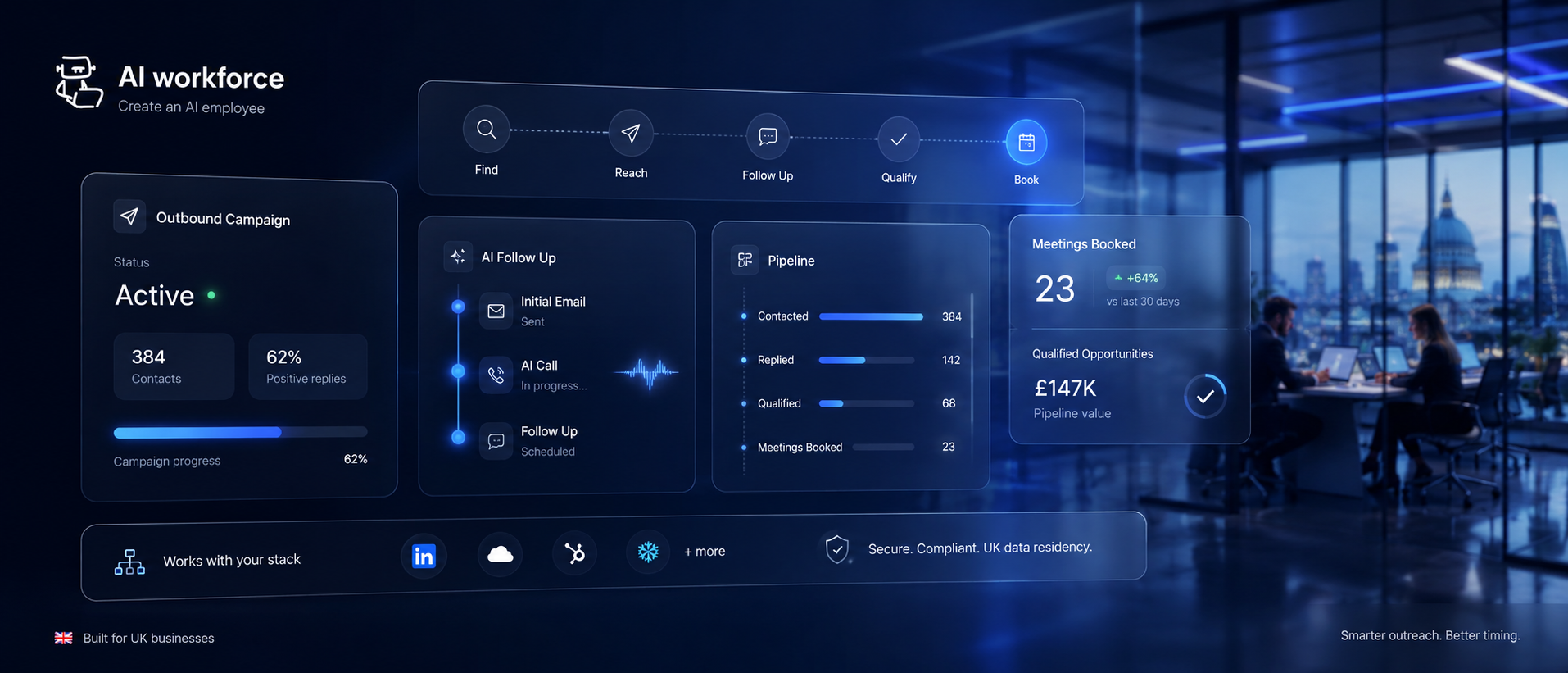
AI outbound sales automation is specifically the system that coordinates proactive prospecting and contact across one or more outbound channels: find a prospect, research them, prioritise them, make first contact, follow up, classify what comes back, qualify genuine interest, and hand a real opportunity to a rep.
That definition matters because "AI outbound sales" gets used loosely to describe several adjacent but different categories, and the distinction is covered in full in the next section. What sets outbound apart from the wider sales automation category is the word proactive. Outbound automation initiates contact with someone who has not asked to hear from you, which is precisely why it carries a materially different compliance and reputational risk profile from a system that only responds to an inbound enquiry.
AI is increasingly being used to handle the repetitive research, drafting and follow-up layers of outbound sales, particularly where teams need to cover more accounts without increasing prospecting headcount at the same rate. That is a more defensible claim than saying outbound AI has become the standard way every team works, since adoption, maturity and results still vary considerably by business and by how well the workflow was built.
How Does an AI Outbound Sales Agent Work?
Marketing copy for this category often describes a single smooth loop: reads data, decides who to contact, writes the message, books the meeting. In practice, a mature system is built from four distinct layers working together, not one model doing everything.
Data retrieval: pulls CRM history, company records, enrichment data and approved external signals, such as a funding announcement or a role change
Decision logic: determines eligibility, priority, channel and next action based on defined rules and scoring, not open-ended judgement
Generative AI: drafts research summaries, personalisation lines or reply suggestions, the part of the system doing genuine language work
Deterministic workflow controls: enforce sending limits, suppression rules, channel permissions and escalation requirements as hard rules, not as something the model is asked to remember
That last layer is the one most competing content skips, and it is the most important distinction in this section. AI should not decide whether someone who has opted out can be contacted again. That has to be a hard system rule, enforced at the application level, not a judgement call left to a language model's good behaviour. Once you separate these four layers, it becomes much easier to see where a specific platform is strong, where it is thin, and where its "AI" claim is really doing rules-engine work with a language model bolted on for the drafting step.
Decision logic is worth a closer look, since it is the layer that turns raw data into an actual action. It combines deterministic business rules with ranking signals such as ICP fit, buying signals, prior engagement, suppression status, a confidence score and current campaign priorities. The output is not a simple send or don't-send flag. It decides which channel to use, which sequence a contact enters, whether the action needs human approval first, and whether another contact at the same account should pause while this one is in progress.
What Data Does an AI Outbound System Actually Need?
An outbound system is only as good as what feeds it, and this is where most underperforming builds actually fail, not in the AI layer. The data retrieval layer described above typically draws on:
CRM records: ownership, stage, past outcomes and any existing relationship history with the account
Email and engagement history: previous opens, replies and meeting outcomes, where available and consented to
Calendar and meeting data: to avoid contacting someone already in an active conversation with another rep
Enrichment data: firmographic and role information from a licensed data provider, refreshed on a defined schedule rather than left to go stale
Intent and signal data: approved external signals such as funding news, hiring activity or a role change, treated as a clue rather than proof
Company and account data: structure, size and, where relevant, which other stakeholders are already in active sequences
Suppression and consent records: the authoritative record of who must not enter or re-enter outreach, checked before every action rather than only when a list is first created
Previous campaign history: what this contact or account has already been sent, so a new sequence does not repeat or contradict one that is still running
Gaps or staleness in any one of these feed directly into the failure modes covered later in this guide, which is why data quality is worth auditing before automation is judged on its output. Where this data actually comes from, and how it is sourced and enriched before it ever reaches an outbound workflow, is covered in our AI lead generation guide.
AI Outbound vs AI SDR vs Sales Prospecting vs AI Sales Automation
These four terms overlap heavily in vendor marketing, and treating them as interchangeable makes it hard to evaluate a platform properly or to know which guide on this site actually answers your question.
AI outbound sales automation is the orchestration layer specifically for proactive prospect contact: find, research, prioritise, contact, follow up, classify, qualify, book and hand off. This guide covers that full loop end to end.
Cold email software mainly sends and manages email sequences. It is one channel inside a broader outbound system, not the system itself. Our cold email software guide covers this layer in depth.
AI sales prospecting mainly researches and prioritises: which accounts and contacts are worth pursuing, and why. It typically stops before or at the first message. Our AI sales prospecting guide covers this layer specifically.
An AI SDR may perform several outbound steps autonomously: research, outreach, reply handling and basic qualification, under one product label. "AI SDR" is a broad commercial term rather than a fixed feature set, and our AI SDR tools guide covers what different platforms actually do under that label.
AI sales automation is the broadest category. It can include everything above plus inbound workflows, CRM administration, forecasting, coaching and internal operations that have nothing to do with proactive contact. Our AI sales automation guide covers the full seven-layer picture, including the parts that fall outside outbound entirely.
Knowing which of these you are actually buying, building or reading about prevents a common and expensive mistake: assuming a tool that is strong at one layer, such as prospecting, will automatically be equally strong at another, such as reply handling or meeting booking.
The AI Outbound Sales Stack
Put together, a properly governed AI outbound system runs through eight stages, each with a distinct purpose and a distinct set of risks.
Data source: CRM history, first-party engagement data, public company information and licensed enrichment
Eligibility and suppression: is this person actually allowed to enter outreach, checked against consent status, subscriber type and any existing suppression
Account and contact scoring: why this account, why this person, why now, built from defined criteria rather than a single opaque number
Message generation: a first draft based on approved signals, not invented detail
Human approval or autonomous send: depends on confidence, account value and risk, covered in the confidence-routing section below
Reply classification: interested, objection, out of office, wrong person, opt-out, or uncertain
Handoff, follow-up or booking: routes a genuine opportunity to a person or continues an approved cadence
CRM update and audit trail: logs what happened at every stage so a decision can be reviewed and, where needed, corrected
Skipping the eligibility and suppression stage, or treating it as something the AI will handle correctly by default, is one of the more common ways an outbound build goes wrong before it has sent a single message. Once a meeting is actually booked, what happens next- confirmation, rescheduling and no-show handling- is its own layer, covered in our AI appointment setter guide.
What Should AI Automate vs What Should Stay Human?
A clear split between what the system can usually handle and what should stay with a person, or a hard rule, gives a team a shared, testable starting point.
AI can usually handle account and contact research, first-draft messaging, routine follow-up sends within a tested cadence, reply classification for clear-cut categories, and CRM logging. A person, or an enforced system rule, should stay in control of a specific set of actions regardless of how well the workflow has performed elsewhere:
Overriding an unsubscribe, objection or suppression status
Contacting a record where subscriber type or lawful basis cannot be established
Pricing, discounts and contractual commitments
Responses to complaints or sensitive messages
Senior or strategically important accounts where context outside the CRM matters
Restarting contact after a data protection objection
Treating this as a fixed boundary rather than a case-by-case judgement call is what keeps an outbound workflow from quietly drifting into territory it was never tested for.
Confidence-Based Autonomy for Outbound Decisions
Rather than a single autonomy switch for the whole workflow, the safest way to bound an outbound system is by the model's own confidence in a specific decision:
High confidence and low-risk action: the system proceeds automatically, for example, sending a tested, low-risk follow-up to a clearly classified non-response
Medium confidence: the system drafts the action and a person approves it before anything happens, for example, a first-touch message referencing a signal that needs a quick human sanity check
Low confidence, high-value account, or sensitive reply: the workflow pauses and hands over to a person rather than guessing
Illustrative governance model, not an industry standard. Thresholds should be tested against your own historical outcomes rather than applied as a fixed default.
This gives a team an actual governance model to implement, rather than a general instruction to "keep a human involved somewhere." The threshold for each tier should be tested against real historical outcomes, since what counts as high confidence varies by decision type and by how much labelled history a business actually has.
Confidence-based routing also maps onto a broader maturity curve most outbound teams move through over time: manual outreach, then templated sequences, then AI-assisted drafting with a person still sending, then confidence-based autonomy as described above, then, for a narrow set of tested, low-risk actions, full autonomy. Few teams start at the final stage, and few should try to.
Account-Level vs Contact-Level Automation
Most outbound guides describe personalisation and cadence at the level of a single contact. For enterprise and mid-market outbound, that is not enough, because a single account can involve several stakeholders being contacted by different sequences at the same time.
Consider a realistic failure mode: a CEO receives message A from one sequence, a CFO receives a different message B from another, and an operations director gets contacted by a third. One of them replies negatively or asks to stop. If the other two sequences continue regardless, because each was only tracking contact-level state, the account has now received conflicting messaging and at least one further unwanted contact after an objection.
A mature outbound system needs to track two distinct layers of state:
Contact state: what this specific individual has done, replied, objected, opted out, gone quiet
Account state: what is happening across the wider company, how many stakeholders are currently in active sequences, and whether one negative signal should pause outreach to the account as a whole
Whether an account should pause the moment one stakeholder objects, or only that individual's sequence should stop, is a genuine strategy decision rather than a fixed rule, but it is a decision that needs to be made deliberately and built into the workflow, not left as an accidental gap between two contact records that happen to share a company domain.
How Does AI Personalisation Work?
Not all AI personalisation lands the same way, and the difference usually comes down to whether the message gives a prospect an actual business reason to reply, rather than just proof that a data field was filled in correctly.
Weak: a first name, a job title and a generic compliment stitched into a template. It reads as personalised but gives the prospect nothing to respond to
Useful: a relevant company event tied to a genuine business reason, leading to a specific, proportionate proposition, for example a new office opening connected to an operational challenge your product addresses, stated plainly
Risky: personal information with no obvious relevance to the business reason for reaching out, such as a life event or personal social media activity, which can read as surveillance rather than research, even where the underlying data was technically public
A useful test before a message goes out: could the prospect read the personalised line and immediately understand why it is relevant to a business conversation, without wondering how you found it? If not, it is worth cutting or rewriting, regardless of how technically impressive the underlying research was. Personalisation quality also depends entirely on the enrichment feeding it. Stale or inaccurate company data does not just weaken a message; it can actively damage credibility by referencing something that is no longer true.
Generative AI should only write from verified data already retrieved by the workflow. Allowing a model to invent missing context usually produces convincing but incorrect personalisation, which is considerably more damaging than sending a shorter, factual message. If a signal cannot be confirmed, the safer instruction is to leave it out rather than let the model fill the gap with something plausible.
Email, LinkedIn, SMS and Voice: Not Interchangeable Channels
Technical capability does not mean platform permission, and the four common outbound channels carry meaningfully different operational and legal risk, so they should not be treated as interchangeable extensions of the same workflow.
Email: commonly the easiest channel to scale for structured B2B first-touch and follow-up. Main risk: deliverability and PECR, covered in the next section
LinkedIn: useful for account research and human-led social outreach, but automation needs separate scrutiny. LinkedIn's User Agreement restricts scraping and certain forms of unapproved automated access, and this is enforceable against the account holder, not only the tool provider. A vendor should be able to explain clearly whether it uses an approved API, a partner integration, browser automation or credential-based access before you connect a business account
SMS: effective for short, time-sensitive communication where permitted, but carries its own consent and PECR considerations, particularly for outbound use to individual subscribers
Live calling: works well for qualification and genuine conversation, but requires screening against the Telephone Preference Service and Corporate Telephone Preference Service before dialling
Automated calling: the most constrained outbound channel under UK rules, requiring specific consent regardless of whether the recipient is an individual or a corporate subscriber, which is a materially stricter position than the email rule
Coordinating channels can give a team more ways to reach a prospect, but the additional channel only helps if targeting, suppression and platform compliance are managed consistently across the whole workflow, not layered on as an afterthought once email stops getting replies.
Where Does AI Outbound Sales Commonly Go Wrong?
A fair account of this technology has to include where it fails, not just where it helps. The most frequent failure points are specific and worth checking for directly in your own workflow:
Stale enrichment producing outreach that references something no longer true
Contacting the wrong decision-maker because a role or title in the data is outdated
Invented personalisation, where a gap in a thin record gets filled with a plausible but inaccurate detail
Duplicate outreach to the same contact from more than one sequence running at once
Cross-channel suppression failure, where an opt-out on one channel does not stop contact on another
Weak buying signals treated as proof of intent rather than a clue worth checking
Reply misclassification, where a decline or an out-of-office reply is read as interest
Automated LinkedIn activity breaching the platform's own terms of service
Sending volume damaging domain reputation faster than anyone notices
Multiple contacts at one account receiving conflicting messaging, as set out in the account-level section above
The workflow continuing after a clear rejection because a classification step misread it
CRM write-back errors that quietly degrade the data the next campaign will rely on
None of this makes the category unsuitable. It means a tested escalation path, the deterministic controls described earlier, and a habit of checking what the system actually did, rather than assuming it worked, matter more than how polished the outreach looks in a demo.
UK GDPR, PECR and Platform Rules for AI Outbound Sales
Outbound automation proactively contacts people who have not asked to hear from you, so it sits squarely inside UK data protection and marketing law from the first message onward. This section is general information rather than legal advice.
UK GDPR applies wherever the system processes information relating to an identifiable person, including named contacts held in a CRM or prospecting database, regardless of channel.
PECR governs marketing emails, texts and calls separately from UK GDPR, and the rules differ by recipient type. Individual subscribers, including sole traders and some partnerships, generally need specific consent or the soft opt-in for existing customers, which does not cover contacts obtained from a bought-in list. Corporate subscribers, such as limited companies, LLPs, Scottish partnerships and some government bodies, can generally be emailed or texted without that consent requirement, provided you identify your organisation clearly and give a working opt-out. This exemption does not carry over to live or automated calls: PECR's rules on live marketing calls, including screening against the Telephone Preference Service, apply to individual and corporate subscribers alike, and automated calls specifically require prior, specific consent regardless of subscriber type.
A lawful basis is required for every type of processing involved, most commonly legitimate interests for B2B outbound contact, supported by a documented purpose, necessity and balancing assessment rather than assumed by default. Individuals retain an absolute right under UK GDPR to object to direct marketing at any time, and any valid objection must be honoured by suppressing further contact across every channel the workflow touches, not just the one it arrived on.
Suppression, provenance and retention are practical requirements alongside the legal ones: a working suppression list checked before every send, a record of where each contact's details actually came from, and a defined retention period for prospecting and engagement data rather than an indefinite default.
Platform terms sit alongside data protection law as a separate risk. LinkedIn and similar platforms restrict scraping and unapproved automated access, and this is enforceable against the account holder, not only the tool provider, as covered in the channels section above.
Our guide to AI and GDPR compliance for UK businesses covers the underlying framework in more depth, and our AI sales prospecting guide covers the compliance position specific to research and enrichment before a message is ever sent.
CRM-Native AI vs Prospecting Platforms vs AI SDR Tools
Businesses evaluating outbound automation usually end up choosing between three genuinely different categories of tools, and treating them as substitutes for one another leads to the wrong comparison. The eight tools compared earlier in this guide span all three categories, plus a data-only category that Clay occupies.
CRM-native AI, such as HubSpot's Breeze agents or Salesforce's Agentforce, sits inside your existing customer and pipeline data and is strongest for CRM-adjacent tasks such as scoring and record updates. Our AI sales automation guide covers current CRM-native AI pricing in detail.
Prospecting and sales intelligence platforms, in the style of LinkedIn Sales Navigator, Apollo or Clay, are built for research and targeting: finding and enriching accounts and contacts. They are not outbound execution tools on their own, and comparing a CRM directly against a prospecting tool is a false comparison, since they solve different parts of the process.
Execution and AI SDR tools are built specifically to research, contact, follow up and qualify, the closest category to what this guide describes as the outbound stack. Our AI SDR tools guide covers named platforms in this category.
AI sales assistant tools sit closer to the rep than the workflow, helping with call notes, deal summaries and next-step suggestions rather than running outbound sequences themselves. Our AI sales assistant guide covers that category separately, since it solves a different problem to the outbound stack described here.
Most outbound builds end up combining at least two of these: a CRM as the system of record, a prospecting tool or data source feeding the top of the funnel, and either a specialist AI SDR platform or a custom-built workflow handling contact and follow-up. The question worth asking is which of the eight stack stages in this guide each tool genuinely covers, not which single product claims to do everything.
How Do You Evaluate a Vendor?
Before committing to a platform, put these questions to the vendor directly:
Which stages of the outbound stack does this product actually cover, and which are left to another tool?
How is eligibility and suppression enforced, as a hard system rule or as an instruction to the model?
Where does enrichment and signal data come from, and how current is it?
Can autonomy be set separately by confidence tier, rather than as one blanket setting?
Does the platform track account-level state as well as contact-level state?
Does any LinkedIn or social capability use an approved API or partner integration, or browser-level access that could put an account at risk?
Can outreach be paused instantly across every channel if something looks wrong?
Can you export a full audit log of what the system did, why, and what a person overrode?
Can I reproduce why the AI made a specific decision six months later, not just see that it was made?
Who owns the underlying data once a contract ends?
What happens when reply classification is uncertain; does it escalate or guess?
How are CRM write-backs validated before they overwrite existing records?
A vendor that cannot answer these clearly, or treats the questions as unusual, is a signal to slow down. That question on auditability is becoming a bigger differentiator than most feature comparisons, since it is the one that matters most when a decision needs explaining after the fact, to a customer, a regulator or your own leadership team.
A Four-Week Pilot Plan
Rolling out AI outbound sales automation on a constrained slice of your process is safer than switching on full volume from day one.
Week one: define your ideal customer profile, exclusions, channels, suppression rules and a measurement baseline.
Week two: test research, scoring, suppression and account coordination against known accounts, including deliberately stale contacts, suppressed records and companies with multiple stakeholders already in active sequences.
Week three: run message generation and reply classification in draft-only mode, comparing the system's output against what a rep actually decided.
Week four: launch a restricted live segment with human review on anything uncertain, and track outcomes properly before expanding.
How Do You Measure AI Outbound Sales?
Messages sent or meetings booked alone are not a sufficient measure, since a system can produce more activity while lowering its quality. Track a broader chain of indicators:
Valid-contact rate: how many records actually reach a real, current person
Research correction rate, how often enrichment needed a human fix
Personalisation correction rate, how often a drafted line needed rewriting or cutting
Positive reply rate, tracked separately from total reply volume
Qualification accuracy, checked against what actually became a real opportunity
Meetings per validated prospect, and meeting show rate
Human takeover rate, how often the workflow escalates or needs manual intervention
Account collision rate, how often multiple stakeholders at the same company entered overlapping or conflicting sequences when they should have been coordinated
Opt-out and complaint rate
Sales-accepted opportunity rate, and where visible, cost per accepted opportunity
Time saved per rep, measured against a real baseline rather than assumed
Avoid making open rate a central measure of success. Review the fuller set above over several weeks of real activity before deciding whether to expand a workflow to a new segment or channel.
It also helps to view these metrics as a single chain rather than a list to check separately: research time saved feeds into positive reply rate, which feeds into qualified meetings, which feeds into sales-accepted opportunities, which ultimately feeds into revenue. A workflow that improves one link in that chain while quietly damaging another, for example, generating more replies but lower-quality ones, has not actually improved outbound performance, whatever the top-line activity numbers suggest.
Is AI Outbound Sales Automation Worth It?
AI outbound sales automation is worth evaluating wherever manual research, first-touch drafting and follow-up tracking are consuming meaningful rep time on a structured, repeatable outbound motion. Its value depends on how well eligibility and suppression are enforced, how accurately replies are classified, and whether account-level coordination is built in from the start, not on how much volume the system can technically produce. Judged against cost per accepted opportunity and valid-contact rate, rather than messages sent, it is one of the clearer cases for AI adoption in B2B sales, provided the rollout starts on one constrained segment and expands only after the numbers hold up.
AI Workforce Insight: the outbound builds that hold up over time are the ones where suppression and eligibility are treated as application-level rules from day one, not as something layered on after an early version of the workflow already contacted someone it should not have. That single design decision, made early, prevents most of the failure modes covered in this guide, regardless of which of the eight tools above, or a custom build, ends up running it.
The strongest outbound systems do not try to replace judgement. They automate everything that is structured, measurable and repeatable, while deliberately preserving human control over commercial decisions, sensitive conversations and compliance boundaries. Businesses that treat outbound automation as workflow engineering rather than simply buying another AI tool tend to achieve better long-term results.
Related Guides
Frequently Asked Questions
What is the best AI outbound sales agent?
There is no single best agent; the right choice depends on your needs. This guide compares eight current tools, each strongest in a different area: full autonomous execution, AI-assisted sequencing, data enrichment, or CRM-native prospecting.
Is Clay an AI outbound sales agent?
No. Clay is a data aggregation and enrichment platform. Its Claygent feature uses AI for research, but Clay does not send outreach, handle replies or book meetings itself; it typically feeds a separate sending tool.
How is this different from an AI SDR or AI sales prospecting?
AI sales prospecting mainly researches and prioritises, typically stopping before or at the first message. An AI SDR may perform several outbound steps under one product label. AI outbound sales automation is the fuller orchestration layer that connects research through to handoff. See the category comparison section above for the full distinction, including AI sales automation as the broader parent category.
Can AI handle cold calling and LinkedIn outreach?
To a meaningful degree, but each channel carries different risk. Voice and automated calling have materially stricter UK compliance requirements than email, and LinkedIn automation needs checking against the platform's own terms of service before a business account is connected.
Do UK GDPR and PECR apply to AI outbound sales?
Yes, from the first message. UK GDPR applies to any identifiable contact, and PECR applies separately to marketing emails, texts and calls, with different rules for individual and corporate subscribers, and materially stricter rules for automated calls specifically.
What should never be automated in outbound sales?
Overriding an opt-out or suppression status, contacting a record where lawful basis cannot be established, pricing and contractual commitments, responses to complaints, and restarting contact after a data protection objection. These should stay under human or hard-rule control regardless of workflow performance elsewhere.
How much do AI outbound sales agents cost?
It varies by tool and pricing model. AiSDR and Apollo publish per-seat tiers, Clay combines per-seat pricing with usage credits, and HubSpot's Breeze Prospecting Agent charges $1.00 per qualified lead. Artisan, Regie.ai, 11x and Amplemarket require a custom quote. A custom-built workflow, separate from any of these platforms, commonly costs £3,000 to £10,000 to build, with £200 to £800 a month in ongoing costs.
What is the biggest risk of AI outbound sales automation?
Contacting someone who has opted out, inventing personalisation from stale or inaccurate enrichment, and multiple stakeholders at one account receiving conflicting messaging because the system tracked contact state without tracking account state.
How do I start if I have never used AI outbound sales automation before?
Pick one segment and one channel, run a four-week pilot in draft-only mode first, and only extend to fuller automation once qualification accuracy and valid-contact rate hold up against a real baseline.
Key Takeaways
There is no single best AI outbound sales agent; Artisan, AiSDR, Regie.ai, 11x, Clay, Amplemarket, Apollo and HubSpot's Breeze Prospecting Agent each cover a different slice of the outbound stack
Clay is a data and enrichment platform, not an outbound execution agent, and should not be compared directly against the other seven as if it were
A mature system combines four layers: data retrieval, decision logic, generative AI and deterministic workflow controls, and suppression should always sit in the last layer as a hard rule
The eight-stage outbound stack runs from data source through eligibility, scoring, message generation, approval, reply classification, handoff and CRM update, and is a useful checklist against any vendor's actual coverage
A small set of actions, opt-out overrides, pricing, complaints and strategic accounts should stay under human or hard-rule control regardless of how well a workflow performs elsewhere
Confidence-based routing, high confidence to automatic, medium to draft-and-approve, low to human takeover, gives a team an actual governance model rather than a vague instruction
Account-level coordination matters as much as contact-level personalisation, since multiple stakeholders at one account can otherwise receive conflicting messaging after an objection
UK GDPR applies to any identifiable contact, and PECR applies separately to email, text and calls, with stricter rules for automated calls specifically
Vendor software pricing and custom-build implementation costs are two different purchasing decisions and shouldn't be compared as if they were the same line item
Track valid-contact rate, qualification accuracy, human takeover rate and cost per accepted opportunity, not messages sent or open rate
This article is general information rather than legal advice. UK GDPR and PECR rules are established, but guidance and enforcement priorities continue to develop, particularly around AI-assisted outbound workflows. Take independent legal advice before relying on automated outbound contact for live commercial activity. Vendor pricing, features and product names are correct to the best of our knowledge as of publication and should be independently verified with each vendor before purchase, since AI product features and pricing change frequently.
Ready to Build an Outbound System That Actually Holds Up?
We'll help you map your outbound process against the eight-stage stack, decide what genuinely belongs at each confidence tier, and build a piloted workflow with proper suppression and account-level controls before it touches live prospects.
Sources and Further Reading
About the author: Seth Ayush is Co-Founder of AI Workforce, a British AI company building AI agents for UK businesses. He works on how AI Workforce's outreach and workflow agents are designed, tested and deployed, with a focus on getting reply handling, suppression and escalation logic right before a system is trusted with real prospects.
Reviewed by: Luca Controlo, Operations Lead at AI Workforce, for accuracy against current vendor pricing pages and product documentation.
Reviewed: September 2026.
© 2026 AI Workforce Ltd. All rights reserved.