AI for Insurance Brokers: Practical Uses, FCA Rules and Key Risks
Posted On: August 13, 2026
Written by Clara Miller, Content Marketing Specialist at AI Workforce · Reviewed by Seth Ayush, Co-Founder of AI Workforce
Last updated: August 2026
Quick Answer: AI helps an insurance broker capture enquiries, extract data from documents, compare policies, prepare renewal packs and claims summaries, and flag missing information, so the broker spends more time on advice, negotiation and judgement calls. The FCA wants safe and responsible AI adoption using its existing rules rather than a separate AI rulebook, so Consumer Duty, UK GDPR and normal broking obligations still apply to whatever a customer actually receives, whether or not AI helped prepare it.
At a Glance
What it is: AI that captures, extracts, compares and prepares information for a broker, rather than software that decides what a customer should buy
Wider financial services adoption: FCA-published research found 75% of surveyed UK financial services firms were already using AI, with 84% having a person accountable for AI
Regulation: the FCA supports AI adoption through its existing rules, AI Lab and Sandboxes, and Consumer Duty applies to the outcome a customer receives, not the method used to produce it
UK GDPR: the Data (Use and Access) Act 2025 replaced Article 22 with Articles 22A to 22D, and all of its data protection provisions are now in force
What needs a human: personal recommendations, assessing a client's demands and needs, complex risk placement, vulnerable customers, complaints and significant claims advice
What's Covered
What Is AI for Insurance Brokers?
How Are UK Insurance Brokers Using AI in 2026?
The AI Workforce Insurance Broking AI Model
What Can AI Actually Automate in Insurance Broking?
The AI Workforce Insurance Broking AI Boundary Matrix
AI for Client Enquiries and Lead Handling
AI for Document Processing and Policy Administration
AI for Renewals
AI for Underwriting Support
AI for Claims and First Notice of Loss
Worked Example: Client Enquiry to Policy Renewal
What Should Never Be Left to AI Alone?
FCA, Consumer Duty and Human Oversight
UK GDPR, Profiling and Automated Decisions
What Types of AI Tools Are Available?
How to Choose an AI Tool
How to Measure Whether It Is Working
Common Mistakes
A Four-Week Rollout
Frequently Asked Questions
Key Takeaways
What Is AI for Insurance Brokers?
What is AI for insurance brokers? AI for insurance brokers is software that reads, drafts, compares or organises information on a broker's behalf, rather than software that decides what a customer should buy or whether a claim is paid. It removes administrative weight around a broker's work. It does not replace the broker's professional judgement.
That distinction matters more in broking than in most professions, because a broker's core value is judgement: reading a client's actual situation, negotiating terms with an insurer, and standing behind the advice given. In practice, this means a broker's inbox, policy documents, renewal cycle and claims correspondence are the areas where AI has the clearest role. An enquiry can be logged and summarised automatically. A policy document can be scanned for the details a broker would otherwise extract by hand. A renewal pack can be drafted from last year's file rather than built from scratch. None of that requires AI to make a regulated decision. It requires AI to do the preparatory work well enough that the broker's time goes toward the parts of the job that actually need a person.
The Chartered Insurance Institute has already treated this as a live professional topic rather than a future one. Its New Generation Broking programme published a special report specifically on how insurance brokers can harness AI safely and effectively with clients in mind, aimed at brokers regardless of experience level. That is a useful signal: this is not a hypothetical technology question for the profession; it is a practical one about where AI fits into an existing, regulated way of working. That makes the CII report particularly relevant here because it addresses AI from the perspective of insurance broking specifically, rather than financial services or insurance more broadly.
How Are UK Insurance Brokers Using AI in 2026?
Adoption in UK financial services generally is now the norm rather than the exception. FCA-published research found that 75% of surveyed UK financial services firms had already adopted some form of AI, while 84% had an individual accountable for their AI approach, with cybersecurity flagged as the biggest perceived risk. Insurance broking sits inside that wider financial services picture, alongside similarly regulated intermediaries such as financial advisers and mortgage brokers, and brokerages are moving in the same direction, typically starting with the parts of the job that are repetitive and document-heavy rather than the parts that involve advice.
Lloyd's Lab, the market's own innovation programme, is a useful indicator of where the wider insurance sector is investing. Lloyd's Lab Cohort 16 includes Nolana, an AI-native insurance operating system offering dynamic First Notice of Loss intake and automated claims-decisioning capabilities while maintaining human oversight. That is not a broker-facing tool, but it shows the direction the wider market is taking: automate the operational layer, keep a person accountable for the outcome.
For a broker specifically, the realistic 2026 picture is narrower and more practical than the innovation showcase. Most brokerages are not building AI systems. They are adopting a handful of tools that sit alongside existing policy management software: one for extracting data from documents, one for drafting client communications, one for summarising claims files. The broker's own judgement, and the relationship with the client, remains the part of the job that has not changed.
The AI Workforce Insurance Broking AI Model
AI Workforce developed the AI Workforce Insurance Broking AI Model as a practical framework for checking whether a specific broking task is a good fit for automation, describing how AI should actually move through a broker's workflow, from the first piece of information to the outcome a customer receives.
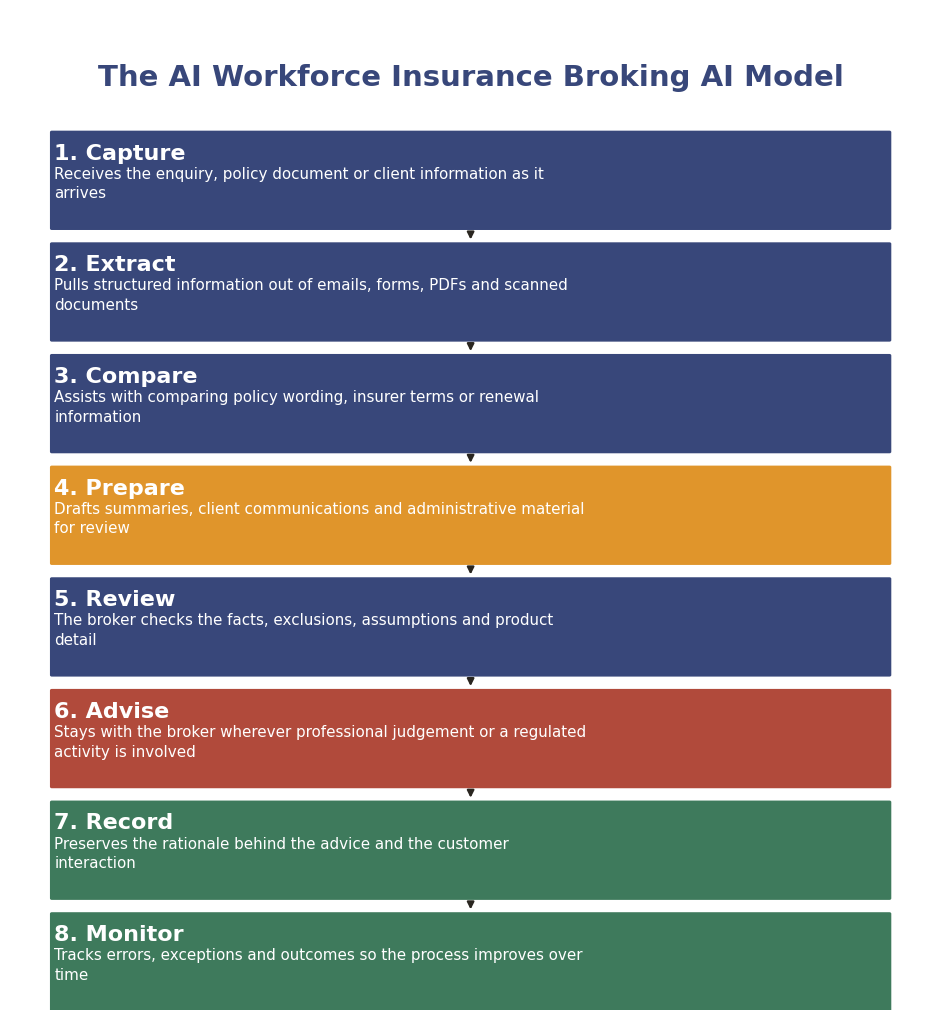
The AI Workforce Insurance Broking AI Model: Capture, Extract, Compare, Prepare, Review, Advise, Record, Monitor.
Capture: receives the enquiry, policy document or client information as it arrives, whatever channel it comes through
Extract: pulls structured information out of emails, forms, PDFs and scanned documents
Compare: assists with comparing policy wording, insurer terms or renewal information against the previous position
Prepare: drafts summaries, client communications and administrative material for a broker to review
Review: the broker checks the facts, exclusions, assumptions and product detail AI has prepared
Advise: stays with the broker wherever professional judgement, a personal recommendation or a regulated activity is involved
Record: preserves the rationale behind the advice and the customer interaction, in line with normal broking record-keeping
Monitor: tracks errors, exceptions and outcomes so the process improves over time
The point of naming each stage separately is that Advise sits deliberately apart from Prepare. AI can get a broker to the point of a well-organised, well-drafted piece of work. It should not be the thing deciding what that work recommends. A workflow that jumps straight from Extract to Advise, skipping Compare, Prepare and Review, is a much higher risk pattern than one that keeps a person genuinely in the loop at the point judgement is required.
What Can AI Actually Automate in Insurance Broking?
What can AI actually automate in insurance broking? AI can automate repetitive, document-based, low-ambiguity work such as reading a form, chasing a missing document, drafting a first version of a renewal letter, transcribing a call or updating a CRM record. For a typical brokerage using AI as an operational assistant, personal recommendations and other consequential customer decisions should remain broker-led unless the firm is operating within a specifically authorised automated decision or advice framework.
These are tasks with a right answer that a person can check quickly, which is exactly the profile of work AI handles well. None of them requires the broker's professional judgement, and all of them currently take up time a broker could spend with clients instead.
What AI cannot safely automate is anything where the right answer depends on a specific client's circumstances, risk appetite or vulnerability, or where getting it wrong has a material effect on the customer. The Data (Use and Access) Act 2025 reinforces this distinction from a different angle: it defines when a decision counts as automated decision-making with a significant effect on a person, which is precisely the category of decision a broker should keep firmly in human hands. A useful way to think about it is that AI automates the steps that lead up to a decision, not the decision itself.
The AI Workforce Insurance Broking AI Boundary Matrix
AI Workforce built the AI Workforce Insurance Broking AI Boundary Matrix so a brokerage has a working answer to "what can we safely automate" rather than deciding it task by task under time pressure.
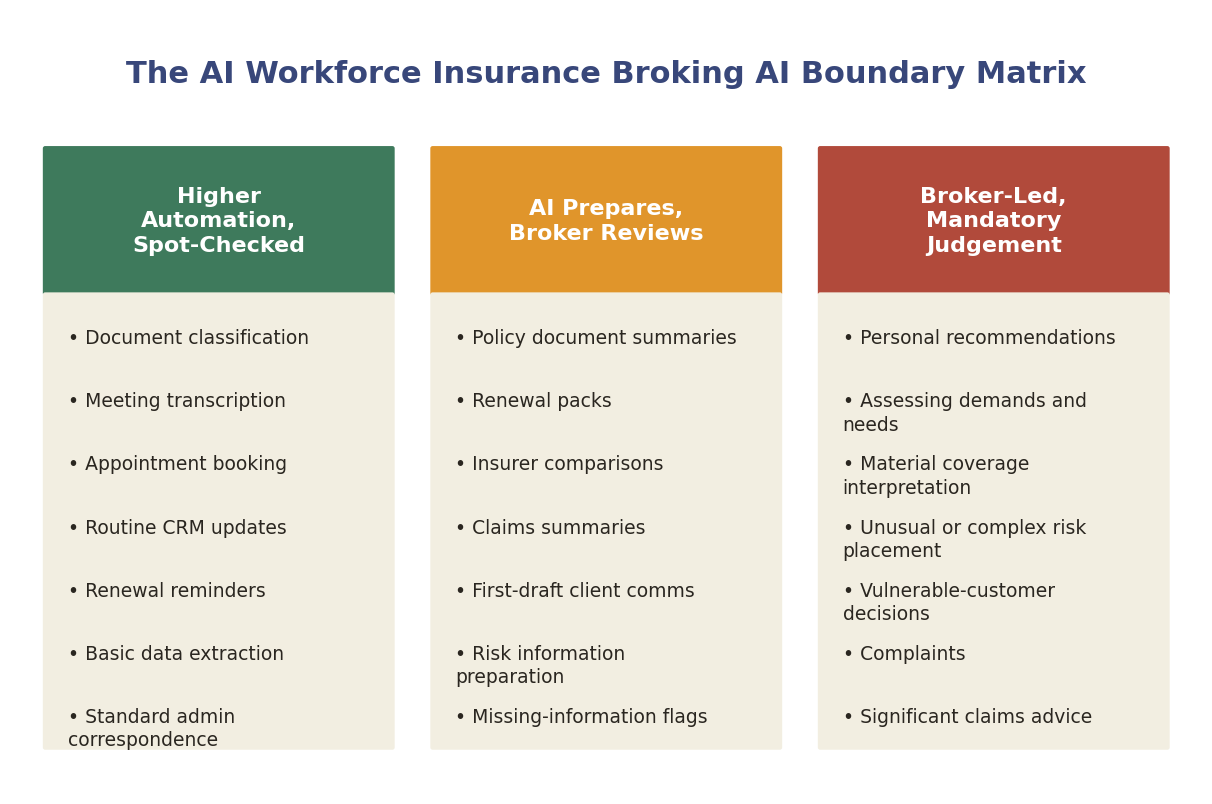
Illustrative starting point. Your own risk tolerance and client base should adjust where a task sits.
Higher Automation, Spot-Checked
Document classification
Meeting transcription
Appointment booking
Routine CRM updates
Renewal reminders
Basic data extraction
Standard administrative correspondence
AI Prepares, Broker Reviews
Policy document summaries
Renewal packs
Insurer comparisons
Claims summaries
First-draft client communications
Risk information preparation
Missing-information flags
Broker-Led, Mandatory Judgement
Personal recommendations
Assessment of a client's demands and needs
Material coverage interpretation
Unusual or complex risk placement
Vulnerable-customer decisions
Complaints
Significant claims advice
A task sitting in the top tier today does not have to stay there forever, and a task that starts in the bottom tier is not necessarily permanent either. The point of the matrix is to make the current boundary explicit, so that moving a task up a tier is a deliberate decision based on evidence, not something that happens by default because a platform technically could handle it.
AI for Client Enquiries and Lead Handling
A new enquiry is usually the first place AI touches a broker's workflow, because it is high volume, time-sensitive, and largely about capturing information correctly. An AI tool can log the enquiry the moment it arrives, pull out the basic facts, such as the type of cover needed, the client's business or personal circumstances, and any stated deadline, and prepare a first response for the broker to check before it goes out.
This matters commercially because a slow first response can increase the risk of a new enquiry going elsewhere. AI does not close the sale; it reduces the delay before a person picks the conversation up properly. The same approach extends to renewal outreach and lapsed-client follow-up, where AI can flag which clients are approaching a renewal date or have gone quiet, without the broker needing to check a spreadsheet manually.
AI for Document Processing and Policy Administration
Insurance broking runs on documents: application forms, policy schedules, endorsements, correspondence with insurers, and client-supplied information that arrives in whatever format the client happens to send it in. AI-powered document extraction reads unstructured material, such as a scanned form or a long email thread, and turns it into the structured fields a broker's system actually needs, which used to be manual data entry work.
This is also where a broker can see some of the clearest efficiency gains, because structured data extraction and routine document administration depend primarily on accuracy rather than professional judgement, and the extracted information can be checked quickly before use. A missing-information flag is particularly valuable here: rather than a broker discovering a gap in the file when it is too late to fix easily, AI can surface it as soon as the document is processed. Policy administration tasks such as updating records, generating standard correspondence, and keeping a client file consistent with what has actually been agreed also sit comfortably in this category.
AI for Renewals
Renewals are a natural fit for AI because the previous year's file already contains most of what a new renewal pack needs: the client's circumstances, the cover in place, the claims history, and the insurer's previous terms. AI can pull that history together, compare it against updated insurer terms, and draft a first version of the renewal communication, which the broker then reviews, adjusts and sends.
Done well, this shortens the time between an insurer's renewal terms landing and the client receiving a clear, accurate summary of their options, without skipping the check a broker should make on anything that changed since last year, such as a new exclusion, a premium increase that needs explaining, or a change in the client's own circumstances that affects the right recommendation. The risk worth naming directly is treating a renewal as routine simply because AI made the paperwork easier. A renewal is still a point at which a broker should confirm the cover still matches the client's needs, not just reissue what was in place before.
AI for Underwriting Support
Can AI make underwriting decisions? AI can support underwriting and, in some authorised insurance workflows, automated systems may contribute directly to underwriting decisions. For a typical insurance broker, however, AI is more likely to prepare and structure risk information for the insurer or delegated authority holder, extracting data, identifying missing information and comparing the current submission against previous ones. The broker should be clear about who actually holds underwriting authority and who is responsible for the decision.
This distinction is easy to lose in generic AI commentary, which tends to talk about "AI underwriting" as a single category covering everything from a broker preparing a submission to an insurer pricing a risk automatically. For a broking audience specifically, the useful version of the claim is narrower: for a typical broker workflow, AI strengthens the quality and completeness of what reaches underwriting; the broker should remain clear about whether the final underwriting decision sits with an insurer, delegated authority holder or an authorised automated system. Where this pays off in practice is submission quality. An underwriter who receives a complete, well-structured submission with no obvious gaps can often turn a quote around faster than one who has to chase missing information first.
AI for Claims and First Notice of Loss
Claims and First Notice of Loss are areas where the wider insurance market is investing heavily in AI, and Lloyd's Lab's current cohort includes a platform built specifically for this: an AI-native operating system offering dynamic First Notice of Loss intake and automated claims decisioning support, while explicitly maintaining human oversight. That is evidence this is a genuinely active area of insurance technology, not a speculative one.
For a broker, the realistic scope is narrower than that market-level example. AI can help capture the first notice of loss accurately, extract the relevant policy and incident details, chase the client or the insurer for missing information, and prepare a plain-language summary of where a claim stands. What it should not do is determine coverage, quantify a settlement, or advise a client on a complex or contested claim without a person directly involved. Whose system is making a decision, and on what authority, is the question a broker should always be able to answer before relying on AI in a claims context.
Worked Example: Client Enquiry to Policy Renewal
A commercial client emails a broker asking about their upcoming renewal and mentions, in passing, that they have added a second location since last year.
Capture: AI logs the enquiry and identifies it relates to an upcoming renewal.
Extract: it pulls out the key detail, a new location, and flags it as a change not in last year's file.
Compare: it compares the previous insurer's terms against two alternative quotes already on file.
Prepare: it drafts a renewal pack using last year's policy as the base, and a client-facing summary that specifically highlights the new location as an open question.
Review: the broker checks the draft, confirms the new location needs to be declared and priced separately, and adjusts the recommendation accordingly.
Advise: the broker sends a personally reviewed summary to the client, with a request for the additional details the insurer will need.
Record: what changed, what was recommended and why is saved automatically.
In this example, AI prepared and structured the information; the broker made the recommendation and remained responsible for the advice. This is the pattern worth generalising: AI shortens the distance between "something arrived" and "the broker has what they need to make a decision." It does not shorten the decision itself.
What Should Never Be Left to AI Alone?
A personal recommendation is the clearest example. Recommending a specific policy to a specific client depends on that client's actual demands, needs and circumstances, which is precisely the kind of context an AI tool does not reliably have or weigh correctly. The same applies to assessing a vulnerable customer's situation, handling a complaint, or advising on an unusual or high-value risk where the standard playbook does not obviously apply.
Anything that could materially affect a customer's financial or insurance outcome belongs in the same category, even if it looks routine on the surface. A renewal that looks like a simple reissue can hide a material change in circumstances. A claim that looks straightforward can turn out to be contested. The safest working rule is that AI prepares, and a person decides, wherever the outcome for a specific customer is genuinely at stake.
FCA, Consumer Duty and Human Oversight
Does the FCA allow insurance brokers to use AI? Yes. The FCA has stated plainly that it wants safe and responsible adoption of AI in UK financial markets, supported through its AI Lab, regulatory Sandboxes and AI Live Testing programme, rather than through a separate AI-specific rulebook. Using AI does not remove a broker's existing responsibilities, and Consumer Duty continues to apply to whatever the customer actually receives.
An AI-drafted explanation, comparison or renewal communication can shape what a customer understands just as much as one written entirely by a person. The FCA's own supervisory focus in insurance specifically continues to centre on customer outcomes: its deputy chief executive told the industry in February 2026 that firms must test their outcomes against the Consumer Duty and that trust across the sector remains low, with 66% of consumers reporting low trust in insurance according to the FCA's 2024 Financial Lives Survey, alongside continued regulatory attention on claims handling following the Which? super complaint. None of that changes because AI was involved somewhere in the process. The outcome is still what gets judged. The same logic applies across regulated financial services, including for financial advisers, where Consumer Duty attaches to the outcome a client receives rather than to the tool used to help produce it.
How does Consumer Duty apply to AI used by insurance brokers? Consumer Duty applies to the customer outcome, regardless of whether AI helped produce it. Brokers therefore need to ensure AI-assisted communications support customer understanding, products and services continue to meet customer needs, and automation does not create poorer support or outcomes for particular customer groups.
For a brokerage, the practical implication is straightforward: keep the AI Workforce Insurance Broking AI Boundary Matrix, or something like it, as an explicit internal policy, document where a person reviewed AI-prepared material before it reached a client, and be able to explain, if asked, which parts of a customer's journey involved AI and where a person made the actual decision.
UK GDPR, Profiling and Automated Decisions
What is the practical difference for a broker under UK GDPR? The post-DUAA framework distinguishes significant decisions based solely on automated processing from decisions where a person remains meaningfully involved. A decision is solely automated where there is no meaningful human involvement, while a significant decision is one that produces a legal effect or similarly significant effect on the individual. Most of the AI uses described in this guide, preparing information for a broker to review and act on, are different because a person remains meaningfully involved in the consequential decision.
Insurance broking involves exactly the kind of personal data that automated decision-making rules are designed to cover: health information, financial circumstances, claims history and risk factors that can feed into pricing, eligibility or fraud scoring. The Data (Use and Access) Act 2025 changed how UK GDPR treats this. The previous single Article 22 has been replaced by Articles 22A to 22D, and as of June 2026 all of the DUAA's data protection provisions are in force.
If a system decided entirely on its own whether to offer cover, materially determine a customer's price, or determine a claim outcome, the firm would need to assess whether this amounted to a significant decision based solely on automated processing and, if so, apply the relevant UK GDPR safeguards. That is exactly why the distinction drawn earlier in this guide, between AI preparing information and AI making a decision, matters legally as well as practically. Keeping a person meaningfully involved in consequential customer decisions can help ensure a workflow does not amount to solely automated decision-making, but the wider processing still needs to comply with the applicable UK GDPR requirements. Our wider guide to AI GDPR compliance covers lawful basis, DPIAs and vendor due diligence for AI generally, beyond the automated-decision rules specific to broking covered above.
Additional restrictions apply where special category data is involved. This matters particularly in insurance where health information may influence underwriting, eligibility or claims decisions, so these workflows need separate assessment rather than assuming the wider post-DUAA automated-decision rules apply in the same way.
What Types of AI Tools Are Available?
Most brokerages are not buying a single AI platform that does everything. They are combining a small number of purpose-built tools: one for extracting data from documents, one for drafting client communications, one for summarising long files such as claims history or policy wording, and one for basic conversational support, such as answering routine policy questions on a website, an approach covered in more depth in our guide to AI voice agents. Some tools sit inside existing policy management software as an added feature. Others are separate and connect through integration.
The distinction worth understanding before choosing anything is between a tool that assists a person and a tool that acts on its own. An assistant drafts, extracts and summarises, and a person reviews the output before it reaches a client. An agent completes a short sequence of tasks with less direct oversight at each step, which raises the stakes of getting the boundary between automation and judgement right, and makes it more important to know exactly what a given tool is authorised to do without a person checking first.
How to Choose an AI Tool
Start with a genuine bottleneck rather than a broad ambition. A tool aimed at reducing document processing time, or at drafting renewal packs faster, has a measurable before-and-after. A tool aimed vaguely at "using AI" does not.
Check where the vendor's tool sits on the AI Workforce Insurance Broking AI Boundary Matrix before adopting it. A vendor that has never worked with brokers may not understand the compliance and record-keeping obligations that come with the job, or may position a tool as making decisions it should only be preparing. Ask specifically what happens with client data, whether it is used to train the vendor's models, and where it is stored, since this is personal and often sensitive data under UK GDPR. Finally, ask what the tool does when it is uncertain. A tool that flags uncertainty and routes the case to a person is a better fit for a regulated profession than one that always produces a confident-sounding answer regardless of how reliable the underlying information actually was.
How to Measure Whether It Is Working
We call this the AI Workforce Insurance Broking AI Measurement Hierarchy, a set of indicators worth tracking together so a brokerage judges an AI deployment on genuine accuracy and outcomes, not on activity volume alone.
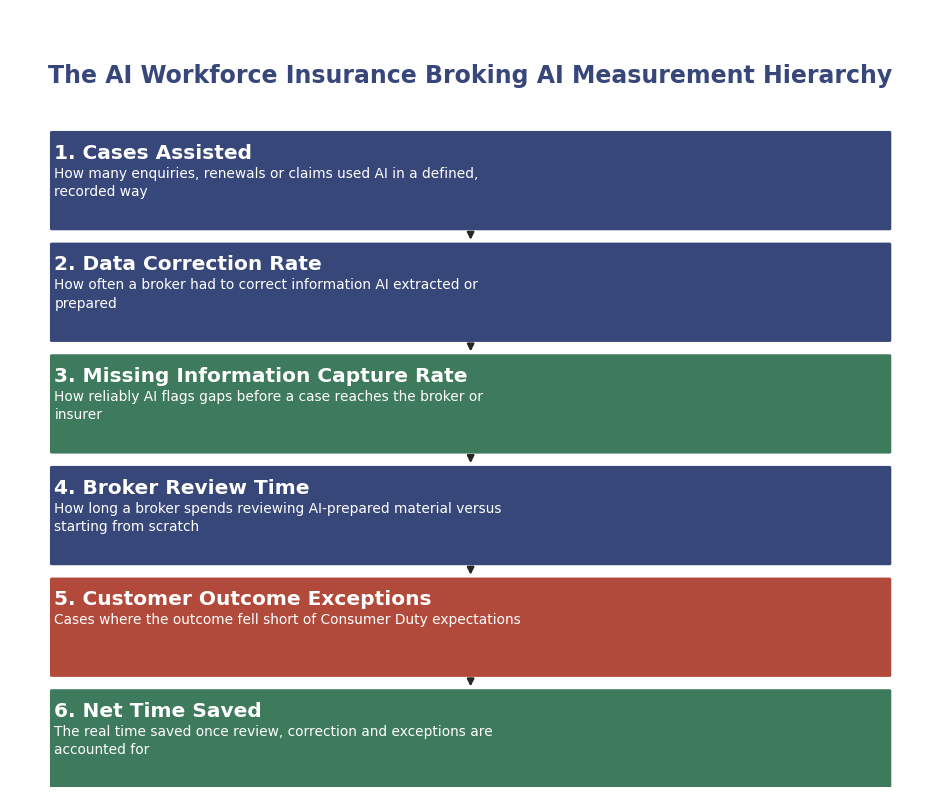
AI Workforce developed the AI Workforce Insurance Broking AI Measurement Hierarchy so a brokerage judges an AI deployment on genuine accuracy and outcomes, not activity volume alone.
Cases Assisted: how many enquiries, renewals or claims used AI in a defined, recorded way
Data Correction Rate: how often a broker had to correct information AI extracted or prepared
Missing Information Capture Rate: how reliably AI flags gaps before a case reaches the broker or the insurer
Broker Review Time: how long a broker spends reviewing AI-prepared material compared with doing the work from scratch
Customer Outcome Exceptions: cases where the customer outcome fell short of Consumer Duty expectations, tracked separately for AI-assisted and manual cases
Net Time Saved: the real time saved once review, correction and exception handling are accounted for
Cases Assisted answers "how much is AI being used." The other five metrics answer the harder question, which is whether that use is actually reliable. A high Data Correction Rate is not necessarily a failure; it might mean the broker is checking properly. A low Missing Information Capture Rate is a genuine problem, because it means the tool is not doing the one job it was adopted for. Net Time Saved is the number that should ultimately justify the investment, and it only means anything once it accounts for the time spent correcting and reviewing, not just the time AI appeared to save on the surface.
Common Mistakes
Common mistakes to avoid: letting AI-prepared material reach a client without a genuine review, treating the review step as a formality once the tool has proven reliable a few times, describing AI as making underwriting or claims decisions it is only preparing information for, adopting a broad platform before proving value on a single, well defined bottleneck, and treating AI vendor selection the same way as choosing general office software rather than checking data handling and human oversight requirements.
A Four-Week Rollout
If you are still working out where your brokerage stands before committing to a pilot, our AI readiness assessment is a useful starting point.
Week one: identify a single, clearly defined bottleneck, such as document extraction on new enquiries or renewal pack preparation, and pick one tool aimed specifically at that task.
Week two: run a small pilot on a limited set of real cases, with every AI-prepared output reviewed by a broker before use, and errors logged rather than quietly corrected and forgotten.
Week three: widen the pilot slightly and start tracking the Measurement Hierarchy metrics above, particularly the Data Correction Rate and Missing Information Capture Rate.
Week four: review the results against the original bottleneck, decide whether to expand, adjust or stop, and document where the AI Workforce Insurance Broking AI Boundary Matrix places the task, so the next person using the tool has a clear reference for what it is, and is not, authorised to do.
Frequently Asked Questions
Can insurance brokers use AI in the UK?
Yes. The FCA supports safe and responsible AI adoption using its existing regulatory framework. A broker using AI still has to meet Consumer Duty, UK GDPR and normal broking obligations for whatever the customer actually receives.
Will AI replace insurance brokers?
No, not in any complete sense. AI can prepare information, draft communications and flag gaps, but a personal recommendation, an assessment of a client's demands and needs, and complex risk advice depend on judgement that stays with the broker.
Can AI compare insurance policies?
AI can compare policy wording, terms and prices to prepare a structured comparison for a broker to review. The broker is responsible for interpreting what those differences mean for a specific client and for the recommendation that follows.
Can AI automate insurance renewals?
AI can prepare a renewal pack, compare current terms against the previous year, and draft the client communication. A broker should still confirm the cover still matches the client's circumstances before it is sent, since a renewal is not always as routine as the paperwork suggests.
Can AI handle insurance claims?
AI can support First Notice of Loss capture, document extraction and status summaries. Coverage decisions, settlement figures and advice on contested or complex claims should stay with a person, whether that is the broker or the insurer, depending on where that authority sits.
Can AI make underwriting decisions?
AI can support underwriting and, in some authorised insurance workflows, automated systems may contribute directly to underwriting decisions. For a typical insurance broker, however, AI is more likely to prepare and structure risk information for the insurer or delegated authority holder. The broker should be clear about who actually holds underwriting authority and who is responsible for the decision.
Does Consumer Duty apply when an insurance broker uses AI?
Yes. Consumer Duty applies to the outcome a customer receives, not to the method used to produce it. An AI-drafted explanation or renewal communication is judged on the same standard as one written entirely by a person.
Can brokers put client data into ChatGPT or similar general AI tools?
This needs care. Client data is personal, often sensitive, and subject to UK GDPR regardless of which tool processes it. A broker should check a tool's data handling terms, whether inputs are used for model training, and where data is stored, before entering real client information into any general-purpose AI tool.
What insurance-broking tasks should be automated first?
Document extraction, meeting transcription, renewal reminders and routine administrative correspondence are the safest and highest-value starting points, because they are repetitive, low in ambiguity, and easy for a broker to check.
Do brokers need to tell clients when AI has been used?
There is no general FCA rule requiring a broker to disclose every routine use of AI simply because AI was involved. However, existing transparency, Consumer Duty and data-protection requirements may require information to be provided depending on how AI is used and how materially it affects the customer. Where AI meaningfully shapes a recommendation or a significant decision, being clear about that is good practice as well as good risk management.
Is a broker's AI tool the same as an insurer's underwriting AI?
No. A broker's AI tools typically prepare, extract and draft information. An insurer's underwriting systems may price risk or make coverage decisions directly. These sit in different parts of the value chain and carry different regulatory weight.
What happens if AI gets something wrong in a client's file?
The broker remains responsible for the advice and the record, which is why review, the Data Correction Rate metric, and clear record-keeping of what changed and why all matter. AI reducing manual work does not reduce a broker's professional responsibility for the outcome.
Key Takeaways
AI for insurance brokers works best on capture, extraction, comparison and preparation, not on the advice or the decision itself
The AI Workforce Insurance Broking AI Model separates Prepare and Review from Advise, keeping professional judgement explicitly with the broker
The AI Workforce Insurance Broking AI Boundary Matrix gives a brokerage a working answer to what can be automated, what needs review, and what stays broker-led
The FCA supports safe and responsible AI adoption through its existing framework, but Consumer Duty and normal broking obligations still apply to the outcome a customer receives
The Data (Use and Access) Act 2025 replaced the previous Article 22 framework with Articles 22A to 22D. Where a person is meaningfully involved in a consequential decision, it is not a solely automated decision for these purposes, although the wider processing must still comply with UK GDPR
Underwriting decisions and claims judgements normally belong to the insurer or the authority holder, not the broker's AI tool, even where AI prepares the underlying information
Start with one genuine bottleneck, measure reliability rather than activity, and expand only once the numbers support it
Ready to Safely Introduce AI Into Your Brokerage?
AI Workforce helps UK insurance brokers identify which parts of client servicing, renewals, administration and document processing are ready for AI, while keeping advice, customer outcomes and consequential decisions under appropriate human oversight.
Related Guides
AI for Financial Advisers: Practical Uses, FCA Rules and Key Risks
Is Your Business Ready for AI? A Self-Assessment for AI Readiness
Sources
FCA, Insurance in the round: Innovation, growth and trust, speech by Sarah Pritchard, February 2026
Chartered Insurance Institute, New Generation Broking: Special report on AI and Broking
ICO, The Data (Use and Access) Act 2025 (DUAA), summary of the changes to data protection law
About the Author
Clara Miller is a Content Marketing Specialist at AI Workforce, where she covers practical AI adoption for UK professional services and financial services firms.
This article was reviewed by Seth Ayush, Co-Founder of AI Workforce.
Reviewed: August 2026. This article is provided for general information and does not constitute regulated financial, legal or professional advice. Insurance brokers should confirm their own regulatory obligations directly with the FCA, their professional body or a qualified adviser.