AI Receptionist vs Human Receptionist: Cost, Pros, Cons and Which Is Better?
Posted On: July 27, 2026
Written by Seth Ayush, AI Workforce · Reviewed by Rodi Taze, Co-Founder of AI Workforce · Last updated: August 2026
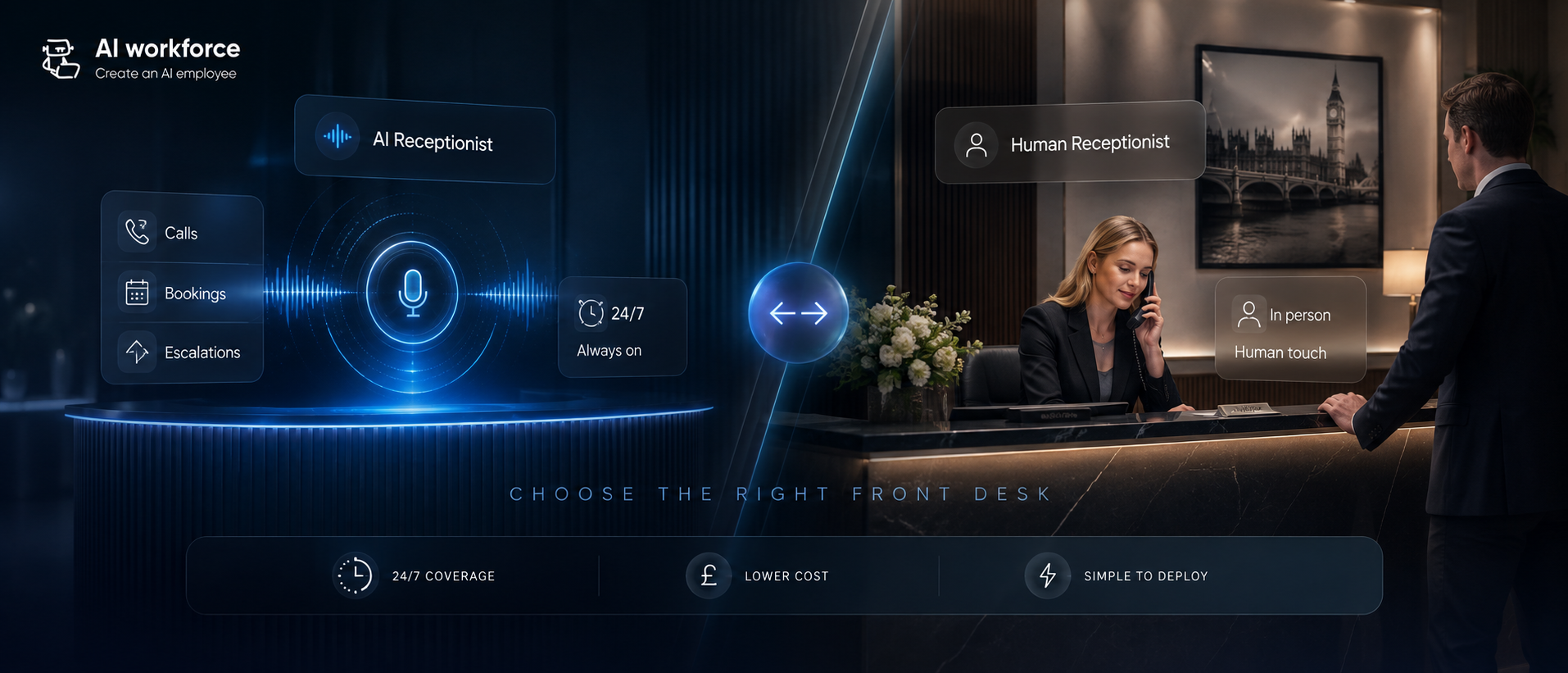
AI receptionists and human receptionists cover overlapping but different parts of the receptionist role. AI can provide concurrent, extended-hours handling for bounded phone workflows; a human receptionist can perform physical front-desk work and deal with situations requiring contextual judgement. The appropriate setup depends on the actual duties the business needs covered. This guide compares the two directly across cost, call handling, booking, customer experience and the specific tasks a human receptionist still does that AI can't, then gives you a simple framework for deciding which setup, or combination, fits your business.
Quick Answer: An AI receptionist can suit businesses where the role is primarily routine phone answering, booking, routing and extended-hours coverage. A human receptionist covers a broader role where physical front-desk work, emotionally sensitive calls, unusual requests and contextual judgement matter. A hybrid model combines automated handling of defined routine calls with human escalation for exceptions. Compare the actual duties, call patterns, required coverage and total cost rather than treating an AI subscription and a receptionist salary as direct substitutes.
At a Glance
AI may suit: 24/7 call answering, repetitive FAQs, booking, overflow, simultaneous calls, consistent workflows, structured CRM updates.
Human may suit: emotional situations, complaints, unusual requests, physical visitors, office coordination, judgement-heavy conversations, relationship continuity.
Hybrid may suit: businesses with substantial routine call volume alongside meaningful exceptions requiring a person.
What's Covered
The Core Comparison
Call Handling
Where Each Wins
Deciding
AI Receptionist vs Human Receptionist: Quick Comparison
An AI receptionist is software that answers a business phone number, understands what a caller needs using natural language processing rather than rigid keyword matching, and completes approved actions such as answering questions or booking an appointment directly into a calendar. For a full explanation of how the technology works, see our AI Receptionist UK guide.
A human receptionist does the same job from the other direction: real judgement, tone, and the kind of empathy that's still hard to fully replicate, particularly for a distressed or upset caller. A receptionist has traditionally been one of the first hires many growing businesses make, partly because the role often extends well beyond the phone.
Factor | AI receptionist | Human receptionist |
|---|---|---|
24/7 coverage | Strong by default | Needs shift, holiday and sickness cover to match it |
Concurrent calls | Can generally handle several at once, subject to the provider's telephony and concurrency limits | Handles one call at a time |
Routine FAQs | Handled well once trained or briefed | Handled well once trained or briefed |
Complex complaints | Should escalate | Handles these directly |
Emotional nuance | Improving but still limited | Strongest area |
Appointment booking | Reliably strong once properly integrated with a calendar | Handled well |
Physical front desk | Not applicable | Human-only capability (visitors, post, meeting rooms) |
Consistency | High once configured correctly | Varies with an individual's workload and day |
Scaling cost | Scales with usage | Scales with headcount |
The rest of this guide works through each of these in more depth, then gives you a simple way to decide which setup, or combination, fits your business.
How Much Does an AI Receptionist Cost vs a Human Receptionist?
The honest cost comparison isn't headline salary against headline subscription price. It's total cost on each side.
A full-time human receptionist's baseline is the UK's National Living Wage, which is £12.71 an hour from April 2026. A 37.5-hour week at that rate works out to roughly £24,785 a year before employer costs are added. On top of salary, a business typically carries employer National Insurance, pension contributions, recruitment costs, onboarding time, equipment, and cover for holiday and sick leave. RingCentral's UK launch material for its AI Receptionist product cites a commonly used estimate, sourced from UK answering-service provider Paperclip, that a £24,000 to £25,000 receptionist salary translates to a true annual cost closer to £35,046 once those wider employer costs are included. Treat that as an illustrative industry estimate rather than a number specific to your business, since actual costs vary by region, sector and how the role is structured; the salary figure above is a verified UK statutory minimum, while the £35,046 total-cost figure is a vendor-sourced illustration rather than a figure specific to your business.
An AI receptionist's cost stack looks different: a monthly subscription or usage-based fee, call or minute charges beyond an included allowance, telephony costs, the integrations it needs to connect to your calendar and CRM, initial setup and configuration time, ongoing monitoring, and the cost of whatever human escalation path you keep behind it. For current UK pricing across specific providers, see our AI Receptionist UK guide, which covers named vendors and published tiers in detail.
Illustrative cost components. Actual figures vary by region, sector, call volume and provider.
Here's where the comparison gets more honest: a business receiving a few hundred routine calls a month doesn't necessarily need a £30,000-plus employee purely to answer those calls. But if that same role also manages visitors, handles post, organises meeting rooms and deals with sensitive client interactions, comparing salary against an AI subscription alone becomes misleading, because you're no longer comparing like for like.
Illustrative example: a small trades business receives around 250 inbound calls a month, with roughly 80% being routine enquiries or bookings. In that narrow phone-only scenario, an AI receptionist may have a materially different cost structure from hiring a full-time employee solely to answer those calls. Once visitors, paperwork, deliveries and office coordination are included, the comparison changes because those duties still require separate coverage.
Which Handles More Calls: AI or a Human Receptionist?
Call volume is where the two options diverge most sharply. A single human receptionist can only take one call at a time, and a busy period means either a queue, a message service, or a missed call. An AI receptionist can generally handle multiple calls at once, subject to the provider's own telephony and concurrency limits, and doesn't need a break, a shift change or a lunch cover arrangement to stay available.
Answer speed follows the same pattern. A properly configured AI receptionist can often answer quickly and consistently, provided sufficient telephony and concurrency capacity is available. A human receptionist juggling several lines during a rush may leave a caller on hold or route them to voicemail, not through any fault of the person, simply because there's a hard limit on how many conversations one person can hold at once.
This difference becomes particularly relevant during demand spikes and outside normal business hours, a promotion, a seasonal rush, or a normally quiet morning that suddenly gets busy, when a call to a human-only line goes straight to voicemail. Home service businesses like plumbers and electricians feel this particularly acutely, since a missed call while someone is on a job can represent a lost enquiry.
How Does Booking and Follow-Up Compare?
A tested calendar integration can allow an AI receptionist to check live availability and create a booking directly during the call, rather than checking a diary manually and calling back later. For the mechanics of how automated booking should work in practice, our AI Appointment Setter guide covers this in more depth.
A connected workflow can also log call details and trigger an approved follow-up automatically. Our guide to AI follow-up automation covers this in more depth.
Human receptionists can perform the same tasks; the relevant comparison is whether automation reduces manual administration without increasing booking errors, inappropriate follow-ups or correction work.
Which Gives a Better Customer Experience?
For routine enquiries, an AI receptionist can provide a quick response where the answer or action is clearly defined, such as opening hours, availability or a straightforward booking, particularly where it avoids a queue or voicemail. Emotionally sensitive or ambiguous conversations require contextual judgement that should normally be escalated to a person.
How a caller experiences the difference depends on the specific system, the specific call, and how well the AI has been configured for that business. Caller preferences also vary, so an easy human-handoff route remains important.
What Can a Human Receptionist Do That AI Cannot?
Most comparisons of this kind quietly assume a receptionist's job is limited to answering the phone. In practice, it's often much broader, and these duties sit outside what a phone-based AI receptionist can perform:
greeting visitors and managing who comes in and out of a physical space
handling post and deliveries
organising meeting rooms and coordinating in-person schedules
providing general office support beyond call handling
reading a room, recognising a nervous first-time caller, a frustrated customer, or someone who needs a moment of genuine reassurance before getting to the point
noticing something unusual that was never explicitly written into a workflow, and knowing it's worth flagging
Illustrative split. The wider a role's scope beyond the phone, the stronger the case for keeping a person in it.
An AI receptionist can be excellent at the call-handling part of the role and still leave this broader scope uncovered. If your receptionist's job is mostly this list rather than mostly the phone, the comparison in this guide should weigh much more heavily toward keeping a person in the role, or building a hybrid setup around them.
The AI Workforce Receptionist Decision Matrix
Rather than treating this as a single yes-or-no choice, it helps to score your own business across five dimensions. This framework does not score AI or humans universally; it helps a business identify which operating model fits the actual role it needs covered.
The AI Workforce Receptionist Decision Matrix
This is an AI Workforce framework, not an industry standard. Score your own business honestly rather than assuming the answer.
Volume: how many calls come in, and how spiky is that volume across the day or week?
Complexity: how much judgement does a typical call actually require, versus how many are genuinely routine?
Availability: do you have a real, ongoing need for evening, weekend or overflow coverage, or is this mostly a business-hours operation?
Customer Sensitivity: how often are calls emotional, regulated, or commercially delicate- complaints, safeguarding, high-value clients?
Front-Desk Scope: is the role limited to answering calls, or does it also cover visitors, post, meeting rooms and general office support?
Dimension | AI-leaning | Hybrid | Human-leaning |
|---|---|---|---|
Volume | High and spiky | Moderate to high | Low |
Complexity | Mostly routine | Mixed | Mostly judgement-heavy |
Availability | 24/7 or overflow coverage genuinely needed | Some extended coverage helps | Business hours only is fine |
Customer Sensitivity | Low | Mixed | High |
Front-Desk Scope | None | Some | Core part of the role |
Mostly AI-leaning answers suggest evaluating an AI-led model. Mostly hybrid answers suggest evaluating a blended model. Mostly human-leaning answers suggest that substantial parts of the role still require human coverage.
When Does an AI-Led Reception Model Make Sense?
An AI-led model can make sense when call volume is high and mostly routine, when extended-hours or overflow coverage genuinely matters to the business, when the role is limited to phone-based tasks rather than a broader front-desk function, and when the budget for a full-time hire isn't there yet but missed calls are a real, measurable problem. A trades business answering calls from a van between jobs is a common example: most calls are simple booking or enquiry calls, and every missed one is a potential lost job. If you're weighing call answering against other early automation priorities, our guide to AI agents for small businesses covers that broader context.
When Does the Role Still Require Human Reception Coverage?
Human reception coverage is normally still needed when the role involves a genuine physical front desk, when a meaningful share of calls are sensitive, regulated or emotionally charged, when relationship continuity matters, a solicitor's office or a long-established client-facing business, for example, and when the volume of calls doesn't justify the overhead of configuring and maintaining an AI system in the first place. A solicitor's office handling sensitive, high-stakes calls has very different needs from a trades business fielding routine enquiries, and the right answer genuinely differs between them.
Illustrative path. Use this alongside the Decision Matrix above rather than as a strict rule.
Is a Hybrid AI and Human Receptionist Model Better?
A hybrid model separates routine phone workflows from calls and tasks requiring human judgement or physical presence. AI can handle defined FAQs, booking, routing and overflow, while a person remains available for complaints, unusual requests, sensitive conversations and front-desk work.
In practice, AI handles greeting, FAQs, booking, basic qualification, routine routing and after-hours calls, while a person handles complaints, distressed callers, high-value enquiries, complex pricing, exceptions, sensitive matters and physical reception work. The part that makes a hybrid setup feel seamless rather than clunky is the handoff: escalating a call to a person without making the caller repeat everything they've already said.
These design characteristics describe how a hybrid setup functions operationally, not evidence that hybrid is universally the more resilient choice:
AI absorbs overflow calls when the receptionist is already on another line
A person is the fallback if the AI system or an integration goes down
After-hours AI coverage closes the gap outside the working day without changing anyone's shift pattern
How to Choose Between AI, Human and Hybrid Reception
There is no universal answer. Use the Decision Matrix above to compare your call volume, complexity, coverage requirement, customer sensitivity and physical front-desk duties. The correct model is the one that covers those requirements at an acceptable total cost and risk level.
Related Guides
AI Answering Service: A Practical Guide for UK Small Businesses
AI Appointment Setter: A Practical Guide to Automated Booking
AI Receptionist vs Answering Service UK: Cost, Features and Which Is Better?
Sources and Methodology
AI Workforce, AI Receptionist UK pricing research
The AI Workforce Receptionist Decision Matrix and worked trades example are AI Workforce frameworks and illustrations rather than industry standards, workforce benchmarks or independent cost studies. The £35,046 total-cost figure is a vendor-sourced illustration, not an independent benchmark.
Frequently Asked Questions
How do AI and human receptionists differ?
AI receptionists cover bounded phone workflows, answering, booking, routing and extended-hours coverage, where the required action is clearly defined. Human receptionists cover physical front-desk work and emotionally sensitive or ambiguous calls that require contextual judgement. The two aren't a straight substitute for each other; they're suited to different parts of the job.
How much does an AI receptionist cost compared to a human receptionist?
A full-time employee's cost includes salary plus employer National Insurance, pension, recruitment, equipment and cover. AI receptionist costs typically combine subscription or usage, telephony, setup, integrations and ongoing monitoring. Compare total costs for the actual duties you need covered rather than salary against subscription alone. See the cost section above for the components on each side.
Can an AI receptionist handle multiple calls at once?
Yes, generally, subject to the provider's own telephony and concurrency limits. This is one of the clearest advantages over a single person, who can only take one call at a time.
What can a human receptionist do that AI can't?
Greet physical visitors, handle post and deliveries, organise meeting rooms, provide general office support, and read emotional or ambiguous situations in a way current AI systems can't reliably match.
When does a hybrid receptionist model make sense?
A hybrid model can make sense where AI handles routine, repeatable calls and extended-hours coverage, while a person handles anything sensitive, complex or relationship-led. Use the Decision Matrix above to check whether your own call pattern and front-desk scope fit that split.
Which businesses are practical candidates for an AI receptionist?
Businesses with high call volume, mostly routine enquiries, and a genuine need for extended-hours or overflow coverage, such as trades businesses and bookings-driven services, are practical candidates for evaluating an AI receptionist.
Key Takeaways
AI can provide concurrent and extended-hours call handling, subject to provider capacity
Human receptionists can cover physical front-desk duties and judgement-heavy situations outside the scope of a phone-based AI receptionist
Total-cost comparison should include the full operating cost on both sides, not headline salary against headline subscription price
Booking and follow-up can be automated where reliable integrations and defined rules exist
The Decision Matrix evaluates Volume, Complexity, Availability, Customer Sensitivity and Front-Desk Scope
A hybrid model separates routine automated handling from defined human escalation and physical reception work
This article is general information rather than legal or financial advice. Salary, cost and vendor figures change; confirm current details directly before budgeting.
Ready to Compare Your Options?
If you're comparing an AI receptionist with an in-house hire, we can map the actual duties, call patterns, coverage requirements and escalation needs before comparing the operating models.
About the author: Seth Ayush works at AI Workforce, covering how UK small businesses evaluate AI tools against traditional staffing decisions, with a focus on giving business owners an honest, total-cost view rather than a simple subscription-versus-salary comparison.
Reviewed by: Rodi Taze, Co-Founder of AI Workforce, for clarity, structure and alignment with how UK small businesses actually make this decision.
Reviewed: August 2026.
© 2026 AI Workforce Ltd. All rights reserved.